
Washer settings should match the garment label, fabric, color stability, soil, and your machine. Two Normal cycles can use different motion, time, water, and spin.

Choose settings in a fixed order: read the care label, assess fabric and construction, consider color and soil, then confirm the washer manual. This is safer than memorizing one setting for every garment type.
Quick Answer: Choose Settings in This Order

The safest choice is the least aggressive combination that can clean the load without exceeding any garment limit. Check the four decisions below before pressing Start.
Care label first
The label may restrict machine washing, water temperature, agitation, spin, or drying. A crossed-out wash symbol, hand-wash instruction, or gentle-cycle requirement changes the entire plan. The Federal Trade Commission care-label guide explains that washing instructions can include method, temperature limits, and warnings when a common care method could harm the item.
Fabric and construction second
Dense cotton can usually tolerate more movement than lace, a loose knit, or a garment with beads. Construction matters as much as fiber. Hooks, elastic, bonded layers, padding, and delicate trim can make an otherwise durable fabric unsuitable for a strong cycle.
Color stability and soil third
New dark colors and saturated dyes may need a cooler, lower-friction approach. Heavily soiled durable workwear may need more wash action or time, but only within the label limits. More aggressive settings are not a substitute for separating incompatible items.
Washer manual and available options last
Match the load to the closest cycle described in the manual. Then adjust temperature, spin, soil level, or rinse only when the machine permits it. Some settings are fixed within a cycle because the appliance was designed and tested to run that program in a specific way.
Why Cycle Names Are Not Universal
Manufacturers use familiar labels such as Normal, Delicates, Heavy Duty, and Bulky, but the actual program behind each name varies. Treat the name as a starting category, not a universal technical specification.
Differences by brand, model, washer type, and region
A front loader tumbles clothing, while many top loaders use an impeller or agitator. Compact, combination, and shared machines may offer fewer adjustments, and regional models may use different temperature wording.
Cycle name versus agitation, wash time, water level, temperature, and spin
Results depend on movement, time, detergent, water, rinsing, and extraction. Heavy Duty may run longer or alter water level, while Delicates may reduce movement and spin. Exact behavior is model-specific.
Why the manual must override generic comparisons
Your manual describes what the appliance actually does and which options can be changed. It also identifies loads that can become unbalanced, oversized, or unsafe. When a general recommendation conflicts with the garment label or appliance instructions, follow the more specific limit.
Read the Washer Control Panel Before Building a Routine
Spend a few minutes identifying what each control changes. This prevents accidental combinations such as a gentle cycle with an unexpectedly high spin or a hot wash that the garment label does not allow.
Cycle selector, temperature, spin, soil level, and option buttons
The cycle selector chooses the main program. Temperature controls the incoming wash-water choice, while spin affects water extraction. Soil-level buttons may lengthen or shorten the wash. Options such as extra rinse, prewash, soak, or steam can change time, water use, and garment handling.
Automatic sensing and load detection
Many machines rotate or pause before filling to estimate load size and balance. Do not add water, repeatedly open the lid, or reset the machine unless the manual permits it.
Dispensers, delayed start, and cycle modifications
Use each dispenser only for its named product. Delayed start needs caution with wet items and treatments that should not remain on fabric for long periods.
Settings that may be locked or model-dependent
A machine may prevent hot water on Delicates or high spin on Bulky. This is not necessarily a fault. The control may be protecting fabric, reducing imbalance, or meeting the program design. Check the manual before trying to bypass a locked option.
The Washer-Settings Decision Framework

Use five load characteristics to narrow the choices. The strictest item in the load usually sets the practical limit for the entire wash.
Fabric strength and construction
Durable woven cotton, sturdy workwear, and plain towels can often tolerate more movement than fine knits, rayon, lace, or garments with unsupported trim. If a load combines different strengths, choose the gentler common setting or separate the fragile pieces.
Dye stability and color group
New or deeply colored garments deserve more caution than established light-colored basics. Lower friction and a label-compatible cool setting can reduce some color stress, but no setting can guarantee that unstable dye will not transfer.
Soil type and level
Light body soil may clean on a standard program. Ground-in dirt on durable fabric may need longer action, while oily or visible stains may require a separate pretreatment. Do not automatically select hot water because some marks can become harder to remove after heat.
Care-label maximums
A temperature or cycle on the label is a limit for routine care, not permission to exceed it when the load looks dirty. Follow warnings such as wash separately, gentle cycle, no spin, or hand wash. When labels differ, remove the item with the strictest instructions.
Load size, bulk, and balance
A basket can look only partly full yet still be too bulky to move correctly. Comforters, bath mats, jackets, and dense towels hold water and can shift to one side. The correct cycle must also be compatible with the washer capacity and balance requirements.
Normal or Regular Cycle
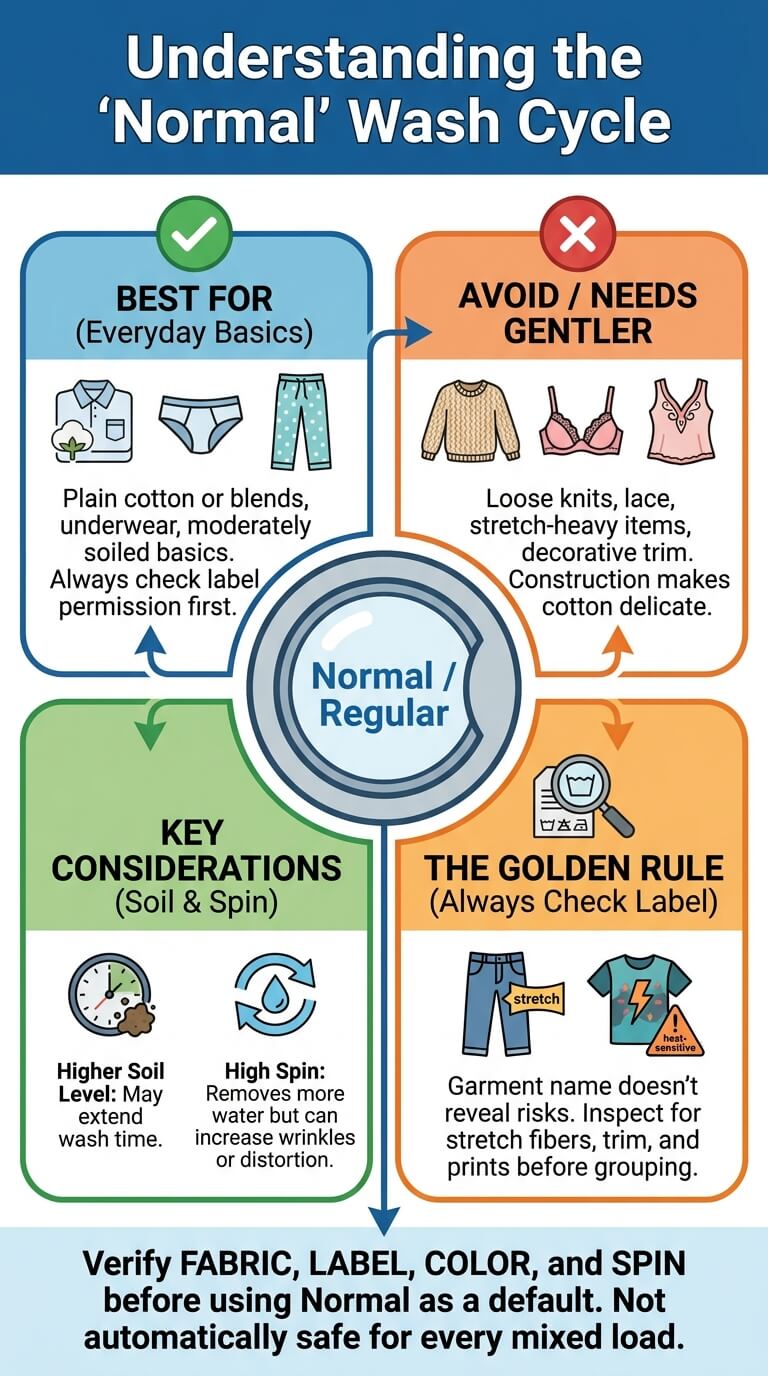
Normal is commonly used for everyday washable clothing, but it is not automatically safe for every mixed load. Confirm the fabric, label, color, and selected spin before using it as a default.
Typical everyday loads
Plain cotton or cotton-blend shirts, pajamas, underwear, and other moderately soiled basics often fit this category when their labels allow machine washing. Keep rough heavy items away from lightweight garments even if both could use Normal separately.
When normal may be too aggressive
Loose knits, lace, bras, stretch-heavy garments, decorative tops, and snag-prone pieces may need a gentler program. A garment can be made from cotton yet still be delicate because of its construction or trim.
Soil and spin considerations
Increasing soil level may extend wash time on some models. High spin removes more water but can increase wrinkling or distortion in some loads. When clothes emerge twisted, deeply creased, or stretched, review both basket fullness and spin selection.
Examples that still require label checks
Jeans may have stretch fibers, printed T-shirts may have heat-sensitive decoration, and white shirts may contain colored trim. The garment name does not reveal every risk. Read the label and inspect the whole item before grouping it with ordinary basics.
Permanent Press or Wrinkle-Control Cycle
This program is commonly intended for synthetic fibers, blends, and wrinkle-prone garments. Its exact motion, cool-down, and spin behavior still depend on the machine.
Synthetic and blended garments
Polyester blends, office shirts, casual trousers, and easy-care items may benefit from a program designed to reduce set-in creases. Avoid packing the basket tightly because crowding can defeat the wrinkle-control benefit.
Reduced wrinkling and cool-down behavior when provided
Some programs use a cooler rinse, gentler final action, or reduced spin to limit wrinkles. Remove clothes promptly after the cycle and smooth them before drying. Leaving a compressed load sitting wet can create creases regardless of the selected program.
When the label or construction calls for gentler handling
A wrinkle-prone garment with lace panels, loose trim, or a hand-wash label does not become safe simply because Permanent Press sounds gentle. Move it to a lower-risk method or professional care when the instructions require it.
Delicate or Gentle Cycle
Delicate programs usually reduce mechanical stress, but they do not make every fragile garment machine washable. The care label remains the first decision.
Lower-agitation or shorter-cycle intent
Depending on the washer, the program may use slower tumbling, shorter wash action, more pauses, or a lower final spin. These changes can reduce snagging and distortion, but the details differ by model.
Mesh-bag and load-size considerations
Place bras, straps, small lace items, or garments with hooks in a correctly sized mesh bag when the label allows machine washing. Close fasteners, keep rough items out, and leave enough room for the bag to move rather than wedging it against the drum.
Why a delicate cycle does not override hand-wash or professional-care labels
Hand washing gives direct control over immersion, squeezing, and support. A professional-care instruction may reflect risks involving structure, dye, lining, or finishing. Stop if the label prohibits machine washing or the garment is expensive, sentimental, heavily embellished, leather-trimmed, or structurally complex.
Heavy-Duty Cycle
Heavy Duty is intended for robust loads that need stronger or longer washing, not for every item that feels thick. Use it only when the fabric, dye, and construction can tolerate the program.
Durable, heavily soiled loads when labels permit
Sturdy work pants, plain durable cottons, and heavily used household textiles may fit this program. Remove loose grit, check pockets, and address stains separately rather than relying on extra movement alone.
Why heavy-duty is not automatically right for every towel, jean, or work garment
Towels may contain decorative borders, jeans may include stretch fibers, and workwear may have reflective trim or coatings. A strong cycle can increase abrasion, fading, and wear. Read each label before treating thickness as proof of durability.
Abrasion, color, and energy tradeoffs
Longer action and stronger spinning can clean durable soil but also increase surface wear. Hotter water adds energy use and may stress dyes or finishes. The ENERGY STAR clothes-washer guidance notes that water heating is a major part of washer energy use, so choose a hotter setting only when the load instructions and cleaning need justify it.
Bedding, Bulky, Towels, and Specialty Cycles
These programs are highly model-specific. Their purpose is often to manage water movement, load balance, and extraction for items that behave differently from ordinary clothing.
Model-specific water movement and balance control
A Bulky or Bedding cycle may change fill pattern, tumbling, spin, or sensing. Do not substitute it for a waterproof-item program unless the manual explicitly allows that item. Some coated or water-resistant goods can trap water and create severe imbalance.
Comforters, blankets, and load-capacity limits
Check both the textile label and machine capacity. An item that fits inside the drum may still be too large to circulate or rinse. Stop if it remains tightly compressed, prevents the door from closing freely, or repeatedly causes imbalance.
Sanitize or allergen-named cycles as label- and model-specific features
These named programs may use particular temperatures, additives, or cycle conditions. They do not create a universal health guarantee. Follow the washer manual, product label, garment label, and any official instructions relevant to the household situation.
Avoiding unsupported health or disinfection claims
Do not assume that selecting Hot or a long program disinfects every textile. Actual water temperature, cycle design, product use, and fabric compatibility matter. For contamination concerns, use guidance appropriate to the specific situation rather than improvising with stronger settings.
Rinse and Spin, Drain and Spin, and Extra Rinse
Utility options solve different problems. Choose the one that matches what is already in the drum instead of restarting a complete wash without a reason.
When an extra rinse may help with residue
An extra rinse can help when label-compatible clothing still feels slick or shows product residue, especially after an overfilled load. First correct detergent amount and basket fullness. Repeated reliance on extra rinsing wastes water and may hide a dosing or loading problem.
Removing excess water before air-drying
A separate spin can shorten indoor drying when the garment label permits it. Increase spin cautiously for sturdy items. Lower spin or remove delicate, stretch-prone, or shape-sensitive pieces before running a stronger extraction.
Correcting an interrupted or unbalanced load
Rinse and Spin may complete a load after an interruption, while Drain and Spin may remove standing water without another full rinse. Redistribute tangled or one-sided items first. The Whirlpool cycle and modifier guide illustrates how these options can differ within one washer family, which is why model instructions matter.
When repeated problems suggest a separate machine issue
Repeated drainage failure, error codes, unusual noise, burning odor, leaks, or failed spinning require appliance troubleshooting. Stop the cycle and follow the service instructions.
Cold, Cool, Warm, and Hot Water as a Decision Framework
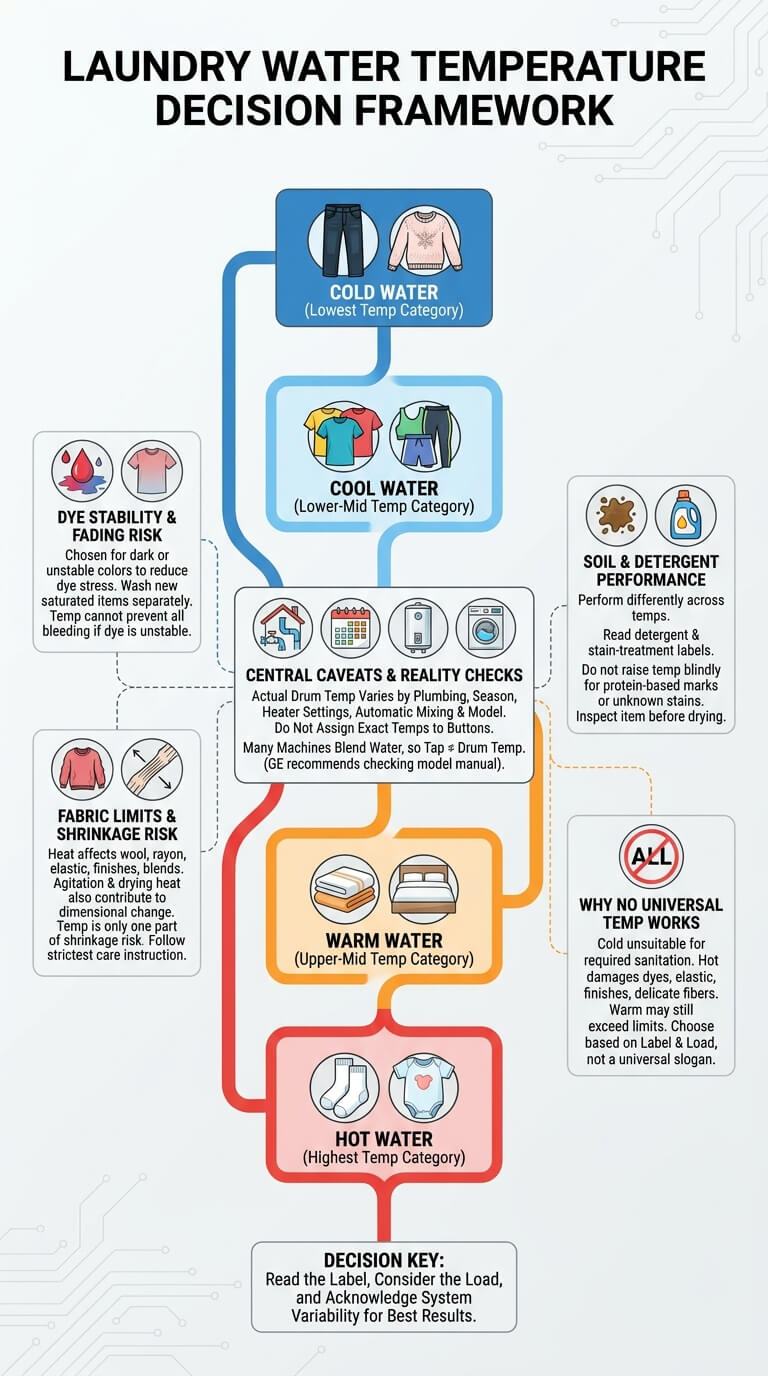
Temperature names are useful categories, but the actual water entering the machine changes with plumbing, season, heater settings, automatic mixing, and model design. Avoid assigning one exact temperature to every button.
Dye stability and fading risk
Cooler label-compatible water is often chosen for dark or unstable colors because it can reduce some dye stress. Wash new saturated items separately when instructed. Temperature cannot prevent all bleeding if the dye is unstable.
Fabric limits and shrinkage risk
Heat can affect some wool, rayon, elastic, finishes, and blended fabrics. Agitation and drying heat also contribute to dimensional change, so water temperature is only one part of shrinkage risk. Follow the strictest care instruction.
Soil and detergent performance
Some soils and products perform differently across temperatures. Read the detergent label and stain-treatment instructions. Do not raise temperature blindly for protein-based marks or unknown stains, and inspect the item before drying.
Washer temperature mixing and regional differences
Many machines blend or regulate incoming water, so tap temperature may not equal drum temperature. GE recommends checking the model manual in its washer water-temperature guidance.
Why no temperature works for every textile
Cold can be unsuitable when a label or official sanitation procedure requires another condition. Hot can damage dyes, elastic, finishes, or delicate fibers. Warm may still exceed a particular garment limit. Choose from the label and load, not from a universal slogan.
Spin Speed and Garment Risk
Spin removes water by force. Faster extraction can reduce drying time, but it can also deepen wrinkles, stretch unsupported fabric, or worsen imbalance in bulky loads.
Faster extraction and shorter drying
Sturdy cottons, towels, and some jeans may tolerate higher spin when their labels allow it. Clothes should emerge damp rather than dripping. A good test is to compare similar loads after changing only the spin setting.
Wrinkling, stretching, imbalance, and delicate construction
Loose knits, bras, lace, rayon, and embellished garments often need lower spin or removal before a utility spin. Stop if straps lengthen, seams pull, or the load repeatedly strikes the cabinet.
Towels, jeans, synthetics, knits, and fragile items
Dense towels retain more water but can become very heavy. Jeans may wrinkle sharply at high speed. Synthetics often release water readily, while knits may distort when unsupported. Fragile pieces should not share the same spin decision as the heaviest item.
When to lower spin or remove an item
Lower spin when the label limits mechanical action, the load tangles, the garment emerges misshapen, or the washer struggles to balance. Remove one risky item and spin the remaining compatible load rather than forcing one compromise setting on everything.
Fabric, Color, Soil, and Label Decision Matrix
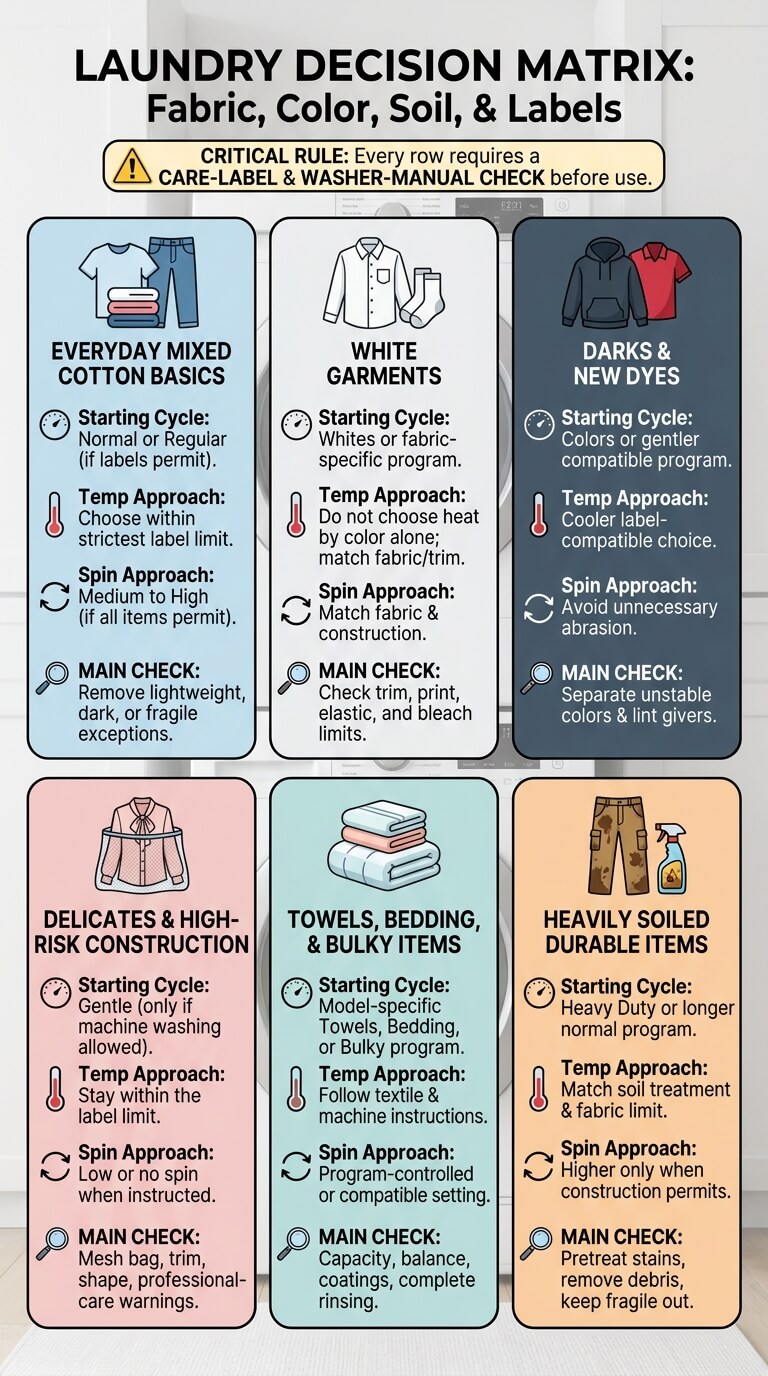
The table below is a starting comparison. Every row still requires a care-label and washer-manual check before use.
| Load type | Likely starting cycle | Temperature approach | Spin approach | Main check |
|---|---|---|---|---|
| Everyday mixed cotton basics | Normal or Regular | Choose within the strictest label limit | Medium to high if all items permit | Remove lightweight, dark, or fragile exceptions |
| White garments | Normal, Whites, or fabric-specific program | Do not choose heat by color alone | Match fabric and construction | Check trim, print, elastic, and bleach limits |
| Darks and new dyes | Normal, Colors, or gentler compatible program | Cooler label-compatible choice | Avoid unnecessary abrasion | Separate unstable colors and lint givers |
| Delicates and high-risk construction | Gentle only if machine washing is allowed | Stay within the label limit | Low or no spin when instructed | Mesh bag, trim, shape, and professional-care warnings |
| Towels, bedding, and bulky items | Model-specific Towels, Bedding, or Bulky program | Follow textile and machine instructions | Program-controlled or compatible setting | Capacity, balance, coatings, and complete rinsing |
| Heavily soiled durable items | Heavy Duty or longer normal program | Match soil treatment and fabric limit | Higher only when construction permits | Pretreat stains and keep fragile items out |
Everyday mixed cotton load
Begin with Normal if all labels permit it. Separate dark new items, heavy rough pieces, and anything with delicate trim. A mixed-color basket is not automatically a compatible load.
Whites with label-compatible settings
White color does not prove that hot water, chlorine bleach, or a strong cycle is safe. Choose by fiber, trim, soil, and label. Wash durable whites separately from delicate white blouses or garments with colored decoration.
Darks and new dyes
Reduce unnecessary friction, keep lint-heavy towels out, and use a compatible cooler setting when the label permits. New saturated garments may need separate washing even when other dark items use the same cycle.
Delicates and high-risk construction
Machine wash only when allowed. Select the gentlest compatible program, protect hooks and straps, reduce spin, and remove the item promptly. Hand washing or professional care may be safer.
Towels, bedding, and bulky items
Use the program named in the manual, not merely the longest available cycle. Keep the load loose enough to move and stop if the item overwhelms the drum or repeatedly unbalances the machine.
Heavily soiled durable items
Separate them from lightly worn clothing. Remove loose debris, pretreat visible marks according to labels, and select stronger action only if the fabric can take it. Extra detergent alone does not replace a suitable program.
Common Washer-Setting Mistakes
Most setting errors come from choosing by habit or garment name instead of checking the full load. Correcting the decision process is more reliable than memorizing more cycle names.
Selecting by garment name alone
Not all jeans, towels, shirts, or blankets are built alike. Stretch content, coatings, trim, weave, dye, and size change the correct approach. Read the label on the actual item.
Assuming cold is always safest or hot always cleans better
Cold may not meet every product or care instruction, while hot can stress dyes and fibers. Cleaning also depends on time, movement, detergent, rinsing, and soil type. Choose the whole process, not one temperature slogan.
Using heavy-duty to solve every problem
Longer or stronger action cannot safely correct an incompatible detergent, overcrowded basket, unstable dye, or delicate construction. It may simply add abrasion and wrinkling.
Ignoring spin, load balance, and detergent compatibility
A suitable wash cycle can still give poor results if the final spin is too strong, the load is unbalanced, or the detergent is wrong for the washer. Review all selected controls before starting.
When to Stop and Check the Manual or Label
Pause when the risk is unclear or the machine behaves abnormally. A slower decision is less costly than damaging a garment or continuing an unsafe appliance condition.
Unknown symbols or temperature limits
Do not guess from fabric feel alone. Look for manufacturer care information and compare the symbol with a recognized reference. Use the least aggressive reversible method until the instruction is clear.
Oversized, waterproof, structured, embellished, leather, suede, or professional-clean-only items
These items can trap water, lose shape, shed trim, transfer dye, or overload the washer. Follow their specific care directions. Professional handling is appropriate when home washing is prohibited or the value and construction make experimentation unreasonable.
Error codes, unusual noise, drainage failure, or repair issues
Stop the machine if there is leaking, burning odor, smoke, severe banging, or an electrical concern. Do not reach into a moving drum or attempt repairs beyond the owner’s instructions. Disconnect power only when it is safe to do so and arrange qualified service when required.
Washer Cycles and Water Temperature FAQ
These answers cover the most common decisions, but the garment label and model manual remain the final limits.
What is the difference between Normal and Permanent Press?
Normal usually provides standard action for everyday washable fabrics. Permanent Press often changes wash, rinse, cool-down, or spin behavior to reduce wrinkles in synthetics and blends. The exact difference is model-specific.
Is Delicate cycle the same as hand washing?
No. A machine still tumbles or agitates and spins the garment. Hand washing allows direct control and support. Do not machine wash an item labeled hand wash or professional care unless its instructions specifically allow an alternative.
Which water temperature is best for dark clothes?
A cooler setting within the garment label is a common starting point because it may reduce some dye stress. New or unstable colors may still bleed, so sort them separately and do not promise that temperature alone will prevent fading.
When should extra rinse be used?
Use it when the washer and garment instructions allow and residue remains after correcting detergent amount and basket fullness. If every load needs extra rinsing, investigate dosing, product placement, water conditions, or machine performance.
Does a faster spin damage clothes?
It can stress fragile construction, deepen wrinkles, or distort unsupported knits, but it also removes more water from sturdy items. Match spin to the strictest garment in the load and lower it when shape, balance, or label limits are a concern.
Final Thoughts
Choose settings by sequence rather than habit. Read the label, assess fabric and construction, consider dye and soil, check load size and balance, then select the closest program. Review temperature, spin, and rinse before starting.
When a result is poor, change one factor at a time. A different cycle will not fix every stain, dosing error, overloaded basket, unstable dye, or appliance fault. Stop when the garment or machine instructions set a limit.

Ethan Carter is the Founder & Editor of HomeCleanSecrets. Based in the United States, he has 5 years of experience creating practical home cleaning, laundry care, stain removal, decluttering, and home organization content. His goal is to help everyday households clean smarter and build simple routines that are easier to maintain.
Read more about Ethan Carter on his author page: https://homecleansecrets.com/ethan-carter/