
Laundry symbols turn a tag into a sequence of care decisions. Instead of guessing whether a garment can go in the washer, dryer, or under an iron, read the label in order: washing, bleaching, drying, ironing, then professional care. Each mark narrows the next safe step.
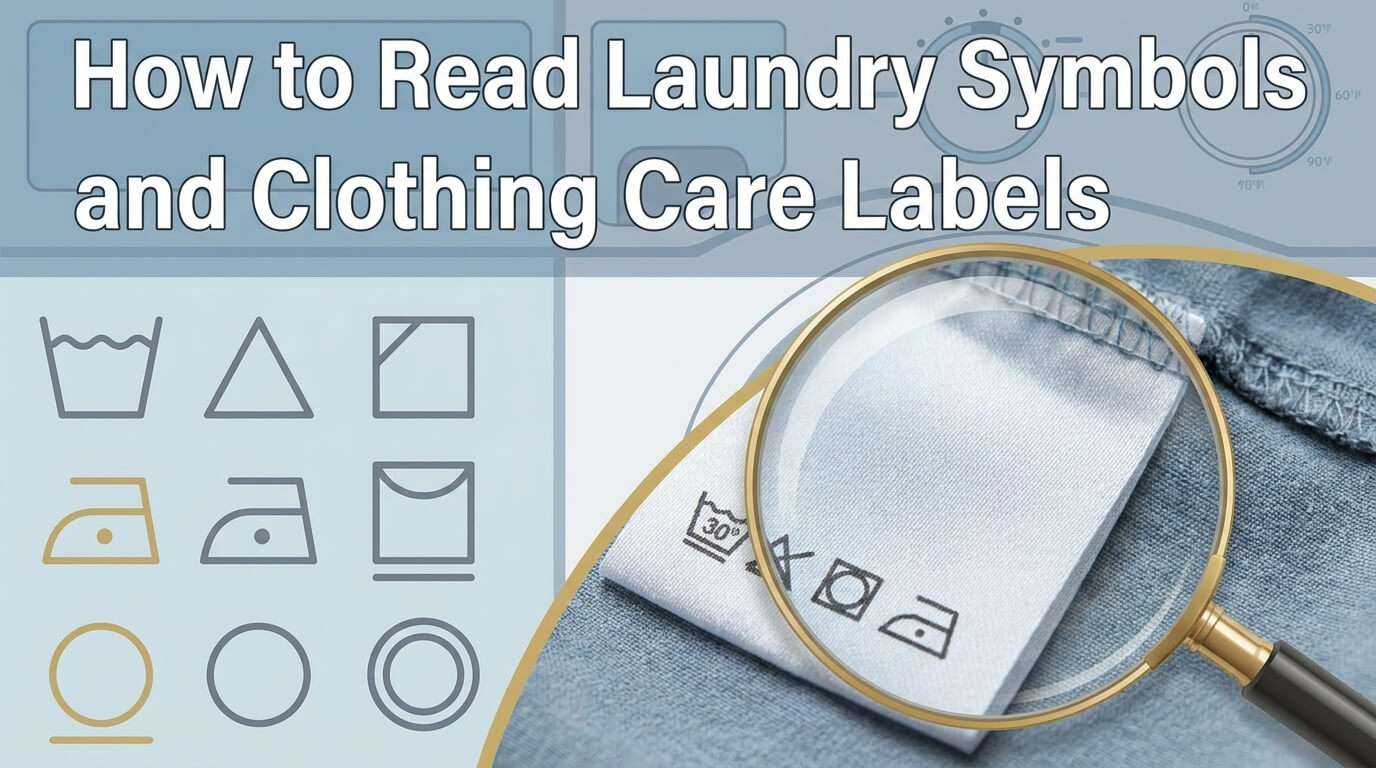
Read the whole label, not one familiar icon. Machine washing does not automatically permit tumble drying, and a dryer instruction does not cancel a gentle-wash limit. Lining, elastic, prints, coatings, and embellishments also affect handling.
The GINETEX care-symbol guide groups the familiar icons into five care stages and explains that they describe the most intensive treatment permitted within that labeling method. That makes the label a boundary, not a promise that the strongest permitted treatment is always the best choice for every wash.
Quick Answer: Read Care Symbols in Laundry Order
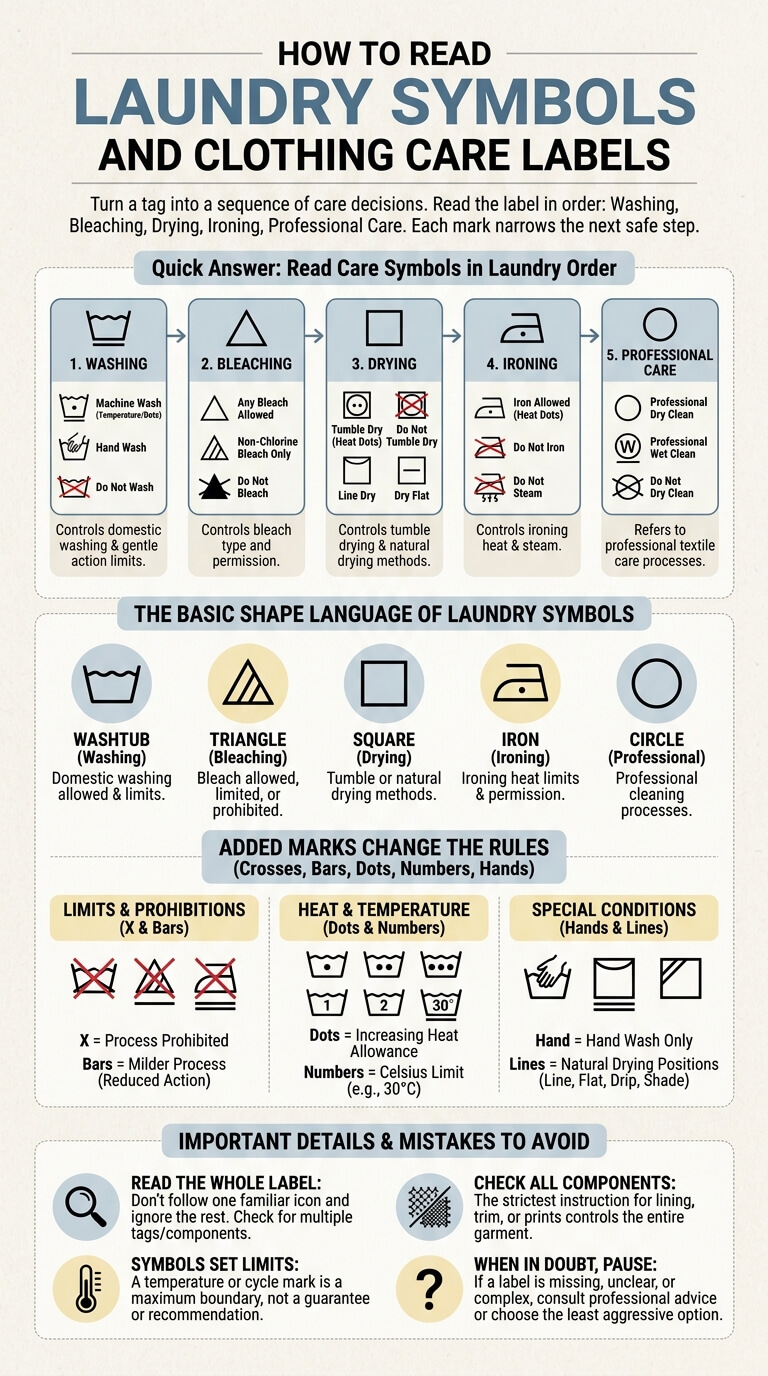
Move from left to right when the symbols appear as a row. If they are printed in separate areas, identify each family by its basic shape and make one decision at a time.
Washing first, then bleaching, drying, ironing, and professional care
The washtub controls whether domestic washing is allowed and how gentle it must be. The triangle controls bleach. The square controls drying, sometimes with a circle inside for tumble drying. The iron controls heat from an iron. A plain circle refers to professional textile care.
A useful habit is to say the instructions aloud as one sentence: “gentle machine wash, do not bleach, dry flat, low iron, no professional dry cleaning,” for example. Reading the row as a complete process reduces the chance of following the wash instruction while overlooking a drying restriction.
Symbols set limits rather than guaranteeing a result
A temperature, cycle, or heat mark indicates an allowed boundary. It does not guarantee stain removal, permanent color, or unchanged shape. When two options are allowed, the less aggressive one may suit a lightly soiled or older garment.
Why local standards and manufacturer wording can differ
Labels may use symbols, words, or both. Temperature can appear as a number, dots, or wording, and natural-drying marks vary. Follow the garment’s label and use the manufacturer’s key when uncertain.
Where to Find the Care Label and What Else It May Include
Care information must be available before you choose the load, products, washer settings, and drying method. Search the garment carefully rather than assuming a missing neck tag means there are no instructions.
Neck, side seam, waistband, pocket, and removable-label locations
Shirts and dresses often place the tag in a side seam or near the neck. Pants may use the waistband, back seam, or pocket area. Reversible garments, scarves, hosiery, and small accessories may have a discreet tag, printed instructions, or information on packaging. Check both the main brand tag and any longer secondary tag.
In the United States, the Federal Trade Commission care-labeling guide explains that covered clothing must provide instructions for at least one safe regular-care method. Other countries can use different requirements, so the garment’s own wording remains the practical starting point.
Fiber content, origin, size, and care instructions
A tag may list fiber percentages, country of origin, size, brand details, and care information together. Do not mistake fiber content for a complete care instruction. Two garments labeled 100 percent cotton may differ because one is preshrunk and plain, while the other has a dark print, interfacing, special finish, or structured shape.
When multiple labels must be read together
A coat may list separate instructions for the shell, lining, filling, trim, belt, or hood. Read every tag. The strictest permanent component controls the garment unless the manufacturer permits separate care.
The Basic Shape Language of Laundry Symbols
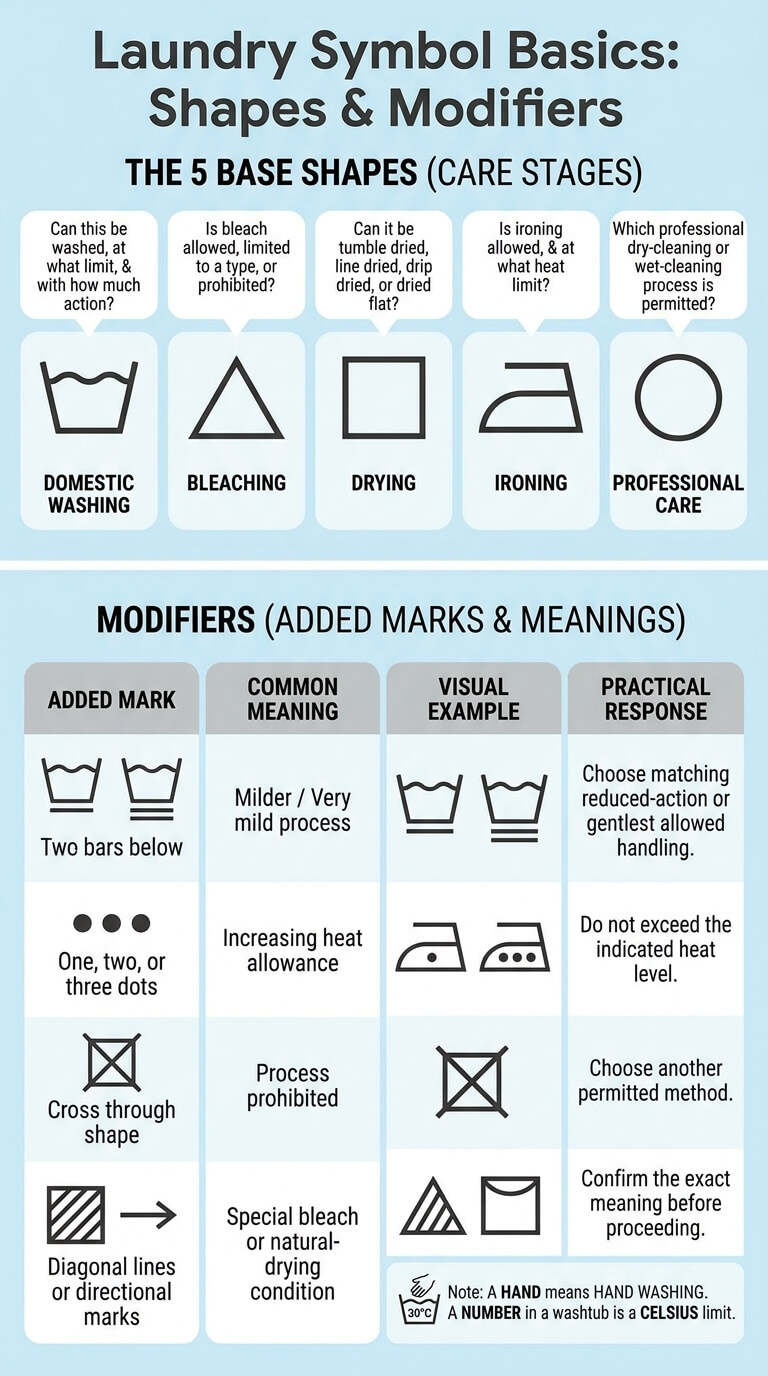
Most labels become easier once you recognize the five base shapes. Added marks change the temperature, mechanical action, drying position, or permission.
Washtub, triangle, square, iron, and circle families
| Basic shape | Care stage | Question it answers |
|---|---|---|
| Washtub | Domestic washing | Can this be washed, at what limit, and with how much mechanical action? |
| Triangle | Bleaching | Is bleach allowed, limited to a type, or prohibited? |
| Square | Drying | Can it be tumble dried, line dried, drip dried, or dried flat? |
| Iron | Ironing | Is ironing allowed, and at what heat limit? |
| Circle | Professional care | Which professional dry-cleaning or wet-cleaning process is permitted? |
Crosses, bars, dots, numbers, and hand symbols
A cross generally means “do not.” Bars call for reduced action. Dots commonly indicate heat for tumble drying or ironing, and some wash labels use dots for water temperature. A number in a washtub commonly gives a Celsius limit. A hand means hand washing.
A symbol-family comparison table
| Added mark | Common meaning | Practical response |
|---|---|---|
| One bar below | Milder process | Choose the matching reduced-action setting or professional process. |
| Two bars below | Very mild process | Use the gentlest allowed handling and avoid a fuller, rougher load. |
| One, two, or three dots | Increasing heat allowance | Do not exceed the indicated heat level. |
| Cross through shape | Process prohibited | Choose another permitted method. |
| Diagonal lines or directional marks | Special bleach or natural-drying condition | Confirm the exact meaning for the label method before proceeding. |
Washing Symbols Explained

The washing family controls the first major decision: machine wash, hand wash, or no domestic washing. Read every added mark before choosing a cycle.
Machine washing and maximum-care limits
A plain washtub permits domestic washing within the displayed limits. Do not exceed a number printed in the tub. Interpret dots or words with the correct label key. A lower allowed temperature may suit light soil when detergent instructions support it.
Normal, permanent press, and gentle or delicate bars
A washtub without a bar usually allows normal action. One bar calls for a milder process, and two bars call for very mild action. Washer names vary, so compare the garment instruction with the appliance manual rather than selecting by name alone.
Hand wash
A hand in the washtub means hand washing within the shown limit. Support the wet item, use a compatible product, and avoid twisting or wringing. A mesh bag does not make a machine cycle equivalent to hand washing.
Do not wash
A crossed washtub prohibits domestic washing. Do not spot-wet the entire garment, soak it, or assume a gentle cycle is an acceptable workaround. Check the professional-care instruction and the manufacturer’s information. Structured, coated, bonded, leather-trimmed, or heavily embellished items deserve particular caution.
Temperature numbers, dots, and wording
Numbers inside a washtub usually indicate degrees Celsius, while some labels use dots or words. Do not guess an unfamiliar conversion. Washer temperatures vary by model and incoming water, so use the label as the limit and the manual to select the closest setting.
How to Turn a Washing Symbol into a Washer Decision
The symbol tells you the garment limit. The appliance panel tells you what the machine can do. Your job is to find the closest compatible combination without exceeding the garment restriction.
Matching the label to the closest machine cycle
Start with the amount of mechanical action: normal, mild, very mild, or hand wash. Then compare wash time, agitation or drum movement, and spin speed. A cycle called “delicates” may still differ across machines. Stop if the machine manual does not describe a setting that fits the garment.
Choosing a water setting without exceeding the label limit
Select a water option at or below the label limit, while also considering color stability, soil, and detergent instructions. Do not assume the highest allowed temperature is required. New dark garments, stretch fabrics, and lightly soiled pieces may benefit from a less aggressive allowed choice.
When the washer manual uses different cycle names
Look beyond labels such as normal, casual, handwash, wool, silk, or easy care. Read what the machine actually changes. Some cycles adjust spin more than wash movement; others change duration or water level. The garment instruction remains the boundary, while the manual explains whether the machine can stay within it.
When hand washing or professional care is the safer route
Step away from machine washing when the tag says hand wash, the available cycle appears too aggressive, or the garment has fragile straps, unstable dye, structure, loose embellishment, leather, suede, or sentimental value. Professional care is also sensible when the label is unclear and an unsuccessful test could permanently change the item.
Bleaching Symbols Explained
The triangle applies to laundry bleach, not only to visible white fabrics. Never decide from garment color alone, and never mix laundry chemicals.
Any bleach when allowed
An empty triangle generally permits bleach under the applicable label method. You must still read the bleach product label, confirm washer-dispenser instructions, and check trim, elastic, prints, finishes, and fiber compatibility. Permission does not mean bleach is needed in every wash.
Non-chlorine bleach only
A triangle containing diagonal lines commonly limits the garment to oxygen or non-chlorine bleach. Follow the exact product wording because “color safe,” “oxygen,” and other claims can describe different formulas and uses. Do not substitute chlorine bleach.
Do not bleach
A crossed triangle prohibits bleach. Check every laundry additive because a product may include a bleaching ingredient even when its front label emphasizes brightening or stain removal. Use only label-compatible detergent and treatments.
Why the product label and fabric construction still matter
The garment tag controls what the textile can tolerate, while the product label controls dosage, placement, contact time, and safety. Both must agree. Stop if colored trim, metallic decoration, spandex, coatings, or an unknown finish makes compatibility uncertain.
Tumble-Drying Symbols Explained

A circle inside a square refers to tumble drying. Heat marks and bars refine the instruction, while a cross prohibits the process.
Tumble dry and heat dots
A plain tumble-dry symbol permits machine drying within any added limits. Dots commonly indicate low, medium, or higher heat allowances, with more dots allowing more heat. Choose no more heat than the label permits and consider a lower allowed setting for delicate construction, elastic, dark color, or a nearly dry load.
No heat or air-only settings
Some labels call for tumble drying without added heat. Use air-only only when the dryer manual confirms it; low heat is not the same as no heat.
Permanent press and gentle drying bars
One or two bars below the tumble-dry symbol call for reduced mechanical action. Match the garment to the closest dryer program and avoid crowding, which can increase wrinkling and extend exposure. Remove the item promptly when the cycle ends.
Do not tumble dry
A crossed tumble-dry symbol means the garment must not go in the dryer. Read the natural-drying instruction to determine whether it should hang, lie flat, drip, or stay out of direct light. Do not use a brief dryer cycle as a shortcut.
Natural-Drying Symbols Explained
Natural-drying marks use a square with added lines or shading. Because details can vary by labeling method, identify the exact mark before arranging the garment.
Line dry and drip dry
Line drying generally means hanging the garment so water can evaporate while the item is supported. Drip drying means hanging it while still wet without forceful extraction. Protect shoulders, hems, and straps from stretching, and place the item where moisture can leave the room.
Dry flat
Flat drying supports a shape-sensitive garment across a clean, ventilated surface. Reshape knits to their original dimensions, smooth seams, and keep layers from overlapping. A towel beneath the item may need changing if it becomes saturated.
Dry in shade
Shading inside the drying symbol indicates protection from direct light. This matters for dyes and materials that may change with strong exposure. Shade does not mean a closed, stagnant room; the garment still needs air movement and a path for moisture to escape.
Combining natural-drying instructions
A label can combine instructions, such as dry flat in shade. Follow every visible element. If the marks are too small, enlarge a photo of the tag or check the manufacturer’s care information.
How garment shape affects the practical setup
Even when hanging is allowed, a wet heavy knit may stretch more than a lightweight woven shirt. Use broad support, distribute weight, and check whether the item is becoming longer or misshapen. Move it to flat drying if the label allows and the hanging setup is causing distortion.
Ironing Symbols Explained
The iron symbol controls direct pressing heat after the garment is clean and dry enough for the allowed process.
Heat dots and temperature limits
Dots inside the iron commonly indicate increasing heat allowances. Match the dots to the appliance manual rather than guessing a fiber setting. Begin below the maximum when dealing with dark fabrics, prints, synthetics, coatings, or unfamiliar finishes.
Do not steam or do not iron variations
A crossed iron prohibits ironing. Some labels use a separate mark to prohibit steam. Steam adds moisture and heat, so “do not steam” is not permission to use the highest dry heat. Read the full symbol and any accompanying words.
Testing hidden areas and protecting trims
When ironing is allowed but the fabric surface is uncertain, test a hidden area at a lower permitted setting. Iron on the reverse when appropriate, avoid direct contact with prints and embellishments, and use a clean pressing cloth if the garment instructions support it. Stop at shine, sticking, odor, color change, or surface distortion.
Where ironing guidance ends
The care tag sets the garment limit, but the iron or steamer manual governs filling, heat selection, cleaning, and electrical safety. Detailed pressing techniques for pleats, tailoring, velvet, leather, or specialty fabrics require material-specific instructions.
Professional-Care Symbols at a Basic Level
A plain circle is intended primarily for a professional cleaner. Letters and bars describe solvents, wet-cleaning methods, or reduced action for trained operators.
Professional dry-clean and wet-clean circles
A circle with a letter such as P or F usually refers to a permitted professional dry-cleaning process. A W refers to professional wet cleaning in labeling methods that use it. The meaning is procedural information for the cleaner, not a product recommendation for home use.
Letters and bars as professional-process information
Bars beneath the circle call for a milder professional process. A crossed circle means the indicated professional process is prohibited. Show the garment and its label to the cleaner, including removable parts, belts, hoods, and known stains.
Why these symbols are not home dry-cleaning instructions
Do not translate a letter into a household solvent or attempt to recreate professional equipment. Home dryer kits and spot treatments have their own labels and do not override a professional-care instruction. Valuable, structured, bonded, leather-trimmed, suede, or heavily embellished garments deserve professional assessment.
A Symbol-to-Action Decision Flow
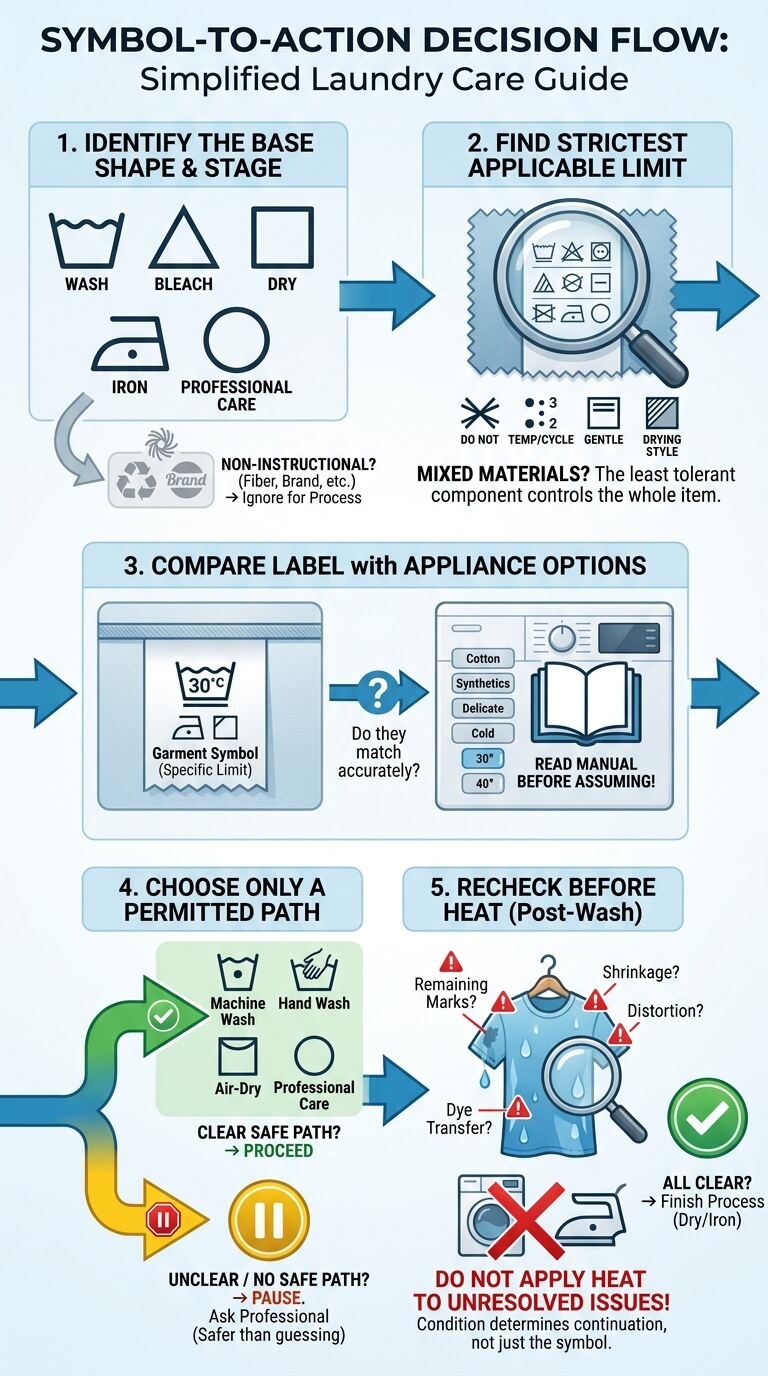
Use the same short sequence whenever a label looks complicated. This keeps one familiar symbol from distracting you from a stricter instruction later in the row.
Identify the care stage
Name the base shape first: wash, bleach, dry, iron, or professional care. If the icon does not match one of those families, check whether it is a fiber, certification, recycling, or brand mark rather than a laundry instruction.
Find the strictest applicable limit
Look for a cross, bars, dots, numbers, shading, directional lines, and accompanying words. On mixed-material garments, include instructions for linings, trims, and removable components. The least tolerant permanent component usually controls the assembled item.
Compare the garment label with washer or dryer options
Read the appliance manual before assuming a named cycle matches the symbol. The American Cleaning Institute laundry guide provides a consumer-friendly overview of common fabric-care marks, but the garment and appliance instructions should decide the actual settings.
Choose machine wash, hand wash, air-dry, tumble-dry, or professional care
Choose only a path expressly permitted by the full label. If no safe path is clear, pause. A reversible low-risk step, such as asking the manufacturer or cleaner, is better than an irreversible experiment with water, agitation, solvent, or heat.
Recheck before heat
After washing, inspect for remaining marks, dye transfer, residue, shrinkage, loose trim, or distortion. Do not tumble dry or iron an unresolved area simply because heat is generally allowed. The care symbol limits the process, but the garment’s condition after washing determines whether you should continue.
What to Do When the Label Is Missing, Faded, or Confusing
A missing tag increases uncertainty because appearance alone cannot reveal every finish, interlining, adhesive, or dye limitation.
Use fiber, construction, trim, and known garment history as risk clues
Check whether the garment is woven or knitted, structured or unstructured, lined, coated, stretchy, pleated, embellished, or trimmed with another material. Consider whether it has been washed successfully before. These clues help assess risk but do not replace the missing instruction.
Compare manufacturer product information when available
Search the brand’s product page, order record, or customer-care information using the exact style name or item number. Compare photos and fiber content carefully because similarly named products can have different constructions. Save the instructions with the garment if the physical tag is unreadable.
Choose the least aggressive reversible option
For a low-value, simple, washable-looking garment, a hidden-area color test or cautious hand-cleaning decision may be reasonable only after checking product instructions. Do not begin with soaking, strong agitation, bleach, high heat, or forceful wringing.
Stop DIY for valuable or uncertain garments
Seek professional advice for sentimental pieces, formalwear, tailoring, leather, suede, bonded fabrics, unstable embellishment, unknown vintage textiles, or garments whose shape depends on internal structure. Stop immediately if a hidden test produces color loss, texture change, puckering, stiffness, or adhesive release.
Conflicting Labels, Mixed Materials, and Regional Differences
Confusion often comes from treating a garment as one fabric when it is actually a combination of shell, lining, trim, elastic, print, filling, and hardware.
Outer fabric versus lining, trim, padding, or decoration
A washable outer fabric does not make a padded bra, structured jacket, sequined dress, or leather-trimmed sweater fully washable. Inspect permanent components and read every attached tag. Remove detachable pieces only when the manufacturer says they can be cared for separately.
Following the most restrictive component
When instructions differ, choose the condition that protects the least tolerant permanent component. That may mean lower heat, reduced movement, flat drying, or professional care. Do not select a harsher process just because the largest fabric panel could tolerate it.
Why symbols and wording may not look identical worldwide
The current ISO 3758 care-labeling standard describes an international graphic approach, while U.S. labels can also use wording or an ASTM-based symbol set. Imported garments may therefore present temperatures, bars, or drying details differently. When a mark is unfamiliar, identify its labeling method before translating it into an appliance setting.
Common Care-Label Mistakes
Most mistakes happen when a reader recognizes one element and acts before checking the rest of the tag.
Reading one symbol and ignoring the rest
Machine washable does not mean bleach-safe, tumble-dry-safe, or iron-safe. Read the complete sequence before starting so you can prepare the correct drying space and avoid using an incompatible additive.
Treating a maximum limit as a recommended setting
A permitted temperature or heat level is a ceiling, not always a requirement. Light soil, dark dye, elastic, age, and surface finish may justify a lower allowed setting. Never exceed the printed limit to chase faster cleaning or drying.
Assuming white means bleach-safe
White garments can contain spandex, colored thread, prints, coatings, finishes, elastics, or trims that bleach may damage. The triangle and the product label decide whether a bleaching product is permitted.
Assuming gentle-cycle and hand-wash instructions are interchangeable
A washer still tumbles or agitates, drains, and spins. Hand washing allows you to support the garment and stop movement immediately. Follow the hand symbol when it appears, unless the garment manufacturer explicitly approves another method.
Laundry Symbols FAQ
These answers address the points that most often delay a wash load or lead to an unsafe shortcut.
What do one, two, or three dots mean?
Dots generally show increasing heat allowance, especially in tumble-drying and ironing symbols. Some wash-label methods also use dots for water temperature. Identify the base shape first, then match the dot count to the relevant label key and appliance manual.
What is the difference between one line and two lines under a symbol?
One bar usually calls for a milder process, while two bars call for a very mild process. Under a washtub, that affects mechanical washing action. Under a professional-care circle, it gives instructions to the cleaner. Do not assume the same machine cycle name will match every appliance.
Can a hand-wash item go on a delicate cycle?
Not automatically. The hand symbol directs you to hand washing, and a delicate cycle can still create more movement and spin than the garment tolerates. Use a machine only when the manufacturer clearly permits it.
What should you do when there is no care label?
Check the manufacturer’s information and assess the garment’s fiber, construction, trim, value, and history. Choose the least aggressive reversible step only when the risk is acceptable. Professional advice is safer for structured, valuable, sentimental, vintage, leather-trimmed, suede, or embellished items.
Are laundry symbols the same in every country?
The major care families are widely recognizable, but temperature notation, natural-drying details, wording, and permitted symbol methods can vary. Do not assume an unfamiliar imported label is identical to one you already know. Use the garment manufacturer’s explanation or the correct regional key.
Final Thoughts
Reading a care label is a decision process, not a memory test. Identify the base shape, read every added mark, move through the five care stages, and compare the limits with appliance and product instructions. When a label is missing or a garment is valuable or complex, pause before using water, movement, chemicals, or heat. Stay within every known limit and leave uncertain, irreversible treatment to a qualified professional.

Ethan Carter is the Founder & Editor of HomeCleanSecrets. Based in the United States, he has 5 years of experience creating practical home cleaning, laundry care, stain removal, decluttering, and home organization content. His goal is to help everyday households clean smarter and build simple routines that are easier to maintain.
Read more about Ethan Carter on his author page: https://homecleansecrets.com/ethan-carter/