
A garage works best when it has a job description. Without one, it becomes the place where tools, bulk paper goods, paint cans, sports gear, garden supplies, holiday bins, donations, and half-finished projects all compete for the same floor space. A useful garage organization and storage guide does not start with buying more shelves. It starts with deciding what the garage must do for your household, what should leave, and which items need safer, easier homes.
The goal is not a showroom garage. The goal is a garage where you can walk without stepping around piles, reach daily items without moving five boxes, keep chemicals away from kids and pets, protect tools from damage, and still use the garage for parking, laundry overflow, yard work, hobbies, or household storage. A good test is simple: if someone else in your home needed a soccer ball, broom, extension cord, or holiday wreath, could they find it and put it back without asking you?
Quick Answer: The Garage Storage Framework
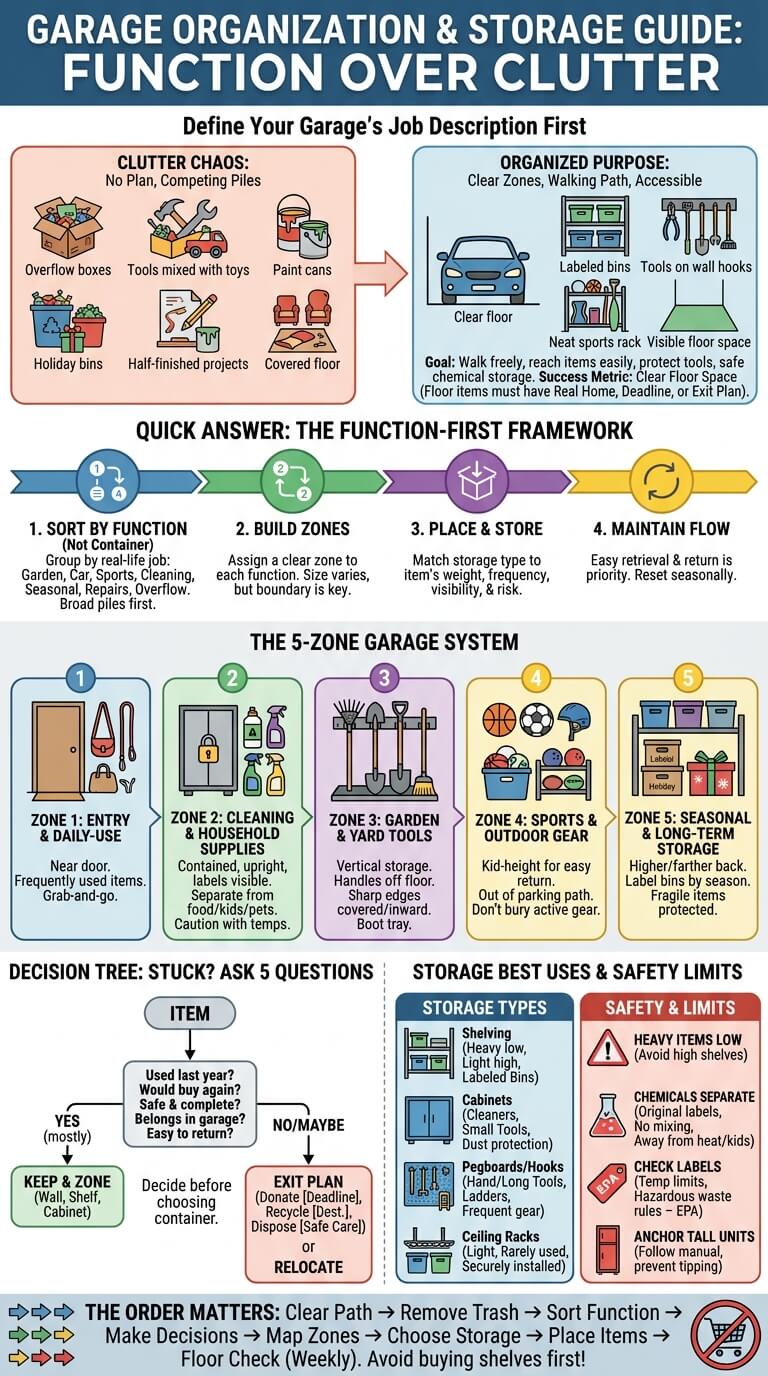
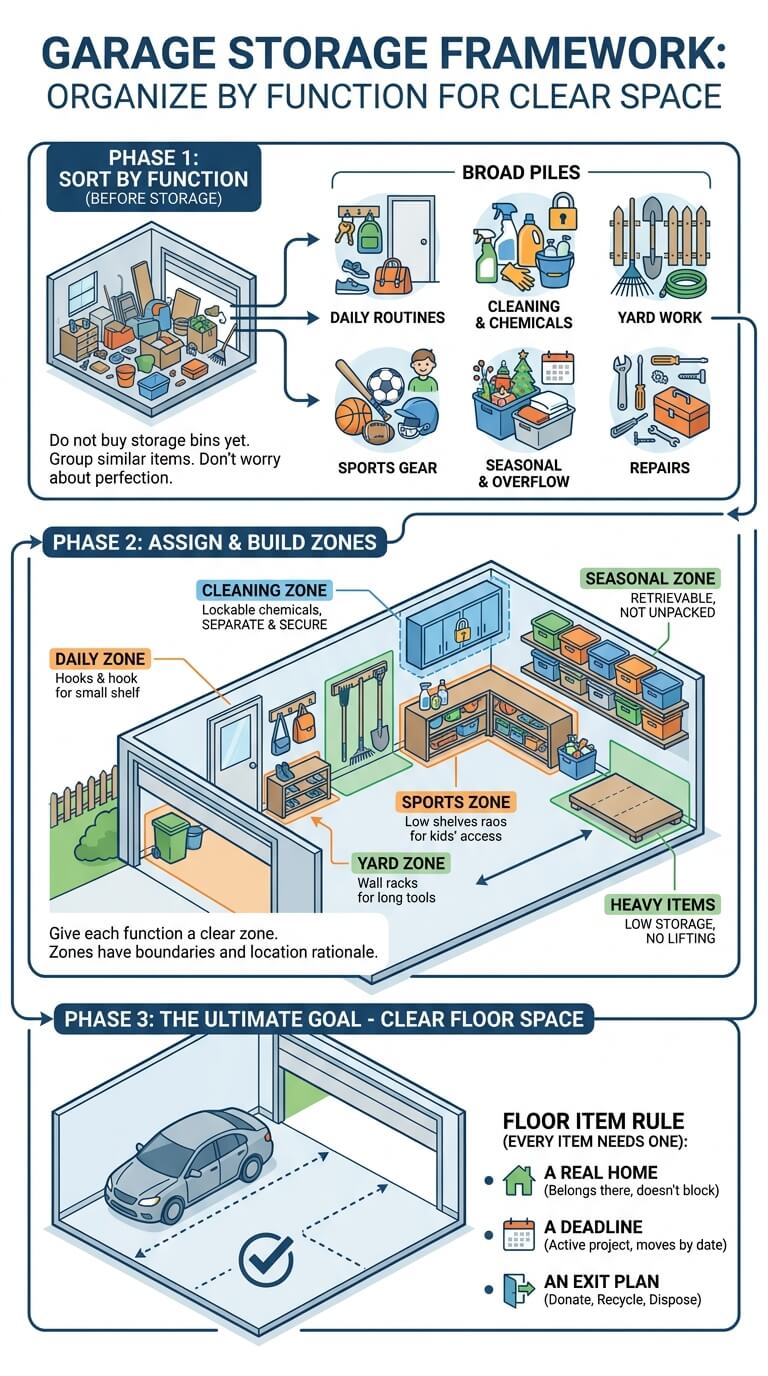
The fastest way to make sense of a mixed garage is to organize by function, not by container type. Before you decide where bins, hooks, shelves, or cabinets should go, sort items into the jobs they support: daily home routines, cleaning, yard work, sports, seasonal storage, repairs, and household overflow.
Sort by function before buying storage
Start with broad piles that match real life. Put garden tools with garden tools, car supplies with car supplies, sports gear with sports gear, and cleaning products with cleaning products. Do not worry yet about perfect bins or labels. The first win is seeing how many separate categories are living in the same garage.
- Daily-use items need reachable storage near the door or main walking path.
- Messy yard items need a wall, corner, or rack that can handle dirt and long handles.
- Chemicals and cleaners need separation, labels facing forward, and child or pet limits.
- Seasonal items need labeled bins that can be retrieved without unpacking the garage.
- Heavy items need low storage so they are not lifted from overhead or high shelves.
Build zones for daily items, cleaning supplies, garden tools, sports gear, seasonal decor, and overflow
Once you know the main categories, give each one a zone. A zone is not always a cabinet or a full wall. It can be one shelf, one vertical strip of wall hooks, one lidded bin stack, or one small cabinet. The important part is that the zone has a clear boundary and a reason for being where it is.
Place daily items closest to the path from the house to the car or driveway. Store sports gear where kids can reach it without climbing. Keep garden tools near the garage door that opens toward the yard. Put long-term seasonal decorations higher or farther back because they are not used every week. Keep chemicals and sharp tools away from casual grab zones.
Make clear floor space the main success metric
Use hooks, shelves, and simple return rules to keep garage floors clear.
A garage can have attractive shelves and still fail if the floor is covered. Clear floor space matters because it protects walking paths, parking space, emergency access, and the daily habit of putting things back. The floor should be reserved for cars, large equipment that cannot be wall-mounted, active projects, and a few heavy items that are safely placed.
A useful rule is that every floor item needs one of three labels: a real home, a deadline, or an exit plan. A real home means the item belongs there and does not block movement. A deadline means it is part of an active project and will move by a set date. An exit plan means it is being donated, recycled, returned, or disposed of.
Why Garages Become Cluttered
Garages collect clutter because they absorb decisions from the rest of the home. When something does not have a place inside, feels too dirty for a closet, might be useful someday, or is too awkward to throw away, it often lands in the garage. Understanding that pattern helps you build a storage system that does more than hide piles.
Mixed household roles create decision fatigue
Most rooms have a main purpose. A garage may serve as parking, mudroom, workshop, sports closet, cleaning closet, gardening shed, donation station, utility room, and seasonal storage area at the same time. That mix creates decision fatigue because every item raises a different question: keep it, use it, fix it, store it, donate it, or dispose of it safely.
Seasonal and bulk items pile up between projects
Garages often become crowded between seasons. Holiday decorations return in January, garden supplies show up in spring, pool items appear in summer, and sports gear changes as kids grow. Bulk household products also land there because they are cheaper to buy in larger quantities but too large for indoor closets.
Seasonal items need a retrieval plan, not just a storage spot. Pack by season or holiday so you do not have to open six bins to find one string of lights. Store the next season closer than the one you just finished. Put rarely used items above shoulder height only if they are light, sealed, and safe to lift down.
Safety risks come from chemicals, sharp tools, heavy boxes, and trip hazards
The garage holds items that are more risky than normal closet clutter. Cleaners, solvents, fuels, pesticides, batteries, sharp blades, ladders, extension cords, and heavy boxes all need extra thought. Poison Control advises reading product labels and avoiding mixed household cleaners because some combinations can create dangerous fumes; that same label-first habit matters when deciding where cleaning products belong in a garage. Poison Control’s cleaning safety guidance is a helpful reference when products are old, unlabeled, or stored near other chemicals.
Heavy items create a different risk. A tall shelving unit loaded unevenly can shift, and a heavy tote placed above head height can be hard to control when lifted down. If children visit the garage, avoid storing attractive items on high shelves that might encourage climbing. The U.S. Consumer Product Safety Commission’s Anchor It education center is focused on furniture and TV tip-overs, but the same practical mindset applies to tall freestanding storage: follow the unit manual, load it correctly, and secure it when the manufacturer requires it.
The 5-Zone Garage System
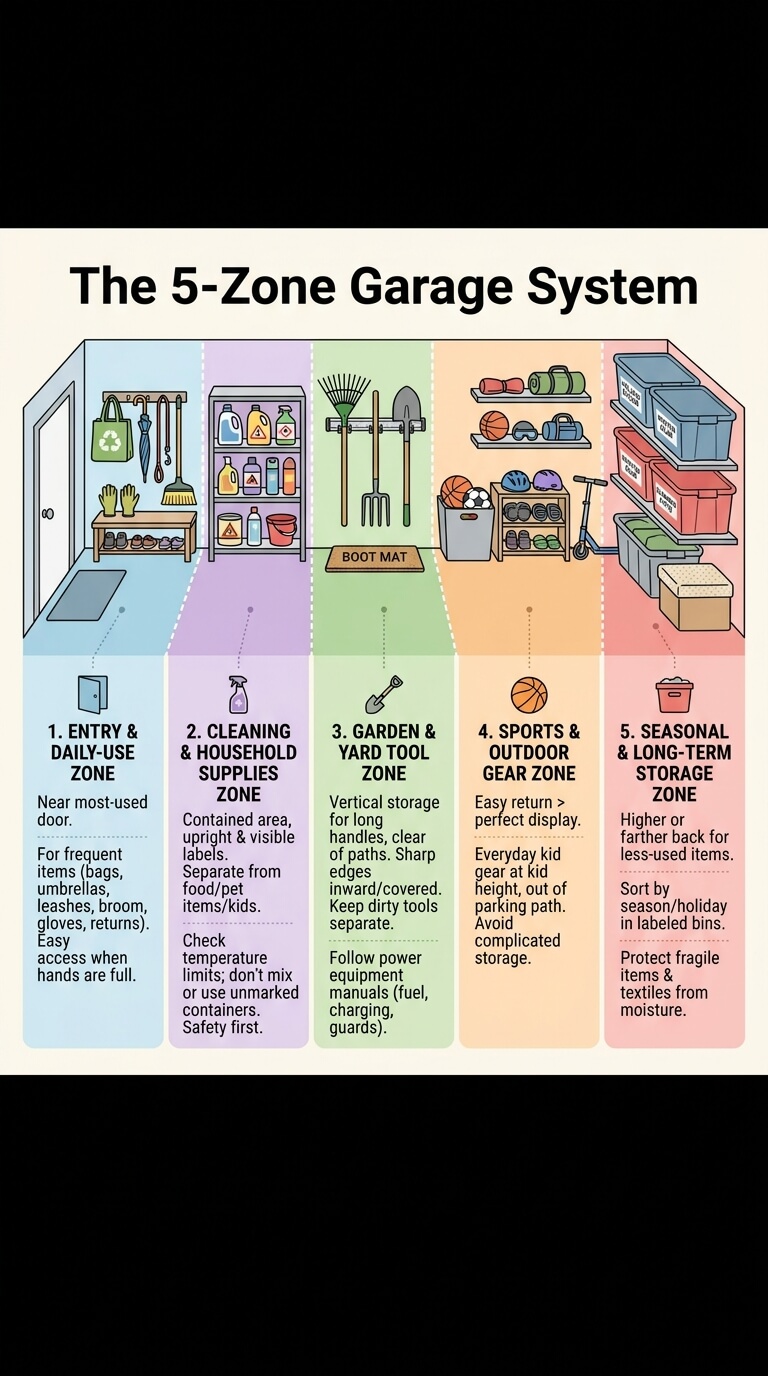
A garage does not need dozens of tiny sections to work. Five main zones are enough for most homes: daily use, cleaning and household supplies, garden and yard tools, sports and outdoor gear, and seasonal or long-term storage. The size of each zone depends on your household, but the boundaries should be clear.
Entry and daily-use zone
The entry zone sits near the door you use most. It should hold items that come and go often: reusable bags, umbrellas, dog leashes, a broom, small hand tools, work gloves, returns, and maybe a compact shoe tray or mudroom-style rack. This zone should be easy to use when your hands are full.
Cleaning and household supplies zone
Because labels, leaks, temperature, and access matter, store cleaning supplies in the garage safely in a controlled area.
Cleaning products do not belong scattered across the garage. Give them one contained area with labels visible and products upright. Keep them away from food, pet items, sports gear, and anything children may grab quickly. If the garage becomes very hot, cold, or damp, check labels before storing products there because some cleaners, aerosols, adhesives, and specialty products may have temperature limits.
Do not pour cleaners into unmarked containers. Do not mix leftovers to save space. If a bottle has no label, has leaked, smells unusual, or was transferred from another container, stop and handle it cautiously. The cleaner may need local disposal guidance rather than a new shelf spot.
Garden and yard tool zone
For safer control of long, sharp, or dirty items, organize garden tools in a dedicated area.
Garden tools work best on vertical storage. Long-handled tools, such as rakes, shovels, hoes, brooms, and pruning tools, should stand or hang where handles do not fall into the walking path. Sharp edges should face inward, downward, or be covered according to the tool design.
Keep dirty tools away from fabric decorations, sports uniforms, paper goods, and indoor cleaning supplies. A small tray or boot mat can catch soil under hand tools and gloves. Battery-powered or fuel-powered yard equipment should follow the manufacturer manual for charging, storage, fuel, blade guards, and temperature limits.
Sports and outdoor gear zone
To stop balls and shared gear from spreading into walkways, organize sports equipment in the garage near the main entry.
Sports gear needs easy return more than perfect display. Balls, helmets, pads, rackets, bats, scooters, skates, and camping items become floor clutter when the storage is too high, too deep, or too complicated for the people using them. Put everyday kid gear at kid height and keep it out of the parking path.
Seasonal decoration and long-term storage zone
To protect fragile and rarely used items, store seasonal decorations with labels, moisture protection, and a rotation plan.
Seasonal decor can live higher or farther back because it is not used daily, but it still needs safe packing and clear labels. Sort bins by season or holiday. Keep fragile items cushioned, textiles protected from moisture, and lighted decorations stored without crushed cords.
Garage Storage Decision Tree
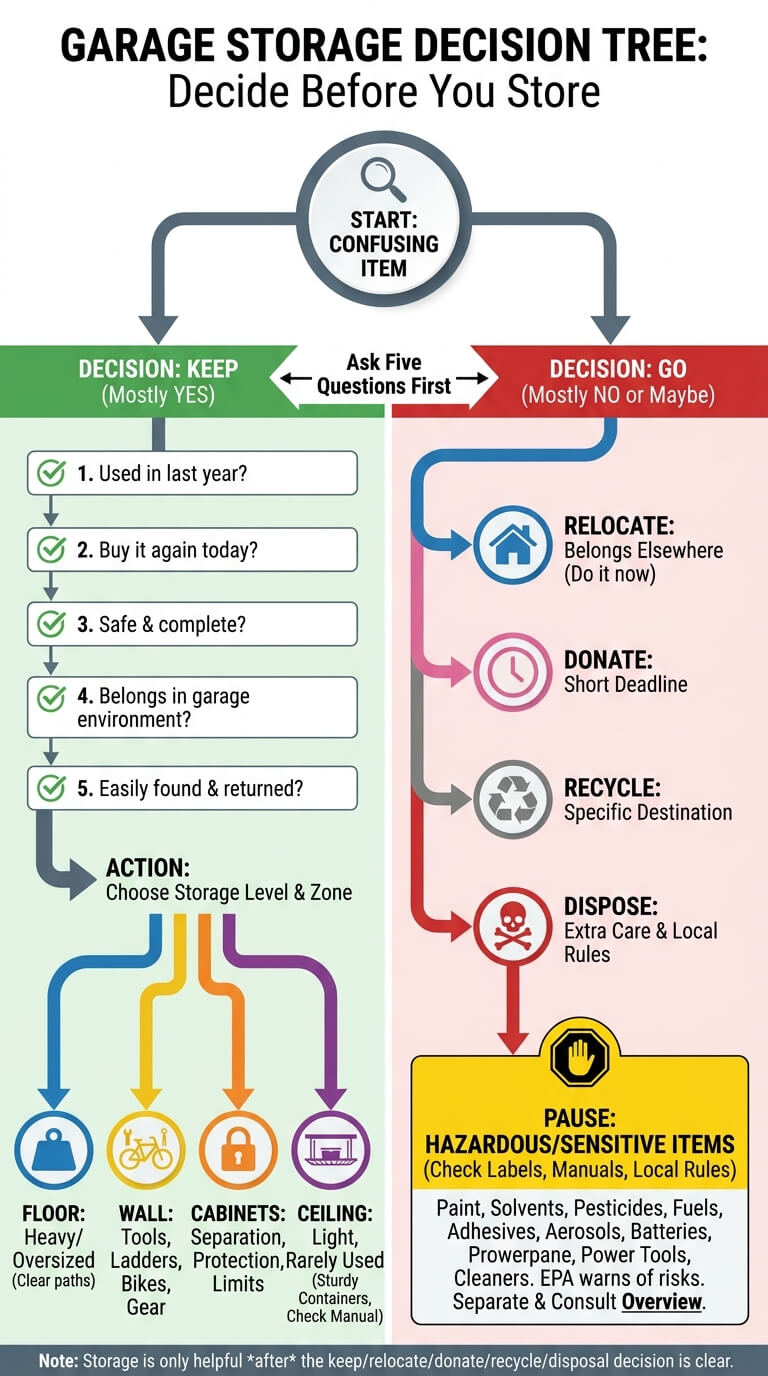
When you are stuck, use a decision tree instead of guessing. The point is to decide what should happen to an item before you choose a container. Storage is only helpful after the keep, relocate, donate, recycle, or disposal decision is clear.
Keep, relocate, donate, recycle, or dispose
Ask five questions for each confusing item. Did you use it in the last year? Would you buy it again today? Is it safe and complete? Does it belong in the garage environment? Can someone in the home find and return it easily? If the answer is mostly yes, keep it and place it in the right zone. If it belongs somewhere else, relocate it before it becomes garage clutter again.
Donation items need a short deadline. Recycling needs a specific destination. Disposal needs extra care when the item is chemical, electronic, sharp, pressurized, oily, flammable, or battery-powered. Keep those items separated until you know the local rule.
Choose floor, wall, cabinet, ceiling, or shed storage
After deciding to keep an item, match it to the safest storage level. Floor storage is for very heavy or oversized items that do not block paths. Wall storage is best for tools, ladders, bikes, light folding chairs, hoses, and frequently used gear. Cabinets are useful for items that need separation, dust protection, or child limits. Ceiling racks are for light, rarely used items in sturdy containers, installed according to the rack manual.
Stop and check labels, manuals, or local disposal rules when items are hazardous or heat-sensitive
Some garage decisions should pause until you read the label or manual. This includes paint, solvents, pesticides, pool chemicals, fuels, adhesives, aerosols, batteries, propane, power tools, chargers, and specialty cleaners. The EPA explains that household hazardous waste can include products such as cleaners, paints, oils, batteries, and pesticides, and that improper disposal can create risks for people, pets, sanitation workers, and the environment. Check EPA’s household hazardous waste overview before pouring, trashing, or combining questionable products.
Storage Types and Best Uses
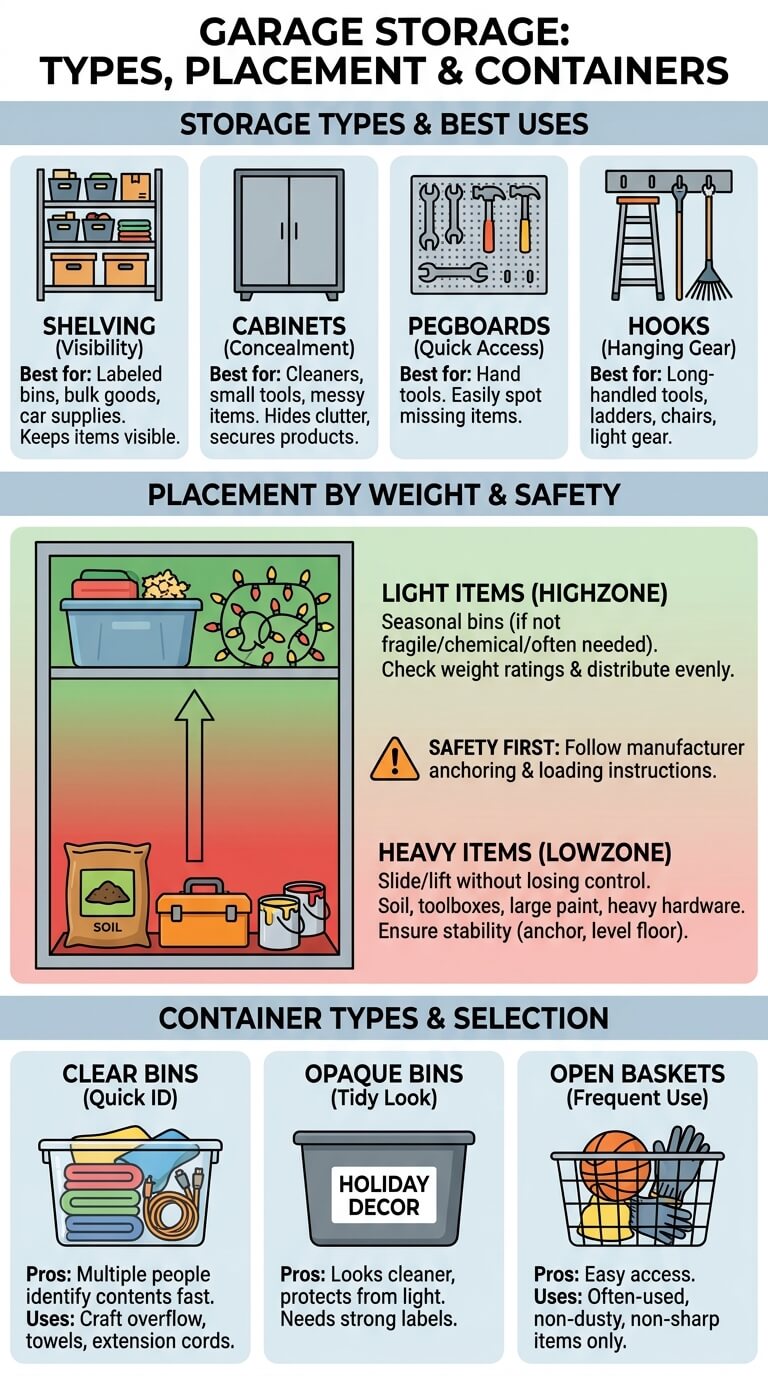
The right storage type depends on weight, frequency, visibility, and risk. A garage usually needs a mix of shelves, cabinets, hooks, pegboards, bins, and possibly overhead racks. The best setup makes items easier to return, not just easier to hide.
Shelving, cabinets, pegboards, hooks, bins, and overhead racks
Shelving is best for labeled bins, bulk household goods, car supplies, and items that need visibility. Cabinets are better for products that need a door, such as cleaners, small tools, or messy utility items. Pegboards work well for hand tools when you want to see what is missing. Hooks are ideal for long-handled tools, ladders, folding chairs, and lightweight gear.
Heavy items low and light items high
Store heavy items low enough that you can slide or lift them without losing control. Bags of soil, toolboxes, large paint containers, cases of water, and heavy hardware should not live on high shelves. Put lighter seasonal bins higher only if they are not fragile, not chemical, and not needed often.
Check shelf ratings before loading. A shelf may look sturdy but still have limits for total weight and weight per shelf. Distribute weight evenly. If a freestanding unit rocks, leans, or sits on an uneven floor, fix the support issue before loading it. Follow the manufacturer instructions for anchoring, wall attachment, leveling feet, and spacing.
Clear bins versus opaque bins versus open baskets
Clear bins help when multiple people need to identify contents quickly. They are useful for craft overflow, car cleaning towels, extension cords, and grouped household supplies. Opaque bins look cleaner and can protect items from light, but they need stronger labels. Open baskets are best only for items that are used often and are not dusty, sharp, chemical, or fragile.
How the Main Garage Jobs Work Together
A garage system improves faster when you tackle jobs in the right order. Some homes need a full reset. Others need a decluttering pass, a safer cleaner cabinet, better tool storage, or a floor-clear routine. The sections below help you decide which job comes first without turning one project into every project.
When to use a full garage organizing sequence
If the surrounding space still lacks structure, take time to organize a garage step by step before fine-tuning this area.
Use a full organizing sequence when the garage has multiple clutter problems at once. Signs include blocked parking space, piles in front of storage, mixed categories on every shelf, family members unable to find items, or repeated buying because nobody can see what is already there.
When garage decluttering needs its own pass
If shelves and bins are overflowing, declutter the garage before adding storage so storage is not built around broken, duplicate, or unused items.
Decluttering deserves its own pass when the garage contains many delayed decisions. Examples include old paint, duplicate tools, boxes from a move, broken sports gear, outgrown bikes, leftover renovation materials, or donations that never left. In that case, organizing too early just gives unwanted items a better-looking place to hide.
How cleaning supplies, garden tools, decorations, sports equipment, and floor-clear routines connect
These categories affect each other because they share the same walls and floor. Cleaning products should not sit beside children’s sports gear. Garden tools should not fall across seasonal bins. Decoration bins should not block the lawn mower. Bikes should not trap the cabinet that holds car supplies. The system works when each category has enough room to be used without disturbing another category.
Safety and Product Limits
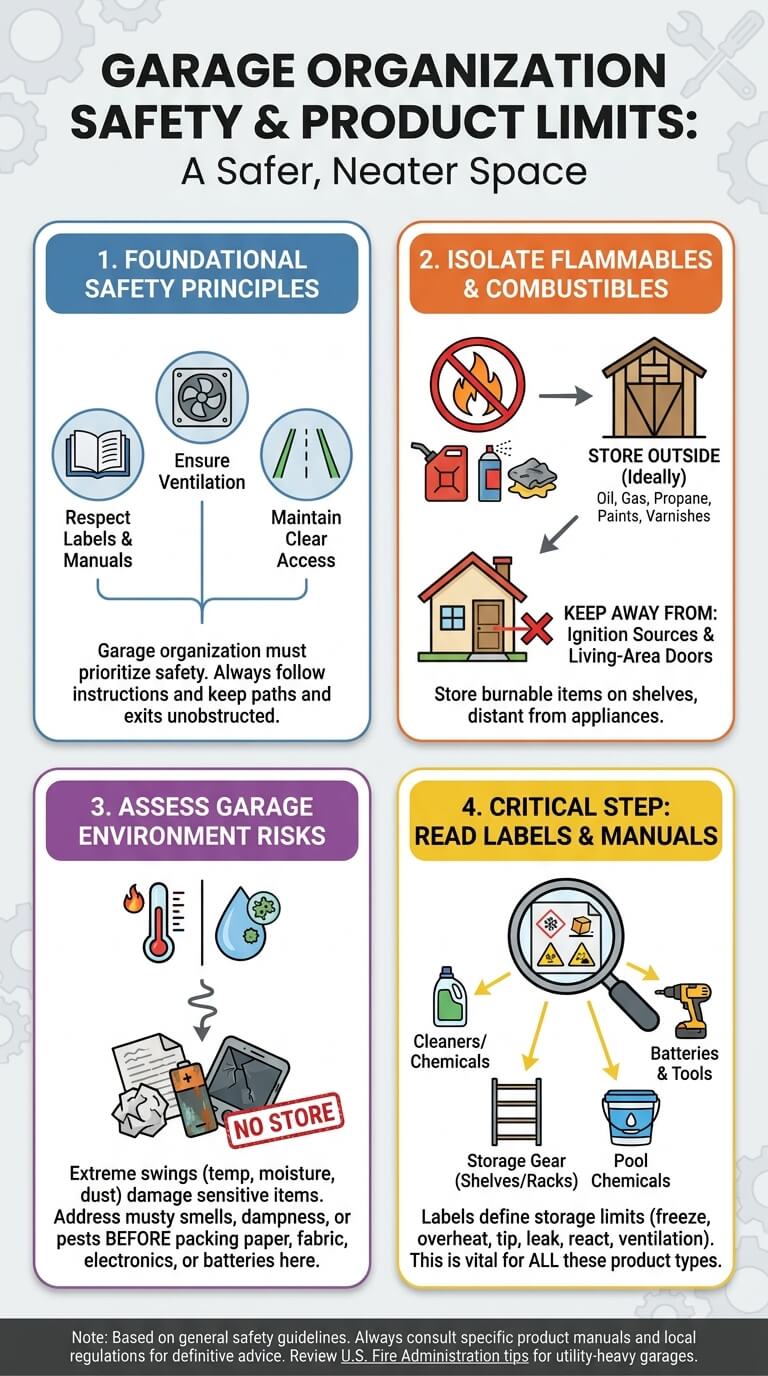
Garage organization should make the space safer as well as neater. Garages often contain heat sources, vehicles, appliances, chargers, sharp tools, chemicals, and stored combustibles. You do not need to panic, but you do need to respect labels, manuals, ventilation needs, and clear access.
Flammables, cleaners, pesticides, batteries, and power tools
Keep flammable products, fuels, solvents, aerosols, oily rags, and similar materials away from ignition sources and living-area doors. The U.S. Fire Administration recommends storing items such as oil, gasoline, paints, propane, and varnishes in a shed away from the home when possible and keeping burnable items on shelves away from appliances. Its garage fire safety tips are worth reviewing before you reorganize a utility-heavy garage.
Moisture, heat, pests, and ventilation considerations
Garages can swing from hot to cold and damp to dusty. Those conditions can damage paper, fabric, photos, electronics, some cleaners, adhesives, paint, and battery packs. If the garage smells musty, has visible moisture, or shows signs of pests, do not pack sensitive items there until the underlying issue is addressed.
Read labels and manuals before changing where products or equipment are stored
Labels and manuals are part of the storage system. They tell you whether an item can freeze, overheat, tip, leak, corrode, react with another product, or require special ventilation. This matters for cleaners, pesticides, pool chemicals, batteries, power tools, shelving units, overhead racks, ladders, and wall hooks.
Common Garage Organization Mistakes
Most garage systems fail for predictable reasons. They are built around products instead of habits, they hide too many decisions, or they make daily items too difficult to return. Fixing these mistakes early saves money and prevents the garage from sliding back into piles.
Buying shelves before measuring
Measure before buying anything large. Check wall length, ceiling height, parking clearance, door swing, outlet access, utility panels, windows, steps, and the space needed to open car doors. A shelf that fits the wall but blocks the house door or car door will create daily frustration.
Storing every category on the floor
The floor feels convenient during cleanup, but it turns into clutter quickly. Once one box lands there, the next item stacks beside it. Soon the garage has shelves and still no walking path. Move lightweight and awkward items onto walls whenever possible.
Mixing chemicals, sharp tools, and children’s sports gear
A mixed shelf can be dangerous even when it looks tidy. Keep children’s gear away from chemicals, blades, pesticides, fuels, and power tool attachments. Store cleaners in original containers with labels forward. Keep sharp tools in a tool zone, not in open bins beside balls, helmets, or outdoor toys.
Ignoring donation and disposal decisions
Garage clutter often survives because exit decisions are postponed. A donation pile without a deadline becomes a new storage category. Old chemicals without disposal research stay on the shelf for years. Broken gear remains because it feels wasteful to throw away, even though nobody plans to repair it.
FAQ
What should not be stored in a garage?
Avoid storing items that can be damaged by heat, freezing, moisture, pests, or fumes unless the label or manual says garage storage is acceptable. Common caution items include photos, important paper records, delicate textiles, some paints and cleaners, certain batteries, pet food, food, electronics, and anything in an unlabeled or leaking container. Fuel, propane, pesticides, pool chemicals, and other hazardous products need label-specific storage and may be safer outside the attached garage depending on the product and local guidance.
How do I organize a garage on a small budget?
Spend money only after sorting and measuring. Start by removing trash, donations, and items that belong elsewhere. Reuse sturdy bins you already own, label them clearly, and group items by function. Add low-cost hooks for long tools and frequently used gear before buying large cabinets. If you need shelves, buy fewer but stronger units that fit your measured space and storage weight. The budget mistake to avoid is buying containers for items you should have donated, recycled, or disposed of.
What is the best order for organizing a garage?
The best order is clear a safe path, remove obvious trash and exits, sort by function, make keep or remove decisions, map zones, choose storage types, place heavy items low, move frequent items within reach, label containers, and do a floor check after one normal week. This order keeps you from decorating clutter too early. It also helps you notice safety limits before products, tools, or heavy boxes are moved into the wrong storage spot.
How often should I reset garage storage?
Most garages benefit from a small reset once per season and a deeper review once or twice a year. Seasonal resets work well because the garage changes when yard tools, sports gear, holiday decorations, and bulk supplies rotate. A reset does not have to mean emptying the whole garage. Walk the floor, return items to their zones, remove donations, check labels on old products, and make sure shelves, hooks, cabinets, and overhead racks are still being used safely.
Final Thoughts
A garage stays organized when every item has a reason to be there, a zone that matches how it is used, and a storage method that fits its weight, risk, and frequency. Start with function, protect the floor, keep risky products separated, and make exit decisions early. Once the broad system is clear, the smaller jobs become easier: declutter what should leave, store cleaners safely, hang garden tools, pack seasonal decor, contain sports gear, and keep the floor open after real daily use.
The best garage system is the one your household can maintain on a busy week. If people can find what they need, put it back without effort, and move through the garage without stepping around piles, the system is working.

Ethan Carter is the Founder & Editor of HomeCleanSecrets. Based in the United States, he has 5 years of experience creating practical home cleaning, laundry care, stain removal, decluttering, and home organization content. His goal is to help everyday households clean smarter and build simple routines that are easier to maintain.
Read more about Ethan Carter on his author page: https://homecleansecrets.com/ethan-carter/