
Board games are easy to enjoy and surprisingly easy to scatter. One box may contain cards, dice, tokens, boards, instruction sheets, timers, pencils, and small plastic pieces, so a shelf can look orderly while the sets themselves are becoming harder to use. The most reliable system keeps each game complete, gives frequently used sets the easiest access, and prevents oversized or heavy boxes from creating unstable stacks.

You do not need matching containers or a dedicated game room. You need clear limits for what belongs here, how each set stays identifiable, where different box shapes fit, and what happens when storage is full.
Quick Answer: Group Complete Sets, Match Storage to Box Shape, and Keep Frequently Used Games Accessible
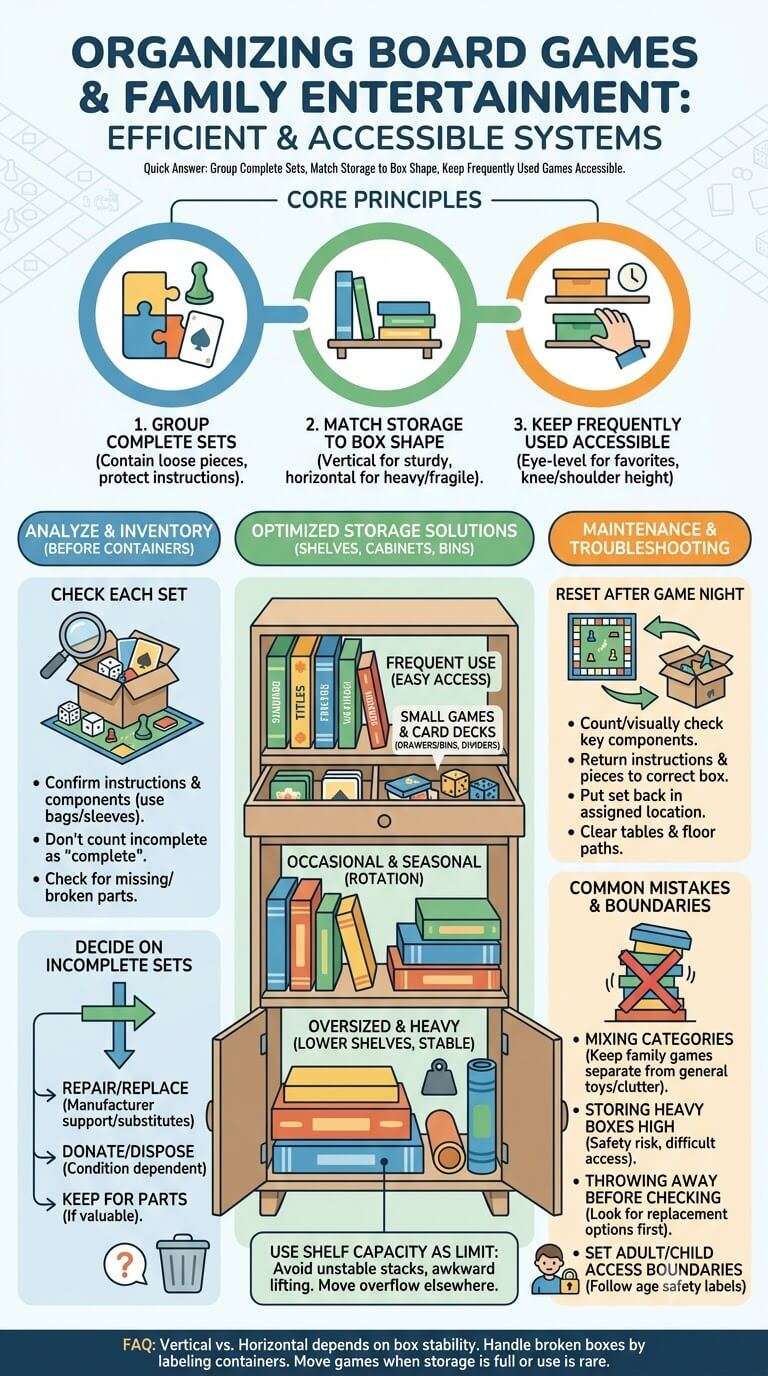
Start with the games you actually own, not with empty bins or an ideal shelf arrangement. Check each set, contain loose pieces inside the correct box, separate high-use games from occasional ones, and then assign storage based on box size, weight, and frequency of use.
Inventory before choosing containers
Pull games from the living room, nearby closets, table drawers, and overflow spots. Keep each set together while you sort. Do not count a box as complete until its important cards and pieces are accounted for. This pass often reveals duplicate decks, empty boxes, unfinished puzzles, and long-unused games.
Protect instructions and components
Instructions should stay with the game whenever possible. Put dice, cards, tokens, pawns, tiles, and other loose parts in small reusable bags or fitted containers inside the original box so opening the lid does not release a mixed pile. If the original rules are missing, check the manufacturer before assuming the set is unusable. Hasbro, for example, maintains an official game instructions library for many of its products.
Use shelf capacity as a limit
A shelf is full when games cannot be removed and returned without shifting unstable stacks, crushing boxes, or awkward lifting. Once the assigned area reaches practical capacity, move overflow elsewhere or review the collection.
Define What Counts as Shared Family Entertainment
The living room does not need to contain every play item in the household. Give this storage area a specific job: shared, mostly non-electronic activities that people use together in or near the room.
Board games
Traditional boxed games are the core category. Keep complete sets together and arrange them so the title is visible from the front or spine when possible. If several expansions belong to one game, store them beside the base set or inside it only when the box can close normally and the added weight does not damage the contents.
Card games
Small card decks need stronger containment because they can disappear behind larger boxes. Original tuck boxes work when they are intact. Worn decks can move to a labeled pouch or small card case, but the name of the game should stay obvious. Do not combine unrelated decks into one unlabeled container simply because they are the same size.
Puzzles
Puzzles belong here when they are part of normal family use and the pieces can stay contained. Give large puzzle boxes a shelf where the lid will remain secure. If a damaged box cannot hold its pieces, transfer the pieces to a labeled bag that clearly identifies the puzzle and keep that bag with the picture or box front when practical.
Party games and family activity kits
Trivia decks, charades sets, bingo-style games, and compact family activity kits can share the same zone when they function like games. Craft supplies, general toys, sports equipment, and electronic consoles should keep their own homes. This boundary prevents the game cabinet from slowly becoming a mixed entertainment closet. Keep non-electronic games separate from the TV stand and media console, which should remain focused on devices and accessories.
Separate Frequent, Occasional, and Seasonal Games
Frequency matters more than perfect category labels. A simple family game used every week should be easier to reach than a large holiday game used twice a year.
Easy-access shelf for frequent use
Place favorites between roughly knee and shoulder height when the furniture and household setup allow safe access. The goal is to let someone remove one game without unstacking five others. Keep small card games in a shallow bin or drawer at the same zone if they would otherwise vanish between larger boxes.
Higher or deeper storage for occasional use only when safe
Occasional games can use less convenient shelves, but do not place heavy boxes high simply because they are rarely used. A large game that requires two hands is usually better on a lower, stable shelf. Deep cabinets can work for occasional sets if the front row does not permanently hide the back row and everyone knows what is stored there.
Rotation instead of overcrowding
If the living room comfortably holds only part of the collection, keep current favorites nearby and move lower-use games to a dry overflow area. Rotate them when interest changes. The secondary location should be intentional and easy to review, not a forgotten pile.
Check Each Set Before You Store It
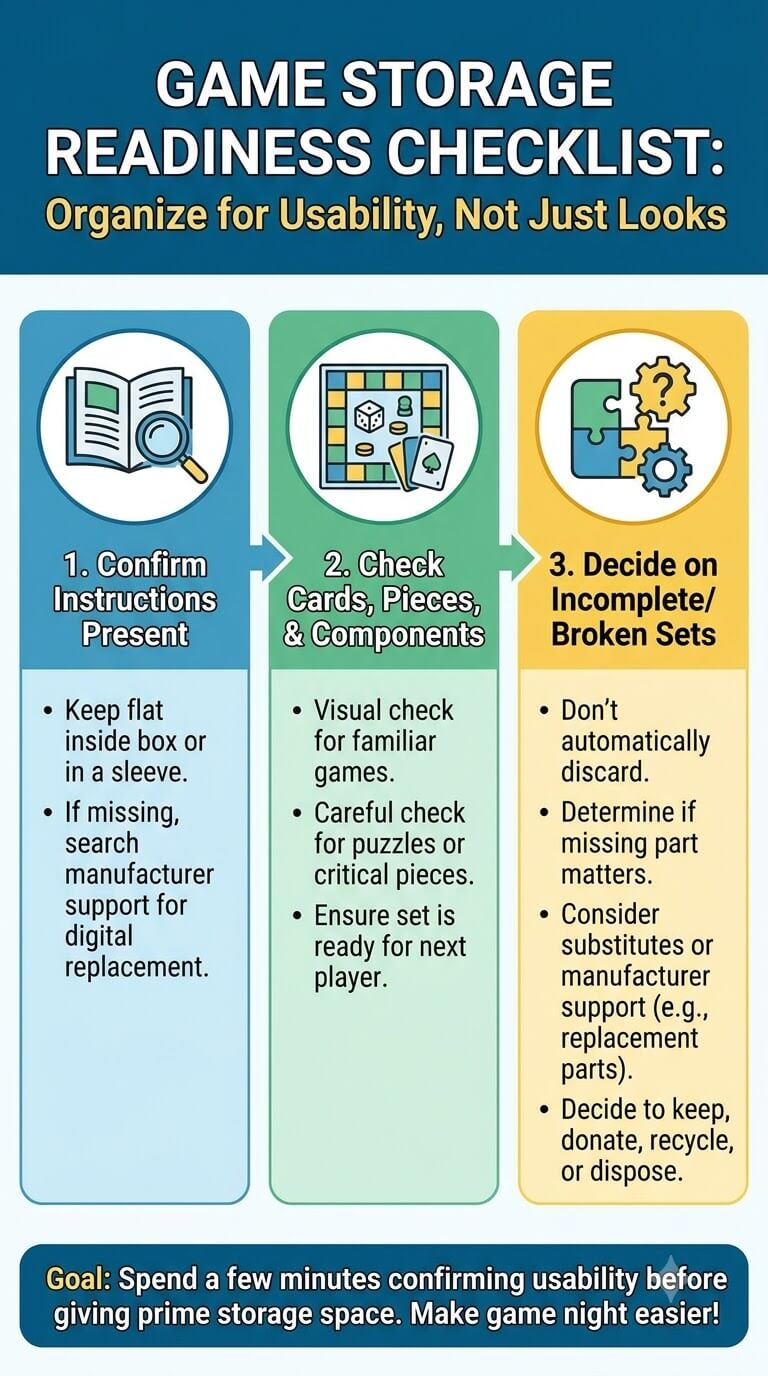
Organizing incomplete games without checking them first makes the shelf look better but does not make game night easier. Spend a few minutes confirming that each set is usable before giving it prime storage space.
Confirm instructions are present
Keep rule sheets flat inside the box or in a sleeve that stays with the set. If the instructions are missing, search the manufacturer’s support materials. When replacement instructions are available, you may be able to keep an otherwise complete game without printing multiple copies or storing loose rule pages in a separate household folder.
Check cards, pieces, dice, tokens, and puzzle components
You do not always need to count hundreds of pieces. For familiar games, a visual check of key components may be enough. For puzzles or sets where one missing piece changes play, check more carefully. A good test is whether the next person could open the box and begin without searching for a missing deck or die.
Decide what to do with incomplete or broken sets
Do not automatically discard a favorite game because one part is missing. First decide whether the missing component matters, whether a household substitute works, or whether the manufacturer offers support. Some companies provide replacement assistance for certain products. Ravensburger, for example, has a replacement-parts service for eligible requests. If the household no longer wants the game, then donation, recycling where accepted, or disposal may be more appropriate depending on condition and local rules.
Contain Small Components Inside Each Game
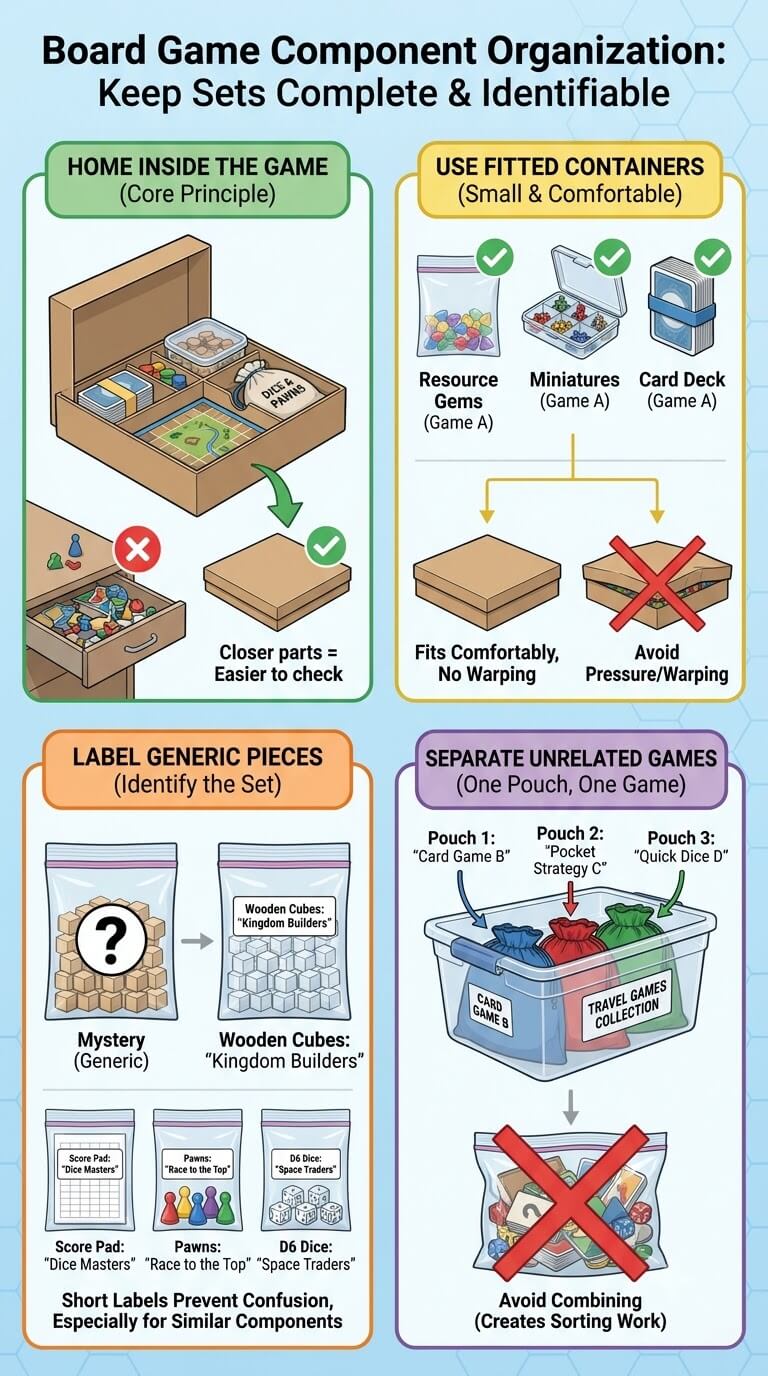
Loose components should have a home inside the game, not in a general drawer nearby. The closer every part stays to its set, the easier it is to notice when something is missing.
Use small bags or fitted containers
Reusable zip bags, bands around card groups, or small lidded boxes can keep pieces together. Choose containment that fits comfortably inside the original box. If the lid requires pressure to close, use a slimmer solution rather than warping the box.
Keep every component identifiable to the set
A clear bag of generic wooden cubes may be obvious today and mysterious six months later. Add a short label when pieces could be confused with another game. This is especially useful when several games use similar dice, score pads, pawns, or card decks.
Avoid combining unrelated games into one pouch
One bag holding several travel games saves space but creates sorting work. Keep each game in its own labeled pouch, then place those pouches together in one bin. The bin groups the category while each set stays identifiable.
Organize Card Games
Card games need a slightly different approach because small decks can be lost inside deep cabinets and their original boxes often wear out before the cards do.
Original boxes versus labeled pouches
Keep sturdy original boxes when they protect the cards and make the title easy to identify. If the box tears or no longer closes, move the deck to a pouch or case labeled with the game name. Include any special cards, score sheets, or tokens that belong with that deck.
Keep rule sheets with the deck
Fold rules only along existing folds when possible and keep them in the same case. If a deck uses a small reference card instead of a booklet, place it at the front so it is easy to find. A separate binder of game rules usually adds another place to maintain unless the household has a specific reason to use one.
Prevent loose cards from mixing in drawers
Do not toss bare decks into a shared drawer with pens, remotes, batteries, and miscellaneous accessories. Use dividers or small containers so each game remains intact. A shallow drawer works particularly well because you can see several labeled decks at once without stacking them deeply.
Organize Puzzles
Puzzles create two storage problems: wide boxes and many small pieces. The system should keep both the image reference and the pieces together.
Keep pieces contained
If the original box closes securely, it may be all you need. If the lid lifts easily, put the pieces in a bag inside the box. For puzzles that are frequently moved between rooms, this extra containment can prevent a dropped box from turning into a household search.
Label replacement bags when original boxes fail
When a box is crushed beyond useful repair, label the replacement bag with the puzzle name, piece count if known, and enough visual information to identify it. Keep the picture from the original box or a printed image with the pieces if that image is needed to complete the puzzle.
Store boxes so lids stay secure
A loose puzzle lid can slide off when stored vertically. If the box does not stay closed, store it flat, use a gentle box band, or place the pieces inside a sealed bag before shelving. Avoid taping a box shut in a way that must be cut open every time, because repeated damage can make the container less useful.
Choose Vertical or Horizontal Storage by Box Stability
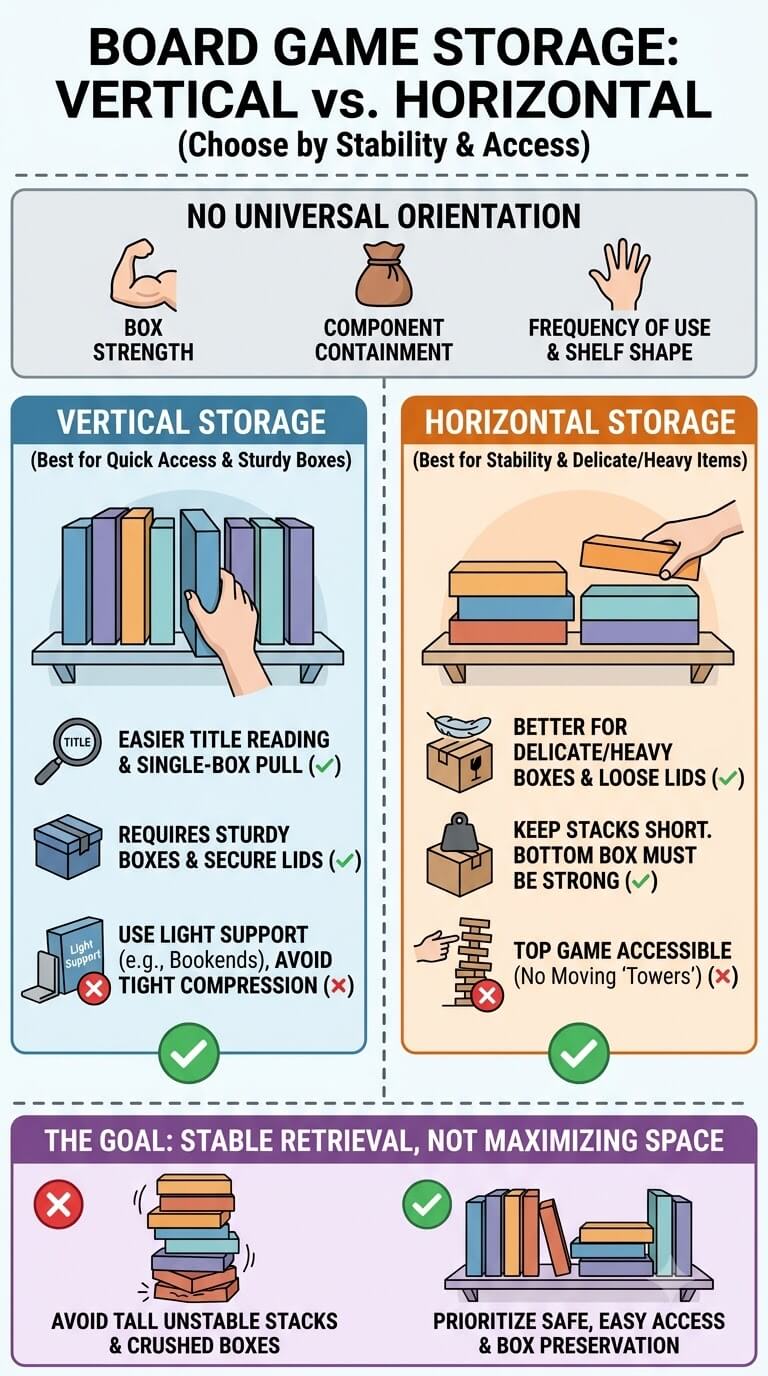
There is no universal orientation for board games. Box strength, component containment, shelf shape, and frequency of use matter more.
When vertical storage works
Vertical storage can make titles easier to read and lets you pull one box without lifting a whole stack. It works best when boxes are sturdy, lids fit securely, and loose components are contained inside. Use bookends or neighboring boxes for light support if games tend to lean, but do not compress boxes so tightly that removing one damages the others.
When horizontal stacking is more stable
Flat storage can be better for delicate puzzle boxes, games with loose lids, or heavy sets that would slump when upright. Keep stacks short. The bottom box should be strong enough to carry the weight above it, and the top game should not require moving a tower of boxes every time someone wants to play. After play, include games in the living room reset so pieces return to their sets and boxes return to assigned storage.
Avoid tall unstable stacks and crushed boxes
A stack that wobbles when one box is removed has exceeded a useful height. Break it into smaller groups or move some games to another shelf. Heavy boxes should not sit on lightweight or already bowed boxes. The goal is stable retrieval, not using every inch of vertical clearance.
Use Shelves, Cabinets, Drawers, and Bins by Category
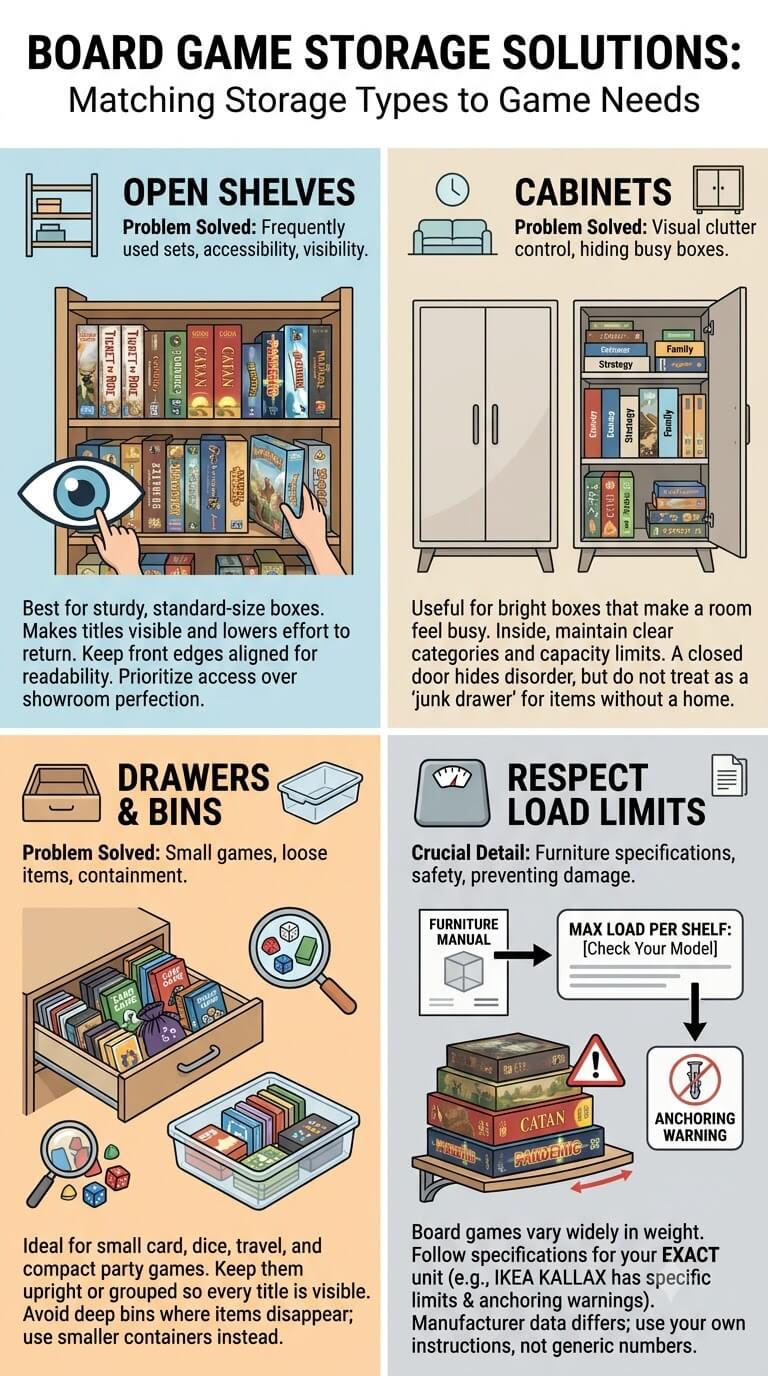
Different storage types solve different problems. Assign them according to what the games need, rather than trying to make every item fit the same container.
Open shelves for frequently used sets
Open shelving makes titles visible and lowers the effort required to return a game. It works well for sturdy, standard-size boxes used often. Keep the front edges reasonably aligned so titles remain readable, but do not worry about achieving a showroom appearance. Access matters more than visual perfection.
Cabinets for visual clutter control
Closed cabinets are useful when bright game boxes make the room feel busy. Inside the cabinet, keep the same clear categories and capacity limits you would use on open shelves. A closed door can hide disorder, so avoid treating the cabinet as a place to push anything that does not have another home.
Drawers and bins for small games
Small card games, dice games, travel games, and compact party games can share a drawer or shallow bin. Keep them upright or grouped by type so every title remains visible. If the bin becomes deep enough that items disappear at the bottom, reduce the number of games or use smaller category containers.
Respect furniture load limits
Board games vary widely in weight, especially when several dense boxes are stacked together. Follow the specifications for the exact shelving unit or cabinet you own. Manufacturer data can differ by model. For example, current IKEA KALLAX specifications list a maximum load per shelf for that particular unit and also include an anchoring warning. Use your own furniture instructions rather than applying that number to a different product.
Set Adult and Child Access Boundaries
A shared game shelf may serve adults, teenagers, and younger children at the same time. Access should reflect the contents of each game and the household’s actual supervision needs.
Follow manufacturer age and safety labels where relevant
Game boxes may contain small pieces that are not appropriate for young children. Keep original warning information with the product and follow the manufacturer’s age and safety directions. The U.S. Consumer Product Safety Commission explains that certain toys and games containing small parts require choking-hazard labeling. Storage should not make a restricted set freely accessible to a child who should not use it.
Keep heavy boxes on stable accessible shelves
Do not solve a child-access concern by placing every heavy game on the highest shelf. A heavy box can be difficult for an adult to retrieve safely from overhead as well. Use closed storage, an adult-managed cabinet, or another appropriate location when a game should not be child-accessible.
Separate child-specific toy systems from shared game storage
A small family-game shelf can include games everyone plays together, but it should not absorb blocks, dolls, cars, art kits, stuffed animals, or the full puzzle collection from a child’s room. When general toys migrate into the living room, return them to their main storage area or keep only one intentionally limited shared-space container.
Handle Oversized and Odd-Shape Games
Large boxes, tubes, long game boards, and unusually shaped packages can disrupt an otherwise simple shelf. Give these items intentional positions instead of forcing them into standard rows.
Use dedicated shelf positions
Reserve one wide or tall section for oversized games if the shelf geometry allows it. Keeping odd-size boxes together reduces the temptation to place them on top of smaller games. If only one game is unusually large, a lower cabinet shelf may be more practical than redesigning the whole setup around it.
Avoid forcing boxes into damaging stacks
If a box bows, the lid no longer closes, or neighboring games must be wedged tightly to make it fit, the storage location is wrong. Turn the box, move it to a deeper shelf, or use overflow storage. Do not remove useful packaging only to make a game fit unless the components can still be clearly identified and protected.
Move rarely used oversized sets to overflow storage if needed
A large game used rarely does not need the best living-room shelf. Move it to a dry, accessible overflow location when that preserves everyday capacity, and use the same destination consistently.
Decide What to Keep Without Sorting the Whole Toy Collection
Game storage sometimes becomes crowded because unused sets remain indefinitely. Review only the family-entertainment category here. General toy decisions belong with the household’s child-specific toy system. If the game area is full, declutter unused entertainment items before adding another cabinet or bin.
Use frequency of play as one factor
A game does not need monthly use to deserve storage, but repeated disinterest matters. Ask whether anyone still chooses it and whether a realistic occasion for using it remains. Keep sentimental or special games deliberately rather than giving them prime shelf space by default. Keep game storage within the broader living-room organization plan so entertainment does not consume seating or circulation space.
Consider condition and completeness
A complete game in good condition is easy to keep, donate, or relocate. A damaged or incomplete game needs a decision. Check whether the missing part can be replaced, whether the game still works without it, and whether anyone cares enough to fix the set. Do not create a permanent repair pile with no next action.
Choose donation, replacement, relocation, or removal based on household preference
Games that are complete and no longer wanted may be suitable for donation if a local organization accepts them. Favorite incomplete sets may be worth repairing. Rarely used games may simply need a closet instead of living-room space. Broken or unusable items should be handled according to the materials and local disposal options. The decision should reflect condition, usefulness, and household preference, not an arbitrary number of games.
Reset After Game Night
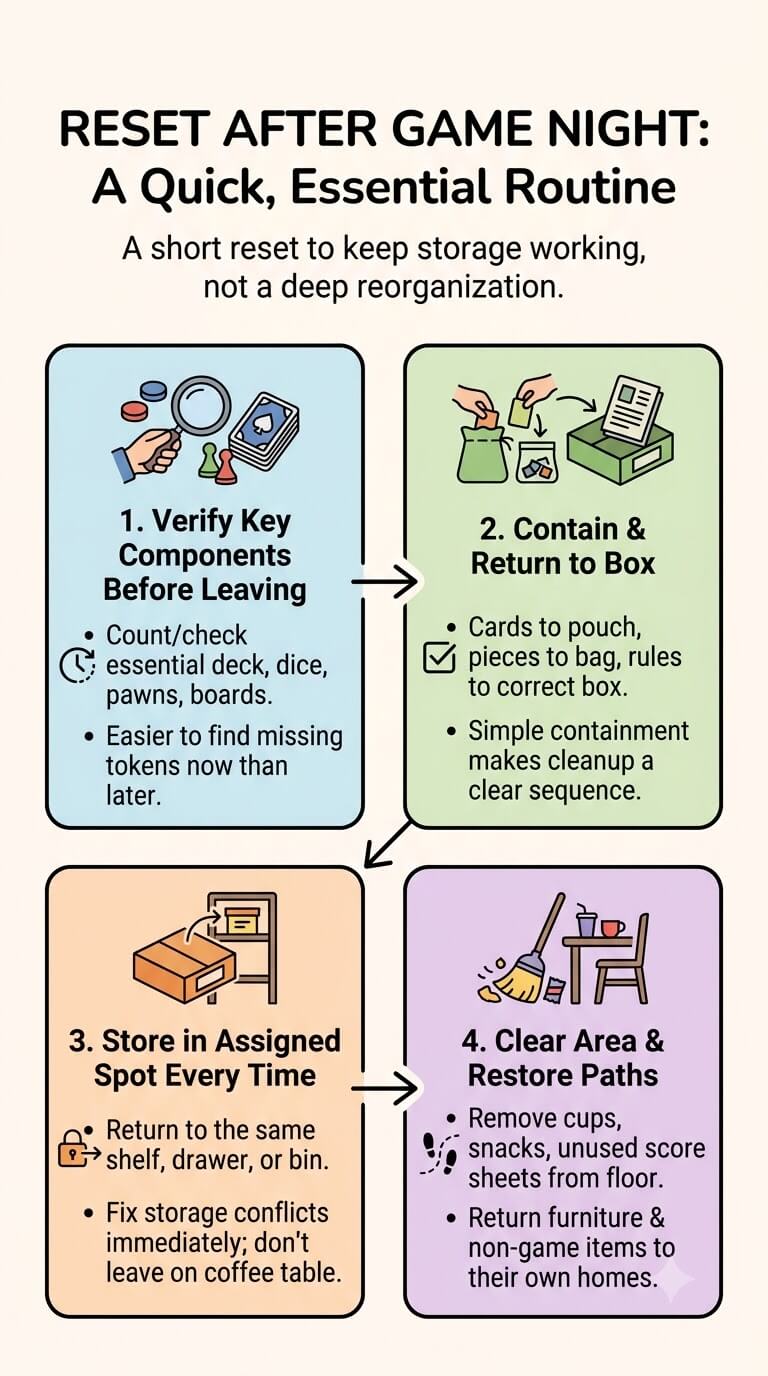
A short reset keeps the storage system working. It is not a deep cleanup and it should not require reorganizing the entire cabinet after every play session.
Count or visually check key components
Before everyone leaves the table, gather the obvious pieces and make sure the essential deck, dice, pawns, and boards are present. For games with many small components, use the game’s own component list when available. Finding a missing token is easier while chairs are still pulled out than after the room has been reset.
Return instructions and pieces
Put cards back in their pouch, pieces in their bag, and rules inside the correct box. This is where simple containment pays off. If everything has a small home within the box, cleanup becomes a sequence of clear actions instead of pushing a mixed handful of pieces under the lid.
Put the set back in its assigned location
Return the game to the same shelf, cabinet section, drawer, or bin every time. If it no longer fits because another item has occupied its space, fix the storage conflict immediately rather than leaving the box on the coffee table. Repeated overflow usually means the assigned zone is carrying too much inventory.
Clear tables and floor paths
Remove cups, snacks, score sheets that are no longer needed, and game pieces from the floor. Return chairs and small tables to normal use without blocking walking routes. Toys, blankets, books, and electronics that were moved during play should return to their own homes rather than being added to the game cabinet.
Common Board Game Organization Mistakes
Most problems come from mixing categories, overloading storage, or protecting the shelf appearance more than the usability of each set.
Storing heavy game boxes high or unstably
Large games are awkward to lift from overhead and can destabilize short stacks below them. Keep heavier boxes lower when practical and use shelving according to its instructions. If furniture needs anchoring, follow the manufacturer’s directions for the exact unit and wall conditions.
Mixing pieces from different sets
A general container labeled “game pieces” looks efficient until the household has to reconstruct three games. Keep components with their original sets. If you find an unknown piece during cleanup, place it in a temporary lost-piece cup and review it soon rather than adding it permanently to another game.
Throwing away incomplete games before checking priorities or replacement options
Missing parts do not always make a game unusable. Check the instructions, ask household members whether they want to keep it, and look for manufacturer support when appropriate. If nobody values the set or repair is unrealistic, then make a clear removal decision instead of storing it indefinitely.
Letting game storage merge into general toy clutter
When action figures, building pieces, art supplies, and random toys begin filling the game shelf, the category loses its purpose. Return child-specific toys to their own storage and reserve the living-room zone for shared games and related components. A limited shared toy basket can exist nearby if the household intentionally uses one, but it should have its own capacity.
FAQ for Board Game Organization
These questions cover the storage decisions that most often affect complete sets, shelf stability, and everyday access.
Is vertical or horizontal storage better for board games?
Neither is always better. Vertical storage works well for sturdy boxes with secure lids and contained components because individual games are easy to pull out. Horizontal storage is often safer for fragile puzzle boxes, loose lids, or heavy sets that slump when upright. Choose the orientation that keeps each box stable and accessible without creating tall stacks.
How do you store games with broken boxes?
If the box can still protect the contents, reinforce it gently without covering the title or instructions. When the box is no longer usable, move components to a labeled container and keep the game name, rules, and any image needed for play with it. Avoid generic bags with no identifying information.
What should you do with missing pieces?
First confirm what is missing using the component list or instructions. Check common play areas and any temporary lost-piece container. Then see whether the game can function without the part or whether the manufacturer offers replacement help. If the game remains unusable, decide whether the household wants to keep it for parts, repair it later with a specific plan, or remove it.
When should games move from the living room to a closet or other storage area?
Move games when the living-room zone has reached practical capacity, when a set is used only occasionally, when an oversized box interferes with everyday access, or when child-access requirements make another location more appropriate. Keep frequently used family favorites nearby and treat overflow as an intentional secondary location, not as a place to hide unsorted boxes.

Ethan Carter is the Founder & Editor of HomeCleanSecrets. Based in the United States, he has 5 years of experience creating practical home cleaning, laundry care, stain removal, decluttering, and home organization content. His goal is to help everyday households clean smarter and build simple routines that are easier to maintain.
Read more about Ethan Carter on his author page: https://homecleansecrets.com/ethan-carter/