
Learning how to store seasonal decorations is less about buying more bins and more about building a system that protects what you actually use. Holiday lights, ornaments, wreaths, garlands, outdoor inflatables, fabric runners, paper banners, and party pieces all fail in different ways when they are tossed into one garage corner. Lights tangle. Fragile ornaments crack. Wreaths flatten. Fabric smells musty. Mystery bins pile up until the next season becomes a search project.
A good seasonal storage setup makes next year easier before this year is fully cleaned up. The goal is to sort decorations by season, pack each material the way it needs to be packed, label bins clearly, and place everything where it will not be crushed, damp, overheated, or in the way of daily garage traffic. You do not need a perfect garage to do this well. You need consistent categories, safe containers, and a simple retrieval habit.

Quick Answer: The Seasonal Decoration Storage System
Place this category within a broader garage organization and storage plan so the surrounding zones work together.
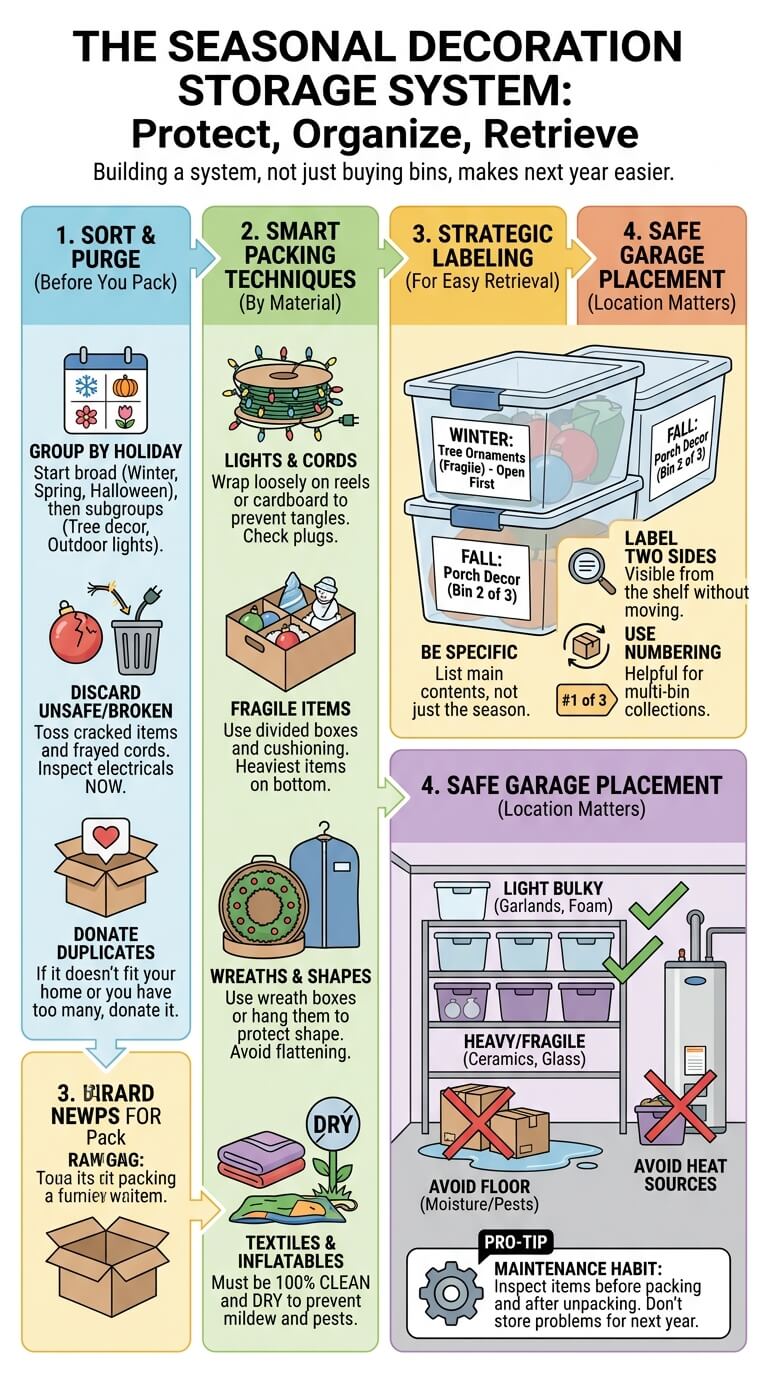
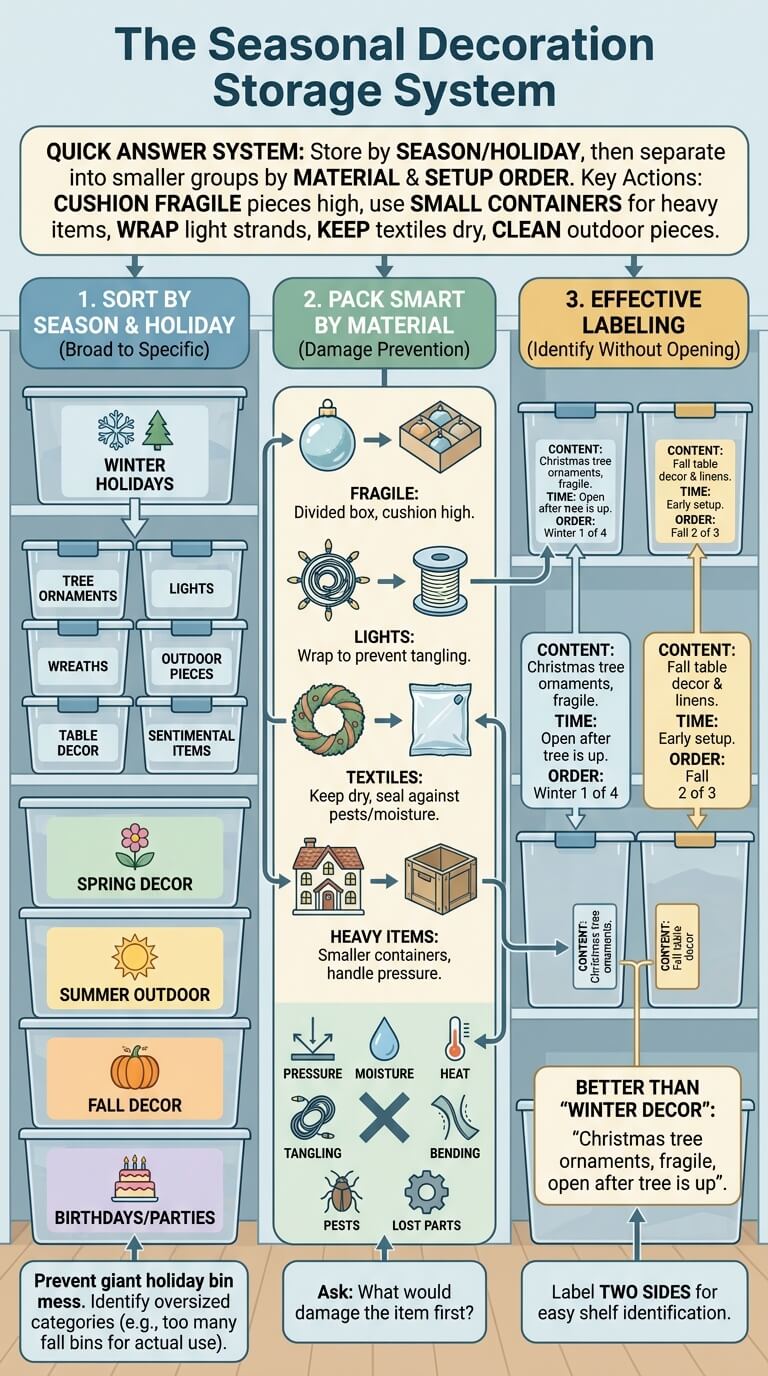
The easiest system is to store decorations by season or holiday, then separate each holiday into smaller groups by material and setup order. Keep fragile pieces cushioned and high in the bin, keep heavy items in smaller containers, keep light strands wrapped, keep textiles dry, and keep outdoor pieces clean before storage. Label at least two sides of every bin so you can identify it from the shelf without opening it.
Sort by season and holiday
Start with broad groups: winter holidays, spring decor, summer outdoor pieces, fall decor, birthdays or parties, and any cultural or family holidays you decorate for every year. Then split large groups into practical subgroups. For example, winter decorations might become tree ornaments, lights, wreaths, outdoor pieces, table decor, gift wrap, and sentimental items.
This prevents one giant holiday bin from becoming a mess every time you need one item. It also helps you see when one category is oversized. If fall decor fills six bins but only one bin comes out each year, that is a storage problem, not a labeling problem.
Pack fragile, bulky, textile, and lighted items differently
Seasonal decor is not one material. Glass, ceramic, wire, plastic, paper, fabric, foam, battery compartments, bulbs, and cords all need different handling. A divided ornament box is useful for small fragile pieces, but it is a poor choice for a wreath. A large tote works for garlands, but it can crush paper decor if heavy items are added on top. Before packing, ask what would damage the item first: pressure, moisture, heat, tangling, bending, pests, or lost parts.
Label bins so retrieval does not require opening everything
A useful label says what is inside, when it is used, and whether the bin should be opened early or late in the decorating process. “Winter decor” is better than nothing, but “Christmas tree ornaments, fragile, open after tree is up” is much more helpful. Put labels on the front and one short side, because bins often rotate on shelves. Add a simple number if you have many bins from one season, such as “Fall 1 of 3” and “Fall 2 of 3.”
Decide What Decorations Are Worth Storing
If shelves and bins are overflowing, declutter the garage before storing decorations so storage is not built around broken, duplicate, or unused items.
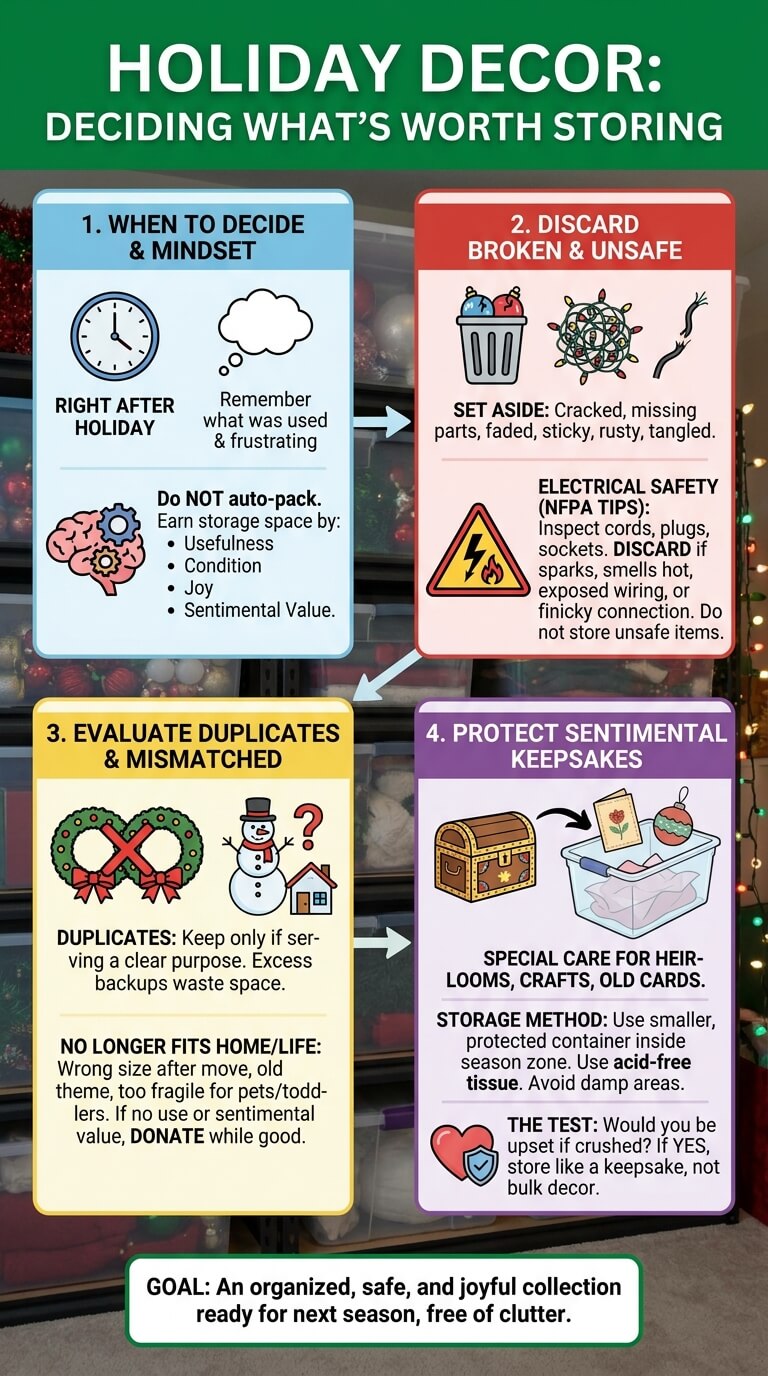
The best time to decide what stays is right after the holiday, while you still remember what you used, what stayed in the box, and what was frustrating to set up. Do not pack every item automatically. Storage space should be earned by usefulness, condition, sentimental value, or clear seasonal joy.
Broken, faded, unsafe, or unwanted items
Set aside anything cracked, missing parts, faded beyond repair, tangled beyond patience, sticky, rusty, or no longer safe to use. This is especially important for electrical items. Before lights and powered decor go into storage, inspect cords, plugs, sockets, battery compartments, and controls. NFPA recommends replacing light strings with worn or broken cords or loose bulb connections in its holiday fire safety tips. If an item sparks, smells hot, has exposed wiring, or works only when the cord is bent a certain way, do not store it for another season.
Duplicates and decor that no longer fits the home
Many storage problems come from harmless duplicates: extra wreaths, old stockings, spare tree skirts, mismatched candle holders, retired outdoor pieces, and decor from a previous color scheme. Keep duplicates only if they serve a clear purpose. If you always use one wreath and keep four backups, the backups are taking space from items you actually need to reach.
Decor that no longer fits your home deserves the same review. A large outdoor display may not make sense after a move. A party theme may be over. A fragile piece may not work in a home with toddlers or pets. If it has not been used for several seasons and has no strong sentimental value, donate it while it is still in good condition.
Sentimental items that need better protection
Sentimental decorations should not be punished by being tossed into the busiest bin. Keep heirloom ornaments, handmade pieces, old cards, children’s crafts, and keepsake textiles in a smaller protected container inside the larger season zone. Use acid-free tissue for delicate paper when possible, avoid damp storage areas, and keep irreplaceable pieces away from bins that will be moved often.
A good test is whether you would be upset if the item were crushed by a stack of heavy bins. If the answer is yes, store it like a keepsake, not like ordinary bulk decor.
Sort Decorations by Use Pattern
To stop balls and shared gear from spreading into walkways, separate seasonal decorations from sports gear near the main entry.
Sorting by use pattern makes storage easier to retrieve. Some items come out every year. Some come out only for a party. Some are outdoor setup pieces that need to be reached before the tree, table, or mantel decor. Your storage should follow the order you actually decorate.
Holiday-specific bins
Create dedicated bins for major holidays that produce enough decor to justify their own containers. A Halloween bin should not share space with spring table runners unless your home has almost no seasonal items. Dedicated bins keep pieces from different seasons from damaging each other and prevent you from opening the wrong container in a hurry.
Inside each holiday bin, group by area: front porch, mantel, table, tree, yard, entryway, or kids’ rooms. This small layer of order saves time because you can decorate one zone without unpacking the whole holiday.
Seasonal bins for spring, summer, fall, and winter
Not every item belongs to a holiday. Spring florals, summer patio pieces, fall leaves, winter blankets, neutral garlands, and seasonal pillow covers can be stored by season instead. These bins work best when they hold items used during the same part of the year, not a random mix of colors and leftovers.
If a seasonal bin becomes too full, split it by room or material. “Fall porch” and “Fall table” are easier to use than one overflowing fall bin that must be emptied on the garage floor.
High-priority items used every year
Some decorations always come out first: tree stands, light clips, outdoor timers, extension cords rated for the job, wreath hangers, stocking hooks, or the small tool kit used for setup. Keep these near the front of the season group or in a clearly labeled setup bin. This saves you from digging through fragile decor just to find the hardware needed to begin.
Rarely used party or outdoor decor
Party backdrops, themed props, large inflatables, extra serving decor, and oversized outdoor pieces can live farther back or higher up if they are light enough. Store them only if they are clean, dry, complete, and likely to be used again. Rarely used items are a good fit for less convenient storage space, but they should still be labeled well enough that you can find them without unpacking the garage.
Choose the Right Containers
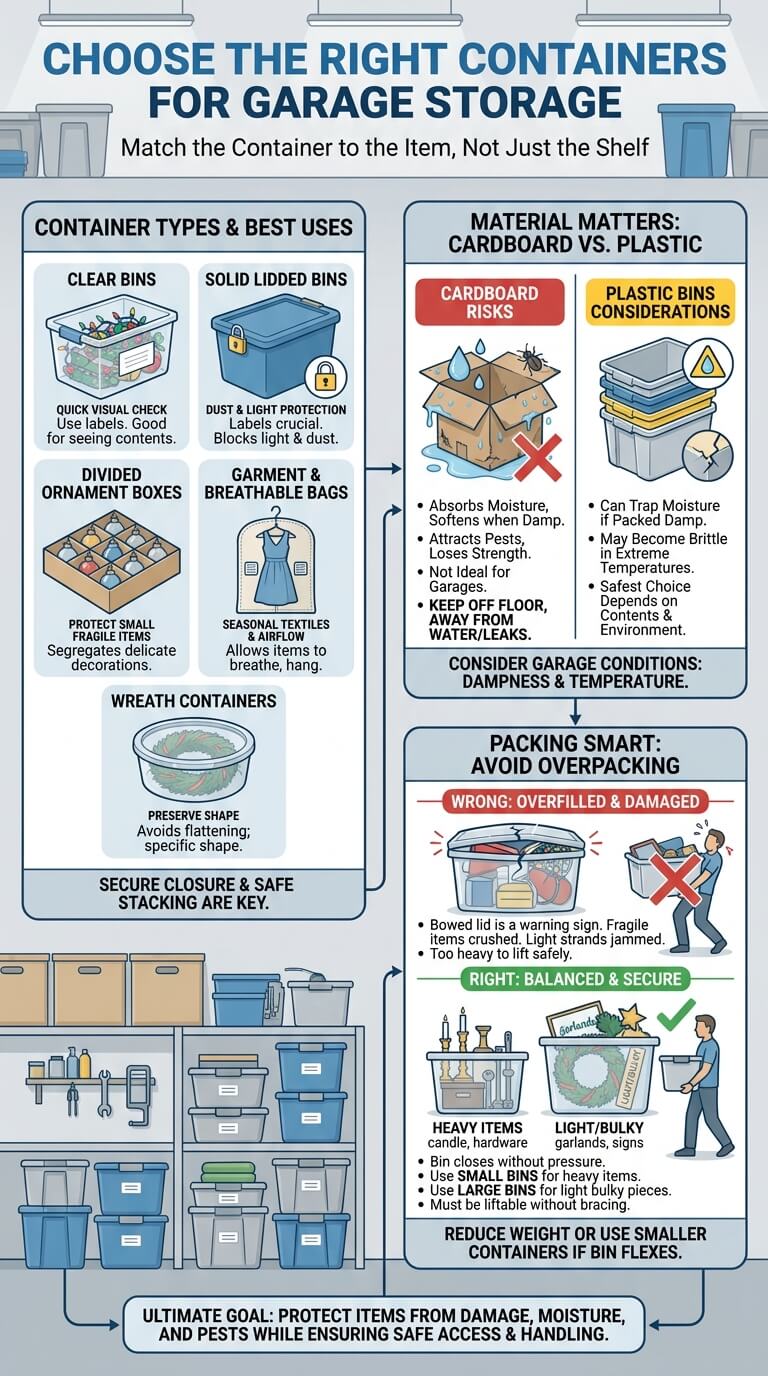
Containers should match the item, not just the shelf. The wrong container can create damage even when the garage looks organized. Overfilled bins crack lids, cardboard softens in damp conditions, and large totes become too heavy to lift safely.
Clear bins, lidded bins, divided ornament boxes, garment bags, and wreath containers
Clear bins work well when you want a quick visual check, but they still need labels. Solid lidded bins protect from dust and light, but they make labels more important. Divided ornament boxes protect small fragile items. Garment bags or breathable fabric bags help with seasonal textiles that need to hang or breathe. Wreath containers protect shape better than forcing wreaths flat inside a tote.
For garage storage, choose containers that close securely and stack safely. A lid that bows under weight is a warning sign. If the bin flexes when lifted, reduce the weight or move the contents into smaller containers.
When cardboard is risky in garages
Cardboard is cheap and easy, but it is not ideal in many garages. It absorbs moisture, softens when damp, attracts pests in some conditions, and loses strength when stacked for long periods. If you use cardboard for lightweight decor, keep it off the floor, away from water heaters, garage doors, exterior walls with leaks, and any area where condensation appears.
Plastic bins are not perfect either. They can trap moisture if items are packed damp, and they can become brittle in harsh heat or cold. The safest choice depends on what you store, how damp the garage gets, and whether the items need airflow.
How to avoid overpacking bins
Overpacking is one of the fastest ways to damage decorations. A bin should close without pressure. Fragile items should not be used to fill gaps under heavier pieces. Light strands should not be jammed around sharp decor. Textiles should not be compressed while damp or musty.
Use smaller bins for heavy items such as candle holders, ceramic houses, metal stands, and dense outdoor hardware. Use larger bins for light bulky pieces such as garlands, plastic yard signs, foam pieces, and empty display forms. If you cannot lift a bin without bracing your body, it is too heavy for routine storage.
Store Fragile Decorations
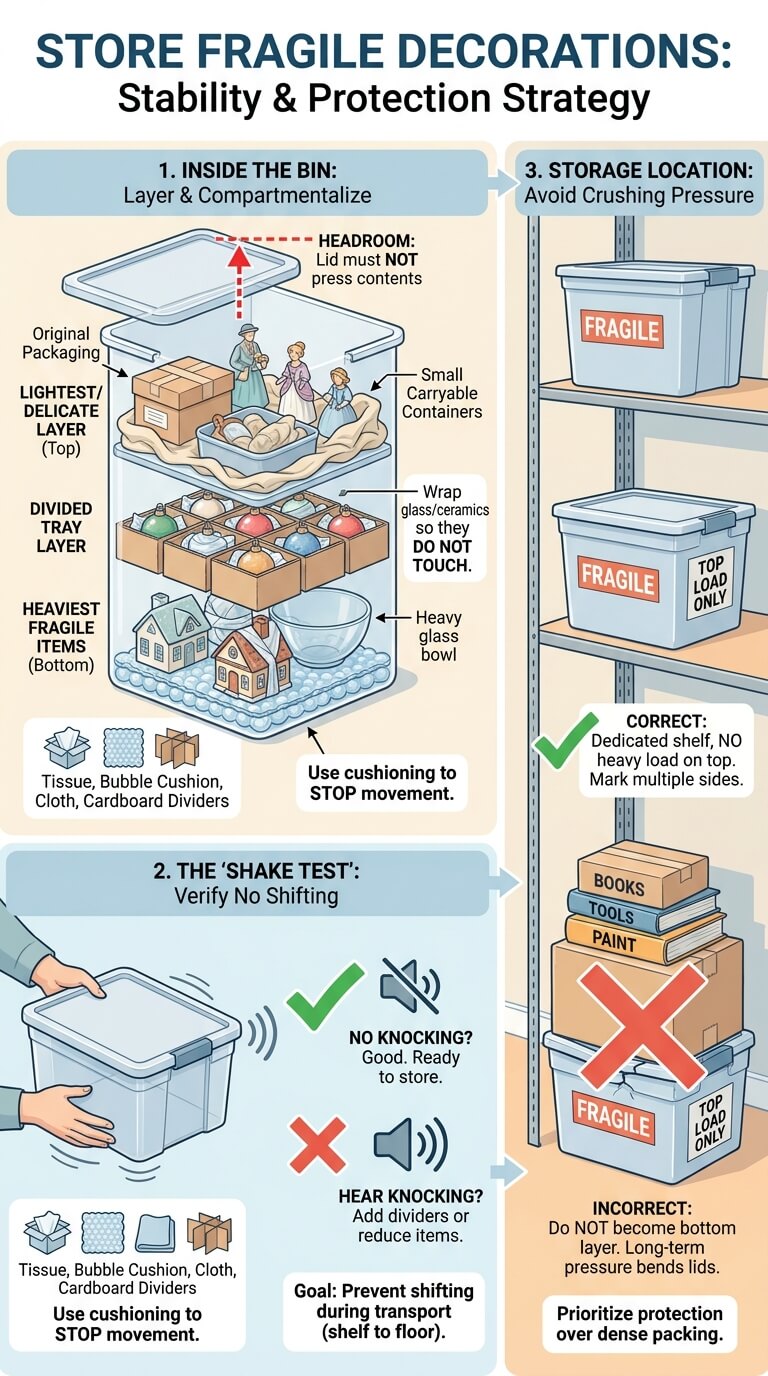
Fragile decorations need stable compartments and protection from pressure. The goal is not just cushioning. It is also to stop items from shifting when a bin is moved from shelf to floor and back again.
Ornaments, ceramics, glass, and heirlooms
Keep ornaments in divided trays, small boxes, or containers with individual compartments. Wrap ceramics and glass pieces so they do not touch each other. Keep very delicate items in their original packaging when it still provides real protection. If the original packaging is crushed or too bulky, replace it with sturdier dividers.
Heirloom decorations should be stored in a smaller container that can be carried carefully. Avoid placing them in a giant bin that requires tipping, digging, or stacking under other items.
Cushioning, dividers, and top-load rules
Use tissue, bubble cushioning, cloth, cardboard dividers, or ornament trays to stop movement. Put the heaviest fragile items at the bottom and the lightest at the top. Leave enough space that the lid does not press into the contents. A good test is to close the bin and gently move it side to side. If you hear pieces knocking together, add dividers or reduce the amount inside.
Why heavy items should not sit on fragile bins
Fragile bins should not become the bottom layer of a stack. Even if the lid looks sturdy, months of pressure from tools, books, paint supplies, or dense decor can bend the lid and crush the items inside. Place fragile bins on a shelf where nothing heavy will be added on top. Mark them “fragile” on more than one side so the warning is visible after the bin is stored.
Store Lights, Cords, and Inflatable Decor
Lighted decor needs extra attention because poor storage can create tangles, cracked insulation, missing adapters, and setup problems next season. The pack-away routine should include inspection, wrapping, labeling, and keeping small parts with the item.
Prevent tangles with reels, cardboard wraps, or labeled bags
Wrap light strands around a cord reel, a flat cardboard piece, a plastic light spool, or a wide hanger. Do not pull the cord tight around sharp corners. Tape or tie the end gently so it does not unravel, and label the strand by location: porch rail, tree, roofline, mantel, or patio. If a strand has a controller, remote, adapter, or spare bulbs, keep those parts in a small bag attached to the wrapped strand.
Check cords and plugs before storing
Inspect lights before they go away, not only when you take them out next season. Look for frayed insulation, exposed wire, cracked plugs, missing bulbs, loose sockets, corroded battery compartments, and signs of overheating. The Consumer Product Safety Commission offers holiday decoration safety tips that include checking lights and using products as directed. If a powered decoration is damaged or unreliable, replacing it is safer than storing a problem for next year.
Keep manufacturer instructions with specialty decor
Inflatables, animated figures, projectors, timers, and specialty lights often have limits for moisture, temperature, storage position, replacement parts, and cord use. Keep the manual, parts list, stakes, tethers, adapters, and repair patches in a labeled bag inside the same bin. If the item has a QR label or model number, take a photo before packing it away.
Dry inflatables completely before folding. Fold along natural seams when possible, avoid crushing fan housings, and keep stakes or metal parts in a separate pouch so they do not puncture fabric.
Store Wreaths, Garlands, Textiles, and Paper Decor
Soft, shaped, and paper-based decorations need a different plan from hard plastic or glass. Their biggest risks are flattening, moisture, pests, dust, and color transfer.
Shape protection for wreaths and garlands
Wreaths keep their shape best in a wreath box, wreath bag, wall hook, or covered hanging space. If you stack wreaths in a bin, keep them upright or lightly layered, not smashed under heavy pieces. Garlands can be coiled loosely and placed in a large bin or hung on a broad hook. Avoid tight bends that crush greenery, lights, or decorative picks.
Moisture and pest considerations for fabric or paper
Fabric runners, stockings, pillow covers, tree skirts, banners, and paper decor should be clean and fully dry before storage. Food crumbs, candle residue, glitter glue, dampness, and body oils can attract pests or lead to musty smells. The EPA’s moisture control guidance is a useful reminder that controlling moisture is key to preventing mold problems in the home.
If a garage has repeated leaks, sweating walls, standing water, or musty odors, paper keepsakes and fabric decorations may need a different storage location. Do not rely on a sealed plastic bin to fix an active moisture problem.
When climate-controlled storage is better than garage storage
Use indoor storage for irreplaceable paper, antique ornaments, delicate fabric, handmade keepsakes, photos, real wax items, and decor that warps or melts. Garages can swing hot, cold, or damp depending on the home. If an item would be expensive, impossible, or emotionally painful to replace, store it in a closet, interior cabinet, or another stable area instead of the garage.
Where to Put Seasonal Decorations in the Garage
If the surrounding space still lacks structure, take time to organize the garage into clear zones before fine-tuning this area.
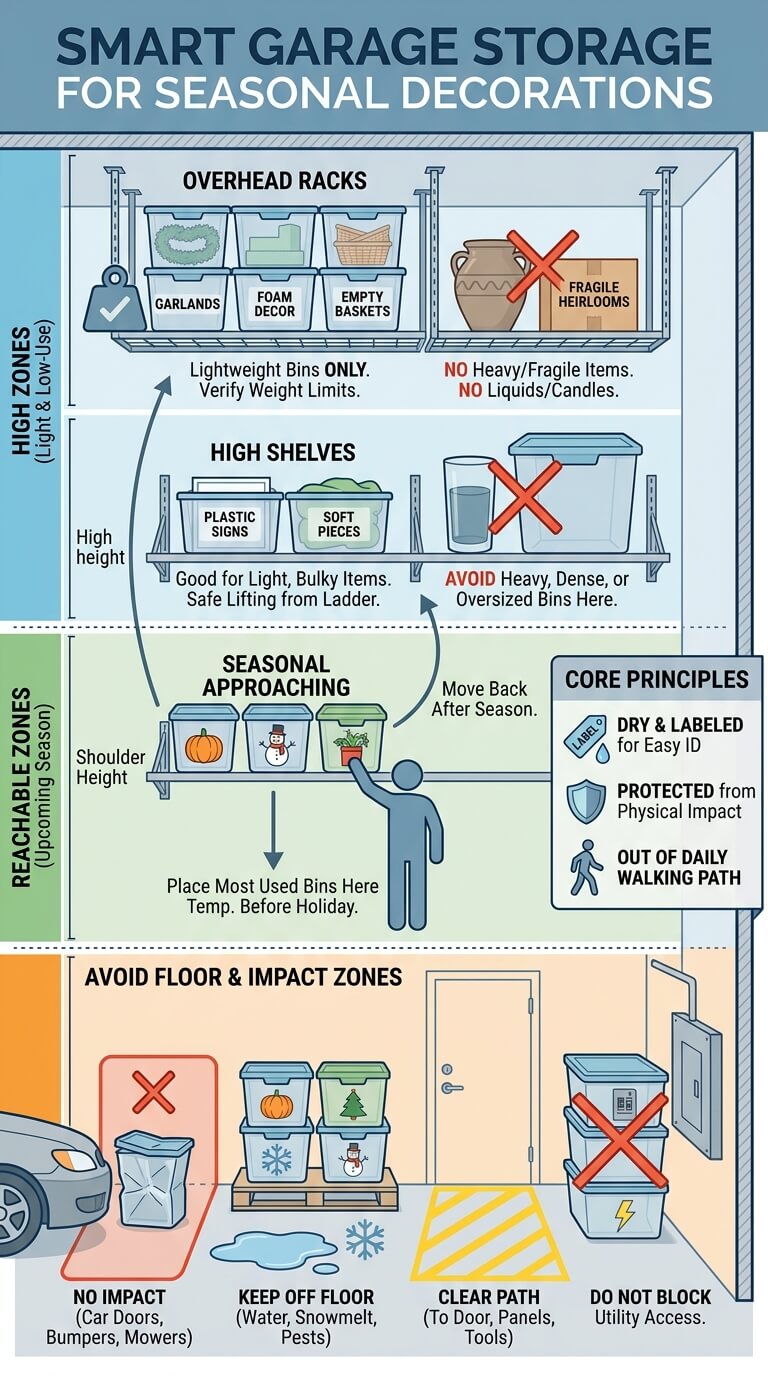
Seasonal decorations are used only a few times a year, so they do not need prime daily-access space. They do need safe placement. The best garage location is dry, labeled, protected from impact, and out of the walking path.
High shelves for light bins
High shelves are good for light, low-use bins such as garlands, foam decor, plastic signs, empty baskets, and soft seasonal pieces. Do not put heavy ceramic, dense glass, or oversized bins above shoulder height. A bin that feels manageable at floor level can become unsafe when you are pulling it down from a ladder.
Place the most used seasonal bins at reachable shelf height when the holiday is approaching. After the season, move them back to the upper or less convenient zone if needed.
Overhead racks only within weight limits
Overhead garage racks can work well for lightweight seasonal bins, but they must be installed and loaded within the manufacturer’s limits. Read the rack instructions, confirm what type of ceiling structure it requires, and do not guess at weight capacity. Store only items you can lift safely and identify from below.
Avoid overhead storage for fragile heirlooms, very heavy bins, liquids, candles that may soften in heat, or items you need while standing on one foot in a crowded garage. If you dread retrieving a bin, the location is too inconvenient or too risky.
Keep seasonal bins away from parking impact, leaks, and floor traffic
Use hooks, shelves, and simple return rules to keep seasonal bins off the garage floor.
Do not store decoration bins where a car door, bumper, bicycle, mower, or rolling cart can hit them. Keep bins off the floor if the garage has water intrusion, snowmelt, puddles, or insects. Leave a clear path to the door, electrical panel, water heater, and frequently used tools. Seasonal storage should not slowly take over the floor just because it is not used every week.
Seasonal Decoration Storage Checklist
A checklist makes the pack-away routine repeatable. The best time to improve storage is while the decorations are still out, not eleven months later when you are tired and trying to decorate quickly.
Pack-away checklist after each holiday
- Remove batteries from items that will sit unused for months, unless the manual says otherwise.
- Wipe dust, pollen, dirt, or outdoor debris from decor before it goes into a bin.
- Dry outdoor items, inflatables, wreaths, garlands, and textiles fully before sealing them.
- Inspect light strands, plugs, sockets, and controls before wrapping them.
- Discard or repair broken items before they return to storage.
- Keep small parts, stakes, adapters, remotes, and clips with the item they belong to.
Label and inventory checklist
- Label each bin by holiday or season, then by contents.
- Add “fragile,” “lights,” “outdoor,” or “open first” when helpful.
- Number multiple bins from the same holiday.
- Write labels on at least two sides.
- Keep a simple phone note or printed list for large collections.
- Update the label when you remove, donate, or add items.
Pre-season retrieval checklist
- Pull the setup bin first if you have one.
- Check lights, cords, timers, and batteries before decorating day.
- Bring fragile bins inside before opening them, especially in cold or damp weather.
- Review outdoor items for missing stakes, clips, and extension cords.
- Set aside damaged items immediately so they do not go back into rotation.
Common Mistakes
Most seasonal storage failures are small habits repeated every year. Fixing the habit is often easier than buying another organizer.
Storing decorations in mystery bins
A mystery bin costs time every season. If you have to open five bins to find one wreath hanger, the system is too vague. Label bins as you pack them, not later. Later usually means the bin goes back on the shelf unlabeled.
Putting heavy tools on holiday decor
Garages often mix tools, bins, sports gear, and home overflow. Heavy tools should never sit on fragile decor, wreath boxes, paper items, or bins with bowed lids. Keep decoration storage in its own zone so it is not used as a shelf for whatever happens to be nearby.
Ignoring heat, moisture, pests, and cord damage
A dry-looking garage is not always a stable storage space. Heat can soften candles and warp plastic. Moisture can damage paper and fabric. Pests can nest in soft materials. Damaged cords can become dangerous when reused. Check the condition of the storage area, not just the container.
Letting seasonal bins become permanent floor clutter
Seasonal bins often land on the floor “just for now” and stay there for months. Give each bin a final home before you start packing. If there is no shelf space left, the solution may be reducing what you store, not adding another stack to the walkway.
FAQ
These answers cover the most common storage decisions people face after a holiday or before a new season begins.
Is it okay to store holiday decorations in a garage?
Yes, many holiday decorations can be stored in a garage if they are clean, dry, labeled, protected from crushing, and kept away from leaks, pests, heat, and vehicle impact. Avoid garage storage for irreplaceable paper keepsakes, delicate antiques, wax items, fragile heirlooms, or anything the manufacturer says should stay in a more stable environment.
How should I store Christmas ornaments?
Store Christmas ornaments in divided trays, small boxes, or containers with cushioning between pieces. Keep heavier ornaments at the bottom and delicate ornaments at the top. Do not force the lid closed. If ornaments are handmade, antique, glass, or sentimental, keep them in a smaller protected container that is easy to carry carefully.
What is the best way to label seasonal decorations?
The best label includes the season or holiday, the main contents, and any handling note. Examples include “Halloween porch decor,” “Christmas tree ornaments, fragile,” or “Fall table linens, clean and dry.” Label at least two sides of the bin and number bins when one holiday uses several containers.
Can holiday lights be stored in plastic bins?
Yes, holiday lights can be stored in plastic bins when they are dry, inspected, loosely wrapped, and not crushed under heavy items. Wrap each strand on a reel, cardboard form, or wide hanger before placing it in the bin. Keep adapters, spare bulbs, clips, and controllers in a small labeled bag with the strand they belong to.
Final Thoughts
Seasonal decoration storage works best when every item has a reason to stay, a container that fits its material, and a clearly labeled place to return after the season. Sort by holiday, pack fragile and lighted items with care, keep textiles dry, follow product instructions, and use high or overhead garage space only when the bin is light and safe to retrieve. Next year’s decorating should begin with opening the right bin, not searching through a wall of mystery storage.

Ethan Carter is the Founder & Editor of HomeCleanSecrets. Based in the United States, he has 5 years of experience creating practical home cleaning, laundry care, stain removal, decluttering, and home organization content. His goal is to help everyday households clean smarter and build simple routines that are easier to maintain.
Read more about Ethan Carter on his author page: https://homecleansecrets.com/ethan-carter/