
A small bedroom works best when you organize around capacity, not around how many storage products you can squeeze into the room. Start by deciding what the bedroom absolutely needs to support, protect the path to the bed and door, then use the remaining floor, wall, bedside, and under-bed space for the items that genuinely belong there.

The important distinction is that a small bedroom can still contain too much inventory even when every piece of furniture is technically useful. Adding another shelf or cabinet may create storage while making the room harder to walk through. The goal is to fit the essentials comfortably, keep frequently used items easy to reach, and move overflow out before storage begins to compete with basic access.
Quick answer: organize capacity before containers

Define the room’s essential functions
Write down what must happen in the bedroom during a normal week. Sleeping is the obvious function, but dressing, reading, charging a phone, or getting ready may also matter. A small room usually cannot support every possible activity equally well, so give space to functions you actually use rather than functions you think a bedroom ought to have.
Protect bed access and walking paths first
Stand at the bedroom door and look at the path you take most often. You should not need to step around baskets, bags, open drawers, or the corner of a storage unit just to reach the bed. Check the path again with drawers and doors open because a layout that looks clear when everything is closed can still be awkward during daily use.
Reduce or relocate inventory before adding furniture
If the room is already full of storage furniture, adding another piece is rarely the first move. Utah State University Extension cautions against buying more storage bins before reducing belongings in its decluttering guidance. In a small bedroom, that principle matters even more because every new container or cabinet consumes limited space.
When this small-bedroom approach is the right fit
The room is physically constrained even if a closet exists
Use this approach when the main problem is limited usable space. You may already have a closet, dresser, and nightstand, yet the room still feels cramped because furniture footprints, walking paths, and storage zones compete with each other. If the problem extends beyond square footage, step back and review the broader bedroom organization system before adding more furniture.
The main problem is placement and capacity
If you have already decided which belongings should stay in the room but cannot place them without crowding the floor or surfaces, you have a capacity problem. That means measuring, prioritizing access, and choosing storage locations more carefully.
Know when another problem comes first
If you cannot decide what to keep, move, donate, or discard, make those inventory decisions before rearranging the room. If the defining issue is that the bedroom has no built-in closet, you may also need a room-level clothing-storage plan rather than treating every clothing problem as a small-space problem.
Measure the usable bedroom, not just the floor dimensions
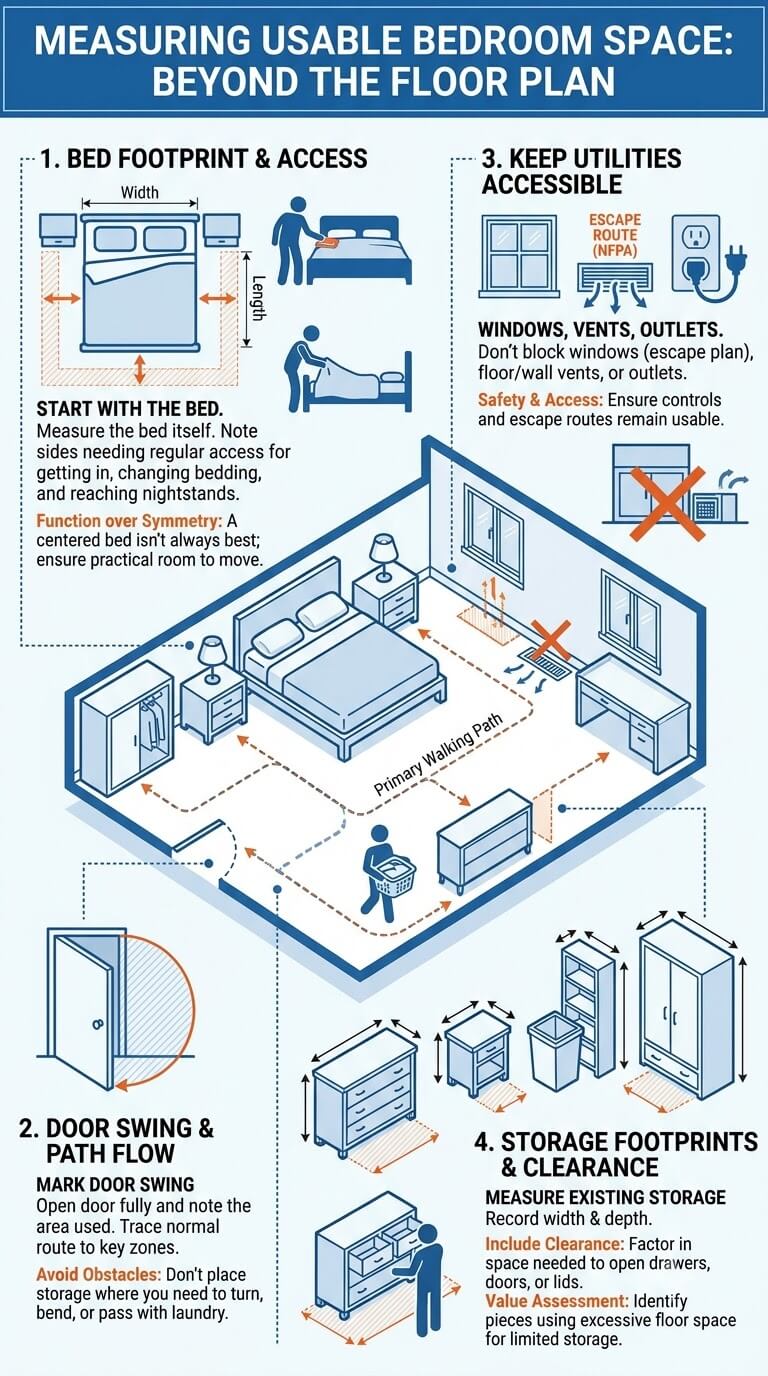
Start with the bed footprint and bedside access
Measure the bed and note which side or sides need regular access. A bed can physically fit in a location while leaving no practical room to get in, change bedding, or reach a nightstand. Do not assume a visually centered bed is automatically the most functional arrangement.
Mark the door swing and primary walking path
Open the bedroom door fully and note the area it uses. Then trace the normal route from the door to the bed, closet, dresser, and window. Avoid placing storage in the exact spots where your body needs to turn, bend, or pass while carrying laundry.
Keep windows, vents, and outlets usable
Do not treat every empty wall section as storage space. Windows may be part of a home escape plan, and NFPA escape-planning guidance recommends identifying two ways out of each room where possible. Also check floor or wall vents, outlets, and any controls that furniture could cover or make difficult to reach.
Measure existing storage footprints
Record the width and depth of the dresser, nightstand, hamper, shelving, and any freestanding rack or wardrobe. Include the extra space needed to open drawers, doors, or lids. This shows which pieces are using more floor area than the storage they provide is worth.
Define the minimum functions the room must support
Protect sleeping and bed access
The bed is usually the largest fixed element, so organize around using it comfortably. Avoid storing loose items at the foot or sides if they repeatedly become trip points. If you must move a basket every night to get into bed, that basket does not have a successful home.
Keep dressing at a room level
The bedroom may need a dresser, active hanging area, hamper, or place for a small number of daily accessories. It does not need to hold every seasonal garment, spare bag, or shoe if those categories can live elsewhere. Keep the room focused on active-use clothing and let the broader clothing system handle the rest.
Add reading, charging, or personal care only when those activities are real
A nightstand, reading light, charger, or small getting-ready tray can be useful when it supports an actual routine. Do not add furniture simply to create a conventional bedroom setup. A small shelf or narrow bedside surface may work better than a full table if you only need a few items.
Be selective with multipurpose use
If the room also serves as a work or hobby area, define exactly what must stay. A compact desk may be justified when there is no other workspace, but boxes of office supplies or hobby materials should not expand indefinitely because the desk happens to be in the bedroom.
Build a small-bedroom capacity map

Separate must-stay items from movable items
List the categories that genuinely require bedroom access. Then make a second list of items that could live in a hallway closet, storage cabinet, office, kids’ area, or another household zone. This keeps you from solving unrelated storage problems with bedroom space.
Separate visible storage from concealed storage
Open shelves and hooks are convenient but expose every item to view. Closed drawers, bins, and cabinets reduce visual clutter, but they require usable opening space and can hide excess. In a small room, use visible storage for a limited set of frequent items and concealed storage for categories that benefit from containment.
Separate daily access from occasional access
Daily clothing, glasses, charging devices, and a hamper deserve easy access. Occasional accessories or seasonal overflow can use less convenient zones if the location is suitable. Do not make yourself crawl behind furniture for something you need every morning.
Place the largest fixed elements around access
Choose bed placement for function, not decoration
Test the bed in the location that gives the best combination of entry path, bedside access, and use of remaining wall space. A wall placement that looks less symmetrical may free enough floor area for a dresser or hamper without creating a narrow passage.
Keep door and window access practical
Open the door, closet door, and nearby drawers while evaluating the layout. Do the same with a window you may need to open. If furniture must be moved to operate one of these features, the placement is too aggressive for the available space.
Watch for narrow routes and sharp corners
Small bedrooms often fail at turning points. The gap beside a dresser may seem adequate until you carry a laundry basket through it. A good test is to walk the route several times while holding the object you normally carry. If you twist sideways or bump furniture, revise the layout.
Do not solve storage by blocking vents or moving components
Leave floor and wall vents clear enough to function as intended. If you have an adjustable bed, storage frame, or furniture with moving parts, follow the manufacturer’s clearance and operating instructions. Do not wedge bins where mechanisms, cords, or supports need room to move.
Choose floor storage versus vertical storage
Use low storage when reach and stability matter
Low dressers, under-bed containers, and short shelving can keep items easy to reach and may feel less visually heavy. They can be a good choice when tall units would make the room difficult to use or would require installation you cannot complete safely.
Use taller storage when it truly saves floor area
A taller unit can provide more capacity in a smaller footprint, but only if it fits the wall, can be used comfortably, and can be installed according to its instructions. Store heavier items lower and avoid placing frequently handled heavy objects at awkward heights.
Respect furniture anchoring and load limits
The CPSC Anchor It! program recommends securing furniture such as dressers and bookcases to help prevent tip-overs. Follow the specific furniture manufacturer’s anchoring, installation, and load instructions rather than assuming a tall unit is stable because it feels heavy.
Consider renter limitations without skipping required safety steps
Renters may prefer freestanding or removable storage, but a product that requires anchoring should still be installed as directed. If you cannot make the required installation under your lease or building rules, choose another storage option instead of using the product unsecured.
Control the bedside footprint
Decide whether you need a full nightstand
A full table is useful when you need a lamp, glasses, charger, tissues, and a small drawer. If you only need a phone and glasses, a compact ledge or other appropriately installed small surface may be enough. The smallest workable bedside setup preserves floor area for movement.
Create one defined bedside landing area
Do not spread bedtime items across a nightstand, windowsill, floor basket, and bed edge. Give immediate-use items one small location. Move receipts, backup products, spare chargers, and unread book stacks elsewhere before the surface becomes a catch-all.
Keep cables and liquids from spreading into the walkway
Route charging cables so they do not loop across the floor or hang where they are easily snagged. Keep liquids stable and away from electrical equipment where practical. A shorter, simpler bedside setup is easier to manage in a tight room than several extensions and devices competing for the same small area.
Control the dresser footprint and top surface
Ask whether the dresser earns its floor space
Open every drawer and look at what it actually holds. If the dresser is mostly empty, contains unrelated household storage, or duplicates a closet system, reconsider whether a smaller unit or different arrangement would serve the room better.
Return clothing to the existing clothing system
Do not use the dresser top as an extra shelf for clean clothes. Put clean clothing away, dirty clothing in the hamper, and any selected rewear items in one controlled temporary zone if your household uses one.
Keep the top from becoming secondary storage
A small tray for jewelry, a watch, or daily personal items can work. Stacks of folded clothes, paper, unopened products, and random household objects are signs the surface is carrying categories that need different homes.
Use under-bed space as a capacity tool, not a dumping zone
Check clearance before choosing containers
Measure the lowest point beneath the frame and include supports, wheels, handles, lids, and mechanisms. A bin that barely fits may scrape the frame or become too difficult to retrieve once it is loaded.
Reserve the space for suitable lower-frequency items
Under-bed storage works best for contained categories you do not need every day. Avoid food, leaking liquids, damp textiles, important documents, or very heavy bins. Keep the detailed item and container system simple enough that you can remember what is stored there.
Keep access straightforward
Place labels on the side you can see and orient handles toward the side you use. If a container can only be reached by moving the nightstand or lifting the mattress, it is not a practical storage location for normal household use.
Add wall-adjacent storage only when it solves a defined need
Use shelves for specific categories
A shelf can hold books, a small display, or contained personal items without using dresser-top space. Avoid filling every wall simply because vertical space exists. Open storage looks crowded quickly when it holds too many unrelated categories.
Use hooks for high-frequency light items
Hooks can be useful for a robe, small bag, or a defined rewear item. Follow the hook or mounting system’s installation and load instructions. Do not rely on a removable product for a load it is not rated to hold.
Balance closed and open storage
If the room already has an open rack, exposed shelves, and visible hooks, adding more open storage may increase visual clutter even if the floor becomes clearer. Use closed storage for categories that do not need constant visibility and keep open zones intentionally limited.
Place the hamper and clothing transition points
Put the hamper where dirty clothes are removed
The best hamper location is usually the one that makes the correct action easy without blocking the path. A narrow hamper beside the dresser or near the closet may work better than a large basket in a corner you rarely reach.
Make clean clothing easy to return
If clean clothing stays in a basket for days, look at the route back to storage. Drawers may be overfilled, a closet may be difficult to access, or categories may not have enough space. The solution is to fix that handoff rather than accept the basket as permanent furniture.
Define a rewear zone if you need one
Some households prefer to separate clothing that is not ready for laundry but is not returning immediately to regular storage. Keep this zone small, such as one hook or a limited section, and empty it regularly. Avoid allowing a chair to become an uncontrolled mixed pile.
Limit duplicates, decor, and miscellaneous storage
Keep one primary drop point
Choose one small place for pocket contents, jewelry, or other everyday carry items. Multiple trays and baskets across the room create several half-managed surfaces instead of one reliable landing area.
Let display items use only leftover capacity
Decor can stay when it does not displace functional storage or make surfaces difficult to use. If a dresser top is crowded with display items and daily objects have nowhere to land, reduce the display rather than adding another organizer.
Move seasonal overflow out of active space when possible
Seasonal clothing, extra bags, spare bedding, and rarely used items should not compete with daily essentials if another suitable storage location exists. Keep the small bedroom for active use and let long-term categories live elsewhere.
Decision tree for an overfilled small bedroom

Too many items or poorly placed storage?
If shelves and drawers contain objects you rarely use, reduce or relocate inventory first. If the retained items are necessary but the room still feels blocked, study placement and storage footprint next.
Closet exists but the room is still over capacity
Check whether the closet or dresser is holding inactive categories while active clothing spills into the room. Keep the detailed clothing reorganization separate, but use the bedroom review to identify where the handoff is failing.
No closet and clothing dominates the room
When there is no built-in closet, the solution may require a freestanding wardrobe, rack, dresser, hooks, or another room-level clothing setup. Do not keep adding random storage pieces one at a time. Plan the clothing footprint as a whole.
Shared room needs ownership zones
If two people share the room, label or clearly define bedside areas, shelf sections, drawers, or under-bed zones. A capacity problem can look like a clutter problem when no one knows which storage belongs to whom.
Repeated overflow means the current setup is undersized
If the room resets well but the same category spills out every few days, the assigned space may be too small or the inventory may be too large. Adjust that category rather than repeatedly tidying the symptom.
Renter-friendly storage decisions
Prefer nonpermanent options when they meet the need
Freestanding low furniture, appropriately rated tension systems, and removable hooks can be useful when they fit the room and are used according to manufacturer instructions. Choose the least complex solution that handles the category safely.
Check permission requirements before drilling or modifying walls
Lease terms and building rules vary. Ask before making permanent changes when required. Keep the storage decision practical: if a wall-mounted product is the only version that fits but you cannot install it as directed, choose another type rather than improvising a weaker attachment.
Do not skip required anchoring to avoid holes
Safety instructions take priority over convenience. A tall dresser or other furniture that requires anchoring should not be treated as safe simply because the room is small or rented. Select furniture you can install properly.
Common small-bedroom organization mistakes

Adding furniture before reducing inventory
More drawers can hide clutter while shrinking the room. Identify the retained categories first, then add storage only for a specific unmet need.
Creating narrow paths between furniture
A layout may look efficient from above but feel awkward in use. Walk the path carrying laundry, open drawers fully, and sit or bend where you normally would. Adjust anything that forces repeated sideways movement or collisions.
Using every wall for open storage
Open shelves and hooks can preserve floor area, but too many visible items make a small room feel harder to read and reset. Leave some visual breathing room and keep concealed categories contained.
Turning under-bed space into forgotten overflow
Loose bags and mixed boxes may disappear from view, but they still consume capacity. Use labeled categories and review them periodically so concealed storage remains intentional.
Treating organization as interior styling
A coordinated set of baskets will not fix blocked access or excess inventory. Prioritize movement, retrieval, capacity, and safe use first. Appearance can follow once the room functions well.
Edge cases that need a different compromise
Very low bed clearance
If containers do not fit comfortably under the bed, do not force them or modify the frame contrary to its instructions. Use another zone or reduce the amount stored in the room.
No room for two nightstands
A couple may use one shared bedside surface, one compact surface on each side, or a different nearby storage solution. Separate personal essentials within the shared area so it does not become a pile of mixed items.
A bedroom that also needs a work surface
Keep the work zone as compact as possible and prevent office supplies from spreading into bedside or clothing storage. At the end of work, clear the chair and floor so the room can return to its primary use.
A small bedroom shared by two people
Protect common walking paths first, then divide personal storage deliberately. Do not assume each person needs identical furniture. One person may use more drawers while the other uses more hanging space, as long as the total room capacity remains workable.
FAQ for small-bedroom organization
Should I declutter before organizing a small bedroom?
Declutter first when the room contains unused items, duplicates, unrelated household storage, or belongings you already know should leave. If you have already decided what must stay and the issue is simply fitting it into limited space, move on to measuring and placement.
Is vertical storage always better in a small bedroom?
No. Vertical storage can save floor area, but it may require anchoring, increase visual clutter, or place items out of comfortable reach. Use it only when it solves a defined storage problem and can be installed and loaded safely.
What if I cannot fit both a dresser and a nightstand?
Prioritize the furniture that handles the larger daily need. You may be able to use a compact bedside ledge, small shelf, or other properly installed surface for bedside essentials while keeping a dresser for clothing. Do not force two full-size pieces into a route that becomes difficult to walk through.
What should move out of a small bedroom first?
Start with items that do not support bedroom activities: paperwork, dishes, household supplies, hobby overflow, seasonal items, and duplicates. Then review furniture or storage pieces that contain little useful inventory but occupy significant floor area.
How do I know the room has more inventory than it can support?
Repeated floor piles, overfilled drawers, inaccessible bins, blocked paths, and surfaces that refill immediately after a reset are strong signs. If every category already has a reasonable location but those locations cannot contain the retained items, reduce or relocate inventory before adding more furniture.
Final thoughts: keep the room easy to move through and easy to reset
A small bedroom does not need a clever storage trick in every corner. It needs a clear priority order: define the essential functions, measure usable space, protect access, keep active items close to where they are used, move overflow elsewhere, and add storage only when a specific retained category still lacks a home. Test the room in real use, not just when everything is neatly closed. If you can walk to the bed comfortably, reach daily items without shifting piles, return clothing easily, and reset the room without moving furniture, the layout is doing its job.

Ethan Carter is the Founder & Editor of HomeCleanSecrets. Based in the United States, he has 5 years of experience creating practical home cleaning, laundry care, stain removal, decluttering, and home organization content. His goal is to help everyday households clean smarter and build simple routines that are easier to maintain.
Read more about Ethan Carter on his author page: https://homecleansecrets.com/ethan-carter/
2 thoughts on “How to Organize a Small Bedroom | Home Clean Secrets”