

A useful nightstand should hold the few things you genuinely need from bed or immediately before sleeping and after waking. It should not become permanent storage for receipts, spare chargers, old books, medications that belong elsewhere, loose jewelry, personal-care backups, or objects that simply landed there because the surface was convenient.
The easiest way to organize a nightstand is to define its bedside job, separate surface essentials from contained drawer items, remove categories that belong elsewhere, and give the remaining small objects clear places. The result should be easy to use in the dark, quick to reset, and simple enough that you do not have to move several things to reach one item.
Quick answer: give the nightstand one bedside job

Keep only items that need immediate bed-adjacent access
Start with the items you use while in bed or within a few minutes of getting in or out of it. Depending on your routine, that may include a lamp, phone, alarm device, glasses, tissues, one current book, a stable water bottle, or a small personal item.
Split visible essentials from contained backup items
The surface should handle the items you reach for most often. A drawer or small contained area can hold a limited number of additional bedside items. If the drawer is filled with things you have not touched for months, it is no longer supporting the bedside routine.
Route papers, clothing, and unrelated personal-care items elsewhere
Mail and receipts belong with household paperwork. Clothing belongs in its existing clothing system or hamper. Personal-care products that are normally used in a bathroom or vanity area should return there rather than expanding into nightstand storage.
When this approach is the right fit
The bedroom is generally organized but bedside clutter keeps returning
Use this process when the problem is concentrated around the bed. If the rest of the bedroom has workable storage but the nightstand surface or drawer repeatedly fills, the bedside zone needs clearer limits.
The main problem is reach, cables, small objects, or drawer overflow
A nightstand often collects items because they are small and easy to set down. Cable ends, jewelry, lip balm, remotes, glasses, and receipts can quickly mix together. The solution is to decide which items deserve bedside access and contain the rest by function.
Know when broader decluttering should come first
If the nightstand is only one of many overflowing surfaces, clear the larger bedroom inventory problem first. A perfectly arranged bedside drawer will not stay organized when the room still has unresolved papers, clothing piles, boxes, and miscellaneous storage.
Define the nightstand’s purpose
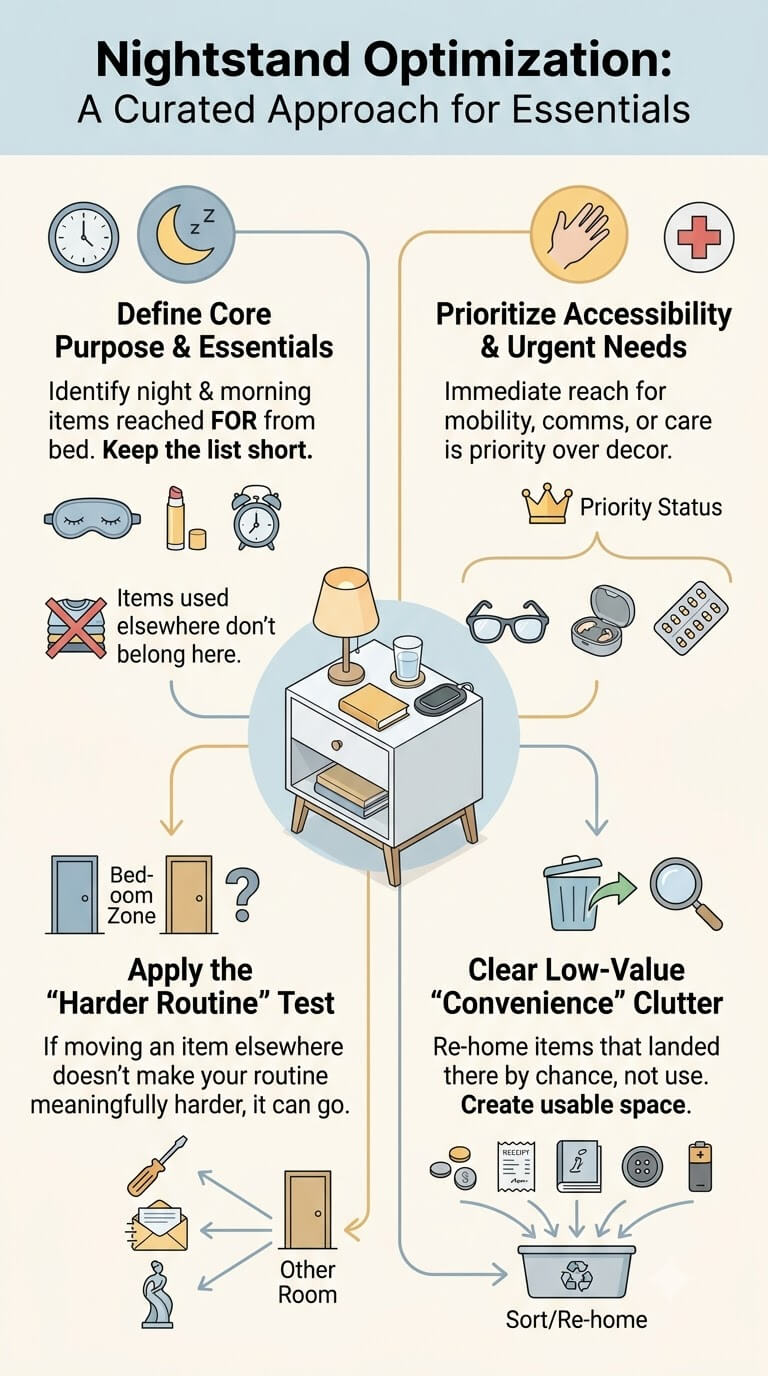
Identify night and morning essentials
Think through a normal evening and morning. What do you actually reach for without leaving the bed? Keep that list short. Items used elsewhere in the room should not stay bedside merely because the nightstand has an empty corner.
Account for accessibility or emergency needs
Some people need specific items within immediate reach for mobility, communication, caregiving, or another practical reason. Give those items priority over decorative objects and rarely used storage. Keep frequently needed items where they can be reached without stretching behind furniture or digging through a crowded drawer.
Remove anything that does not need to live beside the bed
A good test is whether moving an item to another room or another bedroom zone would make your bedtime or morning routine meaningfully harder. If not, it probably does not need scarce bedside space.
Pay special attention to objects that arrived because of convenience rather than use. Spare buttons, coins, unopened skincare, old greeting cards, instruction manuals, batteries, extra pens, and random hardware are common examples. Give each one a destination based on what it is, not where you found it. Clearing these low-value occupants often creates more usable space than buying a new organizer.
Decide what stays on the surface

Place the lamp or lighting control where it is easy to reach
If the nightstand holds a lamp, place it so the switch is accessible and the base does not force every other item to the edge. Follow the lamp manufacturer’s bulb, placement, and electrical instructions rather than treating the lamp as just another decorative object.
Keep the phone, alarm device, or one charger if needed
Only keep the charging equipment actually used at that bedside. Duplicate cables and adapters make the surface harder to clean up and easier to tangle. If several devices charge there, decide whether all of them truly need to remain beside the bed.
Limit books to current reading
Keep the book or small reading stack you are actively using. Finished books, reference books, and books you plan to read someday should return to their main storage. A tall bedside stack makes it harder to reach other items and often becomes a base for more clutter.
Keep glasses, tissues, or water stable and easy to retrieve
Small essentials should have predictable positions. A tray can help keep glasses or a small item from sliding behind the furniture. If you keep water bedside, place it where it is stable and not crowded against charging equipment.
Decide what belongs in the drawer
Keep small personal items that are genuinely used at night
A drawer can hold a few items such as a sleep mask, small notebook, remote, or other bedside-use object. Do not use the drawer as a hidden extension of the surface for anything you do not know where else to put.
Store remote controls only if they are used from bed
If a remote controls a fan, television, adjustable bed, or another bedroom device used while in bed, the nightstand is a reasonable location. Unused remotes should be matched to their devices or removed rather than occupying permanent drawer space.
Give temporarily removed jewelry one small place
If you remove a ring, watch, or earrings at night, one small tray or divided section can keep them from disappearing into the drawer. Larger jewelry collections belong in their established storage rather than migrating into the bedside zone.
Keep backups limited
A drawer may hold a spare tissue pack or another small backup if it is genuinely useful. Do not fill the drawer with several months of personal-care products, batteries, cables, or household supplies simply because they fit.
Use capacity as the boundary. The drawer should open fully, items should be visible without removing a top layer, and you should be able to return something with one hand. When backups begin hiding the objects you use every night, move the extras to the storage area that manages that category.
Create a small-object containment system
Use one tray for loose daily items
A tray works well for a few things that would otherwise roll, slide, or scatter. Keep the tray small enough that it cannot become a general catch-all for coins, receipts, keys, beauty products, and random objects.
Use drawer dividers only for categories that recur
Dividers can help separate glasses accessories, a remote, small personal items, or other recurring bedside categories. Avoid creating tiny compartments before you know what actually belongs in the drawer.
Do not reduce usable space with too many organizers
Nested boxes and multiple small containers can consume more room than the items themselves. If the drawer needs several layers of organizers to close, reduce the contents before adding another divider.
Before buying a divider, empty the drawer, group the items that are staying, and return them loosely once. If the categories are already obvious and nothing rolls around or disappears, you may not need an organizer at all. Add containment only where it solves a real retrieval problem.
Control bedside books and papers
Keep only active reading within reach
One current book or a deliberately small reading stack is easier to manage than a backlog. When you finish a book, return it to its shelf before adding another to the bedside area.
Move mail, receipts, bills, and documents out of the bedroom
Paper found on a nightstand should usually move to the household paper-management area. Do not create a bedside filing system because mail happens to land there after you empty your pockets or bag.
Return notebooks and work papers to their work zone
If you jot down an idea at night, a small notebook may make sense. Full work folders, meeting notes, school papers, and office supplies should return to the desk or other work area after use.
If work regularly follows you to bed, give those papers a return step rather than a drawer. Put them back in a work bag, desktop inbox, or other established work location in the morning. The nightstand should not become the place where unfinished tasks accumulate simply because they are out of sight.
Organize chargers and cables safely

Keep only cables used at this bedside
Trace each cable to the device it serves. Remove old, duplicate, or mystery cables. This reduces tangles and makes it easier to notice when a cord is damaged or an adapter no longer belongs to an active device.
Follow charger and device instructions
Use the charger, cable, and power accessory as directed by the manufacturer. Do not improvise a charging setup that pinches cords behind furniture, traps adapters under bedding, or requires damaged equipment to remain in use.
Avoid damaged cords and overloaded power connections
The CPSC electrical safety guidance advises replacing worn or damaged cords and avoiding overloaded outlets or power strips. Treat visible fraying, cracked insulation, heat, or other damage as a reason to stop using the affected item rather than hiding the cable behind the nightstand.
Route cables to reduce obvious trip and snag problems
Keep cords off the main walking path and away from places where feet, drawers, or furniture repeatedly catch them. Do not run a cord under a rug to hide it. UL Solutions guidance on power strips and surge protectors warns that covering cords can trap heat and that damaged cords should be replaced.
Check cable length as well as location. An unnecessarily long cord can collect behind the nightstand, while a cord stretched tightly between the outlet and device may be easy to snag. Use equipment that is appropriate for the device and room layout, and keep plugs and adapters accessible enough to inspect instead of burying them behind boxes or textiles.
Keep liquids and electronics from competing for the same spot
Give water a stable location
If you keep a glass or bottle bedside, choose a flat, stable area where it is unlikely to be knocked over when you reach for the phone, lamp, or glasses. Avoid balancing drinks on books or near the edge of a crowded table.
Separate liquids from electrical equipment where practical
Do not place a drink directly against a power strip, charger connection, or several bundled cables. A few inches of deliberate separation and a less crowded surface can reduce the chance that one spill affects several devices.
Reduce the number of competing bedside items
If the surface is too small to hold a lamp, devices, books, water, and personal items safely, remove lower-priority objects. The answer is not always a larger nightstand, especially in a small bedroom.
Try a one-week test with only the essentials you believe you need. Notice what you actually reach for and what remains untouched. Items that never move during the test are strong candidates to relocate, while anything you repeatedly fetch from another room may deserve a defined bedside spot.
Handle medication at a safety-aware boundary
Keep medicine bedside only when it genuinely needs to be there
Medication storage depends on the product directions, the household, and who can access the room. Do not make the nightstand a default medicine cabinet simply because the drawer is convenient.
Consider child and pet access
If children can enter the bedroom, an ordinary nightstand drawer may be easy to open. Poison Control medicine-storage guidance recommends keeping medicines up, away, and out of sight and reach of young children, including items carried in purses or pill organizers.
Follow the medicine’s own storage directions
Keep medicines in the conditions specified on their packaging or by the appropriate healthcare guidance. If a product needs a different storage environment, move it there rather than forcing it into the bedside system.
Nightstand setups for different spaces
Nightstand with one drawer
Keep the surface for immediate-use items and reserve the drawer for a few contained bedside categories. If the drawer becomes full, remove unrelated objects before adding organizers.
When resetting the drawer, pull everything out once and return only the items that have a clear bedside purpose. Place the most frequently used object where your hand naturally reaches first, and keep less frequent items behind or beside it rather than stacked on top. If you must remove several objects to reach one item, the drawer is either too full or the categories need a simpler arrangement.
Nightstand with no drawer
Use one small tray or compact container for loose items and keep the visible inventory especially limited. Do not compensate for missing drawers by adding several baskets on the floor around the table.
If you need concealed storage, look first at another existing bedroom zone rather than creating a stack beneath the table. A nearby dresser drawer may hold backup tissues or personal items more effectively, leaving the nightstand surface for immediate use. This is especially useful in narrow rooms where floor baskets would interfere with the path beside the bed.
Very small bedside ledge
Prioritize only what cannot reasonably live elsewhere. A phone, glasses, and one small item may be enough. Move books, tissues, or other supplies to nearby storage if the ledge cannot hold them without crowding.
One shared nightstand for two people
Divide the surface or drawer so each person has a predictable area. Keep shared items limited to things both people actually use. Mixed personal items are harder to reset when ownership is unclear.
Do not assume the split must be identical. One person may need glasses and medication stored according to applicable directions, while the other needs a book and charger. The useful rule is that each person can reach personal essentials without sorting through the other person’s belongings.
Two separate nightstands in a shared bedroom
Let each side reflect the person using it rather than duplicating every object. One person may need reading space while the other needs glasses and a charger. The goal is functional access, not identical setups.
What to do when the nightstand no longer fits the essentials
Remove duplicates and inactive items first
Check for extra chargers, old cables, finished books, empty packaging, unused personal-care items, and objects that have not been touched recently. Clearing these often restores enough capacity without changing the furniture.
Move getting-ready items to the dresser or vanity area
Jewelry used while dressing, fragrance, hair accessories, and other standing-use items may work better away from the bed. Keep only the items you actually remove or need while in bed.
Reassess whether the room needs broader decluttering
If every bedside category is reasonable but the entire room is full, the nightstand may be showing a larger inventory problem. Do not keep shrinking the bedside system while clothing, paperwork, boxes, or other room storage continues to overflow.
Look at what is entering the nightstand from the rest of the room. If clothing lands there because the dresser is full, papers land there because there is no household paper route, or personal-care products collect there because another storage area is overflowing, fix that upstream problem instead of forcing the nightstand to absorb it.
Consider a smaller bedside footprint when space is the problem
A large table is not automatically better. If most of the nightstand is empty except for a few essentials, a smaller properly installed or stable surface may free useful floor area without reducing function.
Nightly and weekly nightstand reset

Return daily essentials to their exact spots
Put glasses, phone, remote, or current book back in the same location each night. Predictable placement matters more than complicated organization because these items are often used when the room is dark.
Remove cups, dishes, receipts, and unrelated objects
A nightly sweep prevents temporary items from becoming permanent categories. Move dishes to the kitchen, papers to the household paper area, clothing to its proper route, and personal-care items to their normal storage.
Check cables and drawer overflow weekly
Look for new cables, adapters, old receipts, empty packaging, or items that have started accumulating in the drawer. Remove them before the drawer becomes difficult to open or the surface loses its bedside function.
Also check whether the arrangement is still easy to use. A cable clip may have moved, a bottle may now crowd the lamp, or a new book may have started a stack. Correct small changes while they take seconds. Waiting until the surface is completely full turns a simple reset into another organizing session.
Common nightstand organization mistakes
Using the drawer as a permanent miscellaneous bin
A closed drawer can hide disorder for months. Give each retained item a reason to be bedside and remove objects that are only there because they are small.
Keeping multiple inactive books or chargers
Bedside storage works better when it reflects current use. Finished books and cables for devices no longer charged there should move out promptly.
Mixing liquids with crowded electronics
A drink beside one phone is different from a drink surrounded by chargers, adapters, and a power strip. Reduce the electronics footprint and create a stable location for any liquid you keep bedside.
Ignoring child or pet access
Small drawers and trays can make medicine, batteries, sharp accessories, or other sensitive items easy to reach. Choose storage based on who can access the bedroom, not only on adult convenience.
Styling the surface instead of defining its function
Decorative objects can stay if there is room after essential use is established. Do not let candles, stacked books, trays, frames, and decorative containers displace the items you genuinely need at night.
FAQ for nightstand organization
What should I keep on a nightstand?
Keep a short list of items you genuinely use from bed or directly before sleeping and after waking. Common examples include a lamp, phone, glasses, tissues, one current book, or a stable water bottle. Your routine should determine the final list.
What should go in a nightstand drawer?
Use the drawer for a limited number of contained bedside items such as a remote, sleep mask, small notebook, or temporarily removed jewelry. Avoid turning it into hidden storage for miscellaneous household objects.
How many books should stay beside the bed?
There is no universal number. Keep only the book or small stack you are actively reading and that fits without crowding other essentials. Return finished and inactive books to their main storage.
Where should receipts and mail go?
Move them to the household paper-management area where bills, receipts, records, and incoming mail are normally handled. A nightstand can collect paper temporarily, but it should not become a filing location, long-term inbox, or second place where important documents can be forgotten.
What if my nightstand has no drawer?
Keep the visible inventory smaller and use one compact tray or container for loose objects. If you need substantially more storage, move lower-priority categories to another bedroom zone rather than surrounding the nightstand with floor baskets.
How do I keep bedside charging from becoming cable clutter?
Keep only cables used at that bedside, remove duplicates and inactive cords, follow device and charger instructions, and route the remaining cables away from the walking path. Replace damaged equipment rather than hiding it behind furniture.
Final thoughts: keep bedside storage simple enough to reset every night
A well-organized nightstand is a small, focused system. Give the surface to immediate-use items, let the drawer hold only a few contained bedside categories, move papers and getting-ready products elsewhere, and keep cables simple enough to inspect and manage. When the nightstand overflows, remove duplicates and unrelated objects before buying another organizer. If the essentials still do not fit, reconsider the bedside footprint or the larger bedroom inventory. The best test is whether you can find what you need in the dark, use the surface without shifting piles, and restore everything in a minute or two.

Ethan Carter is the Founder & Editor of HomeCleanSecrets. Based in the United States, he has 5 years of experience creating practical home cleaning, laundry care, stain removal, decluttering, and home organization content. His goal is to help everyday households clean smarter and build simple routines that are easier to maintain.
Read more about Ethan Carter on his author page: https://homecleansecrets.com/ethan-carter/