
Books earn their place in a living room when they are easy to find, easy to return, and relevant to how the room is used. Trouble starts when the room becomes the default landing place for every household book. Current reading stacks up beside the sofa, borrowed books disappear into personal shelves, and children’s books drift into the same storage as adult titles. A workable system separates those jobs instead of forcing one shelf to do everything.

The goal is not to make a bookcase look staged. It is to give the shared collection a clear boundary, keep shelves within practical capacity, and create a return path that works after ordinary reading. That approach also makes it easier to see when the living room has reached its limit and some books need a different home.
Quick Answer: Define the Shared Collection, Set Shelf Capacity, and Create an Easy Return System
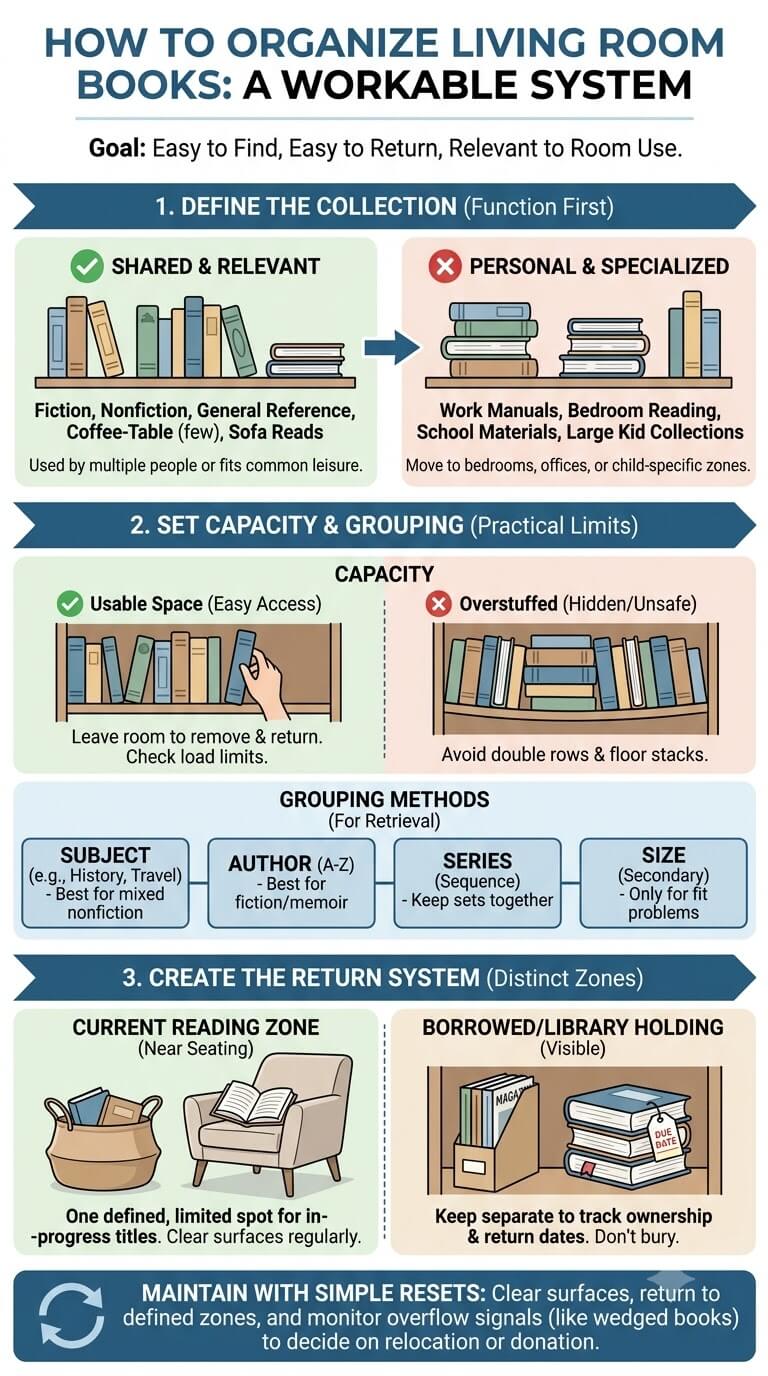
Begin with function before arrangement. Decide which books genuinely serve the living room, then organize only that group. Once the collection is defined, set a shelf limit, choose a retrieval method, and give current and borrowed books their own temporary holding spots.
Keep common-area books that support how the room is used
Shared shelves work best when they hold books that several household members use or that naturally belong near living-room activities. That might include fiction, nonfiction, reference books, a few coffee-table books, and titles routinely read on the sofa. There should be a clear reason each category lives here rather than in a bedroom, office, or child-specific reading zone. Keep the book system aligned with the broader living-room organization plan so shelves support shared use rather than whole-house overflow.
Separate current reading from the full collection
Do not make people reshelve an in-progress book after every reading session. Instead, create one defined current-reading spot near the main seating area. A shallow basket, one shelf, or one small section of a side table can work. The important part is capacity: when the active spot is full, finish, pause, or return a title before adding another. This prevents temporary reading from becoming a permanent pile. When floor space is tight, use small-living-room capacity rules before adding another bookcase.
Move bedroom, office, and child-specific collections to their proper systems
A living-room bookcase loses usefulness when it contains unrelated personal libraries. Work manuals, professional reference books, bedtime reading, school materials, and large groups of children’s books usually function better where those activities happen. A few can visit the living room, but their permanent home should remain elsewhere. This boundary keeps the shared collection browsable without requiring aggressive decluttering.
When This Guide Fits
This approach is for a shared room where books are part of daily life but the storage has become hard to use. It is especially useful when the problem is not lack of affection for books, but lack of clear categories and limits.
Shared shelves are hard to browse
If people scan several shelves without finding what they want, the grouping system may no longer match how the household searches. Mixed categories, hidden second rows, decorative stacks, and books shelved wherever space appears all make retrieval slower. A useful shelf should let someone narrow the search quickly, even if the collection is not arranged with library-level precision.
Books pile on floors or side tables
Floor and table piles often mean the return system is inconvenient or the shelves are full. Before adding another basket, decide whether those books are active reading, borrowed items, overflow, or titles that belong elsewhere. The category tells you what to fix.
When the collection needs a whole-home library system instead
If books occupy multiple rooms, several large bookcases, or substantial archive storage, the living room should not carry the entire catalog. Keep this room focused on common-area use and manage the broader collection as a separate household system. That prevents every shelving decision in the living room from turning into a whole-home inventory project.
Decide Which Books Genuinely Belong in the Living Room
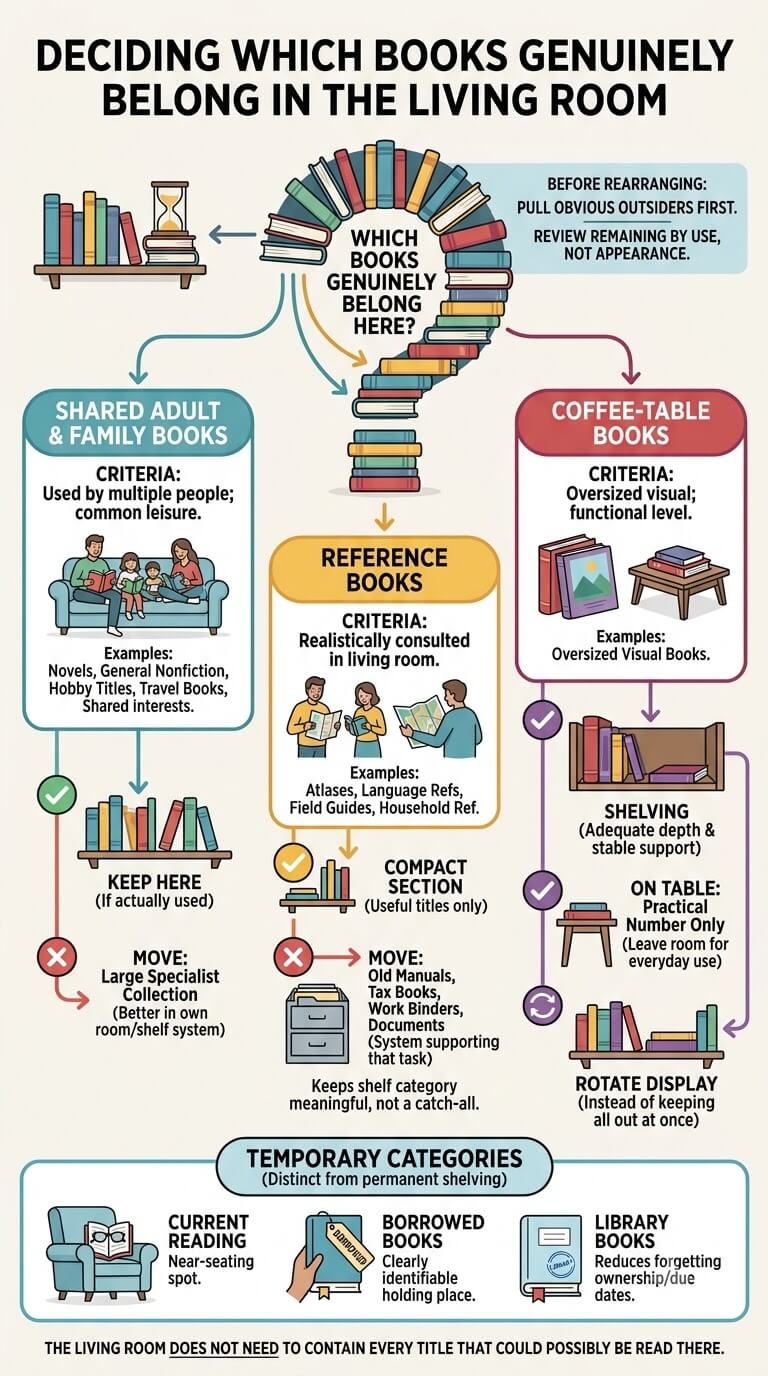
Make this decision before rearranging shelves. Pull obvious outsiders first, then review the remaining books by use rather than by appearance. The living room does not need to contain every title that could possibly be read there.
Shared adult and family books
These are books that more than one person may browse or that fit common leisure time: novels, general nonfiction, hobby titles, travel books, and other shared interests. Keep them here when they are actually used here. A large specialist collection usually works better in its own room or shelf system than in shared storage.
Reference books
Keep reference titles in the living room only if people realistically consult them there. Atlases, language references, field guides, or household reference books may deserve a compact section. Old manuals, tax books, work binders, and documents with a different purpose should move to the system that supports that task. This keeps the shelf category meaningful instead of becoming a catch-all for anything printed.
Coffee-table books at a functional level
Oversized visual books can be part of a shared collection, but they need enough shelf depth and stable support. Keep only a practical number on the coffee table itself. The table still needs room for everyday use, and a large stack is not a substitute for shelving. Rotate display books if you enjoy changing them rather than keeping every oversized volume out at once.
Current reading, borrowed books, and library books
These books belong in the room temporarily, but they should not disappear into permanent shelving. Current reading needs a near-seating spot. Library and borrowed books need a clearly identifiable holding place. Keeping these categories distinct reduces the chance of forgetting ownership or searching the whole bookcase when a return date approaches.
Set Bookcase and Shelf Capacity
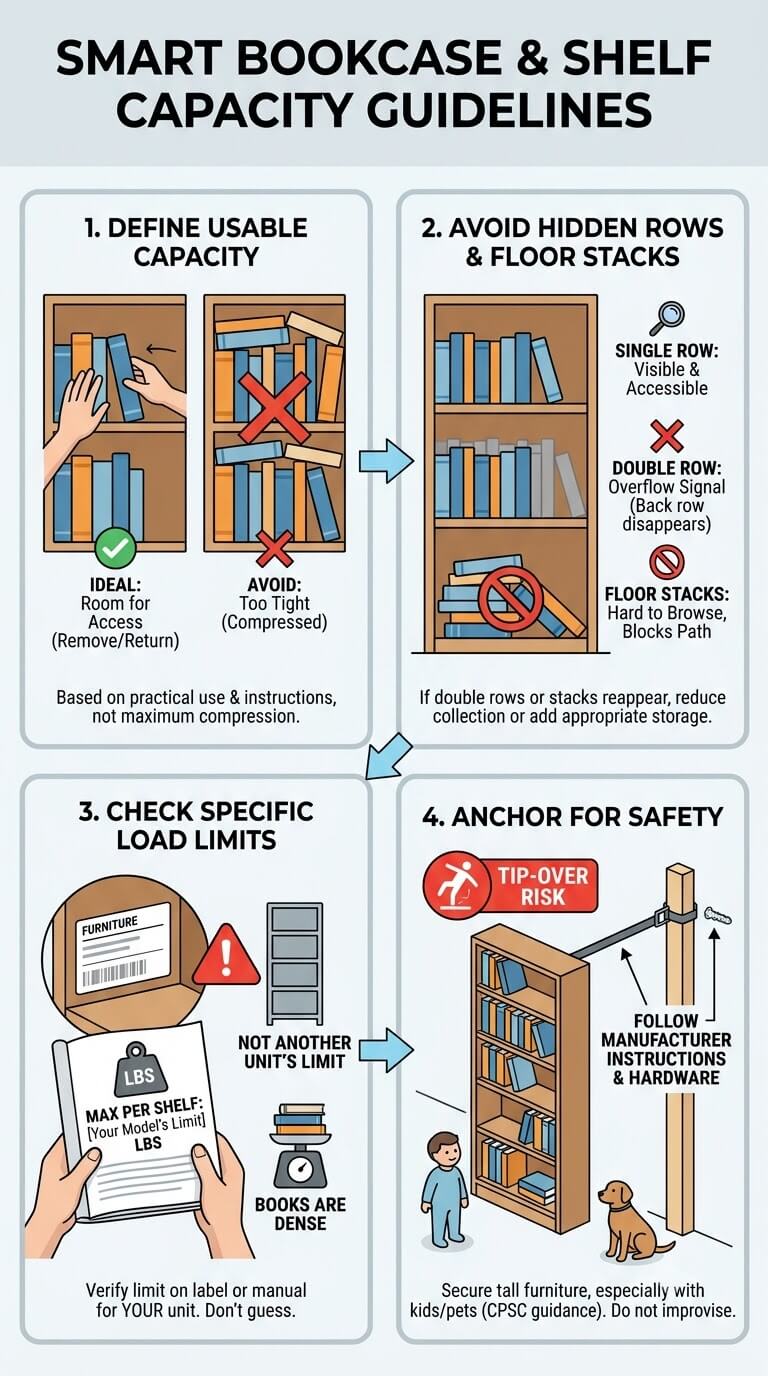
Capacity should be based on usable shelf space and the furniture’s instructions, not on how tightly books can be compressed. Leaving enough room to remove and return books is part of the system.
Avoid double rows that hide books
A second row may increase physical capacity, but it often reduces practical access because the back row disappears. If double rows are the only way the collection fits, treat that as an overflow signal. Move lower-use books to another location, reduce the living-room collection, or add appropriate storage only if the room has space without sacrificing circulation.
Avoid inaccessible floor stacks
Short-term sorting piles are fine while reorganizing, but floor stacks should not become permanent storage. They are harder to browse, easy to disturb, and can narrow walking space. If a stack repeatedly reappears next to a full bookcase, the problem is capacity or an unclear return destination, not a need for a neater stack.
Check shelf and bookcase load limits
Books are dense, and shelving capacities vary by product. Check the label, manual, or manufacturer specifications for the exact unit you own. The current IKEA BILLY product specifications, for example, list a per-shelf limit for that specific configuration. Use your own furniture’s stated limit rather than copying a number from another bookcase.
Anchor furniture according to manufacturer instructions when applicable
Tall or climbable storage needs special attention in homes with children, pets, or frequent traffic. Follow the anchoring hardware and wall-attachment directions supplied with the furniture, including the type of fastener appropriate for the wall. The U.S. Consumer Product Safety Commission’s Anchor It guidance specifically includes bookcases among furniture that can tip. Do not improvise an anchoring method that conflicts with the manufacturer’s instructions.
Choose a Grouping Method Based on Retrieval
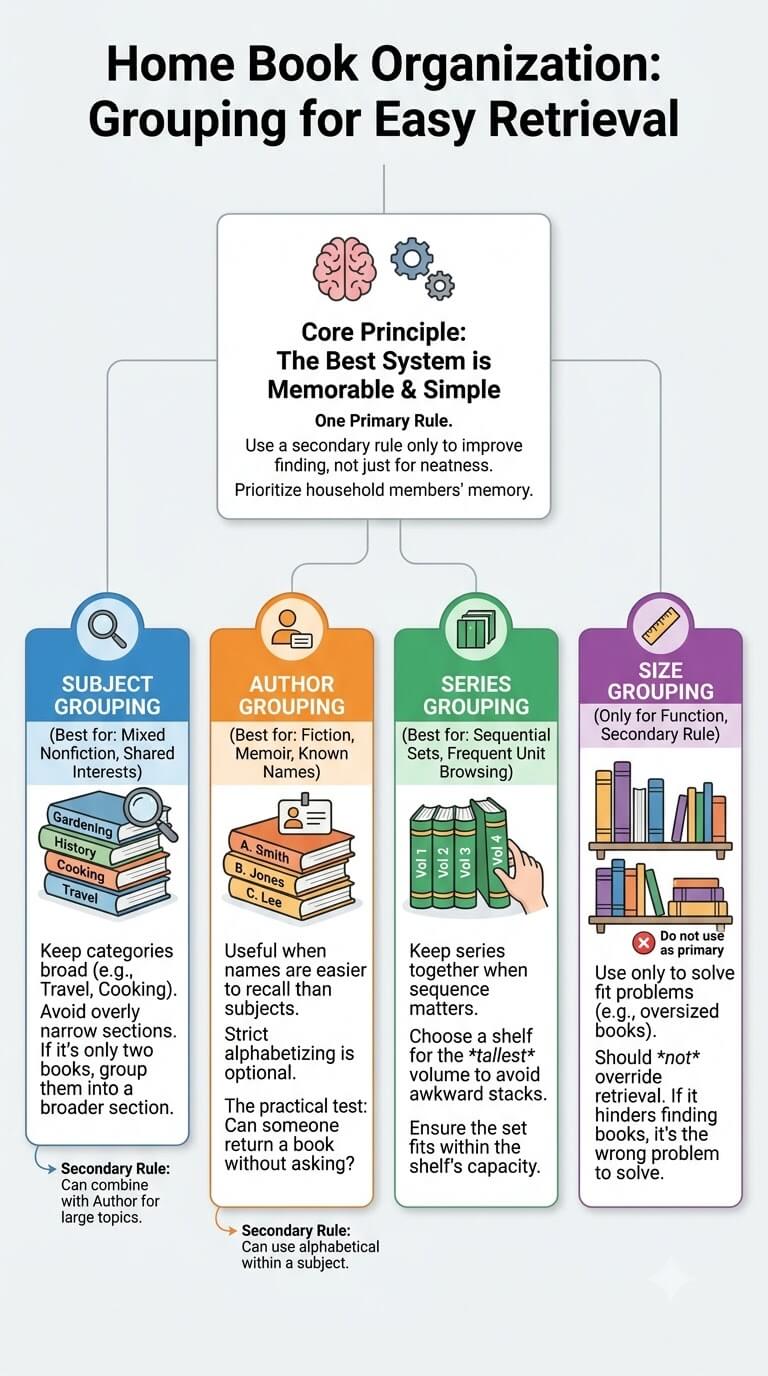
The best arrangement is the one household members can remember. You do not need a complicated classification system. Pick one primary rule, then use a second rule only where it genuinely improves retrieval.
Subject grouping
Subject works well for mixed nonfiction or shared-interest collections. Put gardening together, travel together, cooking together, history together, and so on. Keep categories broad enough that everyone understands them. If a subject contains only two books, it may not need its own labeled section.
Author grouping
Author grouping is useful for fiction, memoir, or collections where household members remember names better than subjects. Alphabetical order can help, but strict alphabetizing is optional for a modest shelf. The practical test is whether someone can return a book without asking where it goes.
Series grouping
Keep a series together when sequence matters or when people frequently browse the set as a unit. If the series includes different physical sizes, choose a shelf that can hold the tallest volume without forcing awkward horizontal stacks. A complete series should still stay within the shelf’s capacity.
Size grouping only when functionally useful
Height-based grouping can solve a real fit problem, especially for oversized books, but it should not override retrieval across the entire collection. Use size as a secondary rule when certain shelves have different clearances. If grouping by height makes people unable to find books, it is solving the wrong problem.
Use Spine-Out Storage as the Default Functional System
Most books are easiest to identify and return when the spine remains visible. This simple default also makes missing space and shelf crowding easier to notice.
Browse and return quickly
Keep books upright where their construction allows it, with titles visible and enough room to pull one out without dragging several others. Very large or structurally delicate books may need different support. For valuable or fragile books, the Library of Congress provides basic guidance on handling and storing personal book collections. Everyday living-room organization should remain simple, but special books may deserve more careful treatment.
Keep labels or category markers minimal
Labels are helpful when several people use the same shelves and categories are not obvious. Small shelf-edge labels such as Fiction, Travel, Reference, or Library Returns may be enough. Avoid labeling every tiny subdivision. If the system takes longer to maintain than it saves in searching, simplify it.
Avoid color sorting when it makes retrieval harder
Color can be visually pleasing, but it is only functional when household members remember books by cover. If you tend to search by author, title, series, or subject, color sorting adds an extra search step. Use appearance as a preference after retrieval needs are met, not as the primary organizing rule by default.
Create a Current-Reading Zone
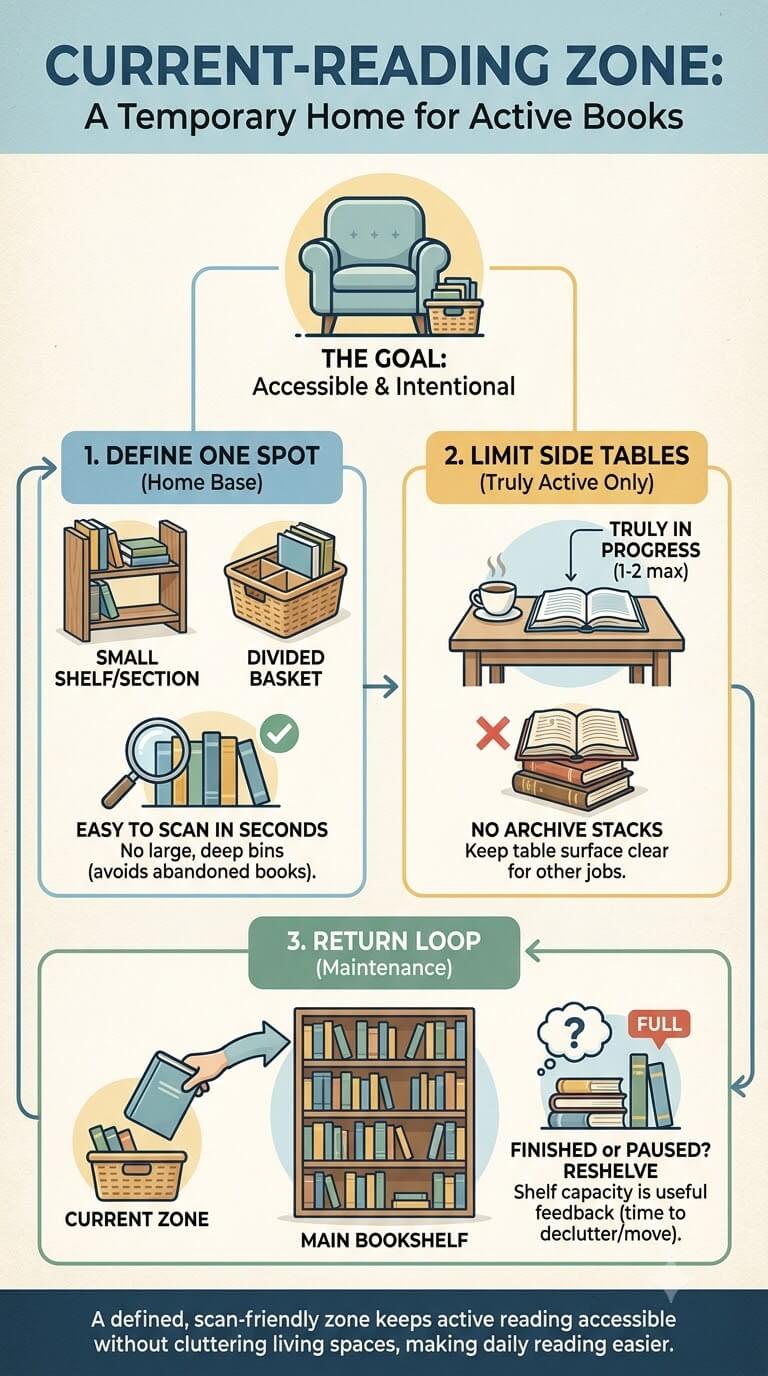
Current reading is the category most likely to spill onto sofas and tables because those books are intentionally in use. Give them a temporary home that is closer than the main bookcase when that makes daily reading easier.
One shelf, basket, or defined spot
Choose one location that fits the number of books people typically read at the same time. Several readers may share a divided basket or small shelf sections. Avoid large open bins that quietly collect abandoned books. The zone should be easy to scan in seconds.
Limit coffee and side tables to active reading
A book can stay on a side table while it is truly in progress. The boundary is that the surface should not become the archive. If three older books are sitting under the current one, return the paused titles to their shelf or move them to the defined current-reading zone. Keep enough clear table area for the table’s other jobs.
Return completed or paused books to the main shelves
When you finish a book or stop reading it for now, reshelve it instead of leaving it in the active zone indefinitely. If it no longer fits, that is useful information. The shelf has reached capacity, the book belongs elsewhere, or another title needs to move before this one can return.
Create a Borrowed-Book and Library-Book Holding Spot
Borrowed items need visibility more than deep storage. The aim is to keep them separate enough that ownership remains obvious without turning the living room into a scheduling center.
Keep borrowed items identifiable
A designated shelf end, magazine file, or shallow basket can work if it fits the book sizes involved. Keep the category small. A simple “borrowed” marker is enough when several household members use the same area. This prevents a friend’s book from being absorbed into a personal collection.
Avoid mixing them deep into personal shelves
Even when a borrowed book fits within your fiction or nonfiction section, permanent shelving makes it easy to forget that it must leave the house. Keep borrowed items distinct until they are returned, then clear the holding spot for the next one.
Choose a place that supports returning them on time without turning this into a scheduling article
Place borrowed books where they are visible during ordinary room resets or near the route you use when leaving home, provided the location is stable and does not create clutter. Track due dates in whatever calendar or library account you already use. The living-room system only needs to make the physical item easy to locate.
Handle Oversized Books and Coffee-Table Books
Large-format books need storage based on physical fit rather than on a decorative stack. Check shelf depth, clearance, and support before assigning a permanent location.
Stable shelf placement
Use a shelf that supports the book without forcing it to lean sharply or protrude into a walking route. If a volume must lie flat because of its size or construction, keep the stack low and easy to lift. Do not wedge oversized books into a shelf where removing one strains the binding or destabilizes neighboring items.
Avoid unsafe high stacks
Heavy oversized books are better kept where they can be reached without climbing or pulling down an unstable stack. Follow the unit’s load instructions and use a stable lower shelf when appropriate. Stop if a shelf bows, hardware loosens, or the bookcase shifts during normal use.
Keep only a practical number on shared surfaces
Coffee-table books should leave enough room for the coffee table to function. If you regularly move a large stack just to set down a tray, play a game, or use the table, the stack is too large for that surface. Store the remainder on a shelf and rotate them when you want something different out.
Handle Magazines Without Building a Second Collection
Magazines can quickly consume book space. Give current issues a tight boundary and decide what happens when that boundary fills.
Current issues at a limited boundary level
Keep magazines you realistically expect to read soon in one holder, basket, or shelf section. The container should be easy to flip through without removing a heavy pile. Once it fills, review the oldest issues before adding more.
Remove abandoned piles
If several issues have remained untouched for months, decide whether there is a specific article or edition you still want. Keep that item deliberately, then recycle or relocate the rest according to local options. Avoid moving an unread stack from the side table to a basket and calling the problem solved.
Do not let magazine storage take over book capacity
If magazines are displacing books that genuinely belong in the living room, reduce the magazine category or give it a separate limited home. The bookcase should reflect the room’s main reading habits, not whichever paper category accumulated most recently.
Make Overflow Decisions
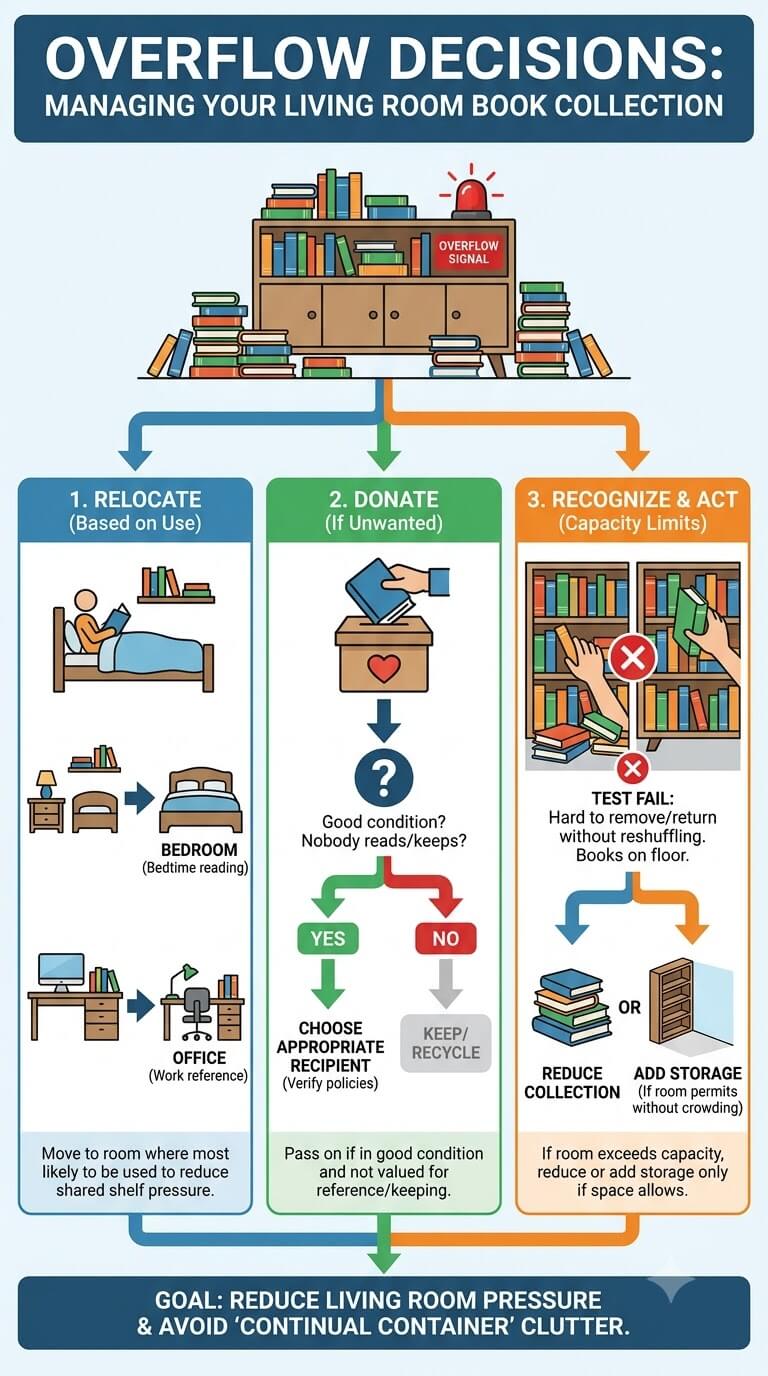
Overflow is a capacity signal. Decide whether those books need another room, another shelf system, or a new owner instead of continually adding containers around the edges of the living room.
Relocate books to bedroom, office, or another shelf system
Move books to the room where they are most likely to be used. Work reference belongs near work, bedtime reading near the bedroom, and specialized hobby collections near the activity when possible. This reduces pressure on shared shelves without requiring you to get rid of books you still value.
Donate books the household no longer wants
If a book is in good enough condition to pass on and nobody expects to read, reference, lend, or keep it, donation may be appropriate. Choose recipients that accept the type and condition you have, since policies vary. Do not treat donation as a way to avoid deciding where wanted books belong.
Recognize when the living room cannot support the collection
A good test is whether books can be removed and returned without reshuffling several shelves. If shelves are packed edge to edge, books remain on the floor, and active reading has nowhere to go, the room has exceeded practical capacity. Reduce the collection or add storage only if the room can support it without crowding circulation.
Keep Kids’ Books as a Separate Collection Boundary
Children’s books can be read in the living room, but a full child-specific collection has different access needs. Keep the boundary clear so the shared room does not duplicate a bedroom or playroom system.
Temporary books can enter the shared room
A few books brought in for family reading can stay in the current-reading zone or a limited family basket. After use, return them to the child’s main book area unless the household intentionally keeps a small permanent living-room selection. The limit should match the shared room’s capacity.
Child-specific access systems belong elsewhere
Low-front bins, picture-book display, reading-level grouping, school-reading routines, and large child-owned collections deserve a dedicated system designed around the child. The living room only needs a clear rule for books that temporarily enter the shared area and where they go afterward.
Avoid duplicating board-book, picture-book, or early-reader organization
If the same child collection is stored in two rooms, it becomes harder to see what is missing or where books should be returned. Keep one primary home for the collection. Use the living room for a small intentional subset or temporary reading, not as an overflow copy of the child’s main shelves.
Build a Simple Book Reset
A reset restores the existing system rather than reconsidering the whole collection. It stays short when every book category already has a defined destination.
Return current reading
Move in-progress books to the current-reading zone rather than scattering them across seating and tables. If that zone is full, identify which paused book can return to the main shelf. This keeps active reading visible without letting it spread.
Remove floor and table stacks
Pick up books from the floor and shared surfaces. Return finished books to their shelf, borrowed books to their holding spot, and child-specific books to their primary collection. If a book has no destination, set it aside for an overflow decision rather than creating a new pile.
Put borrowed books back in their holding spot
Gather library and personally borrowed books into the designated area. Keeping them together makes it easier to see what must leave the house. Do not bury them behind personal books during the reset just because there is a convenient gap.
Check shelf overflow
Notice books laid horizontally on top of full rows, books wedged into gaps, or titles that cannot be reshelved without moving others. Those are early capacity warnings. Address one shelf while the problem is small instead of waiting until the floor becomes overflow storage.
Common Living Room Book Organization Mistakes
Most systems fail because the living-room collection has no boundary, shelves exceed usable capacity, or temporary categories become permanent.
Double-row shelving that hides books
Hidden books are difficult to use and easy to forget. If you need a second row, choose lower-use titles to relocate instead. Keeping one visible row usually provides less raw capacity but much better access.
Overloading shelves
Do not assume a shelf can carry more simply because more books physically fit. Check the furniture instructions and load information, inspect for bowing or loose hardware, and reduce the load if the unit shows signs of strain. If you are uncertain about assembly or anchoring, follow the manufacturer’s support instructions or seek qualified help.
Turning coffee tables into permanent stacks
Shared surfaces should hold current use, not the overflow of the entire collection. Keep one or a few active books near seating, then return the rest to shelves. When a table stack keeps rebuilding, check whether the current-reading zone is too small or the main shelves are full.
Mixing child-specific and shared systems without clear boundaries
When adult books, picture books, school readers, and family reference titles all share the same random gaps, nobody knows where to return them. Keep shared shelves focused. Let child-specific systems handle the child collection, with only a small intentional living-room subset when it helps family reading.
FAQ for Organizing Books in a Living Room
These answers focus on everyday shared-room decisions.
What books belong in a living room?
Keep books that support common-area reading and shared household use: current reading, shared fiction and nonfiction, practical reference books, a limited number of visual books, and borrowed items that need a temporary holding spot. Move work-specific, bedroom-specific, school-specific, and large child-owned collections to the systems that serve those activities better.
What is the best way to group shared books?
Choose the method people naturally use to search. Subject is often useful for nonfiction, while author or series can work well for fiction. Size can solve shelf-fit problems but is usually a secondary rule. The best system is one that household members can browse and restore without needing a detailed map of the bookcase.
How should current reading be stored near seating?
Give active books one small, defined zone such as a shelf, shallow basket, or limited section of a side table. Keep only books that are genuinely in progress there. When the zone fills, return completed or paused titles to the main collection before adding more. Include books in the living room reset so current reading, borrowed books, and finished titles return to their defined homes.
When should books move to a larger library or whole-home system?
Consider a broader system when the living room can no longer hold its shared collection without double rows, blocked shelf access, persistent floor stacks, or crowded circulation. A large specialist or household-wide collection is easier to manage when the living room keeps only the portion that supports common-area use.

Ethan Carter is the Founder & Editor of HomeCleanSecrets. Based in the United States, he has 5 years of experience creating practical home cleaning, laundry care, stain removal, decluttering, and home organization content. His goal is to help everyday households clean smarter and build simple routines that are easier to maintain.
Read more about Ethan Carter on his author page: https://homecleansecrets.com/ethan-carter/