
A practical bathroom storage organization guide should help you build a system, not just buy prettier bins. Bathrooms are small, humid, and used many times a day, so towels, toiletries, backups, grooming tools, cleaners, and shower bottles quickly compete for the same cabinets, drawers, shelves, and counter space.

The goal is a bathroom that resets easily after real use. Daily items should be easy to reach, backups should not crowd the room, moisture-sensitive products need protected storage, and every person who uses the bathroom should understand where things belong. Start with the framework below before buying organizers, because most bathrooms need better decisions before they need more containers.
Before you begin, take a quick photo of the bathroom and note the three areas that bother you most. This keeps the project practical. A cabinet overflow problem needs a different fix than a towel overflow problem, and a crowded shower ledge needs a different fix than a drawer full of small grooming tools. When you know the pressure point, you can improve the room without emptying every shelf at once.
Quick Answer: The Simple Bathroom Storage System
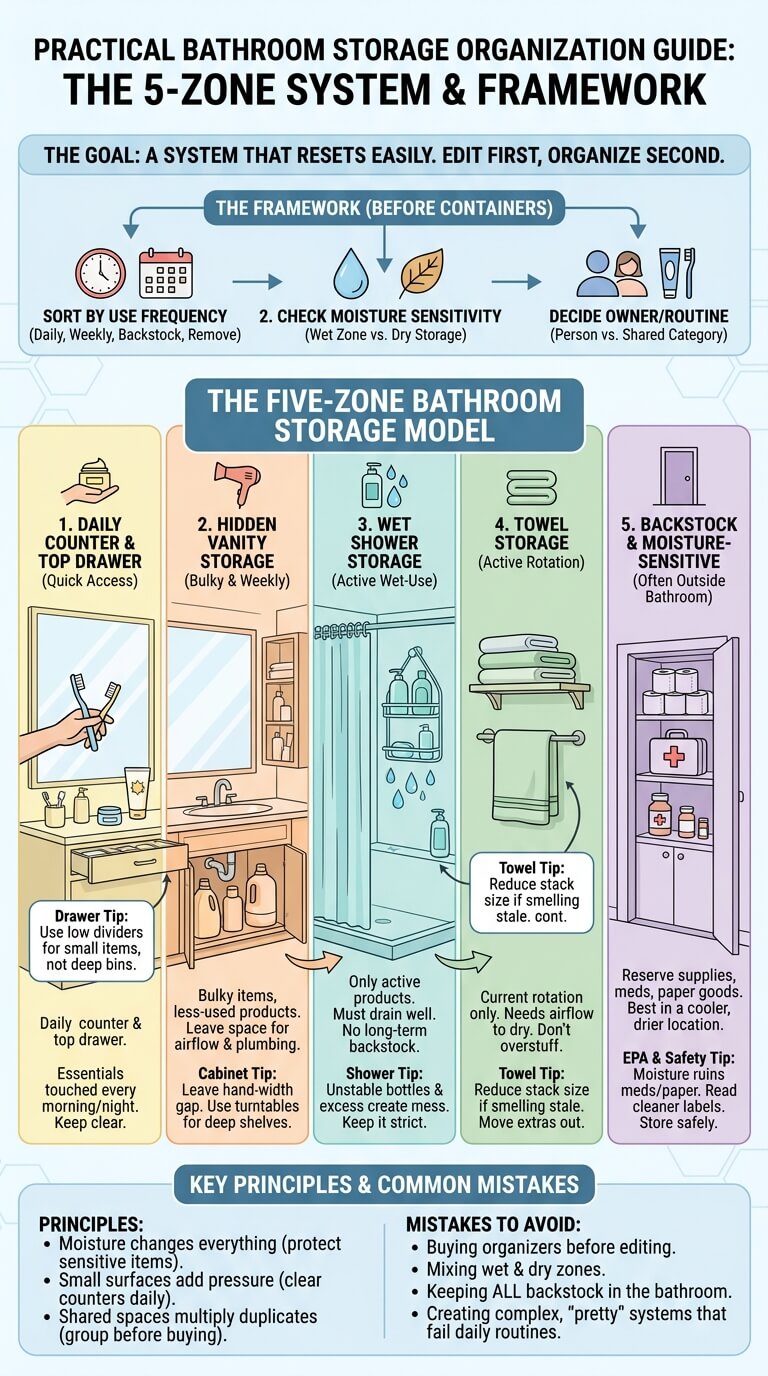
The simple system is to divide the bathroom by use frequency, moisture exposure, and access. Keep daily items close to the routine, hide bulky items in cabinets, divide small items in drawers, limit towel storage to the active rotation, keep only active bottles in the shower, and move excess backstock somewhere drier.
The five-zone bathroom storage model
Think in five zones: daily counter or top-drawer storage, hidden vanity storage, towel storage, wet shower storage, and backstock. The daily zone holds the few items touched every morning or night. The vanity holds bulky or hidden items. The towel zone holds only the rotation that fits and dries well. The shower zone holds active wet-use products. Backstock is the reserve area for extras, and it often works better outside the bathroom.
What should stay in the bathroom and what should move elsewhere
Items that support daily bathroom routines can stay: one active shampoo, one conditioner, current skincare, oral care, hand soap, daily grooming tools, toilet paper within reason, and the towels currently in use. Large backups, most rarely used products, extra towels, old travel bottles, and moisture-sensitive items usually belong in a linen closet, bedroom drawer, hallway cabinet, or labeled backstock bin. The EPA explains that moisture control matters indoors, so bathroom storage should leave damp areas easy to dry and inspect. EPA moisture guidance is a useful reference for humid rooms.
Why Bathroom Storage Gets Messy So Fast
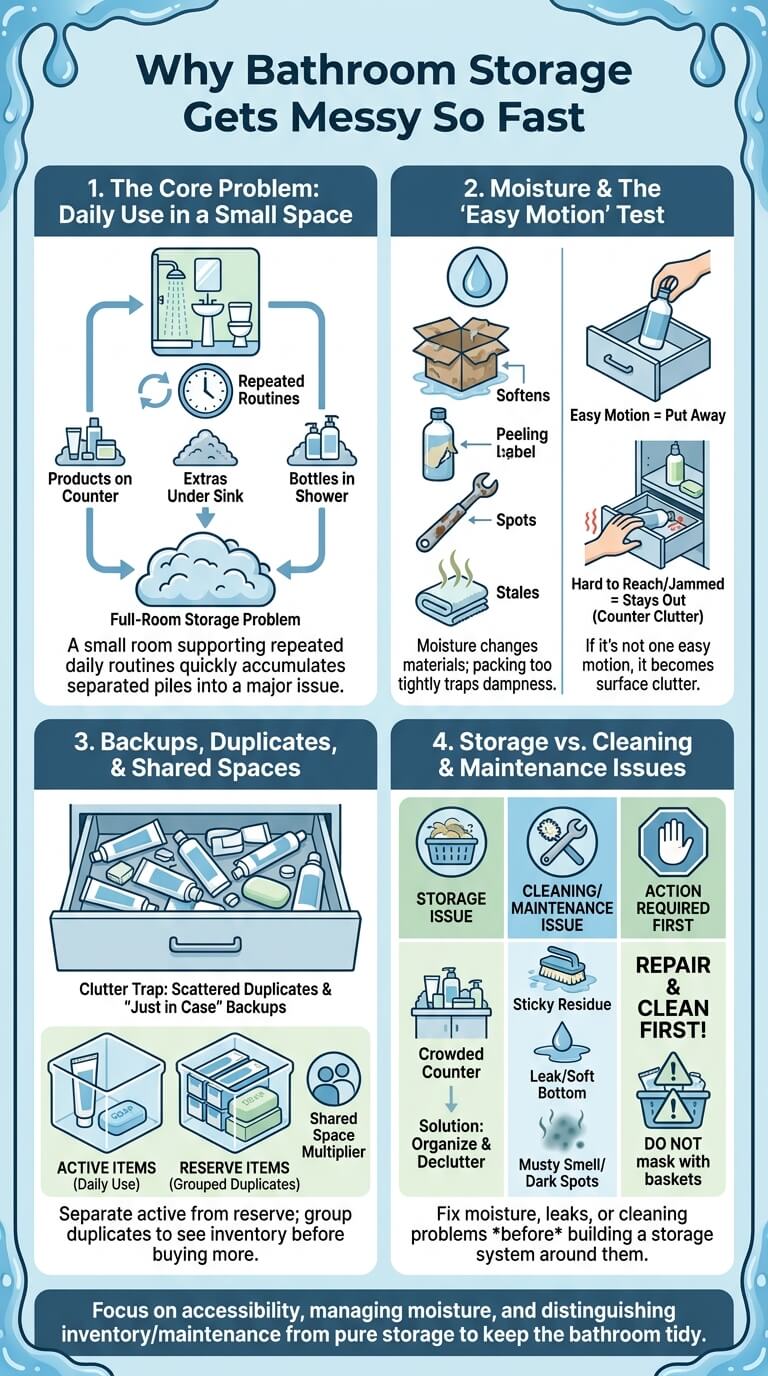
Bathrooms get messy quickly because a small room has to support repeated routines. A few products on the counter, a few extras under the sink, and a few bottles in the shower can become a full-room storage problem when they are not separated by purpose.
Moisture, small surfaces, and daily routines
Moisture changes what works in a bathroom. Cardboard softens, labels peel, metal tools can spot, and towels can smell stale if packed too tightly. Small surfaces add pressure because the counter, tub ledge, and toilet tank become temporary storage. A good test is whether the item can be put away with one easy motion after use. If the drawer is jammed or the bin is hard to reach, the product will probably stay out.
Backup products, duplicates, and shared spaces
Backups cause clutter because each item seems reasonable on its own. One extra toothpaste is helpful; six half-used or unopened tubes scattered through drawers are not. Shared bathrooms multiply the problem when each person owns a similar set of products. Separate active items from reserve items first, then group duplicates so the household can see what exists before buying more.
The difference between storage clutter and cleaning problems
A crowded counter is a storage issue. Sticky residue under a bottle is a cleaning task. Damp towels on the floor are partly storage and partly laundry routine. A leak, soft cabinet bottom, dark spots on caulk, or a musty smell that returns after drying is not solved by baskets. Stop organizing and handle the moisture, repair, or cleaning problem before building a storage system around it.
The Bathroom Storage Framework
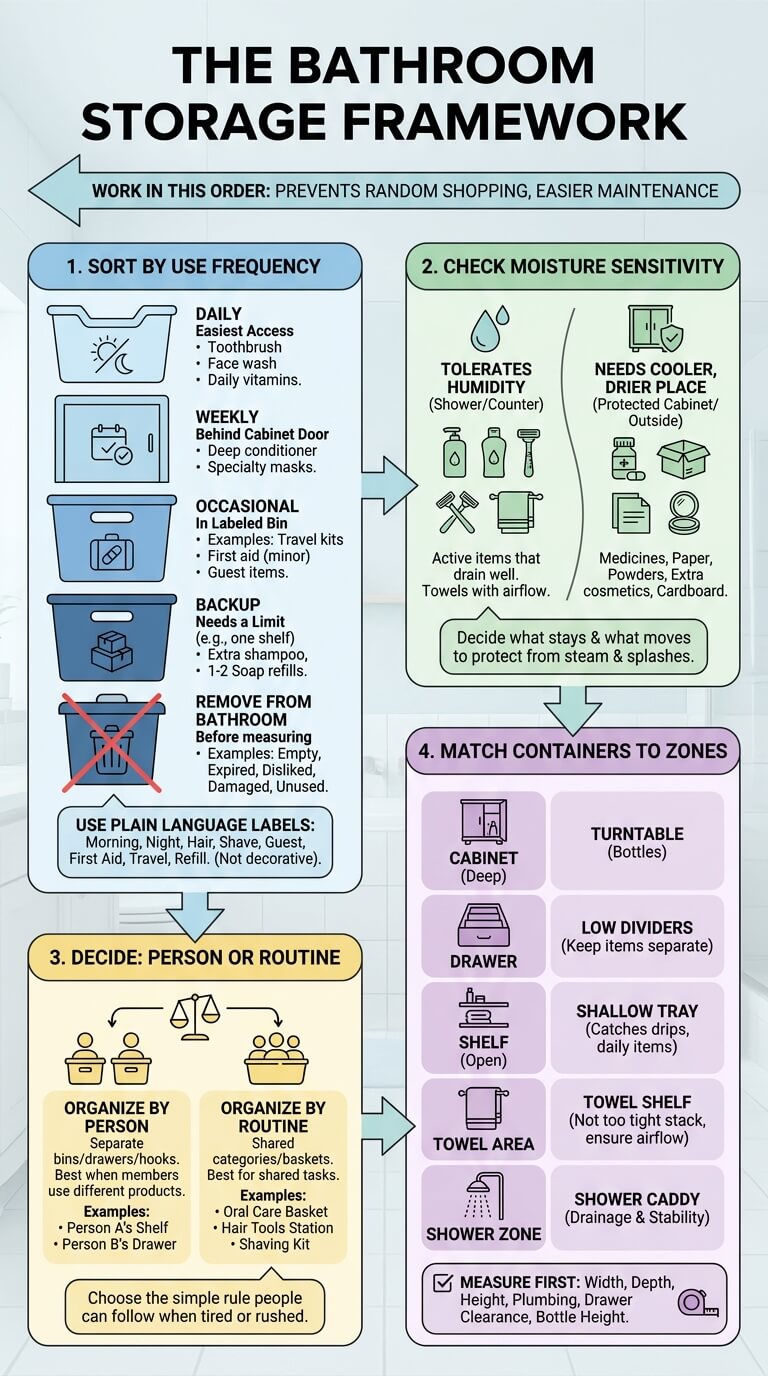
Work in this order: sort by use frequency, check moisture sensitivity, decide whether items belong to a person or a routine, then choose containers that fit the cabinet, drawer, shelf, towel area, or shower zone. This order prevents random shopping and makes the final setup easier to maintain.
Sort by use frequency
Create five groups: daily, weekly, occasional, backup, and remove from bathroom. Daily items deserve the easiest access. Weekly items can sit behind a cabinet door. Occasional items can live in a labeled bin. Backups need a limit, such as one shelf or one small box. Anything empty, expired, disliked, damaged, or no longer used should leave before you measure for organizers.
Label the groups with plain language while sorting. Use words like morning, night, hair, shave, guest, first aid, travel, and refill. These labels are easier to follow than decorative labels that sound nice but do not describe the task. A good category name should tell someone exactly what belongs there without needing a second explanation.
Sort by moisture sensitivity
Decide which items tolerate normal bathroom humidity and which need a cooler, drier place. Active shampoo and body wash can stay in the shower if they drain well. Towels can stay if they have airflow. Many medicines, paper refills, powders, extra cosmetics, and cardboard packaging are better outside the bathroom or in a protected cabinet away from steam and splashes.
Sort by person or routine
Shared bathrooms need a simple access rule. Organize by person when each household member uses different products and needs a separate bin, drawer, shelf, or hook. Organize by routine when the household shares categories such as oral care, shaving, hair tools, skincare, or guest supplies. The best choice is the one people can follow when tired, rushed, or half awake.
Match containers to cabinets, drawers, shelves, towels, and shower zones
Containers should solve a specific problem. A turntable helps bottles in a deep cabinet. A shallow tray catches drips under daily skincare. Low dividers keep drawer items from mixing. A towel shelf works only if the stack is not too tight. A shower caddy needs drainage and stability. Measure width, depth, height, plumbing, drawer clearance, and bottle height before buying anything.
Bathroom Storage Decision Tree
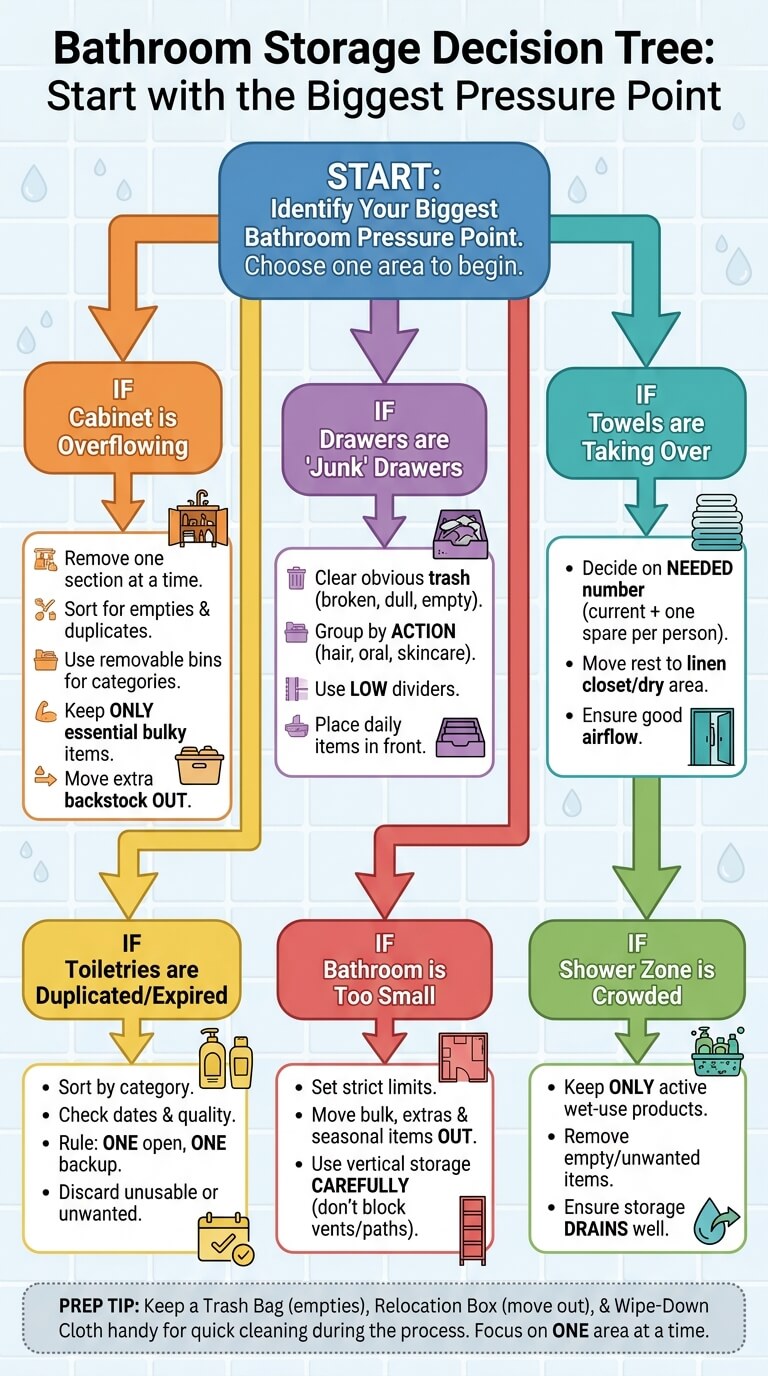
Choose the biggest pressure point first instead of emptying the whole room at once. The decision tree below helps you decide whether the next step belongs in the cabinet, drawer, towel area, toiletry supply, small-space layout, or shower zone.
Work with one container, shelf, drawer, or ledge at a time. Keep a trash bag, a relocation box, and a small wipe-down cloth nearby. The trash bag is for empty packaging and expired disposables. The relocation box is for items that belong in another room. The cloth is for quick dust or product residue after the area is empty, not for turning this project into a full bathroom cleaning session.
If the cabinet is overflowing
Cabinets usually work best for backups, taller bottles, extra paper goods, and items that do not need to be grabbed every morning, so organize bathroom cabinets without wasting deep space.
Remove one shelf or one side at a time. Look for empty bottles, old backups, products stored sideways because they are too tall, and items blocked by plumbing. Keep bulky items there only if they belong to the bathroom routine. Use removable bins for categories, leave pipes visible, and move extra backstock elsewhere if the cabinet has become a product warehouse.
If drawers are turning into junk drawers
Drawers are usually better than deep cabinets for small essentials, especially when you organize bathroom drawers for daily-use items with dividers.
Start with obvious trash: broken clips, dull razors, empty floss, dried samples, and packaging scraps. Then group the rest by action, such as oral care, hair, shaving, skincare, contacts, or makeup. Low dividers usually work better than deep bins because bathroom drawers are shallow. Daily items should sit in the front section, while occasional items move back or down.
If towels take over the room
Towels need a separate plan because they take up more space than small products, so organize towels in the bathroom without crowding shelves.
Decide how many towels truly need to live in the bathroom. Many homes only need the towel in use, one spare bath towel per person if space allows, a few hand towels, and washcloths that are part of the routine. Store the rest in a linen closet or another dry area. If towels smell stale, reduce the stack, improve airflow, or move extras out.
If toiletries are duplicated or expired
Sort one toiletry category at a time, such as lotions, sunscreen, shaving products, hair treatments, or travel sizes. Pair duplicates, check dates where available, and keep products that are safe, usable, and part of a real routine. Avoid combining products unless labels clearly allow it. A simple rule is one open product and one backup for categories used regularly.
If the bathroom is too small for normal storage
When the room has little floor space, no linen closet, or a narrow vanity, it helps to organize a small bathroom with limited storage before adding more containers.
Small bathrooms need stricter limits. Keep active daily items, current towels, reasonable toilet paper, and shower products in use. Move bulk purchases, extra towels, refills, and seasonal products outside the room. Use wall, door, and narrow vertical storage only when it does not block vents, outlets, doors, cleaning access, or the walking path.
If shower bottles are crowding the wet zone
The shower needs its own storage rules, so organize shower products so the wet zone stays manageable and drains well.
Keep only active wet-use products in the shower. Remove empty bottles, duplicates, products no one likes, and items used less than weekly. Good shower storage drains well, stays stable, and keeps bottles off puddled surfaces when possible. If several people share the shower, give each person a limited space or use carry-in bins that dry outside the wet zone.
Category Breakdown for a Complete Bathroom System
The categories below show how a complete bathroom system fits together. Each one can become a deeper project later, but this overview keeps the roles clear so the whole room does not turn into one mixed storage pile.
Cabinets for bulky, hidden, and backup items
Cabinets work best for toilet paper, unopened toiletries, hair dryers, extra soap, small cleaning supplies, and bins for less-used categories. Under-sink cabinets need clear space around plumbing so leaks are easier to notice. Do not pack paper goods directly against pipes or the cabinet floor if drips would be hidden.
Leave at least one hand-width of open space in any cabinet that stores mixed categories. That small gap makes it easier to pull out a bin, check a bottle cap, spot a drip, or add a replacement without crushing everything together. A cabinet that is packed to the top may look efficient, but it usually becomes hard to maintain.
Drawers for daily small items
Drawers are ideal for small daily items that make counters look messy: toothpaste, floss, hair ties, combs, razors, tweezers, contact supplies, and current skincare. Divide them by category or routine. If the drawer catches when it closes, the item is too tall for that zone and should move elsewhere.
Towels for rotation and guest access
Towel storage should match laundry rhythm and available airflow. Households that wash towels often need fewer towels stored in the bathroom. Guests need clean hand towels and an obvious spare, not a crowded cabinet of household overflow. Hooks work for towels in use, but each towel needs enough room to dry between uses.
Toiletries for routines, travel, and backstock
Toiletries are easier to manage when you organize toiletries by daily use and backup stock before assigning them to cabinets or drawers.
Separate daily toiletries, travel toiletries, and backstock. Daily items stay near the routine. Travel items belong in one travel kit. Backstock belongs in a controlled reserve area. Medicines need a separate decision from ordinary toiletries; FDA guidance recommends take-back options for many unused or expired medicines and gives disposal steps when take-back is not available. FDA medicine disposal guidance can help during a bathroom product edit.
Shower products for wet-zone use only
Shower storage should stay strict because it sits in the wettest zone. Keep active shampoo, conditioner, body wash, shaving items, and the few products used in the shower. Backups, unused gifts, and almost-empty bottles should not stay there indefinitely. A better caddy helps only after the number of bottles is reasonable.
Decluttered products before buying organizers
Decluttering makes every storage choice more accurate. Remove empty, expired, unsafe, damaged, disliked, or unused products before choosing bins. A container sized for twenty products is wrong if only eight products deserve to stay. Edit first, measure second, and buy last.
Storage Rules by Bathroom Type
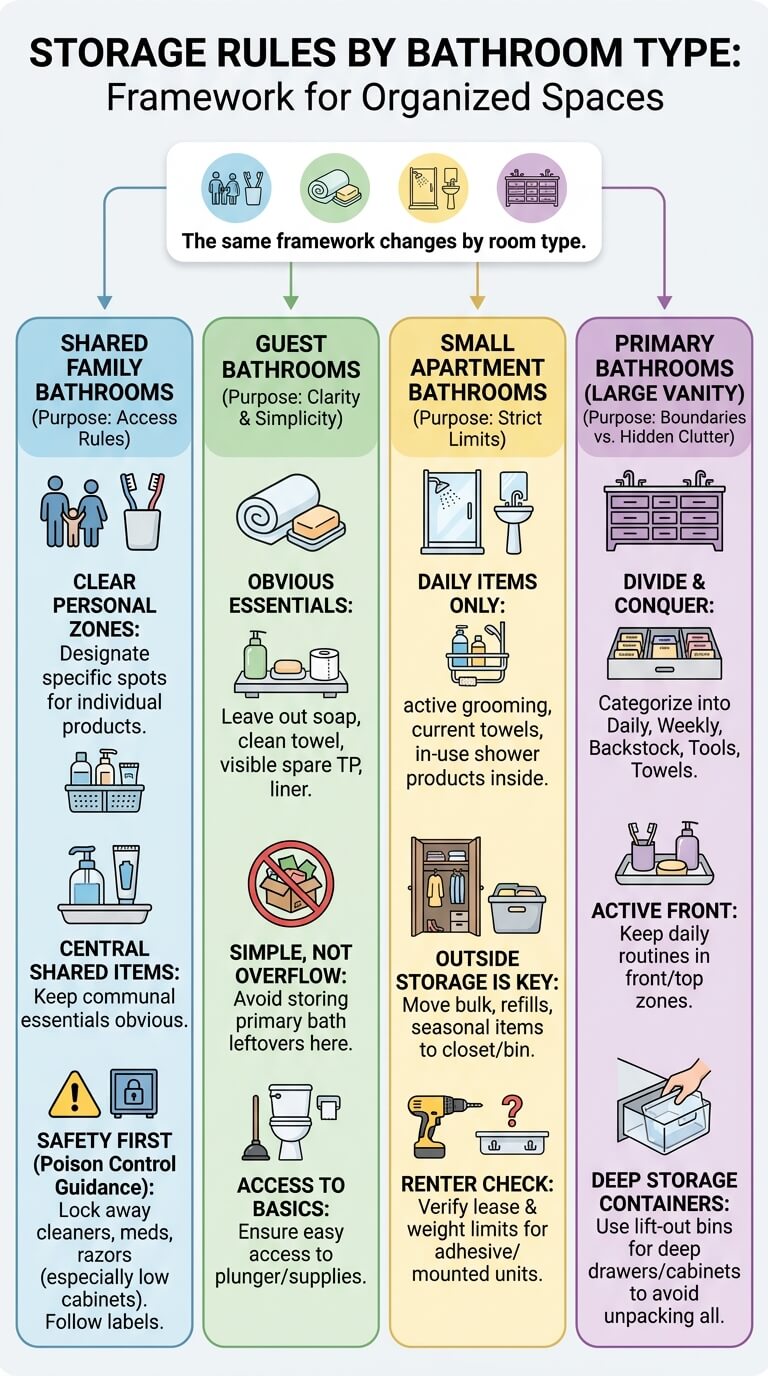
The same framework changes by room type. A shared family bathroom needs access rules. A guest bathroom needs clarity. A small apartment bathroom needs strict limits. A primary bathroom with a larger vanity needs boundaries so hidden storage does not become hidden clutter.
Shared family bathrooms
Give each person a clear place for personal products if shared categories are causing conflict. Keep shared items central and obvious. Store cleaners, razors, medicines, and other sensitive items based on label directions and household safety needs, not just convenience. Poison Control notes that cleaning products should be stored carefully around children, especially in low unlocked cabinets. Poison Control cleaning safety guidance is useful when deciding where cleaners belong.
Guest bathrooms
Guest bathrooms should feel simple. Leave hand soap, a clean hand towel, a visible spare toilet paper roll, a trash liner reserve, and easy access to a plunger or basic supplies. Avoid using the guest bathroom as a place to hide products that did not fit in the primary bathroom. Guests need obvious essentials, not leftover clutter.
Small apartment bathrooms
Small apartment bathrooms usually need outside storage. Keep only daily grooming items, current towels, and active shower products in the room. Move bulk toilet paper, extra towels, refills, and seasonal products to a closet, bedroom bin, or hallway shelf. Renters should check weight limits and lease rules before using adhesive shelves, over-toilet units, or hardware-mounted organizers.
Primary bathrooms with vanity storage
A larger vanity can hide more clutter because the doors still close. Divide it into daily, weekly, backstock, tools, and towels if towels live there. Keep the front and top areas for active routines. Deep drawers and double cabinets need containers that can be lifted out, checked, and returned without unpacking the entire vanity.
Product, Moisture, and Safety Limits
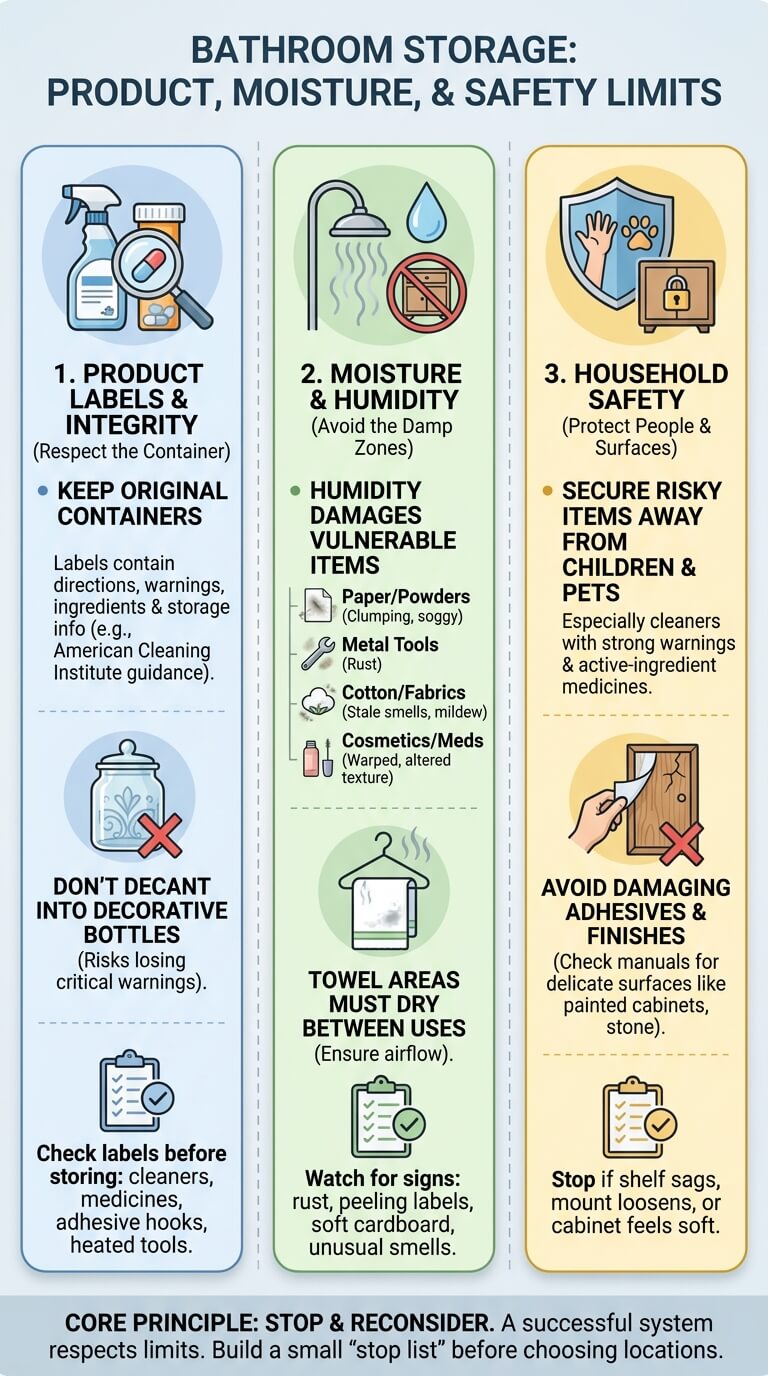
Bathroom storage should respect product labels, humidity, and household safety. A system is not successful if it hides cleaners in risky locations, stores medicines in the wrong environment, damages cabinet finishes, or traps moisture around towels and products.
Build a small stop list before choosing storage locations. Stop and reconsider when an item says to store in a cool, dry place, when a cleaner has a strong warning label, when a product must stay away from children or pets, when an organizer needs adhesive on a delicate surface, or when a towel area does not dry between uses.
Why some items should not live in humid zones
Humidity can affect paper packaging, powders, cotton products, labels, metal tools, some cosmetics, and many medicines. Watch for clumped powder, soft cardboard, rust, peeling labels, warped packaging, unusual texture, or stale fabric smells. These signs mean the category needs more airflow, less crowding, or a drier storage location.
Cleaner, medicine, and cosmetic storage boundaries
Keep cleaners in original containers with labels intact, and avoid decorative decanting that removes directions or warnings. The American Cleaning Institute explains that labels include directions, caution warnings, ingredients, and storage information. American Cleaning Institute label guidance is a useful reminder before storing cleaners in a bathroom cabinet. Medicines and active-ingredient cosmetics should also follow their own labels, especially when heat, light, humidity, or child safety matters.
When to check labels, manuals, or care instructions
Check labels before storing cleaners, medicines, medicated toiletries, adhesive hooks, heated styling tools, cabinet liners, or organizers used near children and pets. Check manuals before attaching storage to painted cabinets, laminate, glass, stone, tile, or shower walls. Stop if a shelf sags, an adhesive mount loosens, a cabinet floor feels soft, or an organizer blocks airflow around damp towels.
Common Bathroom Storage Mistakes
Most mistakes come from treating all bathroom clutter as the same problem. The fix changes depending on whether the cause is too many products, poor daily access, towel overflow, wet-zone crowding, or unsafe storage.
Buying organizers before editing products
Before you measure bins or move shelves around, reduce expired products, duplicates, and items nobody uses so you can declutter bathroom products before you organize them.
Buying first often creates expensive clutter. A matching bin set may look organized while hiding expired products and duplicates. Edit products, measure the real space, then choose the smallest organizer that solves the remaining problem.
Mixing wet and dry storage zones
Active shower products can be wet. Towel reserves, paper goods, cotton products, powders, and many packaged items should stay dry. If an item becomes worse when damp, keep it out of the wet zone or protect it with distance, airflow, and a container that does not trap moisture.
Keeping every backup item in the bathroom
The bathroom usually needs active supplies and a small reserve, not the whole bulk purchase. Move unopened products, extra shampoo, seasonal items, and large paper packs to a secondary storage area when space is limited. When the backstock bin is full, use what you have before buying more.
Creating pretty storage that fails daily routines
Attractive storage fails when it slows people down. Lidded boxes can be annoying for daily deodorant. Tall towel stacks can collapse. Matching jars can remove useful labels. Judge the system after a normal weekday. If items keep landing on the counter, the storage is too far away, too full, or too complicated.
FAQ
These answers focus on the whole-room storage system, not detailed cabinet, drawer, towel, toiletry, or shower procedures.
What is the best way to organize bathroom storage overall?
The best overall method is to divide the bathroom into daily-use, hidden cabinet, drawer, towel, wet shower, and backstock zones. Keep daily items closest to use, limit backups, move moisture-sensitive items to drier storage, and choose containers only after products are edited.
What should not be stored in a bathroom?
Items sensitive to heat, humidity, light, or safety access often should not stay in the bathroom unless labels allow it and the storage is protected. Common examples include many medicines, excess paper goods, large cosmetic backstock, rarely used electronics, damp-prone packaging, and extra towels in a poorly ventilated cabinet.
How many bathroom organizers do I really need?
Most bathrooms need fewer organizers than they first appear to need. A practical starting point is one daily drawer divider or tray, one or two under-sink bins, one towel solution, one shower storage solution, and one backstock container. The final number should come after decluttering and measuring.
How often should bathroom storage be reset?
A light reset once a week keeps counters, drawers, and shower products from drifting out of place. A deeper reset every one to three months catches expired products, duplicates, towel overflow, and backstock creep. Shared bathrooms may need shorter reset cycles.
Final Thoughts
Bathroom storage works when each item has a reason to be in the room, a zone that matches how often it is used, and a storage method that respects moisture and safety limits. Start with editing, not shopping. Separate daily items from backups. Keep wet-zone products strict. Give towels room to dry. Read labels, manuals, and care instructions before storing cleaners, medicines, adhesive organizers, or sensitive materials in a humid room.
Once this foundation is in place, the detailed projects become easier. Cabinets, drawers, towels, toiletries, small bathrooms, shower products, and product decluttering each have their own workflow, but they all depend on the same principle: fewer random products, clearer zones, and storage choices that match real routines.

Ethan Carter is the Founder & Editor of HomeCleanSecrets. Based in the United States, he has 5 years of experience creating practical home cleaning, laundry care, stain removal, decluttering, and home organization content. His goal is to help everyday households clean smarter and build simple routines that are easier to maintain.
Read more about Ethan Carter on his author page: https://homecleansecrets.com/ethan-carter/