
Bathroom drawers become messy faster than cabinets because they hold the items people touch when they are half-awake, rushed, or getting ready with wet hands. Makeup rolls to the back, floss disappears under hair ties, razors land beside skincare, and samples stay in the drawer long after anyone wanted them. The fix is not simply adding more tiny trays. The fix is giving each drawer a job, then dividing the inside around real morning and night routines.

Quick Answer: The Bathroom Drawer System That Works
Drawers are only one part of the room, so connect drawer storage to the full bathroom system before deciding what deserves the easiest reach.
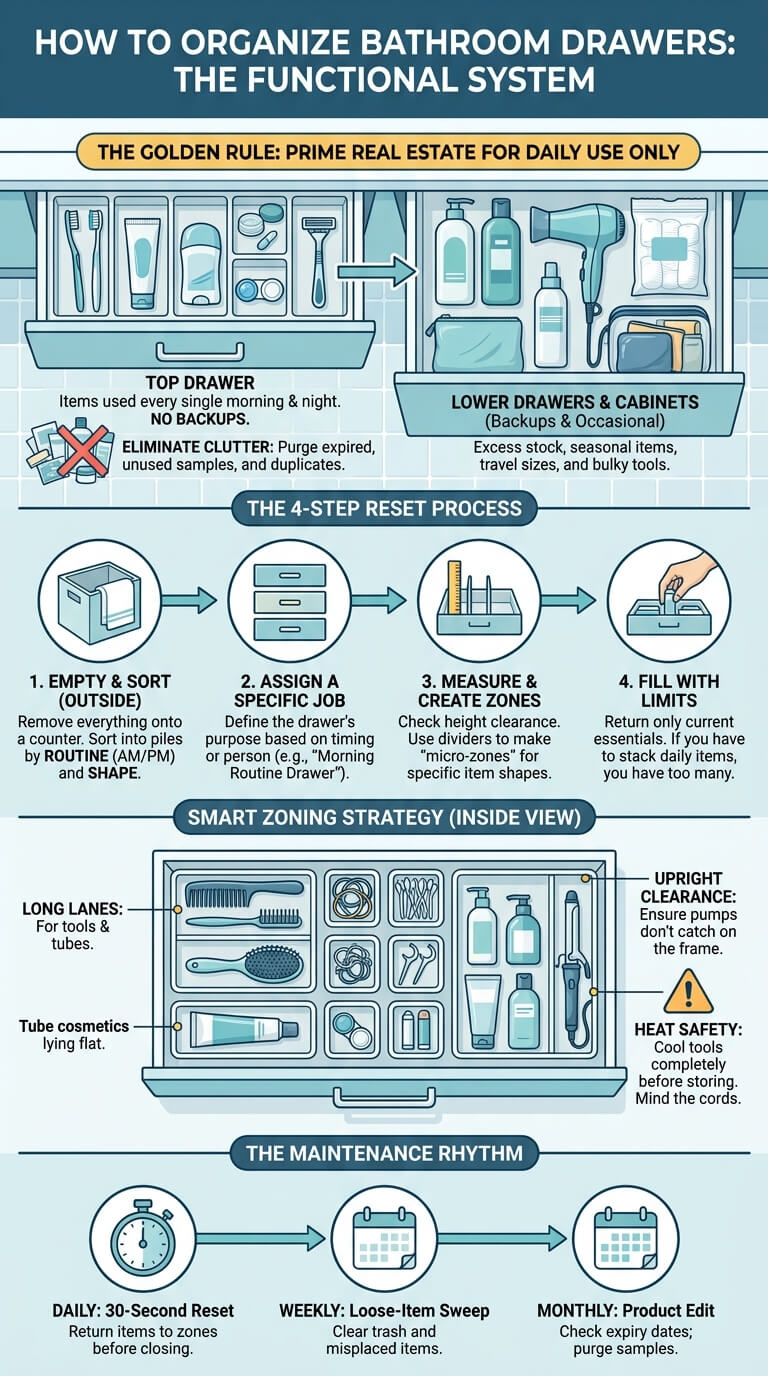
The best bathroom drawer setup puts the most-used items in the top drawer, limits backups, and separates small items by routine instead of by vague categories. A top drawer should hold only the things used daily or nearly daily: toothbrush items, floss, contact lens supplies, lip balm, face basics, shaving items, or a few grooming tools. Anything that is unopened, seasonal, duplicated, expired, or used only once a month belongs somewhere else.
The top-drawer daily zone
The top drawer is prime storage because it is the easiest to open and scan. Give it to items that support the first and last five minutes of the day. A strong top drawer usually has one long zone for brushes, combs, razors, or tubes; one small zone for floss, clips, hair ties, or lip balm; and one clear boundary for the few products that must stay upright or capped.
The backup and occasional-use boundary
Tall bottles, bulk refills, and backup products usually belong when you move bulky backups into bathroom cabinets instead of taking up shallow drawer space.
Drawers fail when backups sneak into daily space. One extra razor pack may be helpful. Five unopened skincare products, three deodorants, hotel lotions, spare toothbrushes, and travel bottles will bury the items used every day. Keep a small backup limit, such as one extra of the products you finish often, and move the rest to a cabinet or toiletries bin.
When Bathroom Drawers Need a Different System
Bathroom drawers are not miniature cabinets. They are shallow, fast-access spaces where every loose item can block another item. A drawer that looks tidy from above can still be frustrating if products are stacked, cords are tangled, or dividers are too small for what you actually own.
Why shallow drawers fail differently than cabinets
Cabinets hide bulk, but drawers magnify small clutter. A single deep cabinet can hold a basket of refills without interrupting the morning. A shallow drawer cannot. When too many categories share a small drawer, the drawer becomes a junk tray with better lighting. Small products slide under larger products, round items roll, and narrow tubes get trapped against the back.
What this guide covers and does not cover
This article covers drawer sorting, dividers, routine zones, shared setups, cosmetics, grooming items, small tools, and simple resets. It does not cover under-sink storage in depth, towel folding, shower caddies, full product inventory planning, or bathroom cleaning. Those topics can connect to drawer decisions, but they should not take over the drawer system.
Step 1: Empty and Sort Drawer Contents
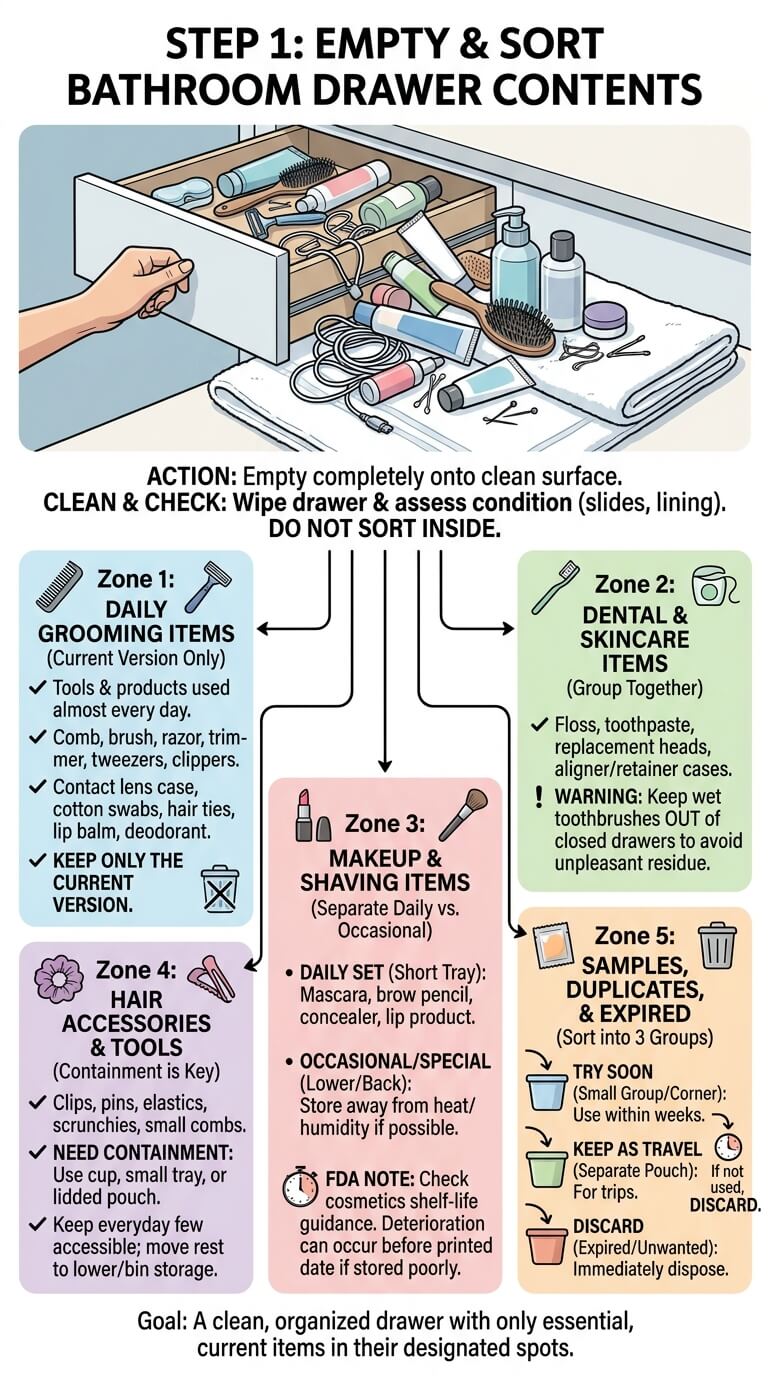
Empty every bathroom drawer you are organizing onto a towel, table, or clean counter. Do not sort inside the drawer. The drawer hides duplicates, old packaging, and products that have rolled behind organizers. Pulling everything out also lets you wipe dust and check whether the drawer slides, lining, or bottom panel need attention before you refill the space.
Daily grooming items
Daily grooming items are the tools and small products you reach for almost every day. They may include a comb, brush, razor, beard trimmer guard, tweezers, nail clipper, contact lens case, cotton swabs, hair ties, lip balm, or deodorant. Keep only the current version of each item in the daily drawer.
Dental and skincare items
Dental items work best when they sit together: floss, toothpaste, replacement brush heads, aligner case, retainer case, and small mouth-care tools. Keep wet toothbrushes out of closed drawers unless your own product setup is designed for that storage and dries well. A damp item in a closed drawer can create residue and make the drawer unpleasant fast.
Makeup and shaving items
Makeup and shaving items create clutter because they are small, varied, and easy to collect. Separate current daily makeup from special-event makeup before choosing dividers. The daily set may only need a short tray for mascara, brow pencil, concealer, and lip product. The occasional set can live lower, farther back, or outside the bathroom if the room gets hot and humid.
The FDA notes that cosmetic shelf life can be affected by storage conditions and that some products may deteriorate before a printed date when stored poorly. Check its cosmetics shelf-life guidance when deciding whether old, opened, or changed products deserve drawer space.
Hair accessories and small tools
Hair accessories need containment more than they need a large drawer. Clips, pins, elastics, scrunchies, and small combs scatter unless they have a cup, small tray, or lidded pouch. Keep the everyday few in the easy drawer and move the rest to a lower drawer or a bathroom accessory bin.
Samples, duplicates, and expired products
If the drawer still jams after sorting, declutter bathroom products before resetting drawers and remove items that no longer belong in the bathroom.
Samples and duplicates are the fastest way to lose a bathroom drawer. Sort them into three groups: try soon, keep as travel, and discard. The try-soon group should be small enough to fit in one corner or one pouch. If it does not get used within a few weeks, it is probably not important enough for prime space.
Step 2: Assign Each Drawer a Job
To make dividers useful, organize toiletries before dividing drawer space and keep the daily products closest to the front.
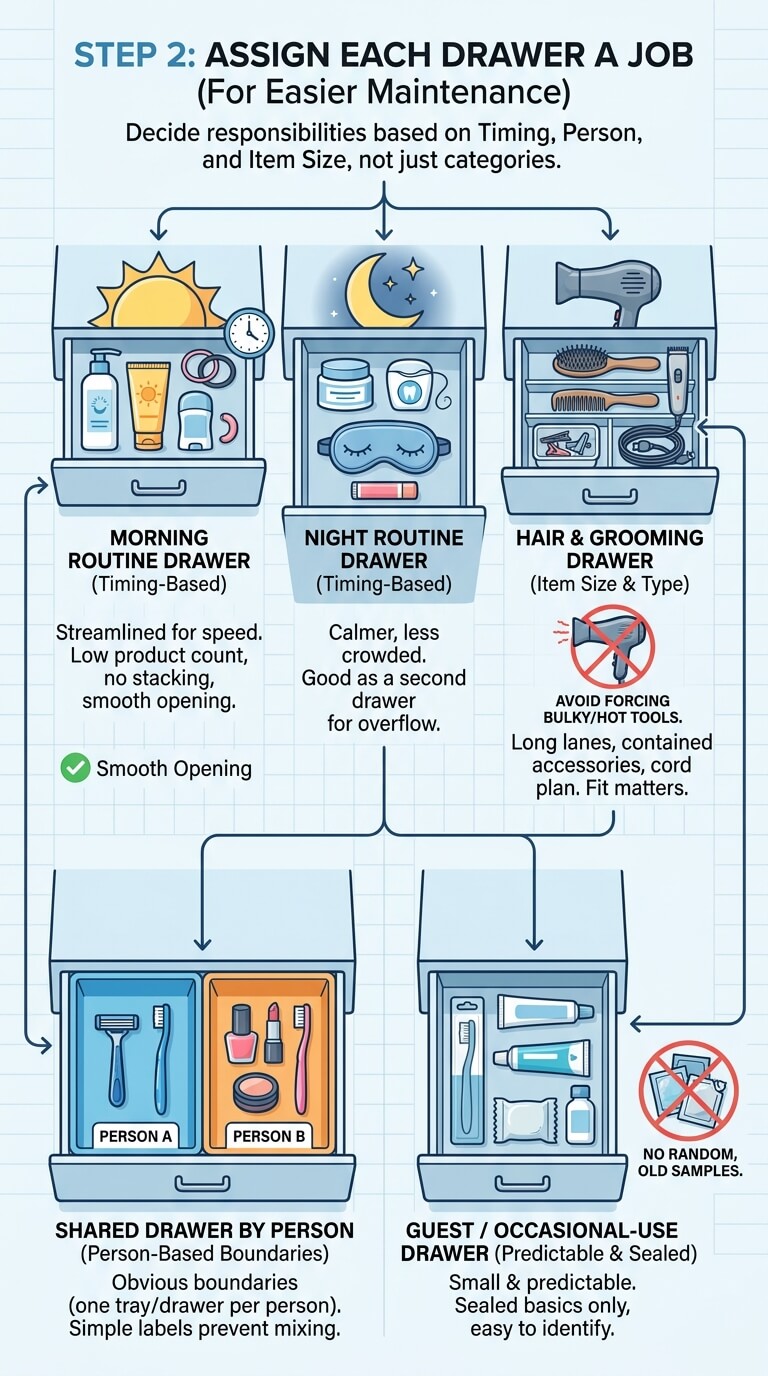
Once the items are sorted, decide what each drawer is responsible for. A drawer with a job is easier to maintain than a drawer with a theme that changes every week. Choose jobs based on timing, person, and item size, not just on category names.
Morning routine drawer
A morning routine drawer should help someone get ready without searching. It may hold face cleanser, sunscreen, deodorant, daily makeup, shaving supplies, hair ties, contact lens items, or a brush. Keep the number of products low enough that the drawer opens smoothly and every item can return to its compartment without stacking.
Night routine drawer
The night routine drawer can be calmer and less crowded. It may hold moisturizer, dental care, retainer supplies, lip balm, a sleep mask, or a small hair wrap. The night drawer works well as a second drawer if the top drawer is overloaded by morning items.
Hair and grooming drawer
A hair and grooming drawer should have long lanes for brushes and combs, a contained area for accessories, and a cord plan for small electric tools. Do not force bulky heat tools into a shallow drawer if the cord bends hard, the tool must be stored before it cools, or the drawer cannot close without pressure.
Shared drawer by person
Shared bathrooms need boundaries that are obvious at a glance. One practical setup is one tray per person inside a larger drawer. Another is one small drawer per person if the vanity has multiple drawers. The labels do not need to be decorative. They just need to prevent one person’s products from covering another person’s routine.
Guest or occasional-use drawer
A guest drawer should be small and predictable. It can hold unopened toothbrushes, travel toothpaste, soap, a small lotion, extra floss, and a few sealed basics. Avoid filling it with random samples that guests cannot identify or products that have been opened for a long time.
Step 3: Measure Before Buying Dividers
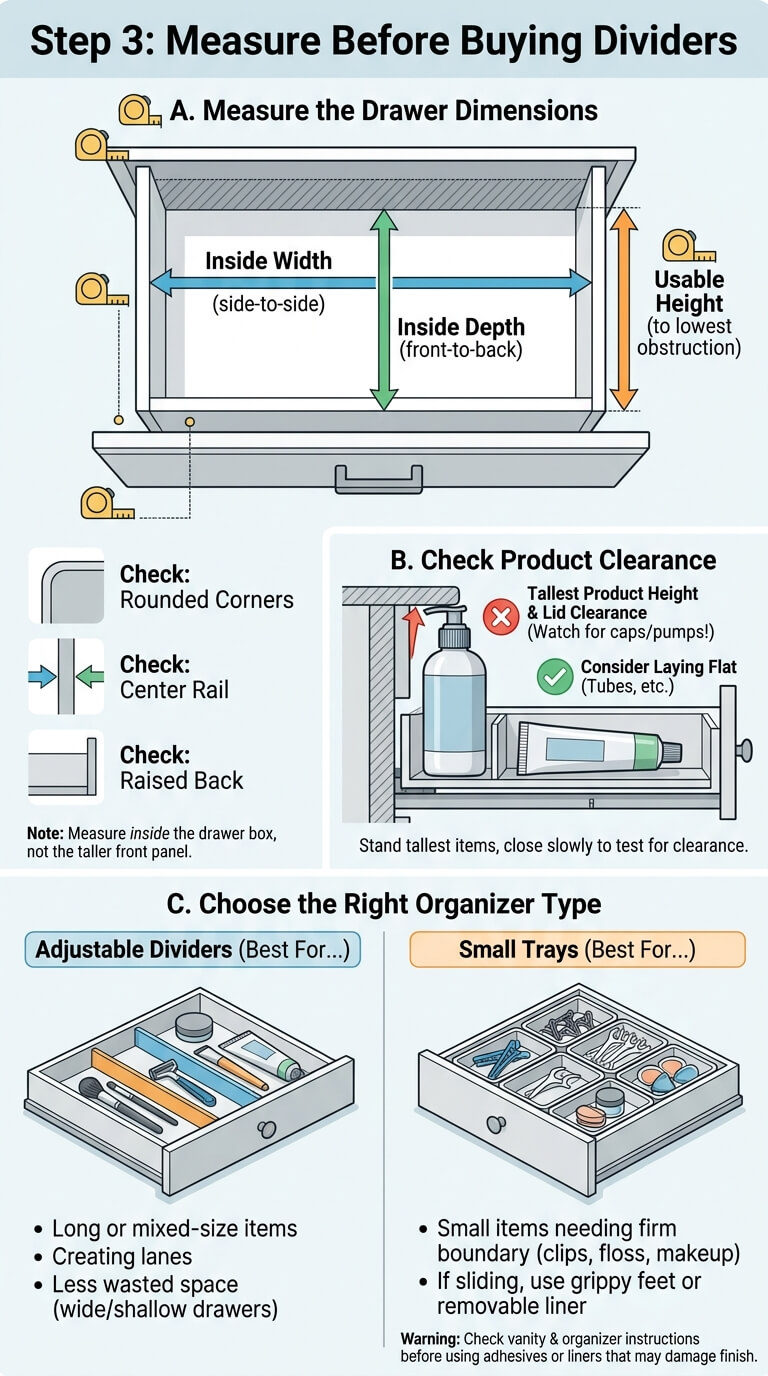
Drawer organizers help only when they match the drawer and the items. Buying first often creates a second problem: now the drawer is cluttered and the organizers do not fit. Measure the space, check the product heights, and decide whether you need adjustable dividers, trays, cups, or no new organizer at all.
Drawer width, depth, and height
Measure the inside width from side to side, the inside depth from front to back, and the usable height from the drawer bottom to the lowest obstruction. The drawer front may be taller than the interior, so measure inside the drawer box. Also check whether the drawer has rounded corners, a center rail, or a raised back.
Product height and lid clearance
Stand the tallest likely products in the drawer and close it slowly. Watch for lids, pumps, caps, and handles. Bottles that barely clear the top can tip, leak, or scrape the drawer above. Tubes may be better lying flat in a long compartment instead of standing upright.
When adjustable dividers beat small trays
Adjustable dividers are useful when a drawer holds long or mixed-size items. They let you create lanes for brushes, razors, tubes, and tools without trapping each item in a tiny box. They also waste less space than several small trays when the drawer is wide and shallow.
Small trays work better for clips, floss picks, cotton rounds, brow tools, nail items, and makeup pieces that need a firm boundary. If trays slide, add a removable liner or choose trays with grippy feet. Check vanity and organizer care instructions before using adhesive, screws, or liners that may damage a finish.
Step 4: Build Micro-Zones Inside Each Drawer
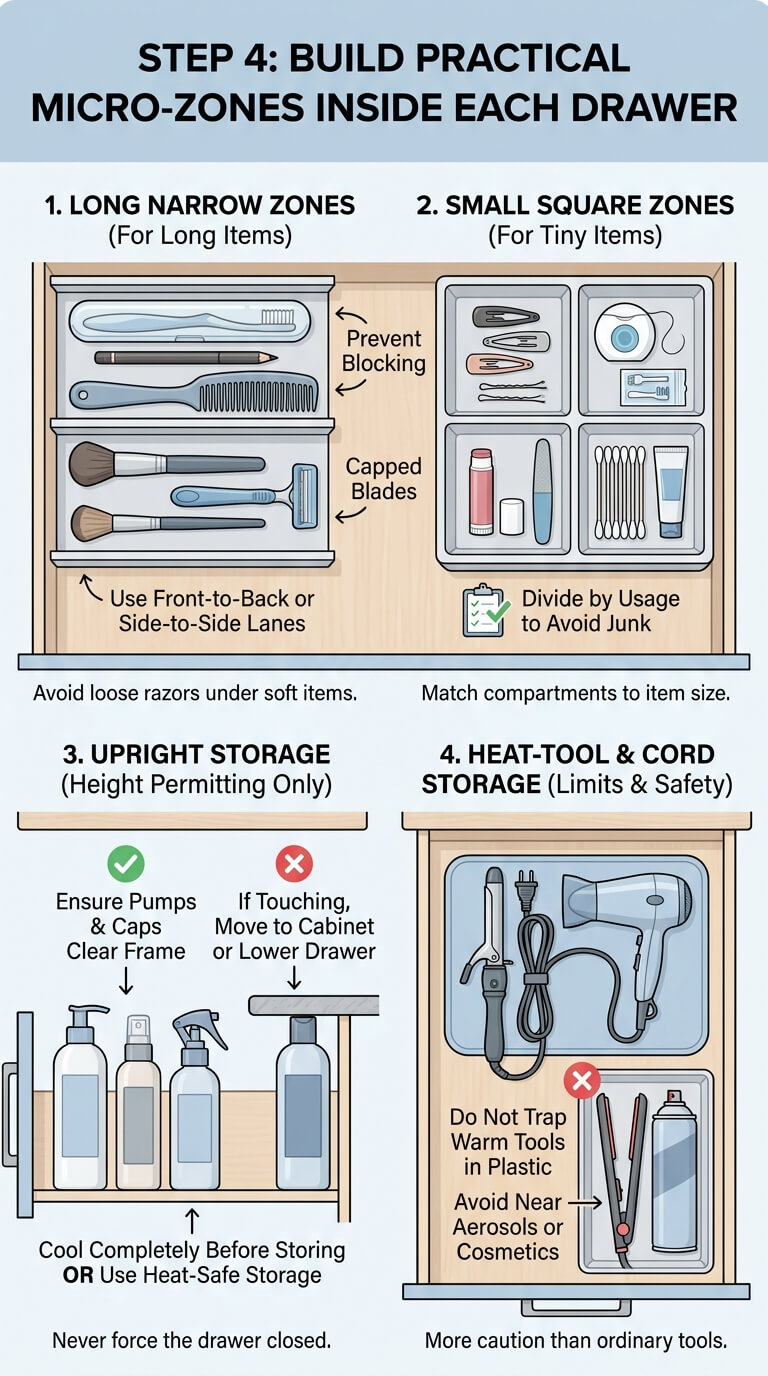
Micro-zones make the drawer usable during rushed routines. They are smaller than categories and more practical than labels. Instead of one large makeup zone, create a daily face lane, a lip corner, and a tool slot. Instead of one grooming zone, create a brush lane, razor slot, and tiny-item cup.
Long narrow zones for brushes and razors
Long items need their own lanes because they block everything else when placed diagonally. Put brushes, combs, razors, toothbrush cases, brow pencils, and narrow tubes in front-to-back or side-to-side lanes depending on drawer shape. Keep blades capped and do not let razors sit loose under soft items.
Small square zones for clips, floss, and tubes
Tiny items need small square or rectangular zones. Hair clips, floss, lip balm, nail files, replacement heads, cotton swabs, and short tubes become junk when they share one open tray. Divide them into compartments that match how they are used.
Upright storage for bottles only when height allows
Upright bottle storage can work in deeper drawers, but it should never force the drawer closed. Pumps, sprays, and caps need clearance. If a bottle touches the underside of the counter or drawer frame, it belongs in a cabinet, on a shelf, or in a lower drawer with more height.
Heat-tool and cord storage limits
Heat tools need more caution than ordinary grooming tools. A straightener, curling iron, hot brush, or small dryer should be cool before it goes into a drawer unless you have storage designed for heat. Do not trap a warm tool in plastic trays, near aerosols, or against cosmetics.
Step 5: Control Makeup, Skincare, and Samples
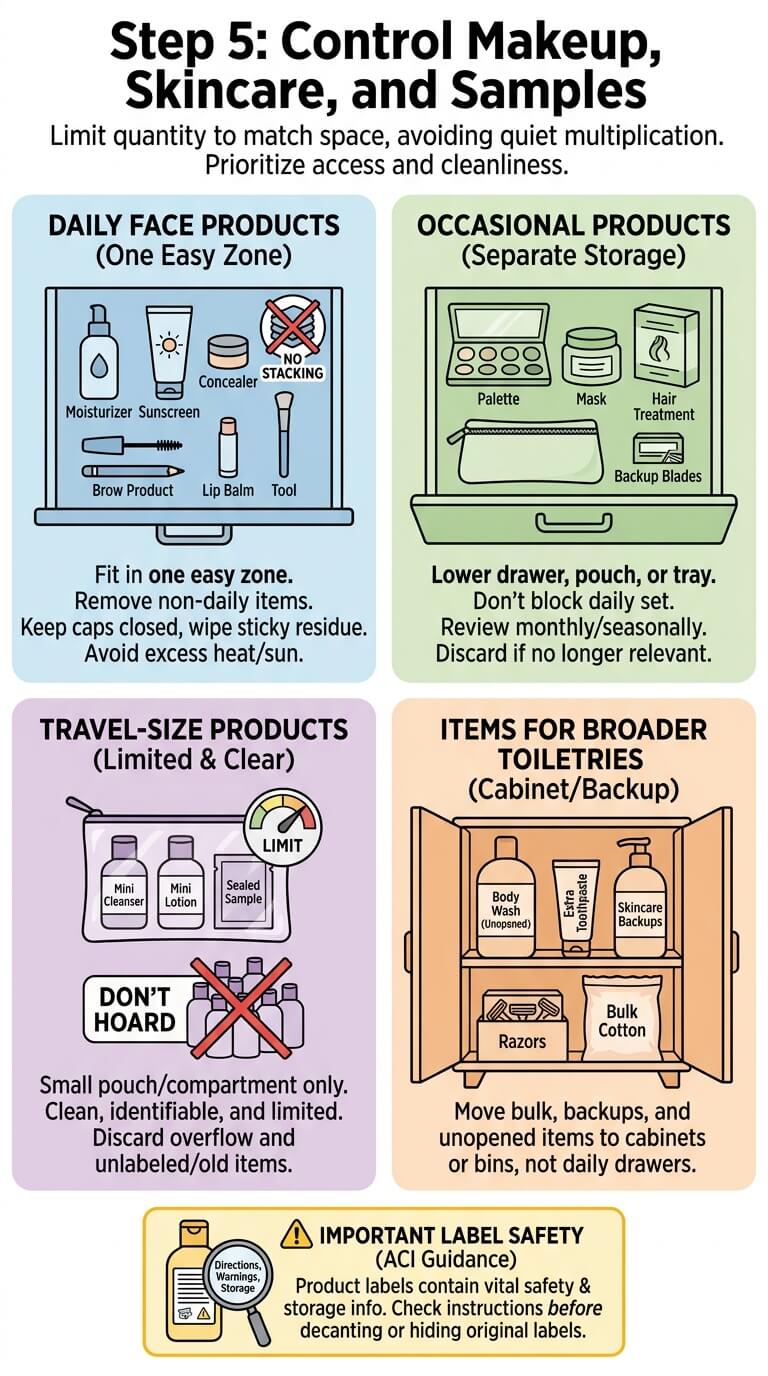
Makeup, skincare, and samples need limits because they multiply quietly. Drawer organization works only when the number of products matches the space. Keep daily products easy to reach, occasional products separate, and samples under a strict try-or-release rule.
Daily face products
Daily face products should fit in one easy zone. That might include moisturizer, sunscreen, concealer, mascara, brow product, lip balm, and one small tool. If the daily zone requires stacking, it is no longer a daily zone. Remove anything not used most days.
Keep caps closed and wipe sticky residue before returning products. Sticky tubes catch dust and make the entire drawer feel dirty even when the layout is good. Avoid storing products where they may be exposed to excess heat, humidity, or direct sun unless the label allows it.
Occasional products
Occasional products include special-event makeup, extra palettes, hair treatments, masks, backup blades, and tools used rarely. Give them a lower drawer, a pouch, or a clearly labeled tray. They should not block the everyday set.
Review occasional products monthly or seasonally. If a product was kept for a trip, event, or routine you no longer have, it may be stealing space from items you actually use. The goal is not minimalism for its own sake. The goal is a drawer that supports your real life.
Travel-size products
Travel sizes are useful only when they are clean, identifiable, and limited. Keep a small travel pouch or one compartment for sealed or clearly labeled minis. Do not keep every hotel bottle because it feels wasteful. Unlabeled or old products create confusion when you pack in a hurry.
If travel sizes overflow, choose the best few and discard or relocate the rest according to local disposal rules and product labels. A bathroom drawer is not the right place for a large travel archive.
Items that belong with toiletries instead
Some products belong in a broader toiletries system, not in daily drawers. Unopened body wash, extra toothpaste, replacement skincare, spare deodorant, sunscreen backups, unopened razors, and bulk cotton products are usually better in a cabinet, bin, or backup shelf.
The American Cleaning Institute explains that product labels include directions, warnings, ingredients, and storage information; its product label guidance is a useful reminder to check instructions before decanting, mixing, or moving products into containers that hide the original label.
Shared Bathroom Drawer Setups
Shared bathrooms need systems that survive real mornings. The best setup is the one everyone can follow while tired, late, or distracted. Keep the categories fewer, the zones larger, and the safety decisions more conservative than you would in a private bathroom.
One drawer per person
One drawer per person is the cleanest setup when the vanity has enough drawers. It gives each person a clear boundary and reduces arguments about who made the mess. Inside each drawer, still create zones for long items, tiny items, and daily products.
This setup works especially well for roommates, couples with different routines, and older children who can manage their own basics. It also makes product editing easier because duplicates are visible by person.
One routine per drawer
One routine per drawer is better when everyone shares the same items. A morning drawer, night drawer, hair drawer, and guest drawer may work better than assigning people separate spaces. This setup prevents one person from owning the top drawer while shared items scatter everywhere else.
Routine-based drawers should be labeled simply or arranged so the job is obvious. The morning drawer should not also hold vacation toiletries, loose backups, and guest supplies. When a routine drawer gets too crowded, remove the lowest-frequency items first.
Kid-safe and pet-aware drawer placement
Homes with children or pets need drawer placement that considers reach, curiosity, and small parts. Razors, medicines, strong products, sharp tools, and small swallowable pieces should not be placed in easy drawers just because the layout looks tidy. Move risky items higher, lock them if needed, or store them outside the bathroom.
Poison Control gives practical advice on household poisoning prevention, including keeping risky products out of reach and using child-resistant packaging properly. Review its poisoning prevention guidance if drawers are accessible to children, visitors, or pets.
Bathroom Drawer Mistakes to Avoid
Most drawer systems fail for predictable reasons. The drawer was not measured, the daily zone became a backup zone, or organizers were chosen because they looked neat before anyone checked how the products actually behave.
Keeping backups in daily drawers
Backups are useful, but they do not deserve the best drawer space. Keep one small refill limit for products used often. Move the rest to a cabinet, linen closet, or toiletries backup bin. If you keep every unopened product in the top drawer, the daily items will disappear again.
A quick check is to count how many unopened products are in the drawer. If unopened items outnumber current-use items, the drawer has become storage overflow instead of routine support.
Using organizers that waste depth
Some organizers look tidy but steal too much space. Thick plastic edges, small fixed compartments, and trays that do not reach the back can make a shallow drawer feel smaller. Before buying more, test the layout with cardboard strips, small boxes, or existing containers.
Adjustable dividers often solve awkward drawer shapes better than a one-piece insert. They let you keep long lanes for grooming items and wider spaces for products that change over time.
Ignoring product expiration and label limits
Organization does not make an old product worth keeping. Check expiration dates where available, period-after-opening symbols, texture changes, scent changes, separation, and packaging damage. Some products do not show a simple date, so the label and manufacturer information matter.
Also check drawer material limits. Adhesive bins, liners, and cleaning products can affect painted, laminated, wood, or coated drawer surfaces. When a vanity manual warns against certain cleaners or adhesives, follow that limit even if the organizer looks harmless.
Drawer surfaces, liners, and trays should match the vanity material. Before adding adhesive holders, screw-mounted dividers, or strong cleaners, check the brand manual or general manufacturer care instructions for finish limits and cleaning cautions.
Mixing wet items into dry drawers
Closed drawers should stay dry. Wet toothbrush covers, damp cloths, dripping razors, and products used in the shower can leave residue, odor, or swelling on some drawer materials. Let wet items dry somewhere appropriate before returning them to enclosed storage.
If a drawer repeatedly feels damp, stop adding organizers and find the cause. It may be wet hands, leaking product, poor ventilation, or an item that belongs in the shower or on an open tray instead.
Five-Minute Drawer Reset Plan
A drawer reset should be short enough to repeat. If the system needs a full reorganization every week, the layout is too complicated or the drawer is holding too much. Use a daily, weekly, and monthly rhythm to keep the drawer from sliding back into clutter.
Daily close-the-drawer reset
At the end of the morning or night routine, return loose items to their zones before closing the drawer. This should take less than thirty seconds. If it takes longer, the zones are too small, too crowded, or not matched to the routine.
A useful test is whether you can reset the drawer with one hand. If every item needs careful placement, simplify the compartments. Daily bathrooms need forgiving systems, not museum displays.
Weekly loose-item sweep
Once a week, remove anything loose that does not belong. Look for receipts, packaging, hair ties in the wrong zone, empty caps, product boxes, and random samples. Wipe crumbs, dust, or powder only as needed, then put the categories back without redesigning the whole drawer.
The weekly sweep is also a good time to check whether the drawer still opens smoothly. If it catches, something is too tall, a cord is trapped, or a tray has shifted.
Monthly product edit
Once a month, check the products that quietly multiply: makeup, skincare, samples, travel sizes, blades, and small grooming tools. Remove items that are expired, changed, unused, duplicated, or stored against label directions. Refill only the products you actually used.
Monthly editing protects the top drawer from becoming a hidden backlog. It also helps you stop buying duplicates because you can see what is already there.
FAQ
These answers focus on drawer-specific problems: top-drawer choices, low-cost dividers, makeup storage, and stopping daily drawers from turning into junk storage.
What should go in the top bathroom drawer?
The top bathroom drawer should hold the items used daily or nearly daily during morning and night routines. Good choices include floss, current toothpaste, contact lens items, lip balm, a razor, a comb, a few hair ties, daily skincare, or a small makeup set. Backups, travel items, bulky tools, and rarely used products should move to a lower drawer, cabinet, or toiletries bin.
How do I organize bathroom drawers without buying organizers?
Start with empty boxes, jar lids, small cups, clean takeout containers, or cardboard dividers as temporary zones. Sort items by shape and routine, then create one long lane for long tools, one small area for tiny items, and one daily product zone. Test the setup for a week before buying anything. If a temporary zone works, you can replace it later with a more durable organizer that matches the same size.
How do I organize makeup in a bathroom drawer?
Separate daily makeup from occasional makeup first. Keep the daily products in one easy tray or lane, such as concealer, mascara, brow product, lip product, and a small tool. Put palettes, special-event items, and extras in a lower drawer or pouch. Check product condition, storage instructions, and shelf-life clues before keeping old cosmetics in a warm or humid bathroom.
How do I stop bathroom drawers from becoming junk drawers?
Give each drawer one job and remove anything that does not support that job. Keep backups out of the top drawer, give tiny items real compartments, and do a weekly loose-item sweep. If random items keep returning, the drawer is probably serving too many people or too many routines. Split it by person, routine, or product shape until the reset feels easy.
Final Thoughts
Bathroom drawers stay organized when they match the way people actually get ready. Empty the drawer, sort by routine and shape, measure before buying dividers, and give daily items the easiest space. Keep backups, samples, risky products, and bulky tools out of prime drawers unless they truly belong there. A simple drawer with clear micro-zones will beat a crowded drawer full of perfect-looking organizers every time.

Ethan Carter is the Founder & Editor of HomeCleanSecrets. Based in the United States, he has 5 years of experience creating practical home cleaning, laundry care, stain removal, decluttering, and home organization content. His goal is to help everyday households clean smarter and build simple routines that are easier to maintain.
Read more about Ethan Carter on his author page: https://homecleansecrets.com/ethan-carter/