
Bathroom cabinets are easy to overload because they hide the mess behind a door. One shelf starts holding backup toothpaste, then a few cleaners, then extra towels, then bottles no one remembers buying. The best fix is not to buy a large set of matching bins right away. The better first step is to decide what your cabinets should do: hold overflow, protect products from daily clutter, keep plumbing visible, and make refills easy to find.

This guide focuses on enclosed bathroom storage: vanity cabinets, under-sink cabinets, tall linen-style cabinets, and wall cabinets. It does not replace a drawer system for tiny daily items, a full small-bathroom layout, or a detailed towel-folding guide. You will build clear cabinet zones, leave room around pipes, separate cleaners from personal-care products, and create a reset routine that keeps the cabinet usable after normal busy weeks.
Quick Answer: The Best Bathroom Cabinet Setup
Bathroom cabinets work best when they fit cabinet storage into the bigger bathroom system instead of holding every product that lacks a home.
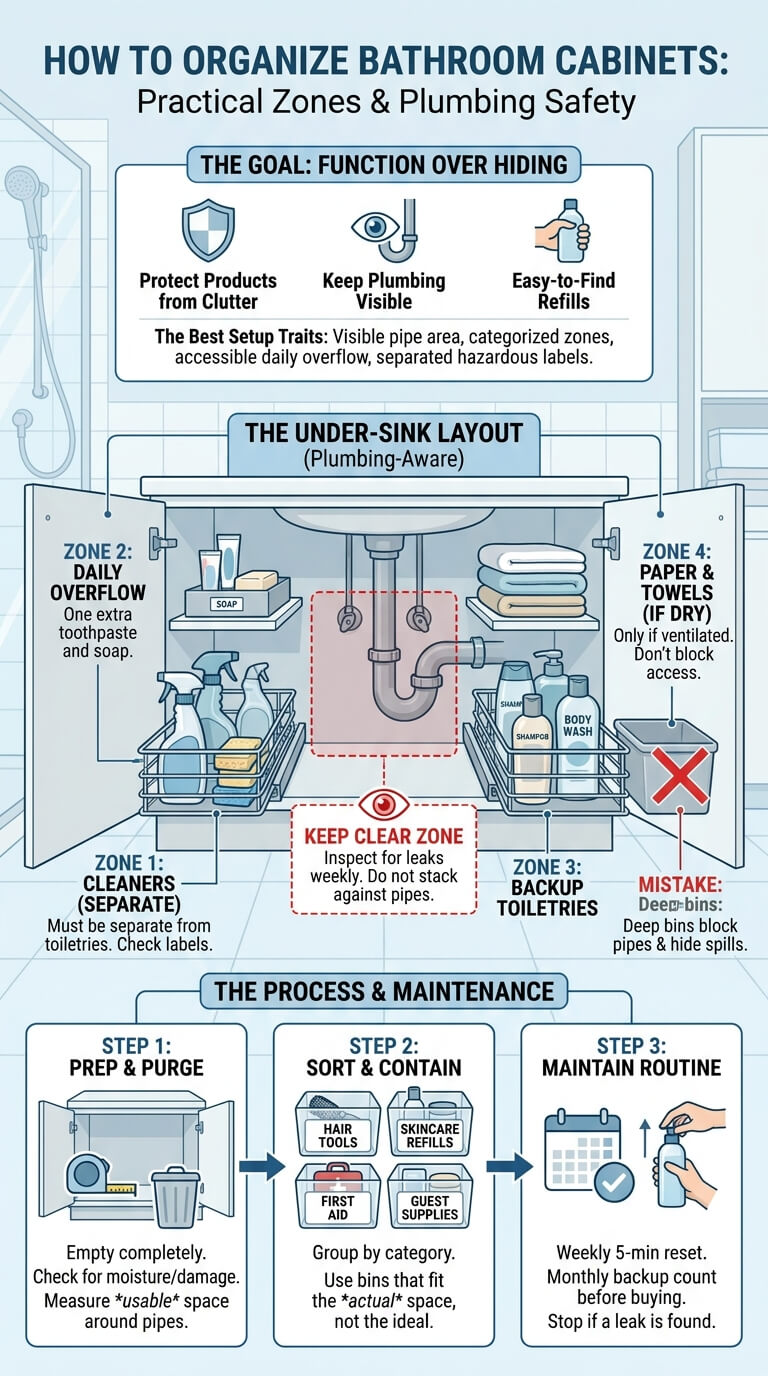
A strong bathroom cabinet setup has four traits: the pipe area stays visible, each category has a container or shelf zone, daily overflow is easier to reach than backups, and anything with a label warning is separated from toiletries. Before you buy organizers, empty the cabinet, remove what does not belong, measure the clear space, and choose bins or risers that fit the actual cabinet instead of the ideal version of the cabinet.
What belongs in bathroom cabinets
Bathroom cabinets are best for items that are useful in the bathroom but do not need to sit on the counter. Good candidates include unopened toiletries, spare soap, extra toilet paper, hair tools, shaving refills, guest supplies, first-aid overflow, cleaning supplies that are safe to store there, and a limited number of towels if the cabinet stays dry. A good test is simple: if you need it weekly or monthly, a cabinet is usually fine. If you grab it with wet hands every morning, a drawer, tray, or open shelf may work better.
What should move to drawers, shelves, or another room
Small daily-use items often work better when you move small daily-use items into bathroom drawers instead of letting them disappear behind taller products.
Cabinets are not ideal for every bathroom item. Tiny daily tools, makeup used every morning, toothbrushes, loose hair ties, nail clippers, and contact lens cases usually work better in drawers because they are shallow and easy to scan. Wet shower products belong in the shower zone, not in a closed cabinet while damp. Bulk warehouse-sized backups may belong in a hall closet, laundry area, or labeled storage bin outside the bathroom if they crowd the vanity.
When to Use This Cabinet Guide
This guide is right when the main problem is hidden storage behind cabinet doors. It helps most when you can close the cabinet today, but you cannot find anything quickly, notice spills too late, or keep buying duplicates because backups disappear in the back.
Vanity cabinets and under-sink cabinets
Vanity cabinets and under-sink cabinets need a different layout from ordinary shelves because plumbing interrupts the space. Pipes, valves, traps, and hoses reduce the usable height and depth. The pipe zone should stay easy to see and reach. Do not build a storage wall in front of it just to gain a little space.
Tall cabinets and wall cabinets
Tall cabinets and wall cabinets are useful for backups, extra towels, guest supplies, and less-used personal care items. Their main weakness is depth. The back of the cabinet becomes a hiding place unless every deep shelf has a front-to-back category. Put lighter items higher and frequently used items at chest or waist height whenever possible.
What this guide does not cover
This cabinet method will not go deep into drawer dividers, shower caddies, medicine routines, or full bathroom cleaning. It also does not explain plumbing repair, mold remediation, tile cleaning, toilet cleaning, or sink drain work. If you discover an active leak, swollen cabinet floor, strong musty smell, or repeated dampness, the organizing project should stop until the underlying issue is handled.
Step 1: Empty the Cabinet and Check the Space
If the cabinet is already full, declutter bathroom products before adding organizers so expired bottles, duplicates, and unwanted samples do not take up the new layout.
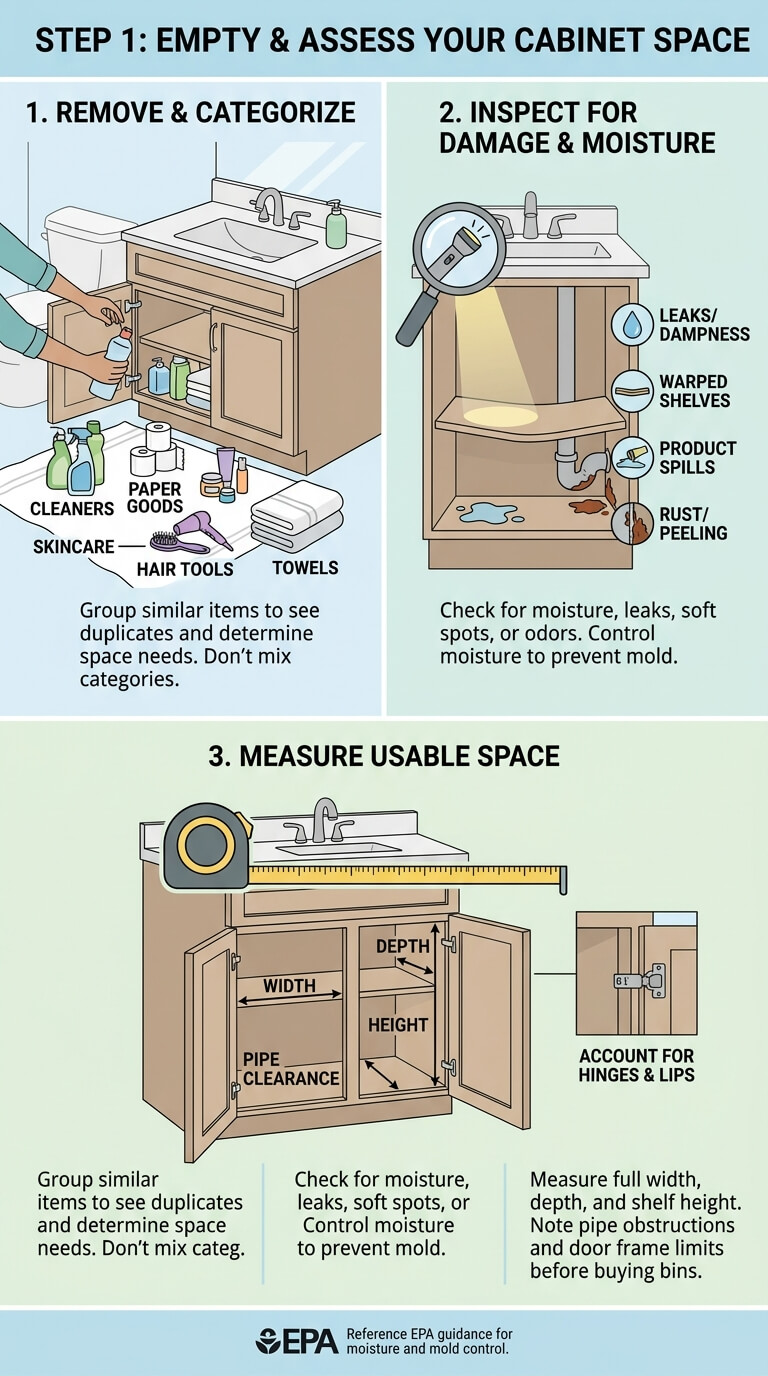
Emptying the cabinet is the fastest way to see what is actually happening. A cluttered cabinet often looks like a storage problem, but the real issue may be duplicates, damp towels, product leaks, poor pipe access, or organizers that are too deep.
Remove everything without mixing categories
Place items on a towel, table, or floor area in rough groups as they come out. Keep cleaners with cleaners, paper goods with paper goods, skincare with skincare, hair tools with hair tools, and towels with towels. Do not make one giant pile. Category groups show duplicates immediately and help you decide how much space each group deserves.
Check for moisture, leaks, warped shelves, and product spills
Before putting anything back, inspect the cabinet floor, back corners, around pipe openings, and under bottles. Look for peeling surface material, swollen particleboard, rust marks, sticky residue, soft spots, musty odor, or dust that looks darker near a pipe. A good test is to run a dry paper towel along the cabinet floor near plumbing. If it comes away damp or stained, stop the storage plan until you know why.
Moisture can turn a tidy cabinet into a damage problem. The EPA explains that controlling moisture is central to limiting mold growth indoors, so bathroom storage should not hide damp areas or trap wet textiles in closed spaces. Read the agency’s moisture and mold guidance before ignoring repeated dampness.
Measure usable height, depth, and pipe clearance
Measure the cabinet before buying bins. Record the full width, usable depth, shelf height, and the clear space on each side of plumbing. Measure from the door frame inward, not only from the back wall, because hinges and door lips can block wide containers. Note whether a bin can slide out straight or needs to clear a pipe, lip, or center divider.
Step 2: Sort Cabinet Items by Zone
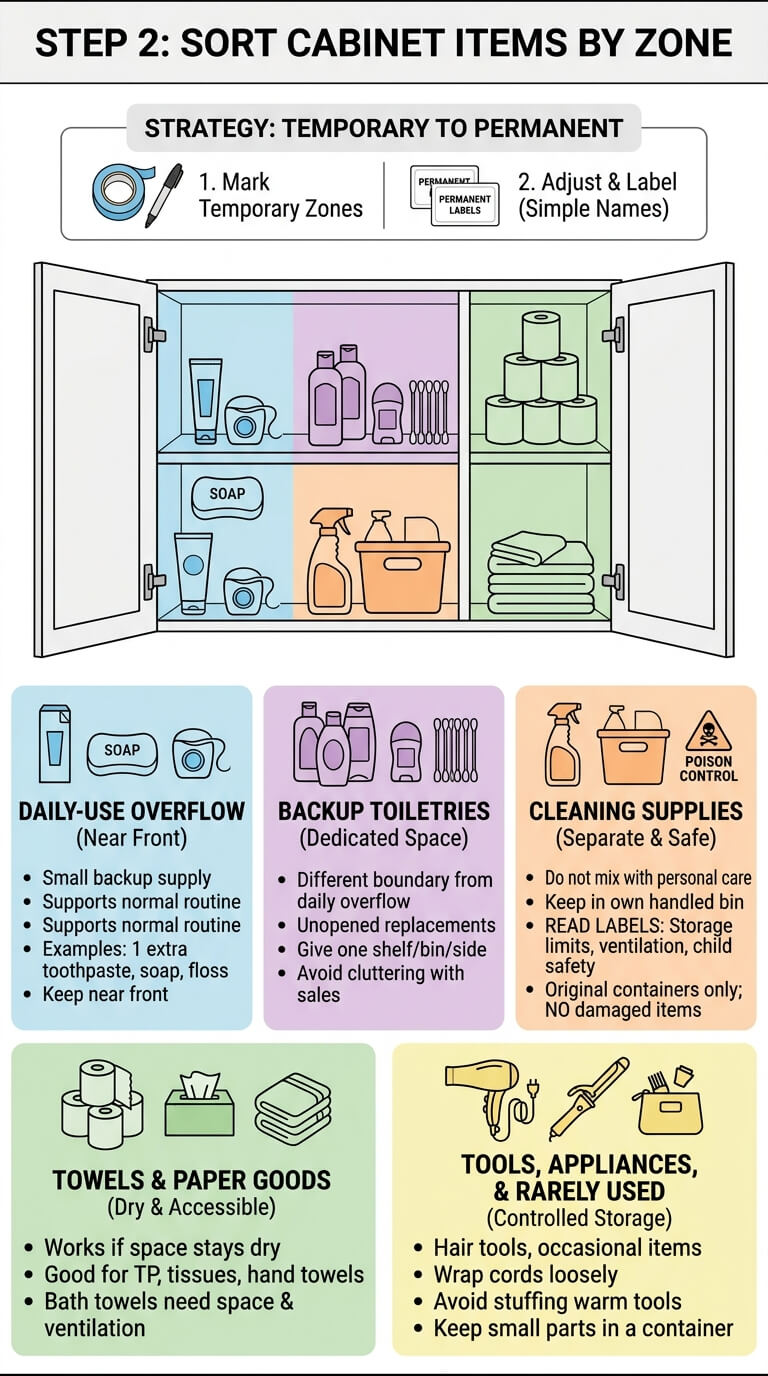
A small strip of painter tape can help during the first week. Mark each temporary zone before making permanent labels, then adjust after you see what people actually reach for and where items naturally return.
Cabinet zones keep hidden storage from becoming a mystery. The zones do not need fancy labels, but they should be obvious enough that someone can put items back without asking. Use simple names such as refills, hair tools, paper, guest, cleaners, towels, and occasional.
Daily-use overflow
Daily-use overflow is the small backup supply that supports your normal routine without living on the counter. Examples include one extra toothpaste, one extra soap, extra floss, a backup razor pack, contact solution, cotton rounds, or a hair product used often but not every day. Keep this zone near the front of the cabinet.
Backup toiletries
Before assigning shelves, group toiletries by daily use and backup stock so the cabinet does not become mixed storage.
Backup toiletries need a different boundary from daily overflow. These are unopened products that replace items later: shampoo, conditioner, body wash, deodorant, toothpaste, razors, cotton swabs, and lotion. Give backups one shelf, one bin, or one side of a cabinet. Do not let every sale purchase enter the bathroom automatically.
Cleaning supplies with label limits
Cleaning supplies should not be mixed casually with personal-care products. Keep them in their own handled bin, away from towels, skincare, medicine, and toothbrush supplies. Read labels before deciding where to store them. Some products have storage limits, ventilation warnings, child safety instructions, or directions about keeping containers tightly closed.
Poison Control gives practical safety advice for household cleaning products, including keeping products in original containers and avoiding risky mixing. Their cleaning product safety guidance is a useful reminder that a neat cabinet still needs safe separation. If a cleaner leaks, smells strong, or has a damaged cap, do not place it back in the cabinet.
Towels and paper goods
Towels and paper goods can work in a cabinet if the space stays dry and the stack does not block access. Toilet paper, tissues, and extra hand towels are usually good cabinet items. Bath towels take more space, so they belong only if the cabinet has enough depth and ventilation for them to stay fresh between uses.
Tools, appliances, and rarely used items
Hair dryers, curling tools, trimmers, travel bags, extra hooks, small first-aid overflow, and occasional grooming tools need controlled storage. Wrap cords loosely and avoid stuffing warm tools into a closed bin. Keep small attachments in a pouch or container so they do not disappear behind pipes.
Step 3: Build a Plumbing-Aware Under-Sink Layout
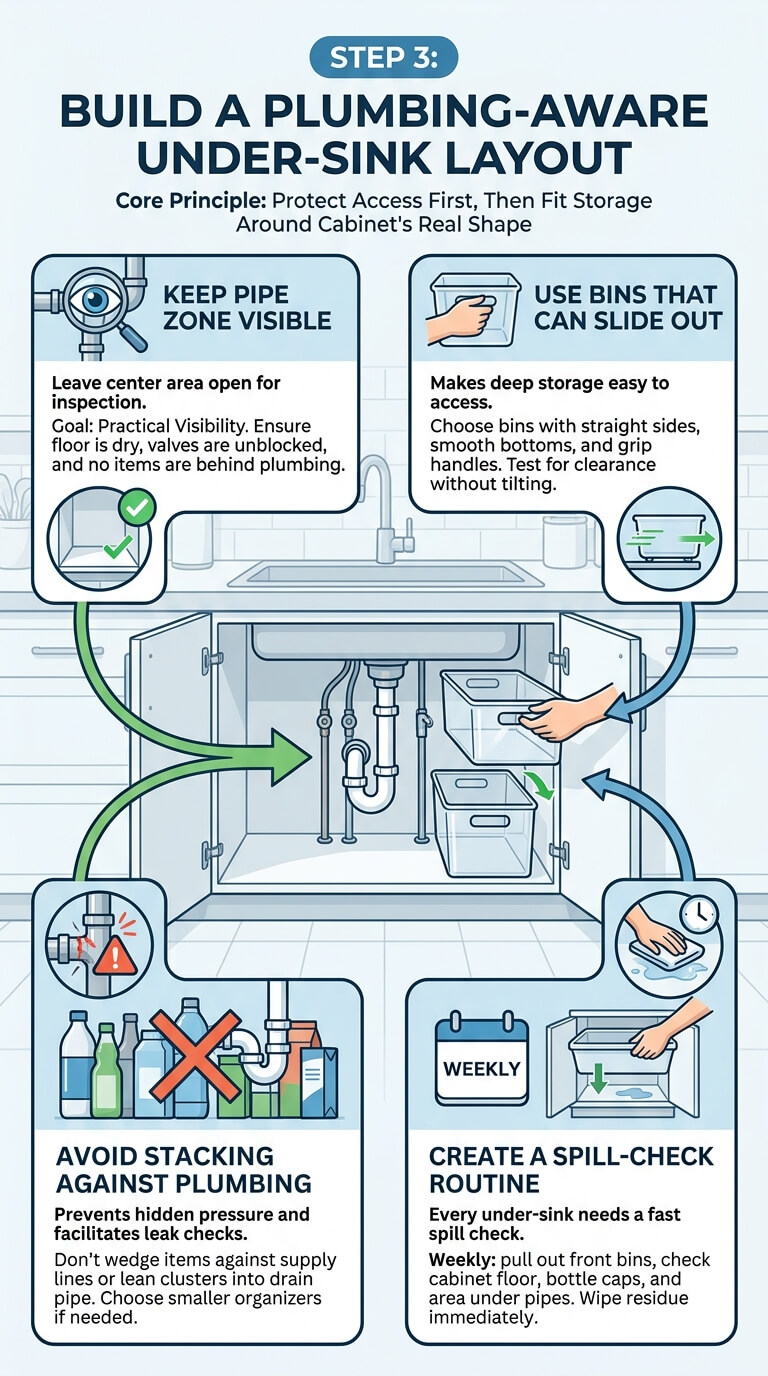
The under-sink cabinet is often the hardest cabinet to organize because the space is uneven. The smartest layout protects access first, then fits storage around the real shape of the cabinet.
Keep the pipe zone visible
Leave the center pipe area open enough to inspect. The goal is not empty space for appearance. The goal is practical visibility. You should be able to open the door and see whether the cabinet floor is dry, whether a valve area is blocked, and whether a bottle has tipped behind the plumbing.
Use bins that can slide out
Slide-out bins make deep under-sink storage easier because you can remove a full category at once. Choose bins with straight sides, smooth bottoms, and handles you can grip. Test the bin before loading it. It should clear the door frame and plumbing without tilting.
Avoid stacking items against plumbing
Stacking around pipes creates hidden pressure and makes leak checks harder. Do not wedge toilet paper, cleaning bottles, or towel rolls against supply lines. Avoid tall bottle clusters that lean into the drain pipe. If an organizer touches plumbing, choose a smaller one.
Create a spill-check routine
Every under-sink cabinet needs a fast spill check. Once a week, open the doors, pull out the front bins, and look at the cabinet floor. Check bottle caps, cleaner bases, and the area under pipes. Wipe minor product residue before it spreads.
Step 4: Use Cabinet Organizers Without Overbuying
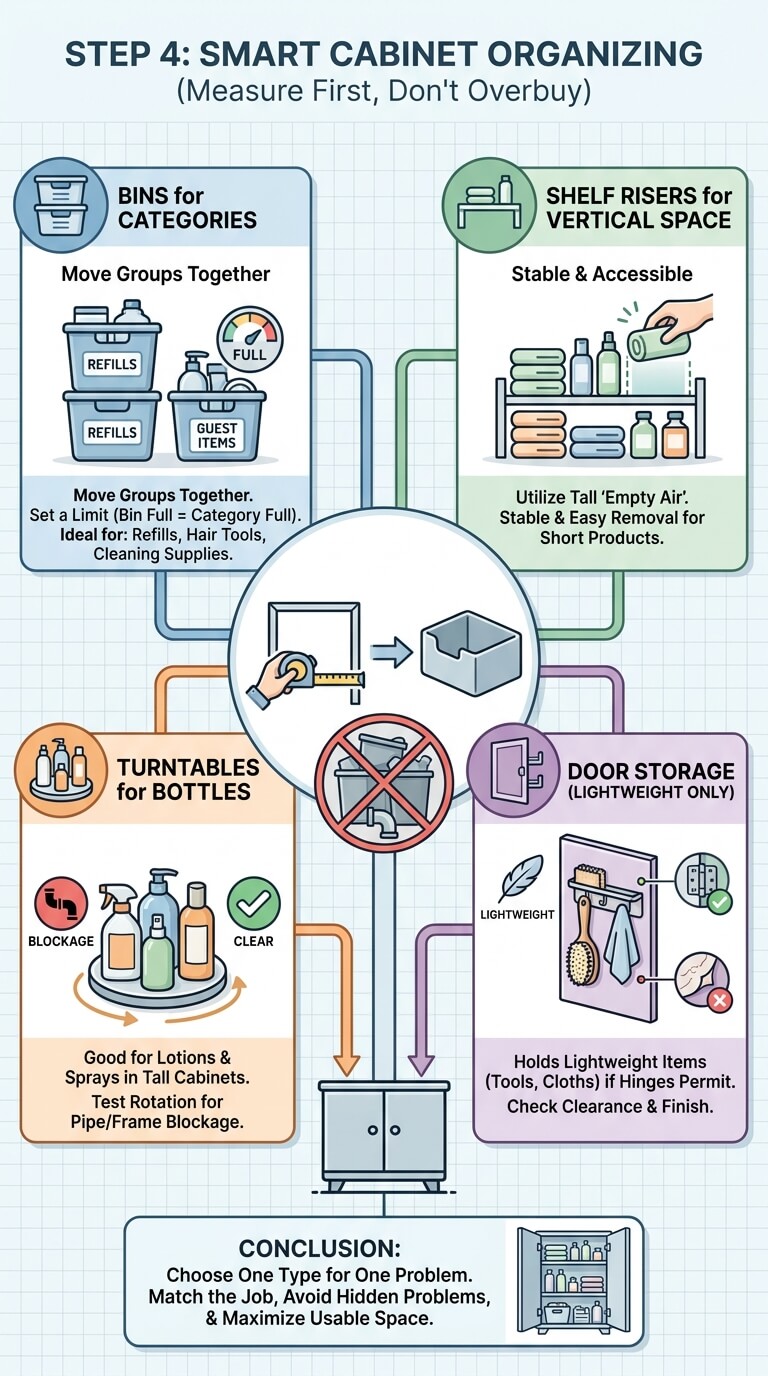
Organizers should match the cabinet’s job. Buying a set before measuring often causes a new problem: pretty bins that hide too much, block pipes, or waste vertical space. Choose one organizer type for one problem at a time.
Bins for categories
Bins are useful when a group of items needs to move together. Create bins for refills, hair tools, cleaning supplies, guest items, paper goods, and occasional products. Give each bin a limit. When the bin is full, the category is full.
Shelf risers for vertical space
Shelf risers help when a cabinet has tall empty air above short products. Use them for small towels, paper goods, or rows of shorter bottles. A riser should feel stable and leave enough height to remove items without scraping.
Turntables for bottles
Turntables can work for lotions, sprays, hair products, or bottles in a tall wall cabinet. They are less useful when pipes, door frames, or shelf lips block rotation. Test the turntable with the tallest bottle before committing.
Door storage and when to skip it
Cabinet door storage can hold lightweight items such as hair tools, brushes, small cleaning cloths, or spare rolls if the door and hinges can handle it. Before adding an over-door rack or adhesive holder, close the door slowly and check whether it hits plumbing, shelves, or bins.
Skip door storage when the finish is delicate, the hinge feels loose, or the rack would make the door swing heavily. Check the cabinet maker or vanity brand before using adhesive holders, screw-mounted racks, or harsh cleaning products; a general example is reviewing care and cleaning instructions for finish limits and surface care.
Step 5: Set Up Cabinets by User and Routine
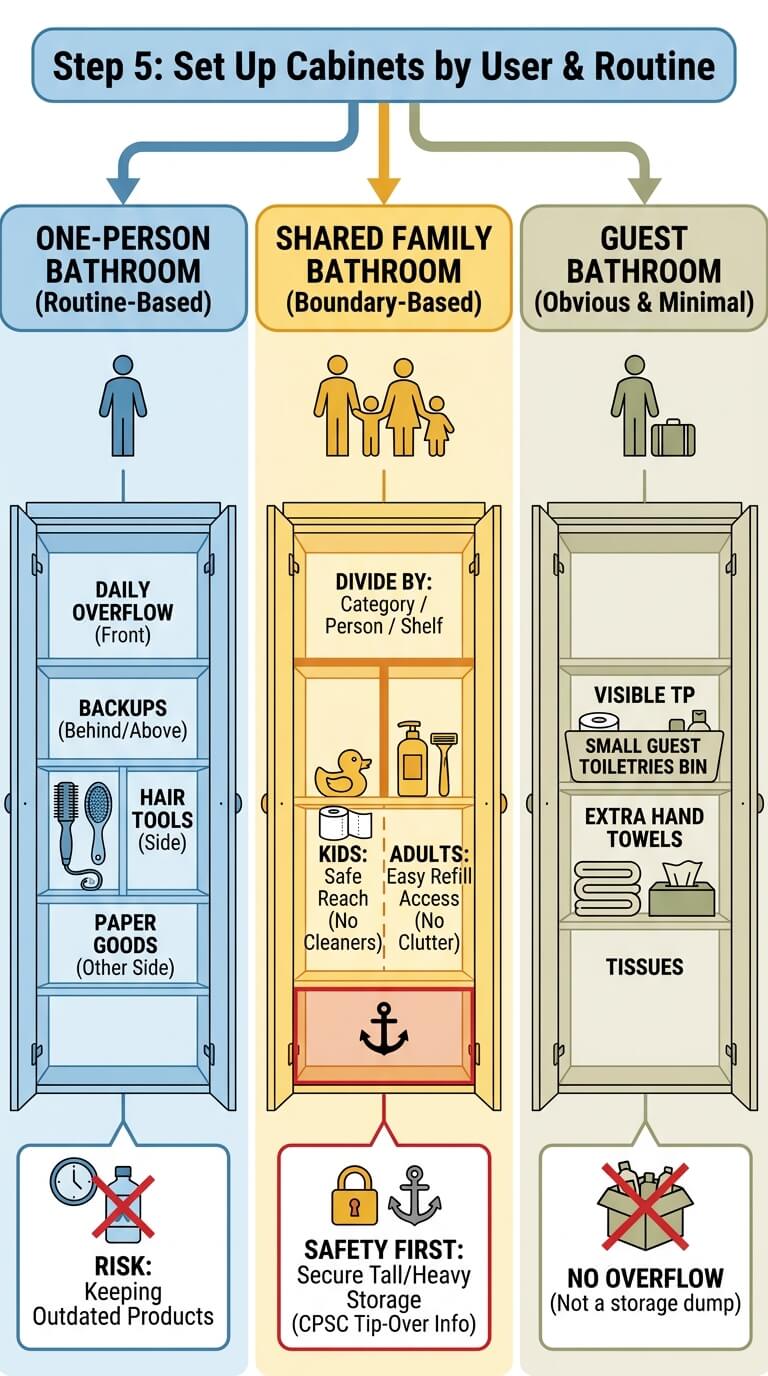
The same cabinet can need a different layout depending on who uses the bathroom. A one-person bathroom can be arranged by routine. A family bathroom often needs clearer limits. A guest bathroom should be obvious and minimal.
One-person bathroom cabinets
A one-person cabinet can be simple: daily overflow in front, backups behind or above, hair tools on one side, paper goods on the other, and cleaners in a separate bin if stored there. The biggest risk is keeping products that no longer match your current routine.
Shared family bathroom cabinets
Shared cabinets need boundaries because everyone reaches for the same hidden space. Divide by category, person, or shelf depending on the problem. Children should not need to move cleaners to reach toilet paper. Adults should not have to dig through toys, hair supplies, and expired products to find a refill.
Homes with children, pets, or frequent guests need secure storage instead of back-corner hiding. Tall cabinets, freestanding shelves, and heavy organizers also deserve caution; the CPSC shares practical tip-over safety information for furniture that could be pulled, climbed, or overloaded.
Guest bathroom cabinets
A guest bathroom cabinet should be easy to understand without explanation. Keep visible toilet paper, a small guest toiletries bin, extra hand towels, tissues, and a simple cleaning cloth or spray only if safe and appropriate for that bathroom. Do not use the guest cabinet as overflow for every product you do not want in the main bath.
Small bathroom cabinets with limited depth
Small or shallow cabinets need stricter limits. Choose narrow bins, short product rows, and fewer backups. Do not store bulk toilet paper, large towel stacks, or duplicate bottles in a tiny vanity if they block the only usable shelf.
Cabinet Safety and Product Limits
Bathroom cabinets sit near water, heat, children, pets, personal-care products, and sometimes electrical grooming tools. Organization should reduce confusion and risk. A neat layout still fails if it hides products in unsafe places or ignores care instructions.
Separating cleaners from personal-care products
Cleaners should have their own clearly defined area. Keep them upright, capped, and in original containers. Do not place cleaners in the same bin as skincare, medicine, toothbrush supplies, cotton rounds, or towels. If space is tight, move cleaners to a different secure location rather than blending categories.
Medicine and child/pet access concerns
Medicine storage needs caution because bathrooms can be humid and easy for others to access. Follow the label and pharmacy instructions for temperature, moisture, and child-resistant storage. If the label says cool and dry, a steamy bathroom cabinet may not be the best place.
Reading labels, manuals, and cabinet care instructions
Product labels tell you how to store cleaners, medicine, personal care items, and aerosols. Cabinet manuals or care instructions tell you what surfaces can tolerate. Read both before adding adhesive organizers, harsh cleaners, heavy bins, or moisture-prone items.
Bathroom Cabinet Mistakes to Avoid
Most cabinet systems fail because they look good on reset day but ignore how people actually use the bathroom. The mistakes below are common because they feel efficient at first.
Hiding expired products in back corners
The back corner is where products go to be forgotten. Avoid storing small bottles, samples, medicine, or half-used toiletries loose in deep corners. They will not be used, and they will make the cabinet feel full even when the useful supply is low.
Buying deep bins that block pipes
Deep bins seem efficient, but they can block plumbing and hide spills. Under a sink, two smaller side bins usually work better than one large center bin. Measure around pipes before buying anything.
Storing too many towels in a damp cabinet
Towels need enough air and dryness to stay fresh. A closed cabinet packed with towels may trap humidity, especially in a bathroom with poor ventilation or frequent showers. Keep only the number of towels that fit without being crushed.
Treating cabinets like junk storage
Bathroom cabinets should not absorb every item that lacks a better home. Random candles, old makeup bags, spare hardware, hotel samples, broken tools, empty boxes, and mystery cords make the cabinet harder to use.
Maintenance Plan for Organized Cabinets
Organized cabinets stay that way when the reset is small enough to repeat. Do not wait for the cabinet to collapse into clutter. Short checks work better than rare full cleanouts.
Weekly five-minute reset
Once a week, open the cabinet and correct the obvious issues. Put loose items back in bins, stand bottles upright, remove empty packaging, check the under-sink floor, and make sure the pipe zone is still visible. This should take five minutes or less.
Monthly backup count
Once a month, count backups before shopping. Check toothpaste, soap, shampoo, toilet paper, razors, cotton products, and cleaning supplies. Write down what is actually low. This prevents duplicate buying and keeps the backup zone from spreading.
Seasonal product review
Several times a year, do a deeper product review. Remove items that are expired, separated, disliked, damaged, or no longer part of your routine. Check towels for freshness, inspect cabinet surfaces, and confirm that organizers still fit the way you use the bathroom.
FAQ
These answers focus only on cabinet storage decisions, especially what belongs behind doors, how to handle depth, and how to stop the same clutter from returning.
What should I store under a bathroom sink?
Store items that can handle enclosed storage and do not need constant counter access: extra toilet paper, a small refill bin, hair tools, cleaning supplies in a separate handled bin, guest items, and selected backups. Keep the plumbing area visible and avoid storing paper goods directly where a drip would be hidden.
Should towels go in bathroom cabinets?
Towels can go in bathroom cabinets when the cabinet stays dry, has enough room, and the towels do not smell stale between uses. Keep a small practical stack near the bathroom and store extra towels elsewhere if the cabinet is shallow, damp, or already crowded.
How do I organize a deep bathroom cabinet?
Deep cabinets need slide-out categories. Use bins that pull out fully, keep small products contained, and avoid loose items in back corners. Put less-used backups deeper only when they are grouped in a removable bin. Keep daily overflow near the front so the cabinet does not have to be unpacked every morning.
How do I keep bathroom cabinets from getting cluttered again?
Give each category a fixed limit and reset the cabinet weekly. Count backups before shopping, remove empty packaging right away, and do not let new products enter unless they fit an existing zone. When a bin overflows, declutter the category before buying another organizer.
Final Thoughts
The easiest way to organize bathroom cabinets is to treat them as practical support storage, not a hidden dumping ground. Keep the pipe zone visible, separate cleaners from personal-care items, limit backups, and choose organizers only after measuring the real cabinet. When each shelf or bin has a clear job, the cabinet becomes easier to use and much easier to reset.

Ethan Carter is the Founder & Editor of HomeCleanSecrets. Based in the United States, he has 5 years of experience creating practical home cleaning, laundry care, stain removal, decluttering, and home organization content. His goal is to help everyday households clean smarter and build simple routines that are easier to maintain.
Read more about Ethan Carter on his author page: https://homecleansecrets.com/ethan-carter/