
A window is more than a sheet of glass. Glass, frames, tracks, sills, screens, hardware, and treatments collect different soil and require different care. The right method depends on the component, material, residue, and safe access.

Quick Orientation: What Counts as the Window System?

Glass, frame, track, sill, screen, and hardware
The glass pane is the most visible surface, but the surrounding frame, moving sash, locks, hinges, cranks, weatherstripping, and drainage features also need attention. Materials may include wood, vinyl, fiberglass, composite, aluminum, and coated finishes.
The interior ledge may be called a sill, stool, or ledge. It can be painted wood, finished wood, stone, tile, vinyl, or another material. Screens include both mesh and a supporting frame, with different moisture and pressure limits.
Blinds, curtains, roller shades, and other treatments
Window treatments bring separate material decisions. Blinds use slats or vanes. Curtains are hanging textiles. Roller shades use one continuous sheet attached to a tube. Each may include cords, coatings, linings, adhesives, or motorized parts.
Check the care label, model information, and construction before adding moisture, even when a fabric appears washable.
Sliding glass doors as a related multi-component system
A sliding glass door combines large panes with a frame, handles, locks, weatherstripping, a threshold, and a track near concealed rollers. Clean it as a door assembly because excess liquid or grit can affect movement.
Why Window Cleaning Requires More Than One Method
Ordinary dust, fingerprints, grease film, sticky residue, and mineral buildup
Dry dust and hair respond best to vacuuming, brushing, or wiping before liquid is added. Fingerprints and household film need a compatible cleaner used sparingly with a clean, lint-free tool.
White rings, cloudy spots, or rough marks may be mineral deposits from sprinklers, runoff, or repeated wetting. If ordinary cleaning removes surface film but leaves distinct spots, assess the deposit instead of repeating the same pass.
Fixed versus removable parts
A removable curtain may be cleaned away from the window when its label and hardware permit. Roller shades usually stay attached. Screens may be fixed or removable, and a sash should tilt or release only when its instructions allow it.
Material, coating, and access limits
Clear glass, exposed coatings, applied films, acrylic panels, stone, painted wood, and coated fabrics do not share one universal cleaner. The National Glass Association guidance on architectural glass warns that certain glass types need different procedures.
Access can make an otherwise simple method unsafe. Do not lean from upper windows, stand on furniture, reach across roofs, or work near electrical lines. Use an approved inward-cleaning feature, a controlled ground-based tool, or professional service.
The Window-Care Framework
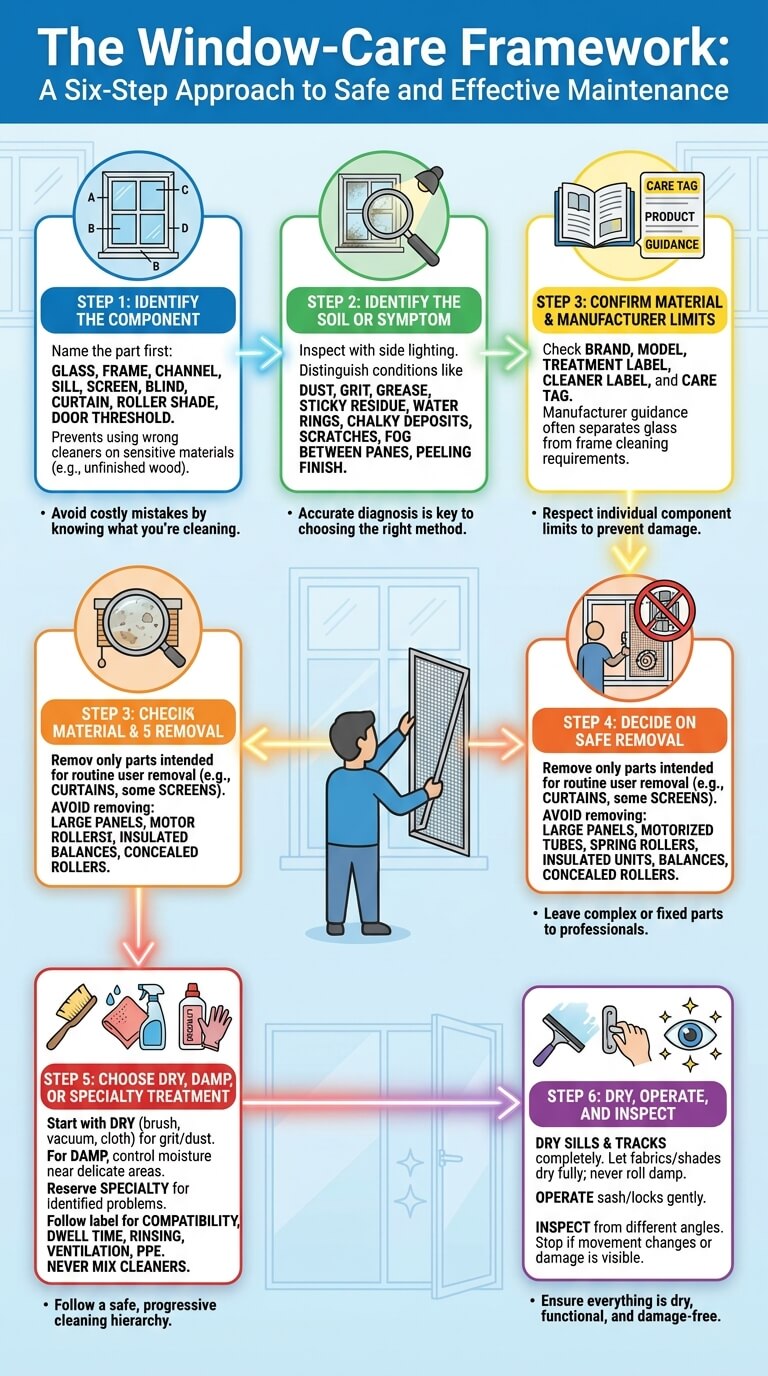
Step 1: Identify the component
Name the part before choosing a tool: glass, frame, channel, sill, screen, blind, curtain, roller shade, or door threshold. This prevents mistakes such as spraying glass cleaner on unfinished wood or pushing wet debris deeper into a track.
Step 2: Identify the soil or symptom
Inspect under side lighting. Dust, grit, grease, sticky residue, water rings, chalky deposits, scratches, fog between panes, and peeling finish are different conditions. A rough deposit differs from haze sealed between panes.
Step 3: Confirm material and manufacturer limits
Check the brand, model, treatment label, cleaner label, and care tag. Manufacturer guidance often separates glass from frame cleaning. Andersen provides care and maintenance instructions for windows, doors, hardware, and screens, showing why each component needs its own limits.
Step 4: Decide whether the part can be removed safely
Remove only parts intended for routine user removal. Curtains and some screens may qualify. Large door panels, motorized tubes, spring rollers, insulated glass units, balances, and concealed rollers do not.
Step 5: Choose dry, damp, or specialty treatment
Start with dry methods for grit, hair, insects, and dust. Use a soft brush, low-suction vacuum attachment, or lint-free cloth. For damp work, control moisture and apply product to the cloth near locks, motors, joints, and tracks.
Reserve specialty treatment for a clearly identified problem. Follow the product label for compatibility, dwell time, rinsing, ventilation, and protective equipment. Never mix cleaners.
Step 6: Dry, operate, and inspect
Dry sills and tracks, let fabric or shades dry fully, and never roll a damp shade. Then operate the sash, lock, handle, or door gently and inspect from different angles. Stop if movement changes or damage becomes visible.
Decision Tree: Which Cleaning Guide Do You Need?

Clear ordinary film but prevent streaks
Use a focused glass process for fingerprints, light grease, dust, or cleaner marks on safely reachable panes. Control product amount, use clean tools, and inspect the edges. Persistent distinct spots may be mineral deposits or damage.
Remove debris from window tracks
Use a track process for grit, insects, hair, or mud in sash channels. Vacuum and brush first, then use minimal moisture. If movement remains difficult, investigate weatherstripping, corrosion, alignment, balances, or other mechanical causes.
Match a sill method to its material
Identify the sill material before wet cleaning. Painted or sealed wood needs little moisture; natural stone may be acid-sensitive. Vinyl, tile, composite, and metal have separate scratch, stain, and corrosion concerns. Peeling or swelling is damage.
Choose care for curtains, blinds, screens, or roller shades
Curtains follow fabric and care-label limits. Blinds need slat-safe dust removal, screens need mesh support, and roller shades need controlled cleaning while the sheet and mechanism are protected.
For treatments with cords, consider safety during and after cleaning. The U.S. Consumer Product Safety Commission window-covering guidance recommends cordless options where young children are present and warns about accessible loops.
Clean a sliding glass door system
Use a door-focused sequence for large panes, handles, frame edges, weatherstripping, the threshold, and the accessible track. Remove dry debris first, keep liquid away from locks and rollers, dry fully, and test movement without force.
Diagnose stubborn mineral spots
Use a mineral-deposit process when ordinary cleaning leaves white spots, cloudy rings, or bonded film. Confirm coatings, protect nearby materials, and use a compatible labeled product. Stop if the area appears etched, scratched, or permanently dull.
Plan safe exterior access
Exterior work starts with reach, weather, ground conditions, and electrical hazards. Ground-level glass and approved inward-tilting sashes may be manageable. Upper stories, slopes, roof edges, balcony exteriors, and overreaching call for professional service.
A Safe Cleaning Order for the Whole Window Area
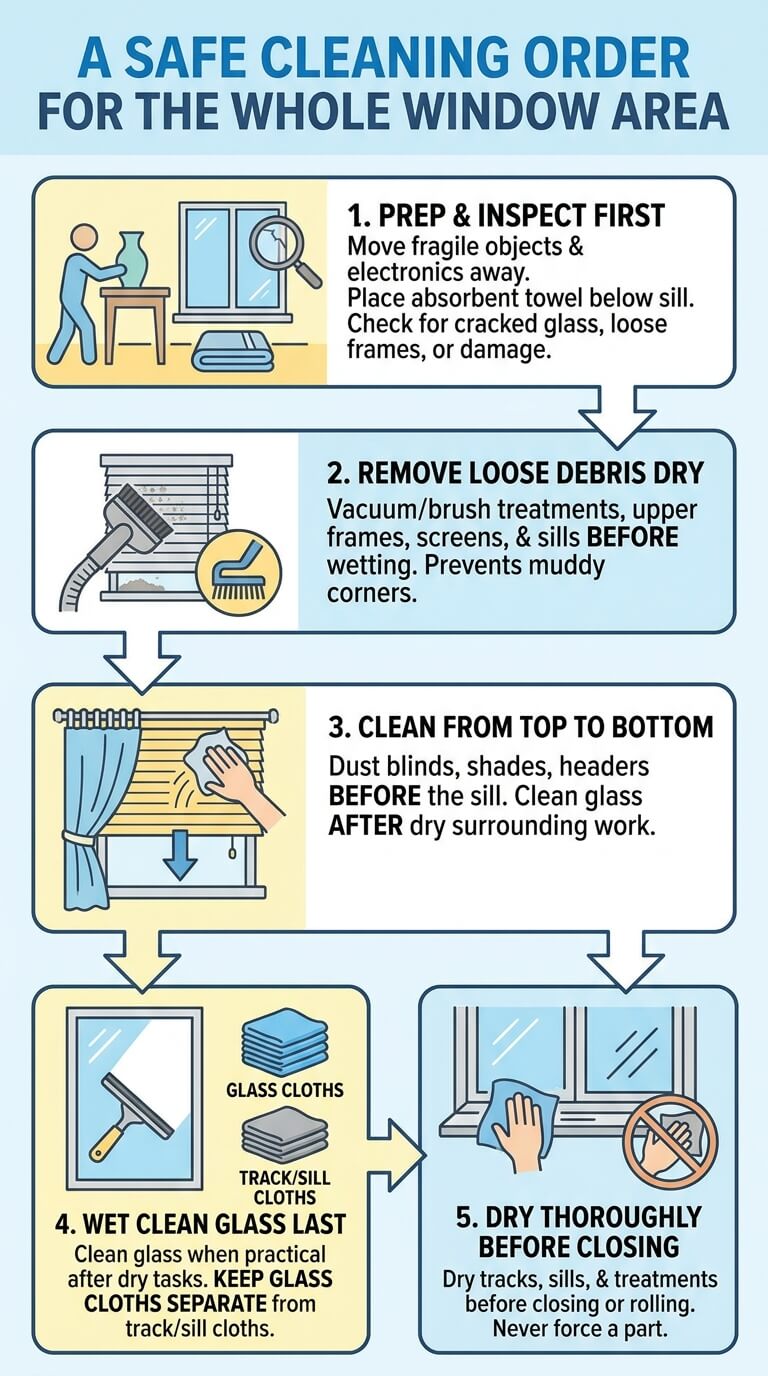
Protect the room and inspect for damage
Move fragile objects and electronics away. Place an absorbent towel below the sill only where it will not create a trip hazard. Check for cracked glass, loose frames, peeling finish, damaged cords, unstable brackets, or difficult movement.
Remove loose debris before adding moisture
Vacuum or brush treatments, upper frame edges, screens, tracks, and sills before damp wiping. This prevents abrasive slurry and muddy corners. Use a separate clean attachment for fabric and glass.
Work from treatments and upper surfaces toward lower ledges
Dust blinds, shades, curtain headers, upper frames, and grilles before the sill. If curtains will be washed, remove them before cleaning glass so dusty fabric does not brush the finished pane.
Clean glass after dusty surrounding components when practical
Clean glass after nearby dry work when practical. Brushing a screen or vacuuming a shade can return particles to a freshly cleaned pane. Keep glass cloths separate from track and sill cloths.
Dry tracks, sills, and treatments before closing or rolling
Do not close a sash, roll a shade, or replace a curtain against a damp sill. Dry corners and allow airflow. Never force a part that feels swollen, blocked, or misaligned.
Component Breakdown: What Each Part Needs

Glass panes and specialty coatings
Glass needs clean tools, limited product, and non-abrasive contact. Specialty coatings, films, decorative surfaces, and certain exterior low-maintenance treatments may have stricter rules. Avoid razors, abrasive powders, rough pads, and improvised scrapers unless the glass manufacturer specifically approves the tool and method for that exact surface.
Frames, channels, tracks, and accessible drainage openings
Frames need care matched to their finish. Channels and tracks need dry debris removal before any damp wiping. Accessible drainage openings may be cleared only at the visible entrance using the method allowed by the manufacturer. Do not push objects deep into concealed cavities or flood a channel to test drainage.
Sills, stools, ledges, and trim
These surfaces collect dust, plant soil, insect debris, condensation marks, and transfer from curtains. Determine whether the finish is intact before wiping. On wood and older painted surfaces, use very little liquid and dry promptly. On stone, confirm whether the cleaner is suitable for that stone type. Cleaning should not disturb loose or deteriorated old paint.
Screens and blinds as separate cleaning jobs
Screen mesh can tear or stretch if scrubbed without support. Blind slats can bend, and cords or mechanisms can be damaged by excess force or liquid. Treat these as distinct jobs with their own tools and limits rather than rushing through them while cleaning the pane.
Curtains and roller shades
Curtains may tolerate vacuuming while hanging, spot treatment, hand washing, machine washing, or only professional care. Roller shades should be fully supported during dry dusting or permitted spot cleaning and must dry before rolling. A crease, lifted coating, frayed edge, uneven roll, or motor issue is not corrected by adding more cleaner.
Sliding glass doors
Sliding doors collect fingerprints, nose marks, patio grit, pet hair, and weather residue. Clean the large glass surfaces with the same caution used for window glass, but keep the sequence centered on the entire door. Handles, frame edges, the threshold, and accessible track all need attention, followed by a gentle operation check.
Material and Product Compatibility Rules

Painted or finished wood
Wood and painted trim are vulnerable when the finish is worn, cracked, or peeling. Start dry, then use a barely damp cloth only if the finish is sound and the product is permitted. Wipe dry immediately. Stop if the surface softens, color transfers, fibers rise, or swelling becomes visible.
Vinyl, composite, and metal
These materials are often described as low maintenance, but they can still scratch, discolor, oxidize, or react with strong solvents. Use soft tools and follow the specific care instructions. Avoid flooding frame joints, hardware, and tracks. On metal, investigate chalky corrosion or bubbling finish instead of repeatedly scrubbing it as ordinary dirt.
Natural stone, engineered stone, tile, and grout
Natural stone can be sensitive to acids, while engineered surfaces may have resin or finish limitations. Tile is usually more tolerant, but grout can absorb soil and moisture. Protect these surfaces when cleaning nearby glass, especially when using any mineral-removal product. A hidden-area test is essential when the exact material is unknown.
Fabric, coated fabric, vinyl-like shade material, and specialty surfaces
Textiles can shrink, bleed, stretch, distort, or lose a finish. Coated blackout material can delaminate or show permanent water marks. Vinyl-like shades may crease or become tacky with an unsuitable product. Use low suction for vacuuming, support the material, and avoid steam or soaking unless the care instructions explicitly allow it.
Spot testing, labels, manuals, and why no recipe is universal
Cleaning labels identify compatible surfaces, required ventilation, contact time, rinsing, and safety precautions. The American Cleaning Institute guidance for hard surfaces emphasizes reading both product directions and the care guidance that comes with the surface or fixture.
Do not assume a homemade vinegar mixture, soap solution, disinfectant, or glass cleaner is right for every pane, frame, stone sill, tint film, or shade coating. Use the mildest approved method, test where a change will not be obvious, and never mix products.
Interior Versus Exterior Window Cleaning
Routine reachable indoor surfaces
Indoor work is usually easier to control because you can manage drips, lighting, and tool cleanliness. Still, avoid standing on furniture or unstable stools. Use a stable floor position and an approved step platform only within its instructions. Keep children and pets away from open windows, cords, buckets, and wet floors.
Ground-level exterior surfaces
Choose calm, mild conditions when exterior glass is not hot. Check for mud, ice, loose gravel, irrigation, insects, and electrical equipment. Keep hoses and poles out of walkways and protect nearby materials from overspray. For ground-level and upper-story reach decisions, use a safety-first exterior window workflow before choosing the washing technique.
Weather, reach, electrical, and fall-risk limits
Wind can move tools and cleaner, while wet or sloped ground reduces stability. The CPSC outdoor safety advice stresses solid, level footing and distance from power lines. Avoid ladder-based window cleaning when a safer option exists.
When extension tools are reasonable and when access is not DIY
A ground-based extension tool may be reasonable on level ground when it stays clear of electrical hazards and remains controllable. It is not suitable above roofs, stairwells, deep wells, steep slopes, balcony edges, or busy paths.
Dirt, Residue, or Damage?

Streaks, cleaner film, and ordinary soil
Streaks usually change with the viewing angle and often improve when the pane is re-cleaned with a clean tool and less product. Cleaner film may feel slick and can collect fresh dust quickly. Ordinary dirt should respond to a suitable routine method without aggressive scraping or repeated chemical treatment.
Mineral deposits and possible etching
Mineral deposits often appear as white dots, rings, or cloudy patches where water repeatedly dried. If a labeled mineral-removal method does not improve the area, the glass may be etched or otherwise damaged. Stop before escalating to abrasives, strong acids, polishing, or grinding, especially on coated, filmed, tinted, or specialty glass.
Failed insulated-glass seals and scratches
Fog, droplets, or haze trapped between panes of an insulated unit cannot be reached by cleaning the exposed surfaces. A scratch remains in the same place and catches light differently from a wipe mark. Neither failed seals nor scratches should be treated with stronger household cleaner.
Corrosion, peeling paint, swollen wood, failed caulk, and damaged weatherstripping
Corrosion, peeling paint, swollen wood, failed caulk, and damaged weatherstripping indicate wear or moisture. Cleaning cannot restore them. Avoid disturbing deteriorated old paint. The EPA guidance on moisture and mold explains that condensation can form on cold windows and should be controlled.
Broken cords, uneven rolling, locks, rollers, and other mechanical faults
A cord that is frayed, a shade that rolls unevenly, a lock that does not engage, or a door that remains difficult to move after visible debris is removed needs repair or replacement assessment. Do not spray lubricant or cleaner into a mechanism unless the manufacturer specifies the product and exact location.
Maintenance Rhythm Without an Arbitrary Calendar
Visible soil and household-contact cues
Clean when you can see dust, fingerprints, nose marks, insects, or residue rather than waiting for a fixed date. High-contact glass near a kitchen, play area, or patio door may need light attention more often than a rarely opened bedroom window. Quick dry dusting can reduce the need for frequent wet cleaning.
Pets, open-window use, insects, sprinklers, and coastal or dusty exposure
Pets add hair and nose marks near lower glass and tracks. Open windows bring in pollen, insects, and outdoor grit. Sprinklers and hose spray can leave minerals on exterior panes. Coastal air and dusty roads may increase residue on frames and glass. Adjust maintenance to these conditions and address repeated wetting early.
Light maintenance versus periodic deeper cleaning
Light maintenance includes vacuuming treatment surfaces, brushing tracks, wiping a sound sill, and removing fresh fingerprints. Deeper cleaning may involve taking down washable curtains, cleaning screens, treating mineral residue, or working through a sliding door assembly. Divide the work into separate sessions if doing everything at once would lead to rushed drying or unsafe access.
Common Window and Treatment Cleaning Mistakes
Adding liquid before removing grit
Grit becomes muddy and can scratch when rubbed across glass, vinyl, paint, or coated fabric. Vacuum, brush, or lift loose particles first. Use separate cloths for dusty tracks and clean glass so abrasive debris is not transferred.
Using one cleaner on every material
A product that works on clear glass may damage stone, wood finish, tint film, painted trim, or a shade coating. Check both the product label and the material instructions. When two surfaces meet, apply the product to the cloth instead of spraying the joint.
Oversaturating tracks, wood, fabrics, or mechanisms
More liquid does not automatically clean better. It can swell wood, leave water marks, carry dirt deeper into tracks, loosen coatings, or enter a motor or cord assembly. Use controlled moisture and dry promptly.
Treating damage as dirt
Repeated scrubbing will not repair fog between panes, etched glass, corrosion, peeling paint, a torn screen, or a delaminated shade. When cleaning produces no change, pause and identify the condition before using a harsher method.
Taking unsafe access risks
Do not stand on furniture, lean through an upper window, climb onto a roof, balance on a railing, or overreach from a ladder. Keep long tools away from electrical lines. A window can be cleaned later; a fall cannot be undone.
When to Stop DIY and Seek Qualified Help
Inaccessible upper-story exterior glass
Professional help is appropriate when the glass cannot be reached from the ground or from a manufacturer-approved indoor cleaning position. This includes many windows above roofs, deep wells, steep slopes, stairwells, ledges, and balcony exteriors.
Cracked glass, loose frames, failed seals, or severe corrosion
Do not press, scrape, or saturate damaged glazing or unstable frames. Cracks can spread, loose components can shift, and severe corrosion can weaken hardware or frame sections. Failed insulated-glass seals require evaluation rather than surface cleaning.
Deteriorated older paint or persistent moisture
Loose older paint should not be dry-sanded, aggressively brushed, or disturbed during routine cleaning. Recurring condensation, staining, soft wood, or dampness after weather events may point to a moisture problem that needs building or repair expertise.
Motorized treatments, damaged cords, and difficult door movement
Stop when a motorized shade behaves unpredictably, a cord is damaged, a bracket is loose, or a sliding door remains hard to move after accessible debris is removed. Disconnect or service electrical parts only as instructed by the manufacturer or a qualified technician.
Window-System FAQ
What should be cleaned first around a window?
Begin with inspection and dry debris removal. Dust or vacuum treatments and upper frame surfaces, then clean tracks and sills as their materials allow. Clean the glass after nearby dusty work so particles are not returned to the pane. Finish by drying and checking movement.
Can the same cleaner be used on glass, frames, and sills?
Not safely in every case. Glass, painted wood, vinyl, metal, natural stone, and coated treatments may have different restrictions. Check the cleaner label and the care instructions for each surface. Apply product to a cloth near joints to limit overspray.
How do I know whether cloudy glass is dirty or failed?
Clean both reachable exposed surfaces with an approved routine method. If the haze remains trapped between panes, changes with temperature, or cannot be touched from either side, the insulated-glass seal may have failed. Distinct rough spots may instead be mineral deposits, while permanent dullness can indicate etching.
How often should window treatments be cleaned?
Use visible dust, household activity, pets, open-window use, cooking film, and the care instructions as your guide. Light vacuuming or dusting may be frequent, while washing or deeper cleaning should happen only as needed and only when the material permits it.
Which window jobs should not be attempted from a ladder?
Avoid ladder work when the ground is uneven, wet, sloped, or near electrical hazards, and when the task requires reaching sideways or handling large tools. Upper-story exterior windows, roof-adjacent glass, and balcony exteriors are better assigned to a qualified professional.
Final Thoughts
Clean windows and treatments by separating the job into real components rather than applying one method everywhere. Identify the part, soil, material, removability, and access condition first. Remove dry debris before adding moisture, keep liquids away from mechanisms, and allow every surface to dry before closing, rolling, or operating it.
The most useful stopping rule is simple: when the mark does not respond to an appropriate mild method, or when access, glass condition, moisture, finish, cords, locks, or movement seem unsafe, stop cleaning and reassess. That protects the window, the treatment, and the person doing the work.

Ethan Carter is the Founder & Editor of HomeCleanSecrets. Based in the United States, he has 5 years of experience creating practical home cleaning, laundry care, stain removal, decluttering, and home organization content. His goal is to help everyday households clean smarter and build simple routines that are easier to maintain.
Read more about Ethan Carter on his author page: https://homecleansecrets.com/ethan-carter/