
Curtains collect airborne dust, pet hair, cooking film, fingerprints, and sill debris. Years of sunlight can also weaken fibers before visible wear appears. The right cleaning method depends on the care label, face fabric, lining, coating, trim, hardware, and overall construction.

Routine vacuuming may be enough for a delicate panel. Wash only when the instructions allow it, and choose professional textile care for dry-clean-only, heavily lined, fragile, oversized, or difficult-to-support drapes.
Gently handle a hidden hem before cleaning. Stop if the fabric crackles, tears with light tension, sheds color, releases coating, or feels weaker on the window-facing side. Cleaning cannot reverse ultraviolet damage, shrinkage, delamination, unstable dye, or distorted interlining.
Quick Answer: Let the Care Label and Construction Choose the Method

Vacuum while hanging for routine dust
Close the curtains and use a clean soft-brush or upholstery attachment on low suction. Support lightweight fabric with one hand, work from the header downward, and include folds, hems, and the back. This removes routine dust while revealing weak areas before washing.
Spot clean only after testing
Read the label and check for lining, coating, or bonded backing. Test the solution with a white cloth in a hidden area, then blot from the mark’s edge inward. Stop if color transfers, texture changes, or a ring appears.
Machine or hand wash only when permitted
Fiber content does not prove washability. A polyester face may have a nonwashable backing, while an unlined cotton panel may allow a gentle cycle. Follow the label for temperature, cycle, detergent, drying, and pressing.
Use professional care for labeled or structurally complex panels
Dry-clean-only labels, silk, velvet, interlining, weighted hems, elaborate trim, unstable dyes, and large tailored drapes require controlled handling. Choose a cleaner experienced with household textiles and describe stains, fading, and previous treatments.
Curtains, Drapes, Panels, and Fixed Treatments
Practical terminology
Curtain often means a lighter panel, while drape may describe a fuller or lined treatment. Retail names vary, so base cleaning decisions on layers, weight, backing, and attachments rather than terminology.
Removable textile panels
Rod-pocket, grommet, tab-top, and many pleated panels can be removed, but removability does not mean washability. Confirm that you can support the weight and photograph hook, ring, and fold positions before taking them down. Curtains are only one part of the window area, while glass, tracks, sills, screens, and fixed treatments require their own material-safe cleaning methods.
Roller shades, blinds, and fixed valances are different systems
A roller shade is attached to a tube and mechanism, while blinds use slats or vanes. Fixed valances may be stapled, boarded, or integrated with other hardware. Clean those products according to their own manufacturer instructions rather than applying a curtain-washing method to them.
Inspect Before Cleaning

Care label and fiber content
Look along the side seam, lower hem, header, or packaging for care instructions. Record the fiber content, but give the care method greater weight. The American Cleaning Institute advises following fabric-care directions and detergent labels in its laundry basics guidance. If the label is missing, begin with dry maintenance and seek product-specific instructions.
Lining, interlining, blackout coating, backing, and bonded layers
Turn the panel over and examine every layer. A separate lining may shrink at a different rate from the face fabric. Interlining adds weight and can hold water. Blackout or thermal backing may crease, peel, become tacky, or develop pinholes if washed or heated incorrectly. Bonded layers are especially vulnerable to separation.
Pleats, trims, hems, hooks, weights, and hardware
Check whether pleats are stitched, buckram-stiffened, or held by removable hooks. Look for glued trim, fringe, beads, metal grommets, magnets, and weighted hems. These details can snag other fabric, rust, distort, or concentrate weight during washing. Remove only components designed to come out.
Colorfastness, sun weakening, fraying, and damaged seams
Compare the window-facing edge with a protected fold. Fading is evidence of light exposure, and the faded section may also be physically weaker. Gently flex the fabric at a hidden hem. The American Cleaning Institute notes that sun degradation can be irreversible and recommends checking curtains before washing in its laundering problems guide.
Curtain Cleaning Decision Tree

Dusty but otherwise clean
Vacuum while hanging, clean the rod and sill separately, and stop. Washing only for dust adds avoidable stress. Repeat dry maintenance when buildup returns, after high-pollen periods, or when pet hair collects at the hem.
Small localized mark
Check whether spot cleaning is allowed, identify the likely soil, test first, and use minimal moisture. If the mark crosses a lining seam or coating, professional care may be safer than repeated treatment.
Machine-washable panel
Confirm that the full construction is washable. Remove approved hardware, secure weak seams, and wash compatible panels without crowding. Follow the stated cycle, temperature, detergent amount, and drying method.
Hand-washable panel
Hand wash only when permitted and when you can support the wet fabric without dragging or twisting. Large layered panels may become too heavy for safe home handling even if water is allowed.
Dry-clean-only or professional-clean-only construction
Do not replace professional cleaning with a washer, steamer, or improvised solvent. Tell the cleaner about stains, prior treatments, sun damage, and missing care information.
No label or uncertain specialty fabric
Limit care to low-suction vacuuming until the manufacturer, retailer, or textile professional confirms a method. Photograph the front, back, header, hem, and hardware when requesting advice.
Routine Cleaning While Curtains Are Hanging

Controlled-suction vacuuming
Check the attachment for grit and rough edges. Use low suction, keep the nozzle moving, and support loose fabric. A securely fitted clean mesh screen can protect some sheers, but stop if the fabric pulls toward the hose.
Top-to-bottom dust removal
Start at the rod so falling debris does not re-soil lower areas. Vacuum the header, folds, back, and hem in overlapping passes. Keep the attachment away from cords, chains, and draw mechanisms.
Pleats, headers, hems, and behind the panel
Open each fold gently to reach concealed dust. Vacuum the back surface facing the glass because this side receives pollen, insect debris, and residue from open windows. Check the hem for weights before passing the attachment over it. Keep cords, chains, and draw mechanisms away from the nozzle.
Hardware and nearby sill dust without spraying the fabric
Move the curtain aside and wipe the rod, rings, finials, track, and sill with a material-compatible method. Apply cleaner to the cloth rather than spraying near the panel. Let every hard surface dry before allowing the fabric to touch it again. The American Cleaning Institute also recommends vacuuming curtains and draperies when regular dismantling is impractical in its window cleaning advice.
Spot Cleaning Curtains Safely
Identify the mark and check the label
Fresh water splashes, oily cooking film, pet nose marks, makeup, food, and unknown dark spots should not receive the same treatment. Blot fresh liquid immediately with a white absorbent cloth. For a dried or unknown mark, avoid guessing with solvents, bleach, or acids. Follow any stain restrictions on the panel label.
Test color and finish
Dampen a white cloth with the approved solution and press it against a hidden seam for several seconds. Let the test area dry. Look for dye transfer, gloss change, stiffness, puckering, coating lift, or a pale ring. A test that looks fine while wet can reveal damage after drying.
Blot rather than spread
Place an absorbent towel behind an unlined washable area when practical. Work from the mark’s outer edge inward with short vertical presses. Rotate to a clean area of the cloth frequently. Rubbing can distort pile, roughen fibers, move dye, and push contamination into the lining.
Limit moisture around lining and coatings
Use a nearly dry cloth on layered panels unless instructions allow more moisture. Do not saturate a blackout backing, stitched header, bonded hem, or interlined section. Stop if liquid wicks beyond the original mark or the back layer changes color or texture.
Dry without setting a ring
Blot away remaining moisture and keep the panel extended with air circulating around both sides. Do not aim high heat at the spot. Feather the final damp edge only when the care instructions support it. If a ring remains after drying, avoid repeated cycles that steadily enlarge the affected area.
How to Prepare Removable Curtains for Washing
Photograph folds and hardware positions
Take pictures before unhooking the panels. Capture the front, back, heading tape, hook spacing, overlap, tiebacks, and hem clearance. Number matching panels with temporary removable tags placed where the label permits. This makes rehanging faster and helps preserve the original fullness.
Remove hooks, rings, tiebacks, and detachable weights
Remove only hardware intended for routine removal. Place small pieces in a labeled container. Close zippers and fasten hook-and-loop tabs when the manufacturer says to do so. Do not force sewn-in grommets, fixed weights, or stiffening material out of the fabric.
Check seams and weak sun-exposed areas
Mend a small open seam before washing if the repair does not conflict with the construction. Do not wash fabric that tears when gently handled. Inspect the window-facing side, top edge, and fold ridges carefully because these areas can be weakened even when the room-facing surface looks sound.
Separate panels by color and construction
Wash matched panels together only when they fit without crowding. Separate dark and light colors and do not combine unlined sheers with heavy lined drapes. Different weights can create abrasion, uneven washing, and different drying times. Never add towels or clothing merely to fill the machine.
Machine-Washable Curtain Workflow
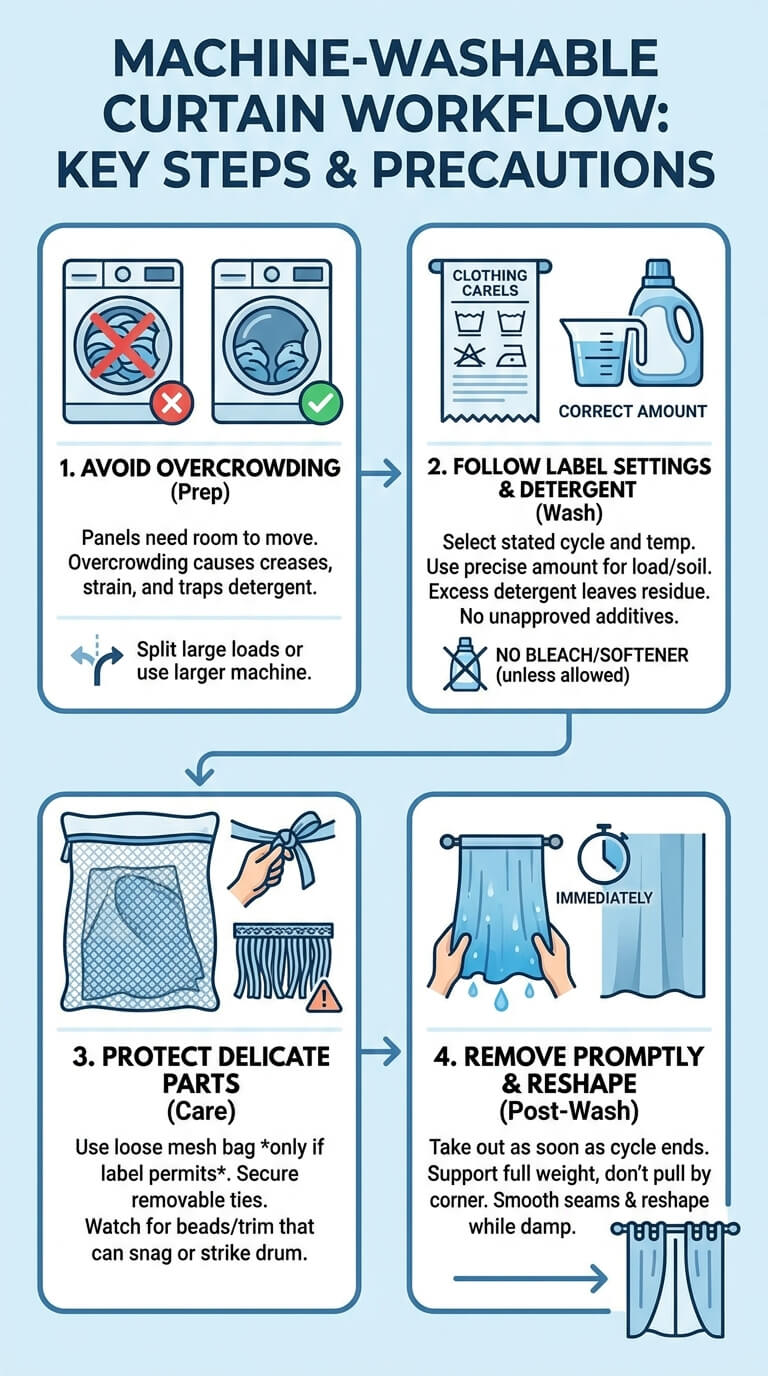
Load size and avoiding overcrowding
Panels need room to move. A crowded drum creates deep creases, traps detergent, and strains seams as heavy wet fabric folds against itself. Use a larger-capacity machine or split the load when allowed. Oversized curtains may need a commercial machine or professional service even when the label says washable.
Label-approved cycle, temperature, and detergent
Select the stated water temperature and cycle. Use the detergent amount for the load size, soil level, water conditions, and product directions. More detergent does not make curtains cleaner and can leave stiffness or residue. Do not add bleach, softener, oxygen products, or fragrance boosters unless the care instructions allow them.
Protecting pleats, trims, and delicate edges
Use a large mesh laundry bag only when the panel fits loosely and the label permits machine washing. Secure removable ties separately. Turn simple panels as directed, but do not fold stiff pleats sharply. Stop before washing if beads, fringe, loose grommets, or glued trim can strike the drum or snag the fabric.
Removing promptly for reshaping
Take panels out as soon as the cycle ends. Support the full weight rather than lifting by one corner or grommet. Shake gently only when the construction allows it, smooth seams with your hands, and compare paired panels before drying. Do not leave damp fabric compressed in the machine.
Hand-Washable Curtain Workflow
Supporting the panel weight
Fill a clean basin according to the label, then lower the panel in while supporting it with both arms. Wet fabric can be several times heavier than dry fabric. Do not hand wash a panel that is too large to lift, turn, rinse, and remove without dragging it across the floor or straining seams.
Gentle agitation within label limits
Press water through the fabric with open hands. Avoid scrubbing, wringing, kneading, or repeatedly lifting the entire panel. Concentrated rubbing can create pale areas, pile distortion, or stretched sections. Give special attention to the hem only if the label allows gentle hand washing throughout.
Rinsing without twisting
Drain the wash water while supporting the panel, then refill with the label-approved temperature. Press gently to release detergent. Repeat only as needed. Twisting a long panel places uneven tension on the weave, lining, and stitched edges and can permanently distort the hang.
Water removal without stretching
Let excess water drain while the fabric is fully supported. Roll a small washable panel in clean colorfast towels only when the instructions allow it. Do not suspend a saturated panel from hooks, grommets, or a narrow line because the weight can lengthen the fabric and strain the header.
Drying, Reshaping, and Rehanging

Label-approved air or machine drying
Follow the stated drying method exactly. Low heat is not automatically safe for coatings, fibers, trim, or lining. If air drying is allowed, spread the weight across a sturdy rack and provide airflow around both sides. Protect floors and finished surfaces from drips.
Preventing shrinkage and distorted hems
Measure panel length before washing when fit is critical. Smooth side seams and hems while damp, without pulling. Dry matching panels under the same conditions. Uneven heat or support can leave one panel shorter, twist a side seam, or create a wavy lining.
Rehanging while appropriately damp only when allowed
Some simple washable panels can be rehung slightly damp so their own weight softens wrinkles, but this is not a universal technique. Do it only when the care instructions permit, the rod is secure, the fabric is not heavy, and the panel will not touch a damp sill, wall, floor, or heater.
Wrinkle-management limits for heat and steam
Check the label before ironing or steaming. Test on the back near a hem and use a pressing cloth when appropriate. Keep heat away from blackout coating, synthetic backing, trim, and unknown finishes. Stop if the surface becomes shiny, sticky, rippled, or discolored.
Fabric-by-Fabric Limits

Cotton and cotton blends
Cotton can shrink, fade, wrinkle, or lose sizing. A cotton label does not guarantee washing because lining, dye, pleats, and finish still control care. Use the permitted temperature, avoid unapproved heat, and reshape promptly.
Polyester and synthetic blends
Synthetic panels may resist wrinkles, but heat can set creases or damage coatings and bonded layers. Follow the label, use the correct detergent amount, and rinse adequately rather than adding more heat or chemistry.
Linen
Linen can crease strongly and change size or hand after washing. Some unlined panels are washable, while tailored or lined drapes require professional care. Support wet linen and never assume a natural fiber needs hot water.
Velvet
Velvet pile can crush, mark, or change direction. Vacuum with the pile on very low suction and avoid rubbing or direct pressing. Seek professional care for lined, silk-blend, tailored, or labeled velvet.
Silk
Silk is vulnerable to sunlight, abrasion, water marks, and dye movement. Limit home care to gentle dry maintenance unless instructions clearly allow more. Dry-clean-only, lined, or sun-shattered silk needs professional handling.
Sheers
Sheers snag easily. Use very low suction and support the fabric. If washable, place a simple panel loosely in a suitable mesh bag and use the stated cycle, then air dry with broad support.
Blackout, thermal, coated, lined, and interlined panels
Treat the construction as a layered product. Coatings may not tolerate immersion, agitation, steam, or tumble drying even when the face fabric seems washable. Product care can differ between versions that look nearly identical. Pottery Barn, for example, lists different care for light-filtering and blackout versions of one linen curtain in its panel care details. Check the exact item rather than relying on the collection name.
When Not to Wash or Remove Curtains
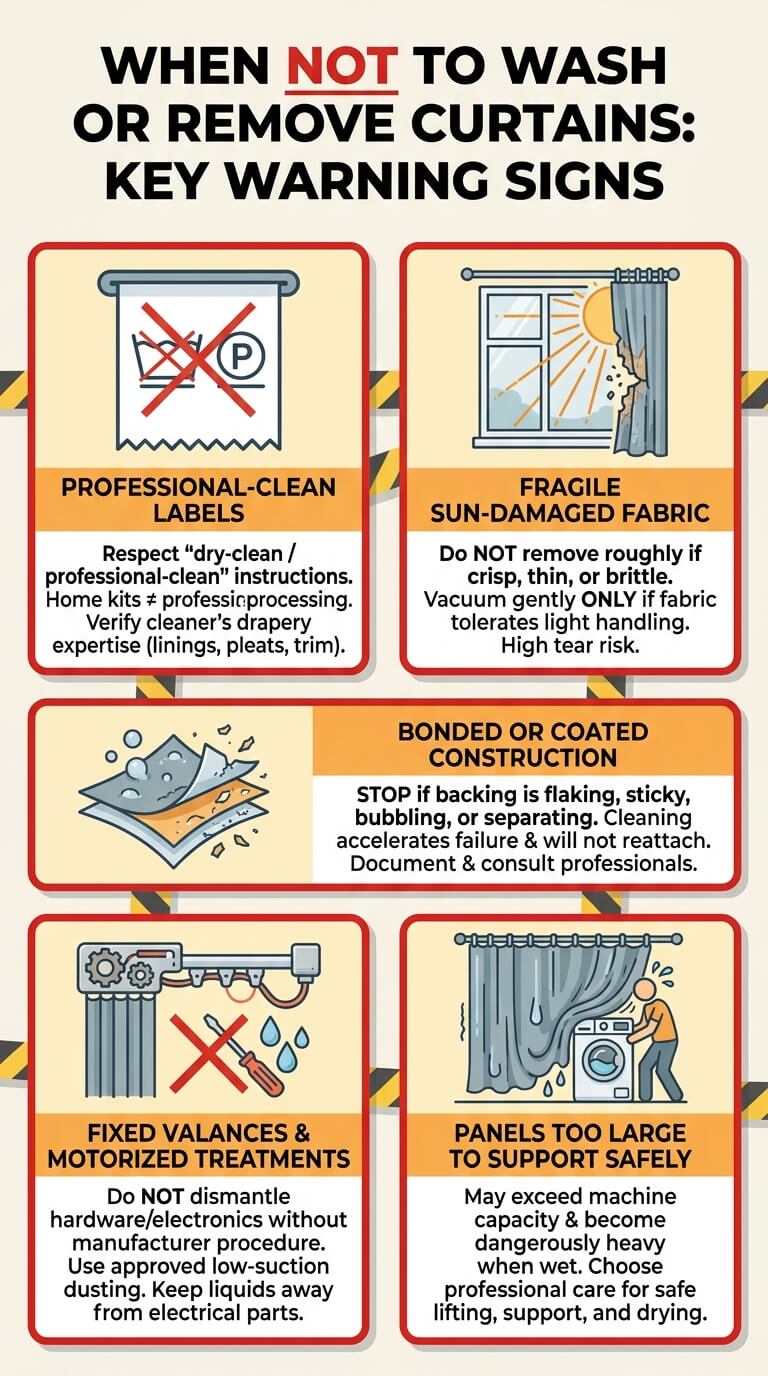
Professional-clean labels
Respect dry-clean and professional-clean instructions. Home kits are not equivalent to professional processing. Ask whether the cleaner routinely handles drapery, blackout lining, pleats, and specialty trim.
Fragile sun-damaged fabric
Do not remove fabric roughly when the window-facing edge feels crisp, thin, or brittle. Vacuum only if it tolerates light handling. Severely weakened panels may tear during removal, cleaning, transport, or rehanging.
Bonded or coated construction
Stop if the backing is flaking, sticky, bubbling, powdery, or separating from the face fabric. Water, heat, and flexing can accelerate failure. Cleaning will not reattach a delaminated layer. Document the condition and check warranty, manufacturer, or professional options.
Fixed valances and motorized treatments
Do not dismantle boards, tracks, motors, wiring, or brackets unless the manufacturer provides a user procedure. Remove surface dust with approved low-suction methods and keep liquids away from electrical parts and moving mechanisms. Arrange service when access requires disassembly.
Panels too large to support or dry safely
Oversized drapes may exceed machine capacity and become extremely heavy when wet. Choose professional care when you cannot control lifting, rinsing, broad support, airflow, and clean drying space.
Odor and Dust Maintenance Between Full Cleanings
Ventilation and routine dust removal
Air the room when outdoor conditions are suitable, and vacuum panels before odor becomes embedded in dust. Address cooking grease, smoke, dampness, or another continuing cause instead of relying on fragrance. Do not spray refreshers, deodorizers, or essential-oil mixtures unless the fabric and product labels allow them.
Managing pet hair and window-side debris
Use low-suction vacuuming or a clean fabric-safe lint tool on sturdy panels. Test rubber tools because friction can distort velvet, loose weaves, and delicate finishes. Clean the sill and floor separately so hair and grit do not transfer back to the hem.
Checking damp sill contact
Lift the curtain away from condensation, wet plant pots, and recently cleaned sills. Repeated damp contact can produce rings, soil transfer, dye movement, or coating damage. Dry the hard surface and investigate recurring moisture before the fabric is returned to its normal position. If the hard surface is stained, peeling, swollen, or repeatedly wet, use a material-specific sill cleaning method before allowing the curtain to rest against it again.
Avoiding fragrance masking as a substitute for cleaning
A fragrance may temporarily cover cooking, pet, smoke, or damp odors without removing residue. Identify whether the odor is in the fabric, lining, wall, sill, carpet, or room air. Seek professional evaluation when a dry-clean-only panel has persistent odor or contamination beyond routine household dust.
Common Curtain Cleaning Mistakes
Assuming fiber name overrides the care label
Fiber name describes only part of the panel. Dye, finish, lining, interlining, header, trim, and coating can impose stricter limits. Follow instructions for the complete construction.
Washing lined panels like unlined fabric
Face fabric and lining may shrink differently, causing puckered seams or a lining that hangs below the hem. Confirm that the washing instruction covers the assembled panel.
Overloading the washer
Crowding prevents rinsing, creates sharp folds, and strains seams and grommets. Use adequate capacity or another method. Do not force a bulky panel into the drum.
Using heat or steam universally
Heat can shrink fibers, set creases, flatten pile, soften adhesives, and damage blackout backing. Check instructions, test cautiously, and stop if sheen, texture, or coating changes.
Rehanging before the construction is safely dry
Moisture can remain in lining, pleats, headers, and hems after the face feels dry. Confirm the thickest areas are dry before the panel touches wood, paint, walls, floors, or metal hardware.
When to Seek Professional Textile Care
Silk, velvet, interlining, trims, or unstable dyes
These features require control of moisture, solvent, agitation, finishing, and support. Tell the cleaner exactly where fading, stains, weak seams, or prior treatment occurred. Ask how the panel will be measured, processed, finished, and protected during transport.
Dry-clean-only labels
Professional care is the correct next step when the label excludes washing. Do not remove the label before service. Bring matching panels together when consistent appearance matters, because cleaning one panel may reveal fading or soil differences compared with the untreated mate.
Large or heavily constructed drapes
Pinch pleats, cornice-mounted panels, weighted hems, interlining, and long floor-to-ceiling drapes can be difficult to remove and reinstall. Professional in-home inspection or take-down service can reduce damage to the fabric, rod, track, wall, and hardware.
Damage, coating failure, or persistent odor beyond routine soil
Cleaning cannot repair torn sun-weakened fabric, brittle coating, separated backing, or corroded hardware. Persistent smoke, water, or animal odor may involve the lining or surrounding room materials. Ask for an assessment before paying for a process that may not restore the panel.
Curtain Cleaning FAQ
Can curtains be cleaned without taking them down?
Yes. Low-suction vacuuming while the panels hang is often best for routine dust. Spot cleaning may be possible when instructions allow it, but do not spray the whole panel or default to steam.
Do all cotton or polyester curtains go in the washer?
No. Lining, coating, dye, pleats, trim, and construction can override fiber content. Wash only when instructions for the complete panel permit it.
How do I prevent curtains from shrinking?
Use the stated temperature, cycle, and drying method, avoid extra heat, do not overcrowd, remove panels promptly, and reshape gently. No method guarantees zero change in aged or complex fabric.
Can blackout curtains be machine washed?
Only when the exact care instructions permit it. The face may be washable while the blackout layer is not. Avoid unapproved soaking, agitation, heat, and steam.
What should I do when the curtain has no care label?
Vacuum gently and avoid wet treatment until the material and construction are identified. Check purchase records or manufacturer information, or ask a professional when the panel is lined, coated, delicate, oversized, or valuable.
Final Thoughts
Safe curtain cleaning starts with the care label and the complete construction. Remove dust with controlled suction, test before adding moisture, wash only when permitted, support wet fabric, and use the approved drying method.
Stop when fabric is sun-weakened, dye moves, coating lifts, lining distorts, or the panel is too heavy to handle. Routine dry maintenance often protects curtains better than frequent deep cleaning, while complex or uncertain panels belong with a professional.

Ethan Carter is the Founder & Editor of HomeCleanSecrets. Based in the United States, he has 5 years of experience creating practical home cleaning, laundry care, stain removal, decluttering, and home organization content. His goal is to help everyday households clean smarter and build simple routines that are easier to maintain.
Read more about Ethan Carter on his author page: https://homecleansecrets.com/ethan-carter/