
A workable kids room and toy organization system should make it easy to see what the household owns, decide what a child can reach, and return items to a clear home. When the floor fills again after cleanup, the real problem may be excess inventory, vague categories, or a reset routine with too many steps.
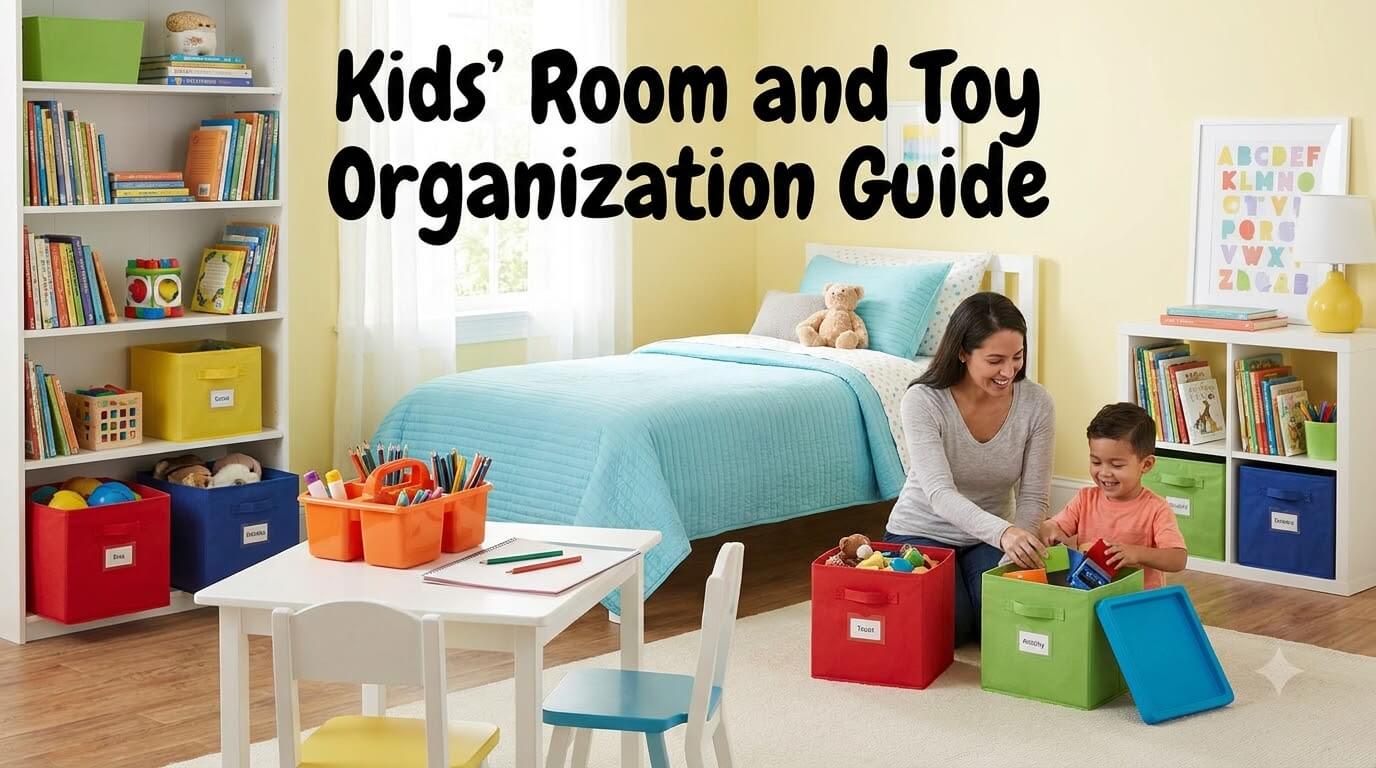
This guide gives you a practical framework for bedrooms, playrooms, and shared family spaces. The goal is not a picture-perfect room. It is a setup that fits the available space, respects safety limits, and can be reviewed as interests, clothing sizes, and sibling needs change.
Quick Overview: Build a System Before Buying More Storage
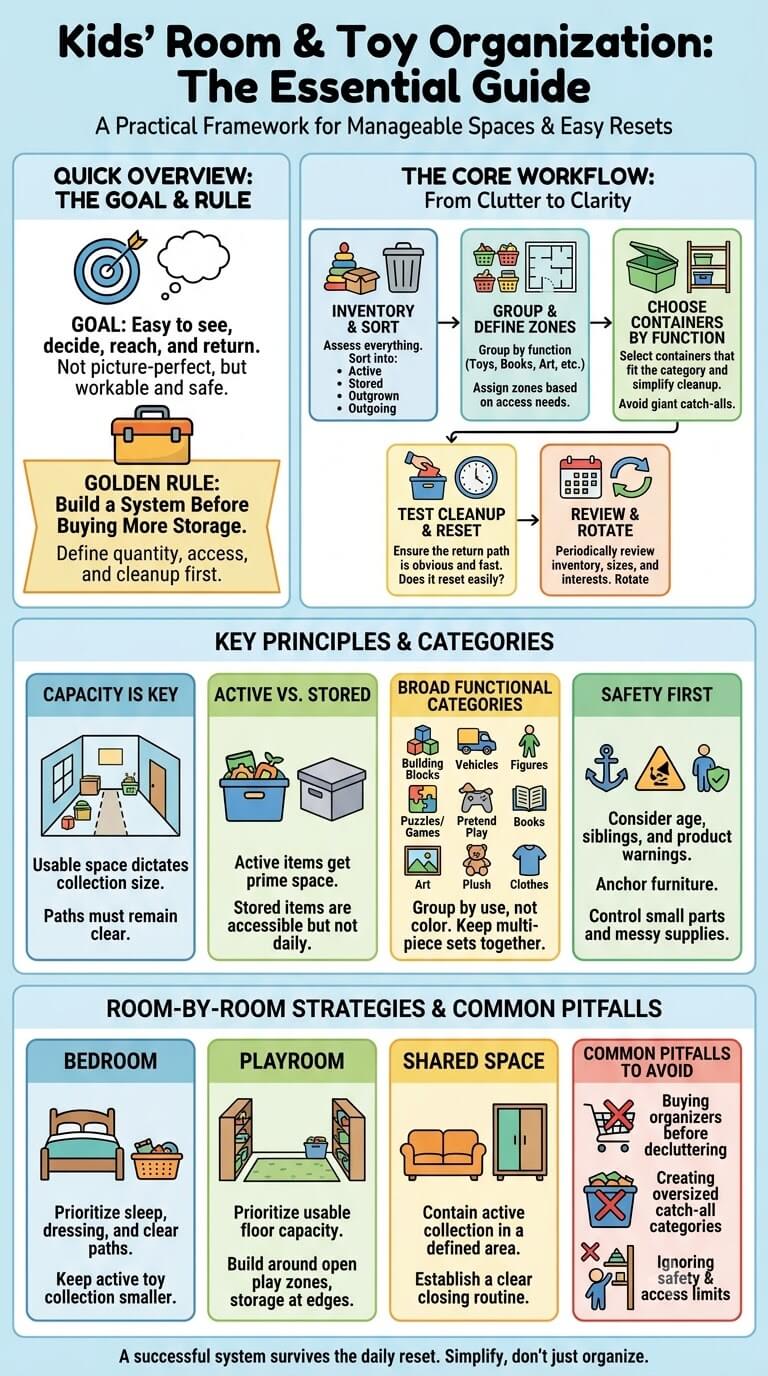
Decide quantity, access, and cleanup before choosing containers.
The core workflow from inventory to review
Work in this order: inventory what is present, remove obvious unusable items, separate active from stored or outgoing items, group the active collection, assign access zones, choose fitting containers, test cleanup, and review overflow. If the room still fails, reduce or rotate inventory before adding storage.
What this guide covers and what needs a more focused system
This framework helps you decide how toys, books, art materials, stuffed animals, clothing, and rotated items fit together. Different categories need different storage: building sets need containment, books need usable support, art supplies may need controlled access, and clothing needs clear size stages.
Why Kids’ Spaces Become Cluttered
Clutter usually reflects a mismatch between belongings, space, and reset habits.
Inventory problems versus storage problems versus routine problems
An inventory problem means the room holds more than its usable space supports. A storage problem means the amount is reasonable but categories lack suitable homes. A routine problem means homes exist, yet putting things away requires too many steps or too much adult sorting.
Growth, gifts, mixed-use rooms, and changing interests
Children’s rooms change quickly because new items arrive while old ones often remain. A bedroom may also need to handle sleep, dressing, reading, and play in the same limited footprint. Shared rooms add another layer because each child may have different interests, clothing sizes, and items that need separate access.
Why more containers can make excess inventory harder to see
Extra containers can hide how much the room is carrying. Large opaque bins are especially easy to turn into mixed catch-all storage, where puzzles, vehicles, craft pieces, and plush toys disappear together. Utah State University Extension advises assessing clutter and reducing unneeded belongings before assuming more storage is the answer, a useful principle for children’s spaces too. Its decluttering guidance also recommends grouping like items so the quantity becomes visible.
Start With Household and Age Context
Room type, siblings, and safe access change the right setup.
Bedroom, playroom, or shared-living-space constraints
A bedroom must support sleep, dressing, and access as well as play. A playroom can hold more storage but still needs open floor space. A living room usually needs a tighter active collection so seating and walking paths remain usable.
Single-child, sibling, and mixed-age considerations
With one child, activity categories may be enough. With siblings, ownership can matter too. Shared items can use common storage while personal collections stay separate. Mixed-age households also need controlled access for pieces suited to an older child but not a younger one.
Child-accessible versus adult-controlled decisions without rigid age rules
Choose access according to the specific item, manufacturer guidance, the child’s current abilities, and who else uses the room. Everyday books, large building pieces, and simple pretend-play items may be suitable for a low-access zone in one household. Paint, adhesives, tiny components, or a complicated set may belong in an adult-controlled zone.
The U.S. Consumer Product Safety Commission explains that toys can carry age and choking-hazard labeling, including warnings for certain products with small parts. Check CPSC toy safety guidance and the toy’s own labeling instead of using a single storage-height rule for every child.
The Active-Use Versus Stored-Inventory Framework
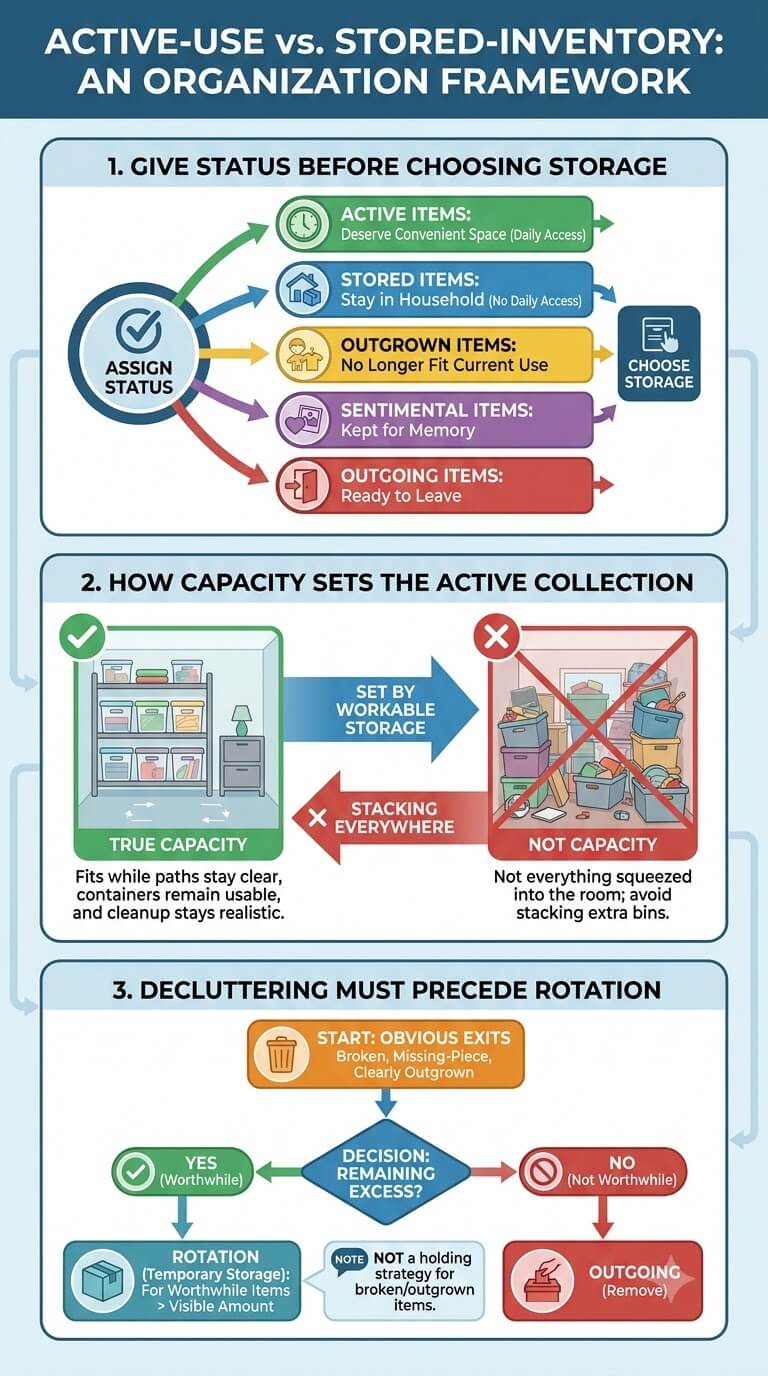
Keep prime space focused on items used now.
Active items, stored items, outgrown items, sentimental items, and outgoing items
Give each item a status before choosing storage. Active items deserve convenient space. Stored items stay in the household without daily access. Outgrown items no longer fit current use. Sentimental items are kept for memory, and outgoing items are ready to leave.
How capacity sets the size of the active collection
Capacity is not everything that can be squeezed into the room. It is what fits while paths stay clear, containers remain usable, and cleanup stays realistic. Set the active collection by safe, workable storage rather than stacking extra bins wherever they fit.
When decluttering should happen before rotation
Rotation is useful when worthwhile items exceed the amount you want visible at one time. It is not a holding strategy for broken toys, missing-piece items that no longer function, or clearly outgrown things. Remove obvious exits first. Then decide whether the remaining excess deserves temporary storage.
Group the Main Kid’s Room Categories
Broad functional groups make finding and returning items easier.
General toys and multi-piece sets
Group toys by use rather than color or brand, such as building toys, vehicles, figures, puzzles, games, and pretend-play items. Keep multi-piece sets together when missing parts would reduce their usefulness. When a category contains tiny pieces, check CPSC small-parts guidance and the product labeling before assigning access.
Books and reading materials
Books deserve a separate collection. Distinguish current favorites, oversized books, series, borrowed books, and clearly outgrown material when useful. Choose storage by quantity and book format rather than by decor.
Art and craft supplies
Separate everyday dry supplies from messier or controlled materials. A caddy may suit crayons and pencils, while paint, adhesives, sharp tools, or tiny craft pieces may need adult-managed storage. Keep in-progress work in a defined tray.
Stuffed animals and bulky soft toys
Plush often creates a volume problem first. Identify bed companions and frequent favorites, then set a capacity for the rest. One broad basket or cubby zone is usually easier to reset than many tiny plush categories.
Clothing by current size, future size, and outgrown status
Keep current clothing in the active dresser or closet area. Future sizes and outgrown items should not compete with everyday clothes for the same drawers. Label stored clothing by child, size, and season when those details are useful, and check care labels before longer-term storage.
Optional rotated inventory
Rotation is a capacity tool, not a requirement. If the room resets easily and the active collection fits, leave it alone. If worthwhile items crowd the visible space, move a selected portion to labeled storage and review it later.
Map Floor, Wall, and Closed-Storage Zones
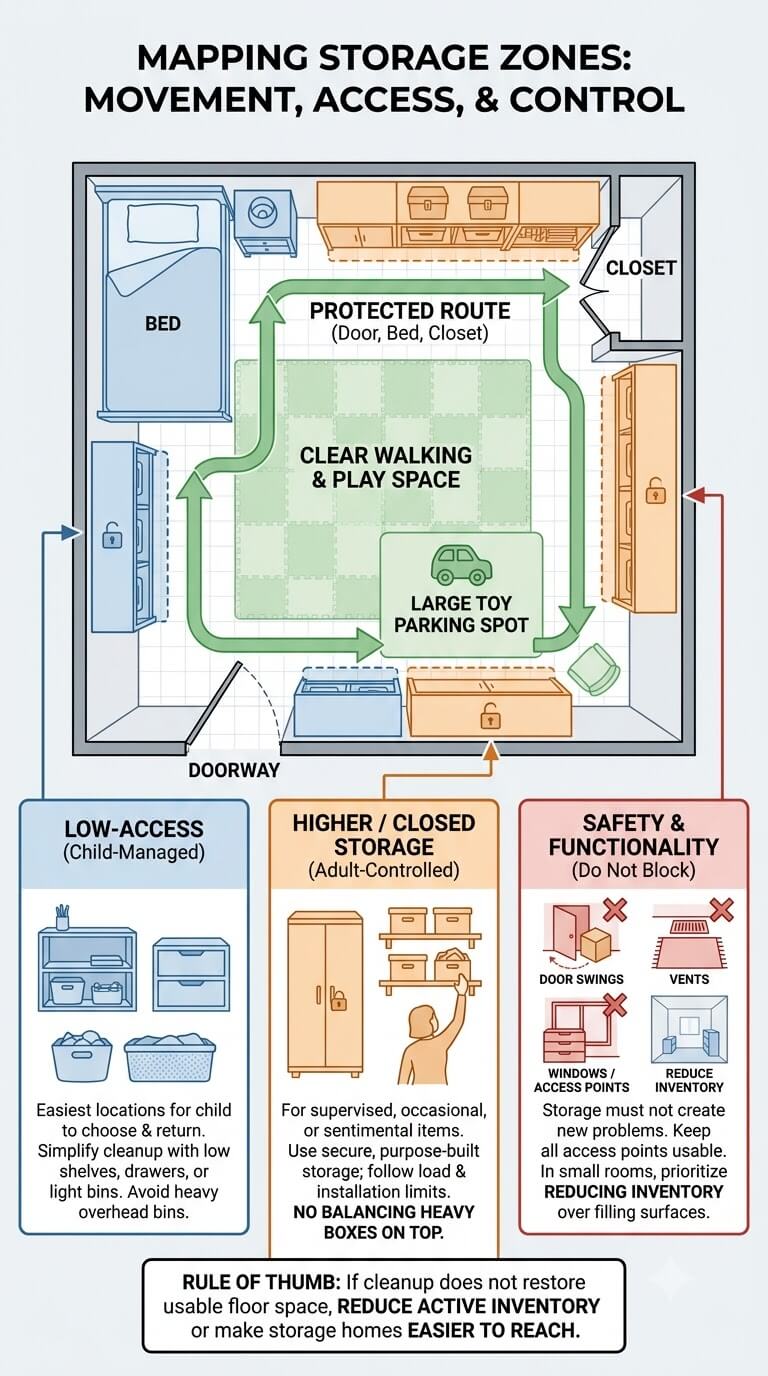
Assign space according to movement, access, and control.
Keep walking and play space clear
Protect routes to the door, bed, closet, and frequently used areas before assigning storage. Give large toys a parking spot. If cleanup cannot restore usable floor space, reduce the active inventory or make storage homes easier to reach.
Low-access storage for child-managed categories
Give the easiest locations to categories the child is expected to choose and return. Low shelves, drawers, baskets, or bins can simplify cleanup. Keep containers manageable and avoid heavy bins that must be pulled down from above.
Higher or closed storage for adult-controlled items
Adult-controlled storage can hold items that need supervision, occasional-use materials, sentimental keepsakes, or pieces that must be separated from younger siblings. “Higher” does not mean “balance a heavy box on top of furniture.” Use storage designed for the location and follow load, installation, and access instructions.
Do not block doors, windows, vents, or access points
Storage should never solve clutter by creating another household problem. Keep door swings usable, do not cover heating or cooling vents, and preserve access to windows or building features that need to remain reachable. In small rooms, reducing inventory is often safer and more practical than filling every vertical surface.
Choose Storage by Function, Not Appearance
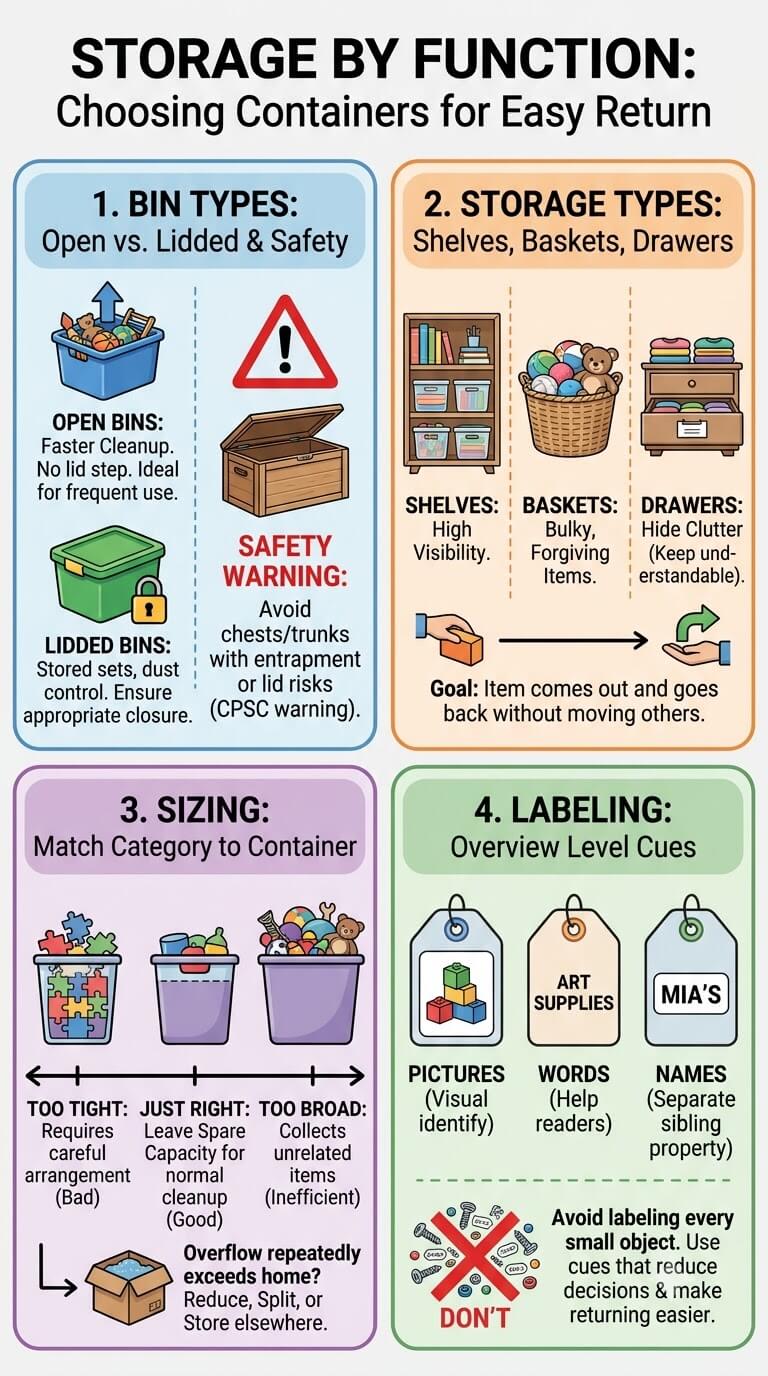
Choose containers that fit the category and return steps.
Open bins versus lidded bins
Open bins make frequent cleanup faster because there is no lid step. Lidded containers can be useful for stored sets, dust control, or adult-managed categories, but the lid and closure need to be appropriate for the intended use. Avoid assuming that any chest or trunk is safe for toy storage. CPSC has warned about hazards associated with some storage and toy chests, including entrapment and lid-related risks.
Shelves versus baskets versus drawers
Shelves help when visibility matters. Baskets suit bulky or forgiving categories. Drawers reduce visual clutter for items that remain understandable when hidden. Choose the option that lets an item come out and go back without moving several other things.
Match category size to container size
Leave enough spare capacity for normal cleanup. If every piece fits only when carefully arranged, the container is too tight. If a huge bin collects unrelated toys, it is too broad. Reduce, split, or store overflow when a category repeatedly exceeds its home.
Picture labels, word labels, and name labels at overview level
Labels should reduce decisions. Pictures can identify categories visually, words can help readers, and names can separate sibling property. Use only the cues that make returning items easier; labeling every small object usually adds unnecessary work.
Safety Limits for Kids’ Storage
Storage must also account for product guidance and changing access.
Small parts and younger siblings
When a younger child shares the room or can enter it, storage decisions need to account for the youngest person who can access the area. Keep age warnings and product instructions with sets when practical, and store pieces that require tighter control outside unrestricted reach.
Furniture stability, anchoring, shelf loads, and manufacturer instructions
Bookcases, dressers, and storage units can create tip-over hazards. Follow the furniture manufacturer’s installation and anchoring instructions, use the correct hardware for the wall and unit, and respect stated load limits. CPSC’s Anchor It! information focuses on preventing furniture and television tip-overs in homes with children.
Heavy bins, lids, cords, hanging systems, and unsafe heights
Do not place dense bins where a child must pull them down from an unsafe height. Be cautious with hinged lids, cords, nets, hanging storage, and improvised wall systems. Follow installation instructions, and stop using storage if hardware loosens or a mechanism fails.
Why no system can guarantee child safety
Organization can reduce obvious hazards and make supervision easier, but it cannot make every product or room safe for every child. Abilities change, siblings introduce new access patterns, hardware loosens, and toys age. Recheck storage after room changes, new furniture, new toys, or changes in who can reach a category.
Room-by-Room Decisions
Every room has different limits and competing functions.
Bedroom: protect sleep, dressing, and floor functions
In a bedroom, give priority to the bed, dressing area, and clear walking path. Keep the active toy collection smaller if toys regularly spread into those functions. Books, a few favorite toys, and a limited soft-toy zone may be enough when a separate play area exists elsewhere.
Playroom: prioritize usable floor capacity and zones
A playroom should have room to play, not just room to store playthings. Build around an open floor zone, then place storage at the edges. If you want a reading corner or art table, make sure those zones do not create narrow passages or force large toys into the center.
Shared living area: contain the active collection and define an overflow destination
Shared spaces benefit from a smaller active collection and a clear closing routine. Give toys a defined cabinet, shelf, or basket area rather than allowing storage to spread across the room. When that area fills, move the excess to its designated storage location or review what still needs to stay active.
Build a Cleanup and Reset Routine
Obvious homes and short return paths make resets simpler.
Make the return path obvious
Cleanup should ask fewer questions than play. Put the storage home close to where the category is normally used when possible. Keep lids, stacked boxes, and complex sorting to a minimum for child-managed items. A good test is whether someone can identify where an item belongs without opening several containers.
Daily reset versus periodic review
A daily reset returns active items to their homes and restores floor space. A periodic review asks bigger questions: Is this category still used? Does it fit? Are future-size clothes overflowing? Are small parts now accessible to a younger sibling? Separating these tasks keeps everyday cleanup from turning into a long decluttering session.
What to do when cleanup takes too long
Find the step causing the delay. Combine categories when sorting is too detailed, move frequent items closer when access is awkward, and reduce active inventory when the homes are simply too full. Do not answer a capacity problem with more labels.
How adults and children can share age-appropriate responsibilities
Adults can handle safety decisions, furniture, donations, and stored inventory. Children can return accessible categories, choose favorites, or identify items they still use when appropriate. Match responsibility to the task and household rather than using one rigid age rule.
Decision Tree: Which Problem Should You Solve Next?
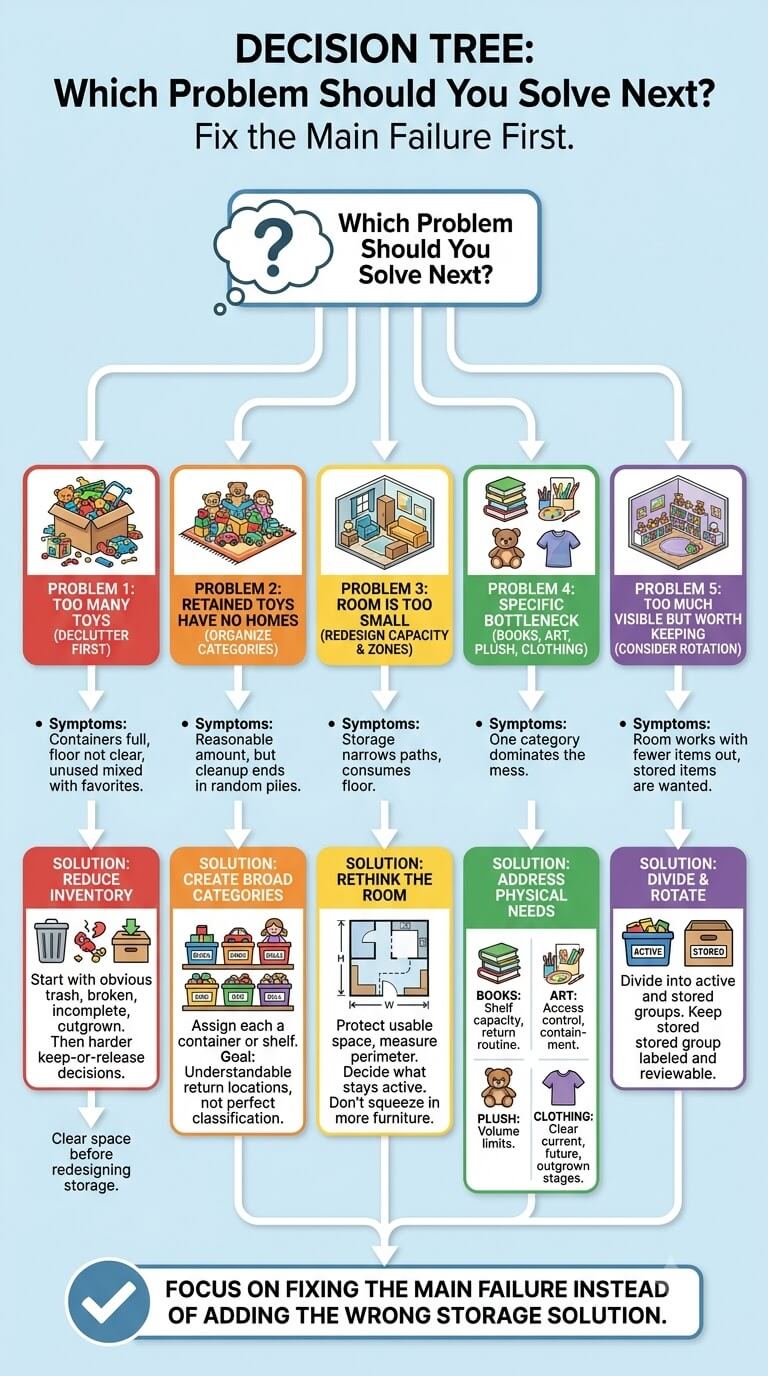
Fix the main failure instead of adding the wrong storage solution.
Too many toys: declutter first
If containers are full, the floor cannot clear, and unused items are mixed with favorites, reduce inventory before redesigning storage. Start with obvious trash, broken items, incomplete sets that no longer function, and clearly outgrown items, then move into harder keep-or-release decisions.
Retained toys have no homes: organize categories
If the amount is reasonable but cleanup ends in random piles, create broad functional categories and assign each one a container or shelf. The goal is not to classify every piece perfectly. It is to give retained toys a return location that remains understandable after normal use.
Room is too small: redesign capacity and zones
When storage narrows paths or consumes the floor, rethink the room rather than squeezing in more furniture. Protect usable space, measure the perimeter, and decide what truly needs to stay active there. Rotation can help only after unusable items are removed.
Books, art supplies, plush, or clothing are the main bottleneck
When one category dominates the mess, use its physical needs to solve it. Books need shelf capacity and a return routine. Art materials need access control and containment. Plush needs volume limits. Children’s clothing needs clear current, future, and outgrown stages.
Too much is visible but worth keeping: consider rotation
If the room works with fewer items out and the stored items are still genuinely wanted, divide the retained collection into active and stored groups. Keep the stored group labeled and reviewable so it does not become forgotten clutter.
Choose the Right System for the Main Bottleneck
Focus on the category or capacity problem causing most clutter.
Organizing retained toys
Once keep decisions are made, retained toys need broad categories, containers, labels, and workable access. The practical question is where each active item should live so it can be found and returned without digging through unrelated objects.
Decluttering toys with children
When quantity is the problem, work through keep, donate, discard, repair, sentimental, and undecided decisions. Children can participate where appropriate, while adults handle safety and obvious-trash decisions rather than asking them to evaluate every item.
Organizing a small playroom
A cramped playroom needs floor capacity, clear walking paths, sensible furniture placement, and limited zones. Storage methods matter, but the bigger decision is how much the room can hold while still leaving space for actual play.
Organizing kids’ books
Books need their own system for current reading, formats, borrowed items, shelf orientation, and collection limits. Avoid dropping them into miscellaneous toy bins where browsing becomes difficult and covers can bend or disappear under heavier objects.
Organizing kids’ art supplies
Art materials add consumables, mess potential, access control, project trays, and restocking to the room. Separate child-managed supplies from items that need adult control, and keep labels available when they contain use or safety instructions.
Organizing stuffed animals
Stuffed animals create a bulky-volume problem involving favorites, bed use, display, and containment. If the intended active collection cannot fit its assigned basket or cubby without spilling out, make a capacity decision instead of adding random containers.
Organizing kids’ clothes by size
Children’s clothing works best when current size, next size, outgrown pieces, season, and sibling hand-me-downs stay distinct. Keep everyday clothing easy to reach while future and outgrown sizes remain outside the active dresser or closet space.
Creating a toy rotation system
Rotation changes which retained toys are active now and which are temporarily stored. Use clear review triggers rather than a complicated calendar, and keep the process simple enough that maintaining stored groups does not create more work than ordinary cleanup.
Common Kids’ Organization Mistakes
Complexity and ignored capacity make systems harder to maintain.
Buying organizers before reducing obvious excess
Buying storage first locks you into assumptions about what needs to stay. Inventory the room and remove clear exits before shopping. You may discover that existing shelves and bins are enough once inactive or outgrown items stop occupying prime space.
Creating oversized catch-all categories
A single giant toy bin looks simple until small pieces sink underneath large toys and the child has to empty everything to find one item. Keep categories broad, but not so broad that retrieving one toy destroys the room.
Giving children access to items that require adult control
Convenience does not override product instructions or household safety needs. Materials with small parts, messy supplies, or items that need supervision can stay organized in an adult-controlled zone and be brought out when appropriate.
Storing too many categories in one room
A child’s bedroom does not need to contain every toy, every book, every future clothing size, every craft supply, and every sentimental item. When too many functions compete for one room, move inactive categories to another appropriate storage area rather than shrinking the walking and play space.
Ignoring the reset test
A system is not finished when it looks neat after setup. It has to survive use. After several normal play sessions, notice what is left out, which bins overflow, and which items are repeatedly placed in the wrong home. Those patterns show where the setup needs simplification.
Seasonal and Growth-Stage Review
Revisit the setup as sizes, interests, and access change.
Review current interests and room capacity
Every few months, or when the room begins failing again, look at what is actually being chosen. Move inactive but worthwhile items out of prime space. If a once-small collection has expanded, decide whether it deserves more room or whether the category needs reduction.
Recheck clothing sizes and hand-me-down flow
Move newly fitting clothing into the active zone and remove pieces that no longer fit. Keep future-size clothing clearly separated so it does not crowd current drawers. Before storing textiles longer term, make sure they are clean and fully dry and follow the garment care label.
Revisit small-part access as siblings grow
Access rules can change in either direction. An older child may become capable of managing more items independently, while a newly mobile younger sibling may make formerly convenient storage inappropriate. Recheck toy labels and the actual reach of the youngest child who can enter the space.
Move inactive categories instead of expanding storage automatically
When a shelf fills, first ask whether everything on it still needs daily access. Moving a low-use category to stored inventory can restore function without adding furniture. New storage should solve a defined need, not become the default response to every full container.
FAQ About the Overall Kids’ Room and Toy System
These answers help adapt the framework to different households.
Should toys stay in the bedroom or playroom?
Keep toys where they can be used and reset without disrupting the room’s other jobs. A playroom may support a larger collection if floor space stays open. A bedroom often works better with fewer favorites when toys interfere with dressing, walking, or closet access.
How do I know whether I need to declutter or organize?
Declutter when the amount of stuff exceeds the usable capacity or many items are broken, outgrown, duplicated, or rarely used. Organize when the amount is reasonable but retained items do not have clear homes. If both are true, reduce obvious excess first and organize what remains.
Are open bins better than closed bins?
Neither is universally better. Open bins reduce steps for frequent child-managed categories. Closed containers can suit stored or adult-controlled items when the container is appropriate for the product and location. Choose based on access, weight, contents, and the manufacturer’s instructions rather than appearance alone.
How many categories should a child manage at once?
There is no universal number. Use enough categories to keep items findable without making cleanup fussy. Combine categories that are repeatedly mixed when doing so remains practical, and split a bin only when one broad group becomes hard to use.
What should be kept out of child-accessible storage?
Keep items out of unrestricted access when the product’s age guidance, small parts, tools, materials, weight, or household circumstances call for adult control. Mixed-age siblings are especially important to consider. Review labels and instructions rather than assuming a storage location is appropriate simply because a child can reach it.
A good kids room and toy organization system proves itself during the reset. When active items fit the room, categories fit their containers, controlled items stay controlled, and overflow has a destination, cleanup is easier to understand. Recheck the setup as children grow or the room stops resetting well, and adjust inventory before adding storage.

Ethan Carter is the Founder & Editor of HomeCleanSecrets. Based in the United States, he has 5 years of experience creating practical home cleaning, laundry care, stain removal, decluttering, and home organization content. His goal is to help everyday households clean smarter and build simple routines that are easier to maintain.
Read more about Ethan Carter on his author page: https://homecleansecrets.com/ethan-carter/