
Learning how to organize toys is less about finding the perfect bin and more about giving each retained toy a home that matches how it is used. A workable setup lets a child find favorite toys without emptying three containers, keeps multi-piece sets together, and makes the floor easier to reset after play.
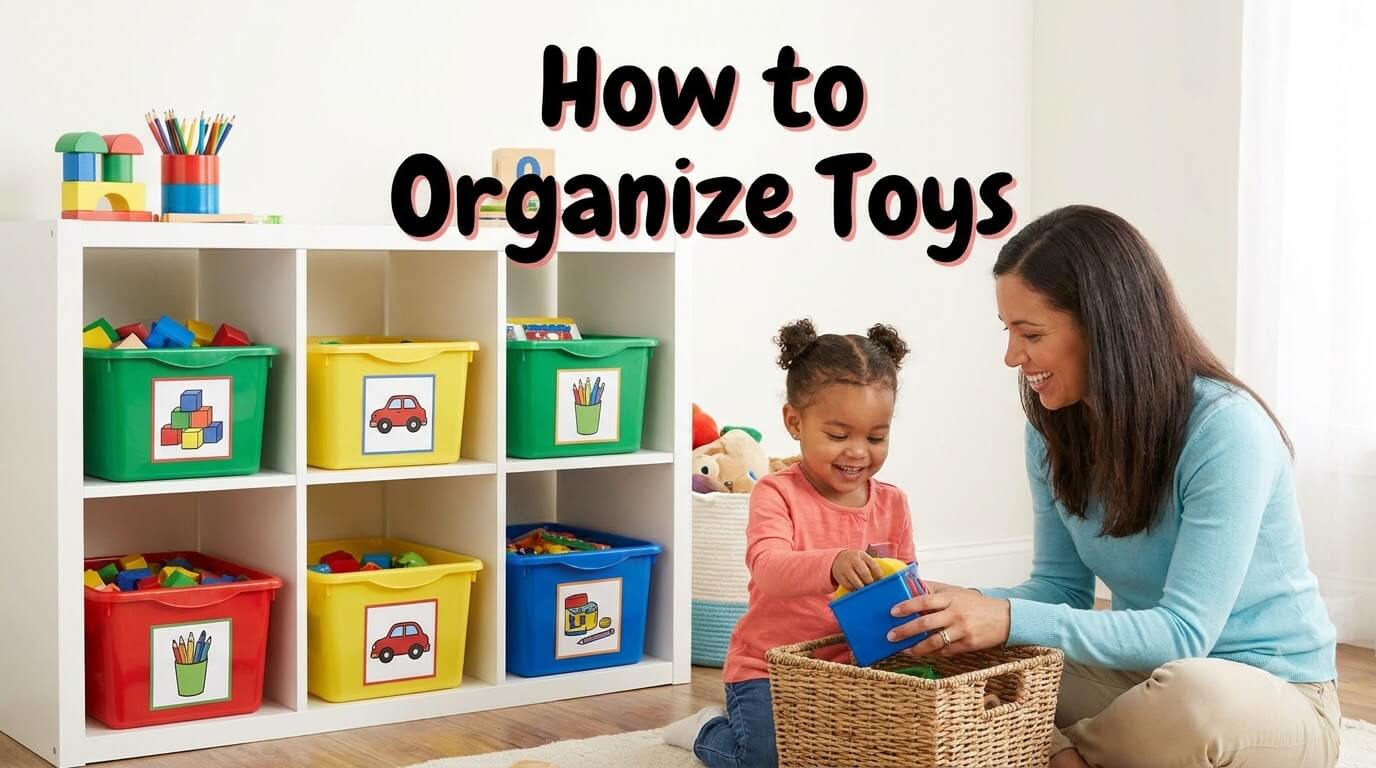
This process starts after most keep decisions are already made. If the room is still holding broken toys, obvious outgrown items, and large amounts that nobody uses, reduce that excess first. Then organize the active collection by function, container size, access needs, and the rooms where play actually happens. If toys are only one part of the clutter, review the broader kids’ room and toy organization system before adding more containers.
Quick Answer: Organize Retained Toys by Use, Capacity, and Access
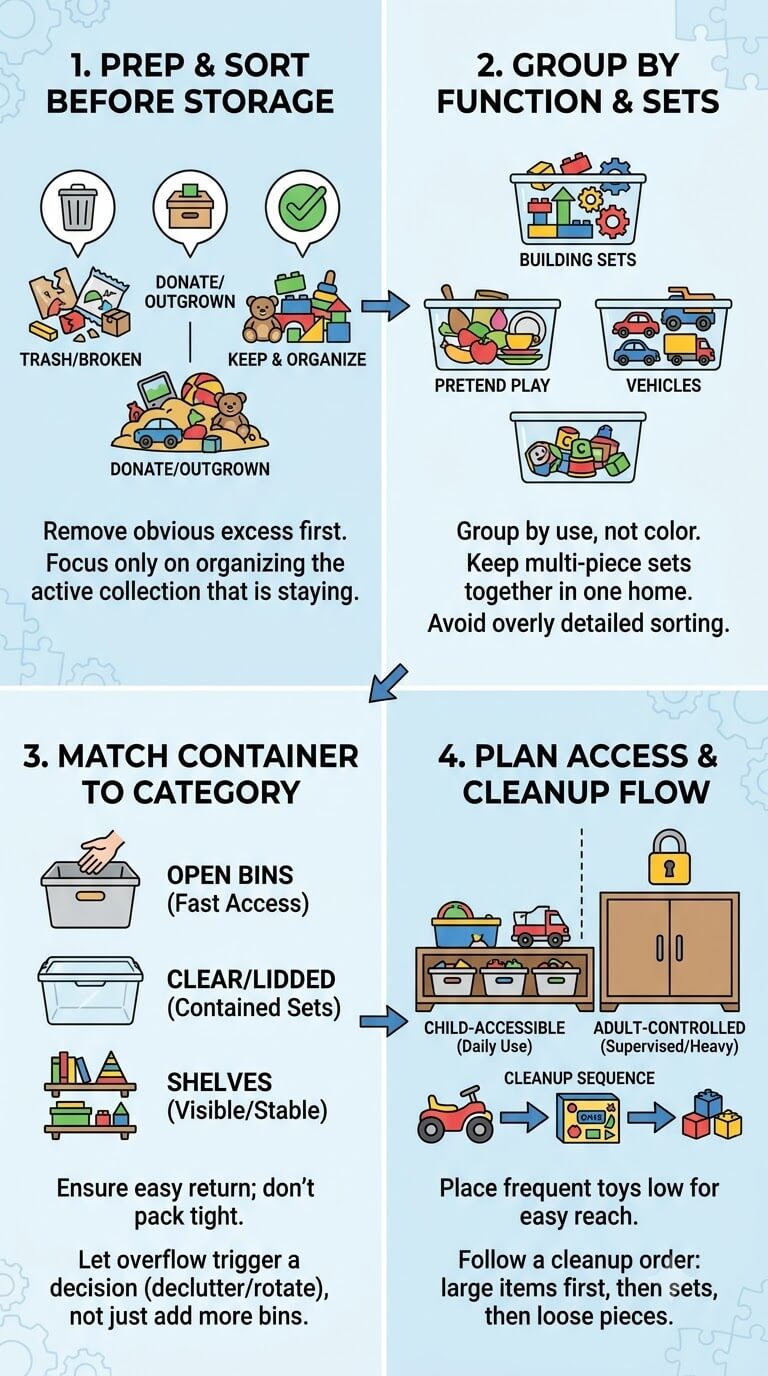
A toy storage system works best when categories are easy to recognize, containers are easy to refill, and safe access is planned before shelves are filled.
What should already be decided before this guide
You do not need a perfectly edited collection, but you should know which toys are staying. Set aside obvious trash, broken items that will not be repaired, and anything already designated to leave so you do not spend time storing it.
The finished system this workflow is designed to create
At the end, each major toy category should have one clear home or a clearly defined set of homes. Frequently used toys should be easy to reach when appropriate, small or supervised items should have controlled storage when needed, and overflow should trigger a decision instead of another random bin. A good test is simple: after normal play, can the room return to usable condition without adults re-sorting every piece?
When to Organize and When to Declutter First
Storage can solve confusion, but it cannot create unlimited capacity.
Signs the inventory is workable
The collection is ready to organize when most toys are still used, the room can hold the active categories, and the main problem is that unrelated items are mixed together. If the floor clears after sorting, storage may be the bigger issue than volume.
Signs no container system can solve the current volume
Pause the storage project if every shelf is packed, bins cannot accept returned toys without force, large toys permanently block walking space, or several categories have no possible home even after grouping. Those are capacity signals. Adding organizers may hide the volume for a while, but it will not make the active collection easier to use.
Separate obvious outgoing items without turning this into a decluttering session
Keep this step narrow. Remove packaging, obvious trash, unsafe broken pieces, and anything already marked for donation or disposal. Put harder sentimental or keep-or-release decisions in a separate holding area so the organization session stays focused on the toys that remain.
Inventory the Toys That Are Staying
Before choosing containers, see the retained collection as a whole.
Pull together toys from the spaces you are organizing
Bring together toys from the bedroom, playroom, living room baskets, and other active areas included in the setup. Leave unrelated long-term storage alone. You need to see each active category together rather than organize half while the rest is hidden elsewhere.
Note category size, part count, and how often each category is used
Look for patterns rather than counting every piece. Mark categories as frequent, occasional, or bulky, and notice which spread fastest during play. This shows which toys need open access, deeper containment, shallow trays, or a dedicated parking spot.
Identify large toys and categories that need adult control
Set apart ride-on toys, large play structures, heavy sets, toys with many small components, and anything the manufacturer expects to be used with supervision. The U.S. Consumer Product Safety Commission recommends paying attention to toy age guidance and warnings. Check CPSC toy safety information and the product’s own labeling when deciding what belongs in unrestricted reach.
Group Toys by How They Are Used
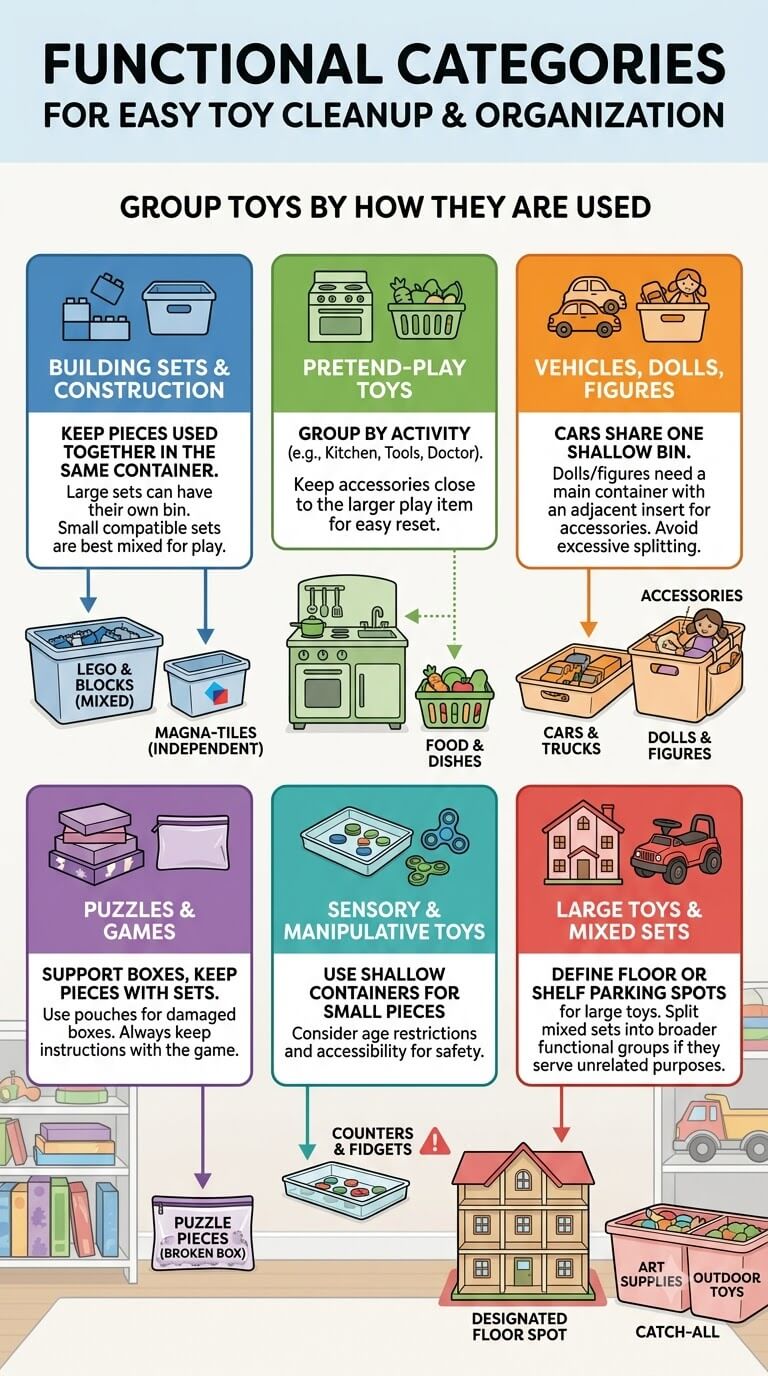
Functional categories usually make more sense during cleanup than appearance-based sorting.
Building sets and construction toys
Keep pieces that are normally used together in the same container or storage area. If one brand or set is large enough to function independently, it can have its own bin. If several small compatible sets are always mixed during play, forcing them into separate containers may create unnecessary sorting work.
Pretend-play toys
Group kitchen food, play tools, doctor kits, dress-up accessories, or similar pretend-play items according to the activity they support. Keep accessories close to the larger play item when practical. A toy kitchen is easier to reset when its food and dishes live nearby rather than across the room.
Vehicles, dolls, figures, and character sets
Cars can share one shallow bin if the collection is manageable. Dolls and figures may need one container for the main toys and a smaller insert or adjacent bin for accessories. Avoid splitting every character or vehicle type unless the child actually uses those distinctions during play and cleanup.
Puzzles and games
Store puzzles and games so boxes stay supported and pieces remain with the correct set. Vertical shelf storage can work for sturdy boxes, while zip pouches or smaller internal containers can help when original packaging is damaged. Keep instructions with the game whenever possible.
Sensory or manipulative toys at a basic storage level
Simple manipulatives, fidget items, counters, and similar materials often benefit from shallow containers because small pieces disappear in deep bins. If a product has small parts or age restrictions, keep those limits in mind when choosing an accessible location, especially in a home with younger siblings.
Large toys and mixed sets
Large toys do not always need containers. Give dollhouses, garages, ride-on toys, or large vehicles a defined floor or shelf parking spot. For mixed sets, decide whether the pieces function as one play activity or whether they have become a catch-all. If the contents serve unrelated purposes, split them into broader functional groups.
Keep Multi-Piece Sets Together
Sets become frustrating when the child can find the main item but not the pieces needed to use it.
When one container should hold the whole set
Use one container when pieces are regularly used together and the set fits without being packed tightly. Keep instruction booklets, cards, or tiny accessories in an inner pouch if they disappear easily. Cleanup should not require rebuilding the original package arrangement.
How to handle mixed sets and mystery pieces
Create one small temporary tray for unidentified pieces you find during the first setup. As you organize, return pieces when their set appears. At the end, make a deliberate decision about the leftovers instead of keeping a permanent mystery bin that slowly becomes another junk container.
Why tiny subcategories can make cleanup harder
A system can become too detailed even when every label is technically correct. If cleanup requires sorting thirty miniature food pieces into six containers, the child may abandon the process or place everything in the nearest bin. Prefer the broadest category that still makes retrieval useful.
Match Each Category to the Right Container Type
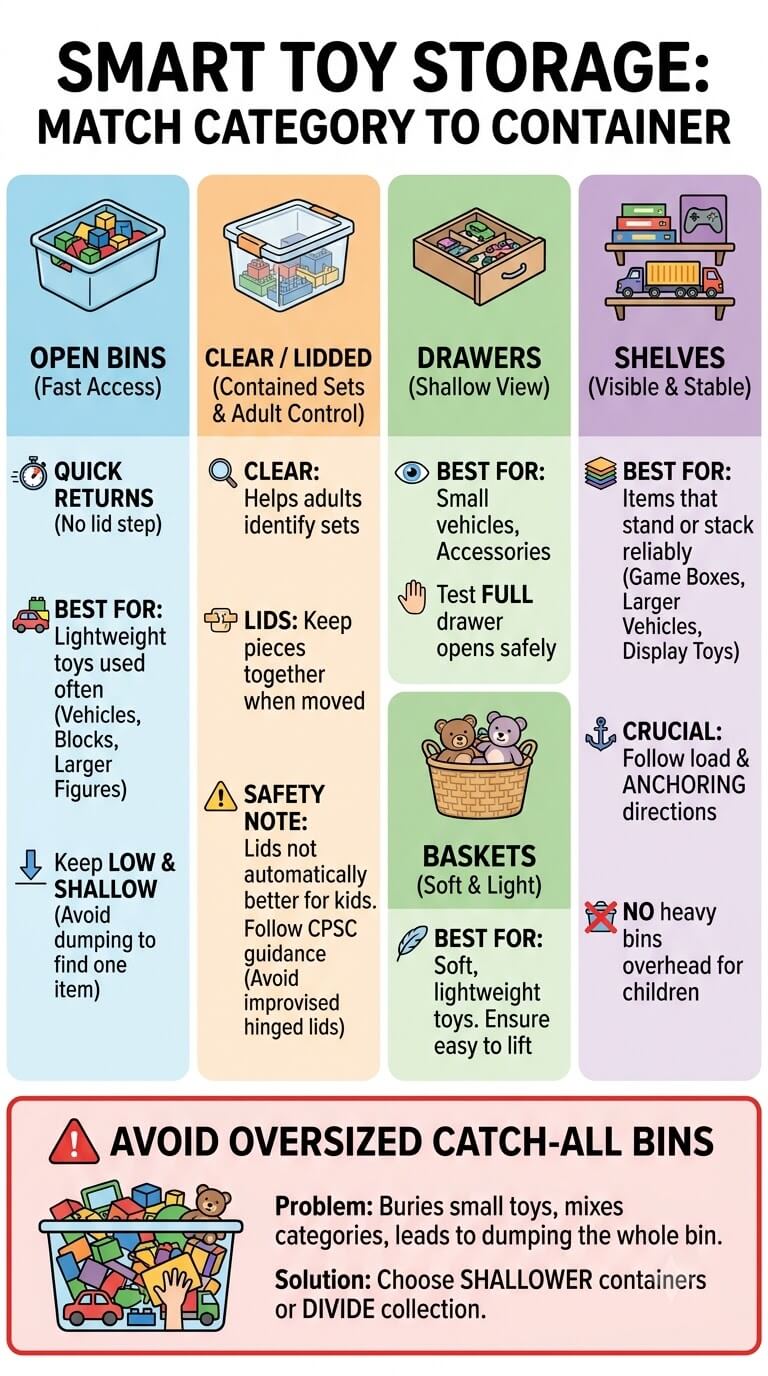
Choose storage according to access, piece size, weight, and cleanup steps.
Open bins for fast-access categories
Open bins work well for lightweight toys used often, such as vehicles, blocks, larger figures, or simple pretend-play pieces. They remove the lid step and make returns quick. Keep the bin low enough and light enough for the intended user, and do not fill it so deeply that finding one toy requires dumping the entire container.
Clear or lidded containers for contained sets and adult-controlled storage
Clear containers can help adults identify stored sets, while lids can keep pieces together when a container is moved. Lids are not automatically better for children’s storage. Some chests and hinged-lid products have specific safety concerns, so follow product instructions and avoid improvised solutions. CPSC has published guidance on hazards associated with some storage and toy chests.
Drawers and baskets for shallow categories
Drawers suit categories that benefit from a shallow view, such as small vehicles or accessories. Baskets work for soft, lightweight toys. Test whether a full drawer opens safely and whether a basket remains easy to lift from its actual shelf.
Shelves for visible, stable items
Use shelves for items that stand or stack reliably, such as game boxes, larger vehicles, or a small number of display-worthy toys that are also used. Do not rely on high shelves for heavy bins that a child would need to pull overhead. Follow the furniture maker’s load, installation, and anchoring directions.
Avoid oversized catch-all bins
Very deep bins look efficient because they hold a lot, but they often mix categories and bury small toys. Choose a shallower container or divide the collection when children repeatedly empty the whole bin to find one item. Container depth should support use, not just maximum volume.
Size the Container to the Category
A category should fit comfortably enough that putting toys away is easier than taking them out.
Leave enough room for easy return
Do not pack a bin to the rim during setup. Pieces need room to fall back in without careful stacking. A shelf also needs enough clearance that an item can be returned without rearranging its neighbors. If the system only works when an adult packs everything perfectly, it is too tight for everyday use.
Use the container as a capacity limit
Let the assigned space show when a category has become difficult to manage. A full bin is not automatically a problem, but spilling, forced lids, or constant dumping are useful signs that volume needs review.
What to do when a category outgrows its assigned container
Choose among three responses: reduce the category, move part of the retained collection into rotation or stored inventory, or relocate the entire category to a more suitable zone. Upsizing the container can be reasonable when the category is genuinely used and the room has capacity, but it should not be the automatic answer every time.
Build Child-Accessible and Adult-Controlled Zones
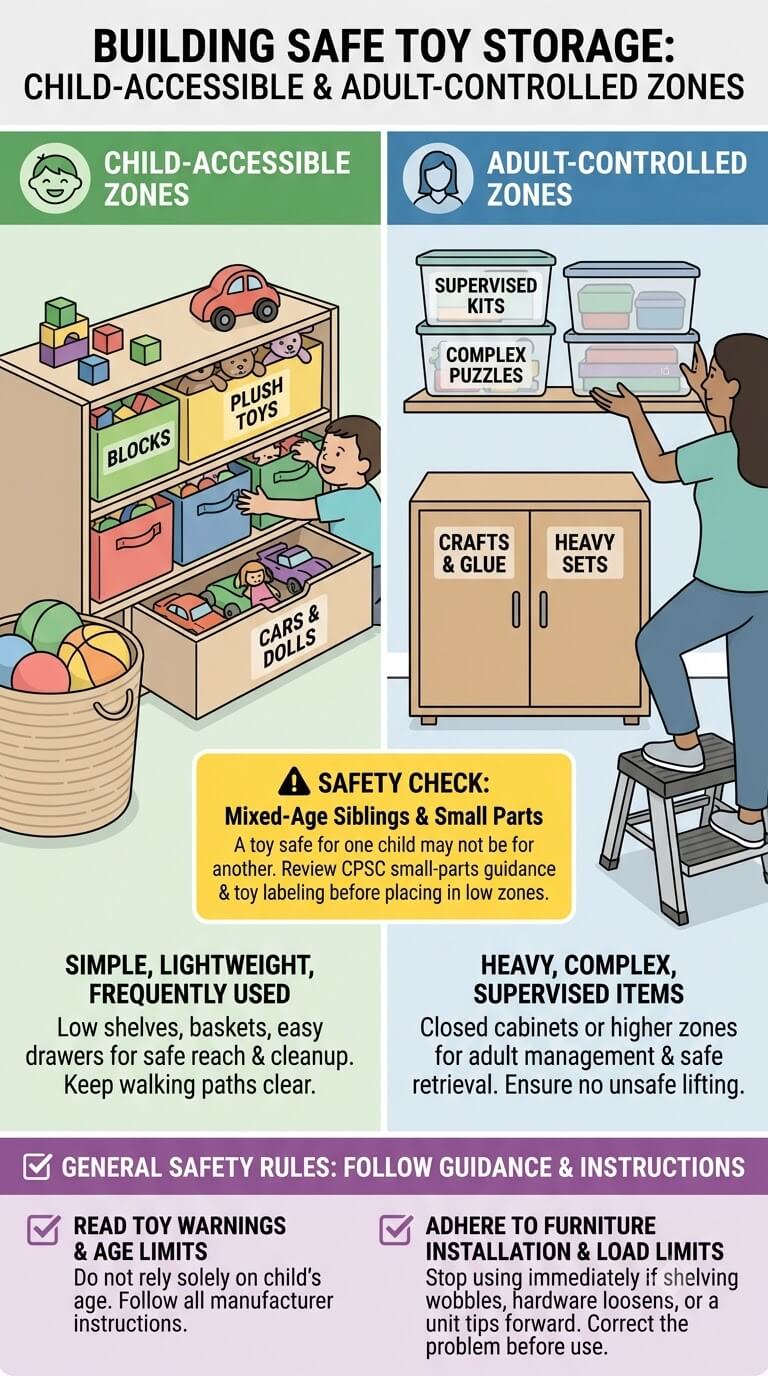
Access should reflect the specific toy, the room, and everyone who can reach the storage.
Frequently used toys within safe reach
Place simple, lightweight, commonly used categories where the intended child can reach and return them without climbing. Low shelves, floor baskets, and easy drawers can simplify cleanup. Keep walking paths clear even when bins are pulled out.
Small parts and mixed-age sibling limits
A toy that is appropriate for one child may not be appropriate for a younger sibling who shares the room. CPSC explains that small parts are subject to specific requirements and warning rules for young children. Review CPSC small-parts guidance, toy labeling, and the actual access pattern in your home before assigning a low storage zone.
Heavy, complex, or supervised items in adult-controlled storage
Keep heavy containers, complicated sets, craft-like toy components, or items requiring supervision in storage adults can manage safely. Adult-controlled does not have to mean hidden in another room. A closed cabinet or higher zone may work when the furniture and installation are suitable and the item can be retrieved without unsafe lifting.
Follow toy age guidance and storage-furniture instructions
Do not make access decisions from the child’s age alone. Read the toy’s warnings and instructions, and follow the storage furniture maker’s installation and load limits. If shelving wobbles, hardware loosens, or a drawer unit tips forward when opened, stop using the setup until the problem is corrected.
Organize Toys by Room Context
The same collection needs different limits in a bedroom, playroom, or shared living area.
Bedroom toy storage without consuming the floor
Protect the bed, dressing area, closet access, and a clear walking route first. Keep everyday favorites near the play area, but move large collections elsewhere if they repeatedly occupy the space needed for dressing or moving through the room. Under-bed storage can suit lightweight, occasional items only when the container fits safely and does not create a difficult pull-out task.
Playroom storage without duplicating the full room-layout plan
Place frequently used categories near where they are played with, then leave a meaningful open floor area. Storage should support the room, not line every available wall simply because space exists. If adding another shelf would shrink the play zone or narrow movement, reduce or relocate inventory instead.
Shared living-space storage with a defined active collection
Living rooms benefit from a smaller visible selection. Give toys a cabinet, low shelf, or limited set of baskets that can be reset at day’s end. Send overflow to one intentional location rather than spreading new bins around the room.
Tiny toy-storage areas and overflow destinations
In a small apartment or shared bedroom, one category may need to live in more than one location, but each location should have a reason. Keep the current favorite portion accessible and send occasional or bulky pieces to a defined secondary zone. When the secondary zone fills too, the collection needs review rather than a third overflow spot.
Use Labels That Make Cleanup Easier
Labels should answer one question quickly: where does this toy go?
Picture labels for visual matching
Picture labels can help children match a toy category to its container without needing to read. A simple photo or clear icon is usually enough. Penn State Extension materials note the usefulness of combining pictures with words on containers for frequently used toys and materials. See its guidance on picture and word labels for an example of that approach.
Simple word and category labels
Use short labels such as Blocks, Cars, Figures, Games, or Dress-Up. Avoid labels that require adults to remember an elaborate classification system. When two categories are often played with together, a combined label may be more practical than forcing a distinction nobody uses.
Name labels for sibling ownership when useful
Names can help with personal collections, special projects, or toys that are not shared. Keep shared categories shared unless ownership truly affects cleanup. Too many name labels can fragment the room and create duplicate storage for items the children normally use together.
Do not label every individual toy
Individual labels create maintenance work without improving most toy systems. Label the home, not each object. Exceptions may include pieces that regularly travel between rooms or special sets that are easily confused, but even then the label should solve a recurring problem.
Create a Cleanup Sequence
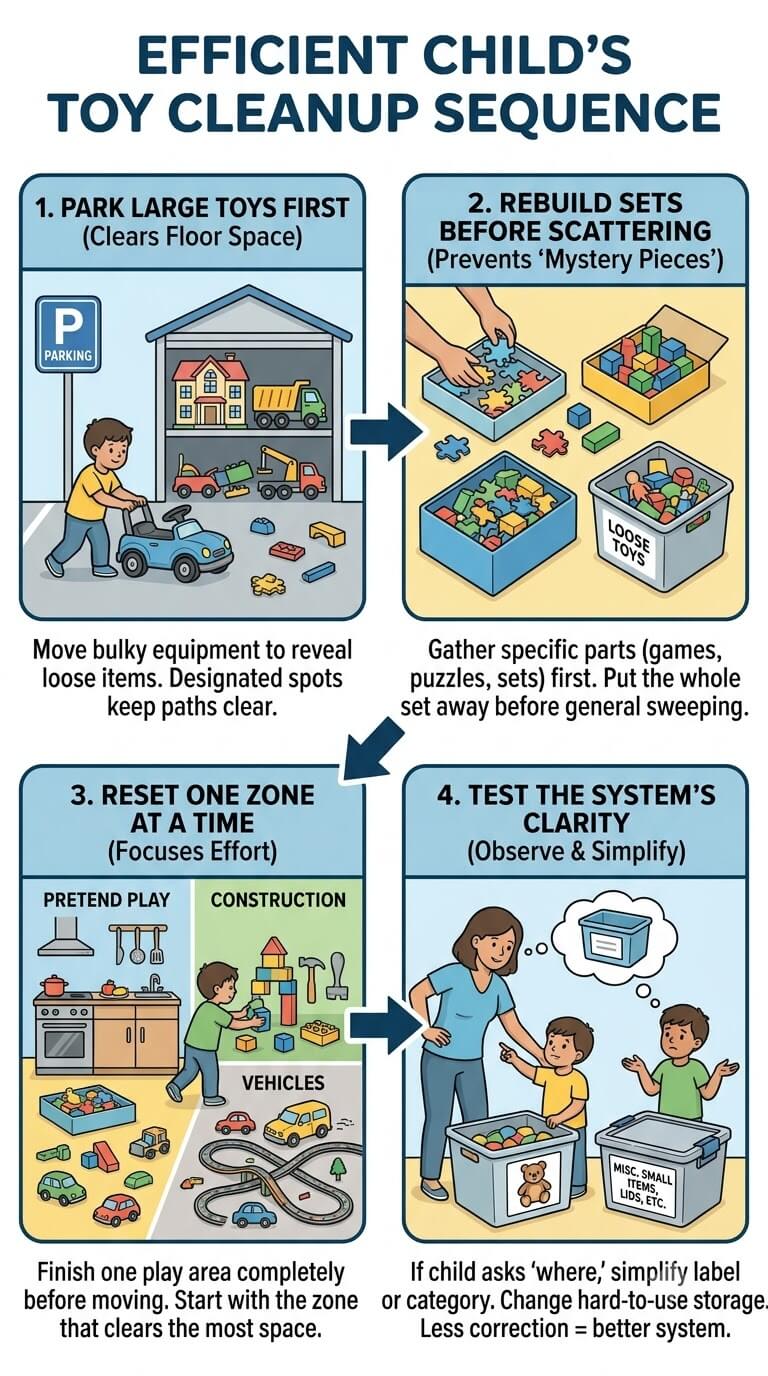
Cleaning up is easier when the order reduces obstacles instead of creating more sorting.
Return large toys first
Park ride-on toys, dollhouses, garages, large vehicles, and bulky equipment first so the floor becomes easier to move across. This also reveals the loose pieces underneath them. Large items should have obvious parking locations that do not block doors or walking paths.
Rebuild sets before loose-piece categories scatter
Gather game pieces, puzzle parts, building components, and set-specific accessories while they are still visible. Put the set away before sweeping unrelated loose toys into general bins. This reduces the number of mystery pieces that appear later.
Reset one zone at a time
Move through one play area rather than carrying individual pieces around the room repeatedly. For example, reset the pretend-play zone, then vehicles, then construction toys. In a small room, start with whatever will clear the most floor space and reduce tripping obstacles.
Test whether the child can understand the return path
Watch what happens during an ordinary reset. If a child repeatedly asks where something goes, simplify the category or improve the label. If a bin is ignored because the lid is difficult, change the storage method. If adults have to correct every placement, the system probably asks for more precision than daily cleanup needs.
Set an Overflow Rule
Decide in advance what happens when a category no longer fits.
When a bin no longer closes or a shelf no longer resets easily
Treat overflow as a prompt to review the category. Pull out obvious damaged pieces, check whether the collection contains duplicates or toys no longer used, and see whether the container still suits the category. Do not force a lid closed or stack unstable piles just to preserve the current arrangement.
Decide whether to declutter, rotate, or relocate the category
Declutter when items are no longer worth keeping. Rotate when worthwhile toys can leave daily access temporarily. Relocate when the category is still active but the current room is the wrong place for its size. These are different decisions, and choosing the right one prevents storage from becoming a holding area for every toy the household owns.
Do not solve overflow by endlessly adding bins
Extra containers help only when the room has capacity. If new bins narrow the floor, block access, or create unstable stacks, stop expanding storage. The room may be the real constraint. If floor space and furniture placement are the real constraint, solve the small playroom layout before adding more toy containers.
Common Toy Organization Mistakes
Most failed systems are either too full, too vague, or too complicated.
Organizing before deciding what stays
If obvious exits remain mixed into the collection, every container decision becomes harder. Remove clear trash, unsafe broken items, and already-designated outgoing toys first. Save difficult sentimental decisions for a separate decluttering session rather than letting them stall the storage setup.
Grouping primarily by color instead of function
Color sorting may look orderly, but it rarely reflects how a child searches for toys. A red car, red block, and red doll accessory have different uses. Functional categories keep play sets together and make it easier to know which container should receive an item during cleanup.
Mixing books and art supplies into miscellaneous toy bins
Books bend and disappear when buried under plastic toys, while art supplies have different access, mess, and restocking needs. Give those categories separate homes. The toy system only needs to make room for them, not treat every child-related object as the same type of storage problem.
Placing heavy bins too high
A high shelf can look efficient until a child tries to pull down a dense container. Keep weight, reach, and furniture stability in mind. CPSC’s Anchor It! information explains furniture tip-over risks and emphasizes proper anchoring. Follow the furniture manufacturer’s installation directions as well.
Building a system too detailed for daily cleanup
More categories do not always mean better organization. If toys constantly land in the wrong bins, merge groups that serve the same activity. A slightly broader system that resets consistently is more useful than one requiring adult correction.
Edge Cases and Adjustments
Some collections need a small modification rather than a completely different system.
Mixed-age siblings and small parts
Separate storage by access need, not just ownership. An older child’s small construction pieces or game parts may need controlled storage even if both children share the room. Make sure the younger child cannot reach a container simply because it has the older child’s name on it.
Large toys with no container
Assign a parking boundary instead of forcing the toy into storage furniture. A marked floor spot beside a wall, a low shelf bay, or a defined corner can be enough if it preserves paths and does not interfere with doors, vents, or furniture use. The key is that the toy has a consistent return location.
Categories used in more than one room
If one set travels often, use a portable container or one primary home plus a temporary carry basket. Return the category to its main home so pieces do not gradually disappear across the house.
When favorites change faster than the storage system
Keep the container structure stable and change what occupies prime spots. A suddenly popular category can move to an easier shelf while a less-used category moves to secondary storage. You do not need to redesign every label or buy furniture each time interests change.
FAQ About Organizing Toys
These answers help fine-tune the system once the main categories and zones are in place.
Should toys be stored in clear or opaque bins?
Use clear bins when seeing the contents helps identify a set. Opaque bins can reduce visual clutter when labels are clear. Choose according to contents, weight, access needs, and cleanup steps rather than appearance alone.
How many toy categories should one bin contain?
One functional category per bin is a useful starting point, but closely related toys can share a container when they are normally used together. Split a bin when pieces become hard to find or cleanup becomes confusing. Combine bins when the distinction creates work without improving play or retrieval.
What should I do with toys that belong to multiple sets?
Store a shared piece with the set that uses it most often, or create one small shared-access container if several sets truly need it. Do not duplicate storage labels for the same item. The child should have one predictable place to return it after play.
How do I organize toys in a shared living room?
Keep a limited active collection in a defined cabinet, shelf, or basket area and give larger or less-used toys another intentional home. Choose containers that can be reset without moving furniture. If toys continually spread beyond the assigned zone, reduce what stays active rather than adding storage across the room.
When should I stop organizing and start decluttering?
Stop rearranging when categories remain over capacity after reasonable grouping, the floor cannot stay clear, or too many retained toys are rarely used. At that point, the main question is no longer where each item belongs. It is whether the household needs to keep the full amount in active inventory.
A durable toy system makes the return path obvious. Group retained toys by function, keep sets together, choose containers that fit without being packed tight, place categories according to safe access, and let overflow trigger a decision. When cleanup becomes difficult again, check volume and category fit before buying another organizer.

Ethan Carter is the Founder & Editor of HomeCleanSecrets. Based in the United States, he has 5 years of experience creating practical home cleaning, laundry care, stain removal, decluttering, and home organization content. His goal is to help everyday households clean smarter and build simple routines that are easier to maintain.
Read more about Ethan Carter on his author page: https://homecleansecrets.com/ethan-carter/