
Learning how to declutter toys with kids is easier when every decision does not carry the same weight. Adults can handle obvious trash, unsafe items, recalls, and practical exit logistics first. Children can then help with a smaller set of meaningful choices about what they still use, what they are ready to pass along, and what needs more time.
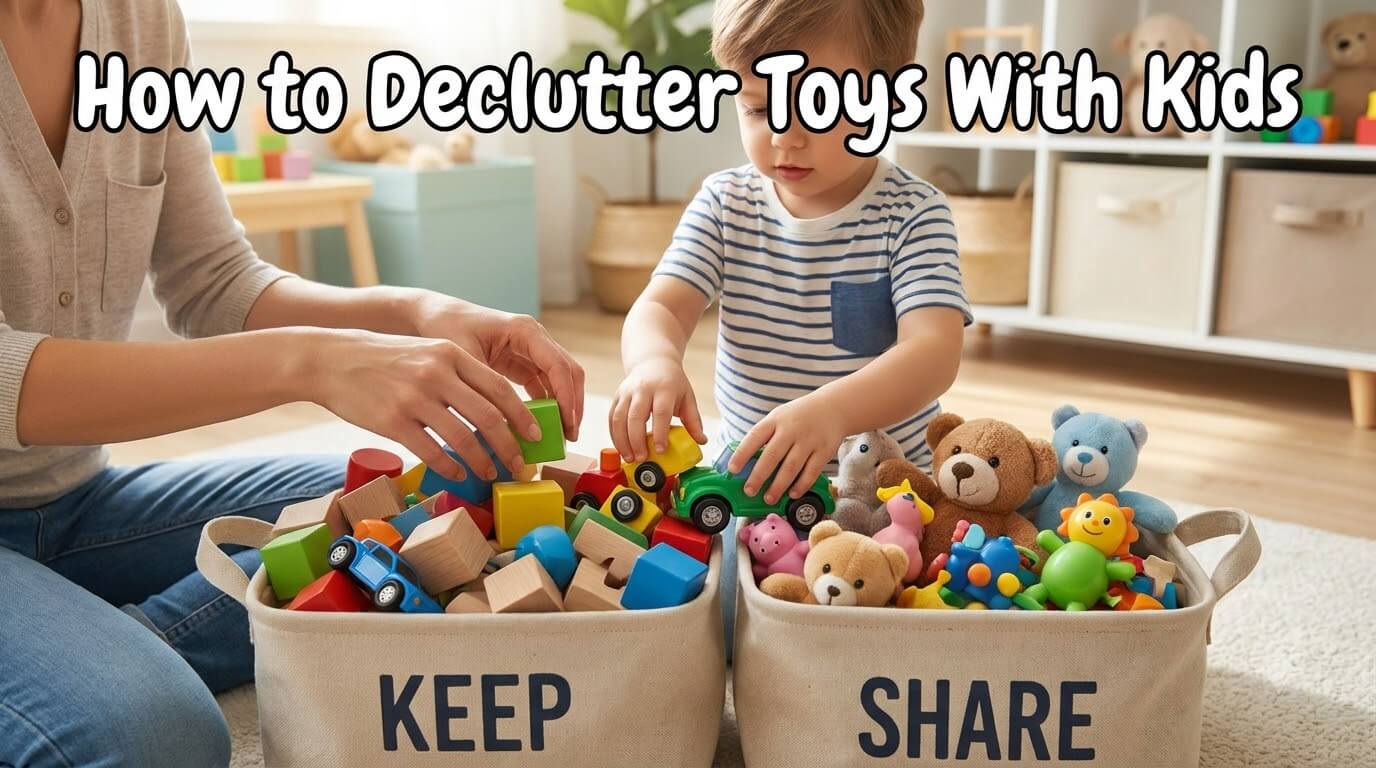
The goal is not to force a perfectly minimal toy collection in one afternoon. It is to reduce excess enough that favorite toys are easier to find, floor space can be recovered, and the toys that remain can move into a workable organization system. Keep permanent removal separate from toy rotation: a rotated toy is still being kept, while a donated, discarded, or recycled toy is leaving the active household inventory.
Quick Answer: Separate Adult-Only Decisions From Shared Decisions
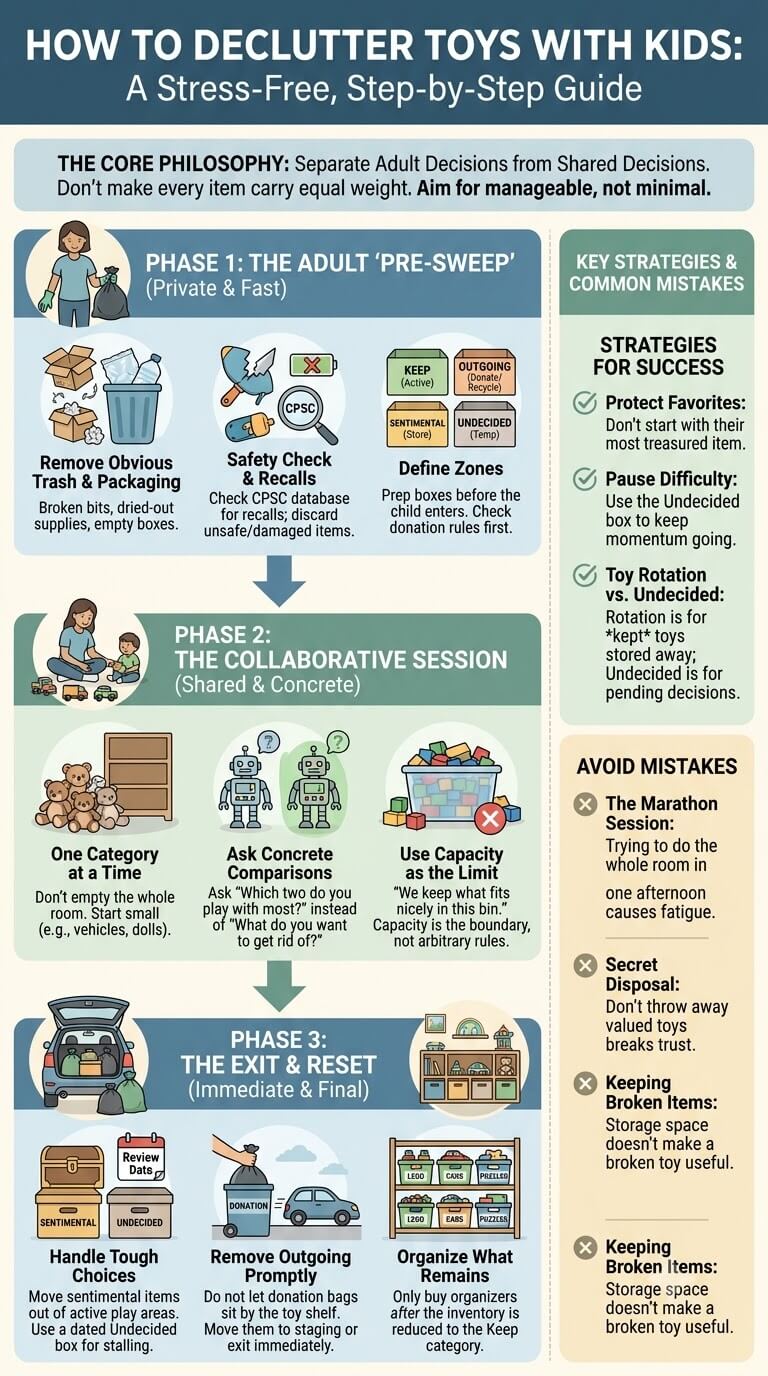
A calmer first pass starts by deciding who actually needs to weigh in on each type of item.
What adults should remove from the decision queue first
Adults can pull out packaging, obvious trash, severely damaged toys, items already designated to leave, and products that need a safety or recall check. This prevents a child from being asked to make choices about items that should not remain available in the first place. Keep questionable items out of play until you know whether they are safe to keep.
What the child can help decide
Invite the child to compare usable toys that are genuinely optional: two similar vehicles, several dolls, old pretend-play sets, or games they have stopped choosing. Ask concrete questions such as which one they reach for first or which set they would want available this week.
What counts as a successful first pass
A useful first pass may clear only one category. Success means outgoing items are clearly separated, retained toys are easier to see, and unresolved decisions are limited rather than scattered everywhere. Stop while the process is still manageable.
Signs Toy Inventory Is Too High
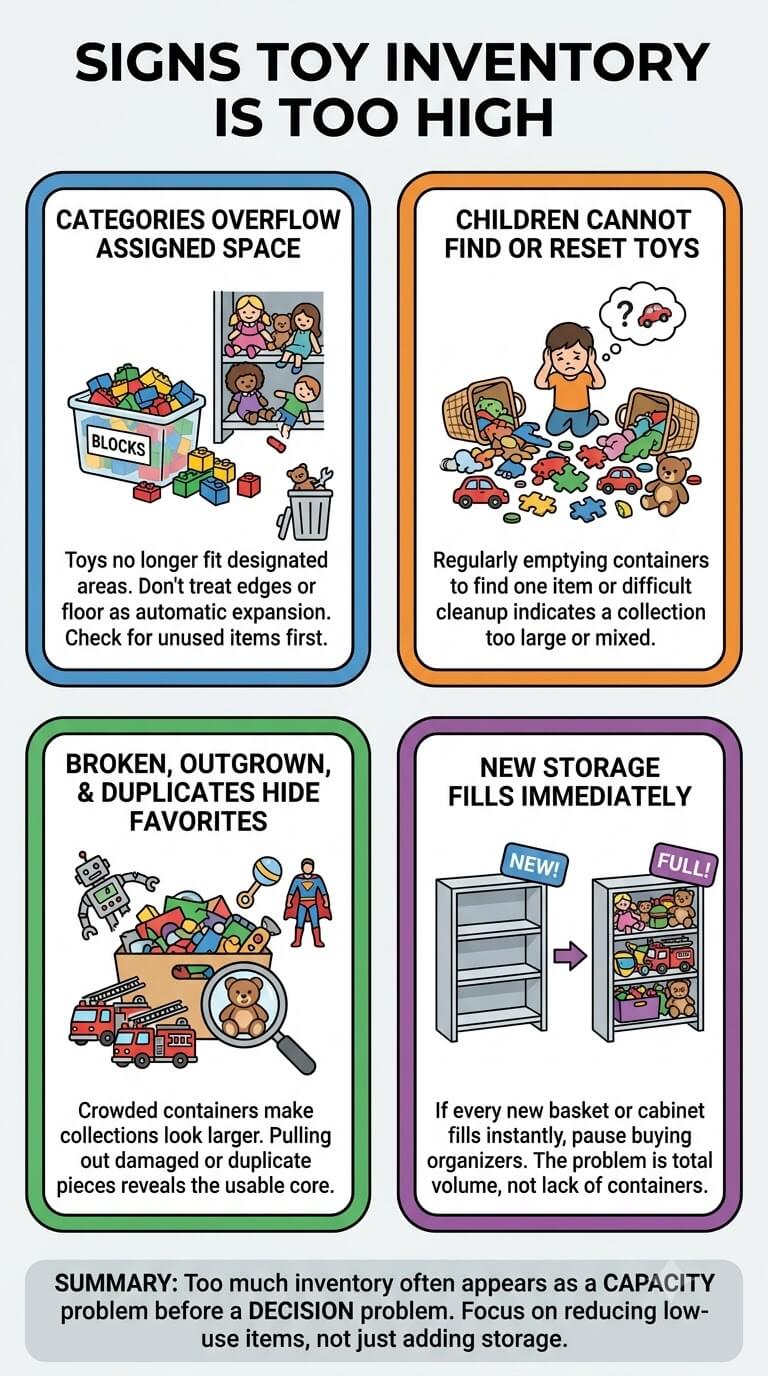
Too much toy inventory usually shows up as a capacity problem before it looks like a decision problem.
Categories overflow every assigned space
When blocks, dolls, vehicles, games, or plush toys no longer fit the areas already assigned to them, first check whether the category contains unused, duplicate, broken, or outgrown items. Do not treat the edge of every shelf or the floor beside a bin as automatic expansion space.
Children cannot find or reset toys
If a child regularly empties several containers to find one item, or cleanup requires an adult to sort dozens of unrelated pieces, the active collection may be too large or too mixed. Decluttering will not solve every storage problem, but reducing low-use items can make later organizing much simpler.
Broken, outgrown, and duplicate items stay mixed with favorites
A crowded container can make a collection look larger and more valuable than it is. Pulling out damaged pieces, obvious duplicates, and toys nobody chooses reveals the usable core.
New storage keeps filling immediately
If every new basket or cabinet fills as soon as it arrives, pause before buying another organizer. The problem may be total volume rather than lack of containers.
Prepare Before Involving the Child
A few minutes of setup can prevent the session from turning into a room-wide shuffle.
Choose one category and a realistic time window
Start with one defined group such as vehicles, pretend food, dolls, puzzles, or stuffed animals. Do not begin by emptying every closet and bin at once. A professional-organizer approach described by Better Homes & Gardens also begins by working through a manageable area and separating clearing, categorizing, deciding, and containing rather than treating the whole process as one step.
Set up keep, outgoing, repair, sentimental, and undecided destinations
Use distinct boxes, bags, or floor zones before decisions begin. Keep is for toys staying in normal use. Outgoing is for donation or another confirmed exit. Repair is only for items with a realistic fix. Sentimental storage is separate from active play, and undecided is a temporary category with a future review date.
Check local donation or recycling acceptance before promising an exit route
Do not tell a child that every toy will be donated before checking what nearby organizations actually accept. National organizations can have local differences. Goodwill, for example, directs donors to its goods donation information and local locations. Confirm condition requirements and exclusions before packing the car.
Make Adult-Only Safety and Obvious-Trash Decisions
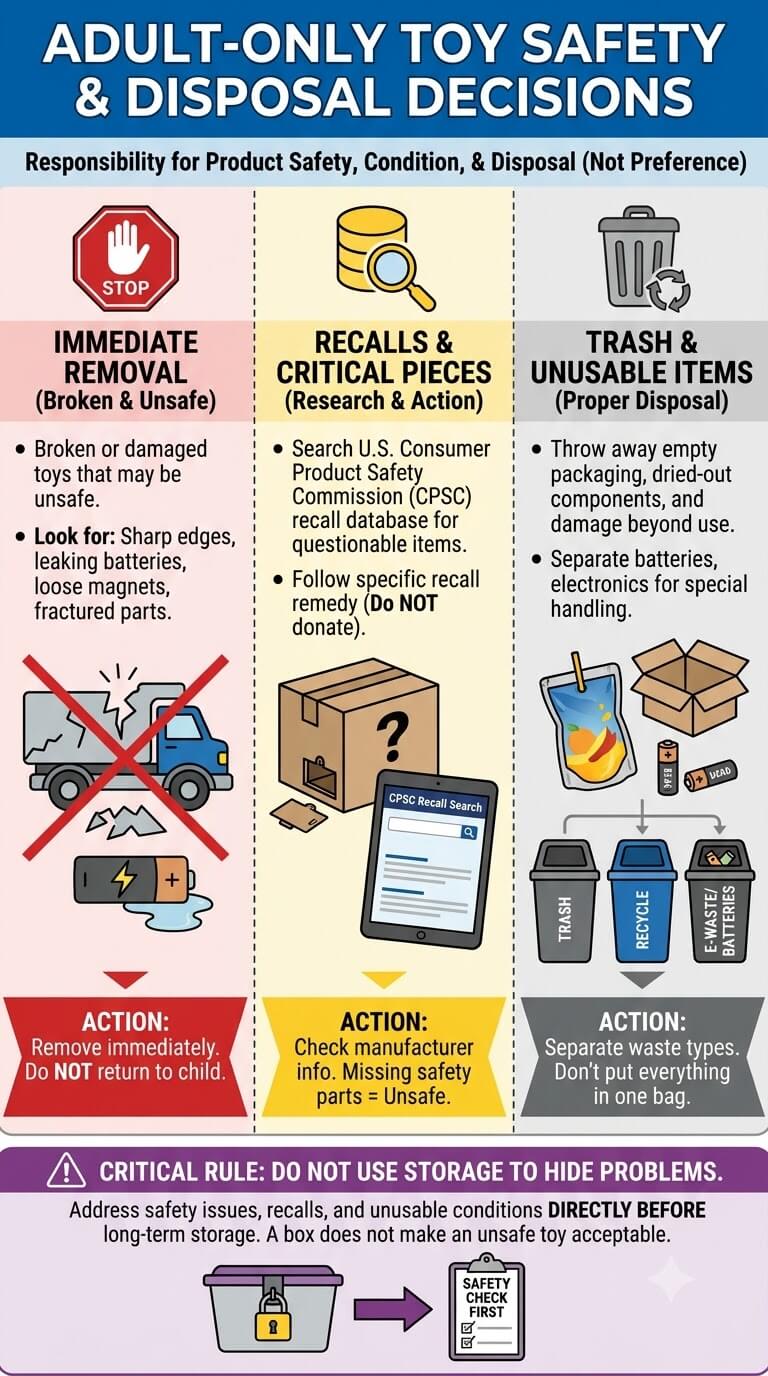
Some choices belong with the adult because they involve product safety, condition, or disposal rather than preference.
Broken or damaged toys that may be unsafe
Remove toys with exposed sharp edges, leaking batteries, damaged battery compartments, loose magnets, fractured parts, or other damage that may create a hazard. Do not hand a questionable toy back to a child simply because it is a favorite. Check the manufacturer information when available and replace or dispose of the item according to the applicable instructions.
Recalled items and missing critical pieces where relevant
If a toy seems questionable, especially an older item, secondhand item, or product with a known safety concern, search the U.S. Consumer Product Safety Commission recall database. Follow the specific recall remedy rather than donating the product. Missing decorative pieces are different from missing guards, fasteners, battery covers, or other components that affect safe use.
Trash and items that are clearly unusable
Throw away ordinary trash, empty packaging, dried-out disposable components, and toys that are damaged beyond reasonable use when no suitable recycling route exists. Separate batteries, electronics, or materials that require special local handling instead of putting everything into one trash bag.
Do not use rotation to avoid dealing with unsafe items
A storage box does not make a broken or recalled toy acceptable. Rotation is for worthwhile toys the household intends to keep but does not need available every day. Safety problems, unusable condition, and confirmed recalls need a direct decision before anything is placed into longer-term storage.
Declutter One Toy Category at a Time
Category-by-category decisions make comparisons clearer and keep the amount in front of the child manageable.
Duplicates and near-duplicates
Place similar toys together and ask whether each one serves a distinct purpose. Two identical trucks may be useful for siblings who play together, while six nearly interchangeable versions may not be.
Outgrown toys
Look for toys that no longer match current interests, physical fit, or manufacturer age guidance. Avoid rigid age cutoffs based only on what other children are doing.
Rarely used toys
Rare use is a prompt to investigate, not an automatic discard rule. Some games are seasonal, social, or reserved for particular visits. Others have simply disappeared behind more popular toys.
Sets with missing pieces
Check whether the missing pieces actually prevent the set from working. A puzzle missing a central piece may no longer be useful, while a building set can often function without every original block.
Toys that no longer fit the household’s space
Large toys deserve the same review as small ones. A play structure or bulky vehicle can dominate a small room even if it is used occasionally. Compare the space it consumes with how often it is chosen and whether another location is realistic.
Use Simple Decision Categories
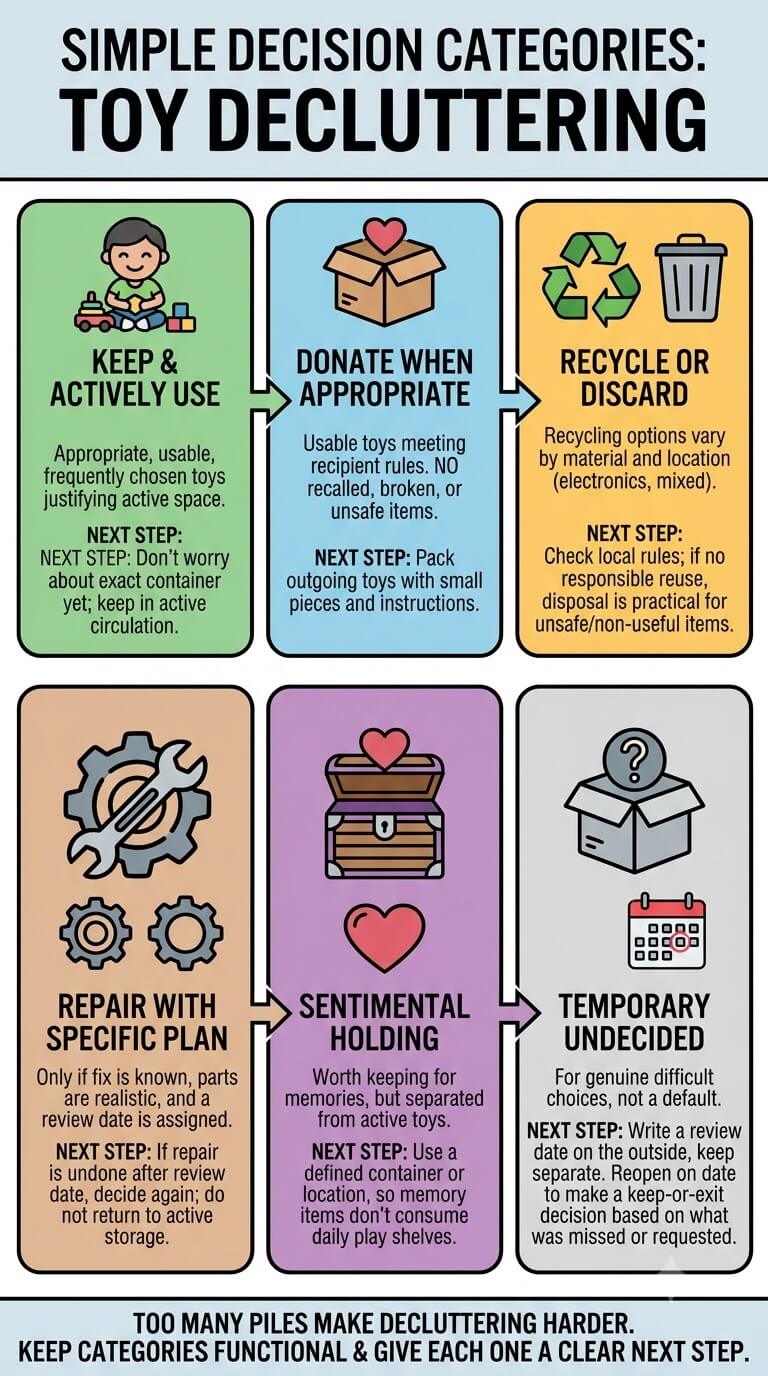
Too many piles make decluttering harder to finish. Keep the categories functional and give each one a clear next step.
Keep and actively use
Keep toys that are currently appropriate, in usable condition, and chosen often enough to justify active space. Do not worry about the exact container yet.
Donate when appropriate
Donation works for usable toys that meet the recipient organization’s acceptance rules. Do not donate recalled, broken, heavily incomplete, or unsafe items just to avoid disposal. Pack outgoing toys so small pieces and instructions stay with the set when possible.
Recycle or discard when appropriate
Recycling options vary by material and location, especially for electronics and mixed-material toys. Check local rules rather than assuming the curbside bin accepts an item. When no responsible reuse or recycling route exists and the toy is not safe or useful, disposal may be the practical outcome.
Repair only with a specific plan
A repair box can quietly become permanent storage. Keep an item there only if the fix is known, the parts or service are realistic, and you can assign a review date. If the repair remains undone after that date, decide again instead of returning the broken toy to active storage.
Sentimental holding box
Sentimental toys can be worth keeping even when they are no longer played with, but give them a different status from active toys. Use a defined container or location so memory items do not consume the same shelves needed for daily play.
Temporary undecided box with a review date
Use an undecided box for genuinely difficult choices, not as a default destination for everything. Write a review date on the outside and keep the box separate from active toys. When the date arrives, reopen it and make a keep-or-exit decision based on what was missed, requested, or still meaningful.
Involve Children at an Age-Appropriate Level
Participation should match the child, the task, and the stakes of the decision rather than a rigid age chart.
Ask limited, concrete questions instead of demanding every decision
Offer a small comparison: “Which two of these do you play with most?” or “Do you want both sets available?” Specific choices are easier to answer than “What do you want to get rid of?” Avoid turning the child into the manager of donation logistics, safety checks, or every item adults brought into the home.
Protect favorite and meaningful items from rushed choices
Do not start with the toy the child sleeps with, a beloved gift, or the collection used every day. Begin with lower-stakes categories so everyone learns the process. If a choice produces immediate strong resistance, set that item aside and continue with easier decisions instead of forcing a quick answer.
When an adult should make the call
Adults should decide on recalls, obvious hazards, trash, household capacity, and whether an outgoing destination is appropriate. Adults may also need to limit how much sentimental storage the home can hold.
Avoid rigid age rules or independence claims
Children differ in language, attention, attachment, and ability to compare options. Use simple participation that the child can understand, and increase responsibility when it works in your household.
What to Do When the Child Wants to Keep Everything
A request to keep everything does not mean the entire session has failed. Change the size and structure of the decision.
Reduce the decision set
Instead of presenting twenty stuffed animals, compare three similar ones. Remove obvious keepers from the discussion and focus on the least-used portion of a category.
Use category capacity instead of arbitrary pressure
Show the actual space available: one shelf for vehicles, one basket for plush, or one drawer for figures. Ask which items deserve that active space. Capacity turns an abstract command to “get rid of toys” into a concrete household limit, while still leaving room for the child’s preferences.
Pause genuinely difficult decisions
Use the undecided box for a few hard cases and move on. Do not let one toy stop the entire category. The box needs a review date so pausing remains a decision tool rather than a new permanent storage area.
Keep the process shorter than the child’s tolerance
End the session before every answer becomes “keep.” Fatigue makes useful comparison harder for adults and children alike. Finish the current small category, remove outgoing items from the play area, and choose another time for the next group.
What to Do When the Parent Wants to Keep Everything
Sometimes the strongest attachment belongs to the adult, especially when toys represent a stage that has passed.
Separate memory from current play value
A toy can be meaningful even if the child no longer uses it. Name that honestly and decide whether it belongs in sentimental storage rather than pretending it still needs prime playroom space.
Limit sentimental storage by defined capacity
Choose a container, shelf, or other realistic boundary for keepsakes. When it fills, compare sentimental items with one another instead of automatically adding another box.
Photographing or documenting is optional, not mandatory
A photo can preserve the appearance or story of a bulky item when that feels useful, but it is not a requirement. Some families prefer the object, some prefer a photo, and others are ready to let it go without documentation. Use the option only when it makes the decision easier.
Avoid turning the child’s room into adult memory storage
If a parent is keeping an item mainly for personal memories, move it out of the child’s active toy zone. The bedroom or playroom should not lose daily capacity to boxes the child is not expected to use.
Handle Gifts, Duplicates, and Sentimental Toys
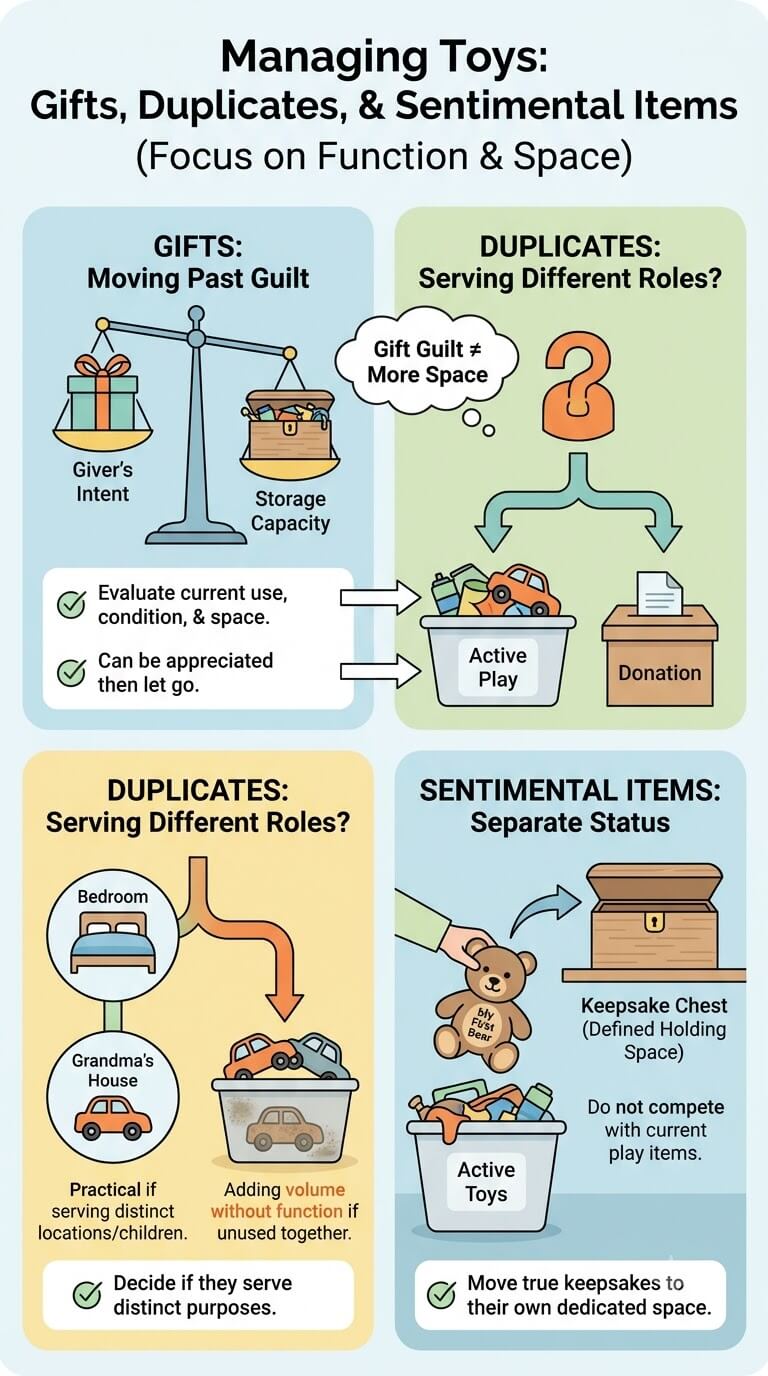
These categories often stay because of the story around the item rather than the role it plays now.
Gift guilt does not create storage capacity
A toy can be appreciated as a gift and still become unnecessary later. Consider current use, condition, and space rather than the original giver alone.
Decide whether duplicates serve different locations or children
Two copies may be practical when siblings use them simultaneously, one stays with a caregiver, or the toys serve different spaces. If the duplicates always sit together and one is never chosen, keeping both may add volume without adding function.
Give sentimental items a separate status from active toys
Do not force a sentimental toy to compete with current play items for the same bin. Move true keepsakes to their defined holding space.
Plan Sibling and Hand-Me-Down Decisions
Saving toys for another child can be useful, but only when the item, timing, and storage plan are realistic.
What is genuinely useful for a younger sibling
Keep hand-me-downs that are in good condition, complete enough to use, appropriate for the younger child when the time comes, and worth the storage space. Do not save a toy automatically just because another child exists.
Where hand-me-down toys wait
Move saved hand-me-downs out of the current active toy area. Label them clearly enough that adults know what they are and who they are intended for.
Keep ownership clear in shared spaces
Shared toys can remain shared, while special personal items can have separate status. Clarity matters when one child is ready to release something and another still uses it.
Do not pass along broken or unsuitable items
Check condition, age guidance, and small parts before saving a toy for a younger sibling. CPSC explains that some children’s products are subject to small-parts restrictions and choking-hazard labeling. A toy that was appropriate for an older child may need controlled storage until it is suitable for the younger one.
Remove Outgoing Items Promptly
Decluttering is not complete while the donation bag is still sitting beside the toy shelf.
Prepare donations according to recipient rules
Group complete sets, contain loose pieces, and follow the recipient’s condition requirements. If a charity does not accept a category, choose another legitimate route instead of leaving the bag indefinitely. Do not place recalled or unsafe products into donation channels.
Keep outgoing bags away from active play zones
Once an item is designated to leave, move it to an adult-controlled staging area. This keeps the child from repeatedly re-sorting the same bag and prevents outgoing toys from being mistaken for active storage.
Set a realistic exit date
Choose a specific errand day, pickup date, or local drop-off window. A vague plan to donate “later” often creates another pile. If the planned destination falls through, reassess the route rather than returning everything to the playroom by default.
Recheck items that cannot be donated or recycled
If an item is refused, find out why before passing it elsewhere. Condition, product type, local rules, or a recall may change the correct next step. Keep unsafe items out of reuse channels and follow any manufacturer or official disposal instructions that apply.
Hand Retained Toys Off to the Organization System
Once keep decisions are finished, shift from deciding what stays to making the retained collection workable.
Group what remains without building the full storage system here
Gather retained toys into broad functional categories such as vehicles, building toys, figures, pretend play, puzzles, and games. This reveals the real size of each group. Do not buy bins yet unless the category size and intended location are already clear.
Identify categories too large for their future containers
If a keep category is still much larger than the shelf or bin available for it, do another focused review within that category. The choice is to reduce it, assign more legitimate space, or keep part of it outside daily access.
Consider rotation only for worthwhile retained items
Rotation can help when the household truly wants to keep more usable toys than should be accessible at once. It is not a place for broken, unsafe, or clearly outgrown items. Only rotate toys you would still choose to keep if storage were not the problem.
Common Toy Decluttering Mistakes
Most setbacks come from making the task too broad, too emotional, or too vague about what happens next.
Making every decision in front of the child
Do not ask the child to approve trash, recall actions, empty packaging, or every logistical decision. Save their attention for meaningful choices.
Secretly discarding cherished items as a universal tactic
Quietly removing clear trash is different from secretly disposing of toys the child actively values. Avoid treating secret disposal as the default solution to resistance. When possible, separate lower-stakes adult decisions from the child’s favorites and handle difficult keepsakes openly and gradually.
Trying to finish the entire room in one marathon
Emptying every bin at once can leave the room less usable than when you started. Complete one category, move outgoing items to staging, and restore the active area before opening another.
Keeping broken items because storage space exists
Available space is not a reason to keep an unsafe or unusable toy. If repair is realistic, place it in the repair category with a deadline. Otherwise follow the appropriate disposal route.
Confusing undecided storage with rotation
An undecided box holds items that still need a keep-or-leave decision. Rotation holds toys that have already passed the keep decision and are temporarily out of daily access.
When to Plan Another Decluttering Pass
Toy needs change, so a finished session does not have to be the final review forever.
After interests or growth stage changes
Review a category when a child stops choosing it for a sustained period, when toys are clearly outgrown, or when new interests replace older ones. Do not force a fixed calendar if the collection remains easy to use and reset.
When categories overflow again
Overflow is a useful trigger because it reflects the actual capacity of the room. Before adding a second or third container for the same category, check whether low-use, duplicate, damaged, or outgrown items have accumulated again.
Before buying more storage for the same problem
If the room previously gained organizers but clutter quickly returned, review inventory before purchasing more. Storage is useful after keep decisions are clear.
FAQ About Decluttering Toys With Kids
These questions cover the decisions that most often stall a toy-decluttering session.
Should I declutter toys when my child is not home?
Adults can handle obvious trash, recalls, damaged items, and other clear safety or logistics decisions without turning each one into a family meeting. For usable toys the child actively values, shared decisions are usually more appropriate.
How do I handle toys my child never uses but refuses to donate?
Narrow the choice, show the actual category capacity, and avoid forcing a decision during a tired or rushed moment. A small undecided box can hold genuinely difficult items until a stated review date.
How long should an undecided box stay closed?
There is no universal number of days. Pick a date that is soon enough to prevent permanent limbo but long enough to reveal whether the items are requested or missed. A few weeks or a season may make sense depending on the category.
What should I do with broken toys?
First decide whether the damage may affect safety. The CPSC toy safety center is a useful place to check current safety information, and the manufacturer may provide product-specific instructions. Repair only when the fix is appropriate and realistic. Otherwise use the correct local recycling or disposal route.
Is toy rotation the same as keeping an undecided box?
No. A rotated toy has already been chosen to stay; it is simply stored outside daily access for a period. An undecided toy still needs a keep-or-leave decision.
A good toy-decluttering process reduces the number of decisions happening at once. Adults handle safety, trash, recalls, and exit logistics; children can help compare usable toys at a level that makes sense for them. Work category by category, give sentimental and undecided items firm boundaries, remove outgoing items promptly, and organize only after the retained inventory is clear. If the clutter extends beyond toys into books, clothing, and room zones, step back and review the whole kids’ room setup before buying more storage.

Ethan Carter is the Founder & Editor of HomeCleanSecrets. Based in the United States, he has 5 years of experience creating practical home cleaning, laundry care, stain removal, decluttering, and home organization content. His goal is to help everyday households clean smarter and build simple routines that are easier to maintain.
Read more about Ethan Carter on his author page: https://homecleansecrets.com/ethan-carter/