
Kids’ books are easier to manage when storage reflects how they are used. A packed shelf may hold everything yet still make favorites hard to find and return. The goal is a collection that stays visible, easy to reset, and appropriately sized for the available shelves.
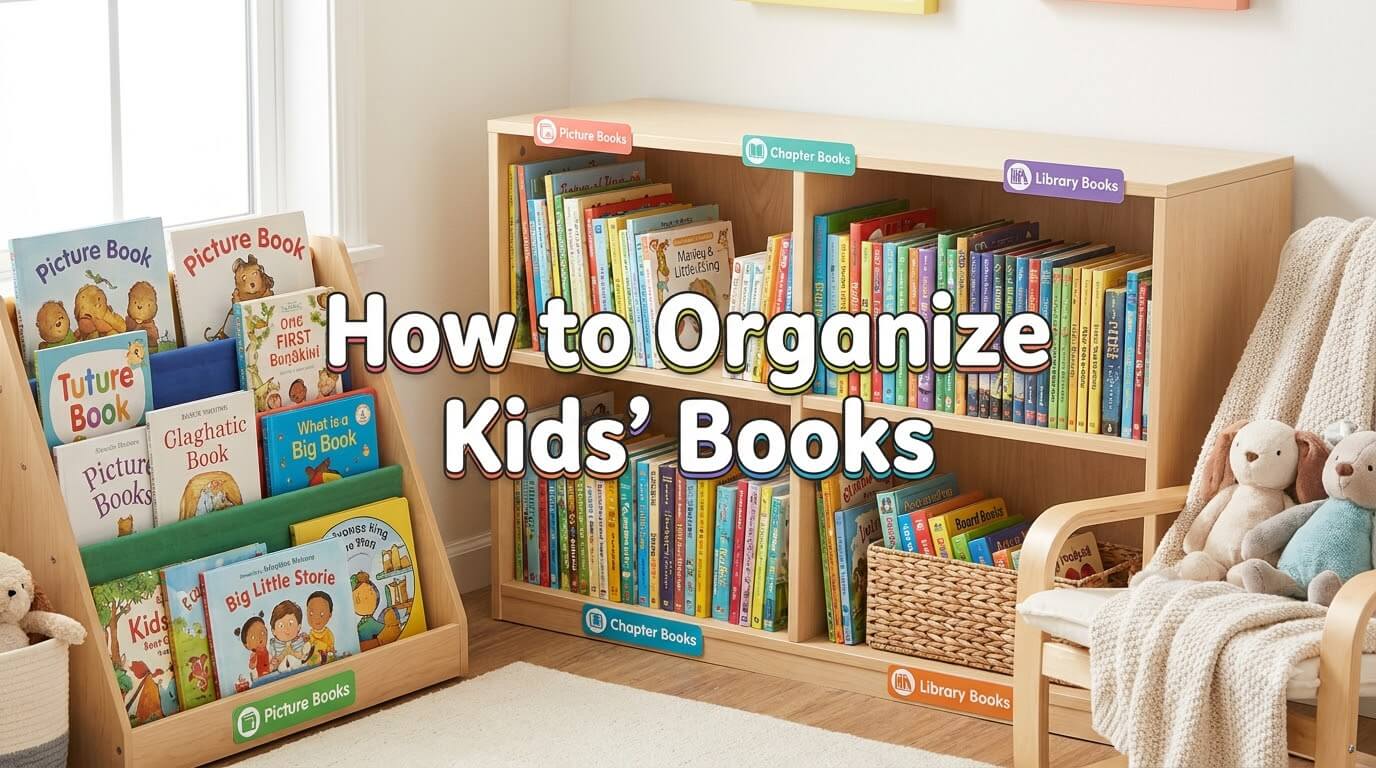
Separate the active collection from outgrown, borrowed, damaged, sentimental, and overflow books. Then match each format to storage that supports its size and use, such as a low board-book shelf, a small front-facing picture-book display, spine-out chapter books, and a separate basket for library books.
Quick Answer: Organize by Reader Use, Book Format, and Shelf Capacity
The simple workflow
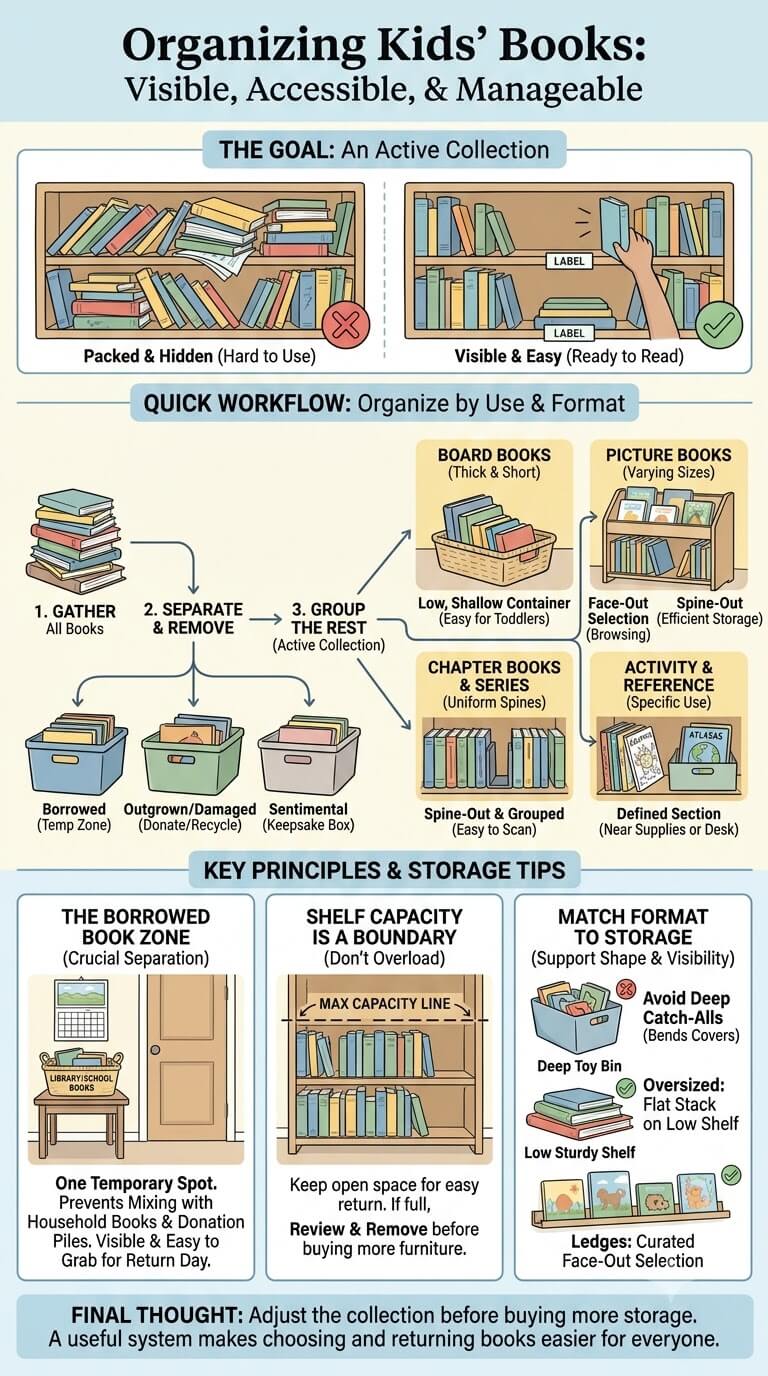
Gather the books, separate household titles from borrowed ones, remove obvious outgrown or damaged items, and group the rest by format or reader use. Keep only the current active amount in prime storage, with enough open space for a child to remove and return one book easily.
What makes book organization different from toy-bin organization
Books need support for their shape, visibility, and edges. A deep catch-all toy bin can bend covers, hide thin books, and turn returning one title into a digging task. Books also create temporary categories such as library loans and school books that must leave the house again. Organize them as reading materials, not as miscellaneous play objects.
Inventory the Children’s Book Collection
Gather books from bedrooms, playrooms, and shared spaces
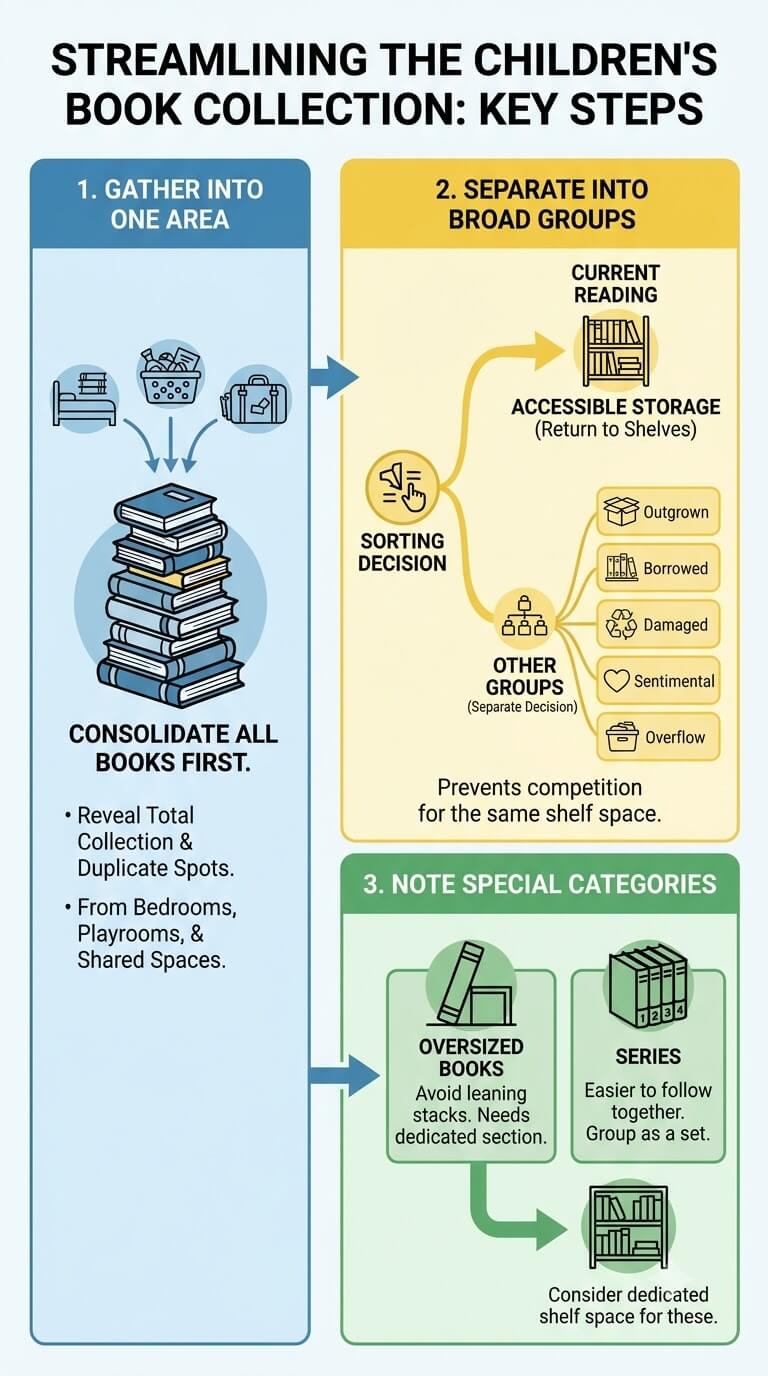
Bring scattered books into one working area. Check bedrooms, playroom baskets, living-room shelves, travel bags, and other reading spots. They do not have to stay together afterward. Gathering them first reveals the total collection and the duplicate storage spots that have developed.
Separate current reading, outgrown, borrowed, damaged, and overflow books
Make broad groups with different next actions: current reading, borrowed, outgrown, damaged, sentimental, and overflow. Current books return to accessible storage, while the other groups need a separate decision or destination. This prevents every title from competing for the same shelf.
Note oversized books and series
Pull out books that do not fit the usual shelf height and identify series that are easier to use together. Oversized books often create leaning stacks in short cubbies, while scattered series become harder to follow. Either group may deserve a dedicated shelf section.
Group Books in Ways That Help Retrieval
Board books
Board books are thick, short, and easy to handle from a low shelf or shallow basket. Keep the category broad unless the collection is very large. One board-book zone is usually easier to maintain than many small themes that add sorting work.
Picture books
Picture books vary in height and thickness, so store them where covers or spines remain easy to see and return. A small face-out selection can support browsing while the rest stay spine-out. The Association for Library Service to Children also discusses face-out displays and topical grouping in libraries.
Early readers
Early readers are often thinner than picture books and can disappear between larger formats. Give them a defined shelf segment, magazine-style holder, or shallow bin if that makes the covers easier to locate. Keep the grouping based on how the books are used in your home rather than trying to recreate a classroom catalog.
Chapter books and series
Chapter books usually work well spine-out because titles and series numbers are easy to scan. Keep a series together when reading order matters. A simple bookend or divider can hold the group in place without requiring a separate label for every author.
Activity and reference books
Coloring books, sticker books, puzzle books, atlases, and reference books are used differently from stories. Keep consumable activity books near supplies only when that area stays manageable. Give reference books a small section so they can be found without searching through bedtime stories.
Oversized formats
If tall or wide books do not fit the main bookcase, place them flat in a short stack on a sturdy low shelf or use storage that supports their full height. Avoid tall floor stacks. One book should be removable without making the rest unstable.
Decide What Belongs in the Active Collection
Frequently chosen books
Give the easiest locations to books chosen most often. Put current favorites where the child normally reads, using a low shelf, cubby, or small bedside basket with a clear capacity. Prime space should reflect current habits rather than every book the household owns.
Current school or library books
Books that need to return to a school or library should remain visible and separate from household inventory. Give them a temporary shelf, basket, or clearly defined end of a bookcase. Keeping them together also makes it easier to check bags before a return day without searching every bedroom and play area.
Seasonal or occasional titles
Holiday books, travel activity books, and other occasional titles do not need year-round prime space. Keep them in clean, dry secondary storage. When they become relevant, swap a small selection into the active area rather than adding them to already full shelves.
When the shelf is signaling excess inventory
If books must be wedged in, fall forward, or migrate to the floor because there is no return space, the active collection is too large for the shelf. Review outgrown, rarely used, sentimental, and secondary-storage candidates before buying another bookcase.
Choose Front-Facing Versus Spine-Out Storage
When front-facing visibility helps
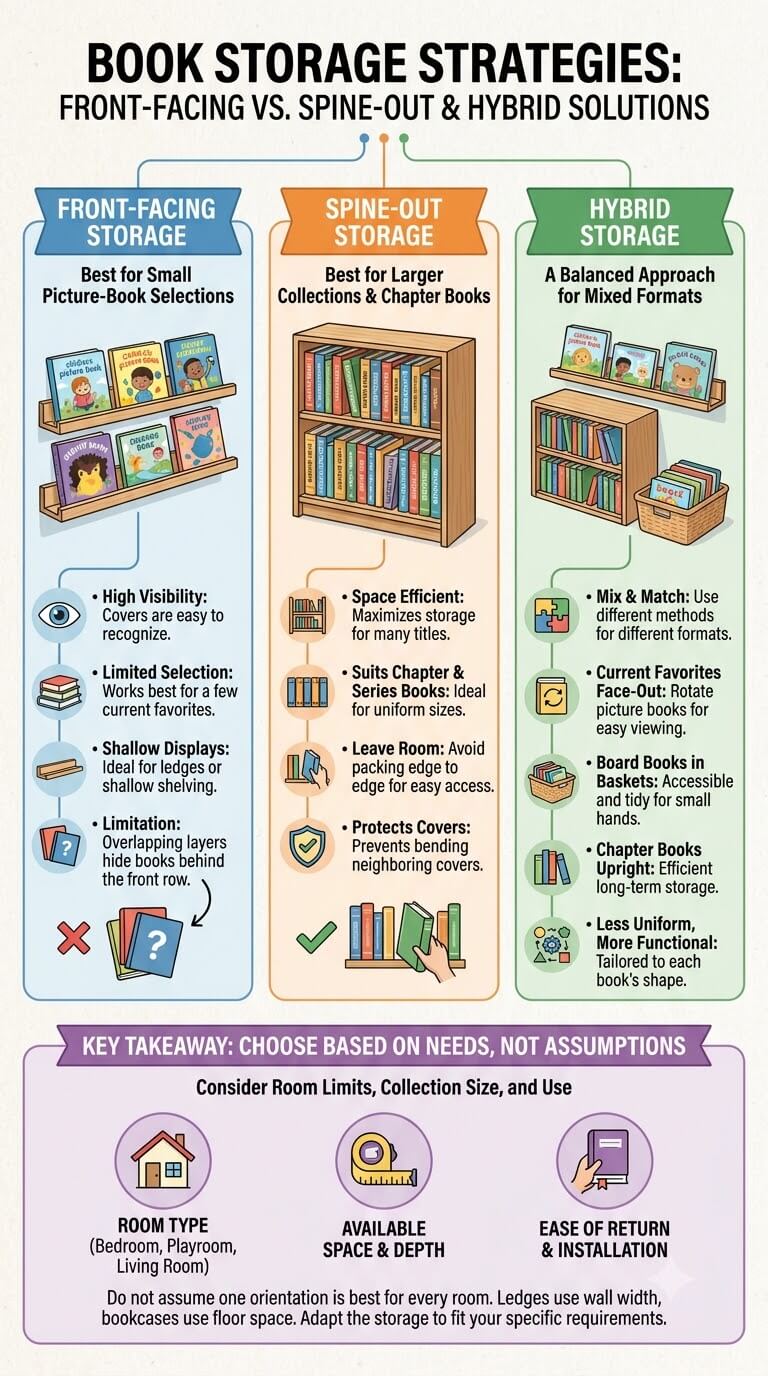
Front-facing storage works well for a small picture-book selection because covers are easy to recognize. Use it on a ledge or shallow display and keep the selection limited. Once several layers overlap, books behind the first row become hidden and harder to return.
When spine-out shelving fits a larger collection
Spine-out shelving uses space efficiently and suits chapter books, series, and many picture books. Leave some open room instead of packing the shelf edge to edge. A child should be able to remove one title and slide it back without bending neighboring covers.
Hybrid storage for mixed formats
Many homes work best with a mix: a few current picture-book favorites face-out, the broader collection spine-out, board books in a shallow basket, and chapter books upright. The setup may look less uniform, but each format gets storage that works with its shape.
Do not assume one orientation is best for every room
Bedrooms, living rooms, and playrooms have different limits. Ledges use wall width, while bookcases use floor space and depth. Choose according to collection size, available space, return ease, and installation requirements rather than assuming one orientation works everywhere. If books are only one category competing for limited bedroom or playroom space, review the larger kids’ room storage system before expanding the book area.
Match Book Type to Storage
Low bookcases
A low bookcase can keep many active titles within reach. Follow the manufacturer’s assembly, load, and anchoring instructions. The U.S. Consumer Product Safety Commission recommends anchoring furniture with drawers, doors, and shelves to help prevent tip-overs.
Book ledges
Use ledges for a curated face-out selection, not automatically for the full collection. Follow installation, fastener, and load instructions. Keep heavy books off ledges not designed for them, and do not place books where a child must climb furniture to reach them.
Bins and baskets
A shallow sturdy basket can work for board books or a small rotating selection. It should let books stand or lean without being buried. If the basket becomes too heavy for easy resetting, reduce the contents rather than choosing a deeper container.
Cubby or shelf sections
Cubbies are useful for separating broad groups such as board books, picture books, and chapter books. Keep each section roomy enough for actual returns. If every cubby is filled to the edge, adding dividers and labels will not fix the capacity problem. Remove or relocate part of the collection before refining the categories.
Keep unstable stacks off the floor
Floor stacks require no furniture, but they become obstacles and collect more books quickly. Move frequently used titles into supported storage and keep any flat stack on a stable low shelf. Clear floor space also gives books an obvious destination during cleanup.
Build a Reading-Area Book Zone
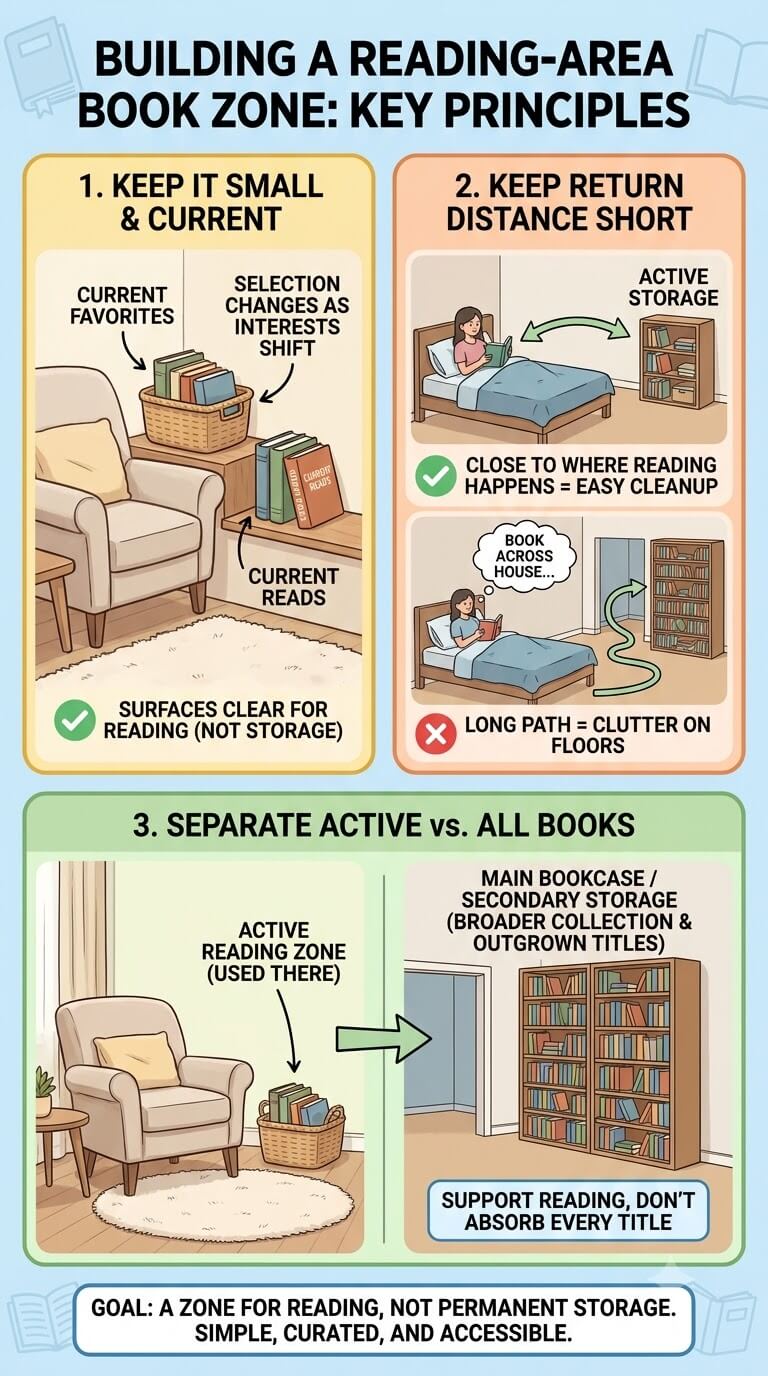
Keep a small current-reading selection near the reading space
A reading corner needs only a small current selection. A basket, ledge, or shelf section with favorites is usually enough. Change the selection as interests shift so seating, rugs, and bedside surfaces stay available for reading instead of becoming permanent storage.
Keep return distance short
Keep active book storage close to where reading happens. Bedtime books stored across the house are more likely to remain on the floor or bedside table. A short return path makes cleanup easier without creating full duplicate collections in several rooms.
Avoid letting the reading corner absorb the entire collection
When a reading corner overflows, separate books used there from all books owned. Keep the first group nearby and return the broader collection to the main bookcase or secondary storage. The reading area should support reading, not absorb every occasional or outgrown title.
Organize Books by Bedroom Versus Playroom
Bedtime or current favorites in the bedroom
Bedroom storage can stay small: bedtime favorites, a current chapter book, or a few requested picture books. Avoid filling every surface simply because books are used there. A defined bedroom limit makes the nightly reset faster and reduces duplicate overflow.
Broader active collection in the playroom
If the playroom is the main browsing space, it can hold the broader active collection. Keep the book zone proportional to the room so shelves do not consume needed floor space or walking paths. Review the collection before expanding the furniture footprint.
Shared-family-space limits
In a shared living area, set one clear boundary such as a shelf, cabinet section, or basket. When it fills, return excess books to the main collection instead of starting another informal pile. The limit keeps books available without taking over unrelated storage.
Avoid duplicating the same overflow everywhere
Several book baskets in different rooms can hide the true inventory. Give each room a reason for holding books and one main destination for extras. If a title has no clear reason to stay there, return it to the main shelf or review pile.
Keep Borrowed Books Separate
Temporary shelf or basket for library and school books
Use one temporary zone for borrowed materials, such as a basket near the entry, one bookcase section, or a shelf near school items. The main purpose is to keep borrowed books out of the household collection and easy to check before return day.
Simple return-date visibility without building a library management system
Keep the receipt, due-date slip, or a simple calendar reminder where the responsible adult will see it. There is no need for a complicated tracking system. Storage only needs to show which books belong elsewhere and where they are when return day arrives.
Prevent borrowed items from entering donation piles
Before decluttering books, empty the borrowed-book zone and set those items aside. This quick check prevents library or school property from entering donation boxes, especially after holidays, moves, or room resets when many books are gathered at once.
Handle Series and Sibling Books
Keep series together when it helps use
If books are normally read in sequence, shelve the series together. This makes the next volume easy to locate and reveals missing books quickly. If the series is too large for one shelf section, split it logically by volume range or move completed volumes to secondary storage instead of scattering them randomly among unrelated books.
Separate ownership only when necessary
Not every sibling needs a separately labeled shelf. Separate ownership when it prevents confusion, protects a special collection, or helps older and younger children manage very different formats. Otherwise, shared categories may be simpler. Use the child’s name only where ownership changes what happens when the book is returned, stored, or passed on.
Shared collections versus child-specific shelves
A shared family bookcase can hold common picture books and reference books, while each child has one smaller section for personal favorites. This hybrid approach prevents duplicate systems and still gives children a predictable place for books they consider their own. Revisit the division when reading habits or room assignments change.
Limit the Active Display
Use shelf capacity as a boundary
The active shelf should stay easy to browse and reset, not merely hold one more book. If returning a title requires pushing, stacking, or moving several others, reduce the active amount until normal returns can happen without reorganizing the shelf.
Rotate a small set at a basic level
If the room cannot display every retained book comfortably, move a limited group to secondary storage and swap titles when interest changes. Keep it simple. There is no need for a fixed weekly schedule or detailed tracking just to keep the visible selection manageable.
Move rarely used books to secondary storage
Choose clean, dry secondary storage away from obvious moisture and extreme heat. The Library of Congress advises avoiding areas near vents, radiators, and large environmental swings in its book storage guidance. At home, avoid damp or wet storage areas.
Declutter when rotation only hides permanent excess
Secondary storage should have a purpose. If boxes remain unopened through multiple growth stages, review them instead of adding more. Keep sentimental books deliberately, pass on genuinely outgrown titles, and return useful books to active shelves rather than postponing every decision indefinitely.
Make Book Return Easy
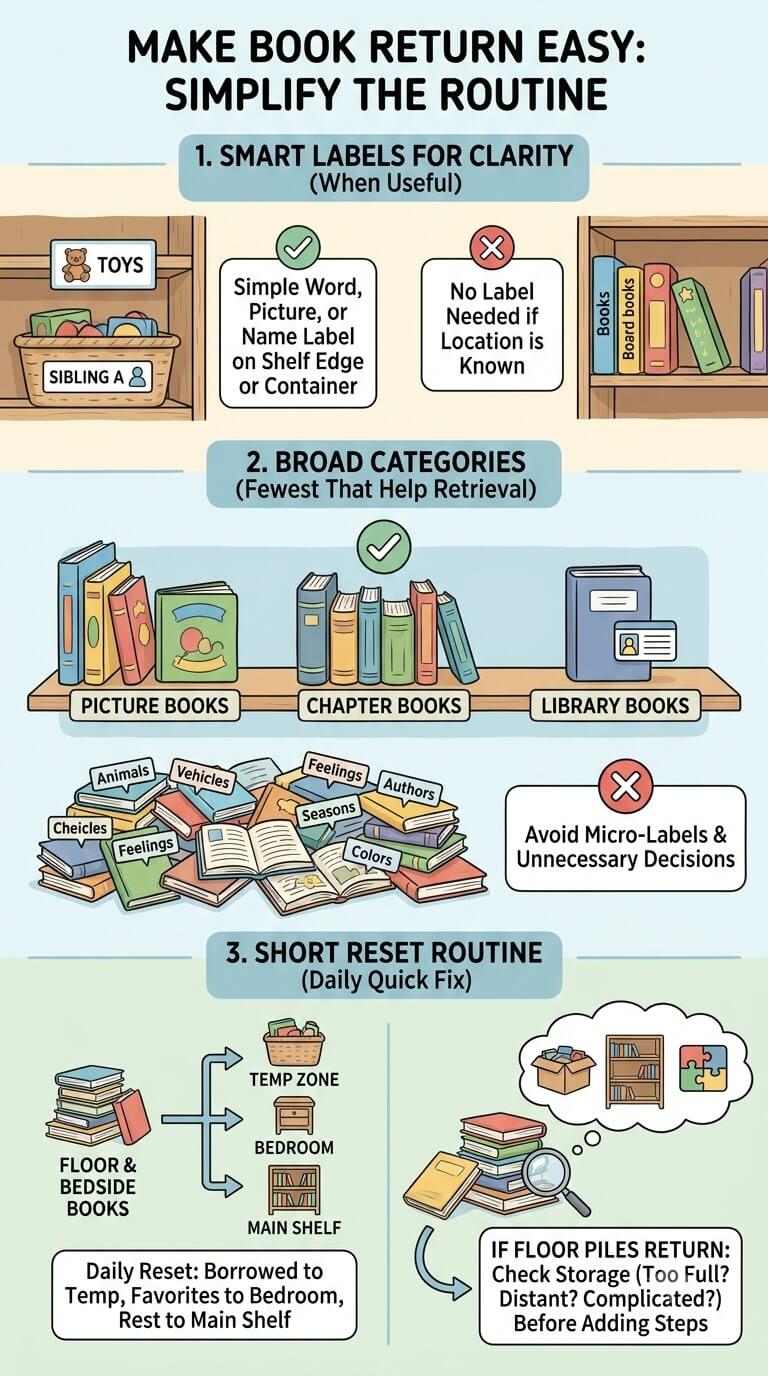
Labels by type or reader when useful
Labels can help when several groups look similar or when siblings share storage. A simple word, picture, or name label is enough. Put it on the shelf edge or container where the category belongs. If everyone already knows where the board books go, adding more labels does not improve the routine.
Broad categories instead of micro-labels
Use the fewest categories that still help retrieval. “Picture books,” “chapter books,” and “library books” may be enough. Sorting every book by animals, vehicles, feelings, seasons, authors, colors, and reading situations creates unnecessary decisions during cleanup. A category is useful only if the family can recognize and return it consistently.
A short reset routine for floor and bedside books
During a daily reset, return borrowed books to their temporary zone, bedtime favorites to the bedroom, and the rest to the main shelf. If floor piles keep returning, check whether storage is too full, distant, or complicated before adding more sorting steps.
Review Damaged and Outgrown Books
Repair only when realistic
Minor tears or loose covers may be worth repairing when the book is still wanted. For keepsakes, avoid improvised repairs that may worsen damage. The Library of Congress recommends careful handling and clean, dry hands in its book handling guidance.
Retire damaged books when appropriate
Remove books with missing pages, exposed sharp parts, serious water damage, active mold, or deterioration that makes normal use impractical. Do not put damp books into closed storage. Set important damaged books apart for appropriate repair advice instead of returning them to active shelves.
Donate outgrown books according to recipient rules
Books that are clean, complete, and no longer useful to your household may be suitable for donation, but acceptance rules vary. Check the receiving organization before packing a large box. Keep items that are stained, wet, moldy, or severely damaged out of donation unless the organization specifically states that it accepts them for another purpose.
Keep sentimental books separate from the active shelf
A childhood favorite may be worth keeping after regular reading ends. Give sentimental books a defined keepsake area instead of prime shelf space. This preserves meaningful items while keeping active shelves current. Review the keepsake area occasionally so it remains intentional rather than becoming overflow.
Common Kids’ Book Organization Mistakes
Overloading shelves
A tightly packed shelf can be hard to use and may exceed the furniture’s intended load. Follow manufacturer limits and secure applicable furniture. CPSC also warns that children may climb to reach desired items, so avoid tempting high placement; see its furniture tip-over safety advice.
Mixing borrowed books with household inventory
When library books disappear among household titles, returns become a search project and borrowed items can accidentally enter storage or donation boxes. One temporary location solves more than elaborate labeling. Keep the borrowed zone visible enough to remember, but contained enough that it does not become another general book pile.
Buying another bookcase before reviewing capacity
More shelving can be appropriate when the collection is intentionally large and the room can support it. But first remove outgrown, borrowed, damaged, and inactive books from the active shelf. If the remaining books fit once those categories are handled, the problem was inventory placement rather than a shortage of furniture.
Treating books like loose toys
Deep bins and broad catch-all baskets hide thin books and can bend larger formats. Give books upright support, shallow containment, or controlled flat storage when needed. Keep toy categories nearby if that suits the room, but do not make books compete with blocks, figures, and vehicles inside the same container.
Making categories too complex
An elaborate filing system can be satisfying during setup and frustrating during daily cleanup. If a child needs an adult to decide where most books belong, simplify. Combine neighboring categories until each destination is obvious. The system should help a book get back to a usable home in seconds, not require classification expertise.
Edge Cases
Very small rooms with no bookcase
In a very small room, use one or two compact solutions instead of scattering books. A shallow floor basket, properly installed ledge, or small section of existing storage may be enough. Keep overflow elsewhere rather than forcing a freestanding bookcase into a walkway.
Large sibling age gaps
With a large sibling age gap, give younger-child formats an easy low zone and older-child series a separate shelf section. Also consider whether younger children can reach materials unsuitable for them. Follow product guidance and household safety needs rather than relying only on ownership labels.
Oversized books that fit nowhere
Measure oversized books before rearranging storage. A few can live flat on a sturdy low shelf, in a wide shallow basket, or in another room with enough shelf height. Rarely used oversized books may fit better in secondary storage than beside the main bookcase.
Books used in more than one room
Choose one main home and allow a small temporary selection in another room. The playroom might hold the larger collection while a few bedtime books stay in the bedroom. During reset, extras return to the main location instead of multiplying full collections throughout the house.
FAQ About Organizing Kids’ Books
Is front-facing storage better for kids’ books?
Not automatically. Front-facing storage can make a small picture-book selection easy to browse, while spine-out shelving uses space more efficiently for a larger collection. Many families benefit from a hybrid system. Choose the method that fits the room, book formats, shelf capacity, and the child’s ability to return books.
How should I organize books for two children?
Start with shared categories when both children use the same books. Create child-specific sections only for personal favorites, very different reading formats, or books that need separate access. A shared picture-book area plus one personal shelf per child is often simpler than dividing every book by ownership.
Where should library books be stored?
Keep borrowed books in one temporary, visible location that is easy to check before return day. A basket near school bags, a dedicated shelf section, or a bedroom spot can work. The main rule is to keep them out of household donation piles and long-term storage.
What should I do when the bookshelf is full?
Review the collection before adding furniture. Remove borrowed, outgrown, damaged, sentimental, and rarely used books from the active shelf. If the books you genuinely want active still exceed safe, usable capacity, then add appropriate storage or move part of the collection to another suitable location.
Can I rotate books without creating a full toy rotation system?
Yes. Put a small group of less-used books in secondary storage and exchange them when interests or seasons change. You do not need a fixed calendar, equal sets, or detailed tracking. Keep favorites available, and declutter books that are truly outgrown rather than repeatedly storing them just to avoid a decision.
Final thoughts: A useful kids’ book system makes choosing and returning books easier. Keep active shelves within practical capacity, separate borrowed materials, match storage to book format, and move outgrown or rarely used books out of prime space. Adjust the collection before buying more storage.

Ethan Carter is the Founder & Editor of HomeCleanSecrets. Based in the United States, he has 5 years of experience creating practical home cleaning, laundry care, stain removal, decluttering, and home organization content. His goal is to help everyday households clean smarter and build simple routines that are easier to maintain.
Read more about Ethan Carter on his author page: https://homecleansecrets.com/ethan-carter/