
A toy rotation system can make a crowded play area easier to use without forcing every worthwhile toy to leave the household. The basic idea is simple: keep a manageable group available for everyday play, store the rest outside the active play zone, and review the groups when space, interest, or cleanup difficulty changes. When rotation is only one part of a crowded bedroom or shared play area, review the broader kids’ room and toy setup before changing the rotation groups.

The system works best when it starts with the room’s real capacity. If the shelves, bins, and floor area can comfortably support only part of the retained collection, rotation gives the extra toys a temporary home.
Quick Answer: Divide Retained Toys Into Active and Stored Sets

The simple rotation process
First identify the toys that are actually staying in the household. From that retained group, choose a smaller active selection that fits the available shelves, bins, and floor area.
Why rotation is not decluttering or general storage
Rotation changes access, not ownership. A stored rotation toy is still wanted and expected to return to play.
What Toy Rotation Is and Is Not
Temporary change in daily access
Think of rotation as reducing how much of a retained collection is visible at once. A toy can move out of daily reach for a few weeks or for an open-ended period and still remain part of the household.
Active toys versus stored rotation toys
Active toys should have obvious homes that can be reached and reset during normal play. Stored rotation toys belong in a secondary location where they are protected, easy for an adult to identify, and not mixed with donation bags or long-term keepsakes.
Permanent favorites and comfort items
Some items do not need to rotate. A favorite doll, a regularly used building set, a comfort item, or a toy tied closely to a daily routine can stay active.
Why broken, unsafe, or clearly outgrown toys do not belong in rotation
Rotation is not a reason to keep an item that should be repaired, retired, or removed from use. Check damaged toys, missing parts, age labels, and current safety information before packing them for later. The CPSC toy safety center provides current recall and toy-safety information for households that need to verify a questionable item.
Decide Whether Rotation Is the Right Tool

When too much worthwhile inventory is visible
Rotation is useful when many toys are still wanted but the room cannot display them all without crowding. Common signs include bins that cannot close, shelves stacked two or three rows deep, sets spread across unrelated containers, and toys that must be moved before there is open floor space to play.
When a small room cannot reset easily
A small bedroom or play area may have perfectly reasonable toys and still be over its active capacity. A good test is the reset: if returning everything to its assigned place requires overflow piles, balancing items on top of bins, or moving toys into hallways, reduce the visible selection before adding more storage.
When decluttering is needed first
If storage is full of broken toys, incomplete sets nobody uses, obvious duplicates, or items everyone agrees are outgrown, deal with those first. Otherwise rotation simply moves excess from one location to another.
A useful test is whether you would be relieved if the item never returned to the play area. If the answer is yes because it is unwanted, outgrown, incomplete, or unsuitable, pause the rotation decision and handle that item separately instead of assigning it storage space.
When better toy organization is the real fix
Rotation will not fix a room where active toys have no defined homes. If every block, vehicle, figure, puzzle, and pretend-play item is mixed in one large catch-all bin, reorganize those categories first.
Inventory the Retained Collection
List broad toy categories
Start with broad, functional categories such as building toys, pretend play, vehicles, dolls or figures, puzzles, games, sensory materials, and large toys. The list does not need every individual item.
Identify large toys and multi-piece sets
Mark items that need special handling before dividing groups. A large toy may consume most of a shelf or floor corner even though it counts as one item.
Mark permanent favorites
Note the small group that reliably stays in use. These toys form the stable part of the room and do not need to be packed each time.
Note books or stuffed animals only if the household wants to rotate them too
Books and plush can be included, but they do not have to be. A household may prefer a stable reading shelf and a separate stuffed-animal basket while rotating only general toys.
Choose the Active Collection by Space Capacity
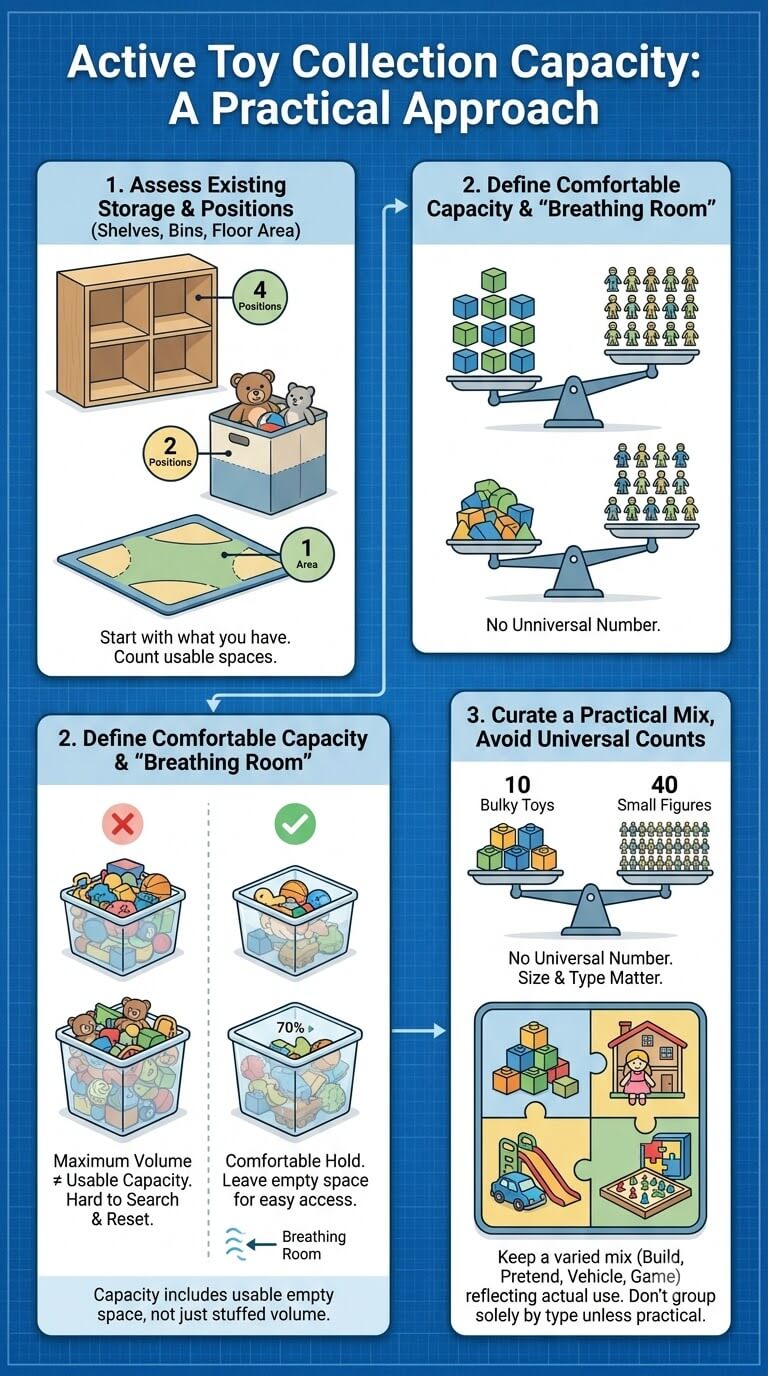
Start from available shelves, bins, and floor area
Count the storage positions that already exist and decide what each one can hold comfortably. Leave enough empty space to remove and replace toys without forcing them into place.
Leave a little breathing room inside each active container. A bin that is filled to the top may technically hold the category, but it usually becomes harder to search and harder for a child to reset. Capacity includes usable empty space, not just maximum volume.
Avoid universal toy counts
There is no practical number that works for every household. Ten bulky toys can consume more room than forty small figures, and one large building set may need an entire shelf.
Keep a Practical Mix of Toy Categories
Avoid creating an active group made entirely of one type unless that reflects how the household genuinely uses the toys. A mix might include something to build, something for pretend play, a vehicle or figure set, and one puzzle or game.
Build Balanced Rotation Groups
Building and construction
Keep construction pieces with the parts required to use them. If one building collection is large, it may be easier to keep that set active and rotate other categories around it.
Pretend play
Group pretend-play materials by the way they are used rather than by tiny subcategories. A kitchen set might keep its basic dishes and play food together.
Vehicles, figures, dolls, or sets
Choose a manageable portion of large collections. A child who owns many vehicles or figures may not need the whole group visible at the same time.
Puzzles and games
Select puzzles and games that fit the household’s current routines and available shelf space. Keep pieces complete and boxes easy to identify.
Large toys
Large toys need a footprint limit. Decide how many parking spots the room can support without blocking play or walking space.
Include Books or Plush Only When Rotation Helps
A small selection of books or stuffed animals can rotate if those categories are crowding the room, but keep their physical storage simple. Do not rebuild the bookcase or plush system inside the rotation plan.
Separate Permanent Favorites From Rotation Toys
Comfort or strongly preferred items
Leave essential favorites available unless the child or household clearly wants a change. A rotation that repeatedly removes the most requested item creates extra retrieval work and frustration.
Items used every day
Notice what actually moves during normal routines. A toy that gets used almost daily may deserve a permanent home even if it belongs to a category that otherwise rotates.
Why forced rotation can make the system harder to maintain
Do not swap a toy simply because a calendar says its turn is over. If it is still being used, leave it and rotate something else.
Pack and Label Stored Rotation Toys
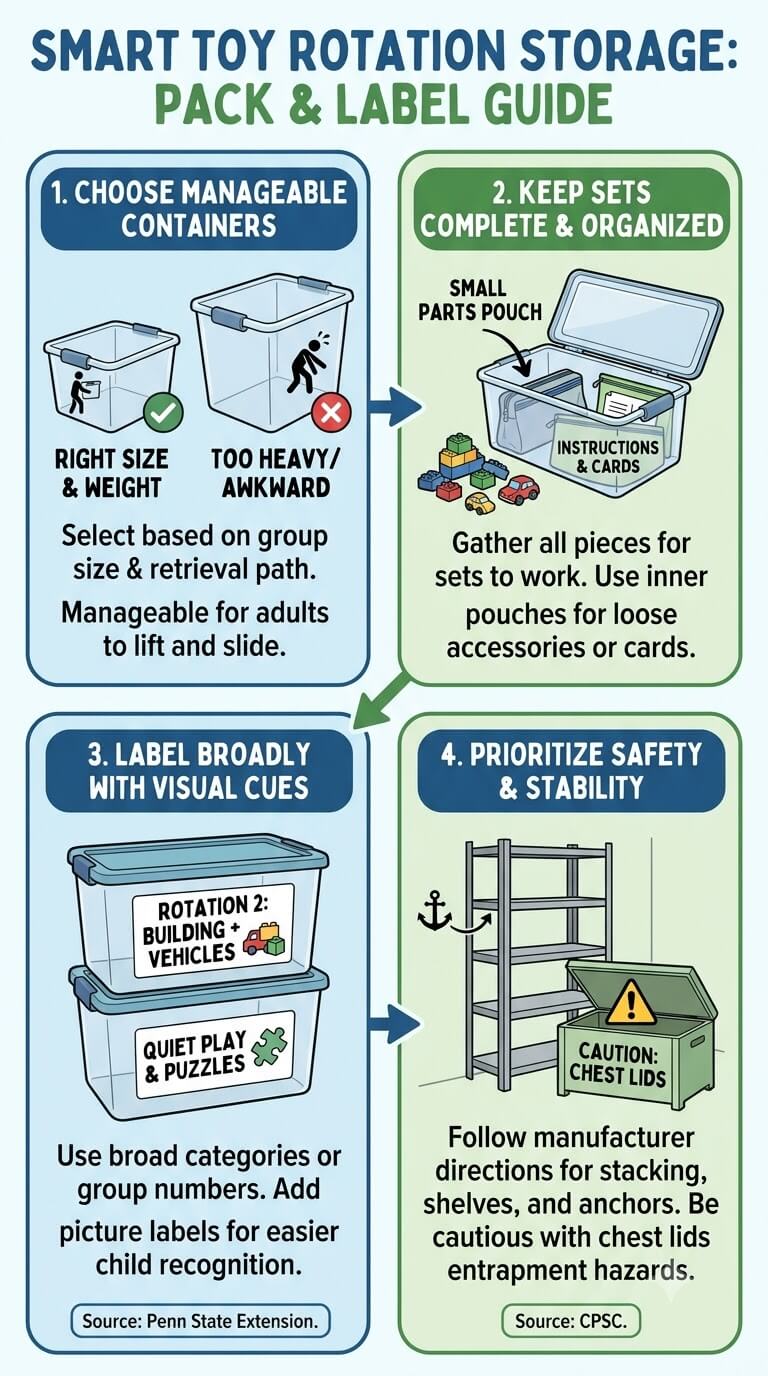
Use containers sized to the stored group
Choose containers based on the size and weight of the group, not on a desire to hide the maximum amount. A bin should be manageable for the adult who moves it and appropriate for its location.
Before choosing a large tote, picture the full retrieval path from shelf to floor and back again. If the loaded container would be awkward to lift, slide, or open in its assigned location, divide the contents into smaller groups rather than creating one heavy storage unit.
Keep sets complete
Before closing a container, gather the pieces required for each set to work. Put loose instructions, cards, or small accessories in a simple inner pouch when needed.
Label by broad category or rotation group
A label such as “Building + Vehicles” or “Rotation 2” is usually enough. Add a short list or picture only when it makes retrieval easier. Penn State Extension notes that picture and word labels on toy containers can help make storage cues easier to recognize for children who use the containers.
Follow container and storage-furniture safety instructions
Follow manufacturer directions for lids, latches, stacking features, shelves, and anchors. Be especially cautious with chest-style storage. CPSC has warned about storage and toy chest hazards involving lids and entrapment, so a container should be chosen for safe use, not only for capacity.
Choose a Storage Location Outside the Active Play Zone
Closet or secondary storage when appropriate
A closet shelf, secondary cabinet, or another dry household storage area can work when it has enough space and the container can be moved safely. Avoid making rotation storage compete with daily clothing or household essentials.
Keep stored toys accessible to the adult managing rotation
Stored does not need to mean difficult to reach. If an adult must use a ladder, unload heavy boxes, or move furniture every time a toy is requested, the location will discourage reviews.
Set a simple retrieval standard: one adult should be able to reach the chosen container without dismantling another storage area. If each swap starts by moving luggage, seasonal boxes, or furniture, the rotation location is too inconvenient for a system meant to be reviewed periodically.
Avoid blocking doors, vents, or required access
Do not use rotation bins to fill walking paths, block a door swing, cover a vent, or occupy an access point. Keep containers fully inside their assigned storage area. If shelving or cabinets are part of the setup, follow installation instructions and consider CPSC furniture anchoring guidance for freestanding units in homes with children.
Keep small parts controlled in mixed-age households
Store based on who can reach the area, not only on who owns the toy. Older children’s sets may contain small components that should not be accessible to younger siblings. Review labels and keep those groups in adult-controlled storage when needed. Make the access rule obvious enough that a later swap cannot accidentally place those pieces within a younger child’s reach.
Track What Is Stored Without Overcomplicating It
Simple paper or phone inventory
A short note is enough for most homes. List each container and two or three broad contents, such as “Bin 1: blocks, vehicles, puzzle.” The record should answer one question quickly: where is the toy I am looking for?
Update the note at the same moment you close the container. Waiting until later is how lists stop matching the shelves. If a toy moves between groups, change one short line rather than documenting dates or play history that the household will not use.
Optional container numbers
Numbers help when several similar bins share one shelf. Put a number on the container and use the same number in a phone note.
Skip complex spreadsheets unless the household genuinely needs them
Most families do not need dates, scores, color codes, or detailed usage logs. Add detail only when it solves a recurring problem, such as managing many shared sets or several storage locations.
Use Flexible Rotation Triggers

Child has stopped choosing several active toys
Notice patterns over time rather than reacting to one quiet afternoon. If several accessible toys remain untouched through normal play while stored items are still wanted, swap a small group.
The room becomes hard to reset
Cleanup difficulty is a useful capacity signal. If every bin is packed, large toys have no parking place, or returning one set requires moving another, the visible collection is too large for the current setup.
Look for two signals together before making a major change: storage is visibly overfull and cleanup repeatedly stalls in the same categories. That combination is stronger evidence of an active-capacity problem than one unusually messy day, especially after a playdate or large project.
Seasonal or household routine changes
Schedules change across school breaks, travel periods, indoor seasons, visits from relatives, or moves between rooms. Review the active group when the way a space is used changes.
Review When Interests or Abilities Change
A child may naturally stop choosing certain toys or begin using others differently. That change is a practical reason to review the selection, not proof that a specific milestone has occurred.
Choose a Review Rhythm, Not a Universal Schedule
Weekly review as an example
A brief weekly look can work for families whose play areas change quickly. It does not mean swapping everything every seven days.
Monthly review as an example
A monthly check works well when the room is stable and stored bins are easy to access. Open the inventory note, look at what has been used, and replace only a limited number of items.
Event-based or interest-based review
You can also review after a birthday, before a long school break, when a room is rearranged, or when the child starts asking for stored items. These triggers may fit family life better than calendar dates because the rotation responds to an actual change rather than an arbitrary deadline.
Why a fixed frequency is not required
If the active selection is being used, the floor resets easily, and nobody needs anything from storage, there is no reason to swap just to follow a schedule. The system should reduce decisions.
Reintroduce Stored Toys
Swap a limited set rather than emptying every container
Open one stored group and choose a few items to return. Avoid dumping all stored toys into the room for selection, because that temporarily recreates the clutter the system is meant to control.
Make the swap at a natural reset point, such as after the floor is clear or before a new week begins. Starting with an orderly active area makes it obvious whether the incoming group actually fits, and it prevents old and new selections from blending into temporary piles.
Return outgoing active toys to storage homes
Before adding the incoming group, pack the outgoing toys into the space prepared for them. Check that sets are complete and that the container label still matches its contents.
Watch whether reintroduced toys are actually used
Give the returned toys normal access and observe whether they rejoin play. Do not force use simply because an item came back from storage.
Keep the process reversible
Nothing about a routine swap needs to be permanent. If the outgoing toy is requested the next day, retrieve it when practical and adjust another category if needed.
What to Do When a Child Asks for a Stored Toy
Retrieve it when practical
If the toy is safe, appropriate, and reasonably accessible, a request is useful information. Bring it back when practical rather than treating storage as a locked-away status.
Swap rather than expand active inventory indefinitely
When a requested toy returns, choose another lower-use item to store if the room is already at capacity. This keeps the visible amount stable.
Keep comfort items outside rigid rotation rules
If an item functions as a consistent comfort favorite or part of a daily routine, give it a permanent home rather than repeatedly packing and retrieving it. The purpose of rotation is to manage optional visible inventory.
Use Rotation in Shared-Sibling and Small-Space Homes
Shared versus child-specific rotation groups
Separate shared collections from clearly child-specific toys when that makes cleanup easier. One shared bin can rotate as a unit, while each child keeps a small personal group.
Small-parts limits for younger siblings
Mixed-age homes need an access check before every swap. A set appropriate for an older child may include pieces that require adult-controlled storage when a younger sibling shares the room. The CPSC small-parts guidance explains the federal choking-hazard framework for young children.
Use room capacity as the controlling variable
Small spaces benefit most when the rotation amount is tied directly to available storage. If one low shelf, two bins, and one large-toy parking spot are the active limits, fill those areas comfortably and stop.
Keep adult-controlled items separate
Do not place adult-controlled sets inside a bin that a younger child is expected to access independently. Separate them physically and label them for the adult managing play.
Let Rotation Reveal Decluttering Opportunities
Toys that are never requested or used after reintroduction
Repeated nonuse is information, not an automatic discard order. Set the item aside for a separate decision when the same toy remains untouched through several normal opportunities.
Outgrown or incomplete sets discovered in storage
Stored bins often reveal items that were overlooked during the first inventory. If a set is clearly outgrown, incomplete, damaged, or no longer useful to the household, stop cycling it.
Handle True Exit Decisions Separately
Keep the rotation review focused on what is active now. When an item needs a permanent keep-or-remove decision, move it into a separate decluttering session.
Common Toy-Rotation Mistakes
Rotating broken or unsafe items
Do not assume storage makes a questionable toy acceptable later. Check condition before packing and again before reintroducing older stored items.
Hiding every favorite
Removing every high-use toy at once can make the new setup harder, not easier. Leave a small core of reliable favorites available and rotate around them.
Prescribing an exact toy count
Piece counts ignore size, storage shape, and household differences. One family may have several compact bins of figures, while another has a few bulky toys that fill the room.
Rotating too often to maintain
Frequent swaps can turn a simple storage method into another chore. If the parent is constantly labeling, moving, and recording toys, extend the interval.
Using storage as a way to avoid needed decluttering
If bins contain toys nobody wants, items that are clearly outgrown, or broken pieces waiting indefinitely, the stored collection is not functioning as rotation. Separate those decisions and reduce the retained inventory.
When to Simplify or Stop the System
Tracking takes longer than cleanup
If maintaining notes and rotation groups requires more time than simply putting toys away, remove steps. Stop numbering boxes, reduce the number of groups, or keep only one secondary storage bin.
Simplifying may mean keeping only two states: active and stored. You do not need named seasons, numbered rounds, or equal category bundles if those details are not helping. A single labeled overflow shelf can be a complete rotation system for a small household.
Stored toys are forgotten indefinitely
If boxes remain unopened for a very long time and nobody remembers what is inside, schedule one review rather than adding new rotation containers. Some items may still be worthwhile, while others may no longer need household space.
The active collection still exceeds room capacity
If the room remains hard to reset after rotation, reduce the active group further or revisit the retained inventory. Do not solve a capacity problem by stacking higher, blocking access, or adding containers to every free surface.
The household prefers stable categories with occasional review
Some families do better with a consistent toy setup and only occasional seasonal or interest-based changes. That is a valid endpoint.
FAQ About Toy Rotation Systems
How often should I rotate toys?
There is no required frequency. Review the active selection when several toys stop being chosen, the room becomes difficult to reset, household routines change, or a stored toy is requested.
How many toys should be out at one time?
Base the amount on the capacity of the actual room instead of an exact count. The active collection should fit comfortably in its assigned shelves, bins, and floor parking areas while leaving walking and play space usable.
Should books and stuffed animals be part of toy rotation?
Only if rotating them solves a real space or visibility problem. A household can rotate general toys while keeping books and plush stable.
What if my child asks for a toy that is stored?
Retrieve it when practical if it is safe and appropriate. If the active area is already full, store another lower-use toy in exchange so the room does not expand beyond its capacity.
How do I know whether to rotate or declutter?
Rotate when an item is still wanted but the room cannot comfortably keep the whole retained collection visible. Declutter when an item is broken beyond appropriate repair, unsafe, clearly outgrown, unwanted, or no longer worth household space.
A useful toy rotation system stays small enough to understand. Keep a stable group of favorites, let the room’s capacity determine how much remains active, store the rest in clearly identified groups, and review only when use or space gives you a reason. If the system starts creating more work than the clutter it was meant to solve, simplify it.

Ethan Carter is the Founder & Editor of HomeCleanSecrets. Based in the United States, he has 5 years of experience creating practical home cleaning, laundry care, stain removal, decluttering, and home organization content. His goal is to help everyday households clean smarter and build simple routines that are easier to maintain.
Read more about Ethan Carter on his author page: https://homecleansecrets.com/ethan-carter/