
An organized entryway or mudroom makes arrivals and departures easier without turning the doorway into long-term storage. Give frequently used items a clear home, contain dirt and moisture, and keep the door and walking route easy to use.
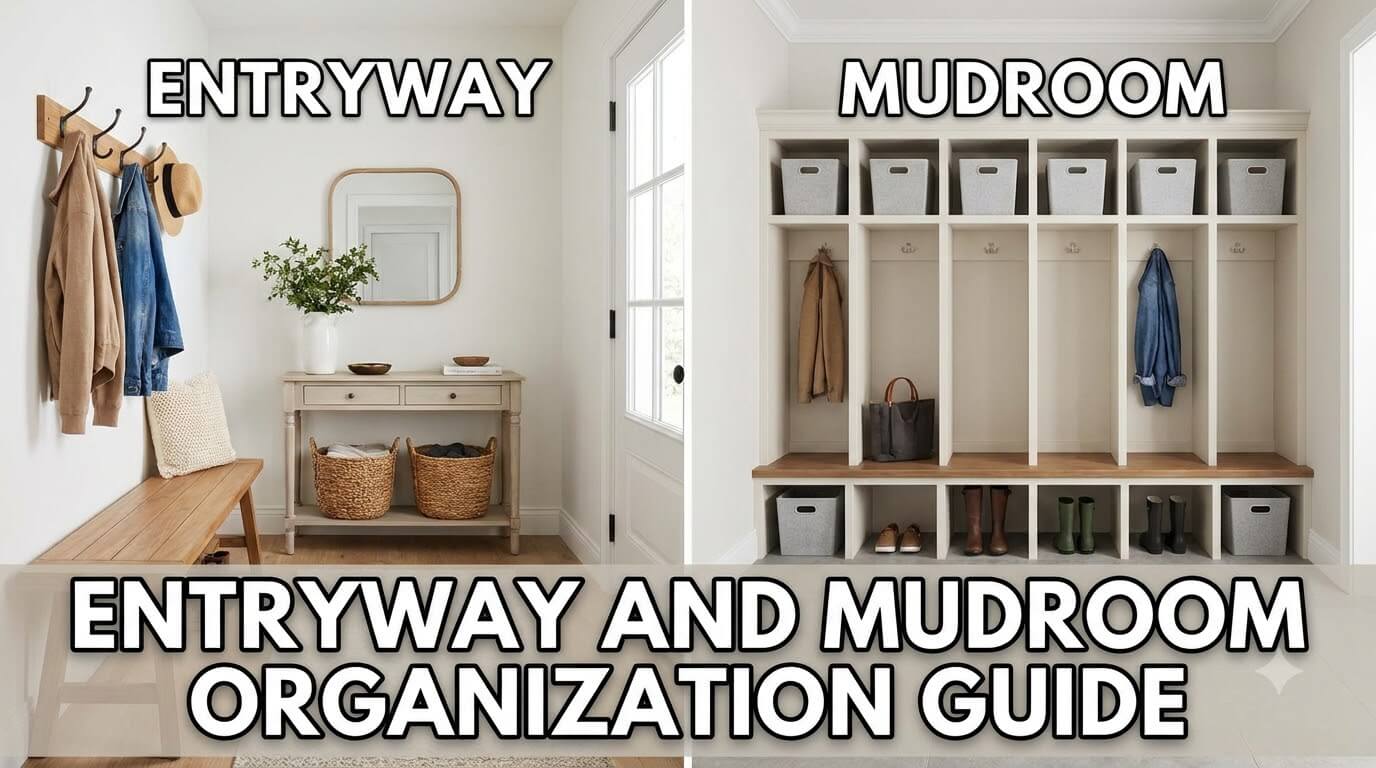
Start with the items that actually cross the doorway, keep only the active rotation nearby, assign zones, choose storage that fits those zones, test the daily flow, and move overflow elsewhere. The same sequence works in a tiny apartment entrance or a family mudroom.
Quick Answer: Build the Entrance Around Daily Flow
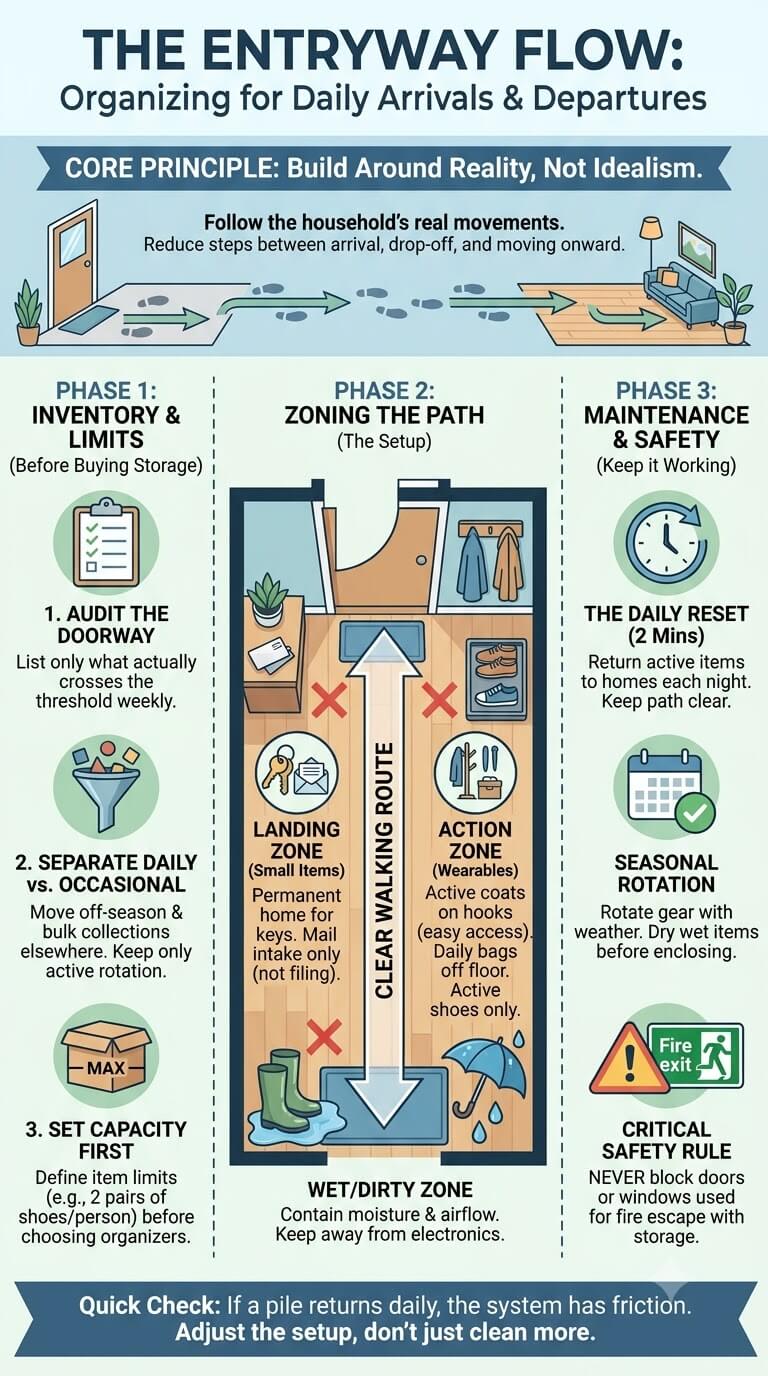
A useful entrance follows the household’s real movements, with the fewest possible steps between arrival, storage, and departure.
The arrive-home to next-departure sequence
During a normal arrival, notice where shoes, coats, bags, keys, paper, and wet gear naturally land. Put storage close to those landing points when doing so does not interfere with the door or walking route.
A good test is to watch the space during a normal weekday instead of imagining an ideal routine. Note where shoes actually land, which hook gets used first, where bags are dropped, and what surface attracts keys and paper. The most successful storage often sits close to those natural landing points, provided it does not interfere with door movement or the walking path.
What a functional transition zone must accomplish
The entrance has four essential jobs: receive active items, separate wet or dirty belongings, keep departure essentials easy to retrieve, and preserve a clear route. Decorative storage comes after those jobs work reliably.
- Daily items need an obvious home that can be reached in one or two actions.
- Wet or muddy items need containment and airflow before they move into closed storage.
- Occasional items need an overflow destination outside the entrance.
- The door, lock, threshold, and primary route through the space need to stay usable.
Entryway vs. Mudroom: What Changes and What Stays the Same
The available square footage changes the storage capacity, but the basic rules of access, limits, and clear movement stay the same.
Basic entryway characteristics
A small foyer, hallway, apartment entrance, or wall beside the front door usually needs strict limits. Prioritize active shoes, one useful outerwear position, keys, and perhaps one or two daily bags rather than maximizing storage.
Dedicated mudroom characteristics
A mudroom can support more categories, including boots, rain gear, bags, and family stations. Its extra capacity still needs limits so unrelated belongings do not turn the room into general household storage.
Hybrid and side-entrance setups
Organize the door people actually use. If a back, garage-adjacent, or kitchen entrance handles most arrivals, let it carry the daily load and keep a formal foyer lighter. Avoid giving keys or bags competing homes at two entrances.
Why Entryways and Mudrooms Become Cluttered
Most entrance clutter comes from excess volume, missing item homes, or storage that is harder to use than the nearest flat surface.
Too much inventory for the available capacity
A zone fails when it starts the day full. If shoes, coats, bags, and accessories already exceed their racks or hooks, reduce the active rotation before adding containers.
No permanent homes for high-frequency items
Daily items need one default location. Keys, school bags, and work bags are easier to retrieve and reset when everyone knows exactly where they return after each use.
Storage placed against natural traffic flow
A cabinet or bench can fit on paper yet still obstruct real movement. Check whether people must turn sideways, move baskets, or fight the door before keeping any furniture in the route.
Temporary holding turning into permanent storage
Returns, packages, donations, and items headed upstairs need a short-term place only if that place is emptied regularly. Keep temporary capacity small enough that forgotten items remain visible.
Inventory Before Storage: The Core Framework
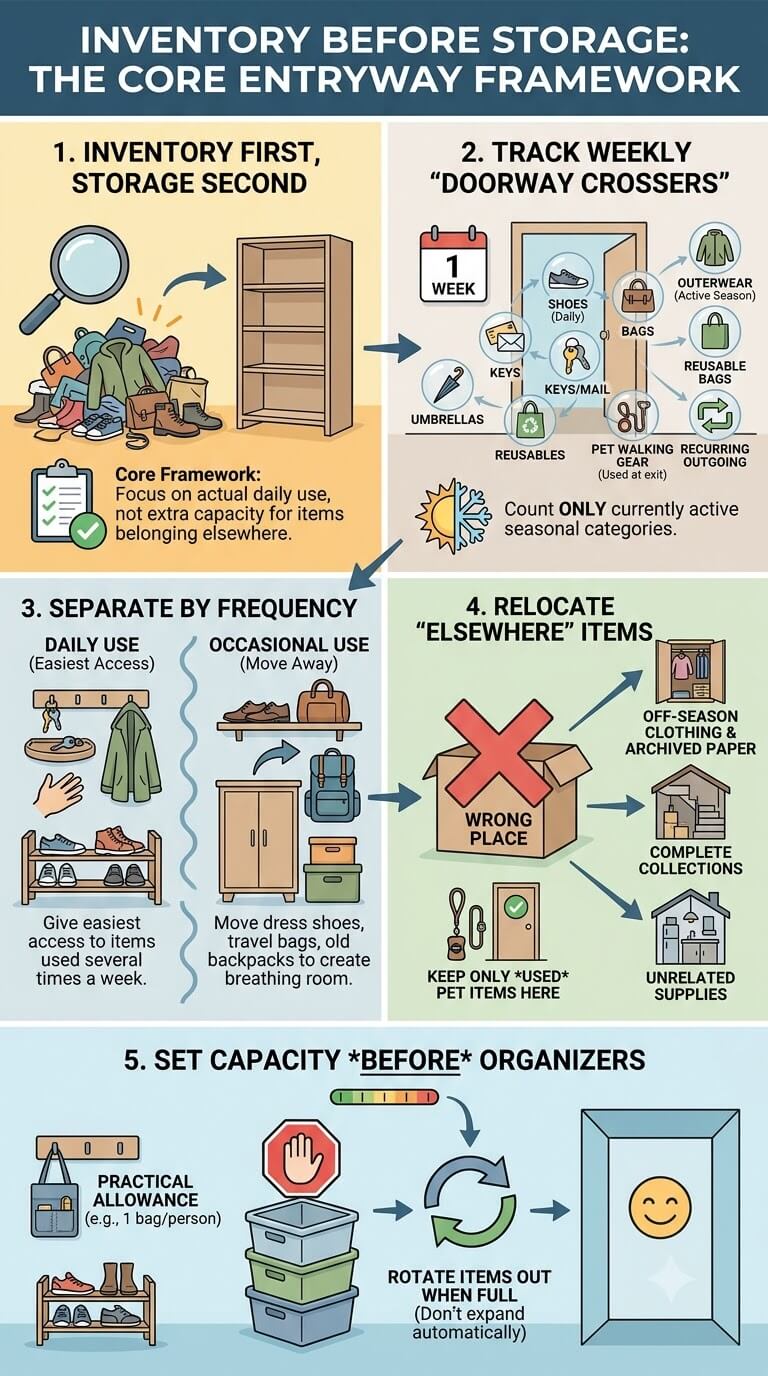
Inventory first so the storage reflects actual daily use instead of becoming extra capacity for items that belong elsewhere.
List what actually crosses the doorway each week
Make a one-week inventory of shoes, outerwear, bags, keys, mail, umbrellas, reusable bags, pet walking gear, and recurring outgoing items. Count only seasonal categories that are currently active.
Separate daily-use from occasional-use items
Give the easiest access to items used several times a week. Move dress shoes, travel bags, old backpacks, and other occasional belongings away from the entrance so daily items have breathing room.
Remove categories that belong elsewhere
Move complete collections, off-season clothing, archived paperwork, and unrelated household supplies to their proper storage. Keep only pet walking items that are actually used at this exit.
Set capacity before choosing organizers
Set a practical allowance for each category before buying storage, such as one bag position or a limited shoe area per person. When the zone fills, rotate items out instead of expanding automatically.
Map Traffic, Door Swing, and the Clear Walking Path
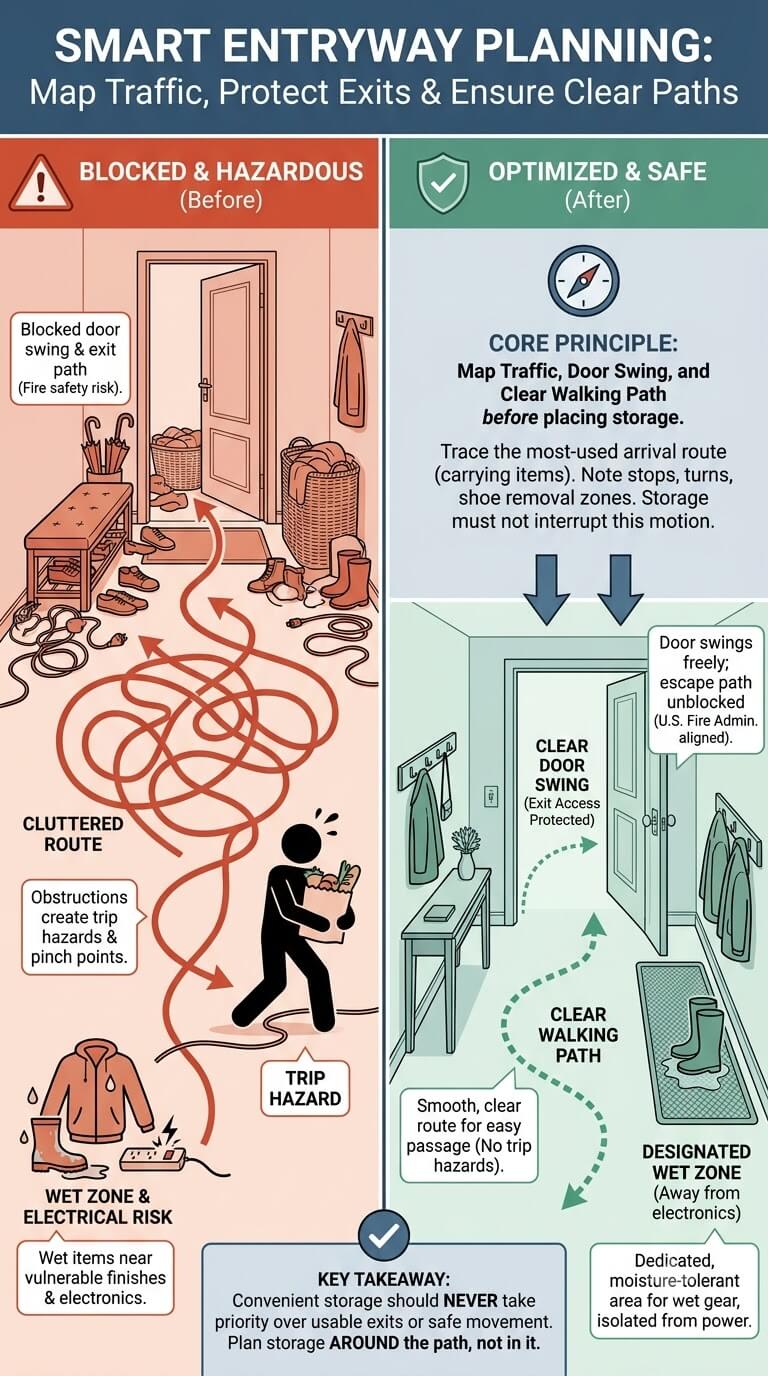
Plan storage around movement before deciding where a bench, rack, basket, or wall system should go.
Trace the most-used route in and out
Walk the arrival route while carrying groceries or a normal work bag. Note where you turn, stop, remove shoes, and reach for storage. Any piece that interrupts those motions is in the wrong place.
Protect exterior-door access and swing
Do not place baskets, benches, shoe piles, or freestanding storage where they prevent a door from opening as intended or make the exit difficult to reach. The U.S. Fire Administration recommends making sure doors and windows used for escape are not blocked in a home fire plan. Its home fire escape planning guidance is a useful reminder that convenient storage should never take priority over usable exits.
Identify trip hazards and pinch points
Keep shoes, umbrella handles, cords, and bag straps out of the route. Someone carrying groceries should be able to pass through without stepping over or brushing against stored items.
Keep wet zones away from vulnerable or electrical areas
Give wet boots and dripping outerwear a moisture-tolerant location away from chargers, power strips, or vulnerable finishes. Follow material care instructions when repeated moisture could affect flooring or furniture.
Build the Essential Entryway and Mudroom Zones

Give each recurring category a defined landing place, then keep its capacity small enough that overflow is obvious.
Shoes and boots
Keep only active footwear near the door in a tray, rack, cubby, or defined floor zone. Let wet pairs dry before enclosed storage, and rotate out rarely used shoes when the area fills.
Coats, jackets, hats, and gloves
Keep current outerwear easy to hang and move seasonal extras elsewhere. Let wet garments dry before closed storage. Use a small accessory container rather than a deep bin that hides hats and gloves.
Bags and backpacks
Give each daily bag a position that keeps straps off the floor. Use hooks only within their rated load, and clear food, trash, and loose paper from bags regularly.
Keys and small daily carry
Give keys one permanent home, such as a hook, tray, or drawer. A small landing spot can also hold sunglasses or transit cards, but valuables may need a less visible location.
Incoming mail and outgoing items
Use the entrance as a paper intake point, not a filing area. Remove obvious junk, route action papers onward, and keep outgoing returns or packages in a small temporary holding spot.
Wet gear and weather containment
Create a clear place for boots, umbrellas, and dripping outerwear during bad weather. Use floor-safe containment and airflow. Persistent dampness needs investigation rather than tighter bins.
Pet walking gear at overview level
A small hook or basket can hold the leash, harness, and waste bags used at this door. Keep straps off the floor and store broader pet supplies elsewhere.
Choose Open or Closed Storage by Item Behavior
Choose visibility, access, and ventilation based on how often an item is used and whether it may be damp.
When hooks and open shelves improve compliance
Open storage reduces steps for high-frequency items and can help damp gear dry. It works best when each position has a narrow purpose and the visible inventory stays limited.
When baskets and cabinets reduce visual clutter
Closed storage can hide small, dry accessories, but keep categories narrow. Do not use a closed cabinet to conceal damp footwear or overloaded mixed bins.
How ventilation changes wet-item storage
Create a temporary drying position for damp gear, then move it to regular storage when dry. This keeps moisture management separate from long-term organization.
Why catch-all containers need strict limits
Catch-all baskets hide unfinished decisions. If you use one, give it a specific job and empty it regularly. Small capacity makes forgotten items easier to notice.
Use Vertical Space Without Overloading the Entrance
Wall space can reduce floor clutter, but mounting method, load, and surrounding clearance matter more than appearance.
Hooks and wall-mounted storage
Use walls to free floor space, but match fasteners and mounting methods to both wall material and expected load. Follow the product instructions rather than copying a photo-based installation.
Slim shelves and shallow surfaces
A shallow shelf can hold keys or a tray without taking much walking space. Keep it narrow, uncluttered, and clear of places where clothing or bags can catch on corners.
Benches, cubbies, and under-bench storage at system level
A bench helps only when there is room to sit and pass comfortably. In tight halls, skip it. If you use under-bench storage, keep daily items visible and easy to reach.
Manufacturer load ratings and installation context
Wall-mounted systems are only as reliable as their installation. IKEA’s general wall anchoring guidance, for example, emphasizes using hardware suited to the wall type. Whatever brand you use, follow its manual, load limits, anchoring instructions, and fastener requirements rather than copying a setup from a photo.
Assign Zones by Household Member
Shared storage works for some categories, while daily personal items are often easier to maintain with individual positions.
Shared versus individual storage
Umbrellas or outgoing items can be shared, while bags and outerwear often work better with a defined position for each person. Individual limits make overflow easier to spot.
Kid-accessible placement at overview level
Store a child’s lightweight daily belongings within safe reach when practical. Keep heavy, adult, or risky items higher or in locations that require adult handling.
Adult and guest overflow
A spare hook can handle occasional guest coats. If visitors routinely displace everyday storage, move less-used household items out instead of adding another crowded rack.
Labels only where they solve a real handoff problem
Label shared baskets or similar cubbies only when labels reduce confusion. Obvious storage does not need extra signage.
Manage Seasonal Rotation and Weather Exposure
Seasonal rotation protects limited near-door capacity and gives wet-weather items enough space to dry safely.
Active season versus off-season inventory
Rotate the entrance with the weather. Keep current boots, jackets, or lighter seasonal items nearby and move bulky off-season gear to longer-term storage.
Wet coats, boots, umbrellas, and drying needs
Reserve a drying position for the weather you regularly face. Use floor-safe containment and follow care labels or material instructions before exposing garments, mats, flooring, or cabinetry to repeated moisture.
Where overflow should move when capacity is reached
Name an overflow destination before you need it: closets for extra shoes or coats, document storage for papers, and bedroom or closet storage for rarely used bags.
Small Entryway, Drop Zone, or Mudroom? A Decision Tree

Choose the setup according to the main problem: limited space, an inconsistent unloading routine, or a larger multi-zone room.
Choose a small-entryway setup when square footage is the main constraint
If the biggest problem is a narrow hallway, no closet, or an entrance that opens directly into another room, prioritize minimum inventory, wall use, and shallow storage. Limit the number of categories before adding furniture.
Choose a drop-zone workflow when unloading behavior is the main problem
If there is enough physical space but keys, mail, wallets, and bags still land randomly, the issue is probably the arrival routine. Build a compact landing area around the sequence people already follow and keep temporary holding capacity small.
Choose a full mudroom plan when multiple dirty, wet, and family zones must coexist
If the room needs to handle boots, coats, several bags, wet-weather items, multiple household members, and occasional utility overflow, organize it as a set of coordinated zones. The room should still have a clear dirty-to-clean flow and should not absorb every storage category in the house.
Combine approaches without duplicating storage
A mudroom can include a drop area, and a small entry can include a tiny shoe zone. Combine functions when they support the same route, but avoid giving one category several competing homes. One key location is easier to maintain than a tray at each entrance.
Choose the Right Detailed Setup for Your Problem
Once the broad layout works, identify the single category or routine causing the most friction and solve that problem directly.
When the entrance itself is too small
Focus on measuring usable wall and floor space, protecting the walking route, reducing active inventory, and moving overflow elsewhere. Small entrances benefit more from strict limits than from adding storage pieces.
When daily items have no landing routine
Build a compact unloading sequence for keys, small carry items, bags, and temporary paper. Keep the landing area intentionally limited so it does not become permanent storage.
When shoes are the main source of clutter
Separate the daily rotation from the full shoe collection. Give wet or muddy pairs a drying and containment plan, then rotate rarely used footwear out of the entrance.
When coats and jackets overload the wall
Reduce the active outerwear rotation, separate dry storage from wet drying needs, and move off-season garments to wardrobe storage. Check the rating and installation of hooks before hanging heavy coats.
When bags keep landing on the floor
Assign each daily bag a parking position and make night-before staging easy. Heavy work bags and loaded backpacks need weight-aware storage so straps and hardware are not overstressed.
When keys disappear and mail piles up
Use a permanent key home and a small mail intake point. The entry should handle quick triage only. Papers that need action or filing should move onward instead of building up near the door.
When a dedicated mudroom has become a catch-all
Rebuild the room around a few essential zones, family traffic, wet-item handling, and clear overflow boundaries. More square footage should support better flow, not more unrelated categories.
When the system works but the space gets dirty
Use a short reset routine to return shoes, coats, bags, keys, and loose paper to their assigned places before cleaning mats and floor edges. Repeated overflow is a capacity problem, not a sign that you need to clean more often.
Daily and Weekly Maintenance at a Glance
Short resets keep the entrance functional, while recurring overflow tells you when the underlying capacity needs adjustment.
A brief daily return-to-home reset
Return keys, park bags, hang dry outerwear, contain shoes, route loose paper, and clear the walking path. If this takes more than a few minutes, simplify the system.
A weekly capacity and overflow check
Empty temporary holding areas, rotate inactive footwear or coats out, clear expired outgoing items, and check whether hooks and baskets are creeping beyond their intended limits.
When repeated mess signals a system problem instead of a cleaning problem
If the same pile returns daily, inspect the friction point. A hook may be too high, a rack may be full, or the assigned key spot may be inconvenient. Adjust the setup instead of repeating the same cleanup.
Common Entryway Organization Mistakes
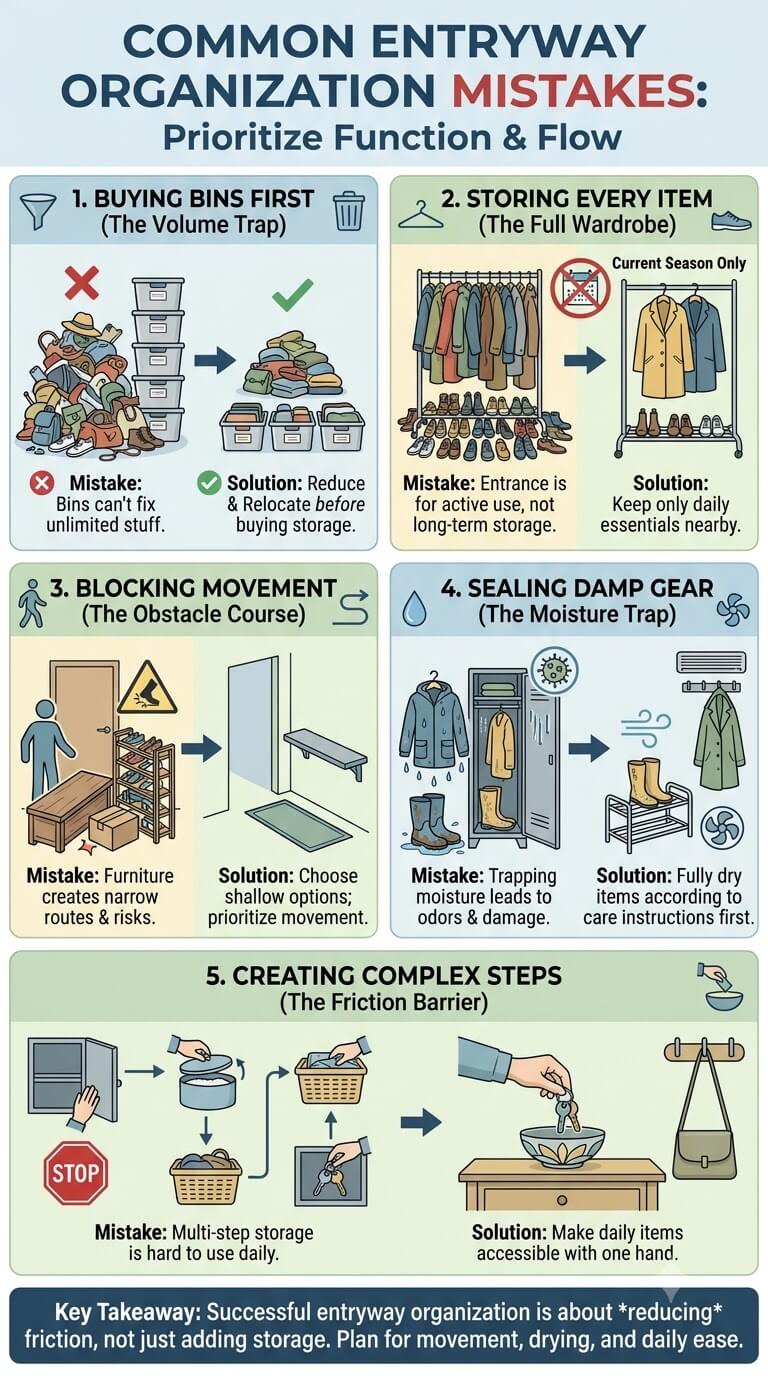
Many failures come from adding storage before reducing inventory or from placing convenience ahead of movement and drying needs.
Buying bins before reducing inventory
Containers can organize a reasonable amount of stuff, but they cannot solve unlimited volume. Reduce and relocate first, then buy only what supports the remaining categories.
Storing every shoe, coat, or bag near the door
The entrance is an active-use area, not the full wardrobe. Keeping the entire collection nearby makes daily choices harder and consumes the capacity needed for current items.
Blocking movement with furniture or floor storage
Storage that makes the route narrower can create daily frustration and increase tripping risk. If a bench, cabinet, or shoe rack interferes with movement, choose a shallower option or remove it.
Sealing damp gear too quickly
Do not close wet boots or coats into airtight storage simply to make the room look tidy. Dry them according to the material’s care instructions first.
Creating too many steps for routine items
Daily storage should be easy to use with one hand while carrying something else. If a person must open a cabinet, remove a lid, move another basket, and then replace everything, items will often stop one step earlier.
Signs the System Is Too Complicated
A workable setup should feel easier than dropping items on the nearest surface; repeated bypassing is useful feedback.
Family members bypass assigned storage
When everyone repeatedly ignores a storage location, assume there is friction before assuming a discipline problem. Check accessibility, capacity, and whether the location is close to the natural arrival route.
Items need multiple actions to be put away
High-frequency items should have the shortest storage sequence. Closed storage can still work, but reserve the most complex arrangements for less-frequent belongings.
Reset takes longer than the daily benefit
If restoring the space feels like a project every night, there is probably too much inventory or too much sorting. Simplify categories until the reset becomes quick enough to maintain.
Overflow appears immediately after cleaning
A spotless room can still have a capacity problem. If hooks and racks refill beyond their limits as soon as the household returns, move more items out of the active zone.
Safety and Access Limits
Storage must fit around the doorway and household movement, not force people to work around unstable or overloaded equipment.
Keep required exits and walking paths usable
Do not let baskets, benches, shoes, or storage interfere with doors, escape windows, or the main route out. The U.S. Fire Administration advises keeping escape openings unobstructed in its home fire safety guidance about blocked exits.
Follow manufacturer load and installation guidance
Do not estimate how much a hook, shelf, or wall system can hold. Loaded backpacks and winter coats can be heavier than they look. Follow the product manual, use fasteners suited to the wall, and stop using hardware that loosens, bends, or pulls away from the surface.
Consider renter permissions and removable options
Renters should check lease requirements before drilling or making permanent changes. Freestanding or removable solutions can be useful, but they still need to be stable and placed safely. Do not choose an unstable tall unit simply to avoid wall mounting.
Avoid unstable freestanding storage and wet-electrical conflicts
Keep heavy items low and follow furniture instructions, especially around children. The CPSC provides furniture anchoring safety information. Also keep electrical devices away from dripping gear.
FAQ About Entryway and Mudroom Organization
These answers cover the most common decisions about what belongs near the door and when to move excess items elsewhere.
What should be stored in an entryway?
Store the items that are used frequently at that entrance: a limited rotation of shoes and outerwear, daily bags, keys, small carry items, temporary mail intake, and weather gear that is currently in use. Move long-term collections and unrelated household storage elsewhere.
How much should stay near the door?
Only as much as the available space can hold without crowding the walking route or creating overflow. Set a practical allowance by person and category, then rotate seasonal or occasional items out when the zone reaches capacity.
Is a bench necessary?
No. A bench is useful when someone needs to sit while putting on shoes and there is enough room to walk around it comfortably. In a narrow entrance, a bench can reduce function. A wall hook and compact shoe area may work better.
How do you organize an entryway with no closet?
Use the wall carefully, keep the active inventory small, and create shallow storage for only the most frequent items. Hooks, a slim shelf, a small shoe tray, and one bag position may be enough. Move off-season clothing and full collections to bedroom or closet storage elsewhere in the home.
How do you keep a mudroom from becoming a catch-all?
Give the room a short list of approved categories, define a capacity for each one, and create a destination for overflow. Temporary holding bins should be emptied regularly. If unrelated items keep appearing, decide where they truly belong instead of expanding the mudroom to absorb them.
When should overflow move to a closet or another room?
Move overflow as soon as active storage becomes difficult to use. If shoes no longer fit the assigned area, coats cover several hooks, bags block the floor, or paper exceeds the intake holder, the entrance has reached capacity. Relocate the least frequently used items first.
Final Thoughts
The most reliable entrance is not the one with the most storage. It is the one that matches real arrival habits, protects the route through the door, and makes active items easy to return. Start with inventory and limits, then choose only the storage each zone needs.
Watch the space for a week and adjust the friction points. If shoes spill out, reduce the rotation. If bags land on the floor, move their parking position. If wet gear lacks drying space, add a drying step before closed storage. Small behavioral fixes usually outperform another basket.

Ethan Carter is the Founder & Editor of HomeCleanSecrets. Based in the United States, he has 5 years of experience creating practical home cleaning, laundry care, stain removal, decluttering, and home organization content. His goal is to help everyday households clean smarter and build simple routines that are easier to maintain.
Read more about Ethan Carter on his author page: https://homecleansecrets.com/ethan-carter/