
Bags are easiest to manage when the ones that leave the house regularly have a fixed parking place near the departure route. The goal is not to display or store every purse, tote, suitcase, and backpack by the door. It is to keep the active few easy to grab, keep straps and heavy loads out of the walking path, and make unpacking after arrival just as automatic as packing before departure.
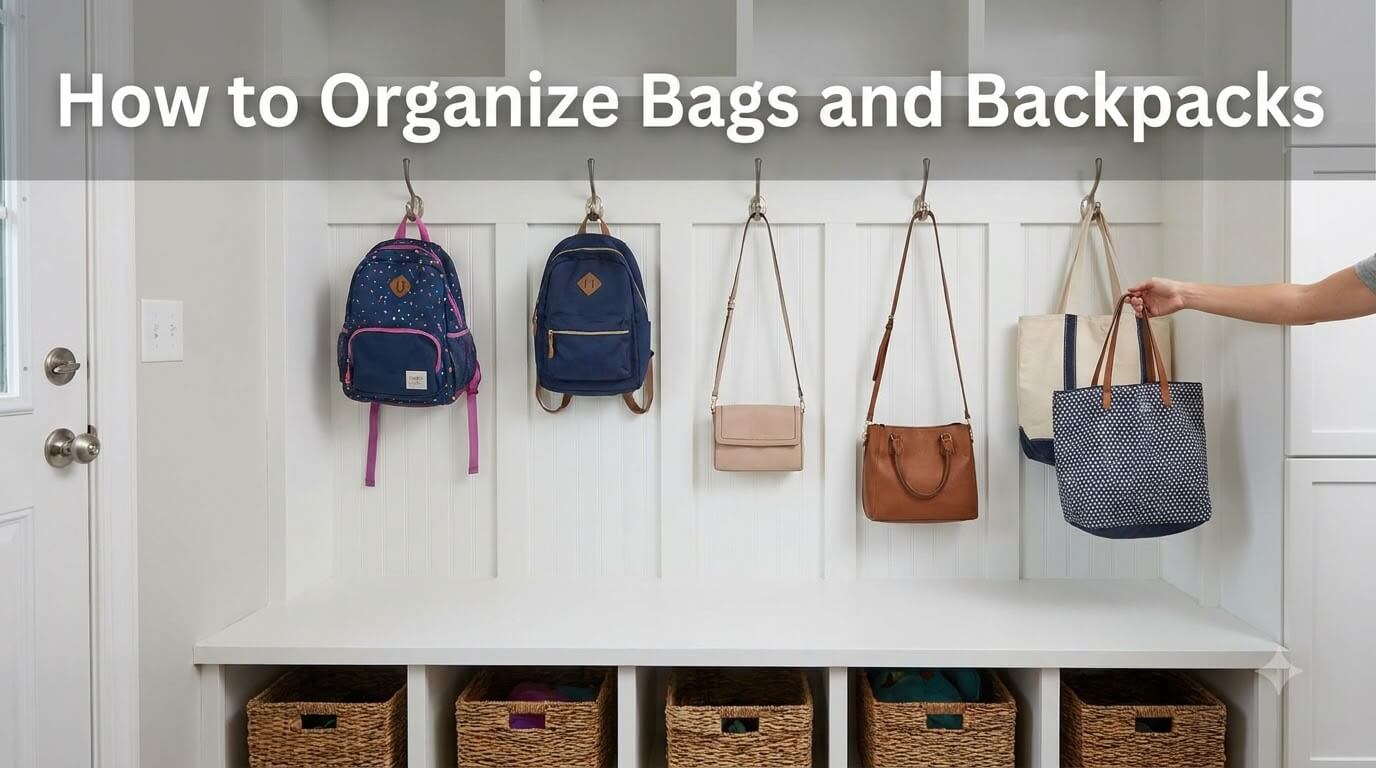
A reliable setup follows a simple order: identify the bags that are truly in active use, set a limit for each person, choose storage that matches the weight and shape of each bag, empty items that belong elsewhere, and reset the station before the next trip. When bags keep landing on chairs or counters, check the parking location and capacity before buying another basket.
Quick Answer: Park Daily-Carry Bags Where the Departure Routine Already Happens

Put frequently carried bags where household members naturally pass on the way in and out, but outside the door swing and main walking line. Better Homes & Gardens also recommends defining entryway categories and containing grab-and-go items in a clear zone in its entryway organizing guide. Give each active bag one predictable home and move infrequent bags elsewhere.
Daily-carry versus stored bag collection
Daily-carry bags are the backpack, work tote, purse, gym bag, or shopping-bag bundle someone expects to use this week. Luggage, special-occasion bags, duplicate totes, and inactive activity bags belong elsewhere. Separating the two groups protects prime near-door space for current routines.
Why bag parking needs a hard capacity
Without a limit, one hook becomes three bags and the floor becomes overflow. One assigned hook, cubby, shelf section, or floor footprint per active bag makes excess obvious. Someone should be able to remove a bag without lifting or untangling other items. If bag parking is only one part of a crowded doorway, set the broader entryway and mudroom organization plan first so bags do not displace shoes, coats, keys, or the walking path.
Inventory the Bags That Actually Leave the House
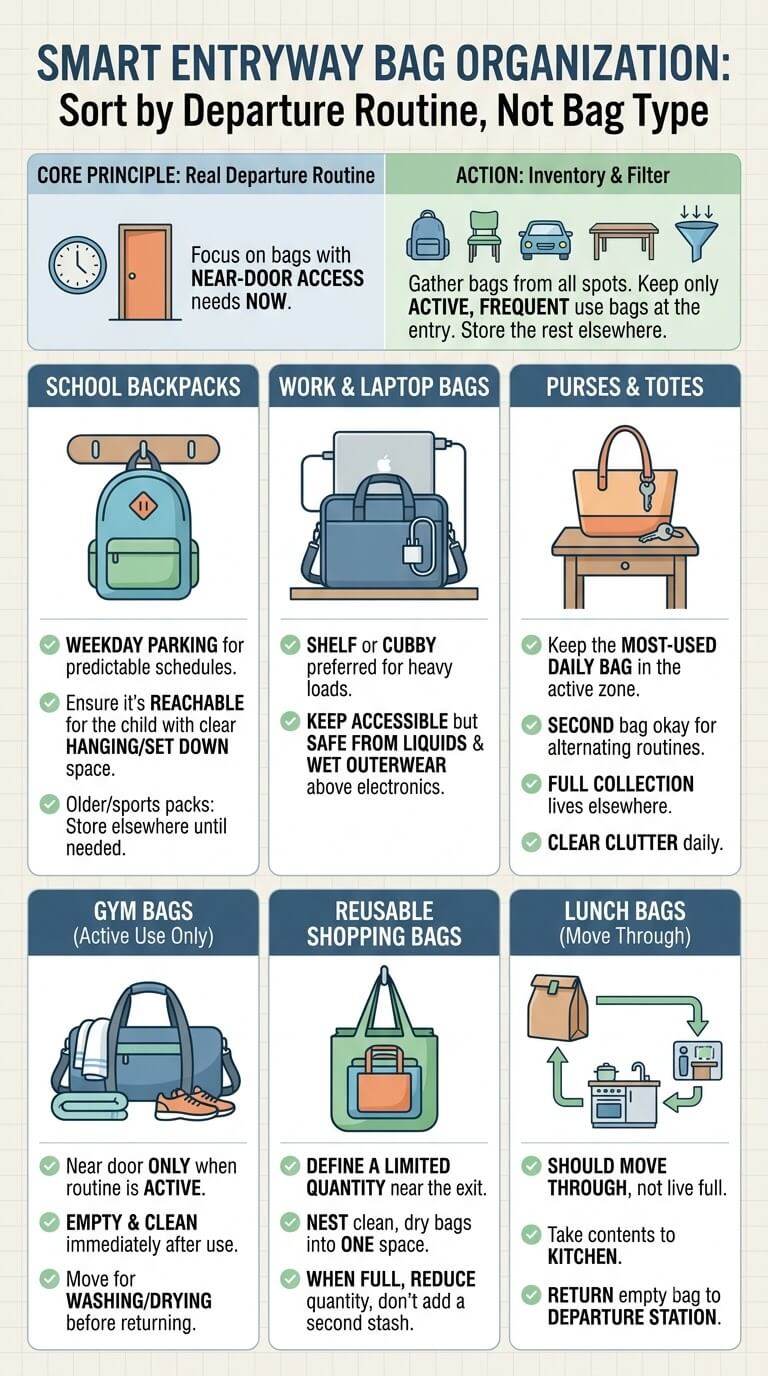
Before choosing hardware or containers, gather the bags currently living by the door, on chairs, under tables, and in the car. Sort them by real departure routine rather than by bag type alone. The question is not whether a bag is useful. The question is whether it needs near-door access now.
School backpacks
School backpacks usually deserve weekday parking because they leave and return on a predictable schedule. Keep the active backpack reachable by the child who uses it, with enough clearance to hang or set down easily. Older or sports-only packs can stay elsewhere until needed.
Work and laptop bags
Work and laptop bags can become heavy once loaded with a computer, charger, papers, and a bottle. A shelf or cubby is often better than a light-duty hook. Keep the bag accessible without placing liquids or wet outerwear above electronics.
Purses and totes
Keep the purse or tote used most days in the active zone. A second bag can make sense for alternating work and personal routines, but the full collection should live elsewhere. Clear receipts, wrappers, and stray items before returning the bag.
Gym bags at daily-use level
A gym bag belongs near the door only while the routine is active. After use, remove damp clothing, towels, shoes, bottles, and food. If the bag needs washing or drying, move it to the appropriate care area before parking it again.
Reusable shopping bags
Keep reusable shopping bags near the exit only in a defined quantity. Fold or nest clean, dry bags into one tote, drawer, basket, or shelf section. When the space is full, reduce the quantity instead of creating a second stash.
Lunch bags at handoff level
Lunch bags should move through the entry, not live there full. Take containers, utensils, ice packs, and food to the kitchen after arrival. Once the bag is emptied and ready for the next trip, return it to its assigned departure station.
Set a Daily-Carry Limit for Each Person
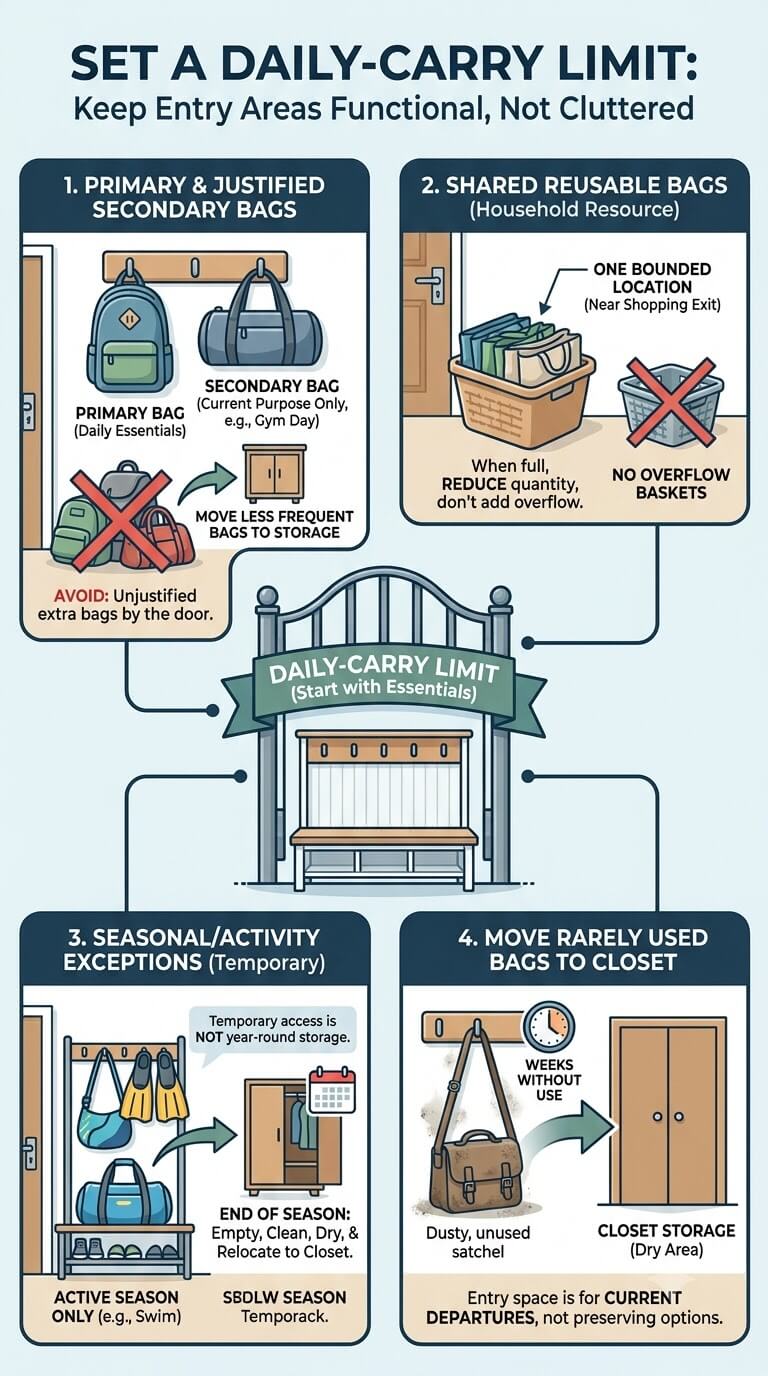
A limit keeps the entry area from becoming storage for every possible outing. Start with what each person truly carries on a normal day, then make specific exceptions rather than leaving the category open-ended.
One primary bag plus justified secondary bags
One primary bag per person is a useful starting point. A secondary bag should have a current purpose, such as a gym bag on training days. If several extra bags always wait by the door, move the less frequent ones to scheduled storage elsewhere.
Shared reusable bags
Shopping bags are usually better treated as a household resource than assigned person by person. Choose one bounded location near the exit used for shopping. When that location is full, reduce the quantity instead of opening a second overflow basket.
Seasonal or activity-specific exceptions
Swim, skating, or sports bags may earn temporary near-door space during an active season. When the activity ends, empty, clean, dry, and relocate the bag. Temporary access should not become year-round storage.
Move rarely used bags to closet storage
If a bag has not left the house in several weeks and has no planned use, move it to a closet or another dry storage area. Prime entry space should support current departures, not preserve every possible option.
Choose a Parking Method by Bag Weight and Shape
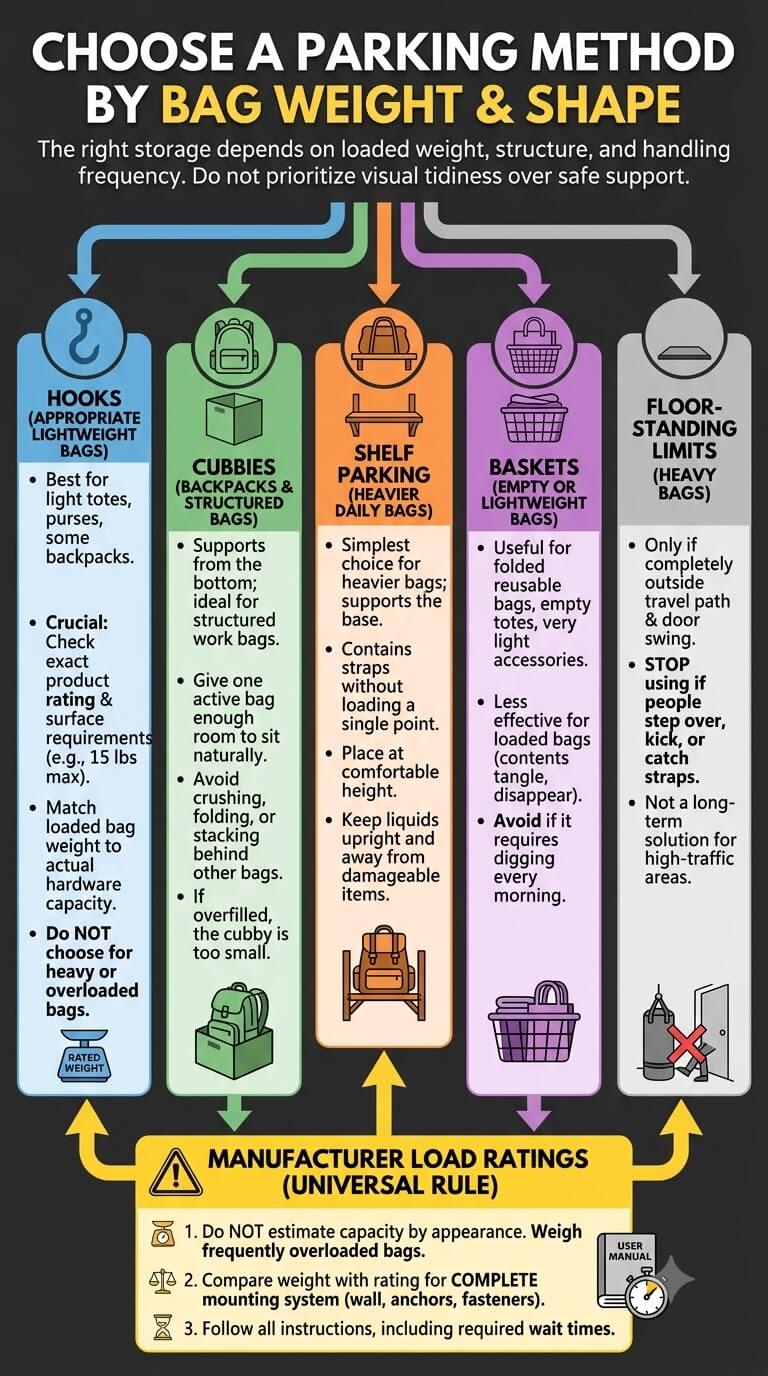
The right storage method depends on loaded weight, strap design, bag structure, wall surface, and how often the bag is handled. Do not choose a hook simply because it is visually tidy. Choose the support that safely handles the real bag in its normal loaded state.
Hooks for appropriate lightweight bags
Hooks work for light totes, purses, and some backpacks, but capacity varies. Check the exact product rating and surface requirements. For example, 3M lists an extra-large Command utility hook rated for up to 15 pounds. Match the loaded bag to the actual hardware.
Cubbies for backpacks and structured bags
A cubby supports a backpack from the bottom and works well for structured work bags. Give one active bag enough room to sit naturally. If the bag must be crushed, folded, or stacked behind another bag, the cubby is too small or overfilled.
Shelf parking
A sturdy shelf is often the simplest choice for a heavier daily bag. It supports the base and contains straps without loading one attachment point. Place it at a comfortable height and keep liquids upright and away from items that could be damaged by leaks.
Baskets for empty or lightweight bags
Baskets are useful for folded reusable bags, empty totes, or very light accessories. They are less effective for loaded backpacks because contents disappear into a pile and straps tangle. If a basket needs digging every morning, it is serving as hidden storage rather than quick parking.
Floor-standing limits
A floor spot can work for a heavy backpack if it sits completely outside the travel path and door swing. Stop using that location if people step over the bag, kick it aside, or catch straps with their feet.
Manufacturer load ratings for heavy bags
Do not estimate capacity by appearance. Weigh a frequently overloaded bag if needed and compare it with the rating for the complete mounting system. Follow instructions for the wall surface, anchors, fasteners, adhesive strips, and any required wait time before loading.
Build Individual Family Bag Stations
In a multi-person household, the best station is not the one with the most compartments. It is the one where each person can identify and use their own location quickly, without moving someone else’s belongings.
Assign one predictable home per person
Give each person a specific hook, cubby, shelf section, or floor position. The storage can differ by user: a heavy adult work bag may need a shelf while a child uses a lower hook. Consistency matters more than symmetry.
Kid-accessible placement
Children should be able to return backpacks without climbing on furniture. Keep storage reachable and the surrounding furniture stable. CPSC home childproofing guidance recommends anchoring shelves, bookcases, and other furniture to help reduce tip-over hazards.
Labels for multi-person systems
Labels help when cubbies look identical or younger children share a station. Good Housekeeping summarizes advice from professional organizers who use assigned near-door spots and labels for school gear in its back-to-school organizing guidance. Use a name, initial, or simple symbol, and label the home rather than every item inside it.
Keep straps out of the walking path
Long straps should hang or tuck inside the assigned footprint. After parking a bag, look from the normal walking direction and check whether any strap extends into foot or door clearance. Reposition the bag if it does.
Create the Daily Unpack-and-Repack Flow
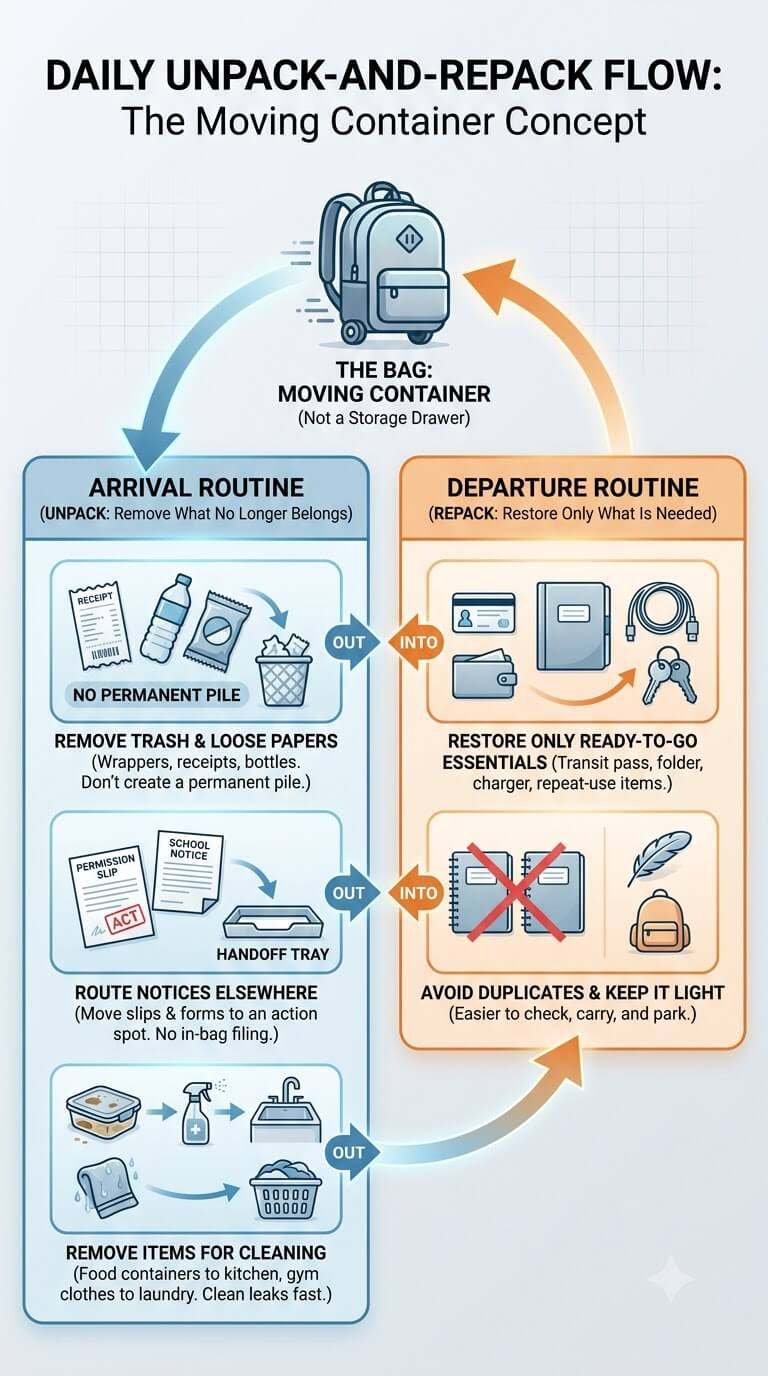
Bag organization improves when the bag is treated as a moving container, not a storage drawer. The arrival routine should remove what no longer belongs inside, while the departure routine restores only what is needed for the next trip.
Empty trash, receipts, and loose papers
Remove wrappers, receipts, empty bottles, and stray papers during the first convenient reset after arrival. A small wastebasket can help, but avoid creating a permanent paper pile beside the bags. If loose paper keeps leaving bags and forming a second pile, route it through the same small mail-and-key intake system used for incoming paper.
Route school notices and mail-like papers elsewhere
Permission slips, school notices, and forms should leave the backpack and move to the place where someone will act on them. A small temporary handoff tray is enough if needed; do not build a full filing system into the bag station.
Remove food or gym contents that require cleaning elsewhere
Take food containers to the kitchen and sweaty clothing or towels to the laundry area. If something leaked, follow the bag care instructions before returning it. This keeps the entry station from becoming a cleaning or food-storage area.
Return only ready-to-go contents
Repack only items that truly belong in the bag, such as a transit pass, school folder, charger, or repeat-use essential. Avoid storing unnecessary duplicates in every bag. A lighter bag is easier to check, carry, and park.
Stage Bags the Night Before
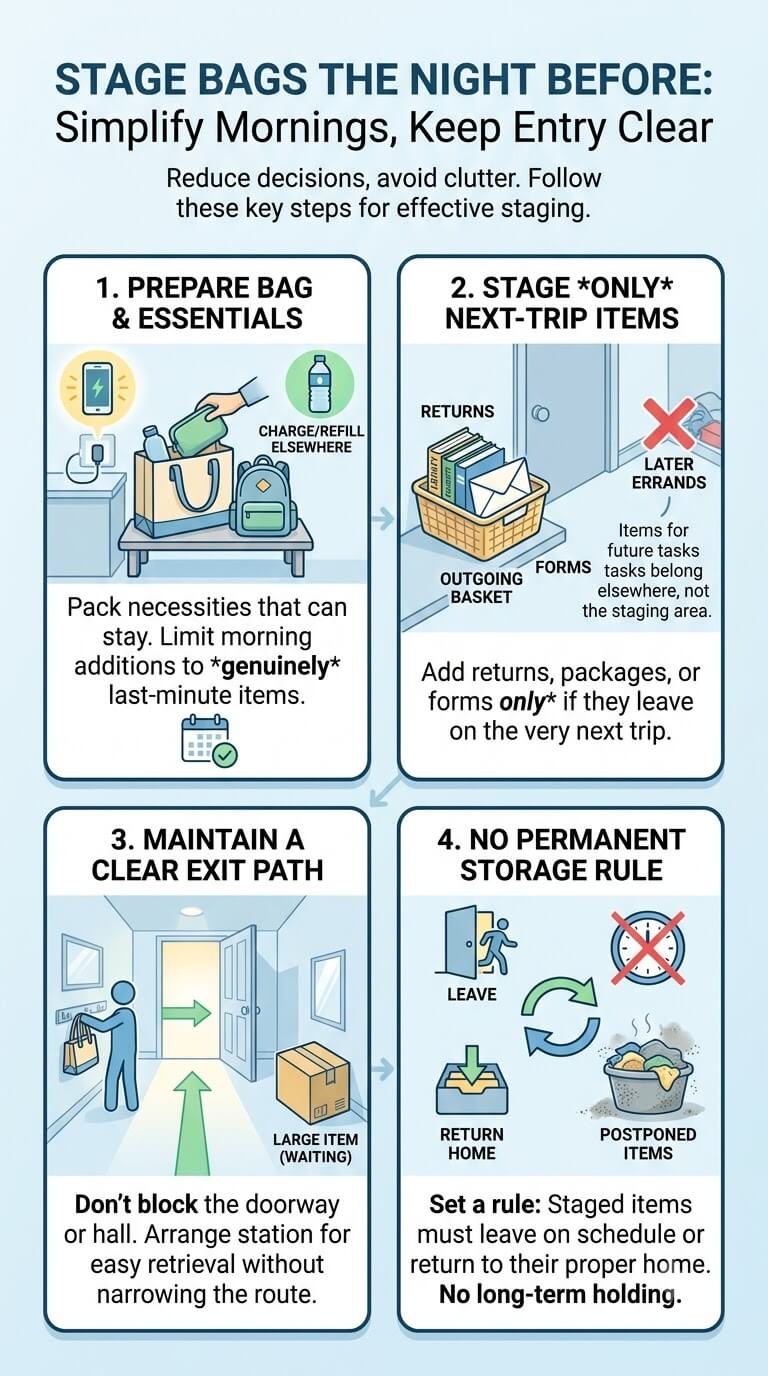
Night-before staging works when it reduces morning decisions without turning the entry area into a warehouse of future tasks. Prepare the bag itself, add the few items that must leave next, and keep the footprint bounded.
Repack essentials
Check the next day and restore essentials that can safely stay packed overnight. Handle charging and refilling in the appropriate places, then return the bag to its station. Ideally, morning packing should be limited to genuinely last-minute items.
Add outgoing items only when they belong to the next trip
Returns, library books, packages, or forms can be staged with a bag when they are leaving on the next trip. Items for later errands should stay elsewhere so the bag station does not become a holding area for unfinished tasks.
Keep the exit path clear
Staging should not push bags into the doorway. Arrange the station so each person can retrieve a bag without placing it in the hall first. Large boxes and returns should wait somewhere that does not narrow the departure route.
Avoid turning staging into permanent storage
An outgoing basket or shelf can become a long-term holding zone when no one checks it. Set a simple rule: an item staged for departure either leaves on the planned trip or returns to its proper home. Repeatedly postponed items should not occupy prime exit space.
Handle Wet, Dirty, or Food-Related Bags
Some bags should not go straight back onto a hook or into a closed cubby. Moisture, food residue, gym contents, or outdoor dirt may require a temporary handoff before the bag is ready to park again.
Separate damp bags from dry storage
If a bag comes home wet, empty it and place it where air can circulate without dripping onto other bags or electronics. Do not seal it in a closed cubby just to make the entry look tidy. Follow the material care instructions before washing or using heat.
Move cleaning tasks to the appropriate care area
The entry station should identify that a bag needs attention, not become the cleaning area. Food spills belong near an appropriate sink, muddy sports bags may need a utility space, and washable totes may go to laundry when their care instructions allow it.
Do not trap moisture in closed storage
Closed storage is for dry bags. If you notice repeated musty smells or damp contents, stop putting the bag away closed and fix the moisture handoff. Often the solution is earlier emptying and more drying time.
Return the bag only after it is ready for use
The station works best when every parked bag is ready to be picked up again. Before returning a cleaned or dried bag, check pockets, zippers, straps, and required contents. This prevents the next departure from starting with an unpleasant discovery.
Coordinate Bags With Coats, Shoes, and the Drop Zone
Bags share a small transition area with other high-use items, so the categories need to cooperate. The goal is not to give every object its own large organizer. It is to prevent one category from making another difficult to use.
Avoid competing hook loads
Do not stack a backpack over several coats on one hook unless the hardware and mounting support the combined load. Heavy bags often need their own support. Separation also keeps damp outerwear away from electronics and papers.
Keep straps away from footwear and doors
A low strap can fall into a shoe tray, pick up mud, or catch under a door. Keep straps inside the bag station. In a narrow space, a shelf or deep cubby may control them better than side-facing hooks. For wallets, keys, sunglasses, and other pocket-size items that come out of a bag, use an entryway drop zone instead of turning bag storage into a catch-all.
Use the drop zone for small carried items without duplicating bag storage
Keys, sunglasses, wallets, and other pocket-size items may have a small landing point near the bags, but avoid turning every bag pocket into a second household storage system. Decide which small essentials live permanently in the bag and which have a separate home used by everyone.
Integrate with a mudroom family station
In a larger mudroom, place each person’s bag near their daily coat and footwear while giving each category separate capacity. Keep wet or dirty gear from pressing directly against clean bags or electronics.
Store Reusable Bags Without Creating a Bag of Bags Problem
Reusable shopping bags multiply quickly because they enter the house from many sources. They stay useful only when the household can see the quantity, grab them easily, and remove extras before the storage spot expands.
Keep a realistic shopping-bag quantity
Estimate what you use on a large grocery trip and a normal smaller errand. Keep that amount plus a modest backup. If more bags routinely enter than leave, reduce the quantity instead of expanding storage.
Fold or nest only clean, dry bags
Do not compress reusable bags that are damp or have food residue. Clean them according to the material and manufacturer care directions, allow them to dry fully, and only then fold or nest them with the clean bag supply.
Choose one bounded storage location
A single tote, drawer, basket, or shelf section gives the category a physical maximum. The container should be easy to empty and refill. If bags are stuffed so tightly that they spring out or hide at the bottom, the quantity has exceeded the useful limit.
Remove damaged or excess bags
Retire bags with torn handles, broken seams, or damage that makes them unreliable. Donate only clean extras when an appropriate recipient accepts them; otherwise use suitable local disposal or recycling options for the material.
Common Bag and Backpack Organization Mistakes
Most failures come from excess quantity, inconvenient placement, or storage that does not match the loaded bag. Fix those conditions before adding more organizers.
Hanging heavy bags on unrated hooks
A decorative hook may have a modest load rating. Check the loaded bag and installation instructions. If the hook loosens, the wall surface changes, or the bag exceeds the rating, stop using that setup and choose better support.
Leaving straps across walkways
Straps that trail from a bench, hook, or floor bag can catch feet and door edges. Tuck them in, face the bag differently, or change the parking method. The bag’s entire footprint, including straps, should stay out of the normal walking line.
Keeping old papers and trash inside bags
A bag can look organized outside while becoming a portable junk drawer inside. A two-minute emptying habit prevents this. Remove obsolete papers, wrappers, and items that belong elsewhere before adding the next day’s materials.
Creating a miscellaneous-bag bin
A large bin for “extra bags” usually hides too many unrelated items. If you cannot say what a bag is for or when it will be used, move it out of the active zone. Current use is a better organizing rule than “anything with handles.”
Storing the entire bag collection by the door
Near-door space should reduce departure friction. Luggage, special purses, inactive seasonal totes, and sentimental bags weaken that function. Keep the active rotation small and move the rest to longer-term storage.
When Bags Belong in a Closet or Other Storage Area
Some bags are important but do not support daily departures. Moving them elsewhere is not a failure of the entry setup. It is what keeps the active station useful.
Travel luggage
Suitcases and large duffels usually belong in longer-term storage unless someone is traveling frequently. They take up too much near-door volume and can narrow walkways. Store them empty, dry, and according to the material and space available in your home.
Handbag collections
Special-occasion purses, collectible bags, and rotating fashion handbags need a different storage approach than an everyday tote. Keep only the currently used bag near the exit and manage the rest where shape, dust protection, and longer-term access can be considered properly.
Rarely used totes
Craft totes, beach bags, picnic bags, and event-specific carriers should move to the room or storage area associated with their use when practical. Their contents can stay with the activity instead of occupying daily departure space.
Off-season activity bags
At the end of a sports or seasonal routine, empty the bag completely, address cleaning or repair needs, and relocate it. Put it back into active rotation only when the activity begins again.
Daily Reset and Weekly Bag Audit
A small reset keeps the station functional without turning bag organization into a large weekend project. Daily actions restore order; a short weekly check catches gradual buildup.
Return each bag to its station
At the end of the arrival routine, every ready bag goes back to its assigned hook, cubby, shelf, or floor position. If someone repeatedly parks a bag somewhere else, inspect convenience. The assigned home may be too far from the natural route or too awkward to use one-handed.
Clear loose contents
Empty wrappers, receipts, papers, bottles, and items that belong in other rooms. Do this before the bag becomes too full to inspect. A weekly pocket check is especially useful for backpacks with many small compartments.
Check for stale outgoing items
Look for returns, forms, library books, or packages that were staged but never left. Either schedule the next action or move the item out of prime entry space. A departure station should reflect upcoming trips, not unfinished intentions from weeks ago.
Remove extras that entered the active rotation
Bags accumulate through events, shopping, school changes, and seasonal activities. Once a week, scan the station for anything that no longer earns daily access. Returning one or two extras to storage is often enough to restore the original capacity.
FAQ About Organizing Bags and Backpacks
These questions address the most common decisions that come up after the basic parking system is in place.
Where should backpacks be stored at home?
Store active backpacks near the route used for daily departures, provided the location does not block a doorway or walkway. A sturdy cubby, shelf, appropriately rated hook, or defined floor position can work. Choose the method based on loaded weight, user height, and available clearance rather than appearance alone.
Is it safe to hang heavy backpacks on hooks?
Only when the hook, fasteners, mounting surface, and installation are rated for the loaded backpack and used according to the manufacturer’s instructions. If the bag is very heavy, changes weight often, or pulls awkwardly on the hook, a shelf or cubby may provide a simpler support.
How do you organize backpacks for multiple kids?
Give each child one clearly assigned location at a reachable height, then keep school papers and food containers moving to their proper destinations instead of accumulating inside the station. Labels or symbols can help. Keep enough spacing that one child does not have to remove another child’s backpack to reach their own.
Where should reusable shopping bags go?
Keep a realistic quantity in one bounded spot near the exit most often used for shopping, such as a drawer, tote, basket, or shelf section. Fold or nest them only when clean and dry. Extras should leave the active zone rather than start a second storage pile.
How do you stop bags from collecting on chairs and counters?
Make the assigned parking place easier than the chair or counter. Put it on the natural arrival path, provide enough room, and remove unused bags that consume capacity. If the habit continues, try a lower hook, sturdier shelf, or location closer to where people actually unload.
Final Thoughts
A useful bag station is small, predictable, and matched to real daily loads. Keep only active bags near the door, give each person a clear home, support heavier bags appropriately, and route food, wet gear, papers, and laundry to the places where they can be handled properly.
If the area keeps overflowing, reduce the active rotation before adding storage. Choose what truly leaves the house, give those bags enough space, test the routine for a week, and move everything else out of the departure zone.

Ethan Carter is the Founder & Editor of HomeCleanSecrets. Based in the United States, he has 5 years of experience creating practical home cleaning, laundry care, stain removal, decluttering, and home organization content. His goal is to help everyday households clean smarter and build simple routines that are easier to maintain.
Read more about Ethan Carter on his author page: https://homecleansecrets.com/ethan-carter/