
Coats and jackets are easiest to manage when the entry area holds only the outerwear people are actively wearing now. The goal is not to fit an entire wardrobe near the door. It is to give each household member a reliable place for the layer they reach for most often, provide a safe temporary spot for wet items, and move off-season or rarely used coats somewhere with more capacity.
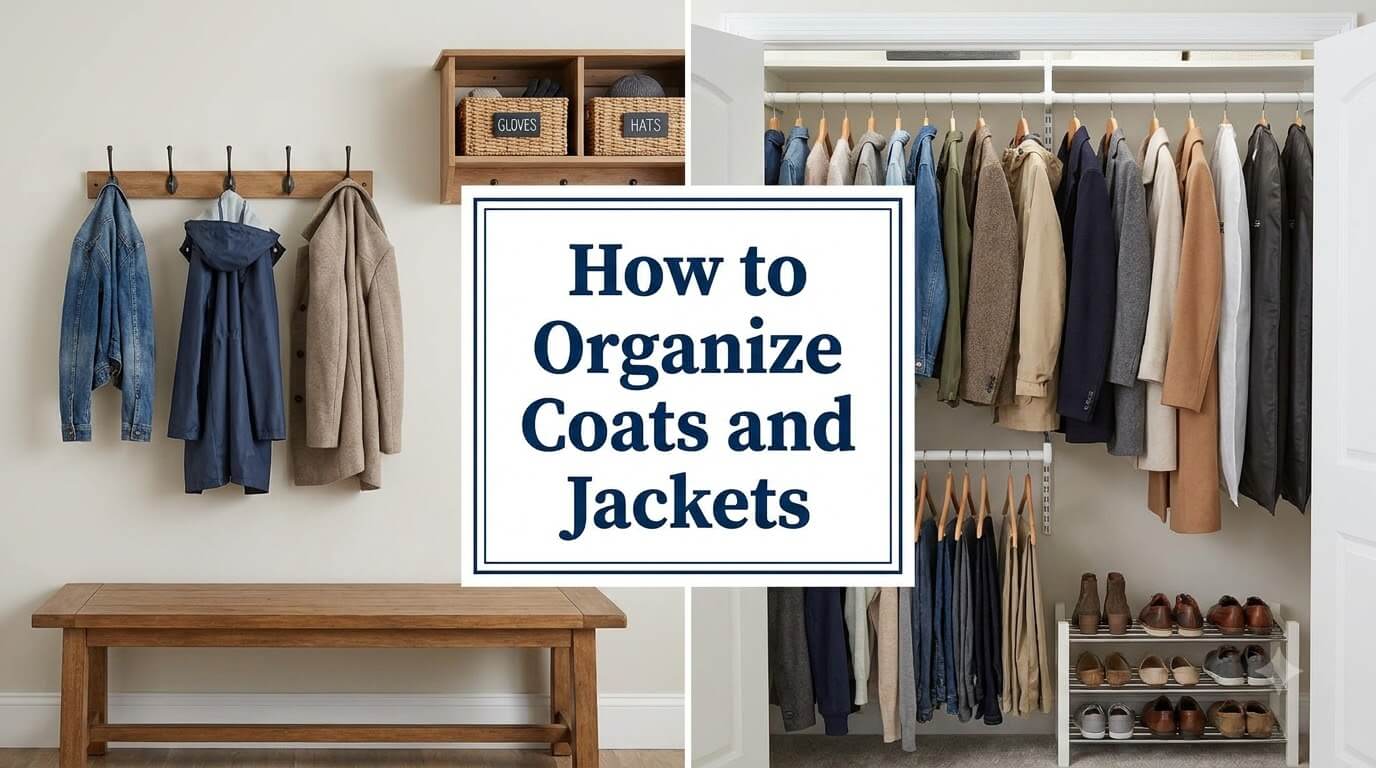
A workable setup usually begins with a simple sequence: identify the current-season pieces, set a hard near-door limit, choose the right support for each garment, assign usable locations by person, and create a separate plan for wet or bulky items. When coats still end up on chairs or the floor, that is usually a sign that the active zone is too full, too high, too inconvenient, or being asked to store more than it can handle.
Quick Answer: Keep Active Outerwear Near the Exit and Rotate the Rest
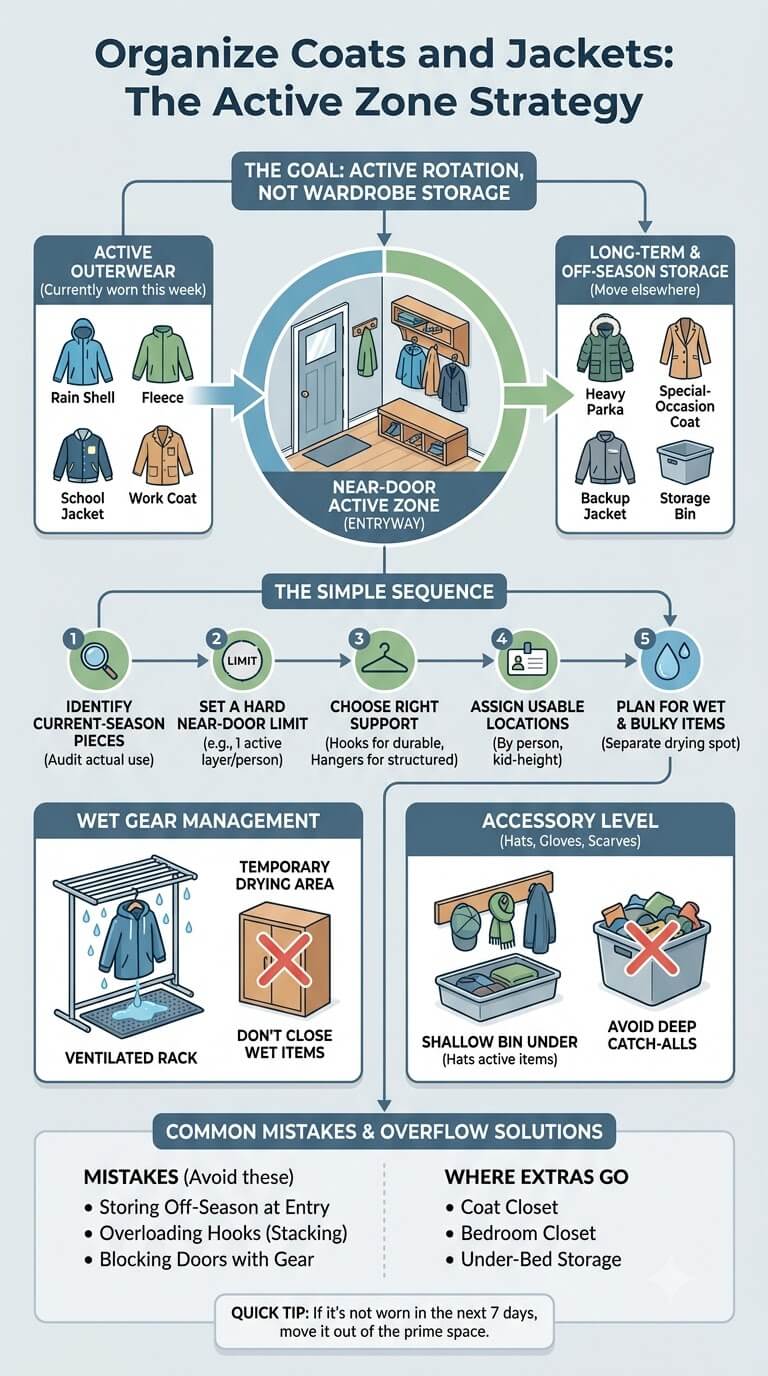
Near-door storage works best as an active rotation, not permanent clothing storage. Keep the few outer layers needed for the current weather and current routines within easy reach, then send the rest to a coat closet, bedroom closet, garment storage area, or another appropriate location.
Active outerwear versus long-term wardrobe storage
Active outerwear is what someone is likely to wear this week: a school jacket, work coat, rain shell, fleece, or weather-appropriate layer. Long-term storage includes special-occasion coats, off-season parkas, backup jackets, and items that may not be worn for months. Keeping those categories separate prevents a near-door hook rail from becoming a compressed clothing rack.
A good test is to look at every coat by the entrance and ask, “Would someone reasonably wear this in the next seven days?” If the answer is no, it probably does not need prime space. Transitional weather can justify a few extra layers, but the total still needs a limit. If coats are competing with shoes, bags, keys, and wet gear for the same entrance, solve the broader entrance organization framework before adding more hooks.
Why hook capacity is not the same as garment capacity
A hook may physically hold several light garments, but stacking them can make the inner pieces hard to reach, hide damp fabric, stretch collars, and encourage people to drop coats elsewhere rather than dig through a pile. Hardware also has a rated load that should not be guessed. If you use adhesive or mounted hooks, check the product instructions and weight rating. Command, for example, publishes product-specific weight limits for its hanging products, which illustrates why the capacity of the actual hardware matters more than how many garments can be squeezed onto it.
Audit the Coats and Jackets Used This Season
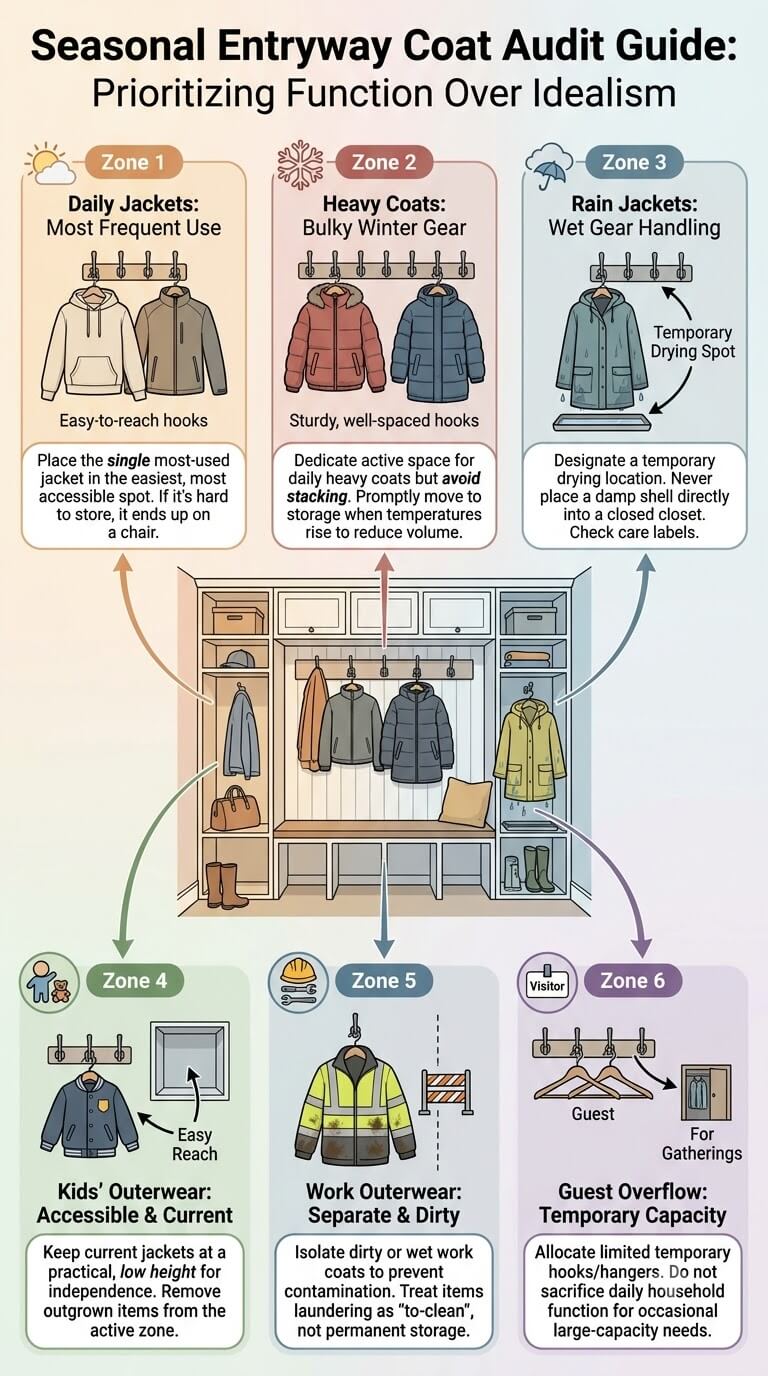
Before adding hooks, cubbies, or another rack, sort the outerwear already near the door. The audit should reflect actual routines, climate, and household members rather than an idealized one-jacket-per-person rule that may not fit real life.
Daily jackets
Start with the jacket each person reaches for most often. In mild weather, that may be a lightweight jacket or hoodie-style outer layer. Give that piece the easiest position because it is the garment most likely to be left on a chair if storage takes extra effort.
Heavy coats
Bulky winter coats consume more depth and hook space than light jackets. If they are needed daily, they deserve active space, but avoid stacking multiple heavy coats on one point. When temperatures rise, move them out promptly so the entrance does not carry winter volume year-round.
Rain jackets
A rain jacket may need a different treatment from a dry everyday coat because it can come home wet. Keep a temporary drying location available rather than automatically pushing a damp shell into a closed closet. If the garment needs washing or technical care, follow its sewn-in care label rather than a generic method.
Kids outerwear
Children are more likely to use a system when they can reach it without help. Keep current school or play jackets at a practical height, with enough open space that a child can hang the garment without moving three other coats first. Extra dress coats and outgrown pieces should leave the active zone.
Work outerwear
Work jackets can carry more dirt, tools, reflective elements, or strong outdoor exposure than everyday coats. If a work coat regularly comes home dirty or wet, place it in a separate active position so it does not press against cleaner clothing. Items requiring laundering or specialized care should be moved to the appropriate cleaning area instead of being treated as permanent entry storage.
Guest overflow
Guest capacity should be temporary. One or two open hangers or hooks may be enough for regular visitors, but do not keep a large section empty at the expense of daily household function. For gatherings, a bedroom or another safe temporary coat location may work better than overloading the entry area.
Set a Practical Near-Door Capacity

Capacity should come from the available space and current routines, not from the number of coats the household owns. A clear limit makes it obvious when an item needs to move elsewhere.
One active layer per person when practical
For many homes, one primary outer layer per person is a useful starting point. It keeps the visual load low and makes each garment easy to retrieve. This is a starting rule, not a universal maximum. A person who alternates between a work jacket and rain shell may need two active positions.
Account for climate and commute needs
Cold, rainy, windy, or highly variable climates often require more overlap. Someone who walks to transit may need a waterproof shell plus an insulating layer, while someone who drives may use fewer pieces. Count what is genuinely needed for departures rather than forcing every household into the same number.
Reserve limited guest space
If visitors are common, reserve a clearly defined amount of temporary space. One small section is easier to keep functional than an undefined “guest area” that slowly fills with household extras.
Decide where extras must go
Every near-door limit needs an overflow destination. That may be a coat closet, bedroom closet, under-bed clothing storage for appropriate off-season items, or another dry location. If there is no defined destination, removing excess coats from hooks simply moves the pile to a nearby chair.
Choose Hooks, Hangers, Cubbies, or a Coat Closet

Storage method should match the garment, the frequency of use, and the available space. Fast access matters, but so does supporting the clothing properly and keeping the walking path clear.
Hooks for durable high-frequency garments
Hooks are convenient for sturdy jackets that are used often and tolerate hanging from a loop or collar area. Use one garment per hook when possible, and check that the hook is installed on a suitable surface according to its instructions. Stop adding weight when the hardware flexes, loosens, or approaches its listed rating.
Hangers for items that need shape support
Structured wool coats, tailored outerwear, and garments prone to shoulder distortion may do better on suitable hangers. Check the care label and garment construction. A coat closet with enough width and a sturdy rod can protect these pieces better than a small wall hook.
Open wall storage versus coat closet
Open storage is fast and makes capacity visible, which can help families notice overload early. Closed storage reduces visual clutter and can protect garments from incidental contact, but it should not become a place where damp items disappear. Choose based on access, ventilation, and how consistently the household returns clothing.
Bench hooks and cubby combinations
A bench with hooks or cubbies can work when the room has enough depth to preserve the walking path. Use the vertical area for outerwear and the lower zone for clearly separate categories such as shoes. Do not let coat hems, bag straps, and footwear overlap in the same narrow passage.
Do not assume every garment belongs on a hook
Some coats are heavy, delicate, or shaped in ways that make hook storage a poor choice. If a garment slips off, stretches, or requires careful support, use a hanger or another method recommended by the maker. Convenience should not override garment care.
Assign Outerwear by Household Member
Shared storage becomes easier to reset when everyone knows where their current coat belongs. The assignment can be simple and still work well.
Individual hook or section
Give each person a consistent position rather than letting everyone use whichever hook is free. A predictable location reduces searching and makes an abandoned garment easy to return without asking who owns the space.
Kid-accessible height
Place children’s hooks or cubbies where they can reach them safely. A system that requires an adult every time is less likely to survive busy school mornings. Avoid encouraging climbing on benches or unstable furniture to reach high storage.
Adult zones
Adult coats can use higher positions if they remain comfortable to access. Keep frequently worn pieces closer to the main exit path and move occasional garments deeper into a closet or another storage area.
Shared guest or temporary space
Shared hooks work best when they have a clearly temporary purpose. A wet coat drying spot or guest hook should be emptied after use rather than becoming the default location for unassigned garments.
Labels only when they reduce confusion
Labels are useful in larger households, especially when identical hooks or cubbies cause mix-ups. They are unnecessary if everyone already uses a distinct location. Add a label only when it solves an actual return problem.
Manage Wet Coats and Rain Gear

Wet outerwear needs temporary handling before it rejoins the dry coat zone. The aim is to prevent drips, trapped moisture, and a growing pile of half-dry garments. In a dedicated mudroom, give wet outerwear a temporary drying position that does not drip onto the shoe or bag zones.
Let wet outerwear dry before closed storage
Do not immediately compress a dripping or damp coat into a packed cabinet. Give it room to dry according to the garment’s care instructions. For technical rainwear, care methods differ by fabric and construction. REI’s GORE-TEX rainwear care guidance specifically advises checking the garment instructions and notes that approved drying methods can vary, which is a useful reminder not to improvise heat or washing steps.
Keep drips away from vulnerable floors and electrical areas
Choose a drying position where water can be contained and wiped up. Keep dripping sleeves away from outlets, power strips, chargers, and other electrical devices. If the floor is moisture-sensitive, use a compatible washable mat or tray beneath the area and clean up standing water promptly.
Separate dry active coats from wet temporary items
A single temporary hook or short drying rail can prevent wet garments from being pushed into the dry rotation. Once the item is dry, return it to the assigned active position so the temporary area stays available for the next rainy day.
When recurring dampness needs a broader moisture solution
If coats remain damp for a long time, the wall feels persistently wet, or the space has ongoing condensation, organization alone will not solve the problem. Increase airflow if appropriate for the home, identify the moisture source, and address repeated dampness rather than adding more closed containers.
Organize Hats, Gloves, and Scarves at Accessory Level
Small winter accessories should support the coat routine without becoming their own oversized storage project. Keep only the active season’s everyday pieces near the door.
Pair small accessories with the active coat zone
Place hats, gloves, and scarves close enough to the coats that getting ready remains one sequence. A shallow cubby or small basket beneath each person’s outerwear area can work well when it does not crowd the path.
Use limited bins or baskets
Small containers are helpful because they prevent loose gloves from spreading across a shelf. They fail when they become deep catch-alls. Choose a size that holds the active set, not every accessory the household owns.
Rotate out-of-season accessories
Move insulated gloves, thick hats, and heavy scarves out when the season ends. Likewise, return only the pieces that still fit, are in usable condition, and are likely to be worn this season.
Prevent small-item containers from becoming catch-alls
If receipts, toys, tools, pet items, and random objects start filling the accessory basket, empty it and restore the category. A good test is whether someone can find matching gloves in a few seconds without digging through unrelated items.
Seasonal Rotation for Bulky Outerwear

Seasonal rotation keeps the highest-volume garments from consuming active space when they are not needed. The transition does not need to happen on a fixed calendar date.
Define the current season
Use actual local weather and household routines. A household may need both rain shells and light jackets during a transitional month, while heavy parkas can move out as soon as they are no longer part of normal departures.
Move off-season coats to closet or clothing storage
Clean and care for garments as required before longer storage, then place them in an appropriate dry wardrobe location. This entrance setup does not need to hold the full off-season clothing system. Its job is simply to release active space.
Handle transitional-weather overlap
During spring and fall, allow a short overlap instead of forcing a perfect one-season swap. Keep the most likely alternatives and set a review date after the weather stabilizes. The overlap should still fit the physical capacity of the coat zone.
Review condition before returning items to active rotation
Before a coat comes back to the entrance, check zippers, buttons, hanging loops, pockets, and overall condition. Follow the care tag if cleaning or repair is needed. Returning only usable pieces prevents the active zone from filling with items that are not actually ready to wear.
Coordinate Coats With Shoes and Bags
Outerwear rarely operates alone. Shoes and daily bags usually occupy the same departure area, so the zones need to work together without overlapping into a single pile.
Keep wet-weather gear in compatible adjacent zones
Wet boots, umbrellas, and rain jackets can share a general weather area, but each item still needs its own containment. Keep footwear low, garments higher, and dripping items positioned so water does not run onto bags or dry clothing.
Avoid crossing straps and coats in the walking path
Do not hang backpacks or tote bags where their straps extend into the route people use to enter and leave. A coat hem brushing a bag is usually harmless, but a shoulder strap at shin height can become a trip hazard. Keep carried bags on a separate hook, cubby, or shelf designed for their weight.
Use a mudroom relationship map without duplicating full room zoning
In a larger mudroom, place coat storage after the dirty shoe landing point but before deeper household storage when that matches the household’s movement. The exact layout can vary. What matters is that someone can remove wet footwear, hang outerwear, park a bag, and continue into the home without crossing back through clutter.
Prevent Overloaded Hooks and Floor Piles
When coats keep falling or ending up on the floor, changing household habits is only part of the answer. The physical setup may be overloaded or inconvenient.
Respect manufacturer load ratings
Check the rating and installation instructions for hooks, rails, adhesive systems, shelves, and wall-mounted organizers. Heavy winter coats can add up quickly, especially when bags are hung on the same hardware. Do not rely on visual appearance alone to judge what a mounting system can support.
Reduce the number of garments per hook
If someone must lift three coats to reach the fourth, the hook is storing too much. Remove off-season pieces, duplicates, and occasional garments first. Adding another hook should come only after the active inventory has been reduced to what the entrance reasonably needs.
Fix storage height that encourages dropping
A coat on the floor may signal that the assigned hook is too high, hidden behind a door, blocked by another item, or difficult to use with one hand. Move the active position to the point where the garment is naturally removed if doing so preserves safe clearance.
Move overflow instead of adding endless hooks
More hooks can make an overloaded wall look organized for a short time without fixing capacity. Once the active rotation has a sensible position, redirect extras to the wardrobe area that owns longer-term clothing storage.
Common Coat and Jacket Organization Mistakes
Most coat-zone problems come from excess inventory, poor support, or a mismatch between the storage location and the household’s real arrival routine.
Keeping off-season outerwear at the entrance
Bulky coats left in place during warm months consume space that daily light jackets need. Rotate by actual use and move dormant pieces promptly.
Hanging heavy bags and coats on the same overloaded hardware
Combining a laptop bag, backpack, and several coats on one hook can exceed the hardware’s rating and makes every item harder to retrieve. Separate the categories and follow the mounting instructions.
Closing wet coats into unventilated storage
Putting a wet jacket directly into a crowded closed cabinet traps it against other garments. Give wet items temporary drying space first, then return them after they are dry enough for normal storage.
Using hooks that damage delicate garments
Narrow hooks can distort some fabrics or stress hanging loops. If the coat is structured, heavy, or delicate, use a suitable hanger or storage method consistent with the care label.
Blocking doors with bulky winter gear
Coats, freestanding racks, and benches should not interfere with the door swing or the normal route out of the home. If a tall freestanding wardrobe or clothing storage unit is part of the setup, review its anchoring and safety requirements. The U.S. Consumer Product Safety Commission maintains information on clothing storage unit tip-over hazards, which is especially relevant in homes with children.
When Outerwear Belongs Somewhere Else
The entrance should release items that are not part of current departures. Moving them is not a failure of the entry setup. It is how the setup keeps working.
Special-occasion coats
Formal coats that are worn only for events usually deserve protected hanger space in a closet rather than a daily hook beside school jackets and rain gear.
Off-season outerwear
Parkas, insulated jackets, or lightweight shells that are clearly out of season should move to the household’s clothing storage area after any required care.
Long-term garment storage
Sentimental garments, backup outerwear, and items being kept for occasional future use should not compete with current coats near the door. Store them with the rest of the long-term wardrobe under conditions appropriate for the fabric.
Oversized collections beyond entry capacity
If the household owns many coats, accept that the entrance cannot display all of them. Choose the active rotation, assign a destination for the rest, and review the selection when weather or routines change.
FAQ About Organizing Coats and Jackets
These questions cover the decisions that most often determine whether a coat zone stays usable from day to day.
Should coats be stored on hooks or hangers?
Use hooks for durable, frequently worn garments when the garment and hardware can handle that method. Use suitable hangers for structured, delicate, heavy, or shape-sensitive coats. Check the care label and the hanging system’s instructions rather than assuming one method is best for every coat.
How many coats should stay by the door?
Start with one primary active layer per person, then add only the extra pieces required by weather or routine, such as a rain shell or work jacket. The final number should fit without stacking garments, blocking access, or exceeding hardware capacity.
Where should wet coats dry?
Use a temporary, ventilated place where drips can be contained and the garment can dry according to its care instructions. Keep it away from electrical devices and do not press it immediately into crowded closed storage. Once dry, return it to the assigned active location.
How do you organize kids coats in an entryway?
Give each child a reachable hook, cubby, or short section for the current jacket, and keep extra clothing elsewhere. The location should be easy to use without climbing on furniture. A small label can help when several children share similar storage.
What do you do with winter coats in warmer months?
Check their condition, follow any care-label instructions, and move them to an appropriate closet or seasonal clothing area. Leave only current-weather outerwear near the entrance. Bring heavier pieces back when they rejoin the household’s normal weekly rotation.
A coat area stays orderly when it is treated as a departure tool rather than a miniature wardrobe. Keep current pieces accessible, give wet items a temporary path to dry, match storage to the garment and hardware limits, and move overflow before the entrance becomes difficult to use.

Ethan Carter is the Founder & Editor of HomeCleanSecrets. Based in the United States, he has 5 years of experience creating practical home cleaning, laundry care, stain removal, decluttering, and home organization content. His goal is to help everyday households clean smarter and build simple routines that are easier to maintain.
Read more about Ethan Carter on his author page: https://homecleansecrets.com/ethan-carter/