
An entryway drop zone gives everyday carry a short path from your hands to a permanent home or a temporary stop. Keys land in one place, bags park in one place, paper gets routed, and unrelated items keep moving.
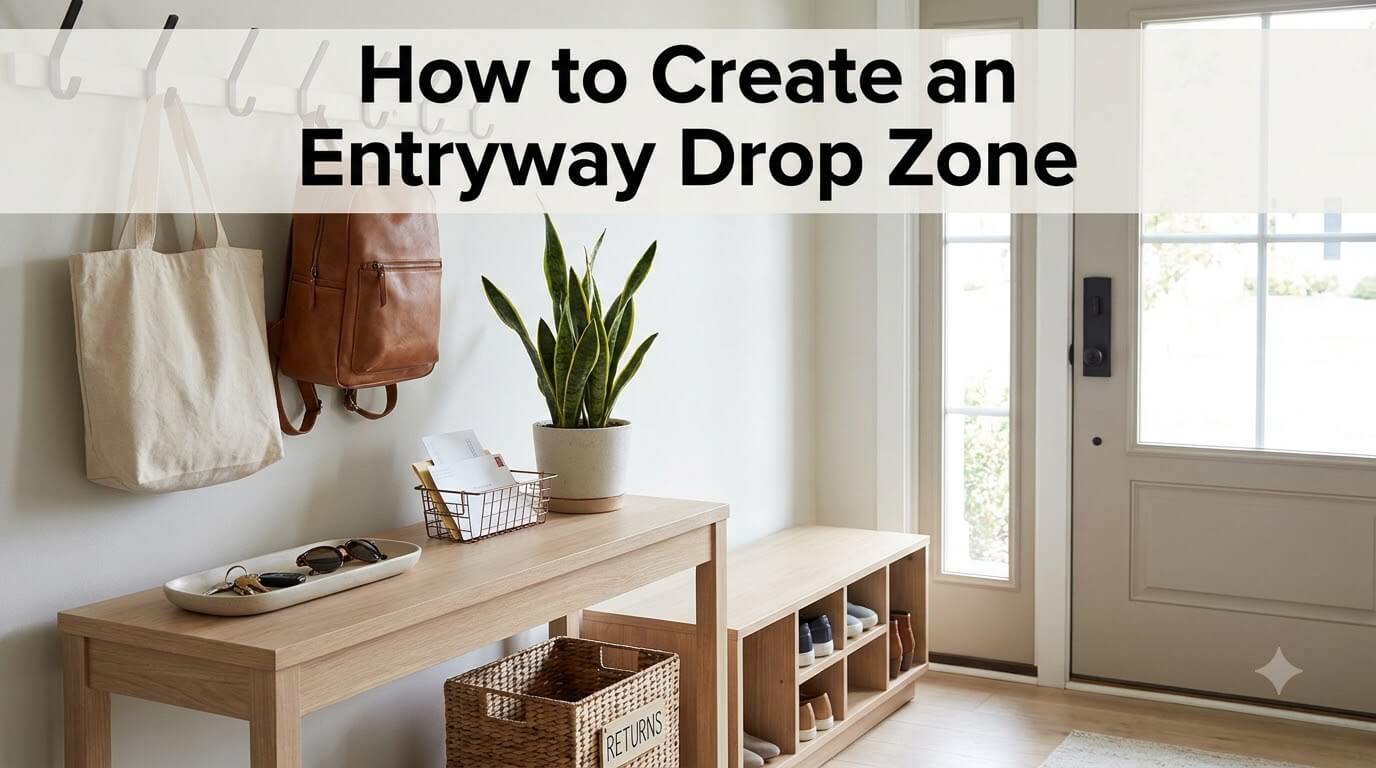
The setup can be tiny: a hook, shallow tray, and small basket may be enough. Larger households may need separate stations, but every storage piece should support a specific arrival or departure action.
Quick Answer: Give Daily Carry a Short, Predictable Landing Path

Build around the order in which you naturally unload. The best location is the first convenient place for daily carry that does not interfere with the door, stairs, or main walking path.
The One-Step Unload Principle
A one-step unload gives each common item a nearby destination. Hang the work bag, place keys in a tray, and put incoming paper in one holder. Extra doors, detours, and obstacles make the nearest table more tempting.
A good test is to walk in while carrying what you normally bring home. If you can unload the essentials while standing in one small area and nothing ends up on the floor, the setup is supporting the behavior you want.
Temporary Holding Versus Permanent Storage
Some items stay near the door; others are only passing through. Keys may have a permanent home, while a return or upstairs item needs a temporary spot and a clear next destination.
Give permanent items small fixed homes. Give temporary items less capacity and a deadline, such as “take upstairs tonight” or “put in the car before the next errand.” Small limits make stale objects easier to notice.
What an Entryway Drop Zone Is and Is Not
A drop zone is a transition point for a limited set of objects entering or leaving the home. It does not need to manage every nearby household category.
Landing Zone Versus Long-Term Storage
Long-term storage is designed for things that may sit for weeks or months. A landing zone is designed for fast turnover. Daily keys, an active tote, sunglasses, and a small amount of incoming paper may make sense. Seasonal decorations, old receipts, spare household supplies, and bags you rarely use generally do not.
If an object can remain untouched for a month without affecting your arrival or departure routine, it probably needs a different home. Before changing the landing routine, check that it fits the home’s overall entryway and mudroom system, especially door clearance, active inventory, and wet-gear handling.
Drop Zone Versus Family Command Center
A drop zone does not need calendars, meal plans, school schedules, bill storage, charging docks, and household paperwork all in one place. Those systems can be useful elsewhere, but adding them automatically makes the entry area harder to reset. Keep this space focused on physical items crossing the door.
Drop Zone Versus Small-Entryway Layout
A small entrance problem is mainly about fitting necessary storage into limited space while protecting the walking path and door swing. A landing workflow can exist in a narrow apartment hall, a large foyer, a kitchen-side entrance, or a mudroom. The behavior stays similar even when the room changes.
Audit What You Actually Carry Through the Door
Before buying organizers, review what actually comes through the door during a normal week. Penn State Extension’s decluttering guidance supports deciding what stays before adding more storage.
Keys, Wallet, Sunglasses, and Small Accessories
Small items cause outsized frustration because they disappear easily. List only the accessories that regularly travel with you. If a wallet always stays in a purse, it may not need a separate entryway home. If sunglasses are used daily, one shallow compartment may be enough.
Bags and Backpacks at Parking Level
Count the bags that are active now, not every bag you own. A school backpack, work bag, purse, or reusable tote can park near the door when it is used frequently. Extra luggage, occasional handbags, and out-of-season bags should not consume the landing area.
Incoming Mail at Intake Level
Paper may enter here, but it should not build a permanent archive here. The entry area only needs enough capacity to catch incoming mail until it can be recycled, acted on, or moved to wherever household paperwork is handled.
Returns, Outgoing Items, and Things Headed Upstairs
These are classic temporary objects. Give them one clearly bounded place. A shallow basket may hold two returns. A stair basket may hold a few items that need to move upstairs. Once that space is full, the answer is to move the contents, not add a second holding bin.
What Should Never Live in the Zone
Remove anything that has no connection to arriving or leaving, especially bulky decor storage, household backstock, paperwork archives, loose tools, and collections. Also reconsider high-value items that would be unnecessarily visible from a window or open door. Convenience should not require exposing valuables.
Design the Incoming and Outgoing Flow

Treat the area as a short sequence: each object stops in a permanent home, pauses briefly, or continues elsewhere.
Arrive, Unload, Route, and Reset
A simple arrival can follow four actions: unload what is in your hands, place permanent items in their homes, route temporary items, and clear anything left behind from the previous cycle. This sequence prevents yesterday’s objects from competing with today’s.
One-Touch Items With Permanent Homes
Keys and a frequently carried bag are good candidates for one-touch storage. You put them down once and pick them up from the same place later. The destination needs to be easy to reach and obvious enough that every regular user can repeat the action without thinking much about it.
Temporary-Hold Items With an Expiration Point
A temporary object needs both a container and a time limit. If a package must be returned, decide whether it leaves on the next errand or moves to the car that evening. If an item belongs upstairs, move it during the evening reset. Without a next action, temporary holding becomes storage by default.
Outgoing Staging Without Blocking the Door
Stage outgoing items beside the route, not in it. Do not place bags, boxes, shoes, or returns where they reduce usable doorway width, interfere with the door swing, or create a trip hazard. If the only available staging location blocks movement, use a different room and rely on a reminder instead.
Build the Smallest Storage Set That Supports the Flow
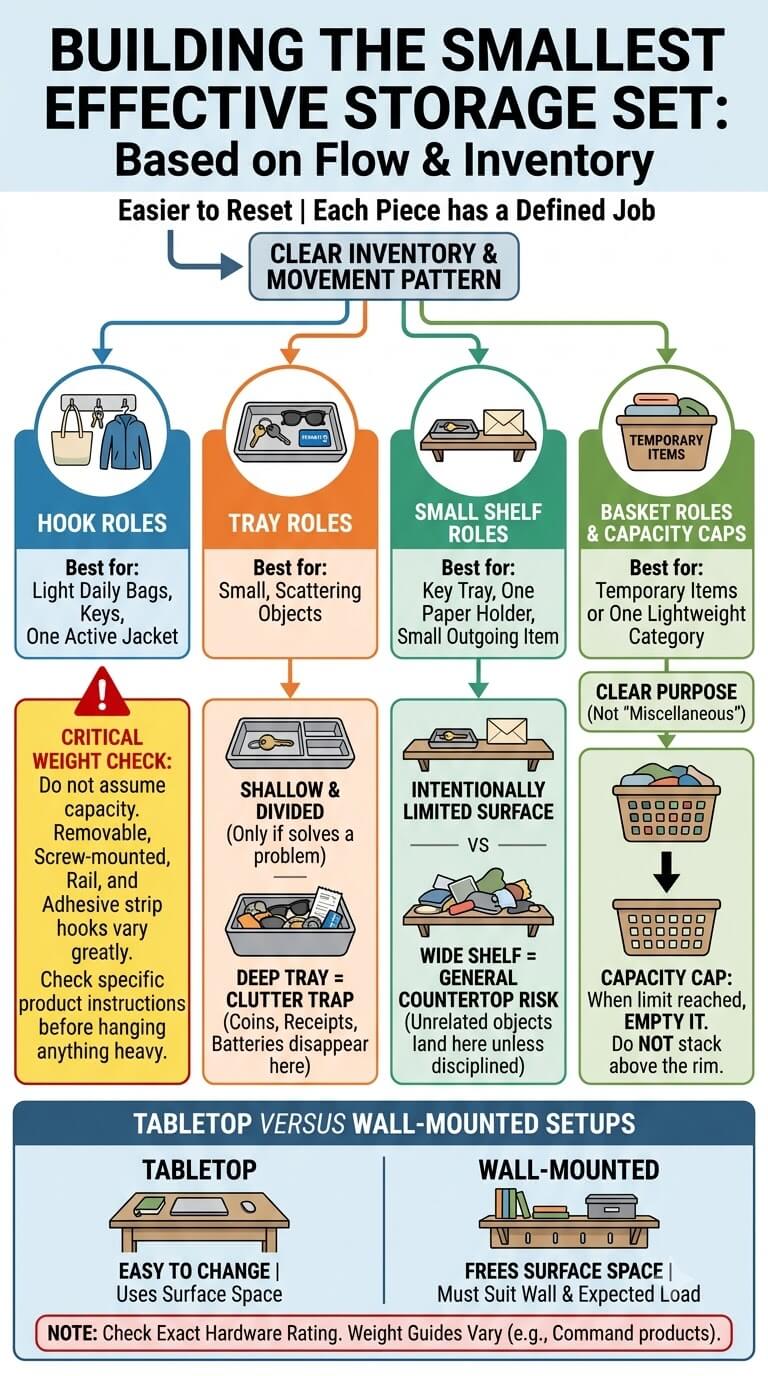
Choose storage after the inventory and movement pattern are clear. Smaller systems are easier to reset because each piece has a defined job.
Hook Roles
Hooks work well for light daily bags, keys, or one active jacket when the mounting method and rated load are appropriate. Do not assume that a removable hook, screw-mounted hook, rail, or adhesive strip can hold the same weight. Check the specific product instructions before hanging anything heavy.
Tray Roles
A tray is best for small objects that would otherwise scatter: keys, sunglasses, or a transit card. Keep the tray shallow and divided only if divisions solve a real problem. A deep tray tends to become a place where coins, receipts, batteries, and unrelated items disappear.
Small Shelf Roles
A narrow shelf can support a key tray, one paper holder, or a small outgoing item. Keep its usable surface intentionally limited. If a shelf is wide enough to become a general countertop, expect unrelated objects to land there unless the household is disciplined about clearing it.
Basket Roles and Capacity Caps
Baskets are useful for temporary items or one lightweight category, but they need a defined maximum. “Items going upstairs until tonight” is a clear purpose. “Miscellaneous” is not. When the basket reaches its limit, empty it rather than stacking items above the rim.
Tabletop Versus Wall-Mounted Setups
Tabletop storage is easy to change, while wall-mounted storage frees surface space but must suit the wall and expected load. The Command product weight guide shows how much ratings vary, so check the exact hardware you use.
Create Individual or Shared Household Stations
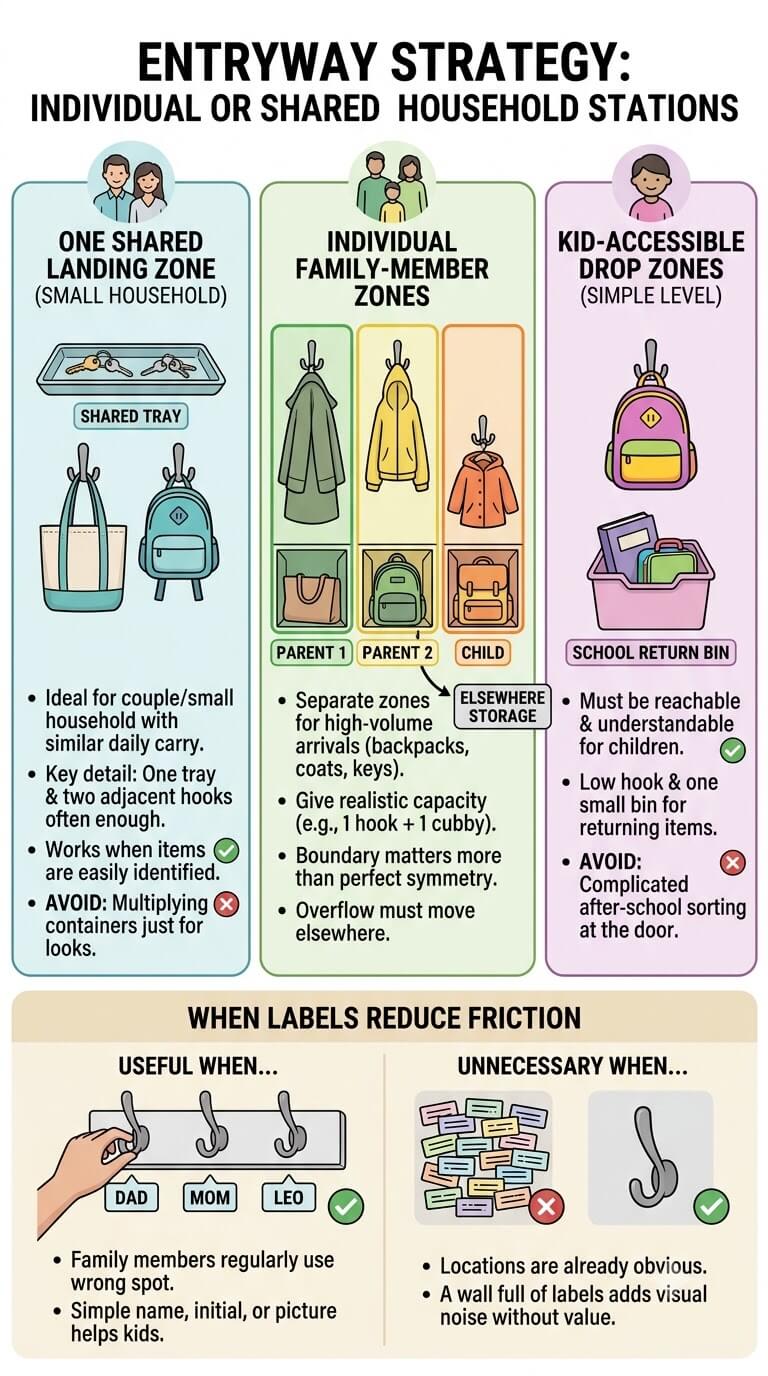
The number of stations depends on who uses the entrance and how much their daily carry overlaps. Personal zones help only when they reduce confusion.
One Shared Landing Zone for a Small Household
One tray for two sets of keys and two adjacent bag hooks may be enough for a couple or small household. Shared storage works when people carry similar amounts and can identify their items quickly. Avoid multiplying containers simply to make the area look more organized.
Individual Family-Member Zones
Separate zones help when several backpacks, coats, and sets of keys arrive at once. Give each person a realistic amount of capacity, such as one hook and one cubby. The boundary matters more than perfect symmetry. When one person’s area overflows, the excess needs to move elsewhere.
Kid-Accessible Drop Zones at a Simple Level
Children need storage they can reach and understand. A low backpack hook and one small bin for items returning to school may be enough; avoid complicated after-school sorting at the door.
When Labels Reduce Friction
Labels are useful when family members regularly use the wrong hook or cubby. They are unnecessary when locations are already obvious. A name, initial, or simple picture can help children, but a wall full of labels can add visual noise without improving the routine.
Decide Where Keys and Valuables Belong
Choose a key location that balances convenience with visibility, based on who uses and passes through the entrance.
Convenience Versus Visibility and Household Context
A key hook directly beside a glass door may be convenient but too exposed for some homes. A small drawer, concealed tray, or location slightly farther inside may be a better compromise. The right choice depends on the household rather than a universal rule.
Permanent Key Home at Overview Level
Whatever location you choose, make it consistent. Keys should not alternate between pockets, purses, kitchen counters, and entry tables. A reliable home reduces the number of places you need to check before leaving.
Why Valuables Should Not Default to an Exposed Catch-All
Do not let the tray become the automatic home for cash, personal documents, spare keys, or expensive electronics just because it is convenient. Store valuable or sensitive items according to your household’s privacy and security needs.
Handle Mail Without Turning the Drop Zone Into Paper Storage
Mail should move through the entrance, not settle there. Keep the intake point small enough that new paper cannot hide older action items.
Intake Only
Use one slot, tray, or holder for newly arrived paper. Do not create separate entryway files for every category. The intake point should be small enough that you notice when it needs attention.
Immediate Junk or Recycle Decision
Discard obvious unwanted paper as soon as practical, following local recycling rules and handling sensitive information appropriately. Removing low-value paper at the door keeps it from migrating to kitchen counters or desks.
Route Action Papers and Filing Elsewhere
Anything that requires payment, a response, filing, or long-term retention should leave the entrance. The next destination may be an office, desk, or household paperwork area. The important point is that the landing zone does not become the final home.
Capacity Limit for the Temporary Paper Holder
Set a physical limit, such as one shallow holder. If it is full, process it before adding another container. A larger basket usually postpones the decision rather than improving the flow.
Park Bags Without Creating a Floor Pile
Park bags where they are easy to grab but cannot spill straps or bulky shapes into the walking route.
Hook, Cubby, or Shelf Parking
Hooks keep lightweight bags visible and off the floor. Cubbies contain backpacks without asking users to hang them. Shelves can work for structured purses or work bags. Choose based on the weight, shape, and routine rather than making every bag use the same method.
Heavy-Bag Load Awareness
A laptop bag or fully loaded backpack can weigh much more than an empty tote. Follow the rated load and installation instructions for hooks, rails, shelving, and wall anchors. If the bag is too heavy for the available mounting method, give it a stable shelf or floor-level cubby instead.
Keep Straps Out of Walkways
Long shoulder straps and backpack straps can extend beyond the storage footprint. Tuck them into the cubby or over the bag so they do not trail across a path. If a bag cannot fit without spilling into the route, the storage is too small or the location is wrong.
Empty Loose Trash and Papers Before Reset
A quick bag check keeps the landing area from becoming the final destination for wrappers, receipts, school notices, and random objects. Remove what does not need to travel again, then repack only what belongs in the bag for the next departure.
Add Shoes and Outerwear Only at Overview Level
Shoes and jackets can support the routine, but keep only the active rotation near the door and move excess elsewhere.
Why the Drop Zone Should Not Absorb the Full Shoe Collection
A few everyday pairs may support the arrival routine. An entire footwear collection does not. When shoes begin spreading beyond a tray or rack, move less-used pairs to a closet or other storage area instead of expanding the landing zone indefinitely.
When a Nearby Coat Hook Supports the Flow
One active jacket per person can make departures easier, especially in cool or wet weather. Wet outerwear should be allowed to dry appropriately before it is shut into poorly ventilated storage. Bulky seasonal coats may need a dedicated coat area rather than sharing bag hooks.
When Dedicated Category Zones Are Needed Instead
If shoe piles, overloaded coat hooks, or several backpacks dominate the area, the problem is no longer just a landing routine. Give that category its own capacity rules and storage so the small-item workflow can remain simple.
Limited-Capacity Rules That Prevent Catch-All Creep

Keep capacity small enough to clear easily. Storage should reflect what the household can reset, not how much clutter it can hide.
One Container, One Purpose
Assign each tray, basket, hook, or cubby a single understandable job. When a container has several unrelated purposes, people stop knowing what belongs there and start using it as a convenient dumping place.
No Unlimited Miscellaneous Baskets
A large unlabeled basket can make a room look cleaner for a day while creating a harder sorting job later. If you need a temporary basket, define exactly what it holds and when it gets emptied.
Define What Must Leave by Bedtime or Weekend
Choose a realistic clearing point. Items going upstairs might leave each evening. Returns may be reviewed on the weekend. The schedule does not need to be strict, but every temporary category should have a moment when it stops being allowed to wait.
What to Do When the Zone Fills Early
Do not solve early overflow by buying another organizer immediately. Empty the area and identify what filled it. If the same necessary category keeps overflowing, increase that category’s storage slightly or reduce what is allowed to stay. If random items caused the problem, improve the routing rule instead.
Daily and Weekend Reset Workflow
A reset simply returns the area to the condition needed for the next arrival and departure.
Two-Minute End-of-Day Clear
Return keys, hang or park active bags, remove shoes that exceed the daily rotation, and clear anything sitting loose on the surface. A short reset is easier to repeat when there are only a few destinations.
Move Upstairs or Elsewhere Items
Carry temporary items to their actual rooms during an existing trip through the house. The goal is to prevent the entrance from becoming the permanent waiting room for things that belong elsewhere.
Empty Temporary Holding
Check the return basket, outgoing area, and paper intake point. Move anything whose next action is already known. If you keep postponing the same object, decide whether it truly needs to remain in the household.
Weekend Audit for Stale Objects
Once a week, look for stale objects such as old receipts, empty totes, forgotten returns, or unworn jackets. Utah State University Extension’s family routine guidance favors predictable, consistent routines over waiting for a large cleanup.
Drop-Zone Failure Patterns and Fixes
Repeated failure usually points to friction between the setup and the way people actually move through the entrance.
Too Many Categories
If the area stores shoes, every coat, sports equipment, school supplies, paperwork, pet supplies, charging equipment, and household backstock, reduce its job. Keep only what directly supports arrivals and departures.
Storage Located Off the Natural Path
A beautiful station will be ignored if people naturally enter through another door or have to walk past the place where they already drop their things. Move the storage closer to the actual path whenever possible.
Containers Larger Than the Behavior They Support
Oversized baskets create permission to postpone decisions. Replace them with smaller containers that match one or two days of temporary holding, or eliminate the container if the item already has another home.
No Outgoing Area
If items need to leave the house but have no designated place, they often sit on the floor or get forgotten. Use one small spot away from the door swing for returns, donations, or items that need to go to the car.
No Rule for Temporary Items
A holding area without a clearing rule becomes storage. Decide what happens to each temporary category and when. If nobody can state the next destination, the category needs a clearer decision.
Decision Tree: Stay, Move, or Leave the Zone

Use a short decision process so capacity stays tied to daily function rather than convenience alone.
Does This Item Cross the Door Daily?
If yes, it may deserve a convenient home near the entrance. If it crosses the door only a few times a month, store it elsewhere unless there is a strong practical reason to keep it close.
Does It Need a Permanent Home Here?
Items such as keys may. A receipt, package, or object headed to another room usually does not. Permanent homes should be reserved for the small set of objects that repeatedly support the same routine.
Is It Waiting for Another Action?
If yes, identify that action in plain language: return to store, take upstairs, give to a neighbor, put in the car. Then give it the smallest temporary space that safely holds it until that action happens.
Where Overflow Should Go
Overflow should move to the place that owns the category: extra shoes to footwear storage, extra coats to a closet, infrequently used bags to longer-term storage, and paperwork to its processing area. Do not let the entryway become the default destination for everything without a decision.
Keep Furniture and Mounted Storage Stable
Check safety whenever the setup uses tall furniture, wall storage, or heavy loads. Never sacrifice a clear exit or walking path for added capacity.
Check Stability Before Adding More Capacity
Freestanding furniture should be stable on the floor and appropriate for the household. The U.S. Consumer Product Safety Commission’s Anchor It guidance recommends following manufacturer instructions and securing top-heavy furniture where appropriate, particularly in homes with children.
Match the Mounting Method to the Wall and Load
Use hardware intended for the wall type and the expected weight. Stop if the mounting surface is damaged, the hardware loosens, or the storage shifts during normal use. Renters should check lease requirements before drilling and use removable systems only within their stated limits.
FAQ About Entryway Drop Zones
These answers cover common decisions after the basic landing flow is working.
What Should Be in an Entryway Drop Zone?
Keep a small set of frequently carried items there: keys, one or two active bags, sunglasses or another daily accessory, a limited mail intake point, and a small area for outgoing items. Add shoes or outerwear only if the space can handle them without becoming crowded.
Can a Drop Zone Work Without a Table?
Yes. A wall-mounted key holder, a few appropriate hooks, and a narrow shelf or small basket can create the same workflow. In a very tight entrance, vertical storage may work better than adding furniture to the floor.
How Do You Make a Drop Zone for Kids?
Keep it low, simple, and limited. One reachable backpack hook or cubby plus one small place for items that need to leave again is often enough. The setup should be easy for a child to use without sorting through complicated categories.
How Do You Stop a Drop Zone From Becoming Cluttered?
Limit each container to one purpose, give temporary items a clearing time, and do a short daily reset. When the space repeatedly fills, remove items that do not support the arrival or departure routine before adding more storage.
Where Should Outgoing Returns Go?
Use one small, bounded location that is visible enough to remember but does not block the door or walking path. If returns are bulky, keep them in another safe area and use a smaller reminder item near the exit instead.
Final Thoughts
A useful entryway drop zone reduces decisions at the door. Give daily items permanent homes, temporary items clear next actions, and the walking path priority. If the area keeps overflowing, reduce the inventory or move whole categories to storage better suited to them instead of expanding the catch-all area.

Ethan Carter is the Founder & Editor of HomeCleanSecrets. Based in the United States, he has 5 years of experience creating practical home cleaning, laundry care, stain removal, decluttering, and home organization content. His goal is to help everyday households clean smarter and build simple routines that are easier to maintain.
Read more about Ethan Carter on his author page: https://homecleansecrets.com/ethan-carter/