
Keys and incoming mail create clutter for different reasons. Keys are small, mobile, and needed again quickly. Mail arrives as a stream of paper that needs a decision before it can move on. A practical entry setup gives keys one permanent home and gives mail one short intake path, without turning the area by the door into a filing cabinet.
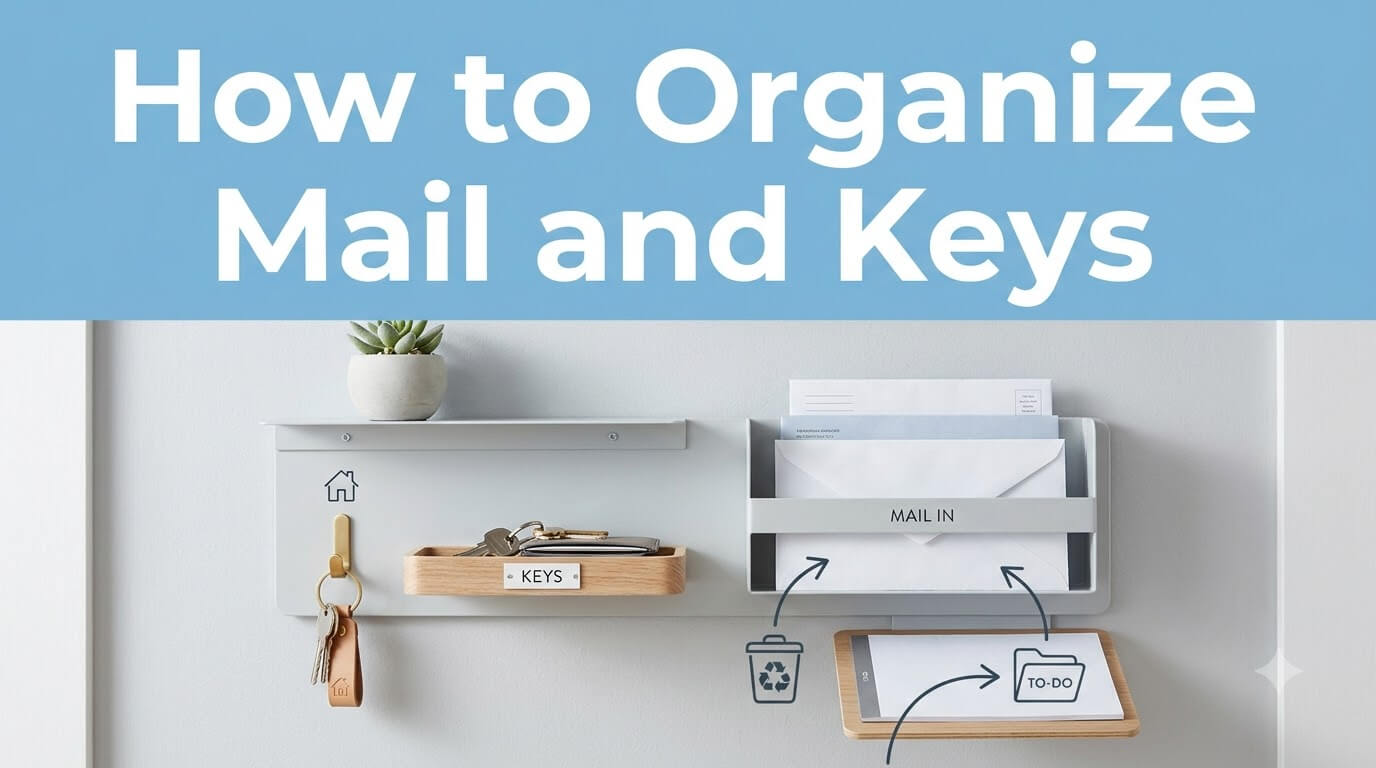
Use a short sequence: return keys, gather new mail, remove obvious junk, move action items to the place where the task happens, and send papers worth keeping to their long-term home.
Quick Answer: Give Keys One Permanent Home and Mail One Short Intake Path
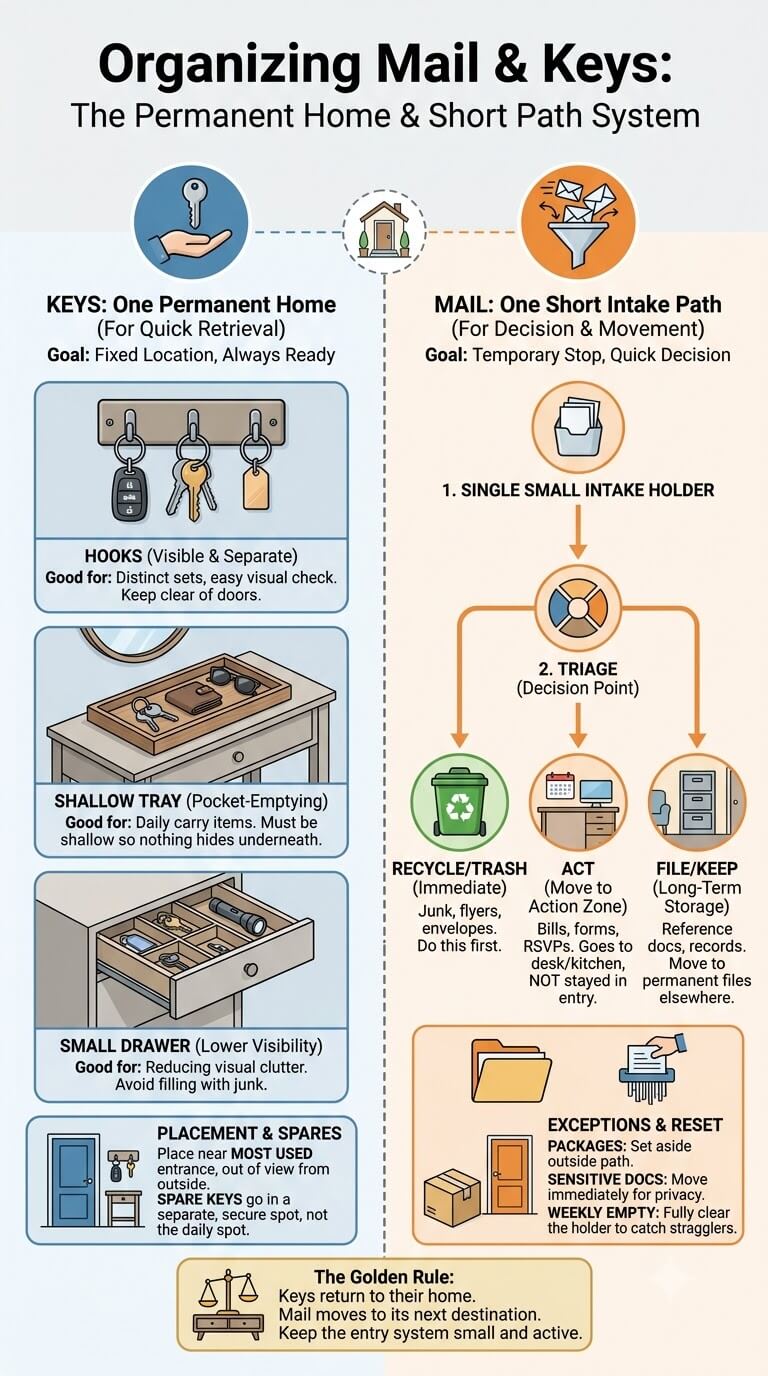
Keep everyday keys in one predictable place near the entrance you use, and keep new mail in one small intake holder that is emptied regularly.
Key retrieval versus paper routing
Keys need a permanent return point because the next task is retrieval. Mail needs movement because the next task is a decision. Treating both categories as things that can simply “sit by the door” is what creates lost keys and growing paper piles. One category stays; the other passes through.
Why both systems must stay intentionally small
A large key bowl invites unrelated pocket contents. A deep mail basket hides old paper under new paper. Choose capacity for normal daily use, not for several weeks of neglect. If the container is routinely full, fix the return or triage habit instead of immediately increasing storage.
Set Up a Permanent Home for Everyday Keys

Collect the key sets currently scattered through pockets, bags, counters, and cars. Separate everyday keys from backups before choosing their permanent return point. If keys and paper are only two of several categories crowding the entrance, fix the overall entryway and mudroom system before expanding this micro-zone.
Individual key sets
Give each regular driver or adult user a distinct place when several similar sets are in circulation. Separate hooks, labeled sections of a tray, or consistent positions in a shallow drawer reduce mix-ups. Keep the label on the storage location rather than adding bulky tags to every key ring unless identification is genuinely helpful.
Shared household keys
Keys for a shared vehicle, mailbox, shed, or other commonly accessed area need a clearly understood home. Store them where authorized household members can find them without asking who used them last. If a shared key must leave the entry for a task, return it as soon as the task is finished.
Spare-key boundaries
Do not mix every spare with the everyday set. Backup keys that are rarely needed can live in a more secure, deliberate location appropriate to the household. The entry station should contain only the keys that benefit from frequent retrieval. Avoid leaving clearly labeled spare keys in an obvious location visible or reachable from outside.
Keep keys out of random bags and pockets
If keys disappear inside a work bag or coat pocket, the storage location is probably competing with an easier habit. Put the key home close to the point where people naturally empty their hands. A good test is whether someone can return the keys while carrying groceries or a backpack without detouring through another room.
Choose a Key Hook, Tray, or Drawer
Match the holder to the habit: hooks separate sets, trays suit pocket-emptying, and drawers reduce visibility. The best choice is the one people will use without extra steps.
Hook for visible quick return
A hook separates key sets and makes a missing set easy to notice. Keep rings clear of doors and walkways. For mounted products, check the surface, preparation steps, and rated load. Command publishes product weight limits for its hooks and key rails, so use the instructions for the exact hardware you install.
Tray for pocket-emptying households
A shallow tray works well for keys plus one or two small daily items, such as a wallet or sunglasses. Keep it intentionally shallow so old receipts, coins, batteries, and miscellaneous objects cannot disappear beneath the keys. When unrelated items begin collecting there, remove them during the daily reset.
Drawer for lower visibility
A small entry drawer can keep keys out of direct view and reduce surface clutter. Use a simple divider if several key sets slide together. Avoid filling the drawer with tools, cords, coupons, and household odds and ends. The drawer should open freely and reveal the keys immediately.
Balance convenience with household security context
Convenience should not mean placing keys where they are easily seen or reached from outside. Consider windows, sidelights, visitors, shared building access, and who regularly enters the home. The right location is easy for household members but not unnecessarily exposed. Security needs vary, so avoid one universal placement rule.
Decide Where the Key Home Should Sit
Watch where keys naturally land, then put their permanent home close to that point without sacrificing walking clearance or reasonable privacy.
Near the frequently used entrance
Use the entrance that drives the daily routine, not automatically the formal front door. In some homes that is a garage entry, side door, apartment door, or mudroom entrance. The storage should support the route people use most often so returning keys becomes the easiest action.
Out of the walking path
Do not place a freestanding basket, narrow pedestal, or protruding wall organizer where people brush against it. Key storage needs only a small footprint. Keep the floor clear and make sure bags, hanging lanyards, and long key chains do not extend into the normal path.
Not automatically in public view
Open hooks can be practical, but they are not right for every household. If the entry is visible through glass, shared with building traffic, or frequently used by service providers and visitors, a drawer or less exposed location may make more sense. Keep convenience and reasonable privacy in balance.
Small-entryway placement constraints
In a narrow entrance, favor flat or shallow storage. A small wall hook, slim magnetic-safe organizer designed for the intended surface, or existing drawer can work better than adding furniture. Renters should follow lease requirements and product instructions before drilling, anchoring, or using adhesive systems.
Create a Single Mail Intake Point
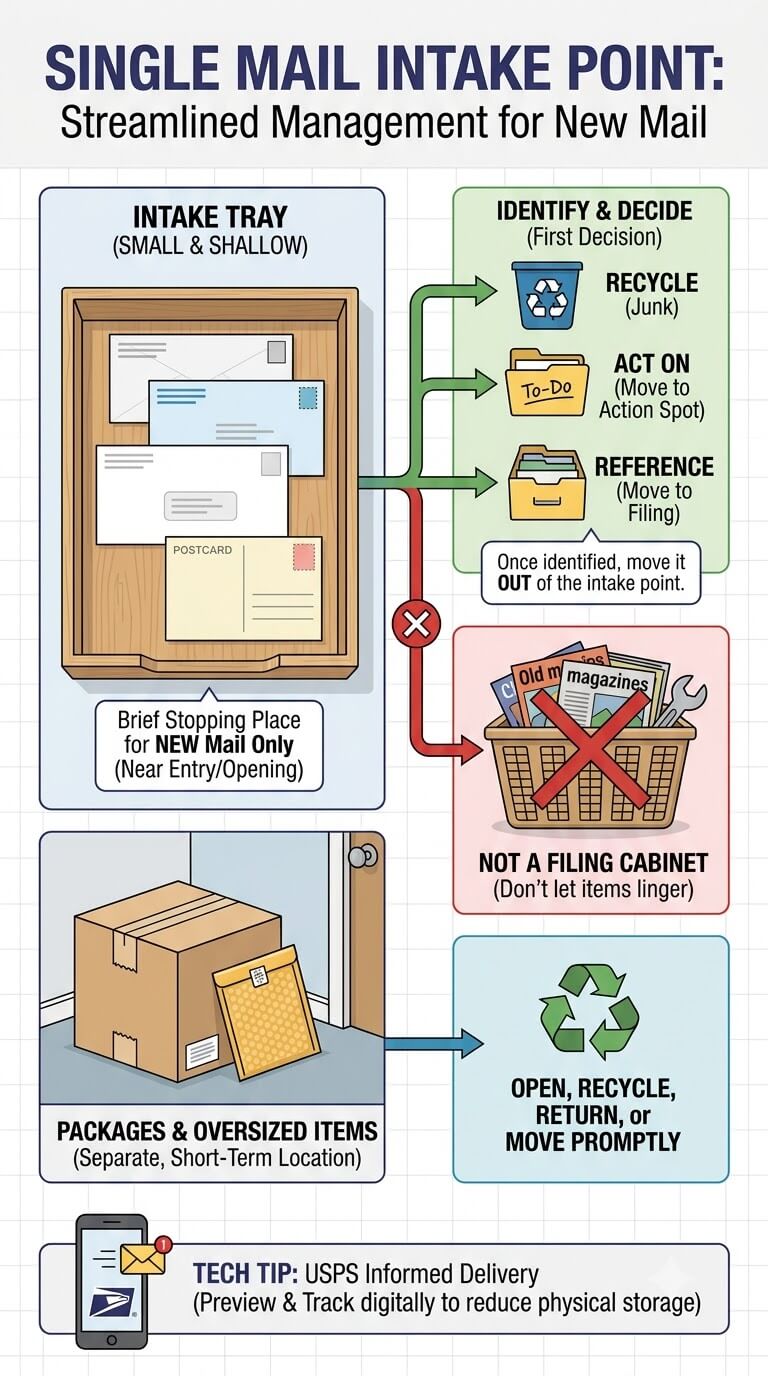
Give new mail one brief stopping place near where it enters or is normally opened. Keep the holder small enough that backlog becomes obvious.
One tray, slot, or small holder
Choose one shallow tray, vertical slot, wall pocket, or narrow holder for new mail. The container should allow a quick visual check of what is waiting. If papers can sink under magazines, catalogs, coupons, and household objects, the intake point is too deep or doing too many jobs.
Keep packages and oversized items separate
Boxes and large envelopes can overwhelm a paper holder. Give them a short-term location outside the door path, then open, recycle, return, or move them promptly. Eligible USPS customers can use Informed Delivery to preview incoming letter-size mail and track packages without increasing physical storage.
Do not let the intake point become a filing cabinet
Nothing should stay in the entry simply because you do not know where else to put it. The intake point is for newly arrived paper awaiting a first decision. Once a paper is identified as something to act on, keep, or reference later, it should move to the location where that next step can actually happen.
Use a Three-Way Mail Triage
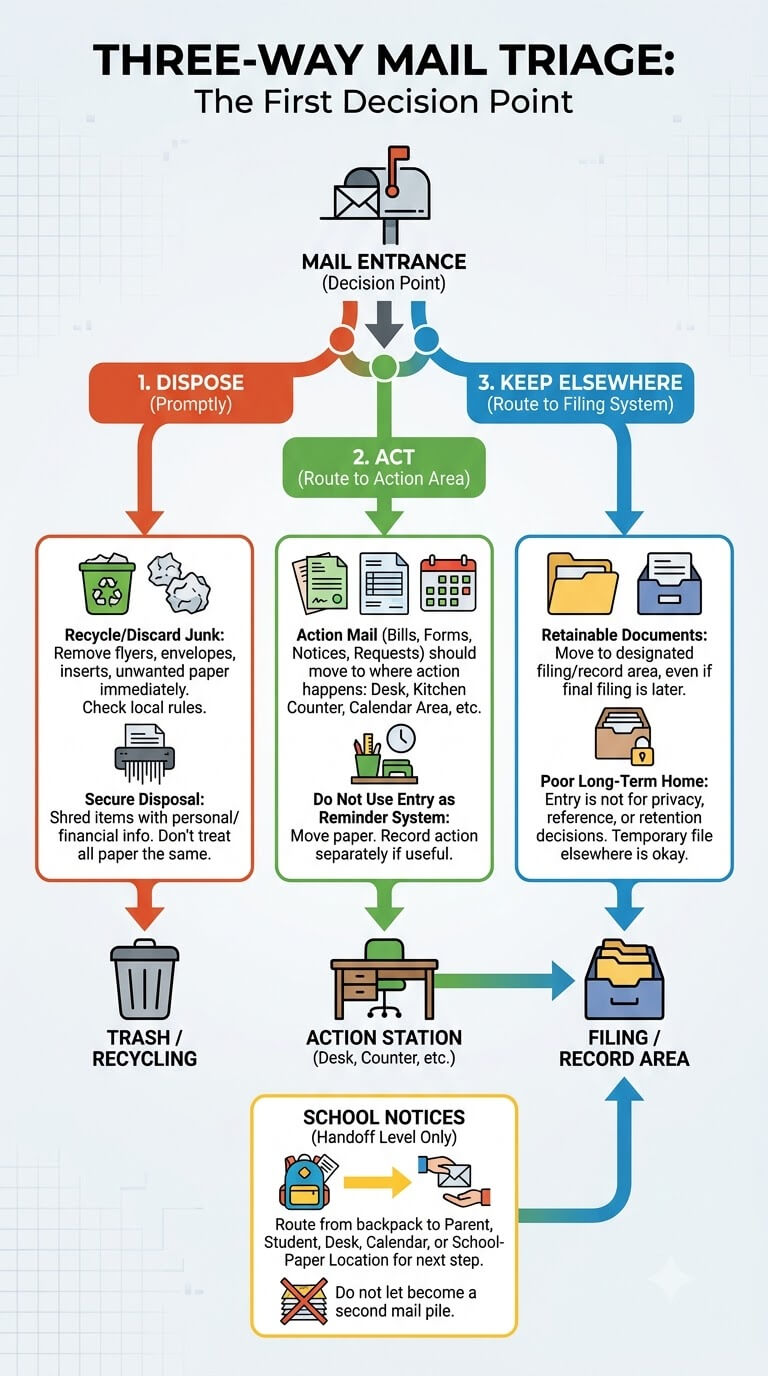
Give each new piece of mail one of three destinations: dispose, act, or keep elsewhere. The entrance is only the first decision point.
Recycle or discard obvious junk promptly
Remove flyers, envelopes, inserts, and other unwanted paper as soon as you are confident they are not needed. Check local recycling rules because accepted materials vary. If an item contains personal or financial information, use disposal methods appropriate to the information rather than treating every piece of paper the same.
Route action mail to the place where action happens
A bill, form, appointment notice, return label, or response request should move to the desk, kitchen counter, calendar area, or other location where the household handles that task. The entry station should not become a reminder system for every unfinished obligation. Move the paper and, if useful, record the action separately.
Route filing papers to the downstream paperwork system
Documents worth retaining should leave the doorway after triage. Put them in the household’s designated filing or record area, even if the final filing happens later. A small temporary file elsewhere can be reasonable, but the front entry is a poor long-term home for records that need privacy, reference, or retention decisions.
Handle school notices at handoff level only
School paper can enter through backpacks rather than the mailbox. At the entrance, the task is simply to remove it and route it to the parent, student, desk, calendar, or school-paper location that handles the next step. Do not let permission slips and newsletters become a second mail pile.
Set a Hard Capacity for Incoming Paper

Use a physical limit that fits normal mail between sorting sessions. Overflow should trigger a reset, not an automatic move to a larger basket.
One inbox or small action holder
Use a single intake holder for new mail and, if needed, one small action holder somewhere appropriate for short-term tasks. Avoid separate bins for every family member, sender, paper type, or imagined future category at the entrance. More containers create more places for forgotten paper.
Daily or near-daily triage
Sort mail often enough that new envelopes do not cover older decisions. Daily may suit a high-volume household; several times a week may be enough for others. A quick regular sort is easier than recovering from a packed basket.
Weekly emptying rule
Once a week, empty the intake point completely. Return misplaced objects, move action papers onward, dispose of unwanted material, and check the bottom of the holder. This prevents a neat-looking container from hiding expired notices, missed forms, and envelopes that were never opened.
What to do when the holder fills too quickly
Do not automatically increase capacity. First check whether catalogs, coupons, old newspapers, packages, or papers from bags are being stored there. Then check whether action mail has a real destination. If the container fills before the next planned triage, shorten the sorting interval or reduce what is allowed to enter.
Protect Privacy Without Turning the Entry Into Document Storage
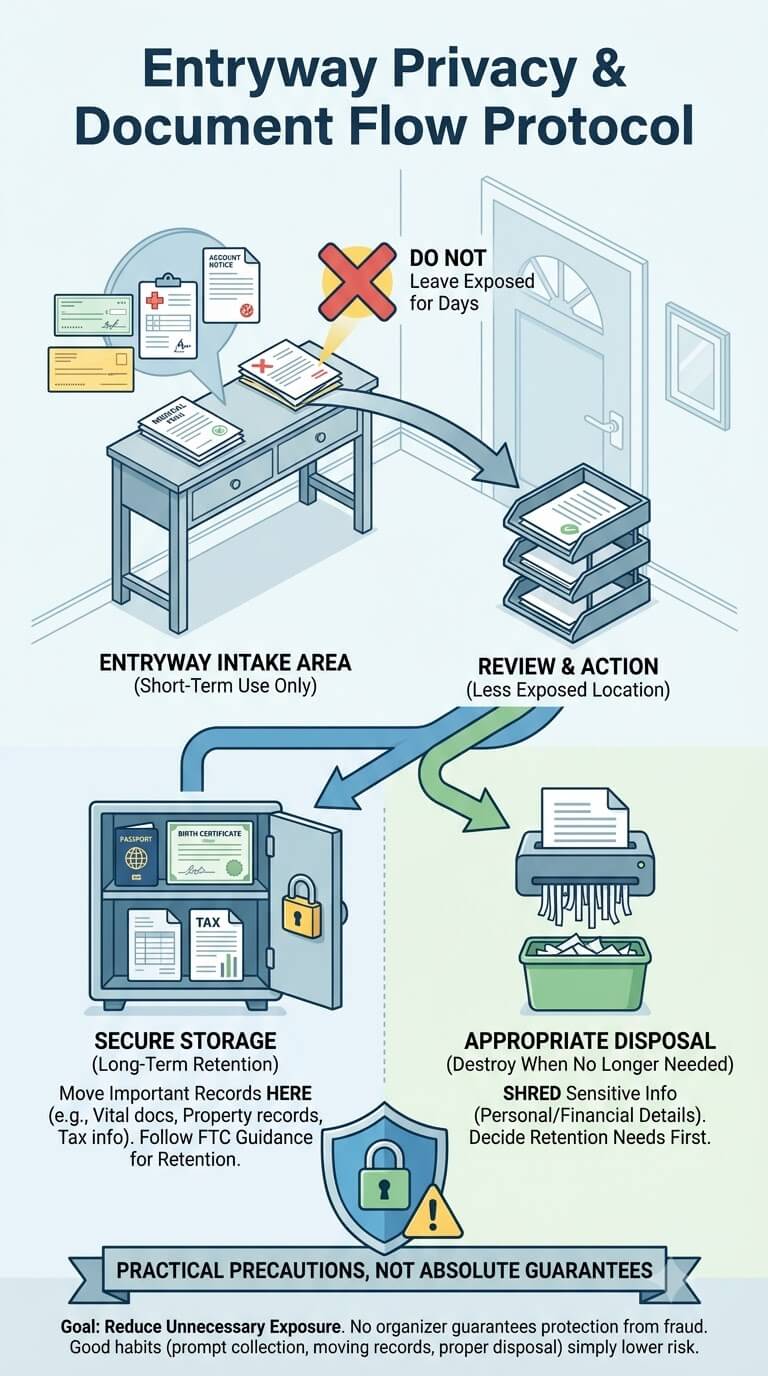
Use the entrance for short-term intake, not indefinite storage of personal or financial records. Sensitive paper should move promptly to a more appropriate location.
Keep sensitive papers from remaining exposed
Do not leave statements, checks, account notices, medical correspondence, or other personal documents face-up on an entry table for days. If immediate processing is not possible, place them in a less exposed action location and finish the routing soon. The goal is reasonable handling, not a promise of perfect security.
Move important documents away from the front door
Birth certificates, passports, tax papers, property records, and similar documents do not belong in an entry organizer. FTC guidance distinguishes papers to retain from those that can be destroyed and recommends securing important records. Review its guidance on keeping and shredding sensitive documents before deciding what leaves the intake area.
Follow appropriate disposal guidance for sensitive information
Paper containing personal or financial details may require more careful disposal than ordinary junk. Shredding can be appropriate once a document is no longer needed, but retention needs vary. Decide whether a record must be kept before destroying it.
Avoid making identity-theft guarantees
No entry organizer can guarantee protection from fraud or identity theft. Good habits simply reduce unnecessary exposure: collect mail promptly, keep sensitive documents from lingering in public view, move records to secure storage, and dispose of unneeded personal information appropriately. Treat these as practical precautions, not absolute protection.
Coordinate Mail and Keys With the Entryway Drop Zone
A broader landing area can hold other daily items, but keys and mail still need different behavior: keys stay in one home while paper keeps moving. If bags, wallets, sunglasses, returns, and other daily carry are landing here too, a broader entryway drop zone can handle those items while the key-and-mail system stays small.
Broad landing workflow versus dedicated micro-zones
A general landing surface can receive several items at once, but give keys and mail their own defined footprints. A small key hook beside a narrow paper slot is often enough. The separation prevents envelopes from covering keys and keeps coins, receipts, and accessories from disappearing into the paper holder.
Keep keys permanent rather than temporarily buried
Keys should not be treated as another object waiting to be sorted. Return them directly to their assigned home every time. If keys keep ending up under mail, inside bags, or in a catch-all bowl, move the holder closer or simplify it until direct return is easier than temporary placement.
Keep mail moving instead of expanding the paper container
When paper piles up, adding a larger basket usually delays the same decision. Check whether the household lacks a place for action papers or saved documents. Fix the next destination so the intake area can stay small. A mail station succeeds by emptying, not by holding more.
Handle Papers That Come Out of Bags
Backpacks, purses, and work bags bring in receipts, forms, and notices too. Route those papers during unpacking instead of adding them to a second pile.
School notices and permission slips at handoff level
Remove time-sensitive school forms when the backpack is unpacked. Send them to the adult, student workspace, calendar area, or other place where the required action will happen. After completion, the form either returns to the bag for school or moves to its proper record location if it needs to be kept.
Receipts and work papers leave the entrance
Receipts, expense records, meeting papers, and work documents should go to the place associated with their next use. Avoid adding them to the household mail holder simply because they are paper. The entry should sort by next action, not by material type alone.
Empty loose paper during the bag reset
During the normal unpacking routine, scan the main pockets for loose paper and route it immediately. This keeps a backpack or purse from becoming hidden paper storage. If a bag regularly produces many papers, place the correct destination close enough that handoff takes only a few seconds.
Do not create a second filing pile
A stack beside the mail tray is still an intake backlog. If paper from bags needs a different destination, send it there directly. When the household cannot decide where a paper belongs, create that decision outside the entry area rather than leaving an undefined pile near the door.
Small-Household and Family Setups
Add only enough separation to prevent mix-ups. More people may need more key positions, but they do not automatically need a larger mail station.
One shared key and mail station
In a one- or two-person home, a compact tray plus one mail slot may be enough. Keep key sets visually distinct and maintain a single paper intake. The setup should take very little surface area so the rest of the entry remains available for movement and other daily essentials.
Individual key zones with shared paper intake
Families often benefit from separate key hooks or drawer sections while continuing to use one shared mail intake. Mail is usually addressed to the household or individual recipients but still needs the same first-stage decisions. Separate paper bins by person only if the shared intake creates consistent routing mistakes.
Family labeling only where necessary
Use names, initials, or simple symbols when similar key sets are confusing. Avoid labeling every pocket and tray if people already know what belongs there. Too many labels can make a small entry feel complicated and do not compensate for excess items or an inconvenient location.
Spare-key rules and household context
Decide who needs access to backup keys and where those backups should live. Consider children, roommates, caregivers, visitors, building access, and household privacy. Everyday convenience does not require every spare to sit beside the front door. Keep the daily station focused on keys that genuinely circulate.
Common Mail-and-Key Organization Mistakes
Most failures come from too many storage spots, excessive capacity, or inconvenient placement. Fix that friction before adding another organizer.
Multiple key homes
A bowl in the kitchen, hook by the door, dish on a dresser, and pocket in a work bag create four places to search. Choose one everyday location. Temporary exceptions should be rare and obvious, such as a key remaining with a vehicle during service.
Hiding keys somewhere too inconvenient to use
Privacy matters, but a location that requires opening several doors or walking across the house may fail in daily use. Find a position that is less exposed without becoming burdensome. If people ignore it for a week, adjust the location rather than blaming the habit.
Oversized mail baskets
A large basket makes paper clutter look contained while allowing weeks of decisions to accumulate. Use a smaller holder that forces regular emptying. If magazines or catalogs dominate the space, remove them from the intake routine quickly instead of letting them bury letters that need attention.
Leaving sensitive documents at the entrance
Important records should not wait near the door simply because they arrived there. Move sensitive material to the location where it will be acted on or secured. This reduces casual exposure and keeps the mail station focused on new arrivals rather than archival storage.
Mixing permanent files with intake papers
The moment you decide a paper is worth keeping, it has completed the entry-stage job. Move it to the household record area. Mixing saved documents with fresh mail forces you to re-evaluate old papers every time new envelopes arrive and makes missed action items harder to spot.
Daily and Weekly Reset
Daily actions keep keys and fresh mail contained; a short weekly reset catches anything that escaped the first pass.
Return keys immediately
When you enter, place keys in their permanent home before setting down other small items when practical. If your hands are full, unload safely and return the keys as soon as the immediate task is finished. The important part is preventing an undefined temporary location from becoming the new habit.
Triage incoming mail
Review mail on the chosen schedule, remove obvious unwanted paper, and route what needs action or retention. Good Housekeeping reports that professional organizers often make easy entryway discard decisions promptly in its entryway decluttering advice.
Clear the action holder
If you use a small action holder, review it at least weekly. Complete the task, schedule it elsewhere, or move the paper to the correct location. Do not let the action holder become a second long-term stack with a more organized appearance.
Move papers to their real destination
Finish the reset by moving saved documents, school forms, receipts, work papers, and other items out of the entrance. When the destination repeatedly feels inconvenient, improve that destination rather than expanding the mail station. The entry works best when paper leaves it quickly.
FAQ About Organizing Mail and Keys
These answers cover the placement, capacity, privacy, and timing decisions that most often determine whether the setup stays useful.
Where is the best place to keep everyday keys
Keep them near the entrance you use most often, in a location that is quick to reach but not unnecessarily exposed to outside view or casual access. A hook, shallow tray, or small drawer can all work. Choose the one household members will actually use every time.
Should spare keys be kept near the front door
Not automatically. Rarely used backup keys often deserve a more deliberate location than everyday keys, especially if the entry is visible or accessible to visitors. Decide based on who needs access and the household setting. Avoid obvious, publicly visible placement for clearly labeled spares.
How long should mail stay in an entryway organizer
Only long enough to receive a first decision. Aim to sort it daily or several times a week, then empty the intake holder completely at least weekly. Action papers and documents worth keeping should move to their next location rather than remaining at the door.
How do you stop mail from piling up
Use one small intake point, remove obvious unwanted paper promptly, and give action papers and saved documents real destinations elsewhere. If the holder keeps filling, shorten the sorting interval before buying a larger container. Capacity should reveal backlog, not hide it.
What papers should leave the entryway immediately
Move sensitive records, important documents, time-critical forms, work papers, receipts needed for another process, and anything requiring focused action to the appropriate location as soon as practical. The entry can receive paper, but it should not become the permanent home for records or unfinished administrative work.
Final Thoughts
A useful mail-and-key station stays small: keys return to one home, new mail gets one short intake path, and every paper has a next destination.
If the entry keeps filling up, do not start with another basket. Check whether keys are returning to one place, whether mail is being triaged often enough, and whether every paper category has a real next destination. A small system that moves items consistently will outperform a large system that only contains delay.

Ethan Carter is the Founder & Editor of HomeCleanSecrets. Based in the United States, he has 5 years of experience creating practical home cleaning, laundry care, stain removal, decluttering, and home organization content. His goal is to help everyday households clean smarter and build simple routines that are easier to maintain.
Read more about Ethan Carter on his author page: https://homecleansecrets.com/ethan-carter/