
A small playroom works best when usable floor space is planned before storage. The goal is not to fit every toy, book, and craft supply inside, but to keep a manageable active collection close to where children use it while preserving clear movement and a simple reset.
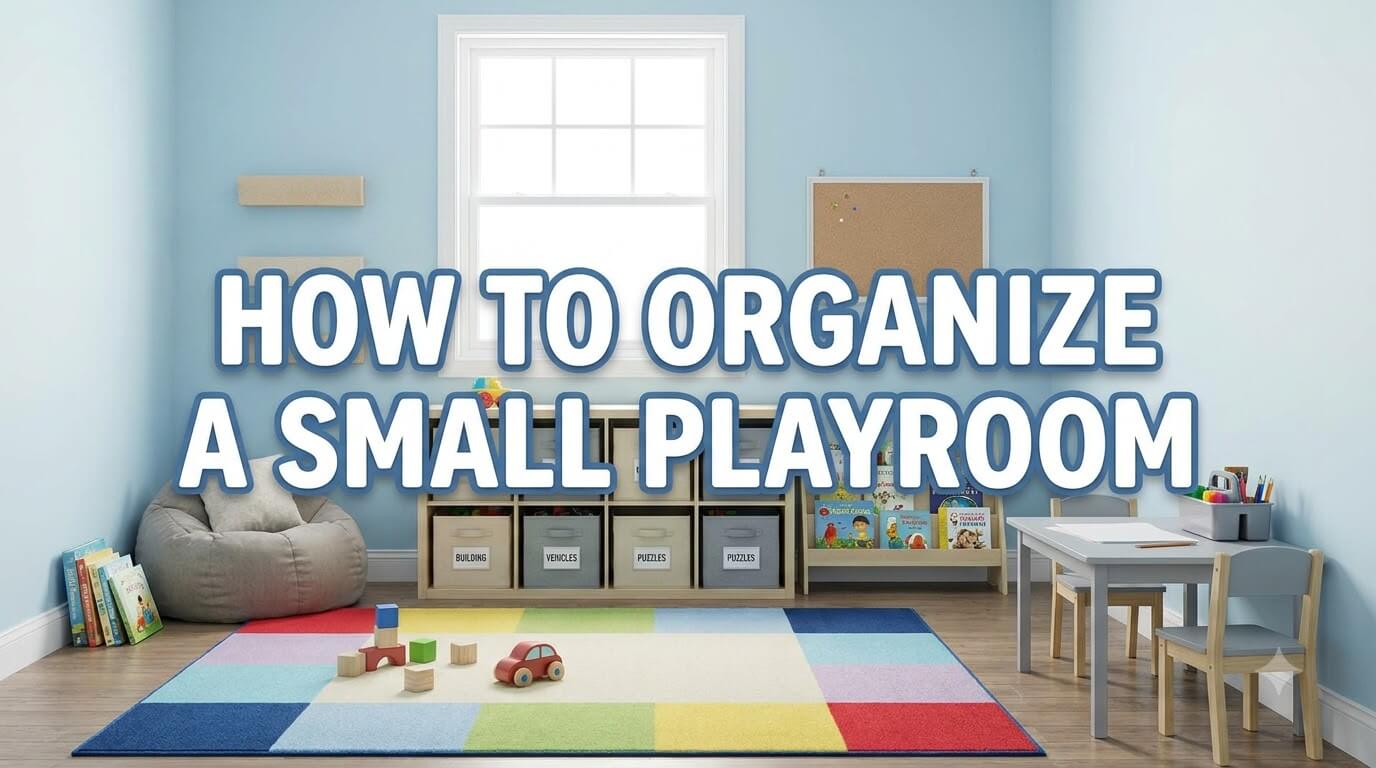
Start with doors, windows, vents, walking paths, and the floor area children need. Then assign a few zones with clear capacity limits. When the room is full, reduce, relocate, or rotate inventory instead of covering another wall with furniture.
Quick Answer: Plan the Floor First, Then Add Storage
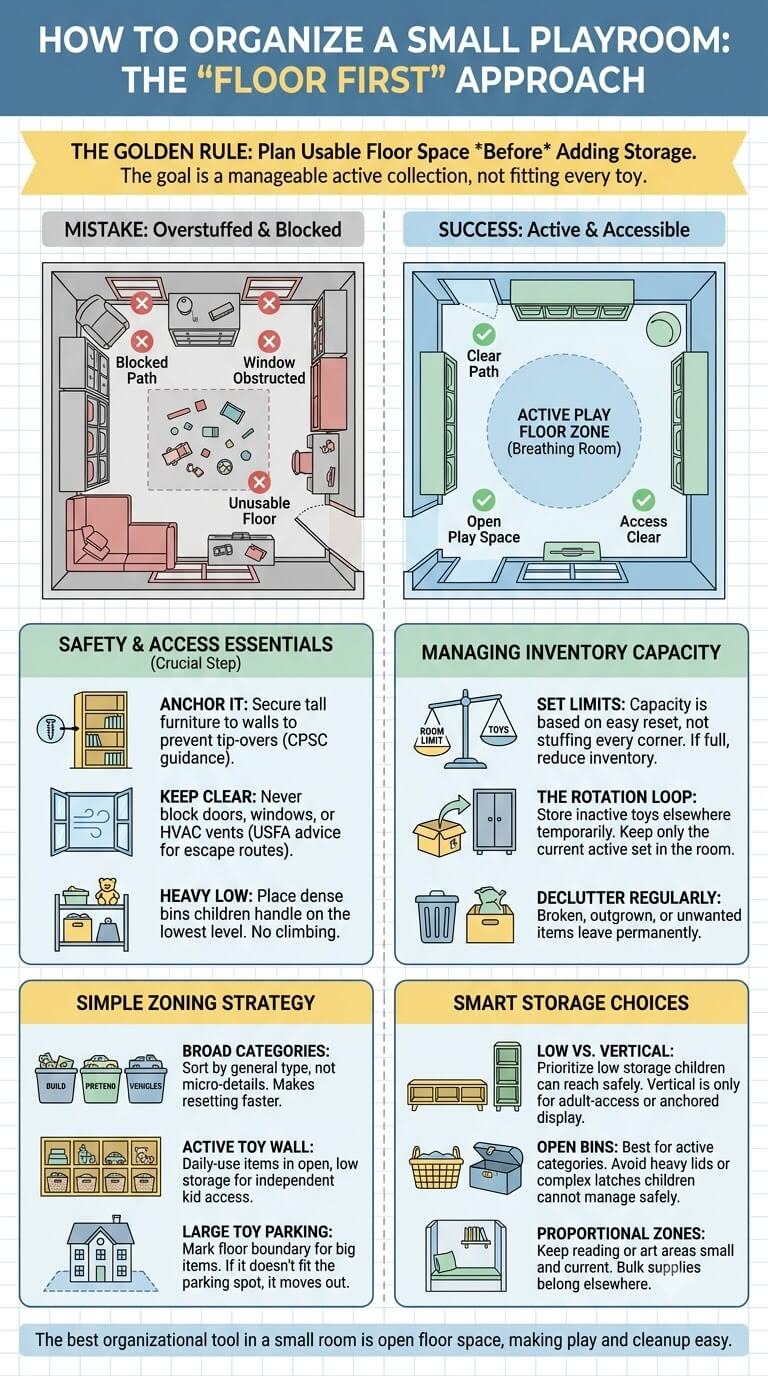
A compact playroom needs empty space as much as it needs containers. Protect the floor and movement route first, then decide which activities deserve permanent space.
The capacity-first layout rule
Set a limit based on what the room can hold and still function. A shelf is not useful if it narrows the only play area or blocks normal movement. A good test is to place the largest daily-use toys on the floor, open the main bins, and check whether people can still move comfortably.
Keep Room Planning Separate From Detailed Category Sorting
The main decisions here are where storage belongs, how much floor stays open, and which activities get a zone. Detailed toy sorting, book systems, art supplies, and rotation inventory can be handled separately so the room plan stays focused on space.
Measure the Usable Room, Not Just the Walls
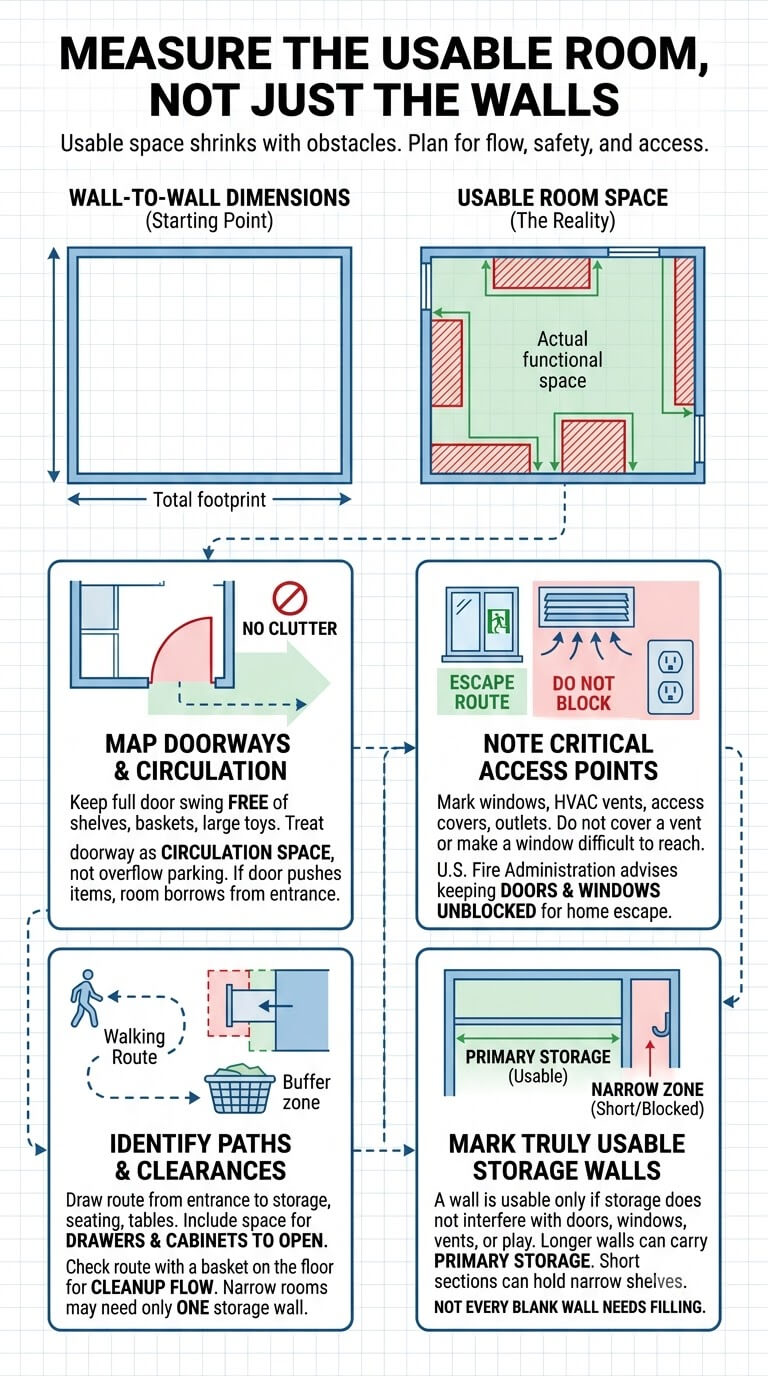
Wall-to-wall dimensions are only the starting point. Usable space shrinks once doors, windows, furniture movement, and access needs are marked.
Map doors and door swing
Keep the full door swing free of shelves, baskets, and large toys. If the door regularly pushes toys aside, the room is borrowing space from its entrance. Treat the doorway as circulation space, not overflow parking.
Note windows, vents, outlets, and required access points
Mark windows, HVAC vents, access covers, and outlets before placing furniture. Do not cover a vent or make a window difficult to reach. The U.S. Fire Administration advises households to keep doors and windows from being blocked as part of home escape planning; its home fire escape guidance is a useful reason to keep access points visible and usable.
Identify walking paths and furniture clearances
Draw the route from the entrance to the main storage, reading area, and any table, including space for drawers and cabinet doors to open. A narrow room may need one storage wall rather than furniture on both sides. Check the route with a basket on the floor because the room must work during cleanup too.
Mark truly usable storage walls
A wall is usable only if storage there does not interfere with doors, windows, vents, or play. Short sections can hold a narrow shelf or parking zone, while a longer wall can carry primary storage. Not every blank wall needs filling.
Decide How Much Clear Floor the Room Needs
Floor space is a working surface in a playroom. Protecting it makes building, pretend play, puzzles, and cleanup easier.
Active-play floor zone
Choose one area where a child can spread out a normal activity without colliding with furniture. There is no universal square-foot target because toy size, child count, and room shape vary. Test the floor with a typical block build, train layout, doll setup, or puzzle and see whether it takes over the doorway.
Movement path from entrance to storage
Keep a direct path from the entrance to the places used most. In a shared room, it should still work while one child plays on the floor. If reaching a shelf means stepping through another activity, move the shelf or shrink that footprint.
Why every open area should not become a storage footprint
Empty corners can look wasted, but filling each one makes the room harder to use. Leave breathing room around the main floor zone so large toys can come out without taking over walking paths.
Set the Room’s Inventory Capacity
A small playroom becomes easier to maintain when the room is allowed to have a maximum active load.
Estimate how much active inventory can reset easily
Fill storage only to the point where items can be returned without careful packing. Bins need spare room, shelves need return clearance, and large toys need parking spots. If an adult must rearrange every container to reset the room, the active inventory is too dense.
Identify categories that belong elsewhere
Not every child-related item belongs in the playroom. Extra bedding, future-size clothes, keepsakes, school materials, and rarely used craft supplies may work better elsewhere. Toys mainly used in another room can move there too.
Use decluttering or rotation when the room cannot hold everything
If useful toys exceed active capacity, either reduce the collection or store a temporary inactive group elsewhere. Decluttering suits broken, clearly outgrown, unwanted, or outgoing items. Rotation suits retained toys that are still useful but do not need daily access.
Build a Simple Zone Plan
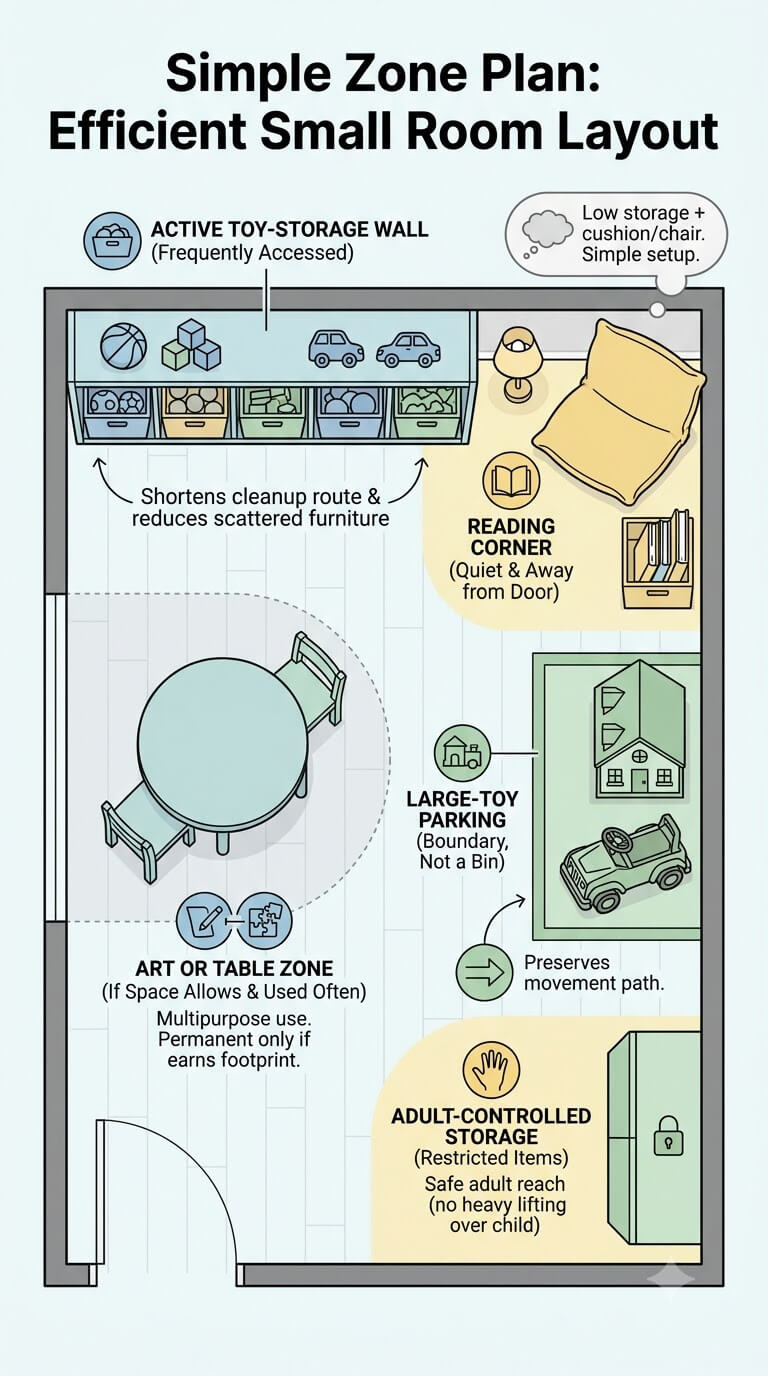
Most small rooms need only a handful of zones. Too many specialized areas consume more floor than they help.
Active toy-storage wall
Put frequently accessed storage along one strong wall when the room shape allows it. Keeping most active toys together shortens the cleanup route and reduces scattered furniture. Use lower locations for lightweight categories intended for independent access.
Reading corner
A reading zone can be low book storage beside a cushion or chair. It does not need a separate bookcase plus decorative furniture. Keep it away from the doorway and main building area.
Art or table activity zone when space allows
Give table activities a permanent zone only if the table earns its footprint. A multipurpose table can support drawing, puzzles, and games. If it consumes most of the floor but is rarely used, another surface may be better.
Large-toy parking
Mark where dollhouses, ride-on toys, large vehicles, or play structures return. Large items often need a parking boundary, not a bin. Choose a wall edge or corner that preserves the movement path.
Adult-controlled or closed-storage zone
Reserve a limited location for items children should not access freely, such as small-piece sets or supervised craft materials. Adults should be able to reach it safely without lifting heavy containers over a child’s head.
Choose Low Storage Versus Vertical Storage
Vertical storage can save floor area, but height should not replace thoughtful capacity limits.
Low storage for reachable active categories
Low shelves, shallow bins, and low drawers suit lightweight items children return themselves. Check that full bins stay manageable and drawers operate safely. Frequently used storage should not require climbing.
Vertical storage only when stable, anchored, and suitable
Tall furniture can add storage without a larger footprint, but it must be suitable and correctly installed. CPSC’s Anchor It information emphasizes anchoring furniture with drawers, doors, and shelves to help prevent tip-over incidents. Follow the furniture maker’s anchoring and installation directions.
Do not place heavy child-handled bins at unsafe heights
High shelves should not hold dense bins children are expected to pull down. Keep heavy collections lower and adult-managed items above only when appropriate. Stop if access requires climbing, overhead lifting, or pulling a loaded bin toward the face.
Avoid overloading walls or shelves
More vertical capacity does not mean every shelf should be full. Check load limits, mounting instructions, and the wall conditions required by the manufacturer. If a shelf bows, fasteners loosen, or the unit shifts during normal use, unload it and correct the installation before continuing.
Use Corners and Narrow Areas Without Blocking the Room
Small gaps can be useful when the storage remains shallow and the route around it stays clear.
Corner storage that preserves movement
A corner can hold a basket, small cubby, or one large toy when it does not project into the main path. Avoid deep corner furniture that creates a hard-to-reach pocket behind it. The best corner storage is easy to empty and easy to reset.
Narrow shelving and shallow storage
Shallow shelves can hold books, puzzles, or small display items without taking the depth of a standard cabinet. Measure the actual items first so you do not buy shallow furniture that cannot contain them. Keep protruding handles and open doors out of the walking line.
Under-bench or low-drawer storage when appropriate
A bench can provide useful low storage if it is stable and its drawers or bins open safely. Use the space for lightweight items. A bench that blocks a vent or tightens the doorway is not gaining useful capacity.
Do not block doors, windows, vents, or service access
Storage should never require moving a toy chest before a door or window can be used. Keep HVAC airflow and service panels accessible as well. This is one reason rolling overflow carts and temporary floor stacks are poor permanent solutions in already tight rooms.
Plan the Toy Storage Wall Around Broad Categories
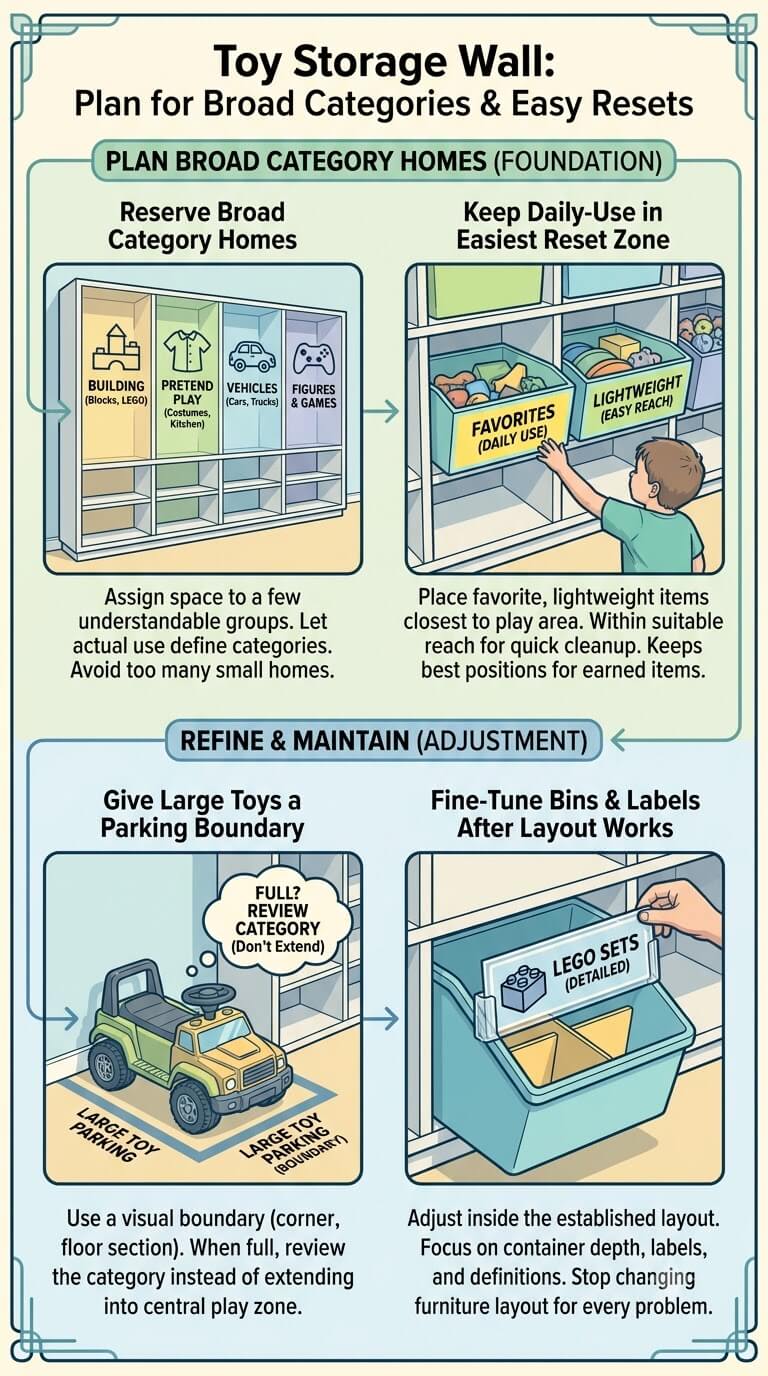
The room plan only needs broad homes for active categories. The detailed sorting can happen inside those boundaries.
Reserve broad category homes
Assign shelf or bin space to a few understandable groups such as building toys, vehicles, pretend play, figures, games, and puzzles. Let actual use define the categories, and avoid so many small homes that the storage wall becomes harder to reset than the floor.
Keep daily-use categories in the easiest reset zone
Place favorite, lightweight categories closest to the main play area and within suitable reach. Occasional sets can move to less convenient shelves. This reduces the number of steps needed for an ordinary cleanup and keeps the best storage positions for items that earn them.
Give large toys a parking boundary
Large toys should not migrate until every wall edge is occupied. Use a visual boundary such as the end of a shelf, a corner, or a small floor section. When that parking area is full, review the category instead of extending it into the central play zone.
Fine-Tune Bins and Labels After the Layout Works
Once the wall has enough capacity, stop changing the room layout to solve every mixed bin. Container depth, labels, set pieces, and category definitions can be adjusted within the storage wall. This keeps room planning focused on space rather than turning furniture into the answer to every toy problem.
Create a Small Reading Zone
Books need enough visibility to be used, but the book area should stay proportional to the room.
Low book storage and easy return
Use a low shelf, ledge, or limited basket that lets books return without complicated stacking. Keep the container close to the reading spot so books do not collect in a separate floor pile. If a child must force books into an overfilled basket, reduce the active selection.
Front-facing versus spine-out at a room-planning level
Front-facing display uses more wall width but makes a small selection easy to see. Spine-out shelving holds more titles in less frontage. Choose based on wall space and collection size rather than treating either method as universally better.
Keep the zone proportional to current reading inventory
A tiny playroom does not need the entire children’s book collection. Keep current favorites and frequently used books in the room, with borrowed books in a distinct spot if needed. Move overflow to another suitable book area rather than adding a second large bookcase.
Add an Art Zone Only if the Room Can Support It
Art storage adds consumables, small pieces, and cleanup needs, so it should earn its space.
Place the work surface and supply boundary
If art happens in the playroom, keep basic supplies close to the work surface. A small caddy, drawer, or shallow cabinet can replace several freestanding organizers. Leave room to pull out a chair without blocking the main path.
Separate child-accessible and adult-controlled storage
Keep simple supplies intended for independent use in the lower zone and move supervised items out of unrestricted reach. In mixed-age rooms, the youngest child’s access changes what can safely stay low. Product labels and household supervision needs should guide that decision.
Move high-mess or rarely used supplies out when capacity is tight
Paint refills, bulk paper, specialty craft materials, and infrequently used tools do not need to consume prime playroom storage. Keep only the amount needed for regular activities nearby, with reserve supplies in another appropriate location.
Manage Shared-Sibling and Mixed-Age Use
Shared rooms need access rules that account for the youngest person who can reach the storage while still giving older children usable space.
Shared versus child-specific zones
Keep common toys clearly shared, and reserve a limited drawer, bin, or shelf for personal items when useful. Duplicating every category by child usually wastes space, so separate storage only where ownership truly matters.
Small-parts separation for younger siblings
Older children’s sets may contain pieces unsuitable for younger siblings. CPSC explains that certain products with small parts carry specific restrictions and warning requirements; review its small-parts guidance alongside the toy’s age labeling. In a shared room, storage must account for who can physically reach the container, not only who owns the toy.
Keep supervised items out of unrestricted access
Place supervised games, delicate kits, or other restricted items in an adult-controlled location that younger children cannot casually open. Do not depend on a label alone to control access. The storage method should match the actual behavior and reach of the household.
Avoid rigid age assumptions
Children of the same age can use spaces differently, and product guidance varies. Base layout decisions on the item, manufacturer instructions, the child’s ability to return it safely, and the presence of younger siblings. Recheck the room when family needs change.
Control Visual Clutter
Visual simplicity in a small room usually comes from limiting what is active, not hiding unlimited inventory behind doors.
Open storage for a limited active set
Open bins and shelves make returns fast when categories are not overfilled. Limit visible containers so each remains recognizable. If open storage looks chaotic even after a reset, the room may be displaying too much at once.
Closed storage for visually dense or adult-controlled categories
Closed storage can reduce visual noise and protect occasional sets, but the closure mechanism matters. Some storage chests have presented lid, entrapment, or latching hazards; CPSC has published storage and toy chest safety guidance. Use products as designed, follow current manufacturer instructions, and do not assume any large lidded box is suitable for child access.
Why filling every wall can make a small room feel harder to reset
More furniture creates more surfaces for piles, more corners to clean around, and more places to misplace categories. One mostly open wall can be more useful than a shallow organizer installed simply because a blank section exists.
Design the Cleanup Route
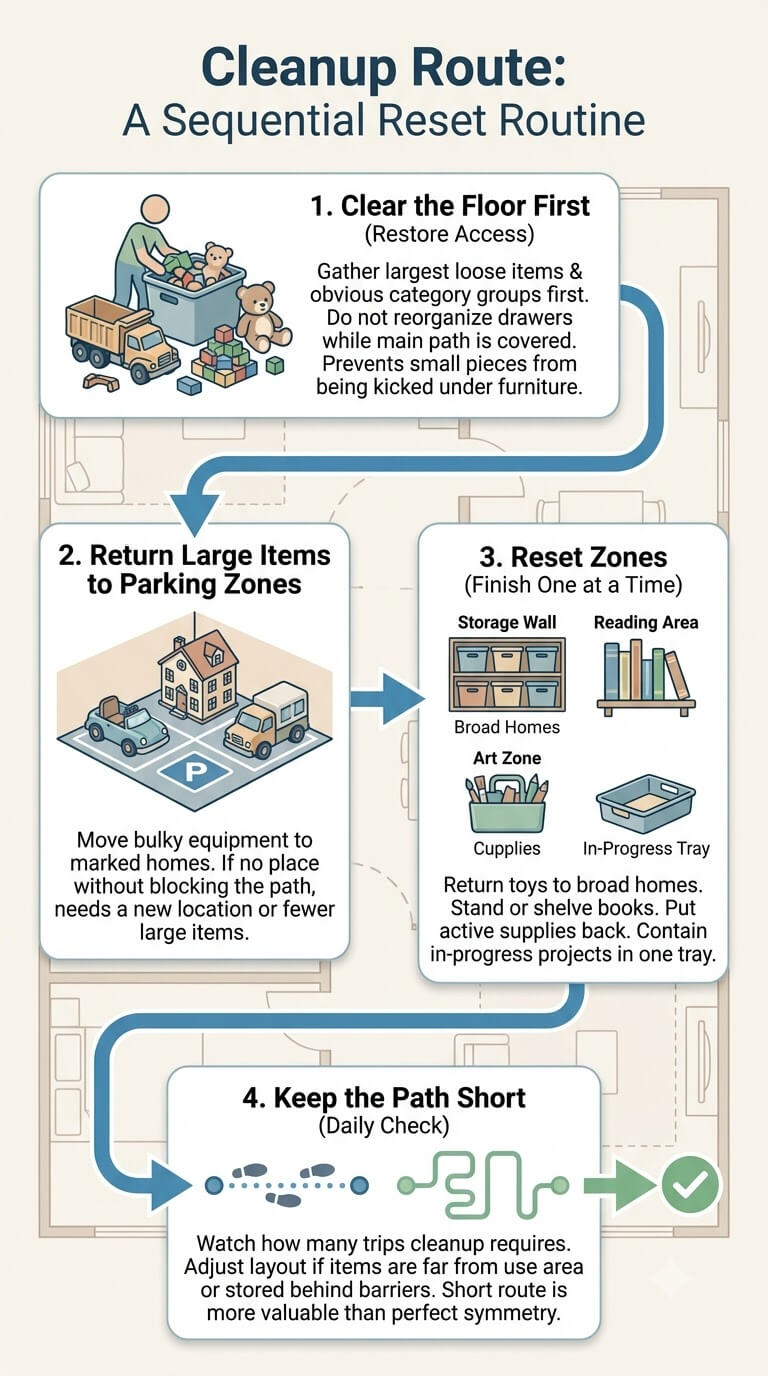
A reset routine should move from large obstacles to smaller categories with as little backtracking as possible.
Clear the floor before fine sorting
Gather the largest loose items and obvious category groups first. Do not reorganize a drawer while the main path is covered. Restoring floor access makes the rest of cleanup easier and keeps small pieces from being kicked under furniture.
Return large items to parking zones
Move ride-on toys, dollhouses, large vehicles, and bulky equipment to their marked homes. If a large item has no place to park without blocking the path, it needs a new location or the room needs fewer large items.
Reset storage wall, reading area, and art zone
Finish one zone before moving to the next. Return toys to broad homes, stand or shelve books, and put active art supplies back at the work area. In-progress projects can have one defined tray instead of spreading across multiple surfaces.
Keep the path short enough to repeat daily
Watch how many trips cleanup requires. If blocks belong across the room from where they are always used, or art supplies are stored behind several toy bins, adjust the layout. A short route is more valuable than a perfectly symmetrical room.
Decide Where Overflow Goes
Overflow needs one deliberate destination. Scattered backup baskets turn a small room into a whole-house storage problem.
Rotation storage outside the active play zone
Retained toys that are temporarily inactive can live in a separate, labeled storage area outside the playroom. Keep the rotation group manageable and safe to retrieve. The playroom should not contain both the active selection and every backup container.
Bedroom or closet overflow only when the adjacent system can support it
Move items to a bedroom or closet only when that space has real capacity. Do not solve one crowded room by creating a pile in another. Assign a specific shelf, bin, or boundary before relocating the category.
Declutter when overflow is permanent rather than temporary
If overflow never returns to active use, cannot fit its assigned storage, or keeps expanding into new locations, review what still belongs in the household. Storage is not a reason to keep broken, unwanted, or clearly outgrown items indefinitely.
Common Small-Playroom Layout Mistakes
Most layout problems come from trying to maximize storage instead of protecting the room’s daily function.
Storing everything in the room
A dedicated playroom does not have to contain every child-related item. Keeping only the active collection makes each zone easier to understand. Bulk supplies and inactive toys can live elsewhere when there is a safe, intentional storage location.
Covering usable floor with furniture
Multiple cubbies, carts, tables, and baskets can leave no place to play. Remove the least useful furniture and test the room. If activities work better with more open floor, do not replace the piece just to regain storage capacity.
Treating every wall as storage space
Walls also provide access to windows, outlets, vents, and visual relief. USFA home planning materials recommend keeping paths to exits clear and doors and windows unobstructed. Do not use storage furniture to squeeze capacity from an access point that needs to remain usable.
Building book or art systems too large for the room
A full library wall or elaborate craft station may be appealing but can overwhelm a compact room. Keep a current selection in the playroom and move reserve inventory elsewhere. The zone should match how often the activity happens and how much room it needs.
Using tall unsecured furniture
Do not treat a narrow footprint as the only requirement for a tall unit. CPSC’s childproofing guidance warns about furniture tip-over hazards and recommends anchoring appropriate products. Follow the manufacturer’s installation, wall attachment, and load instructions for the exact unit you use.
Edge Cases
The same capacity rules still work when the play area is not a standard dedicated room.
No dedicated playroom and a corner of the living room
Choose one boundary, such as a low cabinet and basket area, and limit the active collection to what fits there. Protect living-room circulation and keep large toys out of seating paths. A smaller active selection usually works better than several hidden overflow baskets.
Shared bedroom that doubles as play space
Protect sleeping, dressing, closet, and exit access before adding toy storage. Keep daily favorites near the open floor, and move bulky or occasional toys elsewhere if they interfere with dressing or movement around the bed.
Very large toys in a tiny room
Measure a large toy in its play position, not only where it parks. A dollhouse may fit against a wall but require substantial floor space during use. Keep large items that earn that footprint and give each a fixed return location.
Rapidly changing interests
Do not rebuild the room whenever a favorite changes. Keep the furniture layout stable and adjust broad zones instead. Periodically give more space to newly used categories while ignored ones shrink, rotate out, or leave.
FAQ About Small Playroom Organization
How much floor space should I leave open?
There is no universal percentage. Leave enough for typical floor activities plus a clear route through the room. Test with bins open and a normal activity underway. If the doorway, path, or main play area disappears, reduce furniture or active inventory.
Should a small playroom use open or closed storage?
Use a mix based on access and contents. Open storage is useful for a limited set of lightweight daily toys because returns are quick. Closed storage can contain visually dense or adult-managed categories. Choose products whose doors, drawers, lids, installation, and load limits suit the household.
Is vertical storage safe in a kids’ playroom?
Vertical storage can be appropriate when the furniture is suitable, stable, correctly installed, and anchored as required. Keep heavy child-handled bins low, follow the manufacturer’s instructions, and stop using furniture that wobbles, tips, bows, or has loose mounting hardware.
What should leave the room first when it is over capacity?
Start with obvious trash, broken or unusable items, and things that clearly belong elsewhere. Next, move rarely used but retained toys into a defined rotation or secondary storage area. If the room still cannot reset, review categories that are outgrown, duplicated, or no longer used.
Can books and art supplies stay in a very small playroom?
Yes, if they fit without taking over the main play area. Keep a small current book selection and a compact set of frequently used art supplies. Move reserve books, bulk paper, refills, and high-mess or supervised materials elsewhere when the room is tight.
A small playroom does not need to hold everything. Protect the floor, keep access points clear, give the most-used activities simple homes, and let capacity decide when inventory moves out. If children can play, walk, find what they need, and return items without a complicated reset, the room is working well.

Ethan Carter is the Founder & Editor of HomeCleanSecrets. Based in the United States, he has 5 years of experience creating practical home cleaning, laundry care, stain removal, decluttering, and home organization content. His goal is to help everyday households clean smarter and build simple routines that are easier to maintain.
Read more about Ethan Carter on his author page: https://homecleansecrets.com/ethan-carter/