
Small bathrooms fail fast when every product tries to live in the same tiny room. A normal morning routine can turn into a pile of bottles on the sink, towels on the door, refills under the pipes, and a shower ledge that feels full even after you clean it. The answer is not always a bigger shelf. The first step is deciding what the room can realistically hold.

This guide shows how to organize a small bathroom by mapping the space, setting category limits, and choosing storage that works with moisture, narrow walkways, doors, plumbing, and rental rules. It does not try to replace a full cabinet, drawer, towel, toiletries, or decluttering workflow. Instead, it gives you the layout decisions that make those smaller systems easier later.
Quick Answer: Small Bathroom Organization Starts With Limits
A small bathroom still needs the same basic storage zones as a larger bathroom, so start with the full bathroom storage framework before deciding what earns space.
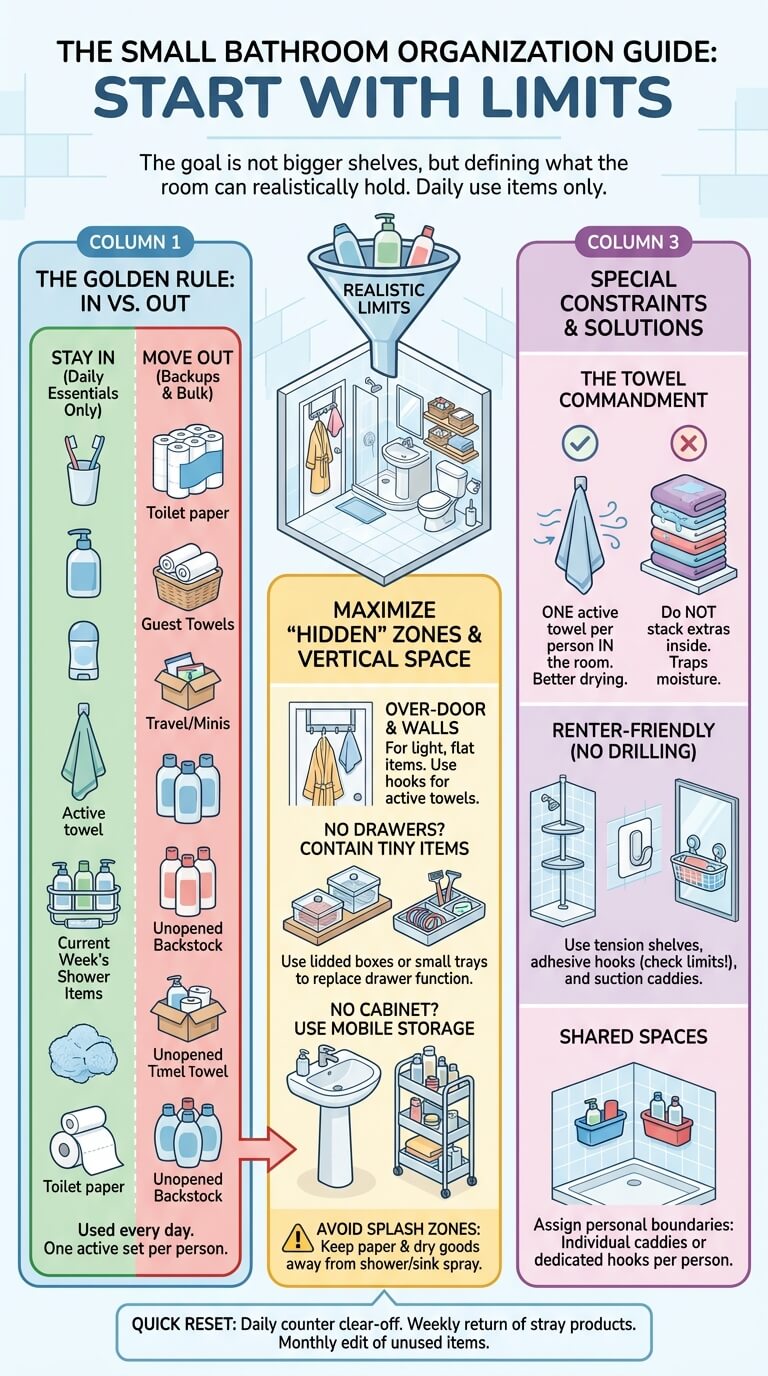
A small bathroom should hold the items you use in that room every day, plus a small number of safety or cleaning items only when they can be stored safely. Everything else needs a stricter test. If the room has no cabinet, no drawer, no linen closet, or no counter space, the limit becomes even more important than the organizer you buy.
Keep only daily essentials in the room
Start with a daily-use list, not with a shopping list. Most small bathrooms can handle a toothbrush, toothpaste, face wash, hand soap, deodorant, a few hair tools, one active towel per person, toilet paper in limited quantity, and the shower products actually used that week. Items used once a month rarely deserve the easiest space.
Before buying slim carts, bins, or drawer dividers, take time to declutter bathroom products so you are not organizing items you no longer need.
Use vertical and hidden zones before buying more bins
Small bathrooms often have more vertical space than horizontal space. The back of the door, the wall above the toilet, a narrow strip beside the vanity, the inside of a cabinet door, and a small section of unused wall can hold items without stealing counter space. Hidden zones are best for practical items. Open zones should stay calmer because every visible bottle makes the room feel smaller.
Move backups out when space is too tight
Bulk toilet paper, extra shampoo, unopened skincare, refill soap, spare toothpaste, and travel supplies are usually the first items to remove. Backups feel harmless because they are useful, but in a small bathroom they often consume the space needed for active routines. Keep one backup only if there is a dry, safe, out-of-the-way spot.
Identify the Real Small Bathroom Problem
Small bathroom organization is easier when you name the exact constraint. A bathroom with no drawers needs a different plan from a bathroom with a vanity but no towel storage. Solving the wrong problem usually creates more bins, more hooks, and more frustration.
No drawers
When there are no drawers, tiny loose items become the biggest problem. Hair ties, razors, floss, nail clippers, lip balm, contact lens cases, and makeup pieces need shallow containment. A lidded box, a divided tray on a shelf, or a small caddy can replace the drawer function without spreading small items across the sink.
No cabinet
A no-cabinet bathroom needs visible storage that stays edited. Pedestal sinks, wall-mounted sinks, and tiny rental vanities leave little hidden space. In this setup, the best plan is usually one daily caddy, one small toilet paper zone, one towel zone, and one wall or door zone. Anything beyond that needs to earn its place.
No linen storage
Without a linen closet, towels can overtake the room. The small-bathroom answer is not to stack every towel in the bathroom. Keep active towels inside the room and move guest towels, extra bath towels, beach towels, and seasonal linens elsewhere. This keeps the bathroom from becoming a damp linen shelf.
No counter space
No-counter bathrooms need a landing zone, even if it is tiny. A narrow shelf, a small tray above the toilet, a wall-mounted cup, or a medicine cabinet shelf can hold the few items used during a routine. Without a landing zone, products migrate to the toilet tank, window sill, floor, or shower edge.
Shared or rental limitations
Shared bathrooms need boundaries by person. Rental bathrooms need storage that respects the lease and the finish. These two limits often overlap. Use removable containers, labeled shelves, color-separated caddies, or individual baskets rather than permanent installations if you are not allowed to drill.
Step 1: Make a Small Bathroom Storage Map
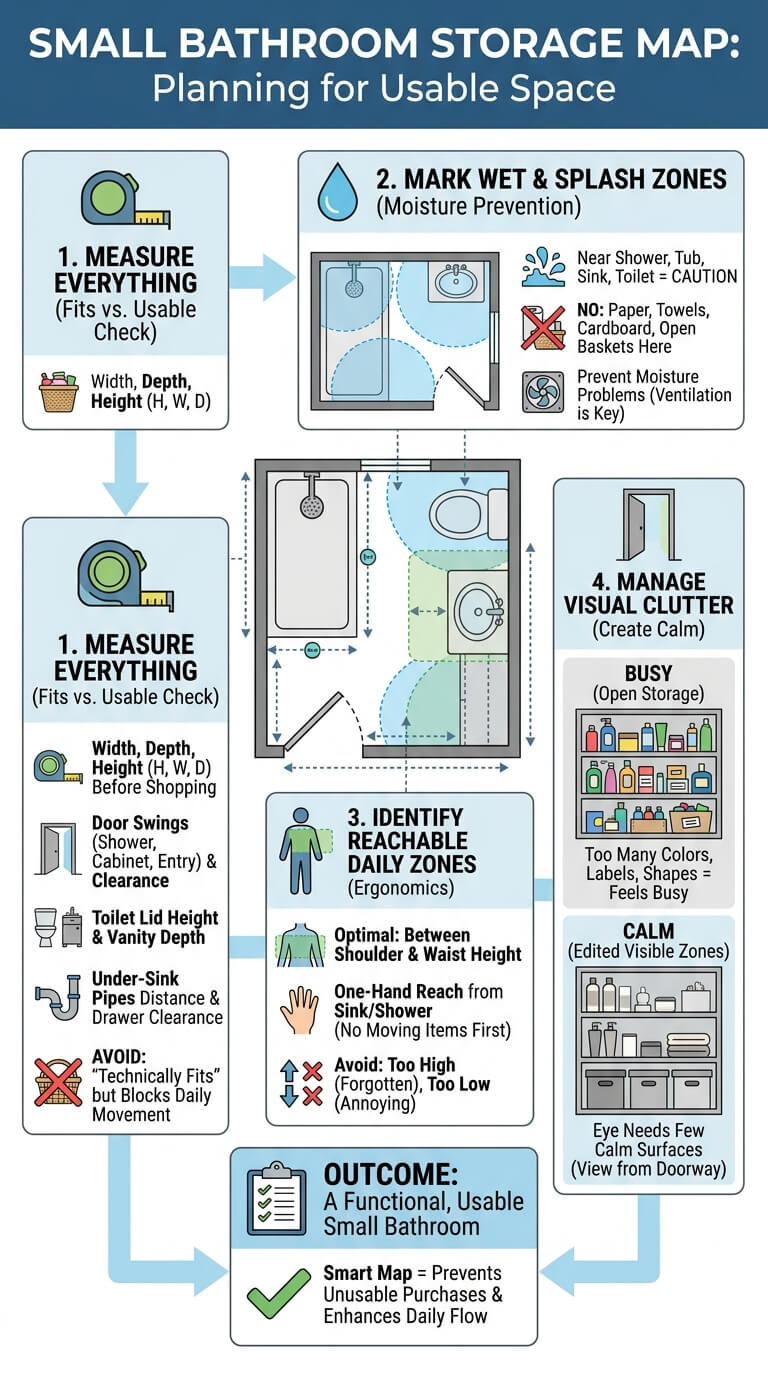
A storage map is a simple room scan that shows what space exists and what space should stay empty. It prevents the classic mistake of buying a cart, shelf, or basket that technically fits but makes the room harder to use.
Measure wall, door, cabinet, and under-sink space
Measure width, depth, and height before shopping. Include the toilet lid height, vanity depth, door swing, shower door swing, drawer clearance if there is one, and the distance around pipes under the sink. In a small bathroom, one inch can decide whether a basket works or blocks daily movement.
Mark wet zones and splash zones
Storage near the shower, tub, sink, or toilet needs more caution. Paper goods, extra towels, cardboard packaging, and open baskets of personal products do not belong where they are regularly splashed. Bathrooms also need ventilation and moisture control, especially in tight rooms with little air movement. The EPA guidance on controlling moisture indoors is a helpful reminder that moisture problems are easier to prevent than fix after materials stay damp.
Identify reachable daily zones
Daily items should sit between shoulder and waist height when possible. Items that are too high are forgotten. Items that are too low become annoying. A good daily zone can be reached with one hand while standing at the sink or shower, without moving another item first.
Identify storage that creates visual clutter
Open storage makes a small room feel busy when it holds too many colors, labels, and shapes. Look at the room from the doorway. If the first thing you notice is product packaging, the visible zones need editing. You do not need a perfectly styled bathroom, but your eye needs a few calm surfaces.
Step 2: Decide What Deserves Bathroom Space
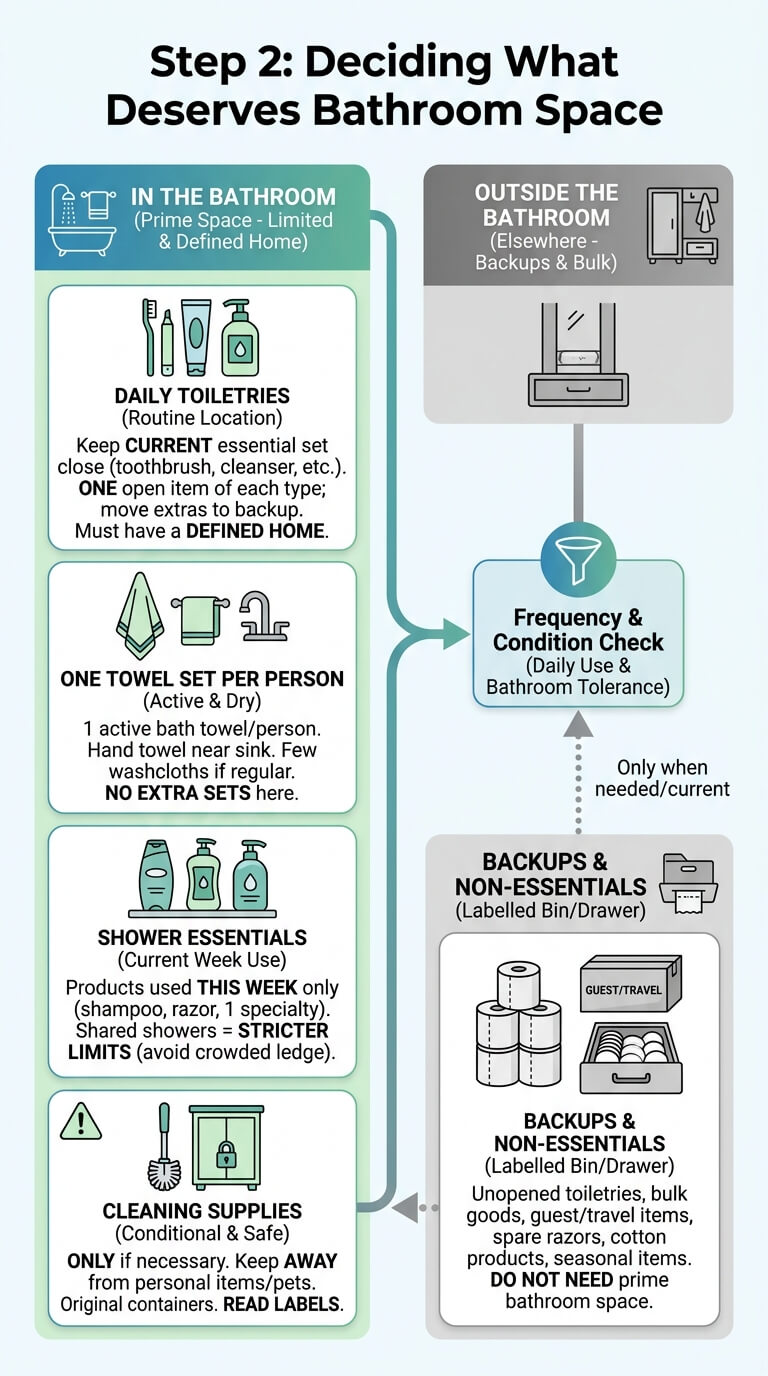
Once the map is clear, sort items by how often they are used and how well they tolerate bathroom conditions. Small bathrooms become easier when each category has a limit before it has a container.
Daily toiletries
Daily toiletries can stay in the bathroom when they have a defined home. Keep the current toothbrush, toothpaste, cleanser, moisturizer, deodorant, shaving item, and hair product close to the routine location. If three similar products are open, choose the one you use most and move the others to a backup or finish-first spot outside the main reach zone.
Counter space disappears fast in a small bathroom, so create one simple place to organize toiletries that you use every day.
One towel set per person
A small bathroom usually works best with one active bath towel per person in the room. Add a hand towel near the sink and a few washcloths only if they are used regularly. Extra towel sets can live outside the bathroom in a dry area.
Shower essentials
Shower storage should hold the products used in the current week. Shampoo, conditioner, body wash, razor, and one specialty product may be enough for one person. Shared showers need stricter limits because one extra bottle per person quickly becomes a crowded ledge.
Cleaning supplies only when safe and necessary
Small bathrooms do not always need to store cleaning supplies inside the room. If you keep a toilet brush, a small bathroom cleaner, or disinfecting wipes there, store them away from children, pets, towels, toothbrushes, and personal care products. Read labels and keep products in original containers.
Backups that should live elsewhere
Backups include unopened toiletries, bulk paper goods, guest items, travel minis, spare razors, replacement toothbrush heads, cotton products, and seasonal items. These products are useful, but they do not need prime bathroom space. A labeled hallway bin or bedroom drawer often works better.
Step 3: Use Vertical Storage Without Crowding the Room
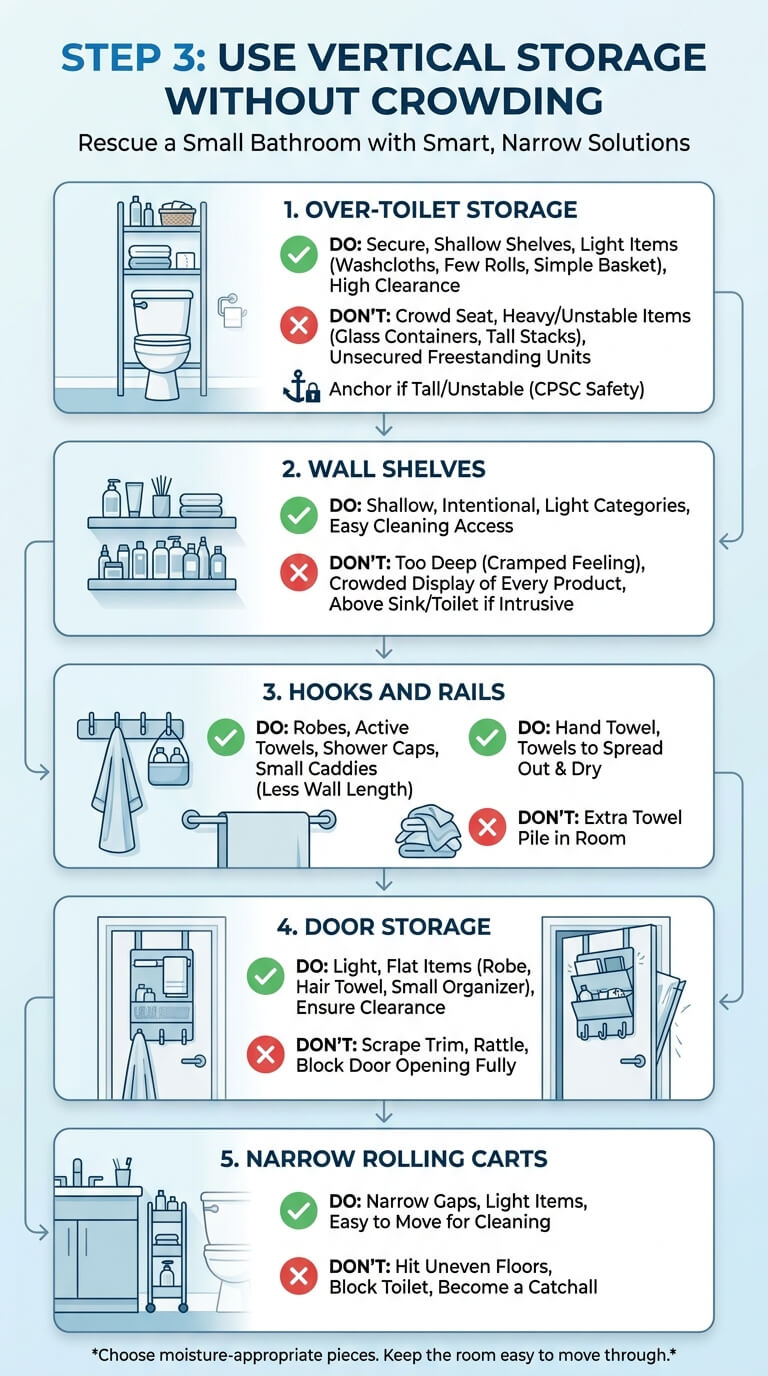
Vertical storage can rescue a small bathroom, but it can also make the room feel boxed in. Choose narrow, stable, moisture-appropriate pieces that leave the room easy to clean and easy to move through.
Over-toilet storage
The wall above the toilet is often unused, but it needs careful planning. Shelves should be secure, shallow enough not to crowd the seat, and high enough that people do not bump them. Store light items there, such as washcloths, a few toilet paper rolls, or a simple basket of guest items. Avoid heavy glass containers and unstable stacks.
If you use a freestanding over-toilet unit, check stability before loading it. The CPSC tip-over safety information is worth keeping in mind for tall furniture, especially in homes with children or pets. Follow the manufacturer instructions for anchoring when the product requires it.
Wall shelves
Wall shelves work best when they are shallow and intentional. A shelf that is too deep can make the room feel cramped, especially above a sink or toilet. Use shelves for light, simple categories rather than a crowded display of every product you own.
Hooks and rails
Hooks use less wall length than towel bars and can work well for robes, active towels, shower caps, and small caddies. Rails are better when towels need to spread out and dry flatter. In a tiny bathroom, a mix can work: hooks for people, a rail for the hand towel, and no extra towel pile in the room.
Door storage
The back of the door can hold light, flat items such as a robe, hair towel, small toiletry organizer, or extra hooks. Over-door racks are useful when the door has enough clearance to close properly. They are frustrating when they scrape trim, rattle, or block the door from opening fully.
Narrow rolling carts and when they work
A slim rolling cart can help when there is a narrow gap beside the vanity, toilet, or tub. It works best for light items that need to move during cleaning. It works poorly when the wheels hit uneven flooring, when the cart blocks the toilet, or when it becomes a catchall for everything without a home.
Step 4: Organize the Sink, Cabinet, or No-Cabinet Zone
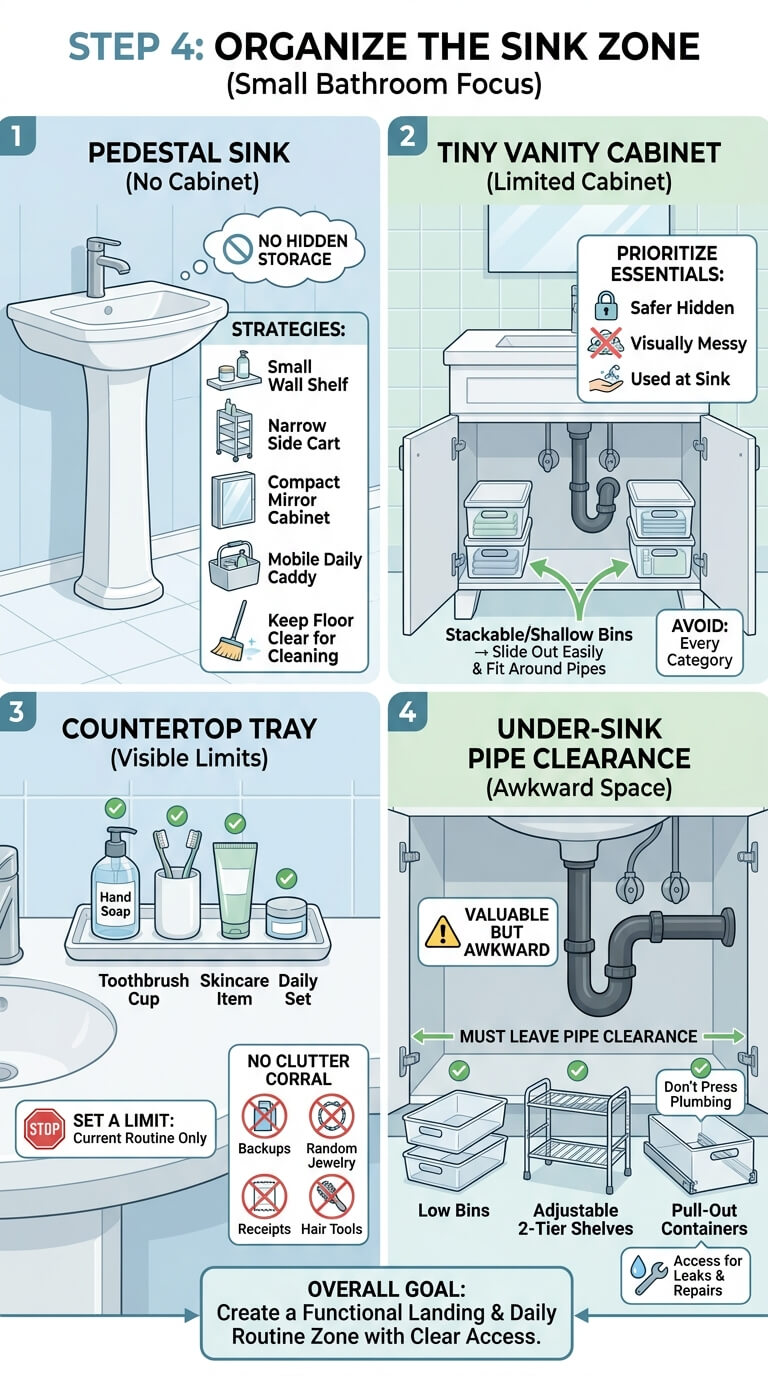
The sink area is the busiest part of most small bathrooms. It needs a landing zone, a daily routine zone, and clear access to plumbing or cleaning areas. The setup changes depending on whether you have a pedestal sink, a tiny vanity, or no hidden storage at all.
Pedestal sink strategies
A pedestal sink gives almost no closed storage, so avoid pretending it can hold a full bathroom system. Use a small wall shelf, a narrow side cart, a compact mirror cabinet, or one daily caddy that moves in and out. Keep the floor around the pedestal easy to clean.
Tiny vanity cabinet strategies
If the vanity cabinet is the only hidden storage you have, make better use of the bathroom cabinet for backups and taller items instead of letting it become a catch-all.
A tiny vanity cabinet should not hold every bathroom category. Prioritize items that are safer hidden, visually messy, or used at the sink. Use stackable drawers or shallow bins only if they fit around pipes and can slide out easily.
Countertop tray limits
A tray can make a tiny counter look organized, but it should have a limit. Keep only the current routine on it: hand soap, toothbrush cup, one skincare item, or a small daily set. Once the tray starts holding backup products, random jewelry, receipts, and hair tools, it becomes a clutter corral instead of a system.
Under-sink pipe clearance
Under-sink space is valuable but awkward. Pipes, shutoff valves, sink bowls, and disposal of occasional leaks need room. Use low bins, two-tier shelves with adjustable parts, or pull-out containers only when they leave pipe clearance and do not press against plumbing.
Step 5: Store Towels in a Small Bathroom
Towels often need a tighter limit in a small room, so store towels when the bathroom has little linen space with hooks, shelves, or narrow storage.
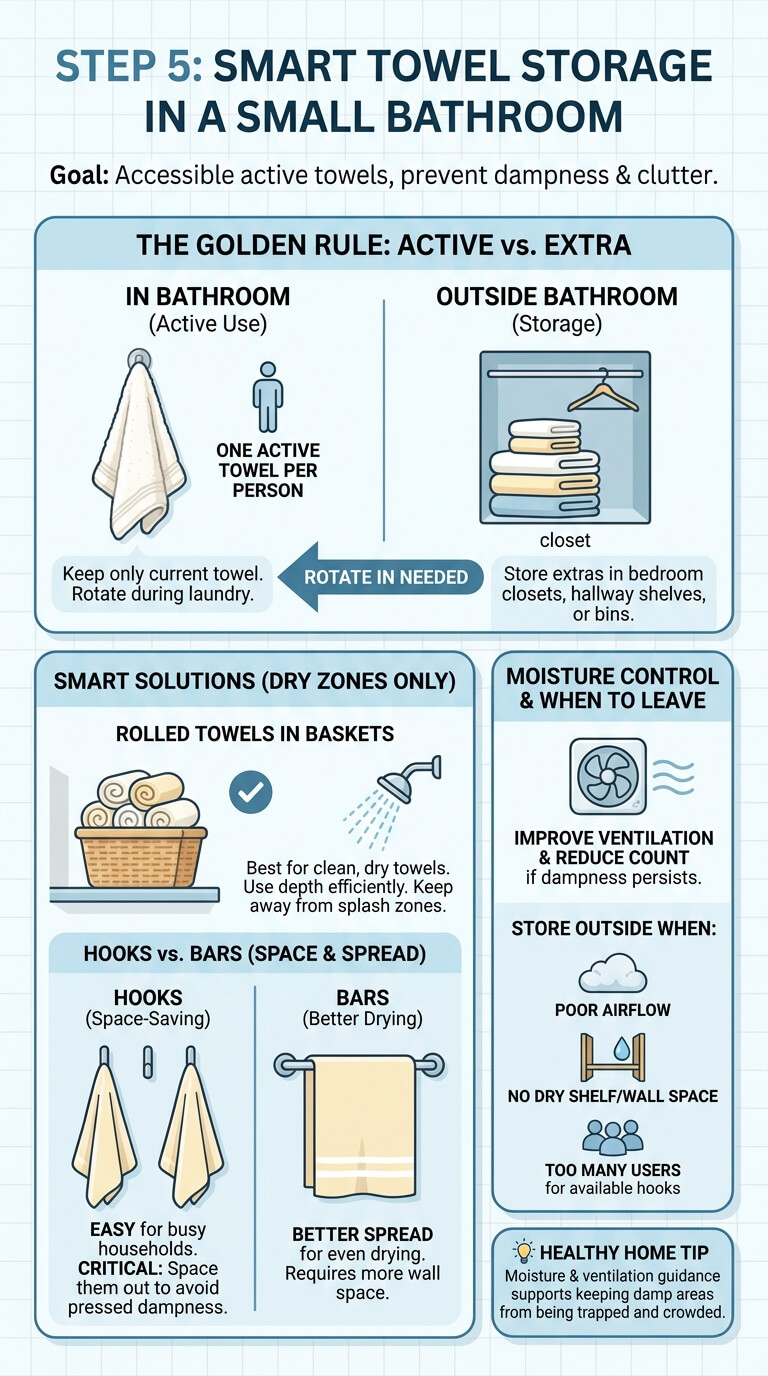
Towels are bulky, moisture-sensitive, and used daily, so they need stricter rules in a small bathroom than almost any other category. The goal is to keep active towels accessible while preventing the room from becoming a damp storage closet.
One active towel per person
Keep one active bath towel per person in the bathroom when possible. Store extras outside the bathroom and rotate them during laundry. This prevents towel stacks from swallowing shelf space and keeps the room easier to ventilate.
Rolled towel baskets
Rolled towels can work on a shelf or in a basket because they use depth efficiently. They are best for clean, dry towels in a dry zone. Do not place a basket of towels where shower spray, sink splash, or toilet proximity makes the storage feel questionable.
Wall hooks versus towel bars
Hooks save space and are easy for busy households. Towel bars allow better spread, which can help towels dry more evenly. In a very small bathroom, hooks may be the only realistic option, but spacing still matters. Crowded hooks can keep towels pressed together.
If towels stay damp, reduce the number of towels hanging in the room, improve ventilation when possible, and move extras elsewhere. HUD healthy homes materials discuss moisture and ventilation as part of a healthier indoor environment, and their moisture and ventilation guidance supports the habit of keeping damp areas from staying trapped and crowded.
When towels should leave the bathroom
Towels should leave the bathroom when the room has poor airflow, no dry shelf, no wall space, or too many users for the available hooks. Store clean extras in a bedroom closet, hallway shelf, laundry area, or labeled bin. Bring in only the towel needed for the day or week.
Step 6: Organize Toiletries and Shower Products in Tight Space
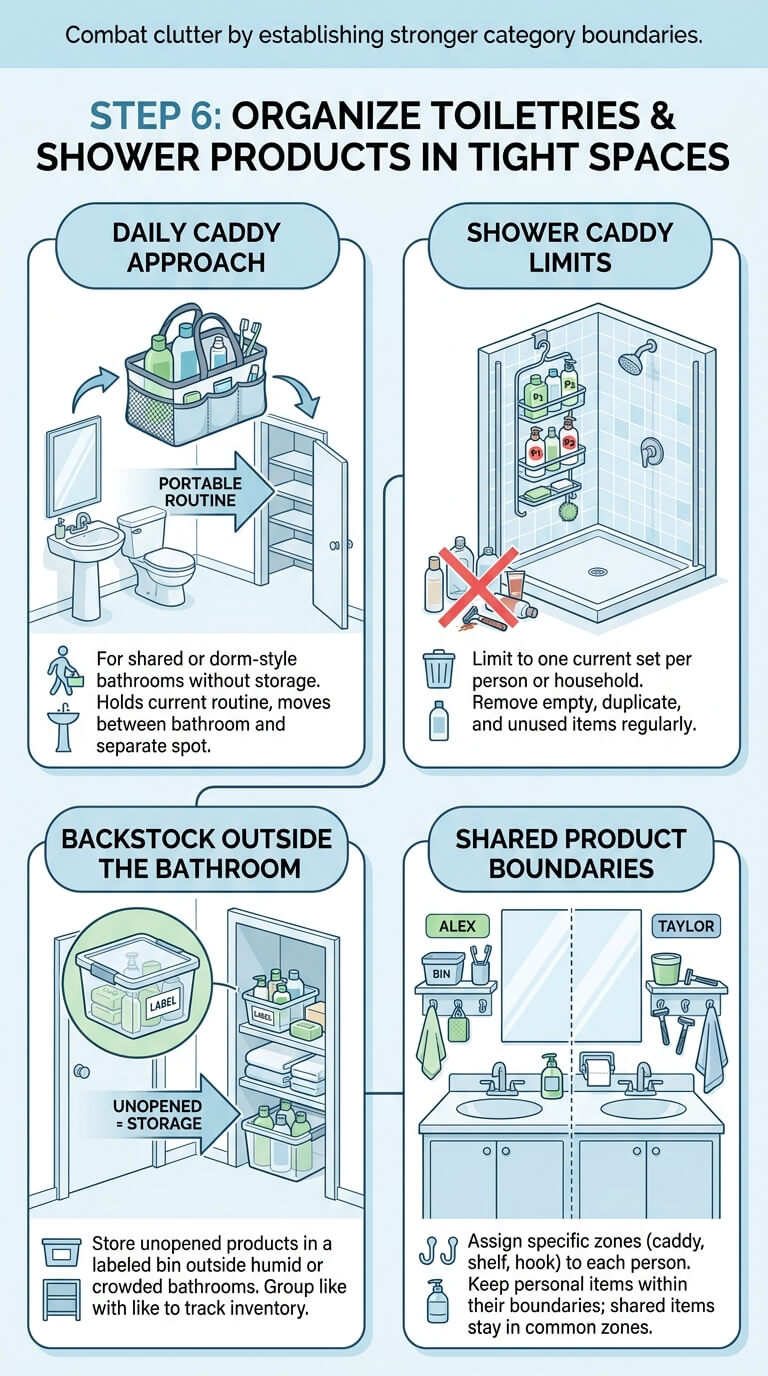
Toiletries and shower products create small-bathroom clutter because they multiply quietly. A bottle stays in the shower after it is replaced. A half-used lotion sits on the sink beside a new one. Travel items wait for the next trip. Tight space requires stronger category boundaries.
Daily caddy approach
A daily caddy works when there is no drawer or cabinet. Choose one container that holds the current routine and can move between the bathroom and another storage spot. This is useful for shared bathrooms, dorm-style setups, and pedestal sinks.
Shower caddy limits
In a tight bathroom, reduce bottle clutter in the shower so the caddy or shelf drains well and does not become overflow storage.
A shower caddy should not hold every open bottle in the house. Keep one current set per person or one shared set for the household. Remove empty bottles, duplicate scents, old razors, and products that are not being used.
Backstock outside the bathroom
Unopened products are backstock, not daily storage. Put them in a labeled bin outside the bathroom, especially when the room is humid or already crowded. Group like with like so you can see what you own before shopping.
Shared product boundaries
Shared bathrooms need clear product boundaries. Give each person a caddy, shelf section, hook, or small bin. Shared products, such as hand soap or toilet paper, can stay in common zones. Personal products should not spread across every ledge.
Renter-Friendly Small Bathroom Organization
Rental bathrooms can be organized well, but the plan must respect the lease, the finishes, and the fact that you may need to remove everything later. Prioritize storage that can move with you and does not rely on risky installation.
No-drill storage options
No-drill options include freestanding shelves, over-door hooks, tension shelves, suction baskets, adhesive hooks, rolling carts, countertop caddies, toilet tank trays, and small floor baskets. Each one has limits. Freestanding pieces need floor space. Tension pieces need stable surfaces. Suction and adhesive products need compatible materials.
Removable hooks and adhesive limits
Removable hooks are useful, but they are not magic. Surface texture, paint condition, humidity, weight, cleaning residue, and curing time matter. Before hanging wet towels or heavy caddies, read the manufacturer instructions for removable hooks and follow the listed weight and surface limits.
Avoiding damage to walls, doors, and finishes
Check painted walls, hollow-core doors, tile, grout, mirror frames, cabinet finishes, and wallpaper before attaching storage. Some products remove cleanly from one surface and damage another. Do not assume an adhesive that worked in a bedroom will behave the same way in a humid bathroom.
Small Bathroom Mistakes to Avoid
The wrong organizing choice can make a small bathroom harder to use. The best systems leave enough empty space for movement, drying, cleaning, and quick routines.
Filling every wall with storage
Every blank wall does not need a shelf. Too much wall storage creates a crowded feeling and gives clutter more places to land. Leave some visual breathing room, especially near the mirror and entry view.
Keeping bulk purchases in the bathroom
Bulk purchases are usually the enemy of tiny bathroom storage. They take prime space, hide current products, and make the room harder to reset. Store bulk toilet paper, extra toiletries, and unopened items elsewhere whenever possible.
Ignoring moisture and airflow
A small bathroom can look organized and still function poorly if damp towels, closed bins, and crowded shelves trap moisture. Watch how the room behaves after showers. If mirrors stay foggy, towels stay wet, or cabinets smell musty, reduce stored fabric and open up the layout.
Choosing organizers that block doors, drawers, or cleaning access
An organizer that blocks a cabinet door, bathroom door, toilet lid, drawer, shower entry, or floor cleaning path will become annoying quickly. Test the movement before keeping it. Open every door and drawer. Sit, stand, turn, reach, and clean around the item.
Small Bathroom Reset Routine
A small bathroom needs short resets because clutter appears quickly in a tight room. The routine should be simple enough to do without turning it into a full cleaning session.
Daily counter reset
At the end of the day, return sink items to the caddy, shelf, drawer, or medicine cabinet. Hang towels on their assigned hooks or bars. Remove clothing, empty packaging, and random items that landed on the toilet tank or counter.
Weekly product return
Once a week, return stray products to their correct zones. Move backups out, remove empty bottles, and check whether shared products have spread into personal spaces. This is also a good time to wipe organizers and check for damp spots under the sink or near the shower.
Monthly space audit
Once a month, look at the room from the doorway and ask three questions: what is always in the way, what is never used here, and what storage is creating clutter instead of solving it? Remove one category or adjust one zone at a time.
FAQ
These answers focus on small bathrooms where space, moisture, rental limits, and daily routines decide what should stay in the room.
How do I organize a bathroom with no storage?
Start by reducing the bathroom to daily essentials. Use one daily caddy, one towel zone, one toilet paper zone, and one vertical or door zone if allowed. Move backup products, guest items, extra towels, and bulk purchases outside the bathroom. Then add storage only for the categories that remain.
What should I remove from a small bathroom?
Remove unopened backups, bulk paper goods, extra towels, expired or unused toiletries, travel products, rarely used hair tools, decorative items that crowd surfaces, and cleaning supplies that cannot be stored safely. Keep the bathroom focused on what is used in the room every day or every week.
How do I store towels in a tiny bathroom?
Keep one active bath towel per person in the bathroom, plus the hand towel currently in use. Use hooks when wall length is limited, a bar when towels need more spread, and a small basket only in a dry zone. Store extra towel sets outside the bathroom if the room has poor airflow or no dry shelf space.
Are over-the-toilet shelves a good idea in a small bathroom?
They can be useful when they are stable, shallow, secure, and lightly loaded. They are not a good fit if they crowd the toilet, wobble, block access, or invite heavy storage above someone’s head. Use them for light items such as washcloths, a few paper rolls, or a small basket, and follow the product’s installation instructions.
Final Thoughts
Small bathroom organization works best when the room has firm limits. Keep daily items close, move backups out, use vertical space carefully, and leave enough empty space for towels to dry, doors to open, and the room to be cleaned. Once the layout is calm, the smaller cabinet, drawer, towel, toiletry, and shower systems become much easier to maintain.

Ethan Carter is the Founder & Editor of HomeCleanSecrets. Based in the United States, he has 5 years of experience creating practical home cleaning, laundry care, stain removal, decluttering, and home organization content. His goal is to help everyday households clean smarter and build simple routines that are easier to maintain.
Read more about Ethan Carter on his author page: https://homecleansecrets.com/ethan-carter/