
Stuffed animals are easy to love and surprisingly hard to store. They are soft, bulky, irregularly shaped, and often carry more sentimental value than other toys. A basket that looks roomy when empty can overflow after only a few large plush toys, while a bed can disappear under favorites that never make it back to a shelf.
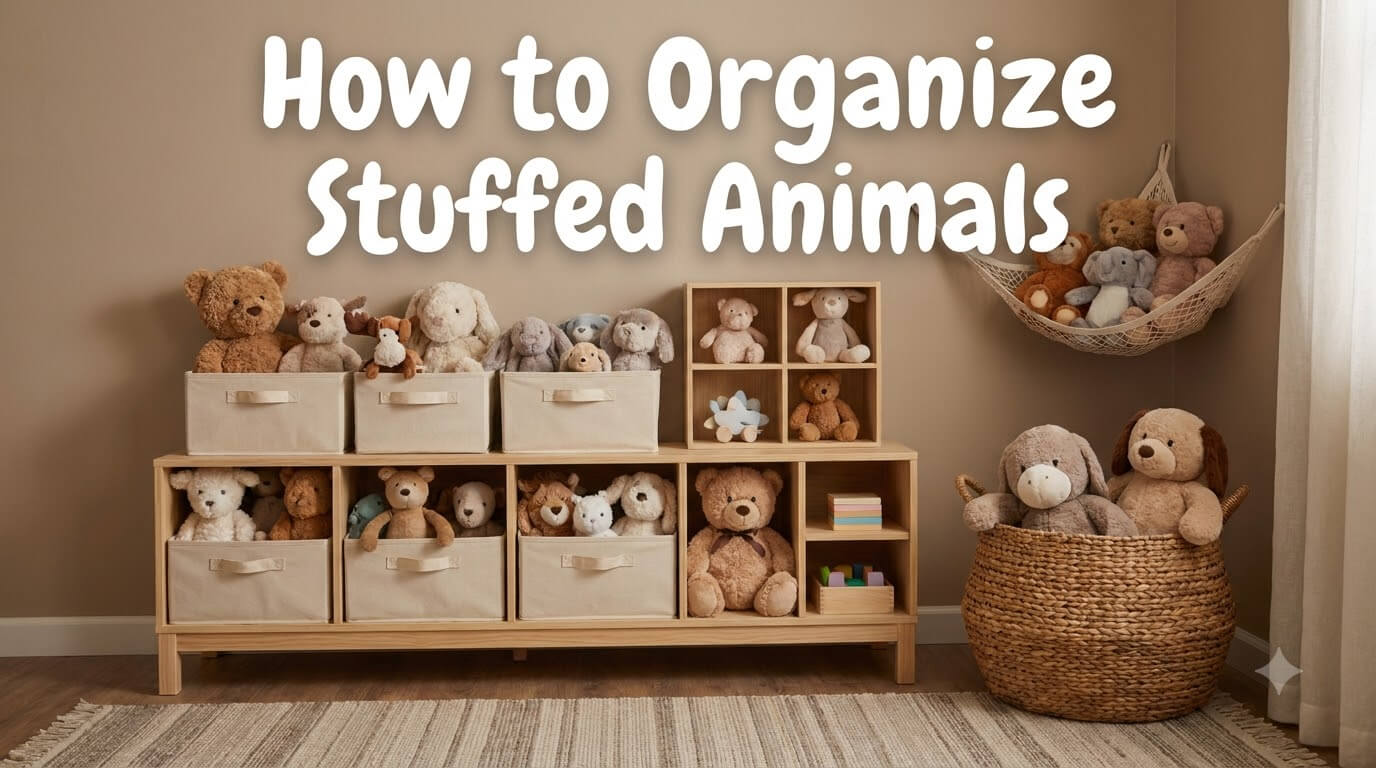
A workable system starts by separating what needs to stay easy to reach from what only needs occasional access. Then give each group a physical limit that fits the room. The goal is not to squeeze every plush toy into one clever container. It is to keep favorites usable, walking space clear, and the collection small enough that a child can understand where things go.
Quick Answer: Separate Favorites, Active Play, Display, and Stored Plush
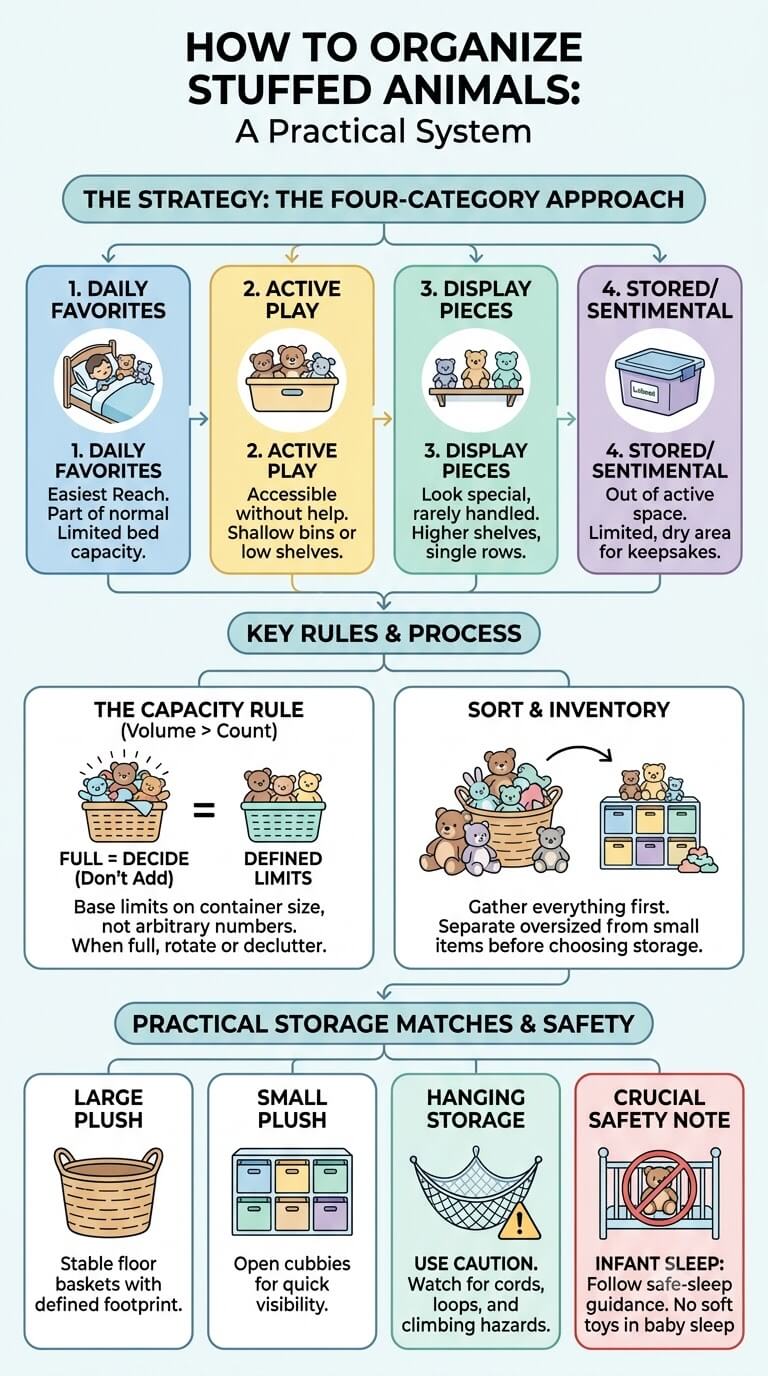
The four-category approach
Begin with four broad groups: daily favorites, active-play plush, display pieces, and stored or sentimental items. These categories answer a practical question: how often does this stuffed animal need to be handled? Daily favorites deserve the easiest return spot. Display pieces can live higher or farther back. Stored items do not need to consume active room space.
Why bulky soft toys need their own capacity rule
Plush toys behave differently from blocks, figures, or puzzles because volume matters more than piece count. Ten small animals may fit where two oversized animals will not. Base the limit on the available container, shelf, bed, or floor area rather than an arbitrary toy count. When that boundary fills, make another decision instead of adding another pile. Keep blocks, figures, puzzles, and other general toys in the broader toy organization system rather than sharing the plush container.
Inventory the Stuffed-Animal Collection
Gather plush from beds, floors, shelves, baskets, and storage
Bring the collection into view before assigning containers. Check beds, under furniture, cubbies, playroom corners, closets, car bags, and any overflow boxes. Work one location at a time if a room-wide pile would create chaos, while noting where hidden or forgotten plush was stored.
Sort large versus small plush
Separate oversized stuffed animals from medium and small pieces before choosing storage. Large plush often need a floor basket, shelf end, or defined parking spot, while small plush can share bins or cubbies. Mixing every size in one deep basket makes small favorites disappear and complicates cleanup.
Note favorites, occasional toys, sentimental items, and damaged pieces
Mark what is used often, what is mostly decorative, what has sentimental importance, and what needs attention because a seam, eye, accessory, or surface is deteriorating. If a toy appears damaged, check the original label and current safety information before returning it to child access. The CPSC toy safety center is also useful for checking current recalls and warnings.
Decide What Must Stay Reachable
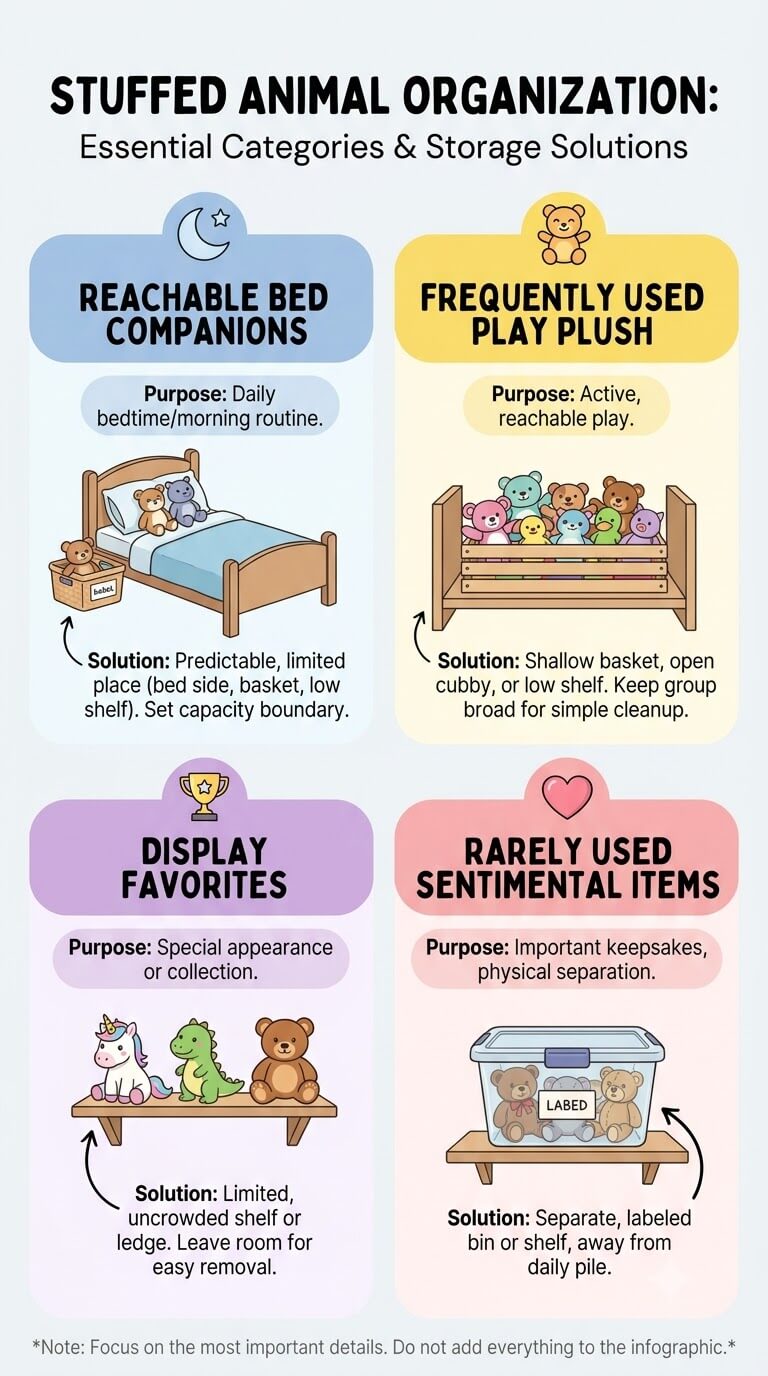
Bed companions
Identify the few plush toys that are genuinely part of a child’s normal bedtime or morning routine. Give them a predictable place to land when the bed is made, such as one side of the bed, a nearby basket, or a low shelf. Treat that place as a capacity boundary so the sleeping surface does not gradually become the default storage area for the entire collection.
Frequently used play plush
Active-play animals should be reachable without requiring an adult to unload a high shelf or remove three other containers first. A shallow basket, open cubby, or low shelf works when it matches the child’s access needs and the room setup. Keep the group broad enough that cleanup is simple. Sorting every animal by species or character usually creates more work than value.
Display favorites
Some stuffed animals are kept mainly because they look special, were gifts, or form a small collection. Display only the number that fits safely on the chosen shelf or ledge without crowding. Leave enough room to remove one item without knocking several others down. If the display becomes a compressed wall of plush, it is functioning as storage overflow rather than a useful display.
Rarely used sentimental items
Sentimental plush does not need the same access as everyday play toys. Place genuinely important keepsakes in a separate, limited area where they will not be tossed into the daily cleanup pile. One labeled bin or shelf is enough. The purpose is physical separation, not judging what a child should value.
Set a Bed and Floor Capacity Goal
Keep sleep and walking surfaces functional
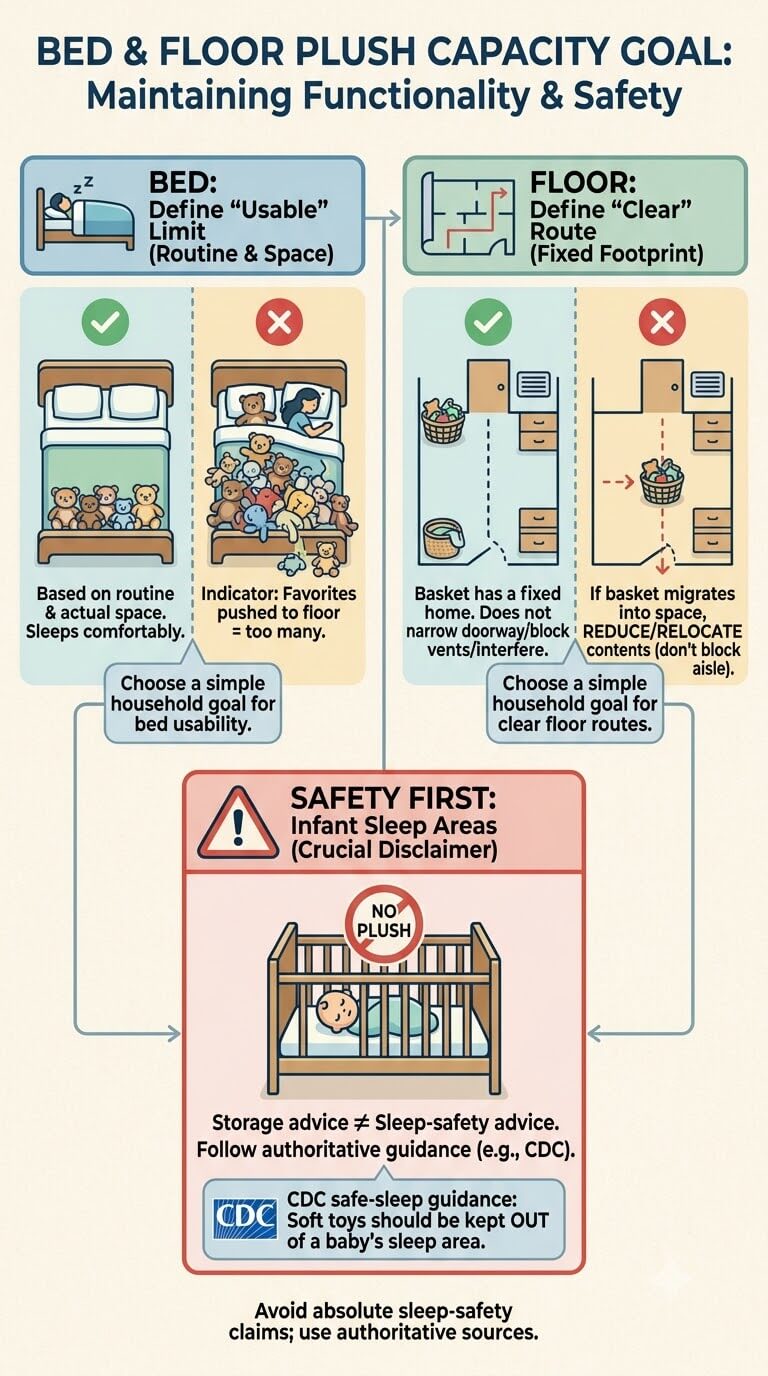
Choose a simple household goal for the bed and floor before selecting containers. The floor should keep a clear route through the room, and the bed should remain usable for its intended purpose. In a small bedroom, plush may need to stay on one wall or in one basket instead of spreading across several surfaces.
Choose how many favorites can live on the bed based on household needs
There is no useful universal number for bed plush. Use the actual sleeping area, routine, and household rules as the limit rather than copying another family’s number. If favorites are constantly pushed to the floor overnight, the bed group is probably too large for the setup.
Give floor baskets a defined footprint
A floor basket is convenient because plush compresses easily, but the basket itself should have a fixed home. Choose a spot that does not narrow a doorway, block a vent, interfere with drawers, or become a tripping point. If the basket migrates into walking space, reduce or relocate its contents instead of treating the aisle as storage.
Avoid absolute sleep-safety claims and use authoritative guidance when relevant
Storage advice should not be treated as sleep-safety advice for infants. If an infant sleep space is part of the household, follow current safe-sleep recommendations rather than a general bedroom organization rule. The CDC safe-sleep guidance says soft toys should be kept out of a baby’s sleep area.
Match Plush to Practical Storage
Floor baskets
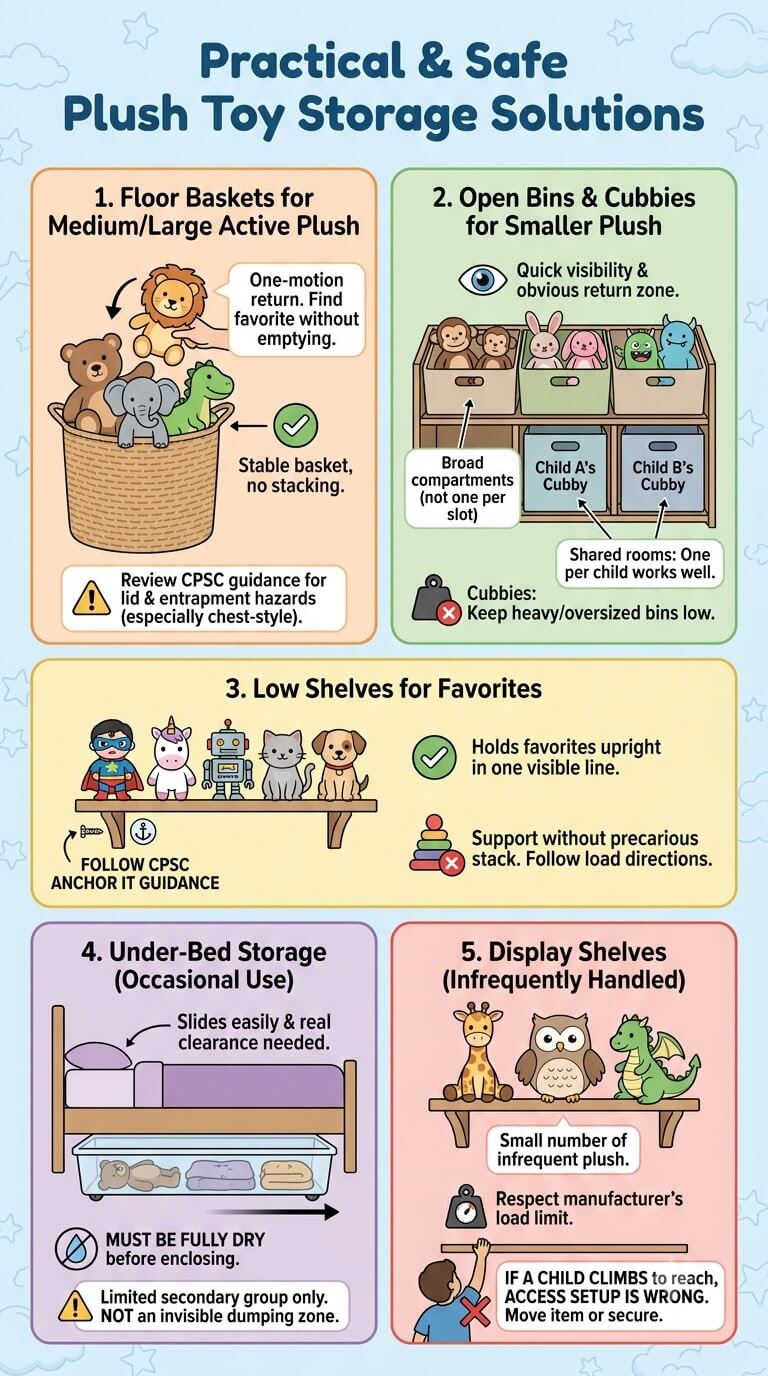
Use floor baskets for medium or large active plush that can be returned in one motion. A good test is whether a favorite can be found without emptying the basket. Choose a stable basket that does not need stacking. If you use a chest-style container, review CPSC guidance on storage and toy chests, especially for lids and entrapment hazards.
Open bins and cubbies
Open bins and cubbies work well for smaller plush because they provide quick visibility and an obvious return zone. Keep compartments broad rather than assigning one animal per slot. In shared rooms, one cubby per child may be simpler than sorting by character. Keep heavy or oversized bins out of high child-access positions.
Low shelves
A low shelf can hold favorites upright, especially when the collection is small enough to stay in one visible line. The shelf should support the toys without a precarious stack. Follow the furniture maker’s installation and load directions. For freestanding storage, review CPSC’s Anchor It guidance and use the anchoring method specified for the furniture and wall type.
Under-bed storage when suitable
Under-bed storage can work for occasional plush when there is real clearance, the container slides easily, and the items are fully dry before being enclosed. Use it for a limited secondary group, not an invisible dumping zone. If the container is heavy or awkward, move it to a more practical location.
Display shelves for a limited group
Reserve display shelves for a small number of plush toys that are handled infrequently. Keep larger pieces lower and respect the manufacturer’s load limit. A display should still allow easy inspection. If a child climbs furniture to reach a displayed toy, the access setup is wrong for that item and household.
Use Hanging or Wall Storage Carefully
When wall pockets or hanging systems may be practical
Wall pockets or purpose-built hanging organizers can save floor area when they are designed for the intended load and installed in an appropriate location. They make the most sense for light plush that can be retrieved without climbing. Keep straps, cords, and protruding hardware away from places where they create access problems.
Follow manufacturer installation and load instructions
Do not estimate how much a wall organizer, shelf, hook, or hanging rail can carry. Use the supplied hardware when appropriate, follow the maker’s wall-type instructions, and respect stated load limits. Stop if hardware loosens, fabric tears, the organizer pulls away, or sagging changes how it is accessed.
Avoid improvised cords, nets, or placements that create entanglement or access hazards
Improvised rope, elastic netting, long cords, or makeshift hanging pockets may create hazards that a simple basket does not. Do not add a suspended system merely because it holds more. If retrieval requires a child to climb, reach over furniture, pull on the organizer, or put the head or body near loose loops, choose another storage method.
Keep Favorites Reachable
Place daily favorites in the easiest return zone
Prime storage should go to the plush toys that actually move through the room each day. Put those favorites near the main play area or bedtime routine, not behind decorative items or seasonal storage. The return action should be obvious: basket, shelf, or assigned cubby.
Avoid burying favorites under a large pile
Deep piles create a search problem. Children pull out half the container to find one animal, then the floor becomes the temporary holding area for everything else. If this happens regularly, split the collection by size or frequency. Keep the most-used plush shallow and visible, and move occasional items to secondary storage.
Give the child a clear return destination
A return destination should be easy to describe in a few words. “Stuffed animals go in this basket” is easier to follow than a six-category sorting system. Picture or word labels can help when bins look alike, but location and size matter more than elaborate labeling. Simplify the setup if cleanup stalls.
Separate Sentimental Plush From Active Play
Create a limited sentimental holding area
Choose one container or one defined shelf for plush that is being kept mainly for sentimental reasons. The limit prevents keepsakes from quietly consuming every active storage location. If the area is full, review what deserves that protected space before adding another bin. This keeps the decision tied to available room rather than pressure to dispose immediately.
Protect stored sentimental items from becoming active-room overflow
If sentimental plush is rarely handled, it does not need to live beside daily toys. Store it in a dry, appropriate place and keep the container identifiable. Do not let a closet corner or playroom floor become an unbounded waiting area. Separating inactive keepsakes makes the active room easier to reset.
Do not turn sentimental decisions into psychological advice
Organization can solve where an item lives, but it should not diagnose why someone wants to keep it. Parents and children may value different objects for different reasons. Set a practical space boundary, allow time for uncertain decisions when needed, and focus on what fits the room. Avoid framing attachment to plush as a character flaw or behavioral problem.
Use Container Capacity as a Limit
One-container rule when it fits the household
A one-container rule is useful when the collection can reasonably fit in one basket, bin, shelf section, or cubby group. The container becomes a visible capacity cue. It is not universal and should not force oversized favorites into an unsuitable space. The storage boundary simply needs to be known before the collection expands beyond it.
What to do when the basket overflows
When plush will not stay below the rim or the basket can no longer be moved easily, stop adding. Pull out the daily favorites first, then identify occasional, sentimental, damaged, or outgrown pieces. Decide whether some belong in secondary storage, a rotation group, or a separate review pile. Add another basket only when it has a clear purpose and permanent home.
Why compressing more into the same area may not solve the volume problem
Soft toys can be squeezed, but heavy compression often hides items and makes the container difficult to use. Storage works only if toys can be retrieved and returned easily. If a child must sit on a lid, force a drawer, or unpack a whole bin to close it, the setup has passed its practical capacity.
Add Rotation Only When It Solves Visibility
Move occasional plush out of daily access
Rotation can help when worthwhile plush toys are used occasionally but make the room visually crowded. Move a small group to labeled secondary storage and leave a manageable active selection. The purpose is to reduce what must be seen and reset each day, not to hide broken, unsafe, or clearly unwanted items.
Keep comfort favorites exempt when appropriate
A rotation system does not have to include every plush toy. If a particular animal is consistently important to the child’s normal routine, leave it accessible. Rotation is a space tool, not a rule that overrides obvious use. Frequently requested items belong in the active group.
Let the rotation system own tracking and schedule details
For plush storage, the only decision needed is whether an occasional item should be out of daily view. Detailed schedules, tracking lists, balanced toy mixes, and rotation triggers belong in the household’s broader toy-rotation process. Keep it simple: active plush here, occasional plush there, with an easy way to bring items back.
Review Damaged, Damp, or Deteriorated Plush
Keep damp items out of closed storage
Do not seal a damp stuffed animal into a lidded bin, bag, or compressed storage container. Let the item become fully dry according to its care instructions before storing it. If there is an unresolved spill, odor, or damage issue, address that before deciding on long-term placement.
Follow care labels before storage
Check the sewn-in care label or manufacturer instructions before doing anything that changes the toy’s condition. Some plush contains electronic parts, weighted inserts, specialty fabrics, or glued decorations that need particular handling. If the label is missing, avoid aggressive cleaning or compression methods that could damage the toy.
Repair, retire, or donate only when appropriate
Loose eyes, torn seams, exposed filling, broken attachments, or deteriorated parts deserve a separate decision before the toy goes back into a child-accessible bin. Detachable parts on some plush products have prompted CPSC recalls. Check the specific product when concerned, especially before passing an older toy to a younger child.
Do not turn this section into a washing guide
The organizational decision is whether the toy is ready to store, not how to deep-clean it. If a plush needs washing, stain treatment, odor removal, or specialized restoration, follow its care directions and handle that task separately. Return it to closed storage only when it is ready for household use and fully dry.
Handle Sibling Ownership
Shared plush versus child-specific favorites
Separate shared play plush from animals that clearly belong to one child when that distinction matters at home. Shared items can use a common basket in the play area, while personal favorites can live near each child’s bed or cubby. This keeps cleanup from becoming an ownership sort and makes each return zone clearer.
Label ownership only when it prevents conflict
Names or simple labels are useful when similar stuffed animals repeatedly get mixed up or when children maintain separate collections. Skip ownership labels if everyone already knows what belongs where. The goal is fewer cleanup decisions. One bin per child may be more practical than tagging every plush.
Consider mixed-age access limits
Older children may own plush toys with accessories or detachable pieces that are not appropriate for younger siblings. Store based on the youngest child who can actually reach the area, not only on the age of the toy’s owner. The CPSC small-parts guidance explains why access to small components matters for young children.
Common Stuffed-Animal Storage Mistakes
Using one huge pile as the system
A large pile looks fast, but retrieval usually breaks the system. Favorites sink, large plush block smaller items, and half the pile lands on the floor during play. Reduce the depth, divide by frequency or size, and make the most-used group visible without unloading the rest.
Letting sentimental items occupy all active storage
Keepsakes can crowd out the toys that are actually used. When that happens, active plush ends up on the floor because the best shelves and baskets are already full. Give sentimental items a separate, limited home. This preserves them without forcing everyday play to compete for the same space.
Installing hanging systems without safety checks
A hanging organizer should never be treated as harmless simply because it is soft. Check installation, load, reach height, nearby furniture, cords, loops, and how the user pulls items out. If a child can climb the furniture, swing from the organizer, or tug the mounting loose, relocate the storage or choose a lower, simpler container.
Adding containers without a capacity rule
More baskets can hide the symptoms of excess volume for a while, but they also consume floor and shelf space. Before adding a container, decide which group it serves and where it will permanently live. If there is no clear location, the room probably needs a collection decision rather than another organizer.
Storing damp plush
Closed bins should receive only fully dry stuffed animals. A damp toy pushed into the bottom of a packed container is easy to forget and hard to inspect. Keep it out until the moisture issue is resolved. This is especially important for under-bed bins, closet boxes, and other secondary storage that may not be opened often.
When the Collection Exceeds the Room
Declutter outgrown or unwanted plush
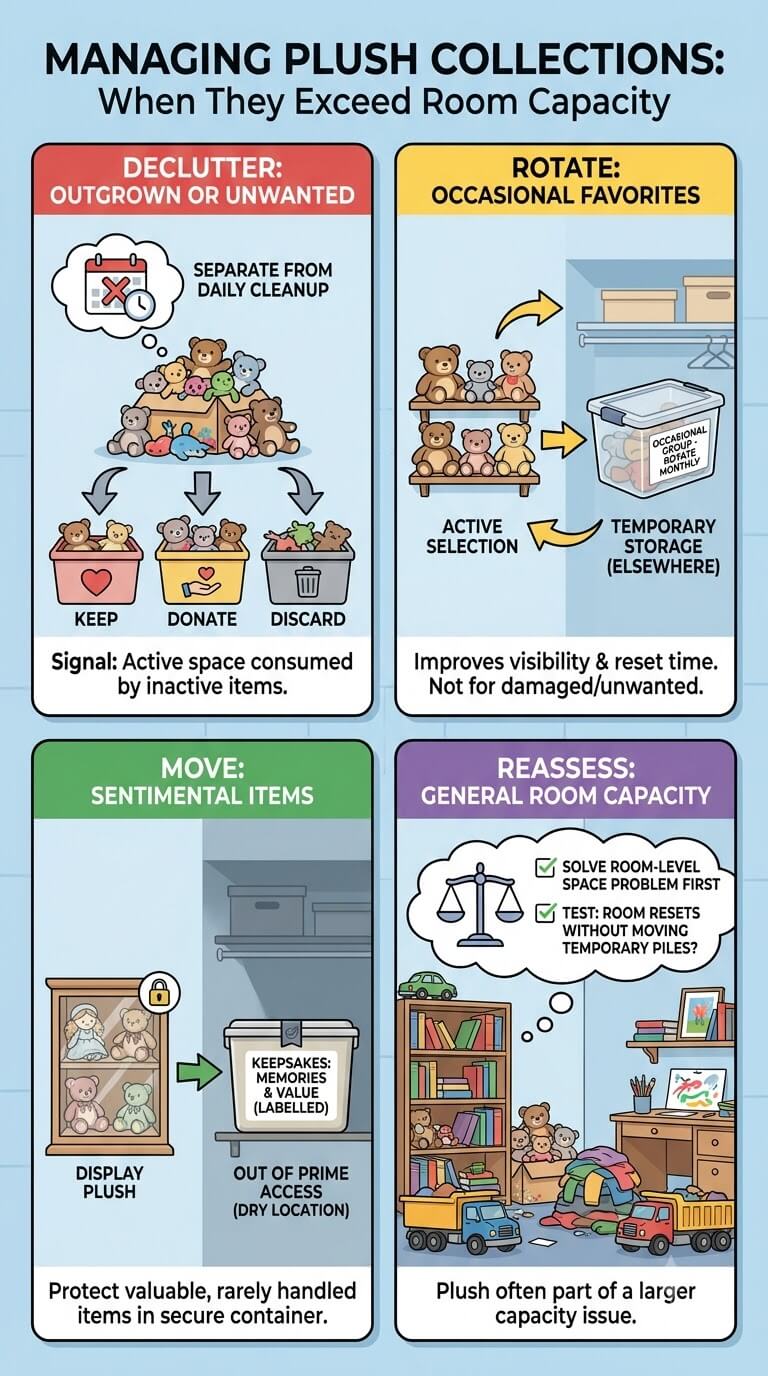
If many stuffed animals are no longer played with, wanted, or meaningful, storage changes alone will not solve the room. Set those pieces aside for a separate keep, donate, or discard review. Do not mix that full decision process into daily cleanup. The signal is simple: active space is being consumed by items that no longer need active status.
Rotate worthwhile occasional plush
Occasional favorites can leave the room temporarily without leaving the household. Store a small, clearly identified group elsewhere and bring it back when it is wanted or when the active selection is reviewed. Rotation helps with visibility and reset time, not damaged or unwanted toys.
Move sentimental items to separate storage
If keepsake plush is valuable to the family but rarely handled, move it out of prime child-accessible storage. Use a dry location and a container that protects the items without being so large that it becomes a new overflow zone. Label the container clearly enough for future review.
Reassess general room capacity
Sometimes the stuffed animals are only one part of a room that is already over capacity. If books, art supplies, large toys, and clothing also compete for the same floor and shelves, solve the room-level space problem rather than forcing plush into unsafe or inaccessible places. A good test is whether the room resets without moving items from one temporary pile to another.
FAQ About Organizing Stuffed Animals
What is the easiest way to store a lot of stuffed animals?
Start with one accessible basket or cubby group for active plush and a separate location for occasional or sentimental items. Sort by use frequency before adding containers. If the active basket overflows after that split, reduce the active collection or rotate part of it instead of letting several floor baskets spread across the room.
Should stuffed animals stay on the bed?
That depends on the child, the bed, and the household. Keep only the number that leaves the bed functional and can be returned easily during normal routines. For an infant sleep space, follow current safe-sleep guidance rather than general storage advice and keep soft toys out of the sleep area.
Are hanging stuffed-animal nets a good idea?
They can provide storage in some rooms, but they are not automatically the best choice. Use a product suited to the location and load, follow installation instructions, and consider cords, loops, reach height, nearby furniture, and retrieval. If the setup encourages climbing or unsafe pulling, use a lower basket, cubby, or shelf instead.
How should I store sentimental stuffed animals?
Separate sentimental plush from everyday play toys, choose a limited dry storage area, and keep the group identifiable. Do not compress delicate items simply to fit more into one box. Review the care label before long-term storage and keep rarely handled toys out of active-room circulation.
When should I declutter instead of rotate plush?
Declutter when items are unwanted, clearly outgrown, unsuitable to keep, or no longer worth household space. Rotate when the toys are still wanted but the active room is too crowded to display and reset them all comfortably. Rotation should not become a holding strategy for broken, unsafe, or permanently unwanted items.
A useful stuffed-animal system is usually simple: favorites stay easy to reach, bulky pieces get a defined physical home, keepsakes leave prime play space, and overflow triggers a decision instead of another pile. When the child can find a favorite and return it without emptying the room, the storage is doing its job.

Ethan Carter is the Founder & Editor of HomeCleanSecrets. Based in the United States, he has 5 years of experience creating practical home cleaning, laundry care, stain removal, decluttering, and home organization content. His goal is to help everyday households clean smarter and build simple routines that are easier to maintain.
Read more about Ethan Carter on his author page: https://homecleansecrets.com/ethan-carter/