
A mudroom works best when it handles transition, not storage for every category in the house. The room should help people come in with wet shoes, coats, bags, and small daily items, move those things into predictable places, and leave again without stepping over yesterday’s clutter.
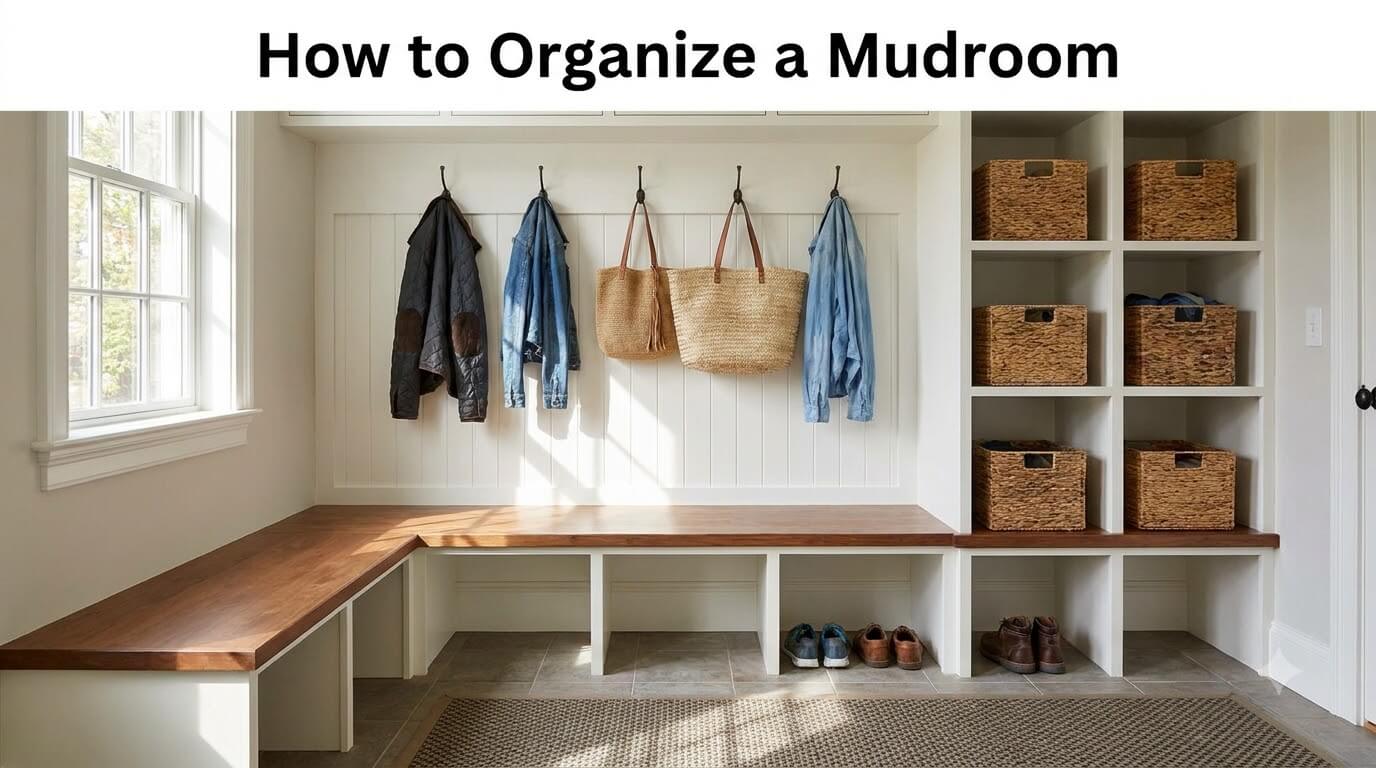
The most reliable setup starts with traffic rather than furniture. Notice which door people use, what arrives through it, where wet or dirty items first touch the room, and which items need to leave again the next morning. Then assign a few clear zones, set capacity limits, and move everything else to a better long-term location.
Quick Answer: Organize the Room From Dirty Arrival to Clean Departure
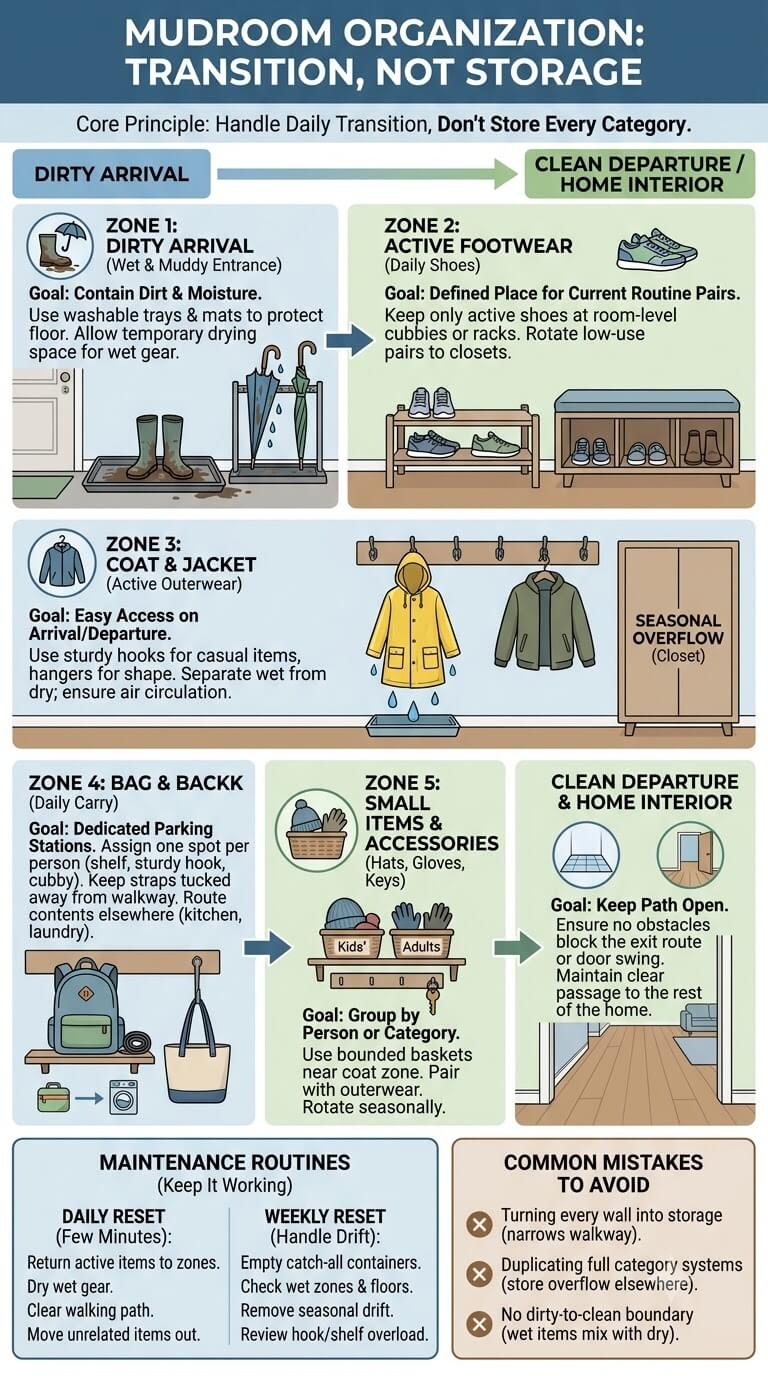
Think of the mudroom as a short sequence: enter, contain dirt and moisture, remove footwear and outerwear, park bags, route small items, and keep the departure path open.
Mudroom versus basic entryway
A basic entryway may have room for only a tray, hooks, and a few active shoes. A mudroom usually has enough space for several coordinated zones and more weather exposure. Use the broader entryway and mudroom framework when you need to compare a dedicated mudroom with a smaller foyer or simple landing zone before deciding how much storage the entrance should carry.
The multi-zone advantage and its limits
A mudroom can separate shoes, coats, bags, accessories, and wet gear so one category does not bury another. The limit is the walking route.
Audit What the Mudroom Is Actually Used For
Before buying organizers, empty obvious overflow and list what passes through the room during a normal week.
Main entrance versus secondary entrance traffic
A side entrance used by the family every day needs different storage from a decorative front entrance used mostly by guests. Count the people and routines that actually use the mudroom.
Daily family categories
List the categories that repeatedly appear: active shoes, one or two outerwear pieces, backpacks, work bags, lunch bags in transit, keys, umbrellas, and seasonal accessories. If an item leaves the house only a few times a month, it usually does not deserve prime daily space.
Weather and wet-item exposure
Track what changes in rain, snow, or muddy seasons. Boots may need a drip-safe landing area, coats may need air circulation, and umbrellas may need a place to drain.
Adjacent laundry, pet, or sports categories
A mudroom beside the laundry room may briefly hold a damp towel before washing, and a household with a dog may keep a leash near the exit. Treat these as handoff points.
Remove categories that do not belong
Return tools, bulk paper goods, unopened packages, old donation bags, household repair supplies, and rarely used gear to their proper homes. If you cannot explain how an item supports arrival, departure, weather handling, or an immediate handoff, it is probably consuming transition space without helping the room function.
Map Traffic Flow Before Adding Storage
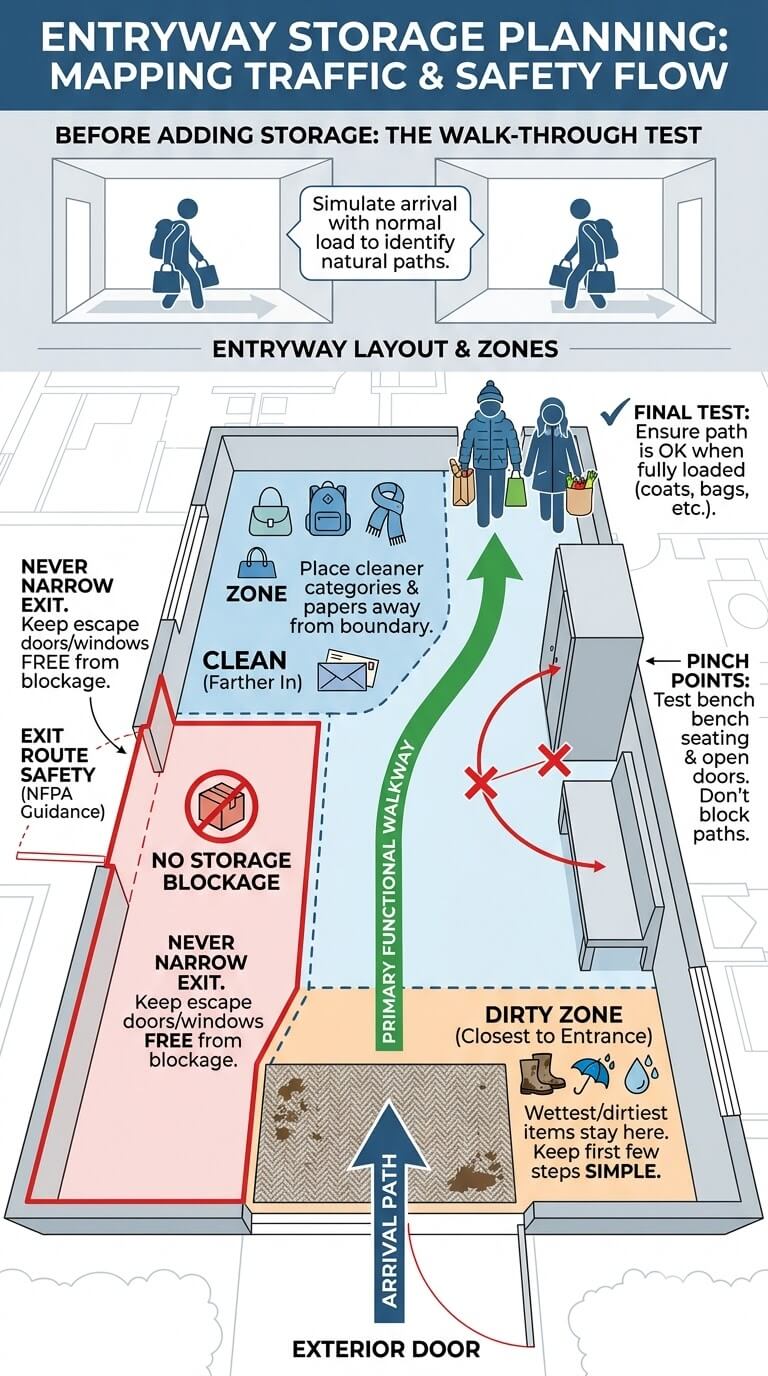
Stand outside the room and walk through it carrying what you normally bring home.
Arrival path
The first few steps inside should stay simple. Put the dirtiest or wettest categories closest to the entrance when practical, then place cleaner categories farther in.
Door swing and exit access
Keep furniture, baskets, shoes, and bags away from the path needed to open and use exterior doors. NFPA home escape guidance emphasizes keeping doors and windows used for escape free from blockage, so storage should never depend on narrowing the exit route. Review NFPA home escape planning guidance when deciding what can safely sit near an exterior door.
Dirty zone to clean zone progression
Use the floor nearest the door for boots, damp umbrellas, and items carrying visible debris. Place bags, clean accessories, and papers farther from that boundary.
Bench and cabinet pinch points
A bench is useful only if someone can sit without blocking another person or preventing a door from opening. Open cabinet doors and drawers before final placement.
Keep the primary walkway functional
Test the room with coats on, backpacks loaded, and grocery bags in hand. A path that feels fine when the room is empty may be awkward when people are dressed for winter.
Create the Shoe and Boot Zone
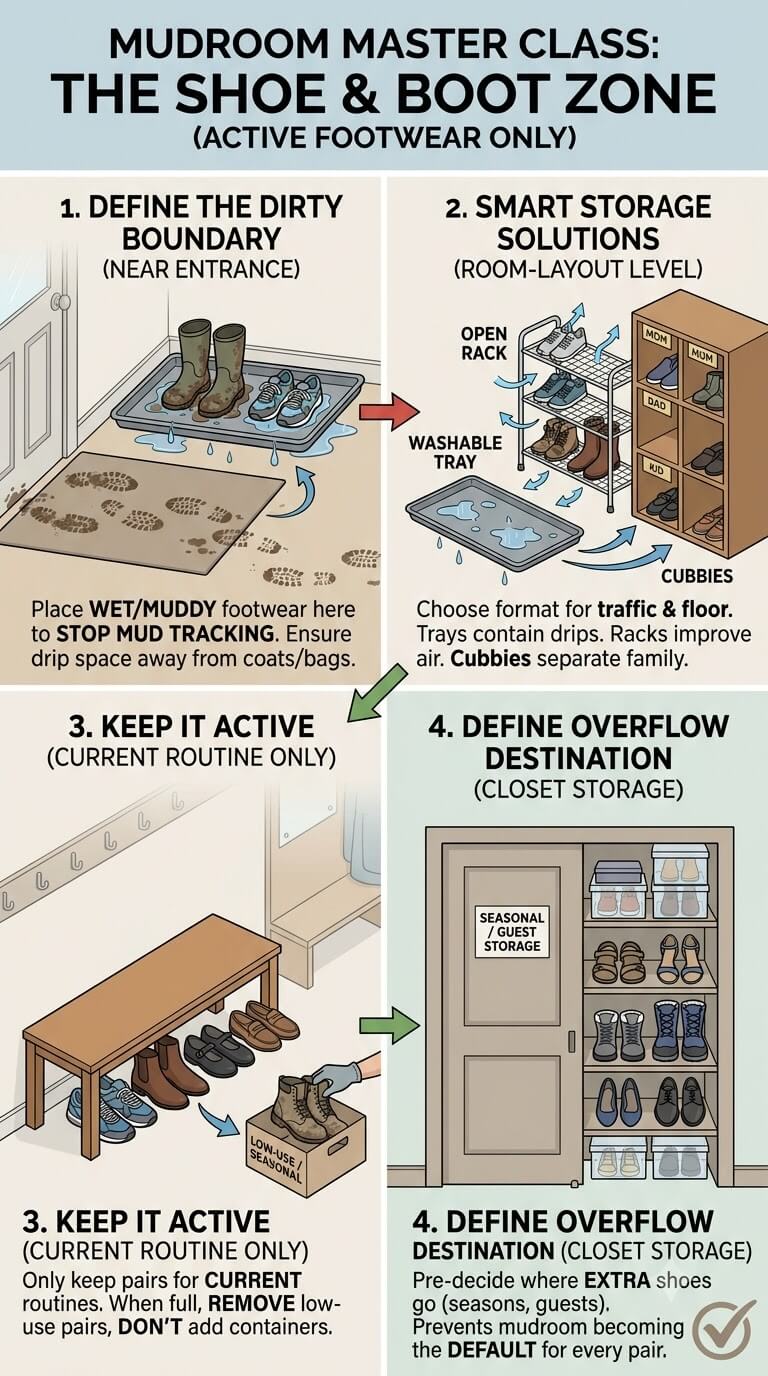
The mudroom needs a defined place for active footwear, not every pair anyone owns.
Place wet or muddy footwear near the dirty boundary
Keep boots and dirty shoes near the entrance so mud does not travel through the room. Leave enough room for wet footwear to sit without dripping onto bags or coats.
Use trays, racks, or cubbies at room-layout level
A washable tray can contain drips, an open rack can improve access and air movement, and cubbies can separate family members. Choose the format that fits the traffic pattern and floor material.
Leave detailed rotation to the footwear system
Keep only the active pairs required for current routines. When one person’s area fills, remove low-use pairs rather than adding another container.
Define overflow to closet storage
Decide in advance where extra shoes go when seasons change or guests arrive. An overflow destination prevents the mudroom from becoming the default location for every pair.
Create the Coat and Jacket Zone
Outerwear should be easy to remove on arrival and easy to grab before departure.
Hooks, hangers, or cubbies at room level
Hooks are fast for casual jackets, while hangers may suit garments that should keep their shape. Cubbies can group a person’s small outerwear items.
Separate wet from dry outerwear
A dripping raincoat should not be pressed between dry wool coats or stored over electronics and bags. Give wet pieces temporary open-air space until they are dry enough for normal storage.
Kid-accessible and adult zones
Place children’s daily hooks and cubbies where they can reach them without climbing on a bench or cabinet. Adult storage can sit higher if needed.
Keep seasonal overflow out of active storage
Heavy winter coats do not need to occupy prime hooks in warm months, and lightweight rain shells do not need a full wall in dry seasons. Rotate the active group as weather changes and move the rest to closet storage so hooks remain easy to use.
Create the Bag and Backpack Zone
Bags need parking places that support the next departure without leaving straps across the floor.
Family-member stations
Give each person one defined parking position for the bag used most often. A station can be a cubby, shelf, sturdy hook, or floor space below a bench.
Cubbies, hooks, or shelf parking
Match storage to loaded weight and bag shape. Heavy laptop bags are often better on a shelf or cubby than on light-duty hooks.
Keep straps out of traffic
Tuck shoulder straps, drawstrings, and loose handles inside the storage footprint. If a backpack hangs low enough for straps to reach the walkway, raise the bag, shorten the straps, or change the parking method.
Route bag contents elsewhere instead of storing papers in the mudroom
Lunch containers go to the kitchen, damp gym clothes go to laundry, and school or work papers go to the place where action happens. The bag station should park the bag itself.
Create a Wet-Weather Zone
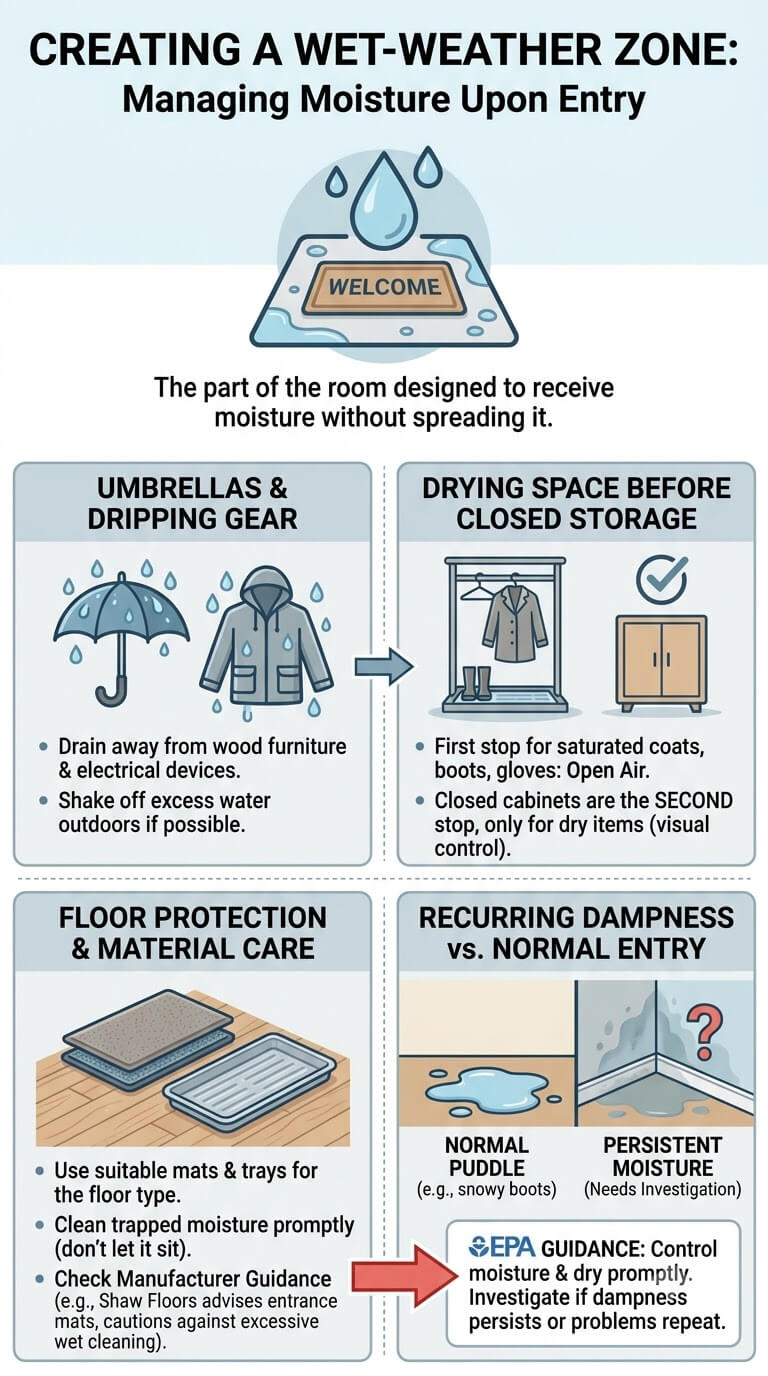
A wet-weather zone is the part of the room designed to receive moisture without spreading it.
Umbrellas and dripping gear
Let umbrellas drain where water will not collect under wood furniture or beside electrical devices. Shake off excess water outdoors when practical.
Drying space before closed storage
Closed cabinets are useful for visual control after items are dry. They are not the first stop for saturated coats, boots, or gloves.
Floor protection and material care
Use mats and trays that suit the floor underneath, and clean trapped moisture before it sits for long periods. Shaw Floors advises using entrance mats to trap dirt and moisture on hardwood, while also warning against excessive wet cleaning. Check flooring manufacturer care guidance before choosing a wet-entry routine for a specific floor.
Recurring dampness versus normal wet-entry conditions
A puddle from snowy boots is different from a wall, floor, or cabinet that remains damp after the gear has dried. Persistent moisture deserves investigation rather than another basket. EPA guidance stresses moisture control and prompt drying when water problems occur. Use EPA moisture guidance if the room stays damp or shows repeated water-related problems.
Organize Hats, Gloves, and Seasonal Accessories
Small accessories disappear when they are scattered across shelves, pockets, and bags.
Pair accessories with outerwear
Place everyday hats, gloves, scarves, and ear protection near the coat zone rather than in a distant cabinet. People are more likely to return them when the storage point matches the dressing sequence.
Use bounded baskets
Give each person or category a basket only large enough for active items. A deep bin can hide unmatched gloves, old hats, and random accessories for months.
Rotate by season
Move insulated gloves and heavy hats out when warm weather arrives, then bring them back before the season begins. Keep transitional pieces available only if they are actually used.
Prevent accessory bins from becoming miscellaneous storage
Do not let batteries, tools, sunscreen, receipts, dog treats, toys, and loose hardware share the glove basket simply because it is nearby. If a small item has no relation to getting dressed for departure, move it to the place where it is used.
Build Family Stations Without Overcomplicating the Room
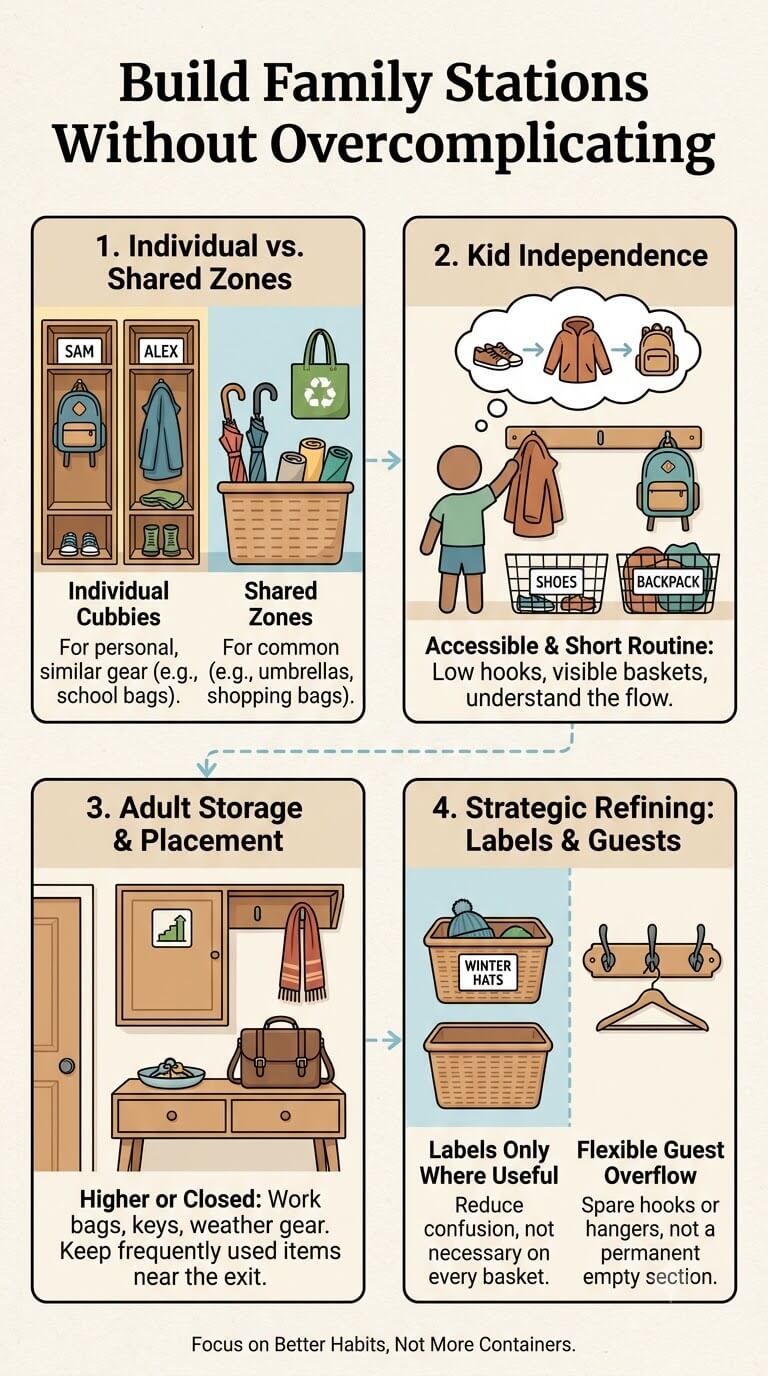
Family stations can reduce mix-ups, but more labels and containers do not automatically create better habits.
Individual cubbies or shared zones
Use individual cubbies when family members carry similar bags or need separate school gear. Shared storage can work for umbrellas, reusable shopping bags, or guest items.
Kid independence
Children are more likely to put things away when they can reach the hook, see the basket, and understand what belongs there. Keep the routine short: shoes here, coat here, backpack here.
Adult storage
Adult work bags, keys, outerwear, and weather accessories can sit higher or in closed storage if that improves the room. Keep frequently used items near the departure route.
Guest overflow
Reserve a small amount of flexible space rather than a permanent guest section that stays empty most of the year. A few spare hangers or hooks may be enough.
Labels only where useful
Labels help when identical cubbies create confusion, but they are not necessary on every basket. Use names, initials, or simple category labels where they reduce decisions.
Decide the Role of Benches, Cabinets, Shelves, Trays, and Baskets
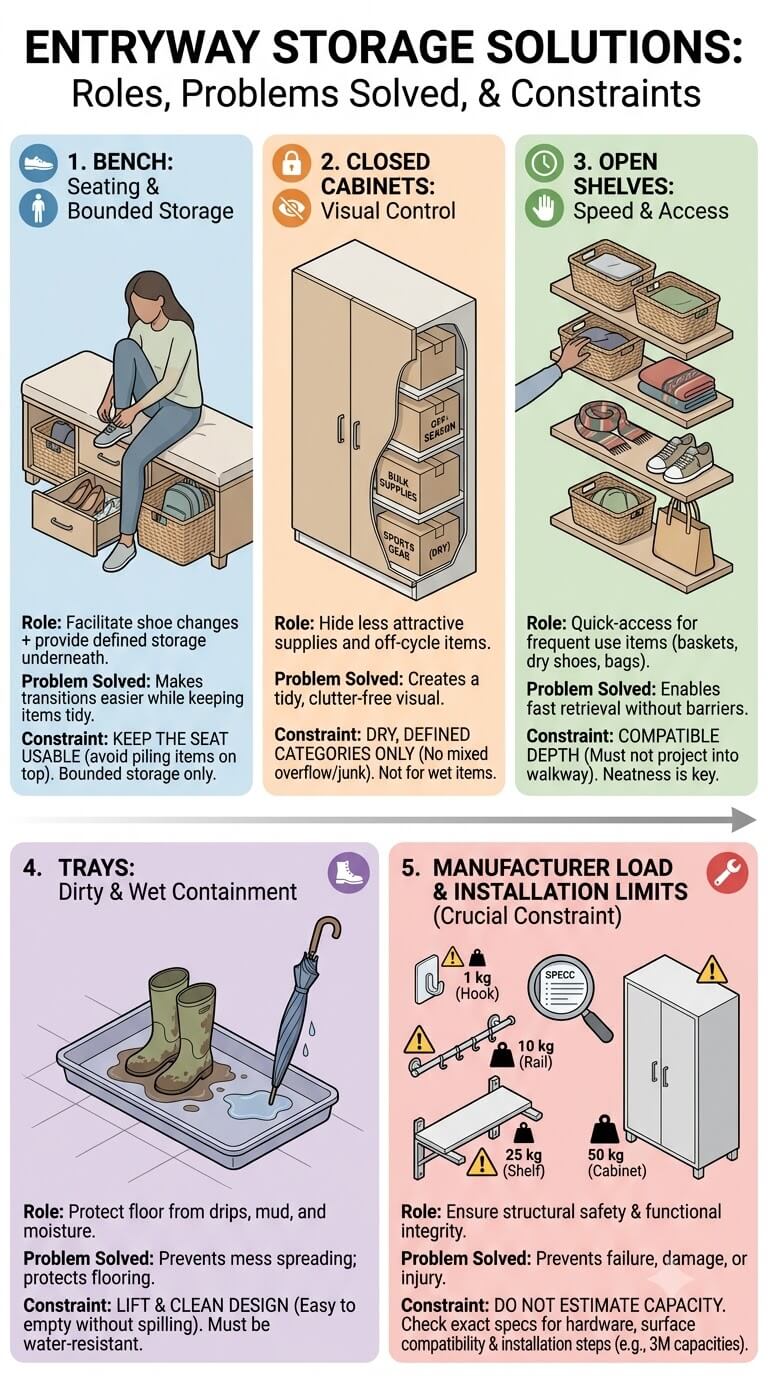
Each storage type should solve a specific problem.
Bench as seating plus bounded storage
A bench can make shoe changes easier and may provide storage underneath. Keep the seat usable.
Closed cabinets for visual control
Cabinets can hide less attractive supplies and off-cycle items, but closed storage should hold dry, defined categories. Avoid using a cabinet to hide mixed overflow.
Open shelves for speed
Open shelves work well for baskets, dry shoes, or bags that need fast access. Keep shelf depth compatible with the walkway so items do not project into traffic.
Trays for dirty or wet containment
Use trays under boots, umbrellas, or other drip-prone items when the floor needs protection. Choose a tray that can be lifted and cleaned without spilling.
Manufacturer load and installation limits
Do not estimate capacity by appearance. A small adhesive hook, wall-mounted rail, shelf, and freestanding cabinet have different limits and installation requirements. For example, 3M publishes specific weight capacities for individual Command products. Check the exact manufacturer’s specifications for the hardware you plan to use, including compatible surfaces and installation steps.
Handle Pet Walking Gear, Sports Gear, and Laundry Adjacency at the Boundaries
These categories can touch the mudroom routine without taking over the room.
One small pet walking station at overview level
A hook or small basket for the active leash, harness, and waste bags can make sense near the exit. Keep pet food, medicine, grooming tools, toys, and backup supplies in their dedicated storage.
Sports gear as controlled overflow rather than a full system
One current practice bag or a pair of cleats may pass through the room. Large balls, protective equipment, seasonal sports bins, and rarely used gear should have another home.
Laundry-adjacent handoff without duplicating laundry-room organization
If the laundry area is nearby, dirty uniforms, wet towels, or washable mats can move there quickly. Do not store detergent, stain products, hampers, and folding supplies in the mudroom unless the room truly serves both functions and has safe, dedicated space for them.
When a category should move elsewhere
Move a category when it does not support arrival or departure, when it crowds a primary zone, or when its care needs conflict with the room. Wet laundry, valuable electronics, bulk cleaning chemicals, and long-term collections generally need more appropriate locations.
Seasonal Rotation and Overflow Strategy
A mudroom should change with the household’s current routines.
Active-season capacity
Define how many shoes, coats, bags, and accessory baskets fit comfortably during the busiest season. Use that as the room’s real capacity. If winter requires more space, edit harder in summer so empty containers do not invite unrelated clutter.
Off-season relocation
Move off-season coats, boots, hats, and activity gear to closets, under-bed storage, or another suitable area after cleaning and drying them according to their care needs. Label stored groups if necessary so seasonal changeover does not require searching through several unrelated bins.
Guest and event overflow
Temporary events can exceed normal capacity. Clear a planned overflow location before guests arrive instead of letting coats cover benches and shoes block doors.
When too many categories are being forced into the room
If every shelf has a different purpose, family members cannot remember where things go, or resets require moving one category to reach another, reduce the number of categories. A mudroom is more useful with six obvious zones than with fifteen tightly packed ones.
Mudroom Daily Reset
A daily reset restores the route for tomorrow.
Return shoes, coats, and bags
Put active shoes in the footwear zone, hang or park dry outerwear, and return bags to their assigned stations. Do not spend the reset reorganizing entire collections.
Dry wet items
Spread damp coats, gloves, boots, and umbrellas so they can dry in an appropriate location. Wipe obvious puddles and empty trays if water is collecting.
Clear the walking path
Move straps, packages, baskets, shoes, and dropped accessories out of the route between the exterior door and the rest of the home. Open the door fully as a quick test.
Move unrelated items out
Carry paperwork to its action area, dishes to the kitchen, laundry to the hamper, tools to their storage, and donation items to the planned staging area. A few minutes of routing prevents the mudroom from becoming the place where undecided household objects wait indefinitely.
Mudroom Weekly Reset
The weekly reset handles drift that a daily routine misses.
Empty catch-all containers
Inspect baskets, drawers, and bowls that collect small objects. Return each item to its real home and remove trash. If the same unrelated category appears every week, create a better destination elsewhere rather than giving the catch-all a larger container.
Check wet zones and floor condition
Clean trays and mats according to their material instructions, remove grit, and check the floor around them for trapped moisture. Stop if a mat backing, tray, or rug is discoloring or damaging the surface underneath.
Remove seasonal drift
Look for last month’s sports bag, extra coat, unused boots, or out-of-season accessories that never left. Move them to overflow storage. Weekly editing catches slow accumulation before the room reaches the point where every hook and cubby is overloaded.
Review hook, shelf, and cubby overload
Check whether hooks are carrying multiple heavy items, shelves are bowing, or cubbies are packed tightly enough that items fall out. Freestanding storage also deserves a stability check. CPSC maintains safety information on tip-over hazards for clothing storage units and related furniture. Review CPSC furniture stability guidance and follow the instructions for the exact furniture in your home.
Common Mudroom Organization Mistakes
Most mudroom failures are not caused by a lack of bins.
Turning every wall into storage
More shelves can reduce usable room if they make the walkway narrow or visually crowded. Leave some wall and floor space empty.
Duplicating full category systems
The mudroom does not need the complete shoe collection, entire coat wardrobe, every backpack, all pet supplies, and all sports equipment. Keep only the active portion of each category.
No dirty-to-clean boundary
If muddy boots sit beneath clean bags or dripping umbrellas share a shelf with papers, the room lacks a useful boundary. Move the wettest categories closer to the entrance and keep clean items farther in or higher up where splashes and tracked dirt are less likely.
Too many unrelated categories
A mudroom can look organized while still holding too much. Labeled baskets do not help if many contain items that never leave through the door.
Trapping wet gear
Stuffing damp gloves into baskets or closing soaked boots inside cabinets may hide clutter but creates a poor drying setup. Give wet items temporary open space, then return them after drying.
Blocking door or bench access
Shoes under a door, backpacks beside the threshold, and baskets in front of a bench create daily friction. The room should work without moving objects out of the way.
When the Mudroom Needs a System Change, Not More Storage
Repeated failure after a reset usually points to a design or capacity problem.
Overflow returns immediately after reset
If a cleared bench or floor is covered again within a day, identify which category returns first. That category may have too little capacity, a storage location that is inconvenient, or too many active items.
Family members bypass zones
When everyone drops bags in the same corner despite assigned cubbies, the corner may be closer to the natural route. A good test is to observe where items land without prompting.
Wet items have nowhere to dry
If every storm creates coats over chairs and boots across the floor, the room needs a deliberate drying plan. Free enough open space for the household’s realistic wet-weather load.
The room stores more than it transitions
When most shelves hold things that have not left the house in months, the mudroom has become a general storage room. Reclaim it by moving long-term categories elsewhere.
FAQ About Organizing a Mudroom
These answers focus on the decisions that determine whether a mudroom remains easy to use during normal family traffic and wet-weather days.
What zones should a mudroom have
Most mudrooms benefit from a footwear zone, outerwear zone, bag zone, small seasonal-accessory area, and a place for wet gear to dry. Add a compact landing point for daily small items only if needed.
How do you organize a mudroom for a family
Start with shared traffic flow, then assign personal stations only where ownership matters. Give each person a defined place for active shoes, outerwear, and a primary bag.
Where should wet boots and coats go
Place wet boots near the dirty entrance boundary on a floor-safe tray or mat, and hang wet coats where air can circulate without dripping on bags or electronics. Let items dry before moving them into closed storage, and address any room surface that stays persistently damp.
Do you need a bench in a mudroom
No. A bench is useful when people regularly sit to change shoes and there is enough clearance to keep the seat accessible.
How do you keep a mudroom from becoming a catch-all
Limit the room to active transition categories, give every zone a visible capacity, and route unrelated items out during a short daily reset. Empty catch-all containers weekly.
What should move out of an overcrowded mudroom
Move off-season footwear and outerwear, rarely used bags, bulk pet supplies, full sports collections, paperwork, household tools, donation piles, and long-term storage first. Keep the items that leave through the door frequently or need a short wet-weather handoff, then reassess how much furniture the room actually needs.
Final Thoughts
An organized mudroom is not the room with the most cubbies.
When the room starts failing, return to the sequence instead of buying another organizer: audit what is active, protect the walking route, separate wet from dry, assign limited zones, test the daily flow, and remove what exceeds capacity. A simpler mudroom that supports real routines is easier to reset than a heavily furnished room trying to store everything.

Ethan Carter is the Founder & Editor of HomeCleanSecrets. Based in the United States, he has 5 years of experience creating practical home cleaning, laundry care, stain removal, decluttering, and home organization content. His goal is to help everyday households clean smarter and build simple routines that are easier to maintain.
Read more about Ethan Carter on his author page: https://homecleansecrets.com/ethan-carter/