
Choosing between natural cleaning and commercial cleaners is not really a contest between “good†and “bad.†The better question is what you are trying to remove, what surface you are touching, and whether the job is basic cleaning, stain removal, odor control, grease cutting, scale removal, or disinfecting. A mild soap solution may be perfect for a daily counter wipe, while a labeled disinfectant may be the better choice after raw meat prep, illness, or a bathroom mess that needs more than visible soil removed.
This guide compares natural cleaning vs commercial cleaners without turning it into a brand list or pretending one category solves every household problem. You will see where vinegar, baking soda, dish soap, and water shine, where store-bought formulas are more dependable, and when disinfectant should follow its own label directions.
Quick Answer: Which Cleaner Should You Choose?
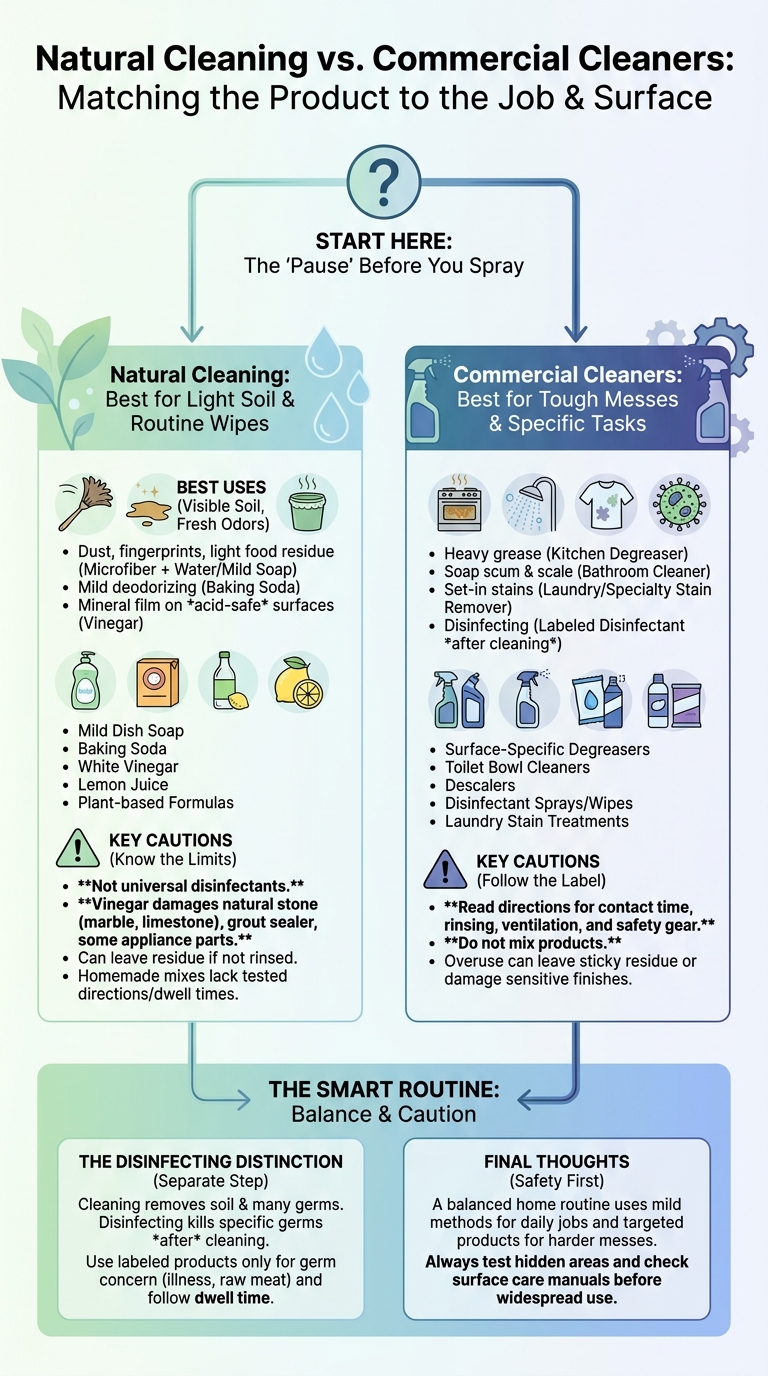

Most homes need both simple cleaning methods and a few well-chosen commercial products. Natural cleaners work well for light soil, fresh odors, mineral film in safe places, and many routine wipe-downs. Commercial cleaners often work better when you need a tested formula for heavy grease, soap scum, disinfecting, appliance care, specialty stains, or a surface that has specific care limits.
Best uses for natural cleaners
Natural cleaning products are usually best when the mess is low-risk and the surface is compatible. A few drops of dish soap in warm water can handle many washable surfaces, especially when the goal is removing dust, fingerprints, light food residue, or sticky spots. Baking soda can help with mild deodorizing and gentle scrubbing when used carefully. Vinegar can help with some mineral deposits and hard-water film, but only on acid-safe materials.
- Use warm water and mild soap for routine cabinet fronts, painted trim, plastic bins, and many sealed household surfaces.
- Use baking soda as a light deodorizing helper in trash cans, refrigerators, and washable containers after the main soil is removed.
- Use vinegar only where the surface can tolerate acid, such as some glass or certain removable shower parts, and avoid it on natural stone.
- Use microfiber and water when dust, fingerprints, or light smudges are the real problem.
A good test is to clean a small hidden area first and wait until it dries. If the surface looks dull, sticky, etched, swollen, or discolored, stop and switch methods before cleaning the whole area.
Best uses for commercial cleaners
Commercial cleaning products make sense when the job needs more consistency than a homemade mix can give. A kitchen degreaser, toilet bowl cleaner, soap scum remover, laundry stain treatment, dishwasher cleaner, glass cleaner, or disinfectant wipe is built for a narrower job. The value is not just strength. It is also clearer directions, contact time, surface warnings, storage instructions, and in some cases a claim that has been reviewed or tested for a specific use.
Choose a store-bought cleaner when the soil is greasy, the stain has set, the surface is expensive, the appliance manual limits what you can use, or the job involves disinfecting. If a label says the cleaner needs a wet contact time, rinsing, gloves, or ventilation, treat those details as part of the cleaning method, not optional fine print. The EPA explains that products in its Safer Choice program are reviewed against criteria for ingredients, performance, packaging, and human health and environmental considerations through its Safer Choice program.
When disinfectants are a separate decision
Cleaning and disinfecting are related, but they are not the same job. Cleaning removes soil, grease, crumbs, body oils, and many germs from a surface. Disinfecting uses a product labeled to kill certain germs when used exactly as directed. The CDC recommends cleaning surfaces before disinfecting because dirt and other material can interfere with how disinfectants work in its home cleaning and disinfecting guidance.
That means a natural cleaner may be enough for a dusty shelf, a lightly used table, or a daily bathroom counter wipe. A disinfectant may be appropriate after illness, toilet accidents, raw meat prep, trash leaks, or other situations where germ control is the main concern. Do not assume a cleaner disinfects unless the label says so and gives directions for that purpose.
What Natural Cleaning Usually Means

Natural cleaning usually refers to simple household ingredients or products marketed as plant-based, low-scent, dye-free, biodegradable, or less harsh. The phrase can be useful, but it can also be vague. A product can sound gentle and still irritate skin, damage a finish, or fail at disinfecting. The safest way to think about natural cleaning is as a category of tools for certain jobs, not as a guarantee.
Common natural cleaner categories
The most common natural cleaning options are mild dish soap, castile-style soap, vinegar, baking soda, washing soda, lemon juice, salt, hydrogen peroxide, alcohol-based products, and plant-based store-bought cleaners. They do not all do the same thing. Soap helps loosen oils and soil. Vinegar is acidic. Baking soda is mildly abrasive and alkaline. Hydrogen peroxide can affect dyes and some materials. Essential oils add scent, but scent is not the same as cleaning power.
Before using any of these, ask one question: what does this ingredient do to the mess and to the surface? Vinegar can be useful on some mineral buildup, but the same acidity can harm stone, grout sealer, and certain appliance parts. Baking soda can help lift residue, but scrubbing too hard can dull plastic, stainless steel coatings, glass cooktops, and glossy finishes.
Strengths for everyday soil and odors
Natural cleaners are strongest when the job is frequent, light, and visible. A damp microfiber cloth can remove dust without adding residue. Mild soap can remove food film from a washable table. Baking soda can reduce stale smells inside a clean, dry container. Vinegar can help loosen some water spots on acid-safe glass. These are practical jobs where the goal is cleaner-looking, better-smelling, more manageable surfaces.
They are also useful when someone in the home is sensitive to fragrance. A low-scent routine with fewer products can make cleaning feel less overwhelming. This does not mean “chemical-free,†because everything is made of chemicals, including water and vinegar. It means you are using simpler formulas, less scent, and fewer specialty products where the task allows it.
Limits on germs, grease, scale, and material safety
The biggest mistake is expecting a natural cleaner to do every job. Vinegar is not a universal disinfectant. Baking soda is not a degreaser for thick cooking oil. Lemon juice is not safe for every surface. Soap is excellent for many soils, but it can leave a film if not rinsed where needed. A homemade mixture also does not come with the same tested instructions as a labeled product.
Stop using a natural cleaner if the surface changes texture, the stain spreads, the area becomes sticky after drying, or the smell gets sharper instead of fading. Those are signs that the product is either not reaching the soil or is reacting poorly with the material. At that point, rinsing with clean water, drying, and checking the care instructions is safer than adding a stronger ingredient on top.
What Commercial Cleaners Usually Do Better

Commercial cleaners are not automatically stronger, safer, or more effective than simple cleaning methods. Their advantage is that many are designed for a specific cleaning problem. A toilet cleaner is made for a toilet bowl, not a kitchen counter. A degreaser is made for oily buildup, not untreated wood. A disinfectant is made for germ control, not necessarily for removing thick grime by itself.
Degreasing, disinfecting, descaling, and specialty stains
Commercial formulas often do better when the soil has a clear chemistry problem. Kitchen grease needs a product that can cut oil. Bathroom scale may need an acid-based remover that is safe for that fixture. Rust, tannin, mildew stains, hard-water rings, and laundry stains may need targeted treatments. These products can save time because they are made for a specific soil instead of relying only on scrubbing.
The safety limit is just as important. A strong cleaner used on the wrong surface can create permanent damage faster than a weak cleaner used patiently. Stone, painted cabinets, acrylic tubs, glass cooktops, unsealed grout, appliance coatings, and specialty flooring should be cleaned according to the care guide whenever you are unsure.
Convenience and consistency
A ready-to-use product removes guesswork. The label tells you where to use it, how long to let it sit, whether to rinse, what not to mix it with, and how to store it. This is helpful for busy households because the same bottle can be used the same way each time. It also reduces the risk of making a homemade mix too strong, storing it badly, or forgetting what was in the container.
Convenience matters most in high-use zones. A bathroom cleaner kept near the bathroom, a food-safe dish soap near the kitchen sink, and a labeled disinfectant reserved for germ concern can create a cleaner routine than a cupboard full of half-used ingredients. The goal is not to own more products. It is to own fewer products that match real messes.
Label directions and surface claims
The label is part of the product. It tells you whether a cleaner is meant for sealed surfaces, food-contact areas, toilets, glass, stone, stainless steel, laundry, or drains. It also tells you when to ventilate, wear gloves, rinse, avoid fabrics, keep children away, or avoid mixing. The American Cleaning Institute emphasizes reading and following product directions for safe and effective use in its cleaning product safety guidance.
If the label does not name your surface, do not treat it as permission. Test discreetly, check the manual, or choose a milder method. This is especially important on newer appliances and surfaces with protective coatings, where the wrong cleaner may remove shine, damage a seal, or void a care recommendation. Before combining products or homemade ingredients, review the cleaning products you should not mix.
Comparison Table by Cleaning Job

The right choice becomes clearer when you match the product to the job instead of matching it to a personal preference. Use the table as a starting point, then check the surface, label, and care instructions before applying anything widely.
| Cleaning job | Natural option that may work | Commercial option that may work better | Key caution |
|---|---|---|---|
| Light dust and fingerprints | Microfiber with water | Surface-safe all-purpose cleaner | Avoid overwetting wood or electronics. |
| Fresh food spills | Mild dish soap and warm water | Kitchen cleaner for heavier residue | Rinse food-contact surfaces when the label requires it. |
| Greasy stovetop film | Soap for light oil | Degreaser made for the surface | Check glass, enamel, stainless, or coating limits. |
| Hard-water marks | Vinegar on acid-safe surfaces | Lime or scale remover | Keep acids away from stone and sensitive finishes. |
| Illness cleanup | Cleaning first with soap and water | Labeled disinfectant after cleaning | Follow wet time, ventilation, and storage directions. |
| Set-in laundry stains | Pre-rinse and mild soap for fresh stains | Laundry stain remover | Check fabric care tags and colorfastness. |
Kitchen grease and food zones
Kitchen cleaning usually starts with soil removal. Warm water and dish soap are often enough for counters, handles, cabinet fronts, and fresh spills when the surface allows it. Grease near the stovetop is different. If the film feels tacky after a soap wipe, a surface-safe degreaser may work better than repeated scrubbing.
Food zones need extra care. Do not leave cleaner residue where food is prepared. If a product label says to rinse after use on food-contact surfaces, rinse and dry before using the area again. A mild cleaner used correctly is safer than a stronger product used casually.
Bathroom soap scum, scale, and toilets
Bathrooms create several different messes in one room. Soap scum is a mix of soap residue, minerals, and body oils. Hard-water scale is mineral buildup. Toilet bowls may need a product made for toilet surfaces. Vinegar may help with light mineral film on compatible materials, but it is not a universal bathroom cleaner.
Commercial bathroom cleaners can be helpful because they are targeted. The main risk is stacking products. Do not add bleach, acids, toilet cleaners, or disinfectants on top of each other. If one product did not work, rinse thoroughly, ventilate, dry if the label requires it, and choose the next step only after the first product is gone.
Floors, stone, wood, glass, and appliances
Surface compatibility matters more than the cleaner category. Natural stone can be damaged by acidic cleaners. Wood can swell if overwet. Glass can scratch if scrubbed with gritty powders. Stainless steel can streak or dull if cleaned against the care instructions. Appliances may have coated panels, rubber seals, filters, and sensors that need specific care.
When the item is expensive or new, the safest first step is the manual or care tag. Many manufacturers give surface-specific cleaner limits, and those details matter more than whether a product sounds natural or heavy-duty. A hidden spot test is still useful, but it does not replace a clear care warning.
Laundry, stains, and odors
Laundry is where simple methods and commercial products often work together. Cool water, blotting, and plain detergent can help with fresh spills. A stain remover may be better for oil, makeup, grass, blood, or set-in marks. Baking soda may help with mild odors in some wash routines, but it will not fix every smell if the real issue is mildew, trapped body oil, overloaded washing, or a dirty machine.
Check the care tag before adding boosters, soaking, or using stain treatments. Stop if dye transfers to the cloth, the fabric roughens, or the stain spreads. Those signs mean the method is too aggressive or the stain needs a different approach.
Surface Compatibility and Damage Risks
Most cleaning damage comes from a mismatch: the wrong product, too much product, too much dwell time, or too much scrubbing for the material. Natural cleaners can cause this damage too. Commercial cleaners can also be gentle when chosen correctly. The surface should lead the decision.
Vinegar and acid-sensitive materials
Vinegar is popular because it is inexpensive, easy to find, and useful on some mineral deposits. Its weakness is acidity. Do not use vinegar on marble, limestone, travertine, many stone counters, some grout sealers, certain appliance parts, or surfaces where the manual warns against acidic cleaners. Etching can look like dull spots, cloudy patches, or a rougher texture that does not wipe away.
A safer habit is to reserve vinegar for surfaces you know can handle it. When in doubt, use mild soap and water first. If mineral buildup remains, choose a product labeled for that surface instead of increasing vinegar strength or dwell time.
Abrasives on delicate finishes
Baking soda, powders, scrub pads, salt, and stiff brushes can all act like abrasives. They may be fine on some durable surfaces, but they can dull plastic tubs, scratch glass, haze stainless finishes, and wear protective coatings. Damage often appears only after the surface dries, which is why testing matters.
Use the least abrasive tool that still moves the soil. Start with soaking, dwell time allowed by the label, or a soft cloth before using powders or scrubbing pads. If you hear a gritty sound or see dull streaks forming, stop and rinse.
Product residue and overuse
More cleaner does not mean more clean. Too much soap can leave a sticky film that attracts dirt. Too much spray can seep into seams, electronics, wood edges, or appliance controls. Too much disinfectant can leave residue if the label requires rinsing and you skip that step.
A clean surface should feel normal after it dries. If it feels tacky, slick, powdery, or strongly scented long after cleaning, you may be using too much product or not rinsing when needed. Reduce the amount, switch to a damp rinse cloth where safe, and dry the surface fully.
Safety, Storage, and Scent Considerations
Safety is not decided by the word natural or commercial. It depends on ingredients, concentration, ventilation, contact time, surface compatibility, storage, and whether products are mixed. A simple routine with clear labels and careful storage is safer than a crowded cabinet of mystery bottles.
Natural does not always mean risk-free
Vinegar can irritate and damage certain materials. Essential oils can bother people with scent sensitivity and may be risky around some pets depending on the oil and exposure. Hydrogen peroxide can affect color. Washing soda can irritate skin. Even mild soap can make a floor slippery if too much is left behind.
Poison Control warns that household cleaning products can cause problems when used incorrectly, swallowed, splashed, inhaled, or mixed with other products in its cleaning product safety overview. Store all cleaners, including homemade ones, away from children and pets, and do not put cleaners in drink bottles or unlabeled containers.
Commercial does not always mean harsh
Some store-bought products are fragrance-free, dye-free, plant-based, or designed for sensitive households. Others are strong specialty products that require gloves, ventilation, and careful storage. The category alone does not tell you how harsh a cleaner is. The label and the task do.
A practical setup might include mild dish soap, microfiber cloths, a surface-safe all-purpose cleaner, a bathroom cleaner, a laundry stain product, and one disinfectant for times when it is truly needed. That can be less risky than constantly mixing new homemade recipes or using a strong cleaner for every wipe-down.
Label reading, ventilation, and storage
Read the directions before the first use, not after something smells too strong. Look for the surface list, dwell time, rinse instructions, first-aid directions, storage instructions, and warnings about mixing. Open a window or turn on a fan when the label calls for ventilation or when scent builds up in a small room.
Keep products in their original containers whenever possible. If you mix a small amount of a simple cleaner for immediate use, label it clearly and avoid storing unknown leftovers. Never combine products because you hope the mixture will work faster. If one cleaner fails, rinse and reset before choosing another product.
Decision Tree: Natural, Commercial, or Disinfectant?

The easiest way to choose is to pause before spraying. Identify the mess, surface, care limits, and whether visible cleaning is enough or germ control is needed. That short pause prevents over-cleaning and many damage mistakes.
Is it soil, odor, stain, scale, grease, or germ concern?
Soil and dust usually need cleaning. Odor may need washing, drying, ventilation, or removing the source. Stains may need a targeted treatment. Scale usually needs a mineral-removal approach on compatible surfaces. Grease needs a grease-cutting product. Germ concern may need cleaning first and then a disinfectant.
Choosing by mess type keeps you from using disinfectant on dust, vinegar on grease, baking soda on delicate finishes, or a heavy degreaser on a surface that only needed a damp cloth. The job should define the product.
What surface are you cleaning?
Before choosing a cleaner, name the surface as specifically as possible. “Counter†is not specific enough. It may be laminate, quartz, granite, marble, butcher block, stainless, painted wood, or sealed concrete. “Floor†may be vinyl, tile, sealed hardwood, laminate, stone, or cork. Each material can react differently.
If you cannot identify the material, start mild and keep water controlled. Avoid acids, abrasives, strong solvents, and long dwell times until you know more. The wrong product can create permanent damage even when the mess itself was minor.
Is there a label, manual, or care tag limit?
Labels, manuals, and care tags are decision shortcuts. They tell you what the product or surface maker considers safe. This matters for appliances, flooring, counters, upholstery, clothing, painted cabinets, and fixtures. If a manual rules out vinegar, abrasive pads, bleach, steam, or certain sprays, follow that limit. A practical cleaning supplies list can turn this comparison into a small kit matched to your actual surfaces.
When the label on a cleaner and the care instructions for the surface disagree, choose the more cautious path. A product can be safe for some surfaces and wrong for yours.
Common Comparison Mistakes
The most common mistakes come from turning a preference into a rule. Some people use vinegar everywhere because it feels simpler. Others use strong commercial products everywhere because they want to feel thorough. Both habits can waste time and damage surfaces when the cleaner does not match the job. The broader guide to cleaning mistakes to avoid covers the workflow and surface errors that product choice alone cannot solve.
Treating every DIY recipe as safe
A homemade recipe is not automatically safer because the ingredients are familiar. Mixing acids, oxidizers, alcohols, soaps, or powders can create irritation, residue, or poor performance. Some mixtures cancel each other out, some damage surfaces, and some should not be stored.
Keep homemade cleaning simple. Use one purpose at a time, make small amounts when needed, label anything you keep briefly, and avoid mixing products with disinfectants, bleach, drain cleaners, or specialty chemicals.
Disinfecting when cleaning is the real need
Many household jobs do not need disinfecting. Dusty shelves, light fingerprints, crumbs, most cabinet fronts, and routine floor soil usually need cleaning. Using a disinfectant for every small mess can create extra residue, scent, cost, and label steps without solving the real issue.
Reserve disinfectants for times when germ reduction is the actual goal. Clean first, then follow the disinfectant label. If the label says the surface must stay wet for a set time, a quick swipe does not give the product the conditions it needs.
Ignoring material compatibility
Cleaner choice should change when the material changes. Vinegar on glass is not the same decision as vinegar on marble. Baking soda in a trash can is not the same decision as baking soda on a glossy cooktop.
When damage would be expensive, slow down. Test, read, and choose the gentlest effective method.
FAQ
These answers cover the comparison questions homeowners usually have when deciding between simple ingredients, natural products, and store-bought formulas.
Are natural cleaners as effective as commercial cleaners?
Natural cleaners can be very effective for light soil, mild odors, routine wiping, and some mineral deposits on compatible surfaces. Commercial cleaners are often more effective for heavy grease, disinfecting, soap scum, set-in stains, specialty surfaces, and jobs that need clear label directions. Effectiveness depends on the mess and surface, not the category name.
Is vinegar safe for every surface?
No. Vinegar is acidic and can damage marble, limestone, travertine, some grout sealers, certain appliance parts, and other acid-sensitive finishes. It may be useful on some acid-safe glass or mineral deposits, but it should not be treated as an all-purpose cleaner. Check the care instructions first.
Do natural cleaners disinfect?
Most natural cleaning methods are for cleaning, not disinfecting. Some products may have disinfecting claims, but you should only rely on that if the product label states what it disinfects and how to use it. Soap and water can remove soil and reduce many germs from surfaces, but a disinfectant is a separate product choice when germ control is the goal.
What is the safest cleaner for everyday home cleaning?
The safest everyday cleaner is usually the mildest option that works on the specific surface: often warm water, a microfiber cloth, and a small amount of mild dish soap. For heavier jobs, choose a product labeled for the surface and follow the directions. Safety improves when you use less product, avoid mixing, ventilate when needed, store cleaners correctly, and stop when a surface reacts badly.
Final Thoughts
Natural cleaning vs commercial cleaners is a practical decision, not a loyalty test. Use simple methods for light daily soil, low-scent routines, and compatible surfaces. Use commercial cleaners when the mess is heavier, the task is specialized, the surface has strict care needs, or the label gives directions that a homemade method cannot provide. Choose disinfectants only when germ control is the goal, and clean first so the product can work as intended.
The best home routine is usually a balanced one: mild tools for everyday cleaning, targeted products for harder messes, and careful label reading every time a product touches a new surface. When you match the cleaner to the mess and the material, your home gets cleaner with less damage, less clutter, and fewer risky shortcuts.

Ethan Carter is the Founder & Editor of HomeCleanSecrets. Based in the United States, he has 5 years of experience creating practical home cleaning, laundry care, stain removal, decluttering, and home organization content. His goal is to help everyday households clean smarter and build simple routines that are easier to maintain.
Read more about Ethan Carter on his author page: https://homecleansecrets.com/ethan-carter/