
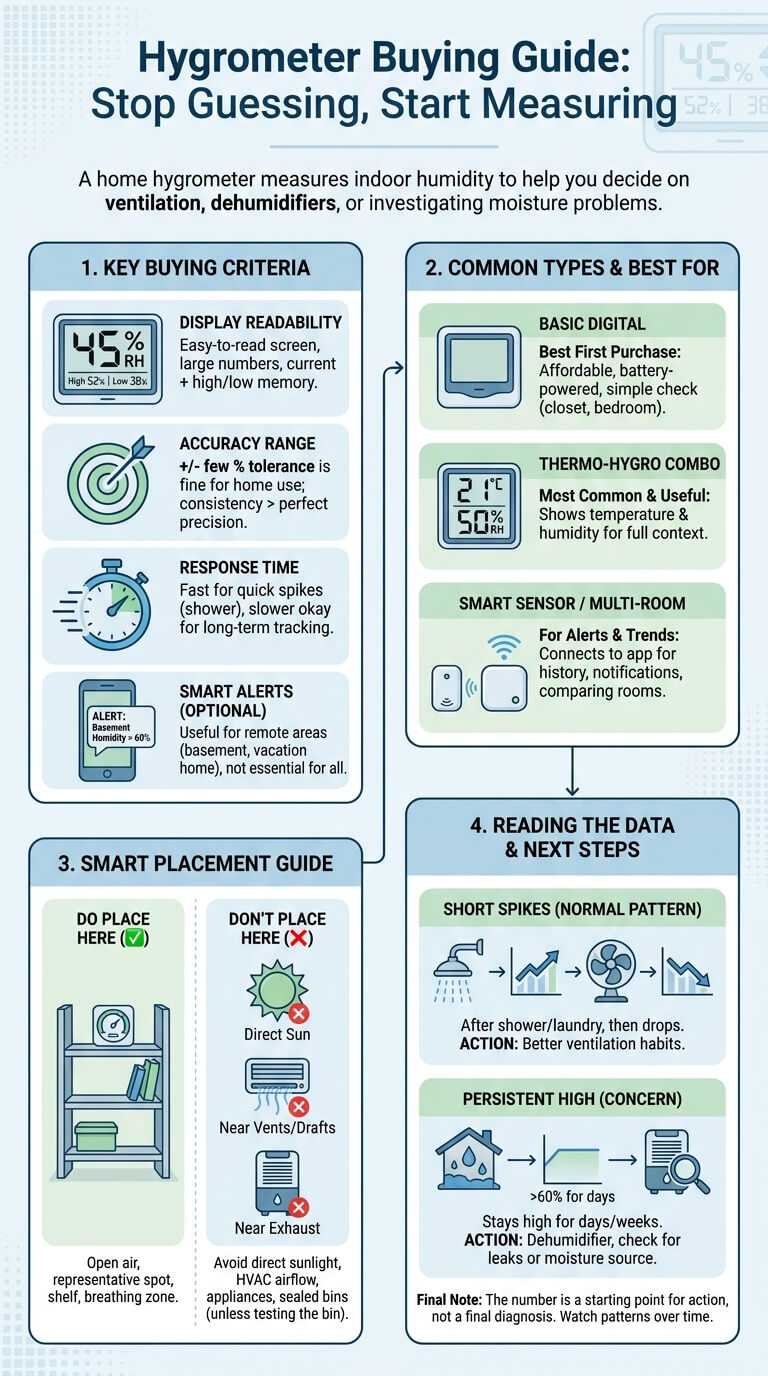
A home hygrometer is a small humidity meter that helps you see whether a room is actually damp, temporarily humid, or just uncomfortable for another reason. For most homes, the best choice is a simple digital hygrometer with an easy-to-read screen, reasonable accuracy, fast enough response, and a memory feature that shows recent high and low humidity. Smart sensors can be useful when you need alerts in a basement, rental unit, vacation home, nursery, closet, or storage room, but they are not necessary for every household.
The main reason to buy one is to stop guessing. A room can smell stale because of closed windows, dust, storage clutter, wet laundry, poor ventilation, or high relative humidity. A hygrometer cannot remove moisture, clean mold, repair a leak, or tell you exactly what is behind a wall. It can, however, show whether indoor humidity is staying high long enough to justify a dehumidifier, better ventilation habits, a closet moisture absorber, or a closer look for a moisture problem.

Quick Answer: What to Look for in a Home Hygrometer
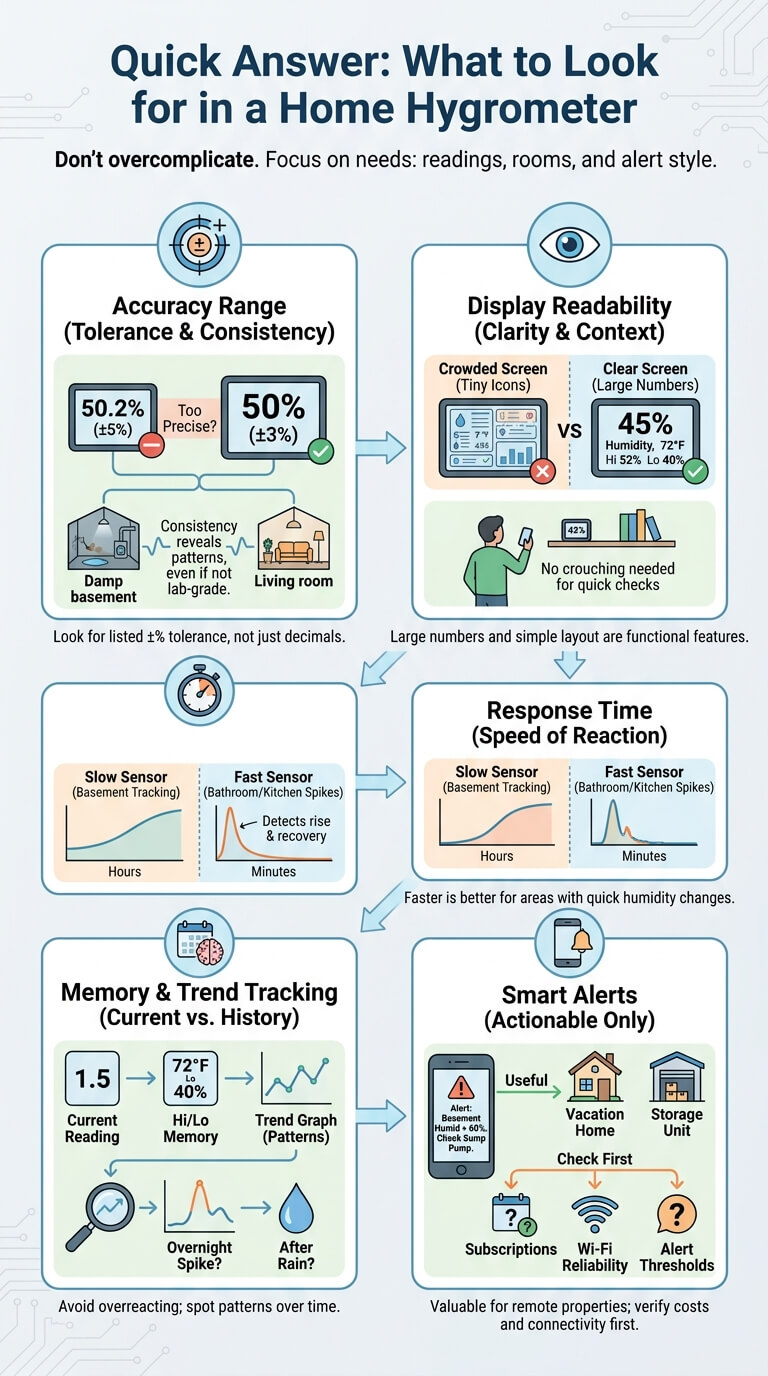
Do not shop for the most complicated humidity gauge first. Start with the readings you need, the rooms you want to check, and whether you need a number on a screen or a phone alert when humidity rises.
Once you have a few readings, you can match them to the right home moisture control products instead of buying from guesswork.
Accuracy range
For normal home use, look for a listed humidity accuracy tolerance, often shown as plus or minus a few percentage points of relative humidity. A display that looks precise to the decimal is not automatically more useful than a clear whole-number reading if the sensor itself has a wider tolerance. For damp-room decisions, consistency matters almost as much as the exact number. If one room keeps reading much higher than another under similar conditions, that pattern is useful even if the sensor is not laboratory-grade.
Display readability
A good indoor humidity monitor should be readable from where you naturally check it. Large numbers, a simple percent sign, clear temperature display, and a visible high-low memory are usually more useful than a crowded screen full of icons. For a basement shelf or laundry room, choose a display that can be read without crouching or picking up the device. For an older homeowner, a busy parent, or anyone checking readings quickly, readability is a real buying feature, not a cosmetic extra.
Response time
Response time is how quickly the device reacts when room humidity changes. A slower sensor may still be fine for tracking a basement over several hours. A faster one is better near a bathroom hallway, laundry area, or kitchen where humidity can spike quickly and drop after fans or open doors are used. If you are testing whether a shower fan routine works, you want a device that notices the rise and the recovery, not only the average hours later.
Memory and trend tracking
At minimum, a useful hygrometer should show current humidity. A better one also stores recent high and low readings. Trend tracking helps you avoid overreacting to one humid afternoon or missing a pattern that happens overnight, after rain, or while the HVAC system is off.
Smart alerts only when useful
Smart alerts are helpful when you will act on them. A phone notification can be valuable for a finished basement, rental property, vacation home, or storage area with items you care about. Before paying more, check subscriptions, export options, reporting frequency, alert thresholds, and Wi-Fi reliability.
What a Hygrometer Does and Does Not Do
A hygrometer is a measuring tool. It tells you about air conditions at its location, then you decide what to do with that information. Knowing this limit prevents two common mistakes: buying moisture-control products too soon, or expecting a small meter to diagnose a hidden home problem.
Measures relative humidity
Most home hygrometers show relative humidity, which is the amount of moisture in the air compared with how much moisture the air could hold at that temperature. Warm air and cool air can feel different even at the same percentage. That is why a basement may feel damp at a reading that seems similar to another room. The NIST humidity program is a useful reminder that humidity measurement is a real measurement field, not just a comfort guess.
Does not remove moisture
A hygrometer will not dry a closet, lower basement humidity, clear condensation, or protect stored items by itself. It simply tells you when the air is humid. If readings are high, the next step may be ventilation, a dehumidifier, changing laundry habits, reducing packed storage, or finding a leak. If readings are normal, buying a bigger moisture-control product may not solve the actual complaint.
Helps decide whether another product is needed
The best value of a humidity gauge is before you buy something larger. If a bedroom stays in a normal range but smells stale, cleaning or airflow may matter more than a dehumidifier. If a basement stays high for days, a dehumidifier or repair check becomes more reasonable. If only one closet runs slightly high, better spacing or a small absorber may be enough.
Why one reading is not the whole story
One reading can be misleading. A room may read high after a shower, during a rainy day, while wet clothes are drying, or when windows are open in humid weather. A good test is to check the same spot for several days at similar times, then compare the highest reading, lowest reading, and how quickly the room recovers after moisture-producing activities. Patterns are more useful than a single number.
Types of Hygrometers for Home Use
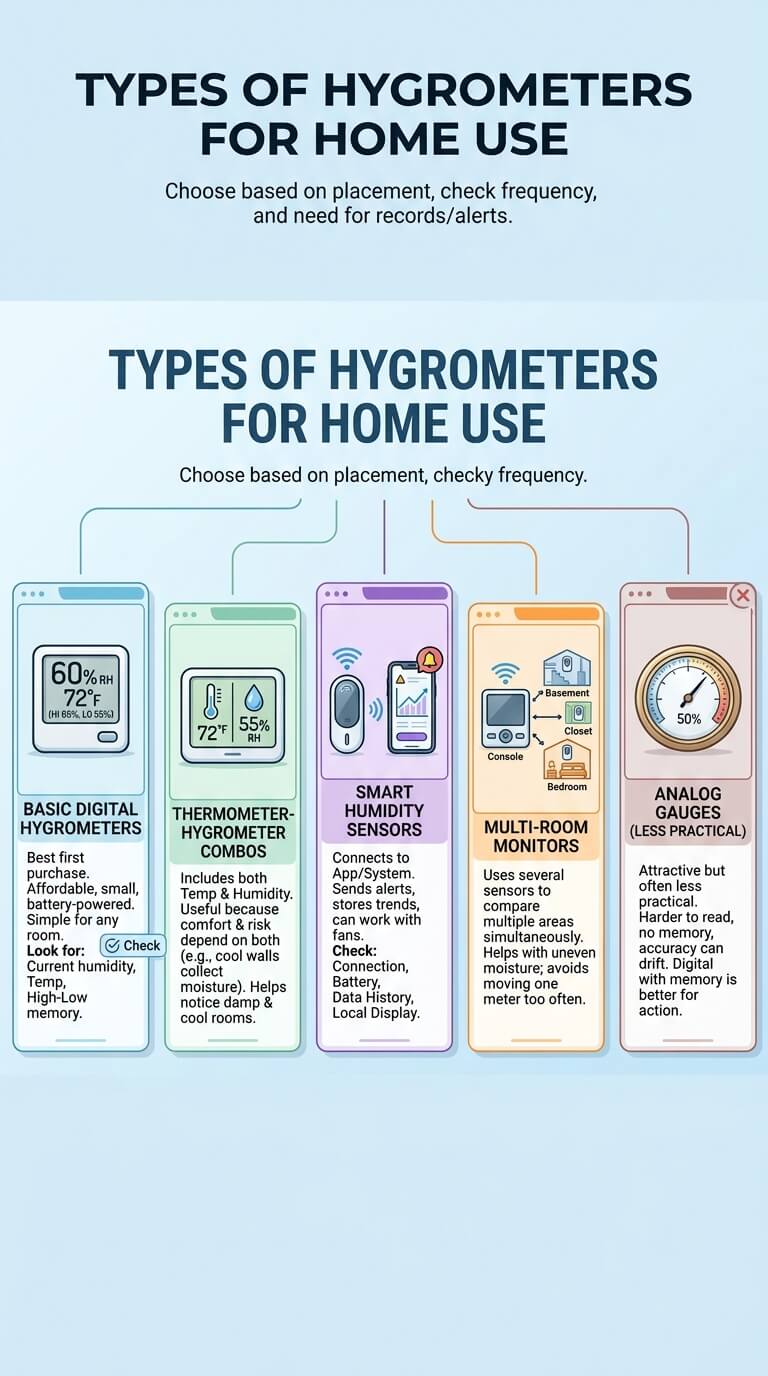
Most shoppers only need one of a few common options. Choose based on where the device will sit, how often you will check it, and whether you need records or alerts.
Basic digital hygrometers
A basic digital hygrometer is usually the best first purchase. It is affordable, small, battery-powered, and simple enough for a kitchen counter, basement shelf, bedroom dresser, or closet ledge. Look for current humidity, temperature, and high-low memory. Skip tiny novelty versions if the display is hard to read or the product listing does not give any accuracy information.
Thermometer-hygrometer combos
Most digital home units include both temperature and humidity. This is useful because comfort, condensation, and material risk depend on both. For example, a cool basement wall can collect moisture even when the rest of the house feels fine. A combination display lets you notice whether a damp-feeling room is also cooler than nearby spaces.
Smart humidity sensors
A smart humidity sensor connects to an app or home system. It can send alerts, store trends, and sometimes work with fans, plugs, or thermostats. Check connection type, battery life, data history limits, and whether readings still show locally if the app or internet connection is down.
Multi-room monitors
A multi-room system uses several sensors so you can compare a basement, bedroom, closet, laundry area, and storage room at the same time. This helps in homes with uneven moisture and avoids confusing the record by moving one meter too often.
Analog gauges and why they may be less practical
Analog humidity gauges can look attractive, but they are often less practical for beginner home troubleshooting. The scale may be harder to read, memory is usually absent, and accuracy can drift. They may be fine for decorative comfort checks, but a digital unit with high-low memory is usually better for deciding whether a basement, closet, or laundry room needs action.
Key Buying Criteria
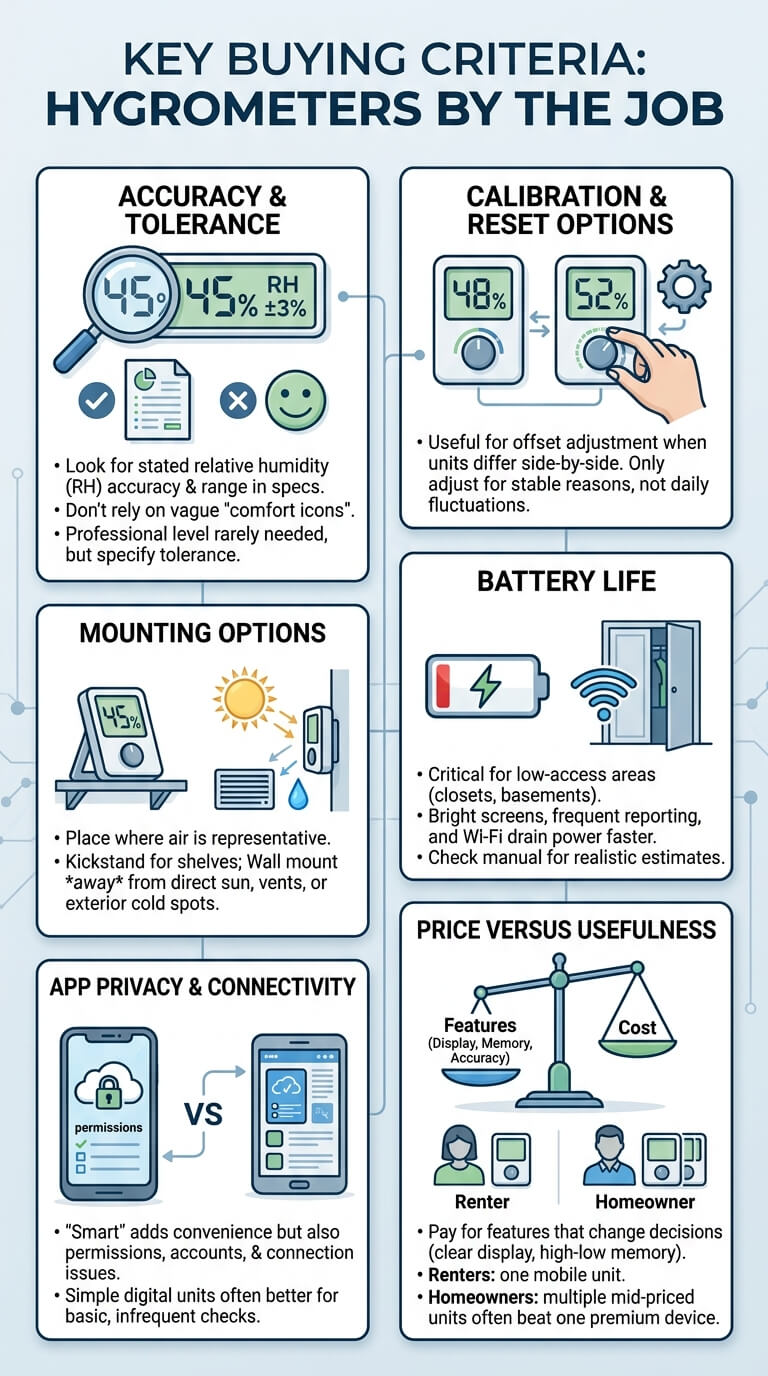
Compare hygrometers by the job you need them to do. A sensor for a closet has different requirements from a sensor for a finished basement, nursery, woodworking room, or rental property.
When the readings confirm room-level humidity, the next step is to choose a dehumidifier with the right drainage, noise level, and maintenance setup.
Accuracy and tolerance
Read the product specifications before buying. Look for a stated relative humidity accuracy tolerance and the range where that tolerance applies. You usually do not need a professional instrument, but you do need more than a vague comfort icon.
Calibration or reset options
Some home hygrometers allow calibration or offset adjustment, while others do not. This is useful when two meters sit side by side and one consistently reads higher or lower. Do not adjust the device every time the room changes. Adjust only when you have a stable reason.
Battery life
Battery life matters most in closets, basements, storage areas, and vacation homes where the device may be forgotten. If the screen is always bright, the sensor reports frequently, or the device connects to Wi-Fi, batteries may drain faster. Check the manual before assuming a smart sensor will run for a year.
Mounting options
A good humidity gauge should sit where the air represents the room. A kickstand is useful on a shelf. A wall mount can work if the wall is not in direct sun, beside a vent, or on an exterior cold spot that skews the reading.
App privacy and connectivity
Smart sensors add convenience, but they also add app permissions, accounts, cloud storage, and connection problems. A simple digital hygrometer may be better if you only need to check a closet or basement once a day.
Price versus usefulness
Pay for features that change your decision. A clear display, high-low memory, and decent accuracy are usually worth it. A renter may do well with one inexpensive unit that moves room to room. A homeowner may get more value from three mid-priced sensors than one premium device.
Where to Use a Hygrometer
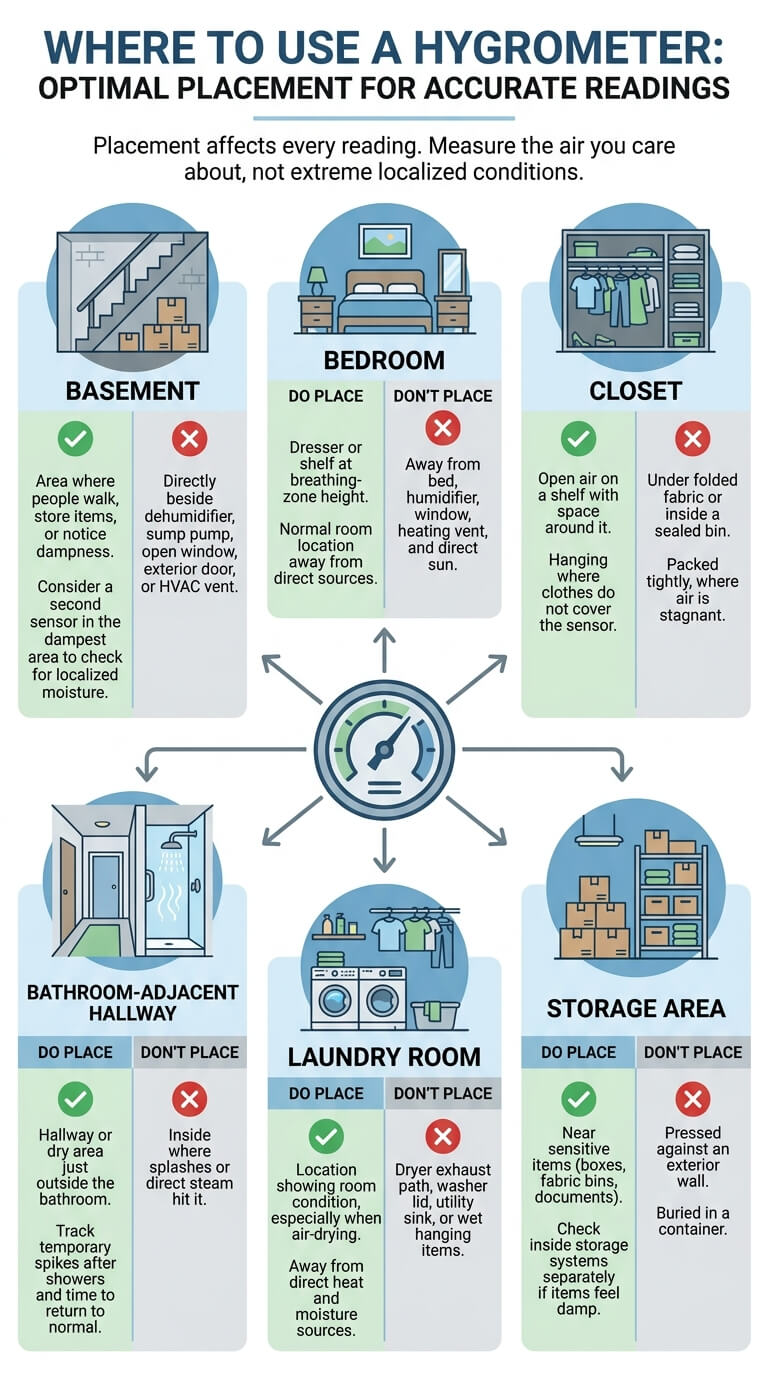
Placement affects every reading. A hygrometer should measure the air you care about, not a vent blast, sunny window, wet towel, or sealed drawer.
Basement
In a basement, place the hygrometer in the area where people walk, store items, or notice dampness. Avoid putting it directly beside a dehumidifier, sump pump, open window, exterior door, or HVAC vent. If the basement is divided, one reading near the stairs may not represent a closed storage room. A second sensor in the dampest area can show whether moisture is localized or widespread.
Bedroom
In a bedroom, place the sensor away from the bed, humidifier, window, heating vent, and direct sun. A dresser or shelf about breathing-zone height is usually more useful than the floor. If window condensation is the concern, compare a normal room reading with a reading closer to the window for a limited test, then return the device to a more representative location.
Closet
A closet hygrometer works best when it sits in open air, not under folded fabric or inside a sealed bin. Put it on a shelf with space around it, or hang it where clothes do not cover the sensor. If the closet is packed tightly, the reading may tell you the air is stagnant, but it cannot measure moisture inside every box or garment bag.
Bathroom-adjacent hallway
For shower-related humidity, a hallway or dry area just outside the bathroom can be more useful than placing the sensor where splashes or direct steam hit it. Check the number before a shower, shortly after, and again after the fan runs. The goal is not to panic over a temporary spike. The useful question is how quickly the area returns toward normal.
Laundry room
In a laundry room, keep the hygrometer away from the dryer exhaust path, washer lid, utility sink, and wet hanging items. If you air-dry clothes indoors, place it where it can show the room condition rather than the humidity inside a crowded rack. High readings that remain long after laundry is dry may point to ventilation, drainage, or room airflow problems.
Storage area
Storage areas need readings where sensitive items are kept. Put the device near cardboard boxes, fabric bins, tools, photos, documents, or seasonal decor, but not pressed against an exterior wall or buried in a container. If stored items feel damp even when the room reading looks normal, check inside the storage system separately and inspect for past wetness.
How to Read Humidity Data Before Buying Products
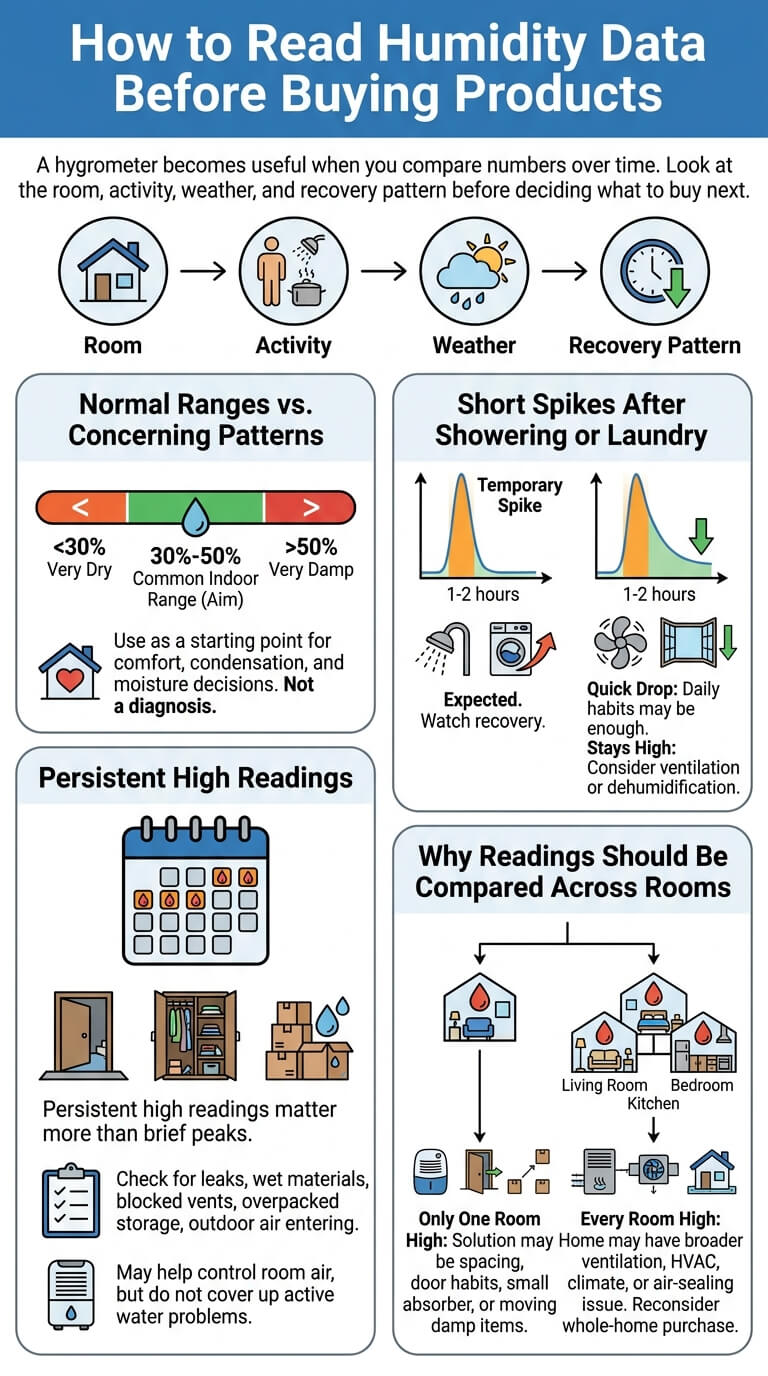
A hygrometer becomes useful when you compare numbers over time. Look at the room, activity, weather, and recovery pattern before deciding what to buy next.
Normal ranges versus concerning patterns
Many home references discuss keeping indoor humidity in a moderate range rather than letting it stay very dry or very damp. The EPA indoor air guidance describes 30 to 50 percent as a common indoor humidity range to aim for. Do not treat one number as a diagnosis. Use it as a starting point for comfort, condensation, and moisture decisions.
Short spikes after showering or laundry
A short spike after a shower, cooking, mopping, or drying clothes indoors is expected. Watch what happens afterward. If the reading drops after the fan runs or wet items are removed, daily habits may be enough. If it stays high for hours, ventilation or dehumidification may be worth considering.
Persistent high readings
Persistent high readings matter more than brief peaks. If a basement, closet, or storage room stays high for several days, check for leaks, wet materials, blocked vents, overpacked storage, and outdoor air entering the space. A dehumidifier may help control room air, but it should not be used as a cover-up for an active water problem.
Why readings should be compared across rooms
Compare rooms before buying a large product. If every room is high, the home may have a broader ventilation, HVAC, climate, or air-sealing issue. If only one closet is high, the solution may be spacing, door habits, a small absorber, or moving damp items. If only the basement is high, you may need a room-specific dehumidifier or a moisture inspection rather than a whole-home purchase.
Hygrometer Placement Mistakes
Bad placement creates bad decisions. Before you assume a room is too damp or perfectly fine, make sure the device is not reading an unusual microclimate.
Good readings also help you avoid dehumidifier mistakes, especially buying before measuring or setting the humidity target poorly.
If one area reads much higher than the rest of the room, that can also help you decide where to place a dehumidifier.
Too close to vents
A supply vent, return grille, fan, or open window can make the reading look lower or higher than the room average. Place the device away from direct airflow unless you are intentionally testing that airflow. If the number changes sharply every time the HVAC runs, move the sensor to a calmer spot and compare again.
In direct sun
Sun can warm the sensor and change the humidity reading around it. A sunny windowsill may also exaggerate daily swings. Use a shaded interior shelf or wall instead. This is especially important in bedrooms, plant rooms, and sunrooms where the display may look convenient but the reading is not representative.
Inside a sealed drawer
A sealed drawer, tote, cabinet, or storage bin tells you about that enclosure, not the room. That can be useful for special storage checks, but do not use it as your main room reading. For closet or storage decisions, first measure the open air in the closet, then separately test a closed container if you suspect trapped moisture.
Next to a dehumidifier outlet
A hygrometer placed right next to a dehumidifier exhaust may show drier air than the rest of the room. A sensor beside the bucket, hose, or warm exhaust can make the machine look more effective than it is. Put the meter several feet away in the living or storage zone you care about, then use the dehumidifier display only as a secondary reference.
Judging by one day of data
Humidity changes with weather, showers, laundry, window habits, and HVAC cycles. One dry day does not prove a basement is fine, and one humid storm day does not prove you need a large dehumidifier. Check a few days and note what was happening when the high reading appeared.
Buying Scenarios
Choose the simplest device that answers your real question. These scenarios cover the most common home uses without pushing you toward features you may not need.
Cheapest useful option for renters
A renter usually needs a portable digital hygrometer with a readable screen and high-low memory. Use it in the bedroom, closet, bathroom-adjacent hallway, and any room that smells damp. Keep notes and photos of readings if you need to discuss ventilation, leaks, or dampness with a landlord. Avoid installing anything permanent unless your lease allows it.
Multi-room option for homeowners
A homeowner with a basement, laundry area, and several storage zones may benefit from a set of matching sensors. Matching devices make comparison easier because the readings are more likely to drift in similar ways. Place one in the main living space as a reference, one in the damp room, and one in the storage area that worries you most.
Smart sensor for alerts
Choose a smart humidity sensor when delayed action could cause a practical problem, such as damp items in a finished basement or humidity rising in a vacation home. Confirm that alerts can be set to your preferred threshold and that the sensor has enough battery life and signal strength. Test alerts before trusting them while you are away.
Closet or storage monitoring
For a closet, choose a small digital display that can sit or hang in open air. A full smart system may be unnecessary unless the closet holds valuable items, instruments, documents, or seasonal clothing you rarely check. If the closet reading stays mildly high, improve spacing and airflow before assuming a chemical absorber or larger appliance is the only answer.
Basement trend tracking
A basement sensor should have high-low memory or app history because basement moisture often changes overnight, after rain, or during seasonal shifts. Put it where stored items or finished materials are located, not only near the stairs. If the trend stays high even after a dehumidifier runs, inspect placement, drainage, open windows, and possible water entry.
What to Do After You Measure
The number on the screen should lead to a practical next step. Match the response to the pattern you see, not just the highest reading.
When readings suggest a dehumidifier
A dehumidifier becomes more reasonable when a room stays humid over time, especially in a basement, laundry room, or closed storage area. Before shopping, measure the room size, note the dampness pattern, and decide how you will drain the collected water. Do not choose capacity from the hygrometer alone. Use humidity data with room size, temperature, and the severity of dampness.
If readings stay high across a full room, use that pattern to decide what size dehumidifier you need.
When a closet absorber may be enough
A small closet absorber may be enough when the issue is limited to a small enclosed closet and the surrounding room is not consistently humid. First remove damp shoes, wet laundry, and overpacked storage. Then use the hygrometer to see whether the closet improves with door-opening habits, spacing, and a small absorber. Read the product label for placement, spill risk, and disposal instructions.
When ventilation habits may solve spikes
If readings rise only after showers, cooking, mopping, or laundry and then drop with fan use or open interior doors, ventilation habits may be the main fix. The North Dakota State University Extension humidity guidance gives practical seasonal context for measuring humidity and watching for condensation. Use those measurements to test whether your daily routine is enough before buying more equipment.
When readings suggest a moisture source problem
Stop relying on product purchases alone when readings stay high near stains, swollen trim, damp carpet, repeated condensation, or musty materials. The HUD Health at Home guidance emphasizes moisture management practices such as reporting leaks and using bath fans. A hygrometer can support the decision to investigate, but it cannot identify what is leaking or what is hidden inside materials.
FAQ
Do I need a hygrometer before buying a dehumidifier?
You do not absolutely need one, but it is a smart first step. A hygrometer shows whether humidity is actually high, how often it rises, and whether one room is worse than another. That information helps you avoid buying a dehumidifier for a room that mainly needs better ventilation, cleaning, or a repair.
How accurate does a home hygrometer need to be?
For most homes, a reasonable tolerance of a few percentage points is enough for practical decisions. You are usually looking for patterns, room differences, and persistent high readings, not laboratory precision. If exact control matters for instruments, antiques, specialty storage, or sensitive materials, consider a higher-quality sensor and follow its calibration instructions.
Where should I place a hygrometer in a room?
Place it in open air where it represents the space you care about. Keep it away from direct sun, vents, windows, wet towels, appliances, and the exhaust from a dehumidifier. A shelf, dresser, or wall location away from obvious heat, cold, and moisture sources usually gives a more useful reading.
Are smart hygrometers worth it?
Smart hygrometers are worth it when alerts or history will change your behavior. They are useful for basements, storage rooms, vacation homes, and spaces you do not check daily. They may not be worth the extra cost if you only need a quick reading in one room and do not want another app or account.
Can a hygrometer detect mold?
No. A hygrometer measures humidity, not mold. High humidity can suggest conditions where moisture problems are more likely, but the device cannot identify mold, measure spores, or tell you what is behind a wall. If you see growth, smell persistent mustiness, or find damp materials, deal with the moisture problem and follow appropriate cleanup or professional guidance.
Final Thoughts
A hygrometer is one of the cheapest tools for making smarter moisture decisions at home. Start with a clear digital display, useful accuracy information, high-low memory, and placement that reflects the room you care about. Upgrade to smart alerts or multi-room sensors only when you need history, comparison, or notifications.
The best way to use the meter is to watch patterns before buying bigger products. Short spikes after showers or laundry may call for better habits. A damp closet may need spacing and a small absorber. A basement that stays high for days may need a properly sized dehumidifier or a closer look for moisture entry. The number on the screen is not the whole answer, but it gives you a much better place to start.

Ethan Carter is the Founder & Editor of HomeCleanSecrets. Based in the United States, he has 5 years of experience creating practical home cleaning, laundry care, stain removal, decluttering, and home organization content. His goal is to help everyday households clean smarter and build simple routines that are easier to maintain.
Read more about Ethan Carter on his author page: https://homecleansecrets.com/ethan-carter/