
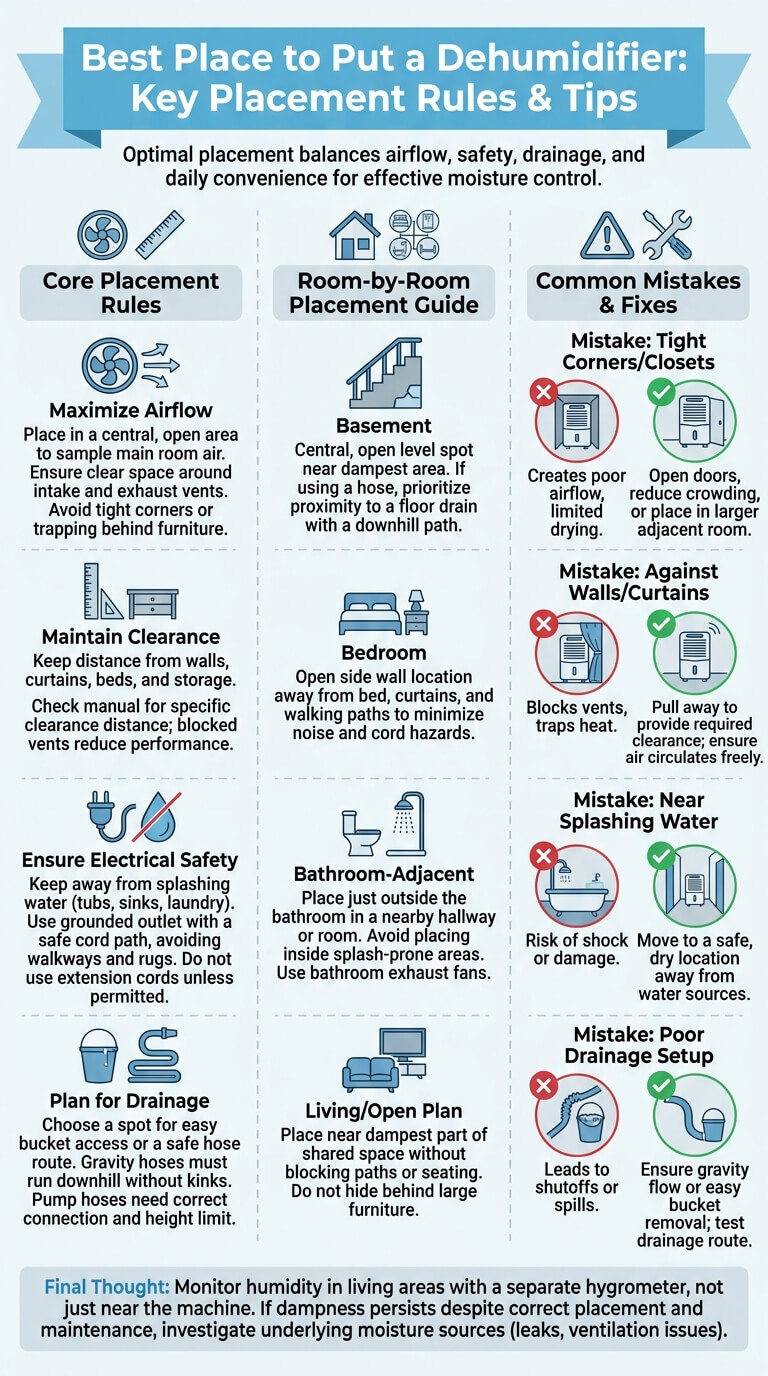
The best place to put a dehumidifier is usually an open, level spot inside the damp area, with clear space around the air intake and exhaust, a safe cord path, and drainage that matches how you plan to empty the water. In a basement, that may mean a central spot near a floor drain. In a bedroom, it may mean a corner with real airflow rather than the exact center of the room. Near a bathroom or laundry area, the right spot is close enough to handle moisture but far enough from splashing water.
Placement matters because a dehumidifier does not pull moisture through walls like magic. It draws room air through the unit, removes moisture from that air, and sends drier air back out. If the unit is trapped behind furniture, pushed tight against a wall, set on an uneven floor, or connected to a kinked hose, it can look weak even when the machine itself is fine.
This guide walks through where to place a dehumidifier in common rooms, where not to place it, how drainage changes the best location, and when moving the unit is not enough because the home has a bigger moisture problem.

Quick Answer: The Best Placement Rules
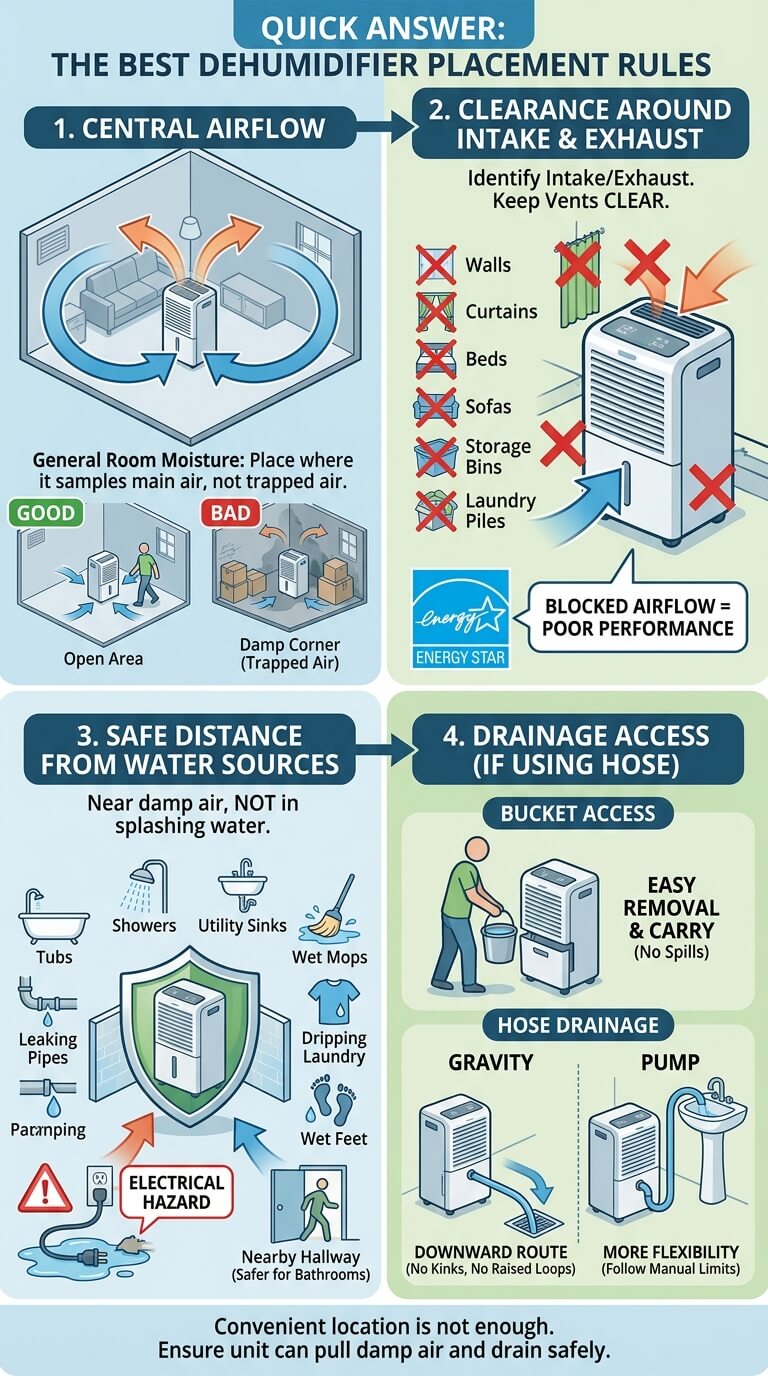
Most portable dehumidifiers work best when they can breathe from all required sides, sit flat, and sample the air from the room they are treating. Before you fine-tune the location, start with these four placement rules.
If the best location requires a hose, pump, or quieter operation, make sure you choose a dehumidifier with those features before buying.
If the room problem might need a measuring tool, closet absorber, air purifier, or repair instead of a placement change, compare the broader home moisture control products first.
Central airflow when possible
For general room moisture, place the unit where air can circulate across the damp space, not in the most hidden corner. A spot near the middle of a basement, a few feet away from bulky storage, often gives better coverage than a corner behind boxes. In a bedroom or living room, a fully central location may be annoying or unsafe, so aim for an open side wall with clear breathing room.
A good test is to stand where the unit will sit and look in every direction. If the machine would be blocked by a sofa, bed skirt, laundry pile, storage bin, curtain, or closed door, the air path is too restricted. If you can walk around it safely and the nearby air feels like the same air people actually use in the room, the location is more promising.
Clearance around intake and exhaust
The most important setup detail is clearance around the intake and exhaust vents. Some models pull air from the back and release it from the side or top. Others are designed differently, so do not guess by appearance alone. Check the manual for the exact clearance your model needs. If the manual gives a larger clearance than a general rule you saw online, follow the manual.
As a practical starting point, avoid pushing the unit tight against walls, curtains, shelving, or upholstered furniture. Blocked airflow can make the unit run longer, read humidity inaccurately, collect less water, or cycle in a way that feels inconsistent. The ENERGY STAR dehumidifier guidance also explains that capacity and conditions affect performance, so a well-sized unit still needs room conditions that let it operate properly.
If the unit has good airflow and drainage but still cannot keep up, the next question is whether you chose the right dehumidifier capacity for the room.
Safe distance from water sources
A dehumidifier is often used near damp places, but it should not sit where it can be splashed. Keep it away from bathtubs, showers, utility sinks, dripping laundry, wet mops, leaking pipes, and any spot where people step out with wet feet. Moisture in the air is the job. Water landing on the appliance, cord, plug, or outlet is a safety problem.
Near a bathroom, the safer approach is usually to place the unit just outside the bathroom door or in a nearby hallway with the door open after showers. In a laundry room, keep it away from hoses, washer overflows, and floor areas that sometimes get wet. Stop and change the setup if the cord has to cross a wet walkway.
Drainage access if using a hose
If you plan to empty the bucket by hand, the best spot must be easy to reach. If you plan to use continuous drainage, the best spot must also work with the hose. Gravity drain setups usually need the hose to run downward toward a floor drain, utility sink, condensate drain, or other suitable drain. Pump models have more flexibility, but the pump hose still needs to be routed exactly as the manual describes.
Do a dry run before you turn the unit on. Place the machine, attach the hose, route the hose, then check for tight bends, raised sections, loose fittings, pinch points under doors, and trip hazards. A machine in a great airflow spot can still fail your home if the hose sends water where it should not go.
Why Placement Changes Performance
Placement affects four things at once: how much damp air reaches the unit, how accurately the machine reads humidity, whether people can live with the noise and heat, and whether the setup is safe for daily use.
Airflow and humidity readings
A dehumidifier uses nearby air to decide when to run. If it sits in a pocket of air that is drier, warmer, colder, or less representative than the rest of the room, the reading can mislead the machine. For example, a unit placed next to a warm appliance may shut off sooner than expected, while a unit tucked into a cold damp corner may run hard without improving the rest of the room.
Do not judge placement only by how much water appears in the bucket on day one. Also check the room with a separate hygrometer, especially in the area where people sleep, store items, or notice musty air. The best placement lowers the humidity of the usable space, not just the tiny pocket around the appliance.
Damp corners versus whole-room moisture
There is a difference between treating a whole room and drying a problem corner. If the entire basement feels damp, a central open location usually makes more sense. If only one corner smells musty because boxes are against an exterior wall, the real fix may be moving storage, improving airflow, and checking for water entry, not aiming the dehumidifier at the corner forever.
For a localized damp smell, pull items away from the wall, let air circulate, and measure humidity nearby. If the area stays damp even with clear space and the dehumidifier running, investigate the wall, floor, window, or foundation instead of assuming the unit needs a new location.
Noise and daily use
The best technical location is not always the best living location. In a bedroom, the center of the room may give better airflow but create noise, heat, and a cord hazard. In a living room, a good airflow spot may still be too close to seating or a television. In a basement, a central walkway can become an obstacle.
Choose a place where the unit can run long enough to do its job. A slightly less central spot with good clearance is often better than a perfect airflow spot that everyone keeps unplugging. Check the bucket, filter, controls, and hose access too. If maintenance is awkward, the setup will not stay consistent.
Safety and cord routing
The cord should reach a proper outlet without stretching, crossing a walkway, passing under a rug, sitting in water, or being pinched behind furniture. Avoid using an extension cord unless the manual specifically allows it and the cord meets the appliance requirements. Many portable appliances draw enough power that a casual household extension cord is not a safe shortcut.
The Consumer Product Safety Commission guidance on extension cords explains that missing safety characteristics can create shock or fire hazards. For a dehumidifier, the safer starting point is a grounded outlet close enough for the factory cord and a location where the cord stays visible and dry.
Before You Pick a Spot
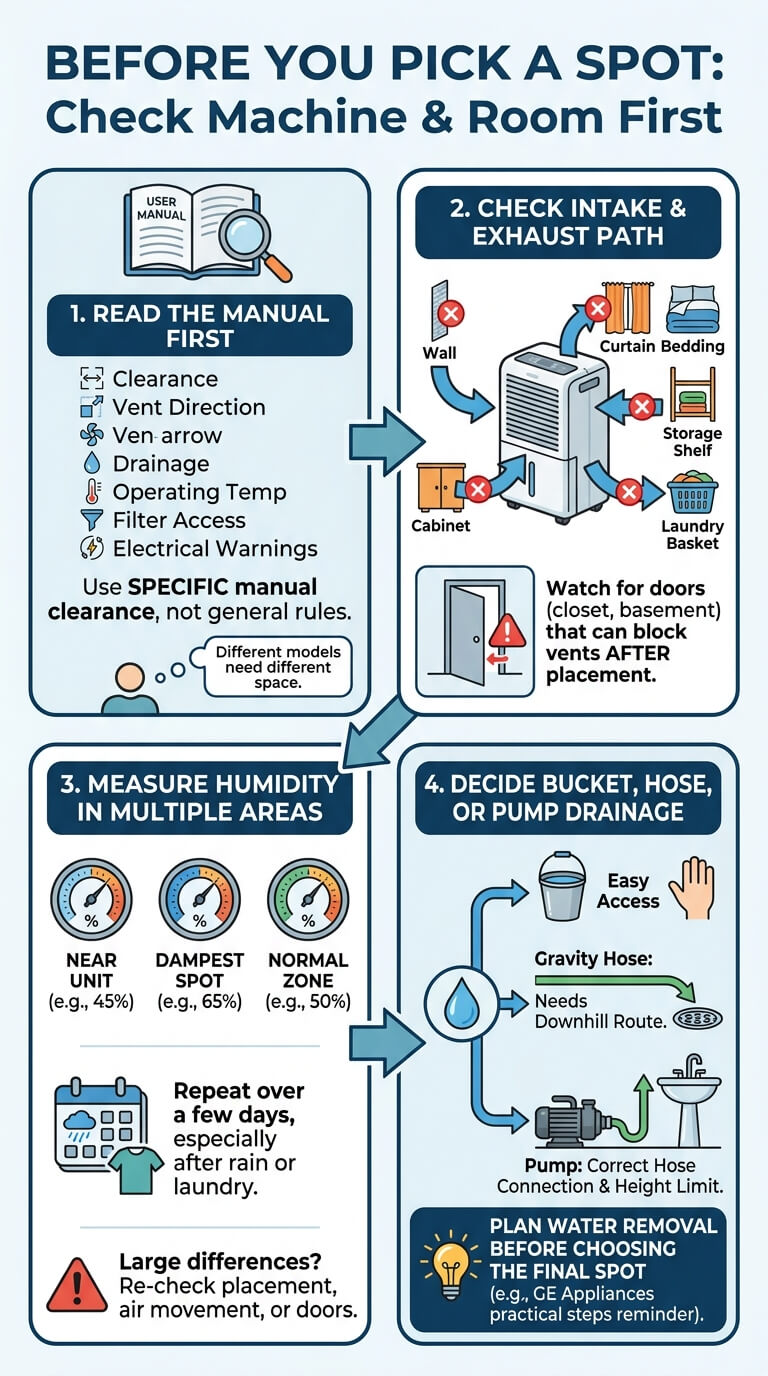
A few minutes of checking the machine and the room can prevent most placement mistakes. Do this before you decide that one corner, drain, outlet, or doorway is the answer.
Read the manual first
Open the manual for your exact model and look for placement, clearance, drainage, operating temperature, filter access, and electrical warnings. Portable dehumidifiers may look similar, but vent direction and clearance requirements vary. Some units are designed with rear intake. Some exhaust upward. Some need extra space near the side where the hose connects.
Do not hide the manual after setup. Keep a digital copy or photo of the key pages on your phone. You will need it when cleaning the filter, connecting a hose, moving the unit for winter, or deciding whether a location is allowed.
Check intake and exhaust direction
Find the intake grille and the exhaust outlet. Then imagine air moving into one side and out another. That air path should not be blocked by a wall, cabinet, curtain, storage tub, or bed. If the exhaust blows warm air directly into a tight corner, it may recirculate around the appliance instead of mixing with the room.
A good placement test is to set the unit in position while it is off, then open nearby doors, drawers, and walkways as you normally would. If a closet door, laundry basket, or storage shelf will frequently block a vent, choose a different spot before the habit becomes a performance problem.
Measure humidity in more than one area
A built-in humidistat is helpful, but a small hygrometer lets you compare the problem area with the rest of the room. Take readings near the dehumidifier, near the dampest spot, and in the normal living or storage zone. If the numbers are very different, you may need better air movement, a different placement, or a separate plan for the damp source.
Take readings at the same time of day for a few days. Basements, bathrooms, and laundry rooms can change after rain, showers, cooking, laundry loads, or open windows. One reading is a clue. A pattern tells you whether the dehumidifier is placed where it can actually help.
Decide bucket, hose, or pump drainage
Drainage often decides the real-world location. A bucket-only setup can go almost anywhere with safe airflow and a safe outlet, but you must be able to remove and carry the bucket without spilling. A gravity hose needs a route that slopes down to the drain. A pump model can send water upward or farther away only if the pump hose is installed within the product limits.
GE Appliances gives practical steps for connecting a standard hose and leading it to a floor drain in its dehumidifier drainage instructions. Even if you use a different brand, the bigger lesson is the same: hose setup is part of placement, not an afterthought.
Room-by-Room Placement Guide
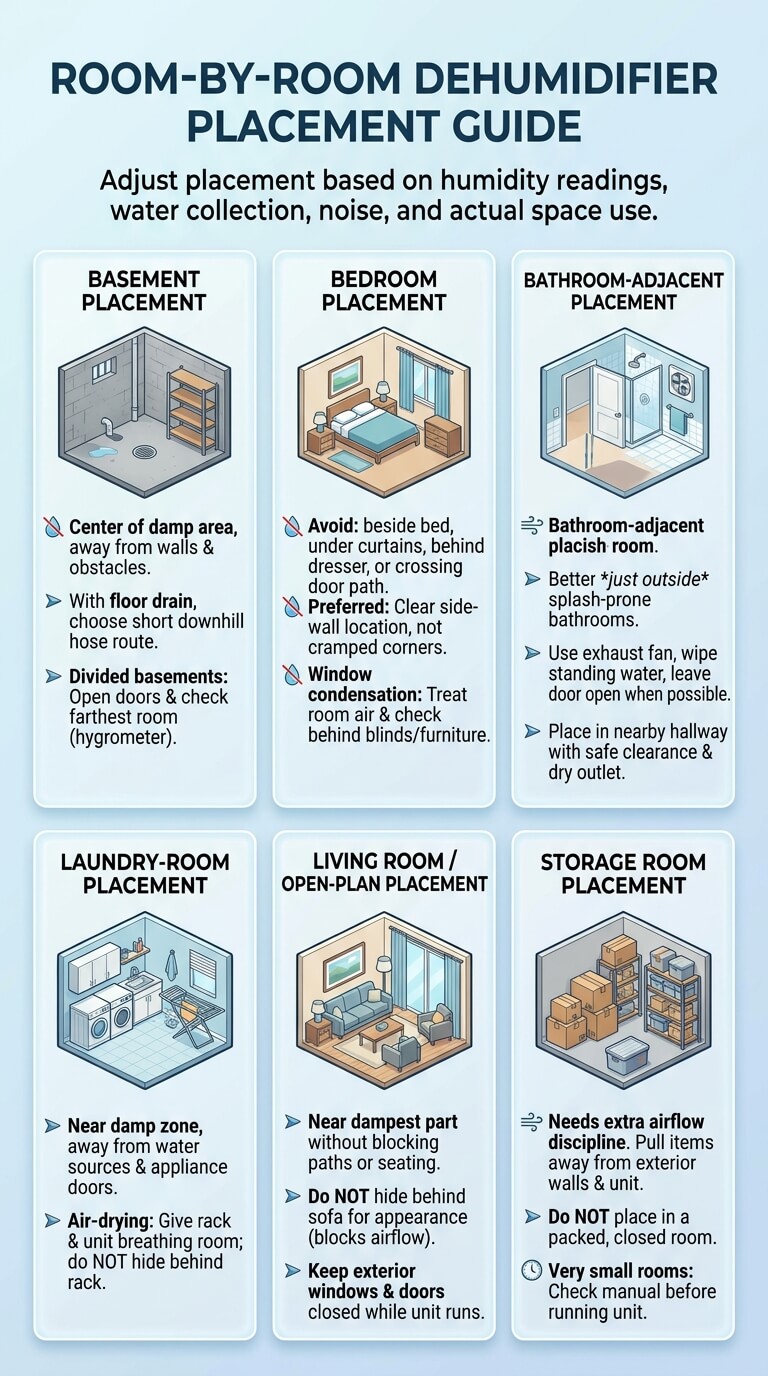
The best location changes by room because moisture sources, traffic, outlets, drains, and noise tolerance are different. Use these room notes to choose a starting spot, then adjust based on humidity readings and daily use.
Basement placement
For an open basement, start with a level spot near the center of the damp zone, away from walls, storage boxes, laundry piles, and furnace or water-heater access paths. If there is a floor drain, a location that gives both good airflow and a downward hose route is usually the easiest long-term setup.
In a divided basement, one unit may not handle every closed room well. Open interior doors when safe and practical, and check humidity in the room farthest from the unit. If a back storage room remains damp while the main basement improves, the issue may be closed airflow, a separate moisture source, or a need for another approach in that room.
Bedroom placement
In a bedroom, avoid placing the unit right beside the bed, under hanging curtains, behind a dresser, or where the cord crosses the path to the door or bathroom. A side wall with clear space around the vents usually works better than a cramped corner. If the bedroom has window condensation, do not press the dehumidifier against the window. Let it draw from the room while you also check the window area for cold surfaces, leaks, or blocked airflow.
Noise matters in bedrooms. If you run the unit overnight, choose a spot where the sound is tolerable and the display light is not disruptive. If you run it during the day, leave the interior door partly open only if that helps the target room and does not pull moisture from a different damp area.
Bathroom-adjacent placement
Most portable dehumidifiers should not sit in a bathroom where they may be splashed or where the cord could be near wet feet. A safer setup is often just outside the bathroom door, in a hallway or nearby room, after showers. Run the bathroom exhaust fan first if you have one, wipe obvious standing water, and leave the door open when privacy is no longer needed.
If the bathroom has recurring moisture, the dehumidifier may help the nearby air, but it should not replace ventilation, leak repair, or proper drying. Persistent wet walls, soft flooring, bubbling paint, or repeated visible growth need investigation beyond appliance placement.
Laundry-room placement
A laundry room can have short bursts of moisture from wet clothes, washer use, utility sinks, or air-drying racks. Place the dehumidifier where it can draw air from the damp area without blocking appliance doors, laundry sorting space, or access to shutoff valves. Keep it away from washer hoses and any floor area that sometimes gets wet.
If you use the dehumidifier while drying clothes on a rack, aim for room airflow rather than blasting one wet garment from inches away. Leave enough space around both the rack and the unit so moist air can move. A small fan can sometimes help air mixing, but keep electrical items away from wet fabric and follow each product manual.
Living room or open-plan placement
In an open-plan area, the best spot is often near the dampest zone while still open to the larger air volume. Do not hide the unit behind a sofa because it looks better there. If the room connects to a kitchen, entry, or hallway, think about where humid air is entering. During humid weather, open exterior doors and windows can overwhelm a portable unit.
For a living area, convenience matters. Choose a location where the bucket can be removed without dragging the unit, the filter can be reached, and the warm exhaust air is not blowing directly at seating. If the machine becomes annoying, people will turn it off before it can stabilize the room.
Storage room placement
Storage rooms are tricky because boxes, bins, and clothing can block airflow. Do not place a dehumidifier inside a packed storage room and expect it to dry every hidden corner. Pull items away from exterior walls, leave gaps between storage rows, and keep vents clear. If the room is very small and closed, check the manual before running a portable unit in that space.
For a closed closet with limited airflow, moisture absorbers for closets may be safer and more practical than forcing a dehumidifier into a tight space.
For stored clothing, documents, tools, or holiday decor, use a hygrometer to confirm the room is improving. If musty odor is strongest inside a closet, cabinet, or sealed bin, a room dehumidifier may not reach that enclosed air well. The storage setup may need better spacing, cleaning, or moisture-absorbing products designed for small enclosed areas.
Where Not to Put a Dehumidifier
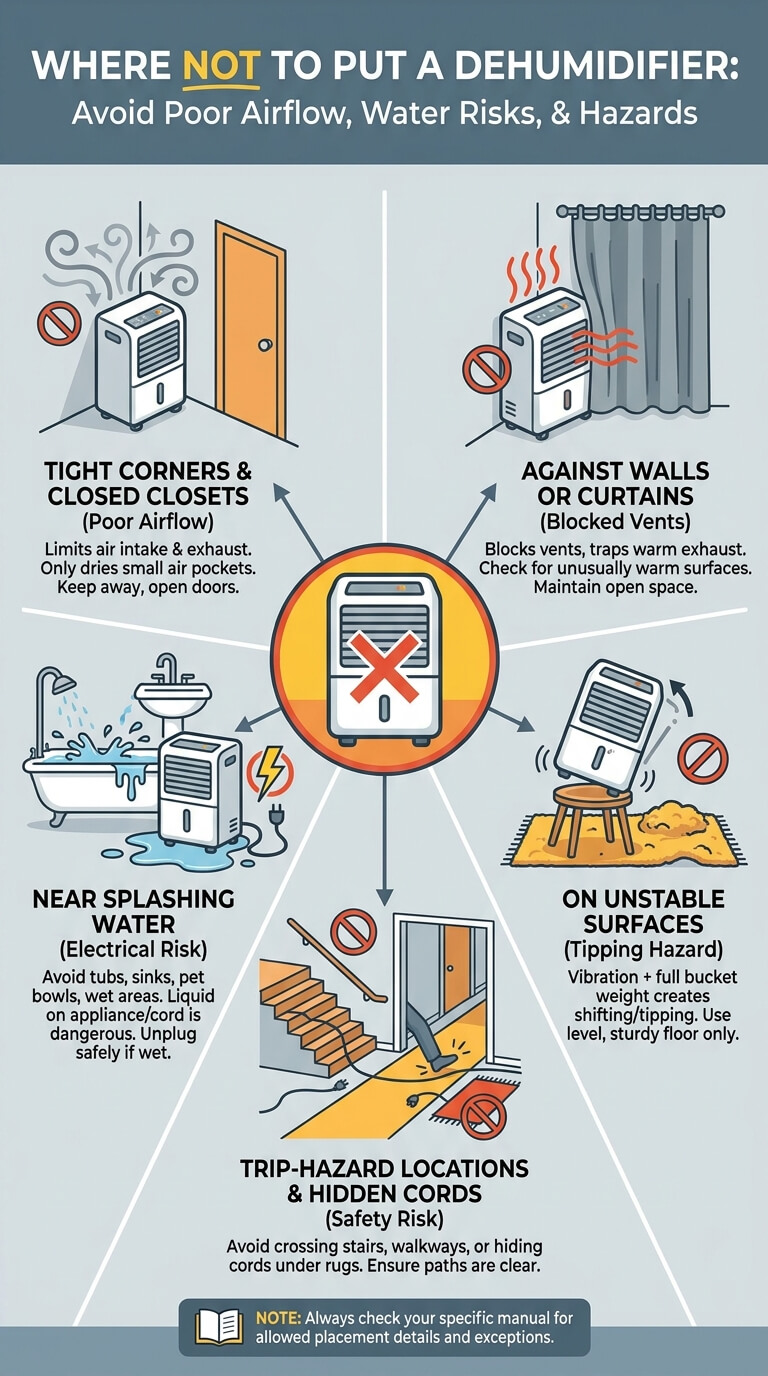
Bad placement can reduce performance, create water problems, or make the unit unsafe to live around. Avoid these locations even if they seem convenient.
Tight corners and closets without airflow
A tight corner limits the air the unit can pull in and push out. A closet is worse if the door stays closed or the space is packed. Unless the manual allows that type of enclosed use and the area has enough ventilation, a closet is usually the wrong place for a portable dehumidifier.
If the closet itself smells damp, open it, remove crowded items, clean what needs cleaning, and measure humidity in the room. Use the dehumidifier to improve the surrounding room air, then decide whether the closet also needs spacing changes or a small moisture absorber.
Against walls or curtains
Do not press the unit against a wall unless your exact model is designed for that position. Rear intakes, side intakes, and exhaust vents need space. Curtains can also get pulled toward the intake or trap warm exhaust air, especially in bedrooms and living rooms.
Look behind the unit after it has run for a while. If the wall, curtain, or furniture nearby feels unusually warm or damp, or if the machine sounds strained, move it into a more open position and recheck the manual clearance.
Near splashing water
Keep the unit away from tubs, showers, sinks, wet laundry, dripping umbrellas, pet water bowls, and mop buckets. A dehumidifier is not a wet-area appliance just because it handles moisture from air. The cord, plug, outlet, and control panel should stay dry.
Stop using the unit and unplug it safely if water spills on or around it. Do not restart it until the appliance and outlet area are dry and you have checked the manual for what the manufacturer recommends after exposure to water.
On unstable surfaces
Place the unit on a level, sturdy floor. Avoid thick rugs, uneven tile, wobbly shelves, stools, laundry baskets, or any surface that can tip. Dehumidifiers collect water, and a full bucket adds weight. An unstable setup can spill water, damage flooring, or pull on the cord.
If you need height for drainage, do not improvise with a weak stand. Use a setup allowed by the manual, and make sure the unit cannot vibrate, slide, or be bumped by children, pets, or laundry baskets.
Extension cord and trip-hazard locations
A good location becomes a bad location if the cord crosses a hallway, stairs, bedroom path, laundry route, or basement walkway. Do not run the cord under rugs or behind tight furniture where heat or damage can go unnoticed. Keep the plug accessible so you can unplug the unit before cleaning or moving it.
If the only open airflow spot requires a risky cord route, choose a safer nearby spot or have a qualified person evaluate outlet options. Convenience is not worth a cord setup that people step over every day.
Drainage and Hose Placement
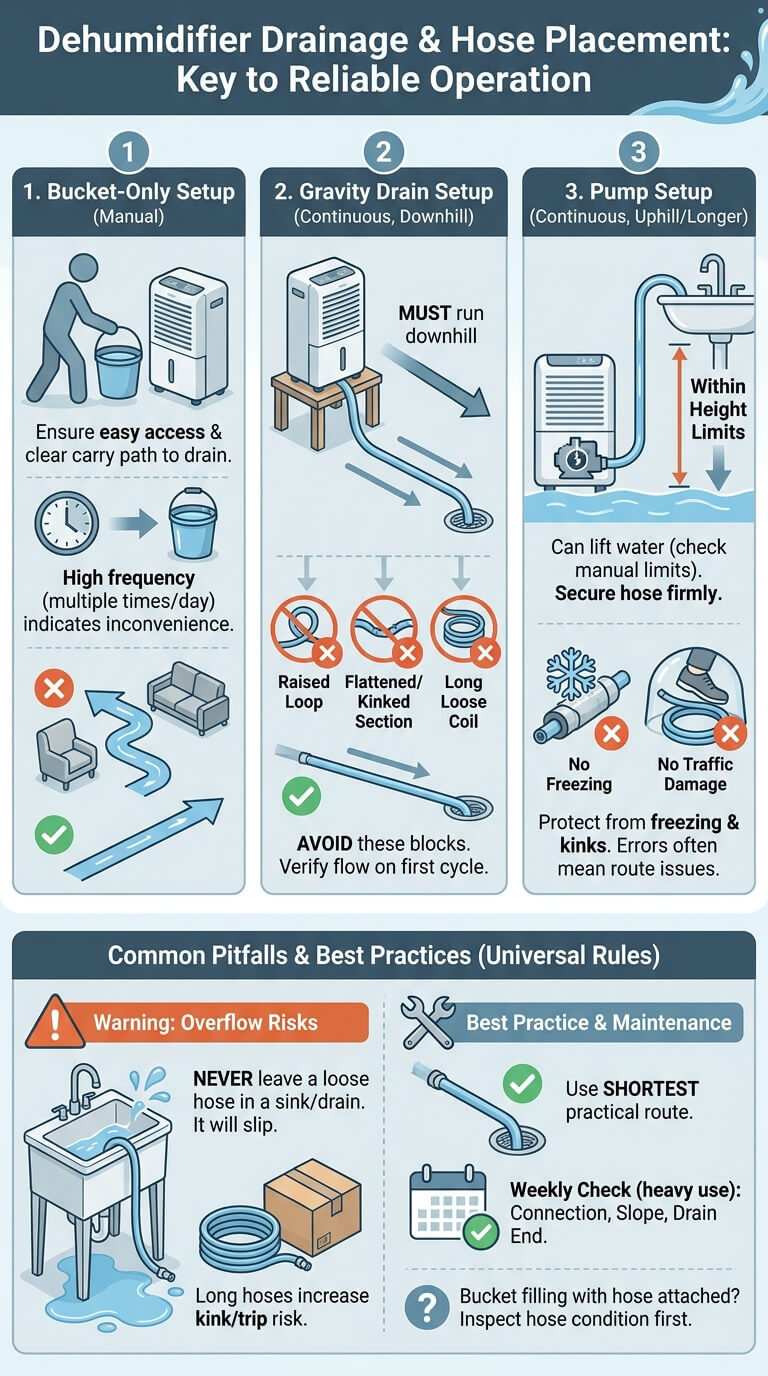
Water removal is part of placement. A dehumidifier that works well but drains poorly can shut off, leak, or become too inconvenient to use.
Bucket-only setup
With a bucket-only setup, place the unit where you can remove the bucket straight out, carry it without twisting around furniture, and pour it into a sink, toilet, or drain safely. Avoid spots where the bucket must be carried down stairs if it gets heavy for the person using it.
Blocked airflow, awkward drainage, and unsafe cord routing are some of the most common dehumidifier setup mistakes to check before blaming the product.
Check how often the bucket fills during the first week. If you have to empty it multiple times a day, the placement may still be fine, but the drainage plan may be wrong. A hose, pump model, or different moisture-control plan may be more practical.
Gravity drain setup
A gravity drain setup works only when water can flow downhill. The hose should slope continuously toward the drain, without loops, kinks, raised sections, or crushed spots under doors. If the hose rises above the drain outlet on the unit, water can back up and the bucket may fill instead.
Test the hose route before leaving the unit unattended. Watch the first drain cycle if possible, then check the floor, hose connection, and drain end. If water appears around the unit, stop and correct the setup before running it again.
Pump setup
A pump model gives more placement options because it can move water to a higher drain point, such as a utility sink, within the product limit. That does not mean the hose can be routed any way you want. The pump hose still needs secure connections, proper height limits, and protection from kinks or freezing.
Place the unit where you can hear or inspect unusual pump behavior. If the pump runs but water does not move, or the unit shows an error, check the hose route and manual. Do not ignore repeated pump shutoffs.
Floor drain and sink considerations
A floor drain is usually easiest for a basement if the path is short and downhill. Keep the hose end positioned so it cannot pop out or be kicked away. Do not place the hose where people walk, roll storage bins, or drag laundry baskets across it.
A sink can work for some pump setups or raised gravity setups only when the manual allows it and the hose can be secured. Never leave a hose loosely hanging over a sink where it can slip out. Check local conditions too. A clogged drain, slow sink, or shared utility area can create problems even when the dehumidifier is working correctly.
Preventing kinks and overflow risk
Use the shortest practical hose route that still reaches the drain safely. Long hoses are easier to kink, step on, or forget behind storage. If the unit shuts off unexpectedly, the bucket fills despite a hose, or the floor feels damp near the appliance, inspect the hose before blaming the machine.
The drainage path should be part of regular maintenance. Once a week during heavy use, check the hose connection, slope, drain end, and floor around the unit. This quick check can catch small placement problems before they become water on the floor.
Placement for Different Moisture Problems
The same dehumidifier may need different placement depending on what you are trying to improve. Match the location to the moisture pattern, not just the room name.
Musty basement air
For general musty basement air, start in the main open area with interior doors open when practical. Keep storage away from the unit and away from exterior walls. Check humidity near the stairs, the far corner, and any storage room after several days.
If only one wall or corner stays musty, look for water entry, poor grading outside, a plumbing issue, or blocked airflow behind stored items. The EPA indoor air guidance notes that moisture control is important for mold control, but a dehumidifier should not be treated as a substitute for fixing a water problem.
Condensation near windows
Window condensation often happens where warm moist indoor air meets a cold surface. Place the dehumidifier where it can treat the room air, not directly pressed against the window. Also check blinds, curtains, and furniture that may trap air against the glass.
If condensation appears only in cold weather, lowering indoor humidity may help, but insulation, window condition, ventilation, and room temperature can also matter. If water is running down walls or damaging trim, investigate the window area instead of only moving the unit closer.
Damp laundry area
In a laundry area, place the unit close enough to the drying rack or washer zone to handle the moisture burst, but keep it out of splash zones and appliance access paths. If clothes are air-drying, space garments so air can move between them. A crowded rack slows drying and keeps moisture trapped.
If the laundry area has a dryer, check that the dryer vent and room ventilation are working properly. A dehumidifier can help room humidity, but it should not compensate for a dryer vent problem, a leaking washer hose, or wet flooring.
Closet smell near a bedroom
A musty closet near a bedroom often needs airflow and storage changes first. Open the closet door, remove crowded fabric or cardboard, and run the dehumidifier in the bedroom or nearby area with good clearance. Measure the bedroom and closet area after the door has stayed open for a while.
If the smell returns when the closet is closed, the issue may be inside stored items, behind the wall, or from poor ventilation in the closet. A room dehumidifier may support the space, but it will not dry sealed bins or packed clothing very well.
Seasonal humidity in apartments
For apartments, choose a location that treats the room you use most or the zone where humidity rises first. Keep windows closed during humid outdoor conditions while the unit runs. If the apartment has an open living area, place the unit where it can draw from that shared space without blocking the path to the kitchen, bedroom, or entry.
Renters should also think about water handling. Bucket-only use may be safer than a hose if there is no reliable drain path. If you notice leaks, recurring wet walls, or damage around windows, document the issue and follow the proper maintenance process for your building.
Placement Mistakes That Look Like Product Failure
Before replacing a dehumidifier, check whether the setup is making a good unit look bad. These mistakes are common and fixable.
Blocked airflow
Blocked airflow can make the unit collect less water, run longer, or shut off before the room feels better. Check the vent sides, nearby furniture, curtains, walls, storage, and dust on the grille. Move the unit into open air and give it a few days of normal use before judging the result.
Wrong humidity set point
If the set point is too high, the unit may not run long enough. If it is too low, the unit may run constantly and make the room feel uncomfortable or waste energy. Many homes feel better when humidity is kept in a moderate range, but the best target depends on season, comfort, condensation, and the limits of your home.
Doors closed between damp rooms
A dehumidifier cannot easily treat air behind closed doors. If the damp area is a storage room, bathroom, or basement bedroom, closed doors can isolate moisture. Open interior doors when safe and practical, then check whether humidity readings begin to even out.
Dirty filter
A dirty filter restricts airflow and makes placement less effective. If the unit worked well at first and then seemed weaker, inspect and clean the filter according to the manual. Put the unit in a location where filter access is easy, not against a wall that forces you to drag the appliance out every time.
Unit too small for the area
Placement cannot fix a unit that is undersized for a large, wet, or connected space. If the dehumidifier has clear airflow, clean filters, closed exterior windows, and a reasonable set point but humidity stays high, capacity may be part of the problem. That is when room size, dampness level, and drainage convenience should be reviewed together.
When Moving the Unit Will Not Fix the Problem
A dehumidifier is useful for managing humidity, but some moisture problems require repair, ventilation changes, or professional evaluation. Moving the unit from corner to corner should not become a way to avoid the real cause.
Leaks and standing water
If you see standing water, active dripping, wet drywall, wet flooring, or a recurring puddle, stop treating it as a placement issue. Find the source if you can do so safely. Common causes include plumbing leaks, foundation seepage, roof problems, appliance leaks, or poor drainage outside the home.
Do not run a portable dehumidifier in standing water or where the cord or plug may get wet. Dry the area safely, protect electricity, and get qualified help when the problem is beyond a simple spill.
Repeated mold growth
If visible growth keeps coming back after cleaning and humidity control, the area may have a hidden moisture source or material that stayed wet too long. A dehumidifier can reduce air moisture, but it will not remove growth from materials or fix wet building components.
Be careful with health claims here. Lower humidity can make conditions less favorable for many moisture problems, but it is not a guaranteed fix for every home or every person. Follow appropriate cleanup guidance and get professional help for large, recurring, or uncertain areas.
HVAC or ventilation problems
Humidity can be affected by air conditioning, exhaust fans, ventilation, crawl spaces, and air leaks. If the home feels humid even with the dehumidifier running correctly, look at the larger system. A bathroom fan that does not exhaust outdoors, an oversized air conditioner that short cycles, or a damp crawl space can keep adding moisture faster than a room unit can manage.
When to investigate the moisture source
Investigate further when humidity rises quickly after the unit shuts off, musty smell returns in the same spot, water marks appear, paint bubbles, flooring cups, or stored items feel damp despite good airflow. These are signs that placement may be only part of the story.
A practical stopping point is this: if you have corrected clearance, drainage, set point, doors, windows, and filter maintenance, and the room still does not improve, do not keep moving the machine every day. Look for the moisture source, measure patterns, and bring in help when repairs or safety concerns are involved.
FAQ
Should a dehumidifier be in the middle of the room?
It can be helpful to place a dehumidifier near the middle of a damp room because the air can circulate more evenly. It is not required in every room, and it is not worth creating a cord hazard. An open side-wall location with the required clearance is usually better than the exact center if people need to walk through the space.
Can I put a dehumidifier in a closet?
A portable dehumidifier usually should not be placed inside a closed, crowded closet. The unit needs airflow, clearance, and a safe cord path. For a musty closet, open the door, improve spacing, remove damp items, and run the unit in the nearby room unless the manual clearly allows the enclosed setup you are considering.
How far from the wall should a dehumidifier be?
Follow the clearance listed in your model manual because intake and exhaust design vary. As a general habit, do not press the unit tight against the wall, curtains, furniture, or storage bins. If your manual requires a specific number of inches on one or more sides, use that requirement rather than a general rule.
Should I put a dehumidifier near a bathroom?
Near a bathroom can make sense, but inside a splash-prone bathroom is often not the safest place for a portable unit. A hallway or nearby room outside the bathroom door may work better after showers, especially when combined with the bathroom exhaust fan and basic drying of wet surfaces.
Is it safe to run a dehumidifier overnight?
Many dehumidifiers are designed for extended use, but safety depends on the model, outlet, cord path, drainage setup, room conditions, and maintenance. Read the manual, keep the unit upright on a level surface, keep vents clear, avoid extension cords unless allowed, and do not run it where water can reach the appliance or cord. If using a hose or pump, test the drainage before leaving it unattended.
Final Thoughts
The best place to put a dehumidifier is the spot that balances airflow, safety, drainage, and daily convenience. Start in the damp area, keep the vents clear, avoid splash zones, route the cord safely, and match the location to how the water will be emptied. Then use humidity readings and room behavior to fine-tune the setup.
If moving the unit improves the room, keep the new setup and make it easy to maintain. If the same damp smell, wet surface, or high humidity keeps returning, stop treating placement as the whole solution. A dehumidifier can help manage indoor moisture, but leaks, blocked ventilation, packed storage, and hidden water problems need their own fix.

Ethan Carter is the Founder & Editor of HomeCleanSecrets. Based in the United States, he has 5 years of experience creating practical home cleaning, laundry care, stain removal, decluttering, and home organization content. His goal is to help everyday households clean smarter and build simple routines that are easier to maintain.
Read more about Ethan Carter on his author page: https://homecleansecrets.com/ethan-carter/