
Choosing between a dehumidifier and an air purifier is easier once you separate two different problems: moisture in the air and particles in the air. A dehumidifier pulls water vapor out of a damp room. An air purifier moves air through filters to capture particles such as dust, pollen, smoke particles, and pet dander. They may sit in the same aisle at a store, but they do not do the same job.
The right choice depends on what you can observe at home. Clammy air, window condensation, damp carpet edges, and a basement that feels wet point toward moisture control. Floating dust, wildfire smoke, pet dander, and visible particles when sunlight hits the room point toward air filtration. Musty smell can go either way, so it needs a little more diagnosis before you buy anything.
This guide compares both product types in a practical way so you can avoid buying the wrong device. It also explains when using both makes sense, when measurement matters, and when a home problem needs repair or professional help instead of another plug-in appliance.

Quick Answer: Which One Do You Need?
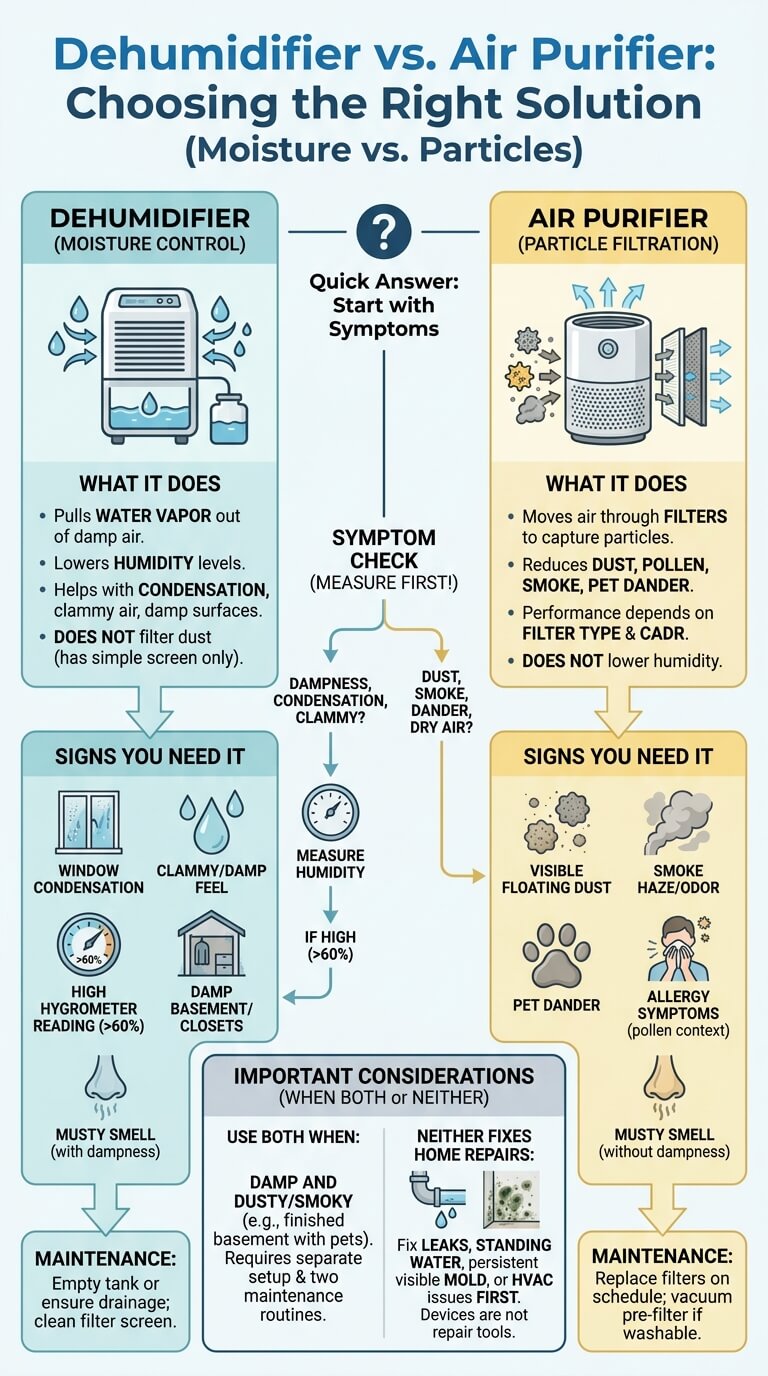
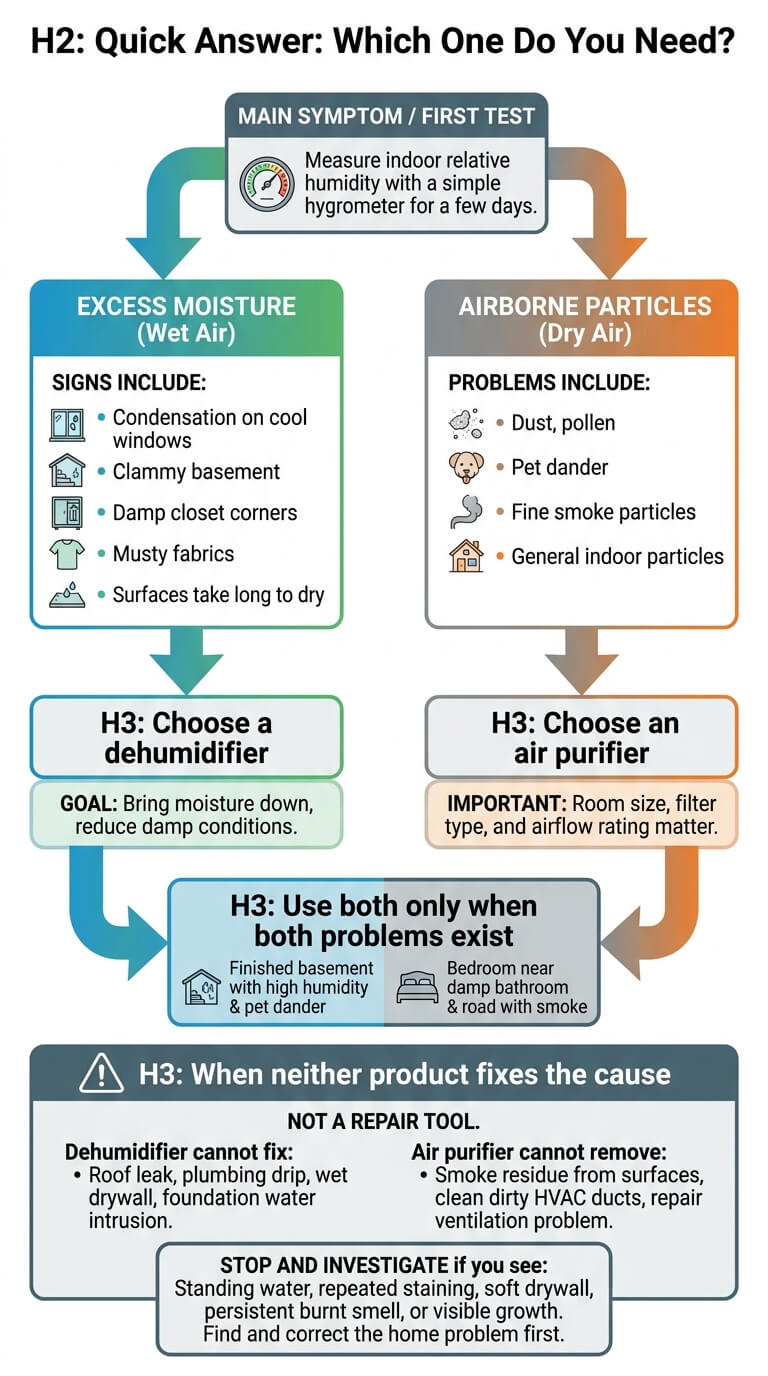
Start with the main symptom, not the product name. A good first test is to measure indoor relative humidity with a simple hygrometer for a few days. If the room repeatedly feels damp or reads high during normal use, a dehumidifier is usually the more relevant tool. If the room feels dry enough but has particles, smoke, or dander in the air, an air purifier is usually the better fit.
If your home has both dampness and air-quality complaints, compare the broader home moisture control products before choosing one device.
Choose a dehumidifier for excess moisture
Choose a dehumidifier when the problem is wet air. Signs include condensation on cool windows, a clammy basement, damp closet corners, musty fabrics, or surfaces that take too long to dry after normal cleaning. The goal is to bring moisture down to a more comfortable range and reduce damp conditions that allow odors and some moisture-related problems to linger.
Choose an air purifier for airborne particles
Choose an air purifier when the problem is what is floating in the air, not how wet the air feels. Dust, pollen, pet dander, fine smoke particles, and some general indoor particles are air purifier problems. A portable unit only works on air that passes through it, so the room size, filter type, and airflow rating matter.
Use both only when both problems exist
Some homes need both products, but not because one device is automatically better. A finished basement with high humidity and pet dander may need moisture removal plus particle filtration. A bedroom near a damp bathroom and a busy road may need humidity control during wet seasons and filtration during pollen or smoke periods.
When neither product fixes the cause
Neither product is a repair tool. A dehumidifier cannot fix a roof leak, plumbing drip, wet drywall, or water intrusion through a foundation. An air purifier cannot remove smoke residue from surfaces, clean dirty HVAC ducts, or repair a ventilation problem. If the room keeps getting wet or contaminated, the product may only reduce symptoms for a while.
Stop and investigate if you see standing water, repeated staining, soft drywall, a persistent burnt smell, or visible growth that returns after cleaning. In those cases, the next step is finding and correcting the home problem before relying on a portable device.
What a Dehumidifier Does
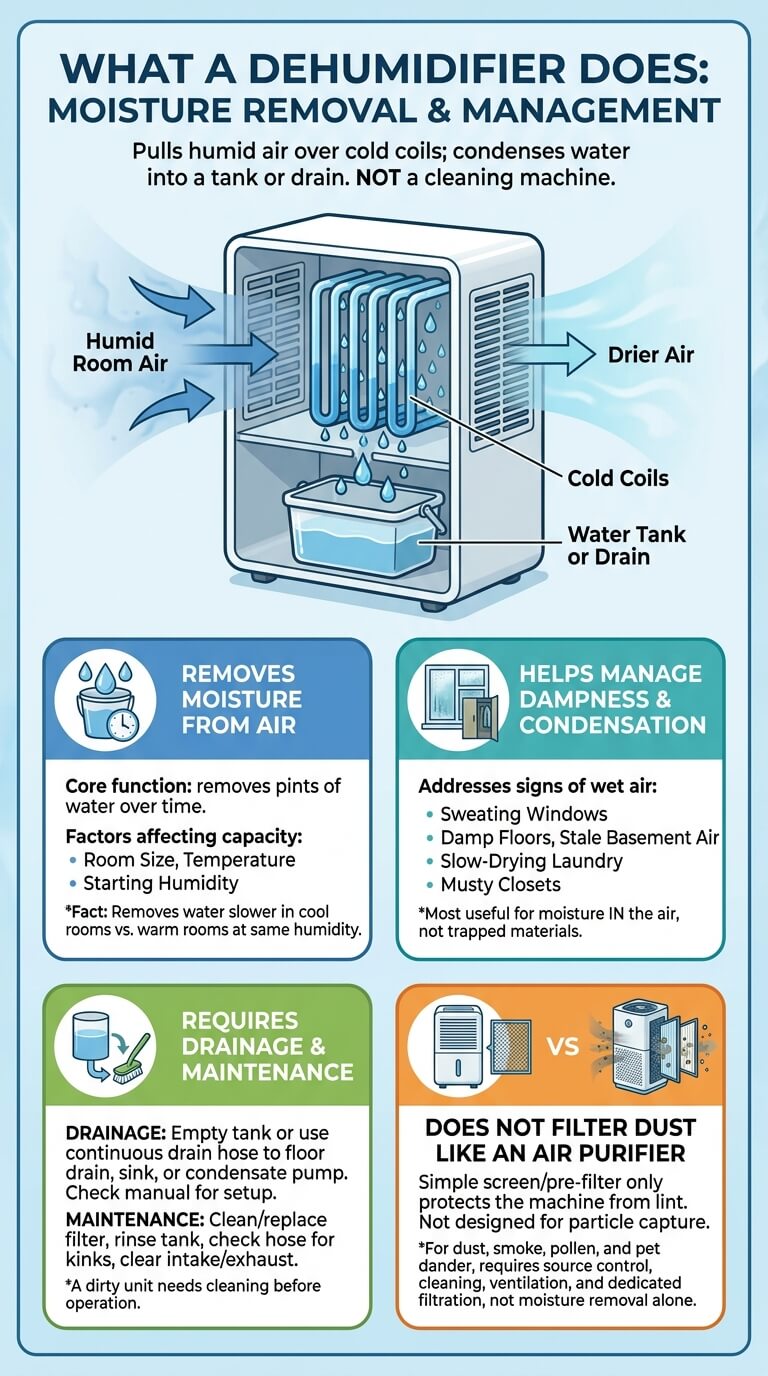
A dehumidifier pulls humid room air over cold coils so water condenses into a tank or drain line. It is a moisture-removal appliance, not a cleaning machine. It helps most when a room is damp enough that air conditioning, ventilation, or normal drying time is not keeping up.
Removes moisture from air
The main function is simple: remove pints of water from the air over time. Capacity, room size, temperature, and starting humidity all affect how much moisture it can collect. In a cool basement, a unit may remove water more slowly than it does in a warmer room with the same humidity reading.
Helps manage dampness and condensation
Dehumidifiers help with signs tied to wet air: sweating windows, damp-feeling floors, stale basement air, slow-drying laundry areas, and closets that smell musty after humid weather. The product is most useful when the moisture is in the air rather than trapped inside a wet material.
Requires drainage and maintenance
A dehumidifier collects water, so it needs somewhere for that water to go. Small units use a tank that must be emptied. Larger setups may use a hose to a floor drain, sink, condensate pump, or utility drain. Always check the manual before setting up continuous drainage, especially if the hose runs uphill or across a walkway.
One of the easiest ways to waste money is to use the right-looking device for the wrong problem, so check the common dehumidifier mistakes to avoid before buying.
Maintenance matters because wet equipment can become dirty. Clean or replace the filter as directed, rinse the tank, check the hose for kinks, and keep the intake and exhaust clear. A unit that smells bad may need cleaning before it should keep running.
Does not filter dust like an air purifier
Many dehumidifiers have a simple washable screen or pre-filter, but that does not make them air purifiers. The screen protects the machine from lint and larger dust, while a proper air purifier is designed to move air through filters that capture particles at a rated airflow.
If dust is the main complaint, a dehumidifier will usually disappoint. It may make the room feel less damp, but dust on shelves, smoke haze, pollen, and pet dander need source control, cleaning, ventilation choices, and filtration rather than moisture removal alone.
What an Air Purifier Does
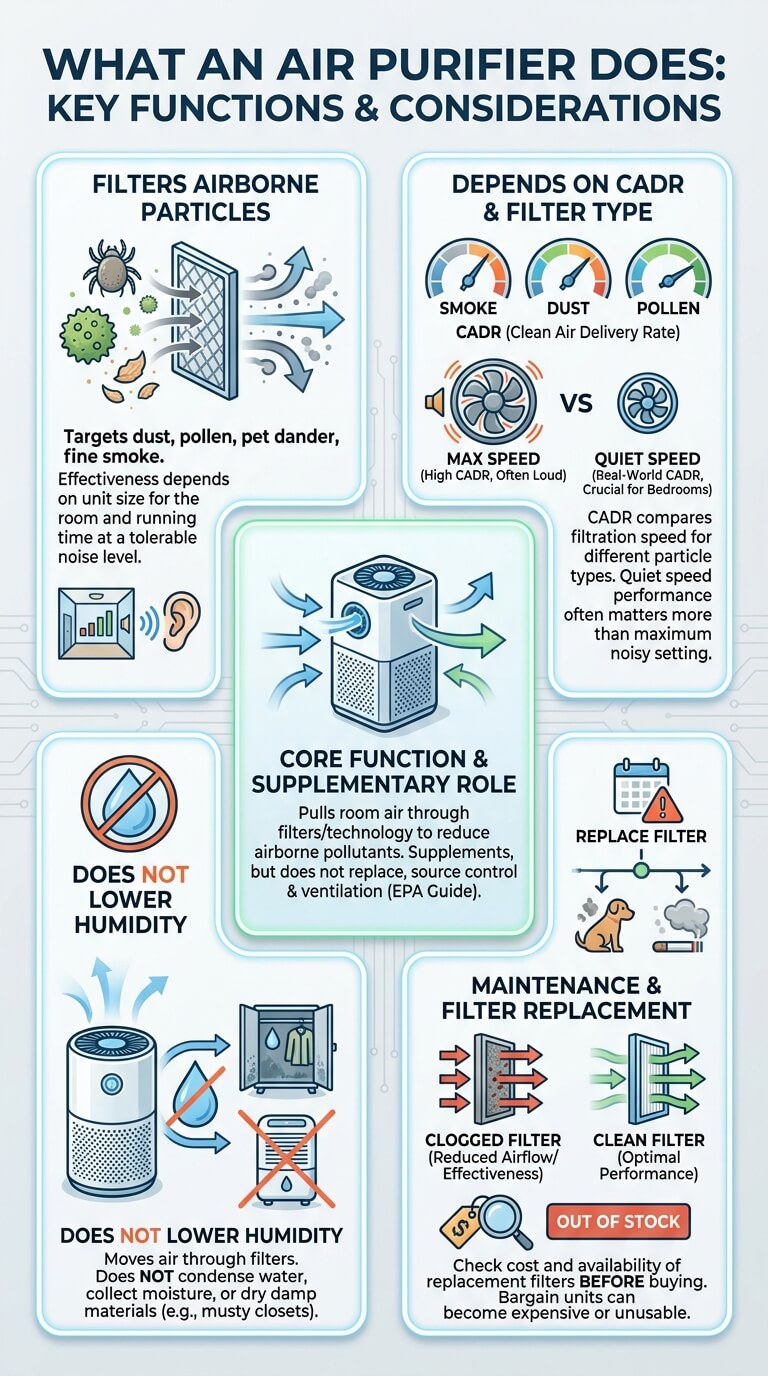
An air purifier pulls room air through filters or cleaning technology to reduce certain airborne pollutants. For most homes, a portable air cleaner with a mechanical filter is the familiar option. The EPA guide to air cleaners in the home explains that source control and ventilation are still important, even when an air cleaner is used.
Filters particles from air
An air purifier is built for particles that can move through the air. Depending on filter type and unit design, that can include dust, pollen, pet dander, and fine particles from smoke. The unit has to move enough air through the filter to matter in the room where it is used.
The practical test is not whether the machine has a long feature list. It is whether the unit is sized for the room, has the right filter for the concern, and can run long enough at a tolerable noise level.
Depends on filter type and CADR
CADR stands for clean air delivery rate. It helps compare how quickly an air cleaner delivers filtered air for smoke, dust, and pollen. The AHAM air cleaner directory explains that CADR numbers are listed separately because particles behave differently.
For a bedroom, the right CADR at a quiet speed may matter more than the highest advertised setting. Many people buy a unit that is technically powerful enough only on its loudest speed, then run it on low because the noise is annoying. That reduces real-world performance.
Does not lower humidity
An air purifier moves air through filters. It does not condense water, collect moisture, or dry damp materials. If a closet smells musty because the back wall is cold and damp, an air purifier in the bedroom may freshen circulating air but will not dry that closet.
Maintenance and filter replacement
Air purifiers need filter changes on schedule, and that schedule may shorten in homes with pets, smoke events, renovation dust, or heavy pollen. A clogged filter can reduce airflow and make the unit louder or less effective. Check the manual before vacuuming, washing, or replacing any filter because not all filters are washable.
Also check the cost and availability of replacement filters before buying. A bargain unit can become expensive if the filter is hard to find, must be changed often, or uses a proprietary part with limited supply.
Comparison Table by Problem
The fastest way to decide is to match the product to the problem. The table below is a practical first pass, not a substitute for checking leaks, measuring humidity, or reading product specifications.
| Problem | Better first product | Why | Check before buying |
|---|---|---|---|
| High humidity | Dehumidifier | Removes water vapor from room air | Measure humidity over several days |
| Musty smell | Depends | Can be moisture, particles, or wet material | Look for damp fabric, leaks, and closed airflow |
| Dust | Air purifier | Filters particles that pass through the unit | Check cleaning habits, HVAC filter, and room size |
| Smoke particles | Air purifier | Targets airborne particles when sized correctly | Clean surfaces and remove lingering residue where possible |
| Pet dander | Air purifier | Helps reduce airborne particles from pets | Grooming, vacuuming, and fabric cleaning still matter |
| Condensation | Dehumidifier | Points to moisture meeting cool surfaces | Check ventilation, insulation, and window conditions |
| Mold-adjacent concerns | Dehumidifier plus investigation | Moisture control is central | Fix wet materials and recurring water problems |
| Basement air | Often dehumidifier first | Basements commonly have moisture load | Check humidity, drainage, and any seepage |
High humidity
High humidity is a dehumidifier problem. If a hygrometer repeatedly shows elevated humidity and the room feels damp, buy for moisture removal, not filtration. A good next step is to identify the wettest time of day and the dampest zone in the room before choosing capacity.
Musty smell
Musty smell is a diagnosis problem first. If the smell gets stronger after rain, inside a closet, near a wall, or around stored fabric, moisture is likely involved. If the smell is more like smoke, cooking residue, pet bedding, or dusty HVAC air, filtration and cleaning may be more relevant.
Dust
Dust points toward cleaning, HVAC filtration, and an air purifier sized for the room. A dehumidifier will not pull settled dust off furniture. If dust returns quickly after cleaning, check windows, pets, bedding, carpets, and the HVAC filter before assuming a portable unit can do the whole job.
Smoke
Smoke is not one problem. Fresh airborne particles may respond to a properly sized air purifier, while settled smoke residue needs surface cleaning and sometimes professional treatment. If smoke is from an active safety issue, leave the area and deal with that safety concern first.
Pet dander
Pet dander is an air particle and surface-cleaning issue. An air purifier can help with particles that stay airborne long enough to pass through the filter. It will not clean pet beds, couches, rugs, or curtains. If pet odor worsens in humid weather, moisture control may also help the room feel fresher.
Condensation
Condensation usually means the air, the surface temperature, or both are creating water on a cool surface. A dehumidifier can reduce the moisture side of the problem. If condensation happens in one corner only, also check air leaks, blocked vents, insulation gaps, and furniture pushed tightly against exterior walls.
Mold-adjacent concerns
Moisture control matters when you are trying to prevent damp conditions from continuing. However, do not expect a portable machine to make visible growth safe or to fix wet drywall. If you see repeated visible growth or suspect a hidden water problem, treat the home condition as the priority.
Basement air
Basements often need a dehumidifier before an air purifier because they sit near soil, cool surfaces, and foundation walls. After moisture is under better control, an air purifier can be useful if the basement still has dust, pet dander, or hobby-related particles. Measure first so you know which problem is bigger.
How to Decide Based on Symptoms
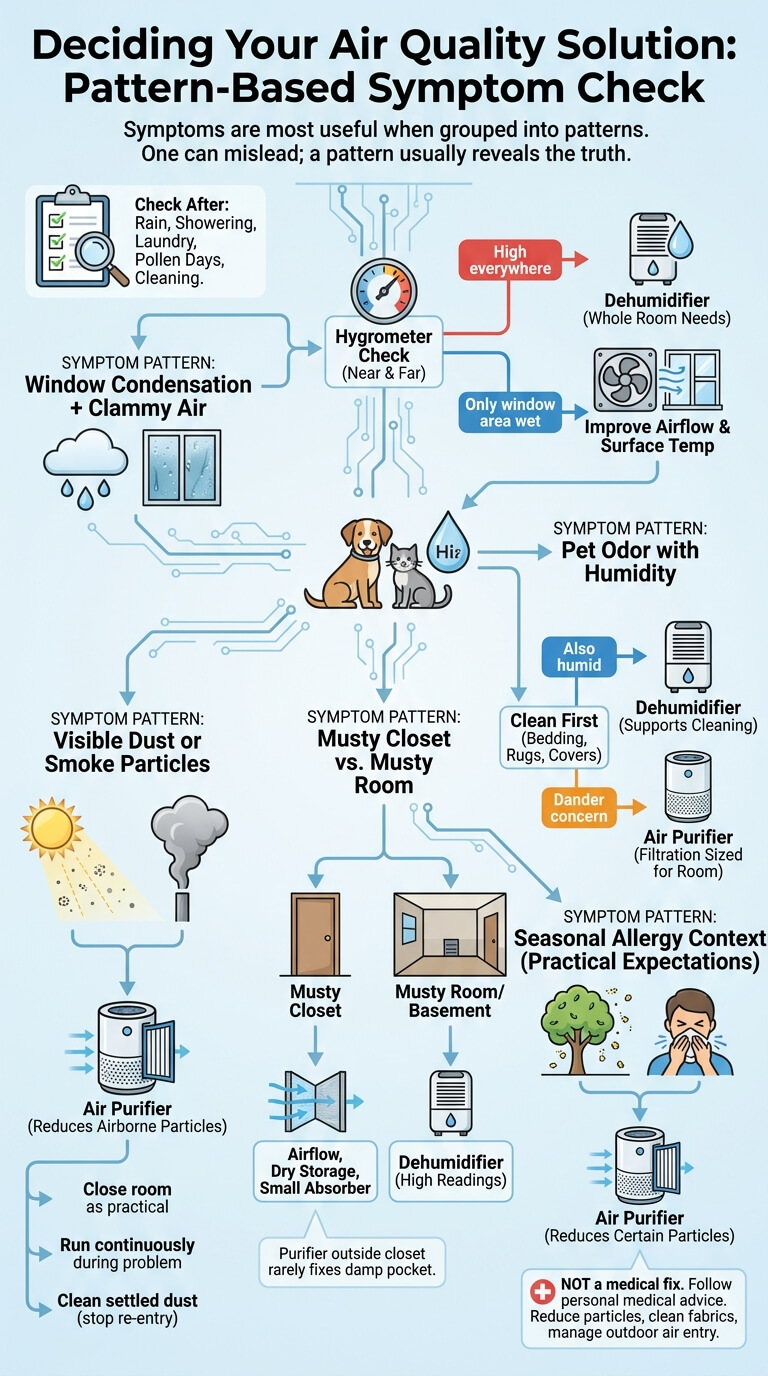
Symptoms are more useful when you group them by what they point to. One symptom alone can mislead you, but a pattern usually tells the truth. Check the room after rain, after showering, after running laundry, during pollen days, and after cleaning.
Window condensation and clammy air
Window condensation plus clammy air is a strong signal for moisture control. Place a hygrometer near the problem area, then check another part of the same room. If readings are high in both places, the whole room may need dehumidification. If only the window area is wet, surface temperature and airflow may also need attention.
Visible dust or smoke particles
If sunlight reveals floating particles or a room smells smoky after a nearby event, an air purifier is the more relevant product. Close the room as much as practical, run the unit continuously during the problem period, and clean settled dust from surfaces so the purifier is not fighting the same particles again and again.
Musty closet versus musty room
A musty closet is not the same as a musty room. A small closed closet may need better airflow, fewer packed textiles, dry storage habits, or a small moisture absorber. A musty room or basement with high readings may need a dehumidifier. An air purifier outside the closet will rarely fix a closed, damp storage pocket.
When the musty smell is limited to one wardrobe or linen closet, moisture absorbers for closets may be more appropriate than a full-room device.
Pet odor with humidity
Pet odor often becomes stronger when humidity is high because fabrics and soft surfaces hold odor differently in damp air. Clean pet bedding, rugs, and washable covers first. If the room also reads humid, moisture control can support the cleaning work. If dander is the concern, add filtration sized for the room.
Seasonal allergy context without promising health outcomes
Many households look at air purifiers during pollen season. A purifier may reduce certain airborne particles in a room when it is correctly sized and maintained. It should not be presented as a medical fix. Keep expectations practical: reduce particles where the unit runs, clean fabrics, manage outdoor air entry, and follow personal medical advice when symptoms are involved.
Can You Use a Dehumidifier and Air Purifier Together?
Yes, the two devices can run in the same room when the room has both moisture and particle problems. The key is to set them up so each unit has clear airflow and a realistic job. Running both blindly can waste energy, create noise, and make maintenance easy to ignore.
When pairing makes sense
Pairing makes sense in a damp basement with pet dander, a humid bedroom during pollen season, or a finished lower level that feels clammy and dusty. In those cases, the dehumidifier manages water vapor while the air purifier captures particles that pass through its filter.
Placement so airflow does not conflict
Do not place the two machines nose-to-nose or jammed into the same corner. Give each unit open intake and exhaust space according to its manual. Put the dehumidifier where damp air can circulate and water can drain safely. Put the air purifier where it can cycle room air without blowing directly into curtains, bedding, or a wall.
Maintenance workload
Two machines mean two maintenance routines. The dehumidifier tank, filter, coils, and hose need attention. The air purifier filter needs inspection and replacement. If you are unlikely to maintain both, choose the product that matches the main problem first and add the second only if the need is still clear.
Cost and noise considerations
Both product types use electricity and make sound. A dehumidifier may add some heat to the room. An air purifier may need to run on a higher speed during heavy particle events. Before buying both, check whether you can tolerate the combined sound in a bedroom, nursery, home office, or TV room.
Buying Criteria for Each Device Without Going Too Deep
You do not need a full feature deep dive to make the basic choice, but you do need to avoid the wrong specifications. Match moisture problems to dehumidifier capacity and drainage. Match particle problems to air purifier CADR, filter type, and room coverage.
Dehumidifier capacity and drainage
Dehumidifier capacity is usually described by pints per day under test conditions. Larger rooms, wetter rooms, and basements usually need more capacity than a small bedroom with mild seasonal dampness. Drainage matters just as much: a tank is simple but requires emptying, while a hose can be easier if a safe drain is available.
Air purifier CADR and filter type
For air purifiers, look at CADR and filter type before smart features. A unit with a suitable CADR for the room and a filter matched to dust, pollen, or smoke particles is more useful than a small decorative unit with vague claims. Check the replacement filter cost before deciding.
Room size for both
Room size affects both devices, but in different ways. Dehumidifiers must keep up with moisture load and room volume. Air purifiers must circulate enough air through the filter. Open floor plans, tall ceilings, doorways, and connected basements can make a room behave larger than the square footage on paper.
Energy and noise
Energy use matters most when a unit runs daily. For dehumidifiers, ENERGY STAR dehumidifier guidance can help compare efficient models. For air purifiers, noise at the speed you will actually use is critical because an undersized quiet setting may not move enough air.
Replacement costs
Replacement costs can change the real price of ownership. Air purifier filters may be replaced several times per year depending on use. Dehumidifiers may need washable filter cleaning, hose replacement, or eventual service. Check parts availability, warranty terms, and manual requirements before choosing a bargain model.
Mistakes When Choosing Between Them
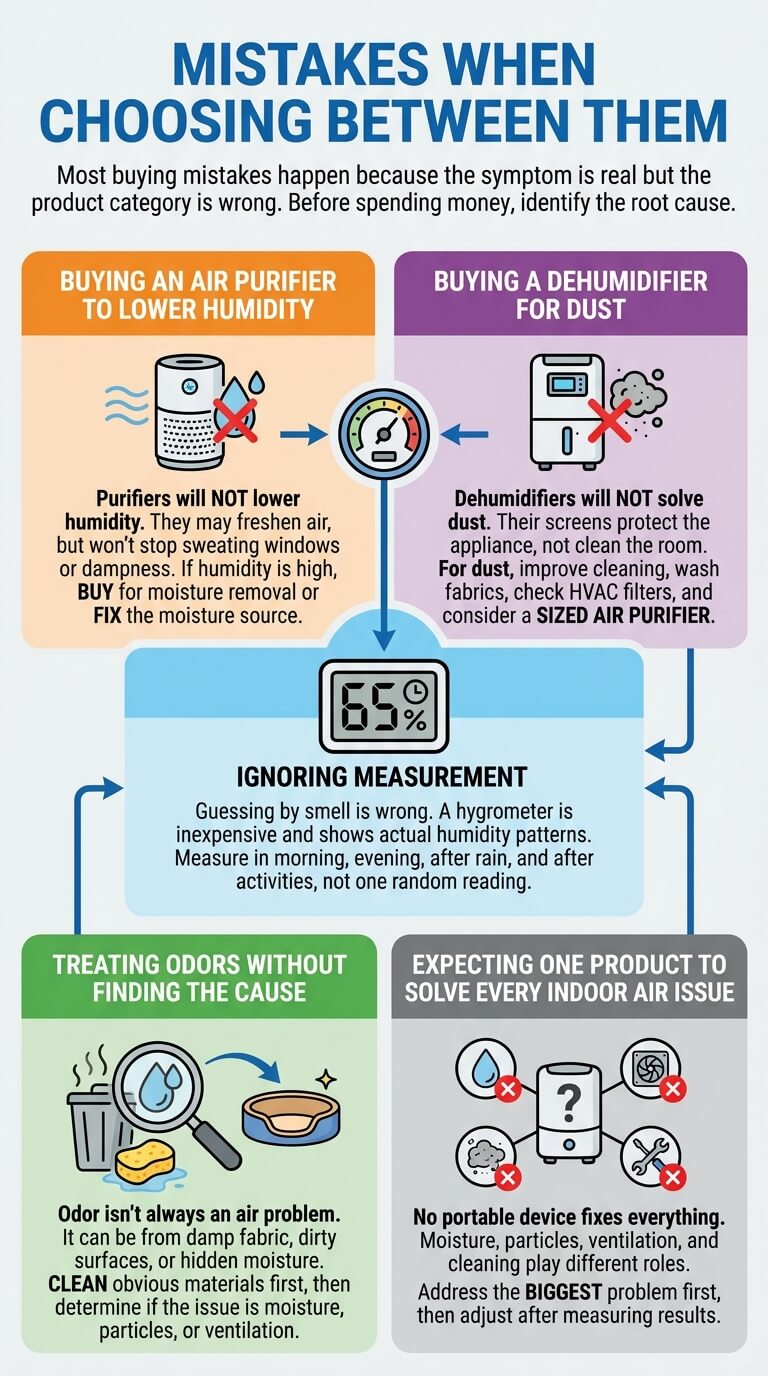
Most buying mistakes happen because the symptom is real but the product category is wrong. Before spending money, identify whether the room is damp, particle-heavy, contaminated on surfaces, poorly ventilated, or affected by a repair issue.
Buying an air purifier to lower humidity
An air purifier will not lower humidity. It may make the air feel fresher if particles are part of the problem, but it will not stop sweating windows or dry damp storage bins. If humidity readings are high, buy for moisture removal or fix the condition adding moisture to the room.
Buying a dehumidifier for dust
A dehumidifier will not solve dust. Its basic screen is there to protect the appliance, not to clean room air like a dedicated purifier. For dusty rooms, improve cleaning routines, wash fabrics, check the HVAC filter, and consider an air purifier sized for the space.
Ignoring measurement
Guessing by smell alone can lead to the wrong purchase. A hygrometer is inexpensive compared with a large appliance and can show whether humidity is actually high. Measure in the morning, evening, after rain, and after normal room activities so you see the pattern instead of one random reading.
Treating odors without finding the cause
Odor is not always an air problem. It can come from damp fabric, dirty carpet, pet bedding, drains, old smoke residue, trash areas, or hidden moisture. Clean obvious materials first, then decide whether the remaining issue is moisture, particles, or ventilation.
Expecting one product to solve every indoor air issue
No portable device solves every indoor air complaint. Moisture, particles, ventilation, cleaning, building repairs, and product maintenance all play different roles. A good purchase decision starts with the biggest problem and leaves room to adjust after you measure results.
When to Investigate the Home Instead of Buying More Devices
Portable devices are helpful only when the home condition is within their limits. The EPA mold and moisture guidance emphasizes fixing water problems and drying materials, which is more important than trying to cover up a recurring damp condition.
Leaks and standing water
Standing water, wet drywall, dripping pipes, and recurring seepage need repair. A dehumidifier can remove water vapor after the leak is fixed, but it should not be used as the main plan while water keeps entering the space. Stop using electrical appliances near water unless setup is safe and dry.
Persistent smoke contamination
If smoke has soaked into walls, carpet, upholstery, or HVAC components, an air purifier may reduce airborne particles but not remove residue from surfaces. Clean or replace affected materials as needed. For severe smoke damage, professional cleaning may be more realistic than relying on a portable air cleaner.
HVAC or ventilation problems
If one room feels stale, dusty, or damp while the rest of the home is normal, check airflow. Closed vents, blocked returns, dirty filters, poor bathroom exhaust, and disconnected ducts can create symptoms that look like a product problem. A portable device may help, but the ventilation issue still deserves attention.
Repeated visible growth
Repeated visible growth means the conditions are returning. Do not assume an air purifier will make the area safe or that a dehumidifier can fix a wet material hidden behind paint, trim, or carpet. Clean small areas safely only when appropriate, fix moisture, and get help when the area is large, recurring, or tied to building damage.
Safety and professional limits
Stop DIY troubleshooting when there is electrical risk, sewage water, major storm intrusion, strong chemical odor, large visible growth, or symptoms that need medical guidance. Portable appliances are not substitutes for repair, remediation, or professional inspection when the situation is outside normal household maintenance.
FAQ
Does an air purifier reduce humidity?
No. An air purifier filters air but does not remove water vapor. If the room is humid, use a hygrometer to confirm readings and consider a dehumidifier, better ventilation, or fixing the condition that is adding moisture.
Is a dehumidifier or air purifier better for musty smell?
It depends on why the room smells musty. If the smell follows rain, damp storage, condensation, or high humidity readings, start with moisture control and cleaning damp materials. If the room is dry but dusty, smoky, or full of pet particles, an air purifier may be more useful.
Can I run both in the same room?
Yes, when both moisture and particle problems exist. Keep each unit clear of walls, curtains, and furniture, follow both manuals, and make sure drainage and filter replacement are manageable. If only one problem exists, start with the matching device.
Which is better for a basement?
A dehumidifier is often the first choice for a damp basement because basements commonly have moisture load. An air purifier can be useful after moisture is under control if the basement still has dust, dander, smoke particles, or hobby-related particles.
Should I buy a hygrometer before deciding?
Yes, in many cases. A hygrometer helps confirm whether humidity is actually high. That single measurement step can prevent buying an air purifier for a moisture problem or buying a dehumidifier when the real issue is dust, smoke, or pet dander.
Final Thoughts
The dehumidifier vs air purifier decision comes down to moisture versus particles. Choose a dehumidifier when the room is damp, clammy, condensed, or musty because of high humidity. Choose an air purifier when the room is dry enough but has dust, smoke particles, pollen, or pet dander. Use both only when both problems are present and each product has a clear job.
Before buying, measure humidity, inspect the room, read product specifications, and check the manual for placement and maintenance limits. A good device can improve a room within its purpose, but the best result usually comes from pairing the right product with cleaning, ventilation, and repair when the home itself needs attention.

Ethan Carter is the Founder & Editor of HomeCleanSecrets. Based in the United States, he has 5 years of experience creating practical home cleaning, laundry care, stain removal, decluttering, and home organization content. His goal is to help everyday households clean smarter and build simple routines that are easier to maintain.
Read more about Ethan Carter on his author page: https://homecleansecrets.com/ethan-carter/