
Medical paperwork becomes hard to use when visit summaries, lab reports, insurance notices, bills, referral forms, and prescription lists all land in the same pile. A workable home system does not require you to understand every clinical detail. Medical paperwork works best within the wider household paper workflow, while keeping health records separated by person and purpose.

The simplest approach is to separate records by household member first, then divide each person’s papers into current-use and historical sections. Keep unresolved bills and forms out of the permanent medical file until the action is finished.
Quick Answer: Organize Physical Medical Records by Person, Purpose, and Current Use
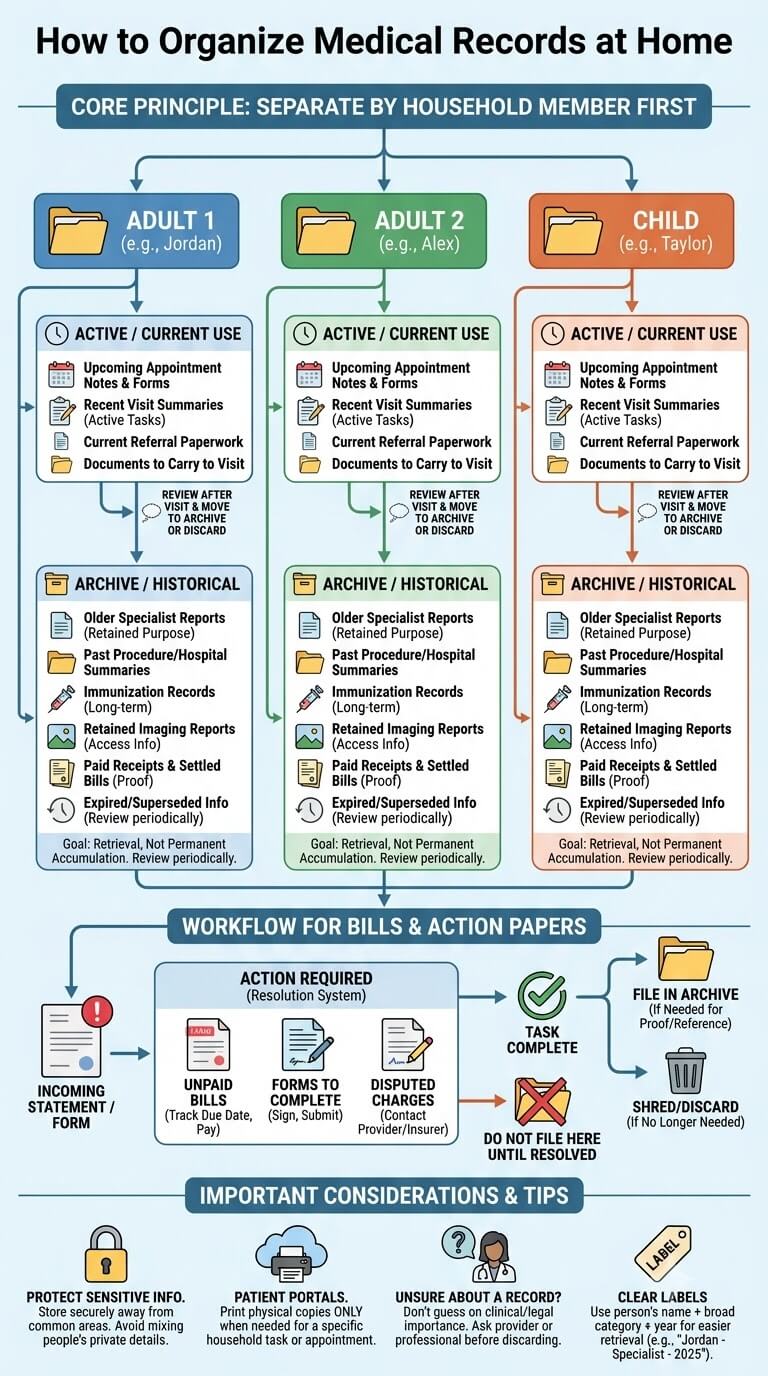
A good medical record system should make the next appointment easier, not create another archive you are afraid to touch. Start with one clearly labeled section per person, then distinguish papers you may need soon from papers kept for reference.
Separate active appointment information from historical reference records
Keep upcoming appointment notes, recent visit summaries, current referral paperwork, and any documents you expect to carry to a visit in an active folder. Older records that still serve a known purpose belong in a separate archive section.
Keep bills, receipts, and clinical records in the workflow that matches their purpose
A statement that needs payment or a call is an action paper, even if it came from a clinic. A payment receipt is proof of a transaction.
What Belongs in a Home Medical Record System
This system is for physical household organization and retrieval. It can help you find records before appointments, keep family members separate, and reduce duplicate paper.
Focus on physical household organization and retrieval
Useful categories include provider information, immunization records, visit summaries, retained reports, appointment forms, and insurance-related health paperwork. Your job at home is to make those papers findable.
Leave diagnosis, treatment, and legal retention decisions to the right professionals
Do not use the filing process to interpret a lab value, decide whether a medication is still appropriate, or determine that a record is safe to destroy. The U.S. Department of Health and Human Services explains patient access to medical and billing records, but your own provider remains the right place for questions about clinical meaning.
Start With One Folder or Section Per Household Member
Person-first separation is the easiest way to prevent mix-ups. It also makes it possible to pull one person’s records without exposing everyone else’s information.
Adults
Give each adult a clearly labeled folder, expanding file, or filing section. Inside it, keep the structure simple enough to remember, such as Current Care, Providers, Reports, Insurance Papers, and Archive.
Children
Use a separate file for each child rather than one general “kids medical” folder. Immunization records, pediatric visit summaries, specialist papers, and school health forms can otherwise become difficult to match to the correct child.
Caregiver-shared records when appropriate
If a caregiver legitimately helps manage appointments or records, create a defined set of papers they need rather than giving unrestricted access to every document. A small active packet can be easier to update and safer to share than an entire archive.
Avoid mixing sensitive information between people
Mixed folders increase the chance that the wrong insurance card copy, provider note, or form travels to an appointment. They also expose more information than necessary when one person retrieves a file.
Current Versus Historical Medical Records
The active-versus-archive split keeps frequently used information near the front while protecting older records from constant handling. It is an organization decision, not a legal retention schedule.
Active care and upcoming appointment materials
Active papers may include a referral, a recent visit summary, a current medication list prepared for discussion with the provider, instructions for an upcoming test, and questions you want to raise at the visit. Remove papers from the active section when the task or near-term need ends, then decide whether they have a valid reference purpose.
Historical reports retained for a valid purpose
Older specialist reports, procedure summaries, imaging reports, or other records may remain useful in some situations, but do not keep them in the front working file simply because they are medical. If you are unsure whether a particular record matters clinically, ask the relevant healthcare professional rather than making that judgment during a decluttering session.
Review intervals are organization checkpoints, not legal retention rules
You can review the archive once or twice a year to remove duplicates, correct misfiled papers, and identify documents whose purpose is no longer obvious. The review date tells you when to reconsider the file, not when a document must be destroyed.
Core Medical Record Categories
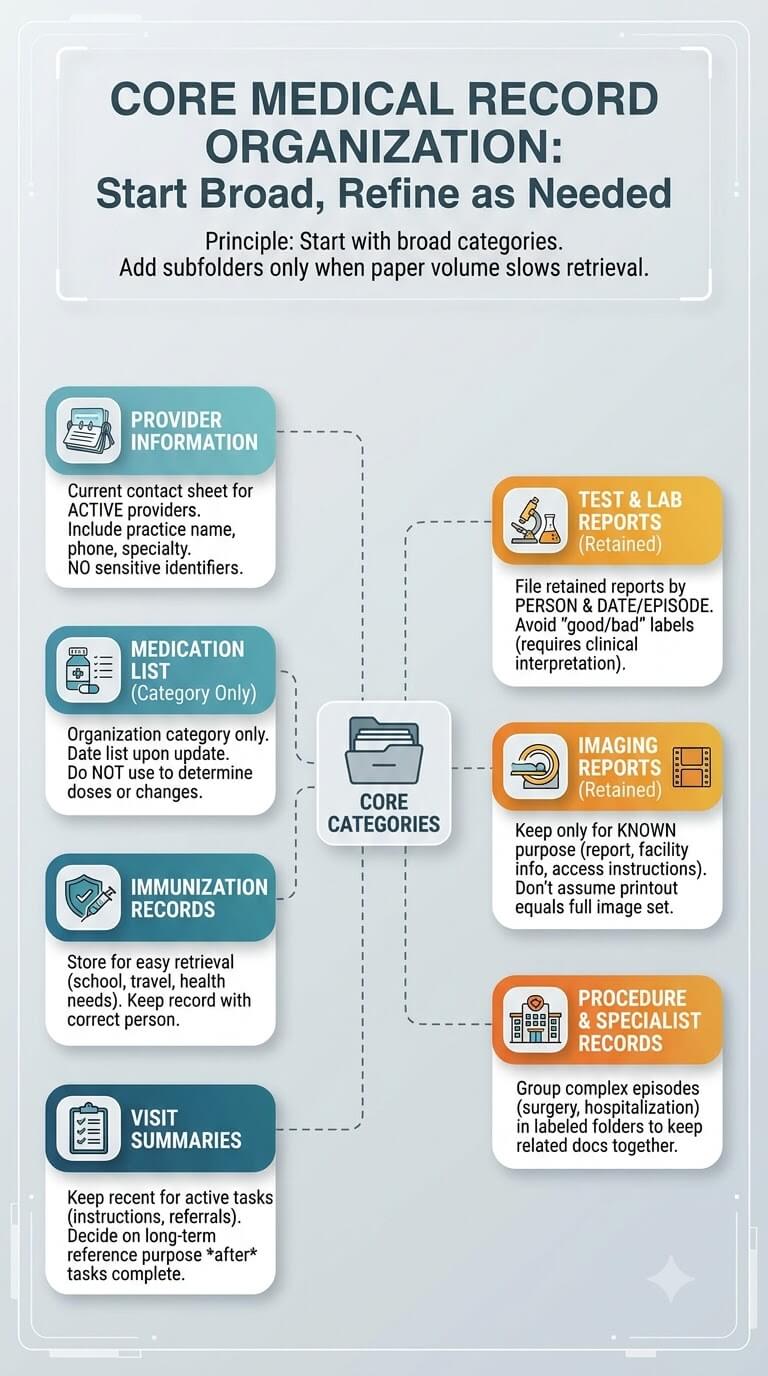
Start with broad categories. Add a subfolder only when papers are accumulating enough to slow retrieval.
Provider information
Keep a current contact sheet for the providers you actually use, including practice name, phone number, and specialty when helpful. Avoid copying sensitive identifiers that are not needed for routine contact.
Medication list as an organization category only
A household medication list can be a convenient document to locate before appointments, but the filing system should not decide doses, changes, or whether a medicine should be stopped. Date the list when you update it so you can recognize an old copy.
Immunization records
Store immunization documentation where it can be retrieved for school, travel, employment, or healthcare needs that apply to your household. Keep the record with the correct person.
Visit summaries
Recent after-visit summaries can be useful while instructions, referrals, or follow-up steps are still active. After those tasks are complete, decide whether the summary has an ongoing reference purpose.
Test and lab reports when retained
File retained reports by person and either date or care episode. Do not create a home category such as “good results” or “bad results,” because that requires clinical interpretation.
Imaging reports when retained
Imaging paperwork may include a report, facility information, or instructions for accessing images. Keep only what serves a known purpose, and avoid assuming a printed report is equivalent to the actual image set or the provider’s complete record.
Procedure, hospital, and specialist records
Group a complex episode of care together when that improves retrieval. A labeled folder for a surgery, hospitalization, or specialist course can keep discharge paperwork, related summaries, and follow-up documents from scattering across general files.
Medical Insurance Paperwork
Insurance papers often resemble bills, but they may serve different purposes. Keep the categories distinct so you do not accidentally pay a notice that is not a bill or file away a charge that still needs action.
Explanation of benefits as a practical category
An explanation of benefits can help you match insurer activity with care received and provider billing, but it is not automatically the same thing as an amount due. For people using Medicare prescription drug coverage, for example, Medicare describes an Explanation of Benefits as a notice summarizing claims and costs. Follow your own plan’s instructions when questions arise.
Coverage and correspondence at a high level
Keep current plan correspondence that you still need to reference separate from clinical records. If a letter requires a response, appeal, correction, or call, place it with action papers until that task is resolved.
Separate insurer paperwork from clinical interpretation
An insurer notice may describe a claim, coverage decision, or cost information, but it does not belong in the section where you track symptoms or clinical instructions. File by purpose, and contact the plan or provider when you need an explanation.
Medical Bills Versus Medical Records
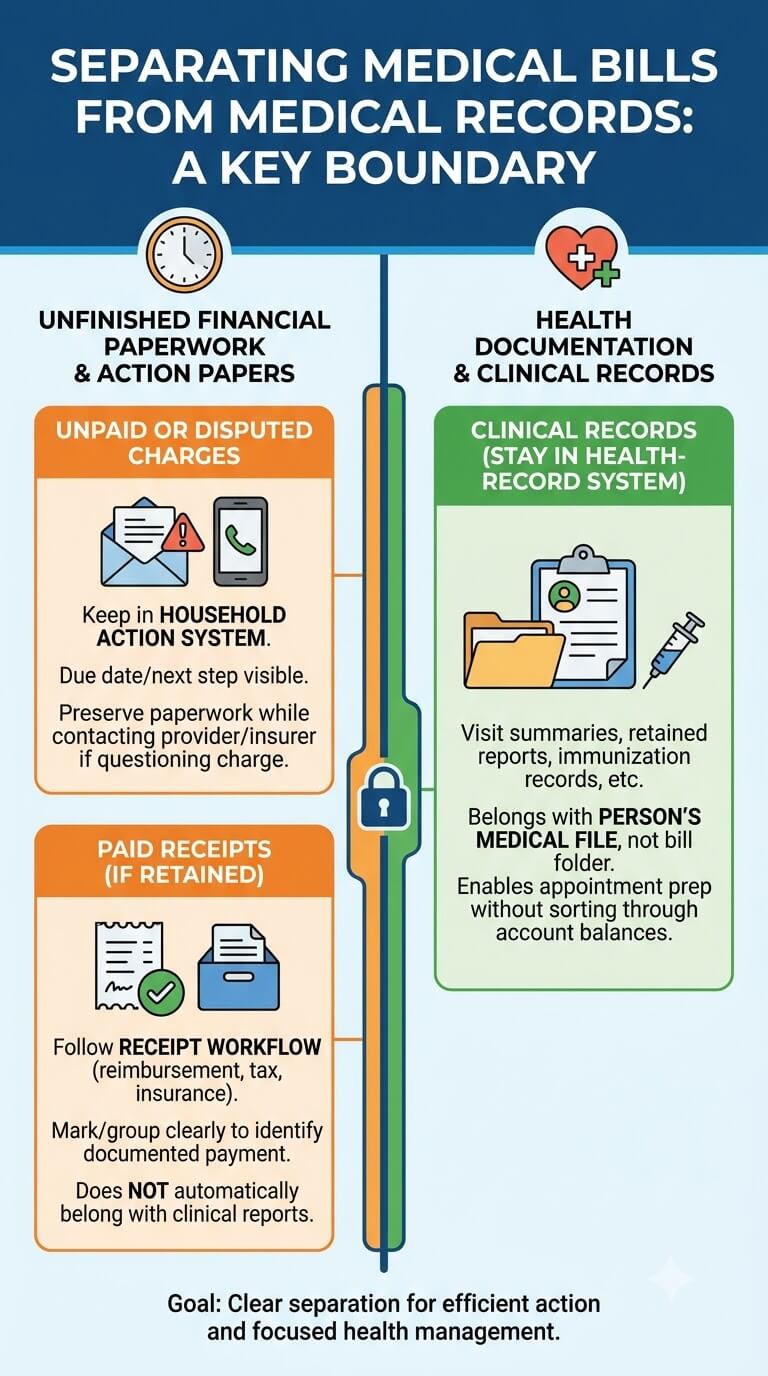
One of the most useful boundaries is separating unfinished financial paperwork from health documentation. The medical file should not become the place where unpaid statements disappear.
Unpaid or disputed charges remain action papers
If a statement needs payment, verification, a phone call, or another response, keep it in the household action system with its due date or next step visible. If you question the charge, preserve the relevant paperwork while you contact the provider or insurer.
Paid receipts follow the receipt workflow if retained
A receipt may be worth keeping for reimbursement, tax, insurance, or another specific reason, but it does not automatically belong beside clinical reports. Mark or group it so you can tell what payment it documents.
Clinical records stay in the health-record system
Visit summaries, retained reports, immunization records, and other health documentation belong with the person’s medical file rather than the bill folder. Keeping clinical records separate means you can prepare for an appointment without sorting through account balances and payment confirmations first.
Referral, Appointment, and Form Workflow
Short-term appointment paperwork needs to stay visible until the visit is complete. Deep filing is useful only after the action is finished.
Papers requiring action before the visit
Referral forms, pre-visit questionnaires, consent forms, imaging instructions, and records-request paperwork may need attention before the appointment date. Keep them in the active section with the appointment noted on your calendar.
What to carry to an appointment
Build a slim visit packet rather than taking the whole household archive. Include only items the provider requested or that you reasonably expect to reference, such as a current list you maintain, referral paperwork, or relevant records from another facility.
What to update or file after the visit
After you return home, remove completed forms, add any new visit summary you intend to keep, update the next appointment or follow-up task, and route new bills separately. When this happens promptly, the active folder reflects what is still current instead of preserving every stage of the visit process.
Build an Active Medical Folder
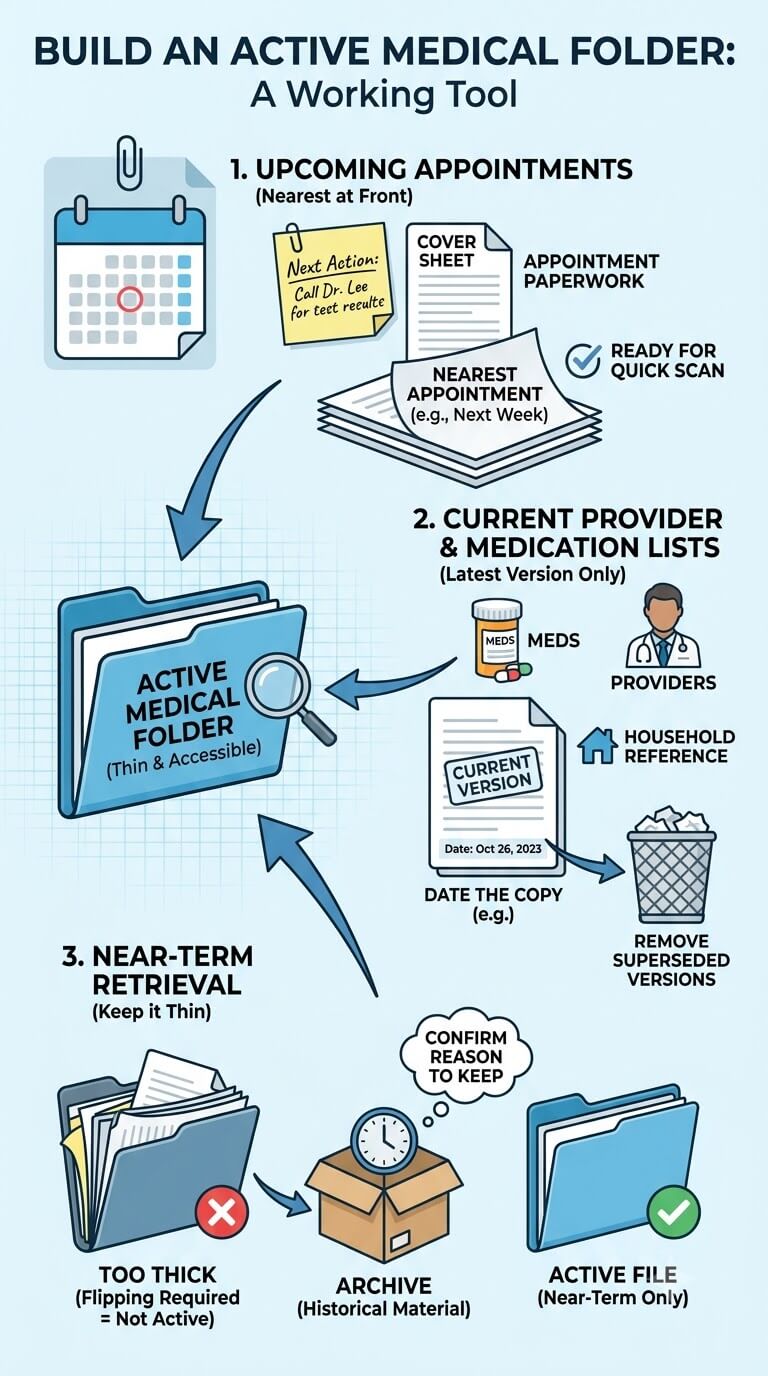
The active folder is a working tool. Keep it thin enough that you can scan the contents quickly before making a call or leaving for an appointment.
Upcoming appointment documents
Place appointment-specific paperwork together and put the nearest appointment toward the front. A sticky note or cover sheet can list the next action without altering original documents.
Current provider and medication-list copies when appropriate
Keep only the current version you use for household reference. Date the copy and remove superseded versions from the active area so no one grabs an outdated sheet by mistake.
Keep only what supports near-term retrieval
If the folder becomes thick enough that you have to flip through old reports to reach current papers, it is no longer functioning as an active file. Move historical material into the archive after confirming it still has a reason to be kept.
Build an Archive Medical Section
The archive is for records you are intentionally retaining but do not need during ordinary weekly life. Its job is retrieval, not permanent accumulation.
Historical records kept for a known purpose
Before placing a paper in the archive, be able to say why it is there, even if the answer is simply “the provider advised us to keep this” or “we may need this history for ongoing care.” Papers with no understood purpose can go into a temporary review folder until you confirm what should happen next.
Label by person and type or period
A straightforward structure such as “Jordan – Specialist Records – 2025” is usually easier to search than a stack of tiny categories. If one person has very few records, one chronological archive may be enough.
Avoid overfilling active files with old records
Archive expansion should not push older papers back into the active folder. When the archive grows, review duplicates, empty envelopes, repeated cover sheets, and documents whose purpose you can now resolve.
Chronic-Condition Folders Can Improve Retrieval
Some households benefit from a separate folder for a long-running care situation, especially when records arrive from several providers. The folder is an organization tool, not a statement about what is medically important.
When a separate folder may improve retrieval
Consider a dedicated section when one person has enough related appointment notes, specialist records, or treatment paperwork that the general medical file becomes difficult to search. Keep routine unrelated records elsewhere so the folder remains focused on the care situation it was created to support.
Group by provider, condition, or treatment episode only for organization
Choose the grouping that makes papers easiest to find. A provider-based structure may work when several specialists are involved, while an episode-based folder may suit a surgery and follow-up period.
Ask healthcare professionals when clinical importance is unclear
If you cannot tell whether a report should stay with current care papers, ask the clinician or medical records office what they recommend for the situation. Do not discard a document simply because it looks repetitive.
Pediatric and Family Records
Children’s records often intersect with school, sports, childcare, and changing providers. Keeping official health documents separate from everyday school papers prevents them from disappearing into backpacks or art piles.
Immunization and school-related health forms
Keep official immunization documentation and completed health forms in the child’s medical section when they remain relevant. A form that still needs a parent signature or return to school should stay with action papers until submitted.
Growth or visit summaries when retained
Pediatric offices may provide summaries after routine visits. Keep the ones you have a reason to reference, but avoid treating every printout as a keepsake by default.
Transition records as children age
As teenagers begin managing more of their own care, clarify which papers remain in the household file and which move under their control. Access and privacy expectations can change with age, care setting, and law, so follow current provider and legal guidance rather than assuming one household rule fits every stage.
Sensitive Information Needs Deliberate Physical Privacy
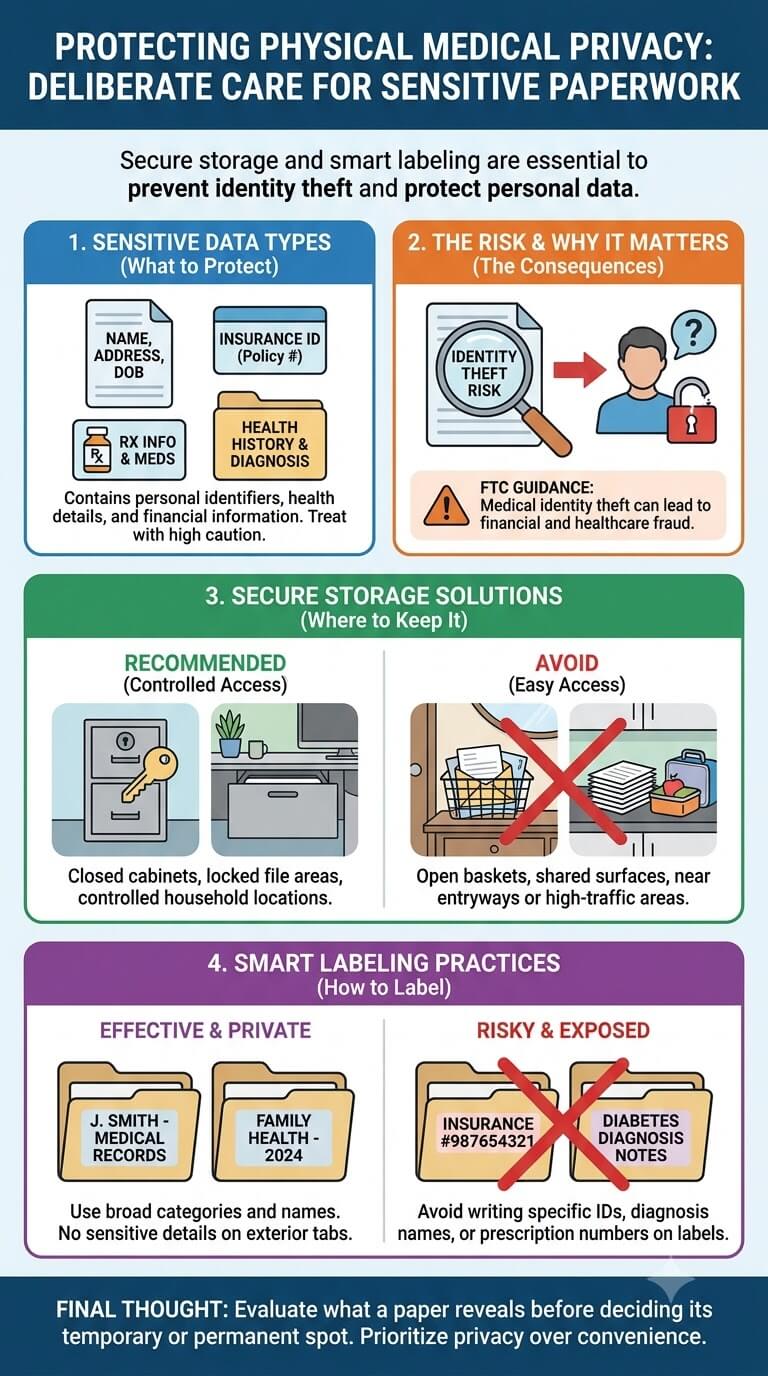
Medical paperwork can contain names, addresses, dates of birth, insurance identifiers, prescription information, and other private details. Store it with more care than ordinary household reference papers.
Health information, identifiers, insurer details, and addresses
Look at what a paper reveals before deciding where it can sit temporarily. A lab envelope on the kitchen counter and a school lunch menu do not have the same privacy needs. The Federal Trade Commission’s medical identity theft guidance explains why medical and insurance information deserves protection.
Choose storage that limits unnecessary access
A closed cabinet, locked file area, or another controlled household location may be appropriate depending on who lives in or visits the home. Avoid leaving medical files in open baskets near entryways or shared work surfaces.
Avoid realistic private-data examples
Labels should help retrieval without exposing more information than necessary. Use a person’s name and a broad category rather than writing insurance numbers, diagnosis details, or other sensitive identifiers on an exterior tab.
What If Most Records Are in Patient Portals?
You do not need to print everything simply because a portal makes printing easy. Physical copies are most useful when they support a real household task, appointment, caregiving need, or backup purpose.
Keep physical copies only when they serve a household purpose
Print or retain paper when you know why you want it, such as carrying a requested report to another provider or keeping a current form accessible for a caregiver. Otherwise, the portal may remain the better place to view routine information.
Optional backup boundaries
A scan or downloaded copy can be useful in some situations, but a backup does not automatically replace an original or satisfy every organization’s requirements. If a specific document must be presented in a particular format, confirm that requirement with the requesting party before relying on a copy.
Keep the physical system focused even when access is digital
Portal access changes how you obtain records, not the purpose of the home file. Keep physical papers that genuinely help household retrieval, then route them by person and use.
Requesting Copies From Healthcare Providers
When a record is missing from your home file, the safest next step is to identify who created or currently holds it and follow that organization’s current request process.
Identify the provider or facility
Start with the office, hospital, laboratory, imaging center, or other facility connected with the record. Write down the approximate service date and the type of document you are trying to locate.
Follow the provider’s current records-request process
Request procedures can differ by organization. The federal health IT site provides current information on getting copies of health records and completing access request forms. Use the provider’s current form and instructions rather than copying an old request from another healthcare system.
Do not substitute household organization for provider instructions
Your folder labels cannot determine whether an office needs identification, authorization, a specific request form, or another step. If you are requesting records for someone else, especially an adult, ask the provider what authority or documentation is required.
Use a Simple Appointment Retrieval Routine
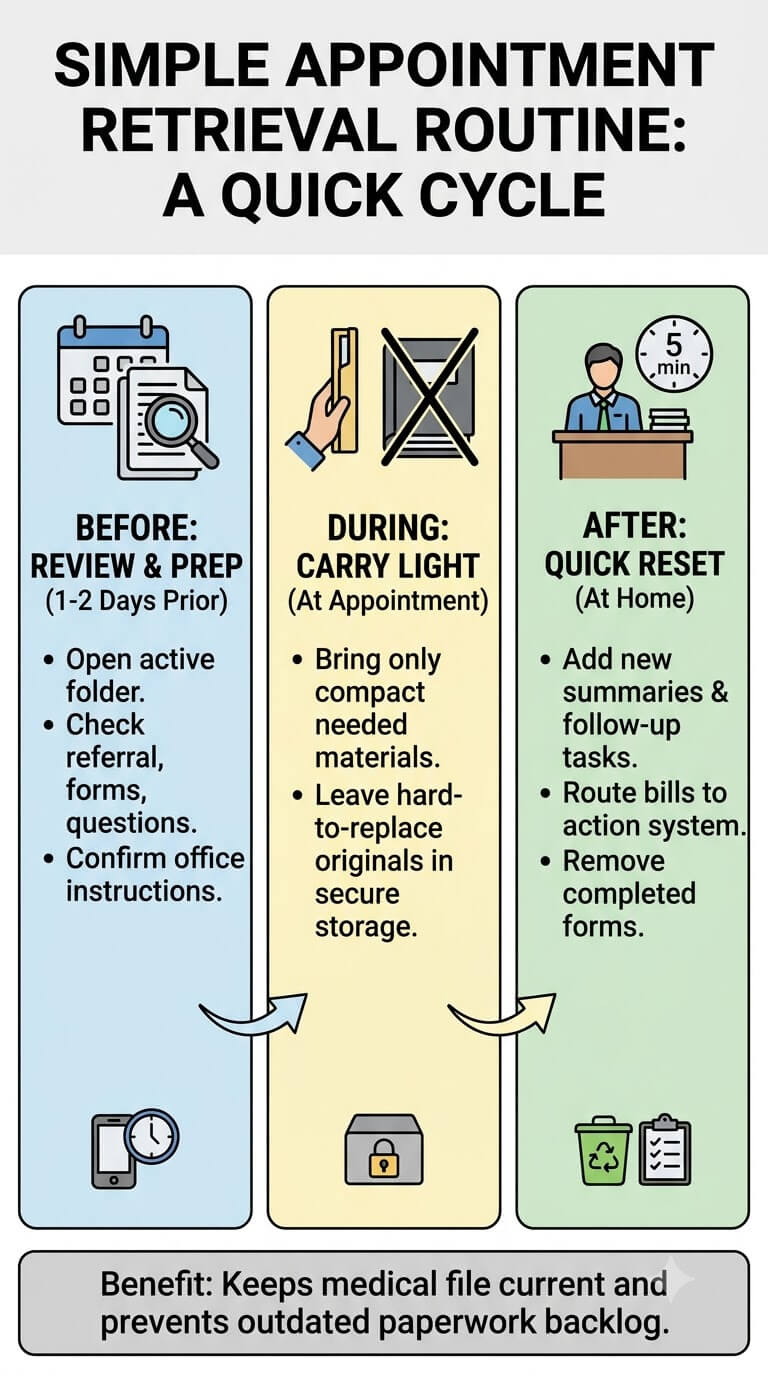
A short routine before and after appointments keeps the medical file current without turning recordkeeping into a daily project.
Review relevant papers before the visit
A day or two before the appointment, open the active folder and check the referral, requested records, forms, and questions you intend to bring. Confirm the office’s instructions when necessary.
Bring only needed materials
Carry a compact packet instead of an entire binder of family records. Originals that are difficult to replace should stay in secure storage unless the receiving organization specifically requires them.
Update the active file afterward
When you get home, add any new summary you are keeping, note follow-up tasks, route bills to the action system, and remove completed appointment forms. A five-minute reset prevents the next visit from starting with a pile of outdated paperwork.
Common Medical-Record Organization Mistakes
Most problems come from unclear boundaries, not a lack of folders. Fix the decision that is failing before buying another container.
Mixing family members
One household folder may seem convenient until two people use the same clinic or insurance company. Separate by person first.
Filing unpaid bills as medical records
A bill that still needs action should remain visible with other unfinished household tasks. Filing it deep in a medical archive can hide the due date or unresolved question.
Keeping every portal printout
Printing everything can produce hundreds of pages that are harder to search than the portal itself. Keep paper selectively.
Storing active appointment papers in deep archive
Referral paperwork and forms for next week’s appointment should not require opening an archive box. Keep near-term items in the active folder, then move or remove them after the appointment.
Exposing sensitive information in open household areas
Kitchen counters, entryway baskets, and open shelving are poor long-term homes for medical records when visitors or unrelated household members pass through. Temporary staging should be brief.
Edge Cases That Need a Clear Decision
Some documents do not fit neatly into one category. Choose the location based on the next action and the reason you expect to retrieve the paper.
Multiple providers for one person
When several providers are involved, create subfolders only if the general file has become difficult to search. You might separate primary care, specialists, and one major treatment episode.
Caregiver access
If another person helps with appointments, give them access to the minimum practical set of records they are authorized to handle. Store the broader archive separately.
Duplicate insurer and provider copies
Two documents may look similar while serving different purposes. Check the sender, document type, service date, and whether either copy includes information the other lacks before discarding one.
Missing records
Create a short “to request” note instead of leaving an empty folder as your only reminder. Identify the provider, approximate date, and record type, then follow the provider’s process.
A document is both medically relevant and an important original
If a record is difficult to replace or has broader legal significance, do not keep the only original in a frequently handled appointment folder. Store the original according to its sensitivity and replacement difficulty, and use an appropriate copy for routine reference when the receiving organization allows it.
FAQ About Organizing Medical Records at Home
These questions cover the decisions that most often slow down a household medical filing routine. When a record has unclear clinical, legal, or insurance significance, confirm the requirement before removing it.
Should each family member have a separate medical file?
Usually, yes. Person-first separation reduces mix-ups and lets you retrieve one person’s records without exposing everyone else’s information.
Where do medical bills belong before they are paid?
Keep them with action papers, not buried in the medical archive. The bill should stay visible until payment, verification, a call, or another required response is complete.
What if my records are mostly online?
Keep the paper system small. Print only records that support an appointment, caregiving task, required submission, or another known household need.
How do I prepare a physical file for an appointment?
Pull the appointment form, referral, requested outside records, and any current household reference sheet you reasonably need. Check the provider’s instructions before bringing difficult-to-replace originals.
How should I handle a medical record when I am unsure whether it should be retained?
Do not destroy it just to finish the organizing session. Put it in a clearly marked review folder and identify who can answer the question, such as the provider, insurer, records office, or another appropriate authority.
Final Thoughts
A home medical record system works best when it helps you retrieve the right paper without requiring you to become an expert in medical records law or clinical care. Separate people first, keep current-use papers distinct from historical records, and route bills, receipts, and unfinished forms according to what still needs to happen.
When a document’s clinical importance, legal status, insurance requirement, or retention need is uncertain, stop before discarding it and check the appropriate current guidance. The goal is a smaller, clearer physical system that supports appointments and household reference while respecting the sensitivity of health information.

Ethan Carter is the Founder & Editor of HomeCleanSecrets. Based in the United States, he has 5 years of experience creating practical home cleaning, laundry care, stain removal, decluttering, and home organization content. His goal is to help everyday households clean smarter and build simple routines that are easier to maintain.
Read more about Ethan Carter on his author page: https://homecleansecrets.com/ethan-carter/