
Receipts are easier to manage when you stop treating them as one permanent paper category. A grocery slip, a receipt for a new refrigerator, a return receipt, and a reimbursement receipt may all look similar, but they have different jobs. The simplest household approach is to capture receipts in one small place, identify why each one matters, keep it only as long as that purpose requires, and move it to another record category only when there is a clear reason. Receipts are one temporary category within the household paper lifecycle, and their purpose determines whether they move to action, records, or disposal.

This keeps wallets, kitchen drawers, and file boxes from filling with paper that nobody can identify. It also makes the receipts that do matter easier to retrieve. The goal is not to decide tax, warranty, medical, or legal requirements for every purchase.
Quick Answer: Organize Receipts by Purpose, Not by the Fact That They Are Receipts

Intake, identify the reason to keep, store temporarily or route, then review
Give every paper receipt the same first path: put it in one small intake location, then ask what job it still has. A receipt may support a return, warranty, reimbursement, tax record, medical record, property record, or major-purchase file. If the reason is temporary, keep it in a short-term holder. If the reason belongs to another household record category, move it there after you have identified that purpose.
A good test is whether another person in the household could look at the receipt and explain why it is still being kept. If the answer is only “just in case,” the paper needs a clearer decision.
Why most receipts should not automatically become permanent files
Automatic filing creates volume without improving retrieval. Small everyday receipts can bury the few records connected to expensive purchases, unresolved returns, reimbursement claims, or warranty coverage.
Instead, use a temporary category until the purchase question is settled. Then either remove the receipt appropriately or place it with the record it supports. The filing decision should follow the purpose, not the paper format.
When to Use This Receipt System
Everyday purchase receipts
Use the system for paper that comes home in grocery bags, clothing bags, pharmacy bags, takeout orders, hardware purchases, household supply runs, and similar daily transactions. The first decision is usually simple: does this purchase still have an unresolved reason to keep the receipt?
Returns, warranties, reimbursements, major purchases, tax-related records, medical receipts, and property-related receipts
These categories deserve more deliberate handling because the receipt may support another task or record. Keep the reason visible. A return receipt belongs with the unresolved return. A warranty receipt belongs with useful product documentation. A reimbursement receipt belongs with the submission task. A tax-related receipt should be handled according to current tax requirements, not a household rule invented for convenience.
Create One Receipt Intake Point
Empty wallets, purses, pockets, and shopping bags
Receipts often become clutter because they never reach a decision point. Pick a routine trigger, such as unpacking groceries, putting away purchases, or emptying pockets at the end of the day. Pull out the slips that might matter and place them in the receipt intake area.
Use a small envelope, tray, or section of the paper inbox
The container should be large enough for a normal week or two of receipts but small enough to signal buildup. A labeled envelope, shallow tray, or narrow divider in an existing paper inbox works well. Avoid a deep box where receipts can sit for months without being reviewed. If a receipt is already tied to an urgent return or reimbursement, move it directly to that task rather than leaving it in intake.
Keep the container capacity limited
Capacity is a maintenance tool. When a small holder starts to fill, process it rather than moving the overflow to another container.
First Decision: Does This Receipt Still Have a Purpose?
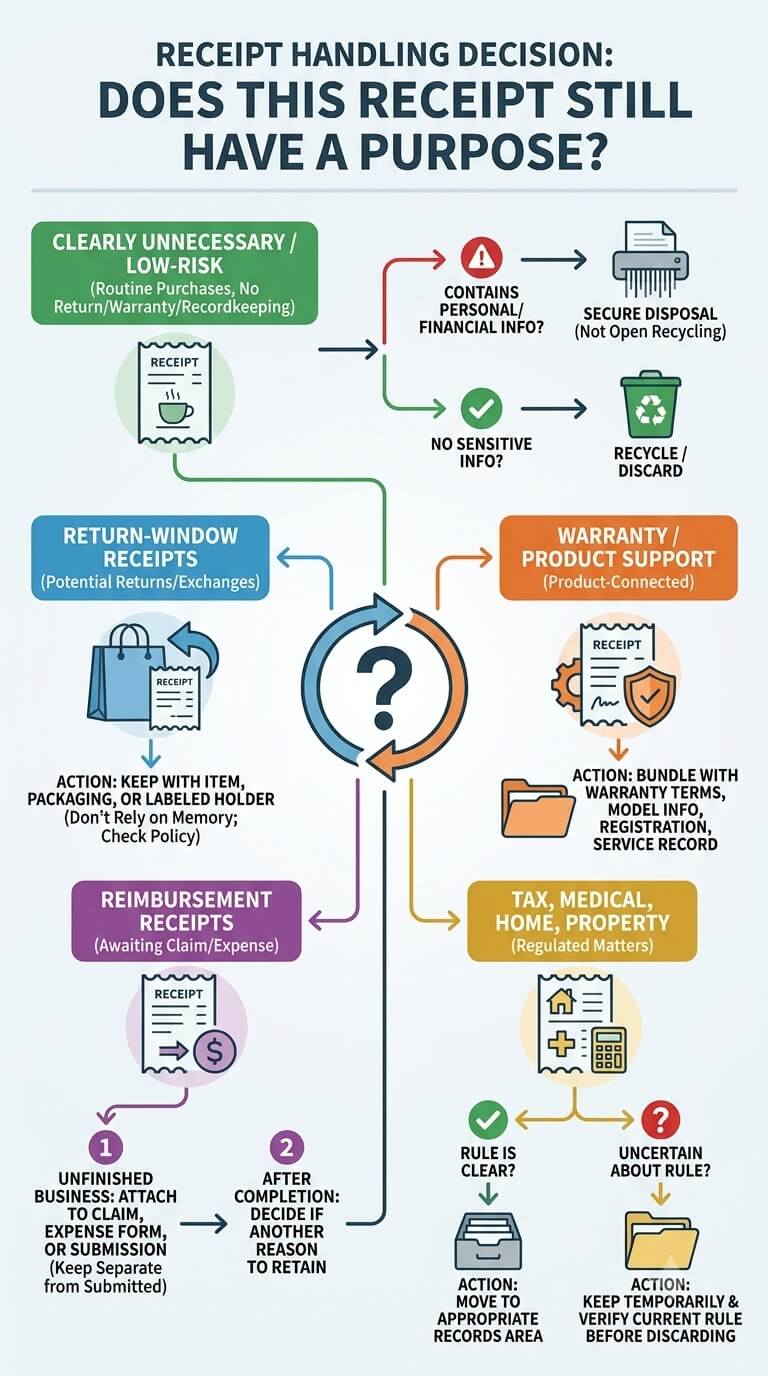
Clearly unnecessary low-risk receipts when appropriate
Some routine purchase slips have no remaining return, warranty, reimbursement, recordkeeping, or other purpose once the purchase is checked and accepted. If you are confident the receipt is not needed and it does not require special handling because of the information printed on it, it can leave the active system. When a receipt contains personal or financial information, make a separate disposal decision rather than dropping it automatically into open recycling.
Return-window receipts
If you might return or exchange an item, keep the receipt with the item, packaging, or a clearly labeled return holder. Do not rely on memory for store-specific conditions. The Federal Trade Commission’s consumer guidance on returns and refunds recommends gathering receipts and other relevant purchase records when resolving a problem with a business. For an ordinary voluntary return, check the retailer’s current policy because requirements differ.
Warranty or product-support receipts
A receipt connected to a product warranty should stay with information that identifies the product and the applicable warranty. The useful package might include the receipt, warranty terms, model information, and any required registration or service record.
Reimbursement receipts
A receipt awaiting reimbursement is unfinished business. Put it with the claim, expense form, benefit submission, or household task that still needs action. Once the reimbursement is completed, decide whether there is another reason to retain the paper. Do not let submitted and unsubmitted receipts mix in one pile because the visual similarity makes missed tasks easy to overlook.
Tax, medical, home-improvement, or property-related routing categories
These labels are routing cues, not permission to make technical decisions from memory. A receipt that may affect a tax return, insurance question, medical record, property transaction, or other regulated matter should move to the appropriate records area until the applicable requirement is clear. If you are uncertain, keep the receipt temporarily and verify the current rule before discarding it.
Temporary Versus Longer-Term Receipt Storage

Short-term holding for returns and unresolved purchases
Temporary storage should be easy to reach and easy to empty. A small “returns and unresolved purchases” envelope can hold receipts for items you are testing, gifts you may exchange, orders with missing parts, or purchases waiting for another household member’s approval. Add the item name or a brief note if the thermal print is hard to read.
Monthly or category grouping
If your household generates many receipts that must be reviewed later, simple monthly envelopes can reduce sorting time. Another option is a few purpose categories such as Returns, Reimbursements, Warranty, and Review. Avoid combining month, store, household member, color code, and purchase type into one elaborate system.
When a receipt should move into another household record category
Move a receipt when its continuing purpose belongs somewhere else. A refrigerator receipt may live with appliance documentation. A medical payment receipt may belong with the applicable medical or benefits record. A property-improvement receipt may belong with property records if there is a valid reason to retain it. Once the paper has been sorted and any required action is complete, retained records can move into a simple home filing system.
Organize Return and Exchange Receipts
Keep with the item or purchase record when practical
For a likely return, proximity beats perfect filing. Put the receipt in the shopping bag, tape a small envelope to the unopened package, or keep both in a designated return zone. Do not attach adhesive directly to a thermal receipt if it could damage important printed information.
Preserve retailer-specific information
Keep the portions that identify the transaction, item, purchase date, and any return information printed on the receipt. If the store uses an online order record, loyalty account, or emailed receipt as another form of proof, note that it exists rather than creating multiple paper copies. Check the current retailer policy before assuming a paper slip is either required or unnecessary.
Move out of action status after the return question is resolved
Once you keep the item or complete the return, close the loop. A completed refund receipt may need temporary retention until you confirm the refund or exchange was processed correctly. After that, keep it only if another purpose remains, such as warranty documentation or a required record.
Organize Warranty and Major-Purchase Receipts
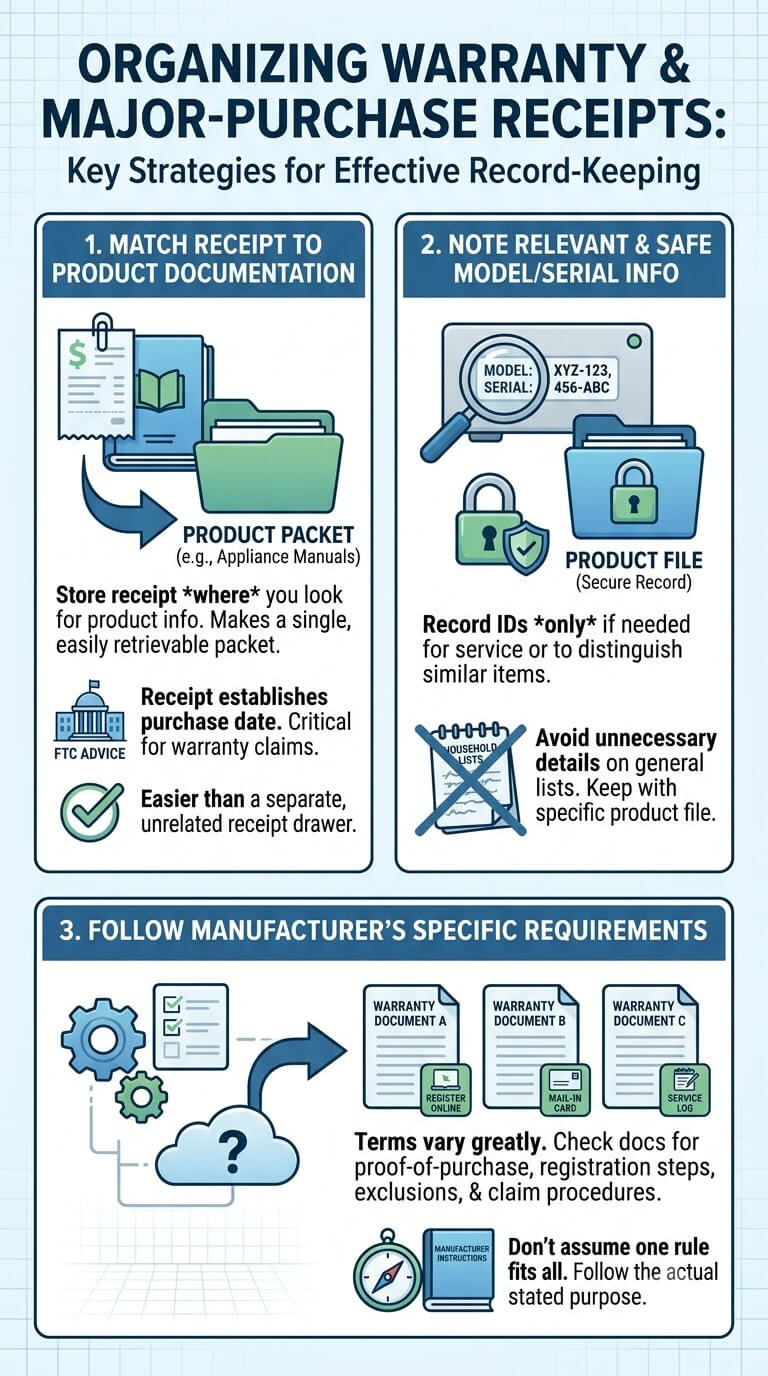
Match receipt to product documentation
For appliances, electronics, tools, furniture, or other higher-value purchases, store the receipt where you would naturally look for product information. The FTC’s warranty guidance specifically advises consumers to save a product receipt with the warranty because the receipt can establish when the product was purchased. A single product packet is usually easier to retrieve than a separate drawer full of unrelated warranty receipts.
Note model or serial information only when relevant and safe
If product identification matters for service, record it with the product file rather than writing unnecessary details across several household lists. Model and serial information can help distinguish similar appliances or devices, but collect only what you expect to use.
Follow manufacturer warranty documentation requirements rather than assuming one rule
Warranty terms vary by product and company. Check the warranty document or current manufacturer instructions for proof-of-purchase requirements, registration steps, service records, exclusions, and claim procedures. Keep the receipt for the purpose the manufacturer actually describes instead of applying a household-wide retention period.
Organize Reimbursement Receipts
Keep receipts attached to the pending reimbursement task
Whether the reimbursement is from an employer, insurer, benefits program, school activity, household member, or another organization, the receipt should stay with the action it supports. A folder labeled by the task is more useful than a generic receipt box because it shows what still needs to be submitted.
Separate submitted from unresolved items
Use two simple states if you handle many claims: Needs Submission and Submitted or Waiting. Add the submission date to your task record if that helps you follow up. Do not mark the original paper in a way that hides transaction details. The key is to know whether the next action belongs to you or to the organization processing the request.
Move completed records only if a continuing purpose remains
After reimbursement is confirmed, ask whether another requirement remains. Some records may need to stay with benefits, tax, medical, or employment documentation according to the rules that apply to the situation. Others may no longer have a purpose. Close the reimbursement task first, then make the separate retention decision.
Tax-Related Receipts Need Current Recordkeeping Guidance
Identify potential tax relevance without deciding deductibility
Your household system can label a receipt “tax review” because it appears connected to a tax matter, but that label does not determine whether an expense is deductible, creditable, reportable, or otherwise relevant. Keep uncertain items together until you can evaluate them using the right tax information.
Follow current IRS or qualified professional guidance
The IRS recordkeeping guidance in Topic No. 305 explains that records such as receipts may support items reported on a return. Tax requirements depend on what the record supports and the facts involved, so use current IRS instructions or advice from a qualified tax professional for your situation rather than relying on a generic home-organization schedule.
Do not use a universal retention period
A neat label such as “tax receipts” does not answer how long every item must be kept. Different circumstances can call for different documentation and different periods. A safe household practice is to review the category periodically for organization purposes while preserving any record whose applicable requirement is still unresolved.
Medical and Property-Related Receipts
Route medical payment receipts by purpose
A medical receipt may support a reimbursement, insurance question, flexible spending or similar benefit, tax matter, or personal payment record. Keep it with the purpose that explains why it matters. Do not mix clinical information, unpaid medical bills, and payment receipts into one undifferentiated envelope. Each may require a different next action and different privacy handling.
Route home-improvement or property receipts when they have a valid continuing use
Receipts for renovations, repairs, major materials, equipment, or property transactions can be important for reasons that extend beyond a normal store return. If a purchase affects property records, insurance documentation, warranties, or a later tax question, place it with the relevant project or property file until you confirm the applicable requirement.
Know when a receipt question needs official guidance
Organization can tell you where a paper lives and how to retrieve it. It cannot determine whether a medical expense qualifies for a benefit, whether a home improvement changes tax treatment, or what evidence an insurer will require. When the answer affects money, coverage, taxes, or a formal claim, check the current instructions from the responsible organization.
Faded Thermal Receipts

Protect legibility from heat and abrasion
Thermal receipts can become difficult to read over time, especially when they are exposed to heat, friction, oils, or rough handling. If a receipt has an important continuing purpose, do not leave it loose on a car dashboard, crumpled in a pocket, or rubbing against other papers. Store it flat in a cool, dry place appropriate for ordinary household records.
Optional photo or scan backup when useful
If legibility matters for a return, warranty, reimbursement, or other valid recordkeeping purpose, a photo or scan can provide a practical backup. Capture the entire receipt while the print is readable. Keep the backup only as long as it serves a useful purpose, and do not assume an image replaces an original when an organization requires original documentation.
Record enough context to match the purchase without exposing unnecessary data
A fading slip becomes almost useless if nobody knows what it represents. Write a brief, non-sensitive note on a separate sleeve or folder, such as “dishwasher purchase, May” or “school reimbursement.” Avoid copying full account numbers, card details, medical information, or other sensitive data into extra places just to make the receipt easier to identify.
Match the Receipt With the Purchase Record
Product, date, store, and reason for retention
Four pieces of context are usually enough for household retrieval: what was purchased, when, where, and why you still have the receipt. You may not need to write all four if the receipt is clear.
Avoid keeping isolated slips no one can identify
An old receipt with faded print and no known purpose creates uncertainty, which encourages people to keep it forever. During review, match mystery slips to purchase emails, card statements, product paperwork, or household memory only when the effort is justified. If the record might affect taxes, warranties, reimbursement, property, medical matters, or another formal requirement, verify before discarding it.
Attach to warranty or major-purchase records when useful
A simple paper clip, document sleeve, or product folder can keep related records together. Avoid stapling through barcodes, return information, or sections that may need to be copied. When several products appear on one receipt, a full copy or backup image may be more practical than cutting the original, provided that the organizations involved accept the documentation you plan to use.
Shared Household Receipt Workflow
One intake point
A shared household works better when everyone knows where potentially useful receipts go. Choose one small intake point and make it easy to reach from the normal unpacking area.
Clarify who owns reimbursements and returns
Ownership should be obvious for action items. If one person bought a jacket for another person to try, decide who handles the return. If a receipt supports a workplace reimbursement, identify who must submit it. A sticky note, task list entry, or named folder can prevent the receipt from sitting in shared intake while everyone assumes someone else is handling it.
Prevent duplicate copies and mystery receipts
If one person photographs a receipt and another keeps the paper, agree which version is the working record and why the second copy exists. Duplicate copies are useful only when they solve a specific risk or access problem.
Reset Years of Unsorted Receipts

Sort by purpose before year
Do not begin a large backlog by making twelve monthly piles for every year. First separate obvious categories: unresolved actions, major purchases and warranties, possible tax records, medical or benefits records, property-related records, and items with no known purpose.
Separate sensitive or high-value purchase records
Pull out receipts that contain personal or financial information, relate to expensive items, or appear connected to a formal claim. Keep them controlled while you work rather than spreading them across the floor. When you are ready to dispose of records containing personal or financial information, the FTC’s guidance on protecting personal information recommends secure handling instead of casual disposal.
Check current authority requirements before discarding uncertain tax, warranty, reimbursement, medical, or property receipts
Create a small Review Needed envelope for papers that cannot be decided confidently in one session. Write the question on a note, such as “needed for warranty?” or “part of property project?” Then check the relevant manufacturer, retailer, insurer, employer, tax authority, healthcare organization, or other responsible entity.
Common Receipt-Organization Mistakes
Filing every receipt forever
This looks safe but usually produces an unreadable archive. The fix is to require a reason for retention. If the reason ends, review the receipt for sensitive information and any applicable requirement, then remove it appropriately rather than letting it remain because a folder has space.
Mixing unresolved returns with completed purchases
Action paper needs visibility. Keep return and exchange receipts in an active location until the decision is complete. A receipt filed neatly in a yearly folder can still cause a problem if the return task disappears with it.
Keeping faded slips with no context
Add a short note while an important thermal receipt is readable. Waiting until the print is nearly blank turns a simple record into a guessing exercise.
Destroying uncertain receipts too early
If you do not know whether a receipt supports a tax matter, warranty, reimbursement, medical record, property record, insurance question, or formal claim, do not make a rushed discard decision just to finish decluttering. Set it aside with the specific question and verify what applies.
Turning the system into bookkeeping
A household receipt workflow does not need to categorize every coffee, grocery item, and routine purchase unless you have a separate budgeting or accounting reason to do so. Keep the organization task focused on retrieval and active purpose. Detailed spending analysis is a different job.
Edge Cases
Email receipt plus paper receipt
If both versions show the same transaction, decide whether each copy has a job. You might keep the paper for a return while the email is easier to search, or keep only the format accepted by the retailer or manufacturer. Do not assume the digital version replaces an original requirement without checking.
Gift receipt
Keep a gift receipt with the gift until the recipient has had a reasonable opportunity to exchange the item under the retailer’s current policy. If the gift is being mailed or stored, place the receipt in a small envelope so it does not get lost among tissue paper or packaging.
Receipt with sensitive account fragments
Handle any receipt that shows personal or financial details more carefully than an ordinary anonymous slip. Avoid leaving it in an open counter tray for months. Once its valid purpose ends, choose disposal appropriate to the information shown and any applicable requirement.
Refund completed but warranty still active
If a purchase was partially refunded, adjusted, or exchanged, keep the record set that explains the product you still own and the transaction that applies to it. Confirm what the warranty provider needs.
No receipt but other proof of purchase may exist
Do not create a fake replacement receipt. Check the retailer, manufacturer, account history, emailed confirmation, payment record, or other legitimate documentation that may establish the purchase. What qualifies depends on the specific return, warranty, reimbursement, or claim process.
FAQ About Organizing Receipts
Should I keep every receipt?
No. Keep receipts because they support a clear purpose, not simply because they exist. Common purposes include returns, warranties, reimbursements, tax records, medical or benefits records, property documentation, and major-purchase records. If a receipt has no continuing purpose, confirm that no applicable requirement remains and handle any sensitive information appropriately before disposal.
How should I organize receipts for returns?
Keep them in an active return location with the item or a clear item note. Separate unresolved returns from completed purchases, and check the retailer’s current policy for required documentation and timing. After the return or exchange is resolved, decide whether the receipt still serves another purpose.
Where do warranty receipts belong?
Store a useful warranty receipt with the product’s warranty information and other relevant documentation rather than in a general receipt pile. Follow the manufacturer’s current proof-of-purchase and service-record requirements. For a major appliance or tool, a product-specific folder or sleeve can make later retrieval much easier.
What should I do with faded receipts?
Protect important thermal receipts from heat, friction, and rough handling. While the text is still readable, add a brief context note and make a photo or scan backup if that supports a real return, warranty, reimbursement, or recordkeeping need. Check whether the organization involved requires the original.
When does a receipt move into the home filing system?
Move it only after you identify a continuing purpose that belongs with a longer-term record. Examples include a receipt that supports an appliance warranty, property project, medical record, or other documented household matter. A receipt should not enter permanent files merely because you are finished processing the week’s paper.
Final Thoughts
A useful receipt system is small because most receipts are temporary. Capture them in one place, decide why each one matters, keep active return and reimbursement records visible, and move longer-term receipts only to the record they actually support.
When a receipt touches taxes, warranties, medical matters, property records, reimbursement rules, insurance, or another formal requirement, organization should make the question easier to see, not pretend to answer it. Keep the paper temporarily, check the current instructions that apply, and then close the loop. The simplest sustainable rule is purpose first, storage second.

Ethan Carter is the Founder & Editor of HomeCleanSecrets. Based in the United States, he has 5 years of experience creating practical home cleaning, laundry care, stain removal, decluttering, and home organization content. His goal is to help everyday households clean smarter and build simple routines that are easier to maintain.
Read more about Ethan Carter on his author page: https://homecleansecrets.com/ethan-carter/