
School papers are easier to manage when every sheet has a next destination instead of a permanent place on the kitchen counter. A permission slip needs a response, a schedule may matter for only a week, a report card may belong with records, and a drawing may be a keepsake. School paper is easier to control when it connects to the broader household paper system without losing its child-specific next step.
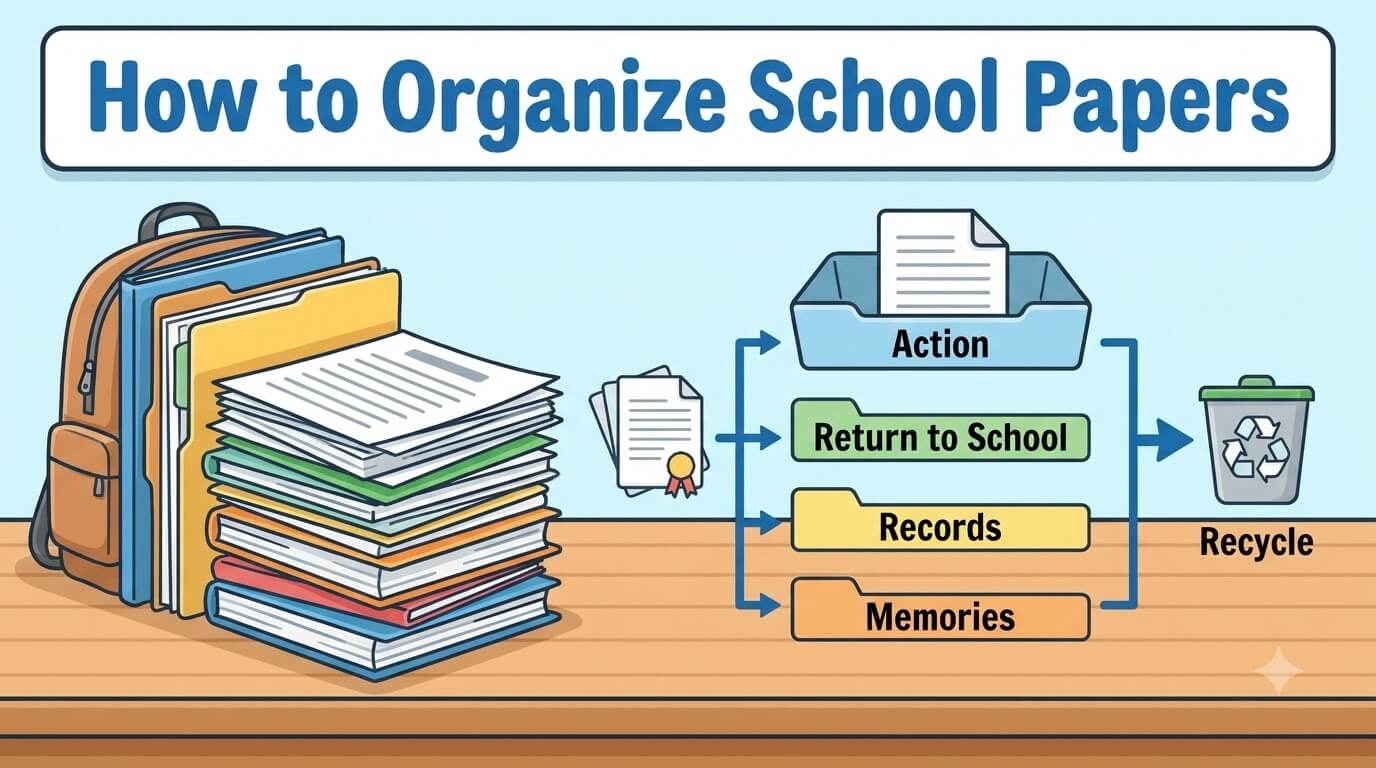
Once paper leaves a backpack, folder, or mail packet, identify who owns it, what must happen next, and what event will remove it from active storage.
Quick Answer: Route School Papers by Next Destination

Use a few destinations based on what each paper still needs, not a folder for every school category.
Parent action, return to school, current use, record, keepsake, or recycle/discard
Give each sheet one of six outcomes: adult action, return to school, current use, long-term record, keepsake review, or appropriate removal. If you cannot decide yet, use one small review section instead of a permanent miscellaneous pile.
Why school papers need a different flow from general household paperwork
School papers have mixed timing. A form may be due tomorrow while a certificate may matter for years. Keeping urgent and long-term items together makes the urgent paper easy to miss, so temporary tasks should stay visible until complete.
Where the School-Paper Routine Starts
The decision begins after paper enters the household and leaves the backpack, folder, or mail stream.
Papers come out of backpacks or arrive through other channels
Check the sources that reliably bring school paper home: backpacks, take-home folders, sports or club bags, mailed notices, handouts brought home after an event, and occasional printouts from school portals. A useful habit is to remove paper while unpacking the bag, before the backpack is put away for the night.
Use the household paper inbox only as temporary capture
If you already have a household paper inbox, school notices can land there briefly when nobody has time to process them immediately. Keep that stop short. A permission slip that waits in a mixed paper inbox for a week is harder to see than one moved promptly to the parent-action or return-to-school area.
Make the child-specific decision as soon as the paper is identified
Once you know a paper belongs to a particular child and school purpose, move it out of general intake. Put it with that child’s active folder, an adult action file, a return-to-school spot, long-term records, or a keepsake review area. This prevents the general household system from becoming a second school pile.
First-Pass School Paper Categories

Keep the first pass broad enough that family members can route a sheet without hesitation.
Parent action
This category holds papers that require an adult decision or task, such as permission forms, sign-and-return sheets, requests for information, event responses, or notices that must be acknowledged. Keep them visible and separate from completed paperwork.
Return to school
Completed forms, signed papers, teacher notes, and other items that must travel back should move to an outgoing location. The best destination is close to the routine that puts items back into the correct backpack, not deep inside a household file drawer.
Current-week reference
Schedules, reading logs, project directions, spelling lists, practice sheets, and temporary classroom information belong here only while they are actively useful. Label the section by child if needed, and give each paper a clear exit event such as the end of the week, project, unit, or event.
Official or long-term record
Some papers are retained because the family expects to retrieve them later, such as certain report cards, enrollment documents, assessment records, accommodation-related documents, or other school-issued records. Do not assume every school paper belongs here. Keep a long-term item because its purpose is known, not because it looks formal.
Keepsake candidate
Use this as a short review category for work that represents a meaningful stage, accomplishment, personality, or memory. A candidate is not automatically a permanent keepsake. The container limit and end-of-term review decide what earns longer storage.
Recycle or discard when appropriate
Routine duplicate notices, superseded schedules, completed practice sheets, and papers with no continuing purpose can often leave the active system after review. Before disposing of a sheet, check whether it contains sensitive student information or whether the school has given a reason to retain it.
Parent-Action Papers
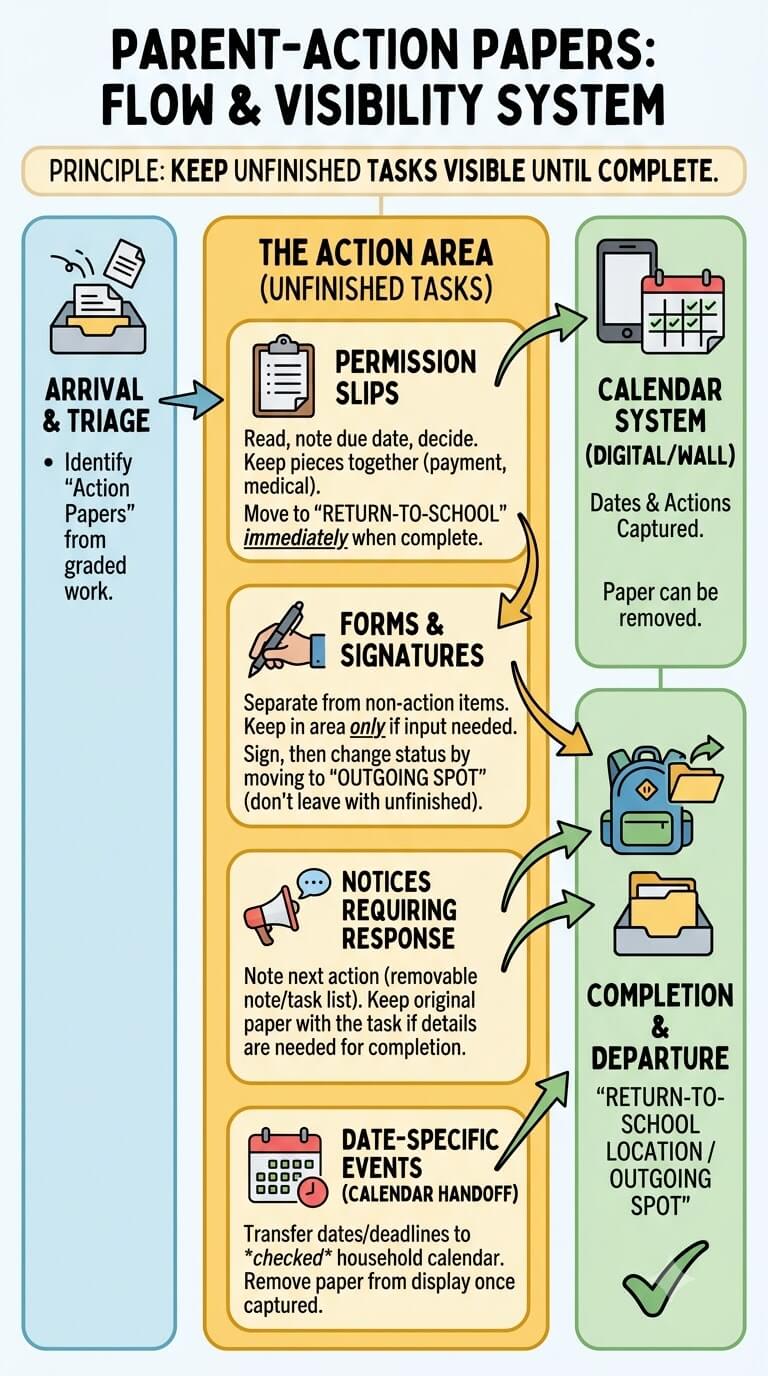
Keep unfinished parent tasks visible until the required response is complete.
Permission slips
Read the form when it arrives, note the due date, complete the decision that belongs to you, and move the finished form immediately to the return-to-school location. If payment, medical information, or another attachment is required, keep the pieces together until the packet is complete.
Forms and signatures
Sign-and-return forms can disappear when they are mixed with graded work. Keep only forms that still need your input in the action area. After signing, change the paper’s status by moving it to the outgoing spot rather than leaving it in the same tray with unfinished forms.
Notices requiring a response
A notice may require a call, registration, reply, document request, or choice from a parent. Write the next action on a removable note or household task list if useful, but keep the original paper with the task when details on the notice will be needed to complete it.
Date-specific events and calendar handoff
When a paper announces a field trip, conference, performance, deadline, testing date, or special schedule, transfer the date to the calendar system your household actually checks. The paper does not need to stay on display solely to act as a reminder once the date and required action have been captured elsewhere.
Return-to-School Papers
Finished school forms need a short, reliable path back out of the house.
Keep return items separate from household files
A finished permission slip is still active because its destination is school. Do not file it with school records or place it behind old report cards. Keep outgoing items in one shallow folder, wall pocket, clip, or other location that is checked during backpack preparation.
Place completed items where they will re-enter the backpack or outgoing routine
If backpacks are packed at night, put the return folder near that routine. If children are old enough to manage their own bags, assign a clear handoff such as “finished forms go in the front pocket tonight.” The location should reduce missed transfers without turning the entryway into a storage zone.
Avoid letting completed forms sit in the paper inbox
Once a form is finished, general intake has done its job. Leaving it there makes it look unresolved and creates an extra search the next morning. Move it to the outgoing spot the same day whenever possible.
Current-Week School Papers
Keep temporary reference paper easy to reach and give it a clear end point.
Schedules, project instructions, and temporary reference sheets
Keep active materials where homework or family planning happens. A thin folder per child, a single family school-reference board, or one labeled pocket can work. Avoid displaying every handout. Put only the sheets someone is likely to consult again before the current task or week ends.
Give short-term papers an exit event
Attach the paper to a natural review point. A project rubric can leave active storage after the project is returned and any needed feedback is reviewed. A weekly schedule can be replaced by the next schedule. Event instructions can be removed after the event unless they become part of another record.
Prevent old current-week papers from becoming archive
A good test is to look at the active folder and ask whether every sheet could still change what someone does this week. If not, process the older items. Move genuine records to long-term storage, select keepsakes deliberately, and let expired reference paper leave the active area.
Graded Work and Worksheets

Separate a paper’s learning value from its sentimental value before deciding what stays.
Review before deciding
Look for teacher comments, corrections that need follow-up, unfinished work, or instructions to return the paper. A worksheet that appears disposable at first glance may still require a signature or review. Once any needed action is complete, decide whether the paper has a continuing academic or sentimental purpose.
Keep representative work instead of every sheet
Choose examples that show progress, a meaningful challenge, strong effort, humor, creativity, or a milestone. Keeping one or two representative pieces from a unit can tell the story more clearly than retaining every repetitive practice page.
Separate learning-use papers from sentimental keepsakes
If a child needs a math sheet to study for Friday’s quiz, it belongs in current use. If the same sheet later matters because it shows a breakthrough or memorable comment, it can become a keepsake candidate. Do not make the keepsake box double as a study folder.
Artwork That Comes Home From School
Route school artwork simply here; larger collections can use a separate keepsake method.
Temporary display
A rotating display area lets children enjoy recent work without requiring an immediate permanent decision. Limit the display by physical space. When a new piece goes up, an older piece comes down and gets reviewed for keepsake storage or removal.
Keepsake candidate
Place meaningful pieces in the same limited review container used for other school keepsakes, or use a separate art-size folder if standard paper storage would damage them. Mark the child’s name and school year on the back when that context is not obvious.
When artwork needs its own keepsake system
Oversized paintings, three-dimensional projects, portfolios, and a large volume of art can overwhelm an ordinary school-paper folder. At that point, keep this system responsible only for routing the piece. Decide on a separate art-storage limit rather than forcing bulky work into files meant for records and forms.
Report Cards, Certificates, and Important School Records
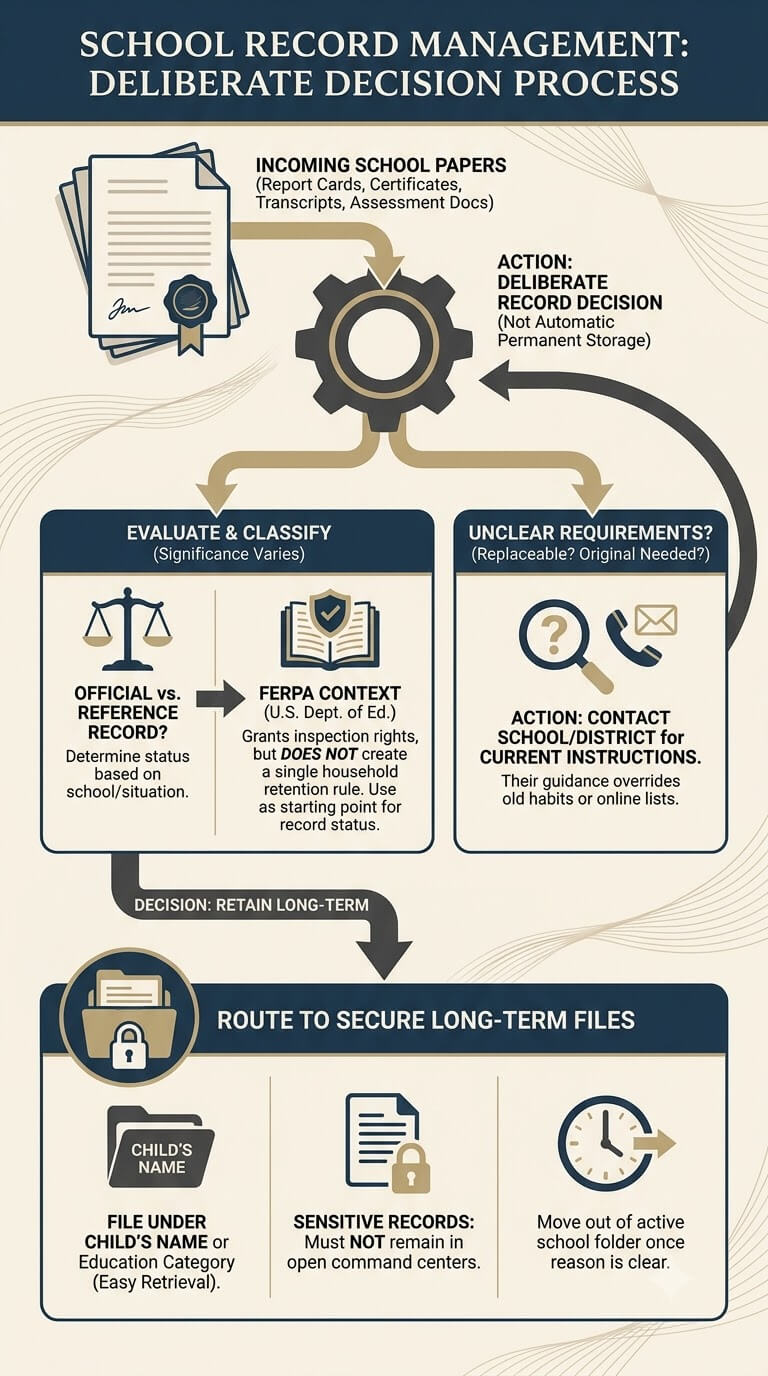
Formal-looking paper deserves a deliberate record decision instead of automatic permanent storage.
Decide whether the paper is an official or reference record
Report cards, transcripts, enrollment paperwork, assessment documents, certificates, accommodation records, and similar papers can have different significance depending on the school and situation. The U.S. Department of Education explains that FERPA gives parents certain rights to inspect and review education records maintained by schools, but that does not create one household retention rule for every paper sent home. Department of Education FERPA information is a better starting point when the status of an education record matters.
Route retained records into long-term household files
Once you have a clear reason to keep a school record, move it out of the active school folder. File it under the child’s name or a household education-record category that is easy to retrieve. Sensitive records should not remain in an open command center simply because they started as school paper.
Check the school or district when document requirements are unclear
If you are unsure whether a paper is replaceable, whether an original is needed, or how to obtain an official copy, contact the school, district, or issuing office. Their current instructions should override a household habit or an old list found online.
Child-Specific Folders
Separate ownership first; a child name often improves retrieval more than extra subject categories.
One active folder per child when useful
A slim folder can hold current-week reference sheets, work awaiting review, and child-specific notices that are still active. Keep parent-action forms in the adult action area if adults need to see them daily. The child’s folder should not become a catch-all for every paper received since September.
School-year labeling
Label folders and keepsake containers with the child’s name and school year or grade when that detail will matter later. Use the school’s academic-year convention consistently. Clear date context prevents a parent from opening several nearly identical folders just to identify when the work was created.
Separate active school papers from long-term records
Current-use folders belong near homework or family routines. Long-term school records belong with other retained household documents. Keeping those locations distinct makes the active folder lighter and reduces unnecessary exposure of sensitive information.
Multiple Children Without Creating Multiple Piles
Scale the system by ownership without multiplying every tray, inbox, and folder.
Clear ownership labels
Put names on active folders, return folders, and keepsake containers where confusion is likely. For children with similar class materials, write the name lightly on the back of keepsake candidates before separating them from the backpack. Avoid adding private information that the household does not need for organization.
Shared household notices versus child-specific items
A district calendar, family event notice, or schoolwide closure announcement may need only one household copy. A permission form or individualized record belongs to the specific child. Removing duplicate shared notices can reduce volume without losing information.
One intake point with separate downstream destinations
You do not need three paper inboxes for three children unless the household truly processes them separately. One small intake point can work if papers are routed promptly to the correct child’s current folder, the adult action area, the outgoing spot, records, or keepsakes.
Keepsake Limits
A fixed physical limit makes sentimental choices manageable while leaving room for meaningful work.
Define one container or another clear capacity limit
Choose a box, file section, portfolio, or other fixed space for each child. The size should match your storage space and how much you genuinely enjoy revisiting. When the container gets full, review what is inside rather than automatically starting another unlimited box.
Choose representative work
Keep variety: a piece of writing, a drawing, a strong project, a funny response, a certificate that mattered, or an example that shows progress. Several nearly identical worksheets usually add less meaning than a smaller set that captures different stages and interests.
Review at term or school-year transitions
Do not force every sentimental decision on a busy Tuesday night. Let a limited candidate folder collect promising pieces, then review it at the end of a term or school year. Compare similar items side by side and choose the strongest examples before moving them to longer storage.
End-of-Term and End-of-Year Review

Use school transitions to clear temporary paper; this is an organization routine, not a legal retention rule.
Clear current-use papers
Remove schedules, project sheets, study materials, and classroom references whose purpose has ended. Check for teacher instructions or unfinished action before discarding anything. The active folder should start the next term with only material that still matters.
Move retained records
Transfer records you have decided to keep into the main household filing area or another appropriate protected location. Do not leave them in the child’s active school folder simply because that is where they first landed.
Select keepsakes
Review the candidate pile with the child when age appropriate. Keep a limited selection that reflects the year rather than every assignment. Add the child’s name and date context before storage so the memory does not depend on remembering which year it came home.
Confirm uncertain official documents with the school or district
If a paper looks formal and you do not know whether the household should retain it, set it aside for verification instead of guessing. Ask the school or district what the document is, whether an official copy is available later, and whether any current requirement applies to your family.
Let Children Participate at the Right Level
Children can help with routing and keepsakes while adults handle sensitive or official records.
Younger children can help choose favorites
Give younger children a small set of reviewed work and ask which pieces they remember, feel proud of, or want to show later. A container limit helps make the choice concrete. Adults can handle papers that contain sensitive information or require formal action.
Older children can route current-use papers
Older students can learn to put forms needing a signature in the adult action area, return completed papers to the outgoing folder, and remove expired study sheets from their active folder. Keep the rules simple enough to explain in a minute.
Adults retain responsibility for official or sensitive records
Student records can include names, addresses, dates of birth, identification details, health information, and other private data. The Federal Trade Commission’s guidance on protecting a child’s personal information is a useful reminder to limit unnecessary exposure of sensitive identifiers. Store such papers where casual household traffic, visitors, or unrelated children do not have routine access.
Common School-Paper Mistakes
Most problems come from mixing papers that have different next actions.
Keeping every worksheet
Volume makes meaningful work harder to find. Review routine worksheets for teacher notes or learning needs, then keep only examples that have a clear academic, record, or sentimental purpose.
Letting action forms hide with graded work
A permission slip should never depend on someone rediscovering it beneath math pages. Move any paper requiring an adult response to the action area as soon as that requirement is noticed.
Using the backpack as permanent storage
Old papers add bulk and make current forms harder to see. Empty the relevant pockets on a predictable schedule. Put current reference items back only when they actually need to travel to school.
Mixing official records with keepsakes
A sentimental box is not the best place for a document you may need to retrieve for enrollment, services, or another formal purpose. Records need predictable filing and appropriate privacy; keepsakes can be stored for memory.
Allowing the paper inbox to duplicate the school system
General intake should not become a second home for school paperwork. Once a paper is identified, move it to its school-specific destination. If school papers repeatedly fill the inbox, the downstream action, return, or current-use area probably needs simplification.
Edge Cases That Need a Different Decision
When a paper falls outside the weekly routine, identify which authority, household, or purpose controls it.
Papers for shared custody or multiple households
Decide which papers need to travel, which household keeps a copy, and how date-specific tasks are communicated. Do not assume one family’s method fits every custody arrangement. Court orders, school policies, and family agreements can affect what is appropriate, so organization should support rather than interpret those requirements.
Homeschool paperwork as a separate use case
Homeschool families may have documentation duties, curriculum records, attendance materials, portfolios, or reporting requirements that go beyond ordinary school take-home paper. Keep those records in a system built around the requirements that apply to the homeschool setting rather than stretching this household routine to cover them.
A medical or legal school document
A health plan, accommodation document, custody-related notice, or other sensitive paper may need more protected handling than a normal school folder. Keep actionable copies where they are needed, but route important originals and long-term records according to the responsible provider, school, court, or issuing authority.
Digital-only notices printed at home
A printout does not automatically become a long-term record just because you created a paper copy. Keep it only while the printed version serves a household purpose, such as posting a schedule or carrying instructions to an appointment. Do not build a second archive of information that is already reliably available elsewhere unless you have a reason.
School-year records with unclear retention needs
Do not solve uncertainty by discarding the paper or by declaring it permanent. Place it in a small review folder, identify what the document proves or supports, and check current school or district guidance. Household review dates can help you revisit the question, but they are not legal retention periods.
FAQ About Organizing School Papers
These answers cover common decisions about active papers, returns, records, and keepsakes.
What school papers should stay in the active folder?
Keep papers someone is likely to use in the near term: current schedules, project instructions, study references, unfinished review items, and child-specific notices that still matter. Remove completed action forms, expired schedules, permanent records, and selected keepsakes so the active folder remains easy to scan.
How do I handle permission slips so they go back to school?
Move the slip to the adult action area as soon as it is identified. Complete the decision, signature, payment, or attachment that applies, then move the finished form to the outgoing school location immediately. The key is changing its physical location when its status changes.
Should I keep every report card and certificate?
No single household rule fits every document or school situation. Decide whether the item is a formal record, useful reference, or sentimental keepsake. If you are uncertain about an official document, check with the school or district before discarding it. For sentimental certificates, use the same physical keepsake limit as other school memories.
How do I limit keepsakes without choosing for my child?
Let the child participate within a fixed container or number of review spots. Ask which pieces feel important and why, then help compare similar items. Adults can preserve context with names and dates while children influence the sentimental choices.
When should a school paper move into the main home filing system?
Move it when its active school purpose is finished and you have a clear reason to retain it as a record or reference document. Long-term filing should be intentional. A paper does not belong in permanent files merely because it came from a school or has an official-looking header.
Final Thoughts
A sustainable school-paper system is a routing routine, not a growing collection of folders.
Review active folders regularly, clear temporary material at term or school-year transitions, and slow down when a paper contains sensitive information or uncertain official significance. The Utah State University Extension household records organizer reinforces the value of keeping important household records gathered and retrievable. Long-term school records work best when separated from fast-moving everyday papers.

Ethan Carter is the Founder & Editor of HomeCleanSecrets. Based in the United States, he has 5 years of experience creating practical home cleaning, laundry care, stain removal, decluttering, and home organization content. His goal is to help everyday households clean smarter and build simple routines that are easier to maintain.
Read more about Ethan Carter on his author page: https://homecleansecrets.com/ethan-carter/