
Important household documents need a different system from ordinary statements, manuals, and everyday reference papers. A birth certificate, passport, vehicle title, court document, or other difficult-to-replace original should be easy for an authorized person to locate without being left in an exposed drawer or buried inside routine files. Important documents are one protected branch of general household paperwork, not a substitute for ordinary intake, action, and filing routines.

A practical setup starts with identification and inventory. Decide which papers are genuinely high-consequence or sensitive, group them by person and purpose, distinguish originals from working copies, choose appropriate physical storage, and make sure the right household members know how authorized access works.
Quick Answer: Separate High-Consequence Originals From Ordinary Household Files
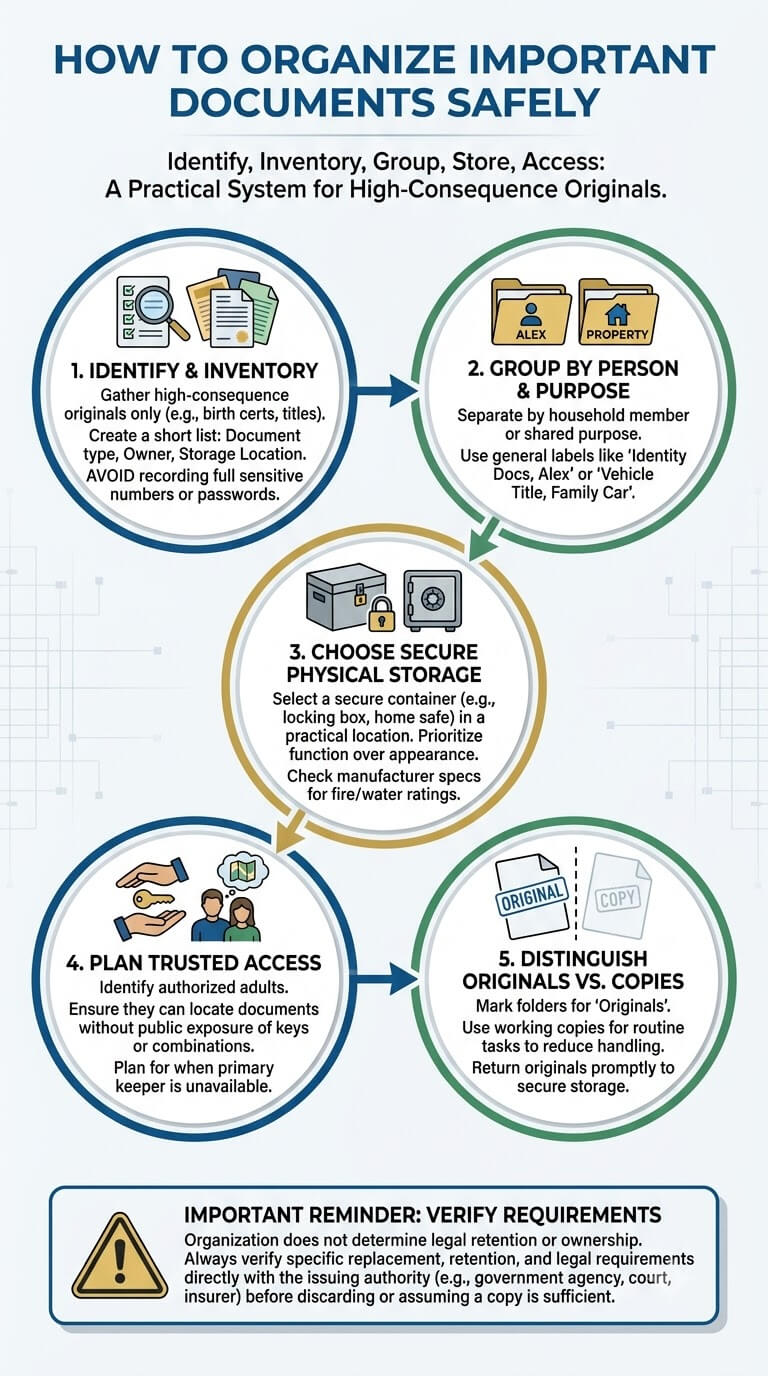
Identify, inventory, group, choose access, then choose appropriate storage
Start by gathering only the documents you already recognize as unusually important. List what each document is, who it belongs to, and where it should be retrieved. Then group related papers and choose storage based on sensitivity, replacement difficulty, frequency of use, and who may legitimately need access.
A good test is simple: if this original disappeared today, would replacing it require contact with a government agency, court, school, insurer, financial institution, property office, or other issuing organization? If yes, it deserves more deliberate handling than ordinary household paperwork.
Organization guidance does not decide legal ownership, retention, or estate requirements
Organization can help you locate a deed, certificate, title, policy, or court record. It cannot determine who legally owns it, how long a particular document must be retained, whether an original must stay at home, or how an estate document should be interpreted.
When those questions matter, check the current instructions of the issuing organization or an appropriate qualified professional. Keep the household system focused on location, access, condition, and retrieval.
What Counts as an Important Document?
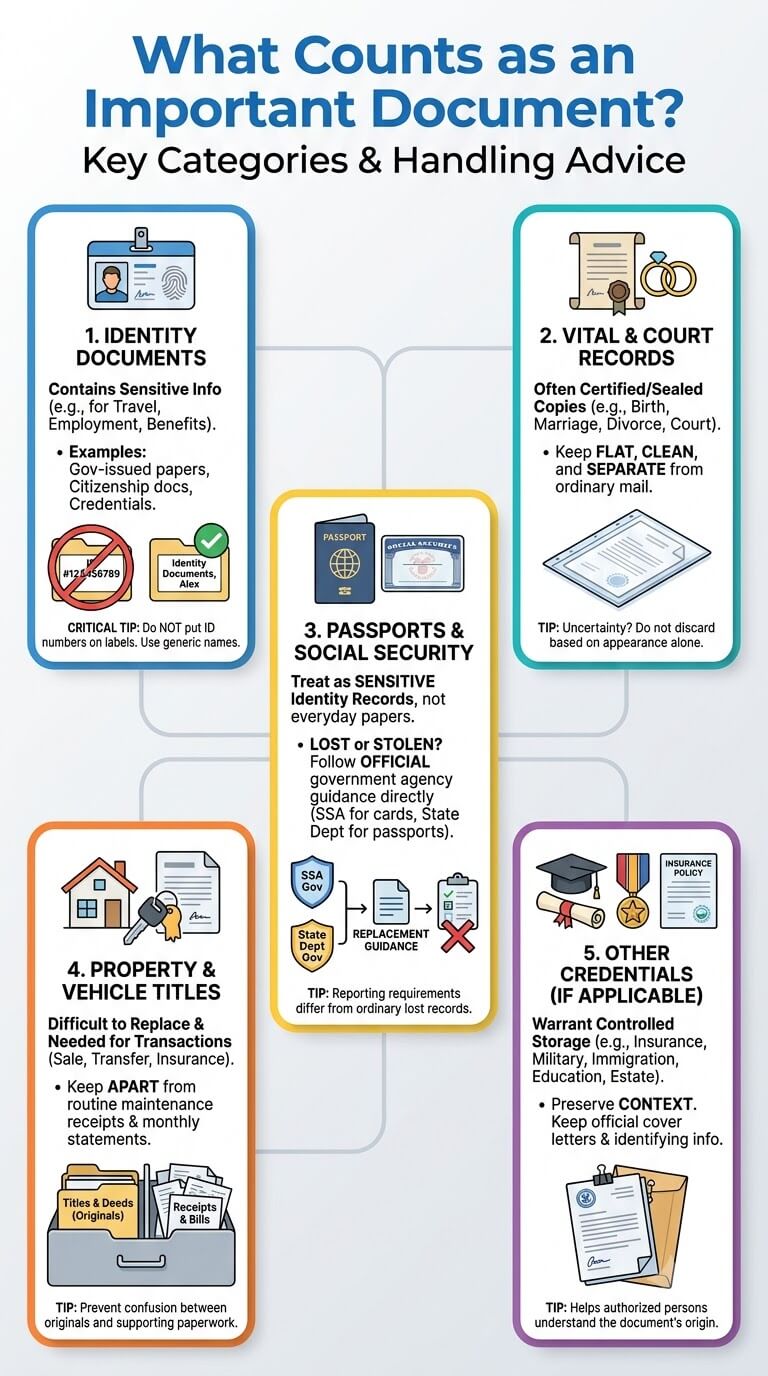
Identity documents
Identity documents usually deserve deliberate storage because they contain sensitive information and may be required for travel, employment, benefits, licensing, or replacement of other records. Examples can include government-issued identity papers, citizenship documents, and certain identity credentials.
Do not place identity numbers on folder labels or open inventory sheets. A label such as “Identity Documents, Alex” is enough. The system should help you find the paper without repeating the sensitive information printed on it.
Birth, marriage, divorce, and court documents at a category level
Vital records and court-related documents often arrive as certified copies, originals, or official copies with seals or other identifying features. Keep them flat, clean, and separate from ordinary mail. If you are uncertain whether a particular copy has legal significance, do not discard it based on appearance alone.
Passports and Social Security-related documents at a category level
Passports and Social Security-related papers should be handled as sensitive identity records rather than everyday reference sheets. If a Social Security card is missing, use the Social Security Administration’s current replacement guidance rather than a third-party checklist.
For a lost or stolen U.S. passport, follow the U.S. Department of State instructions. Reporting and replacement requirements can differ from the way you would handle an ordinary misplaced household record.
Property ownership and vehicle titles
Property and vehicle ownership papers can be difficult or inconvenient to replace and may be needed during a sale, transfer, insurance matter, or other transaction. Keep them apart from routine maintenance receipts and monthly statements so the original is not confused with supporting paperwork.
Insurance, estate-related, military, immigration, and education credentials when applicable
Some households also have insurance policies, military records, immigration documents, diplomas, licenses, professional credentials, or estate-related papers that warrant controlled storage. Treat these as categories, not as invitations to make legal decisions about them.
If a document changes rights, status, ownership, coverage, or another significant matter, preserve its context. Keep any official cover letter or identifying information that helps an authorized person understand what the document is and which organization issued it.
Important Documents Versus Ordinary Filing
Sensitivity, replacement difficulty, and consequence
Ordinary filing is designed for retrieval of routine household records. Important-document storage adds another question: what happens if the wrong person sees this paper, the original is damaged, or the household cannot find it when needed?
That does not mean every paper with a name or account number belongs in a locked container. Reserve higher-control storage for documents where sensitivity, replacement difficulty, or consequence clearly justifies it.
Originals versus routine reference copies
A photocopy of an insurance card and an original birth certificate may both matter, but they do not necessarily need the same treatment. Separate irreplaceable or officially significant originals from convenience copies that are used more often.
When a working copy is enough for a routine task, use that copy and return the original to its storage location promptly. This reduces handling of originals and makes it easier to notice when one has not been returned.
When a general filing cabinet is not the right default
A household filing cabinet can work well for normal records, but it may be too accessible for highly sensitive originals, especially in a shared home, rental, open office, or area used by visitors. Evaluate who can reach the cabinet, whether drawers lock, and whether the location is exposed to spills, humidity, or frequent moving.
Create a Household Document Inventory
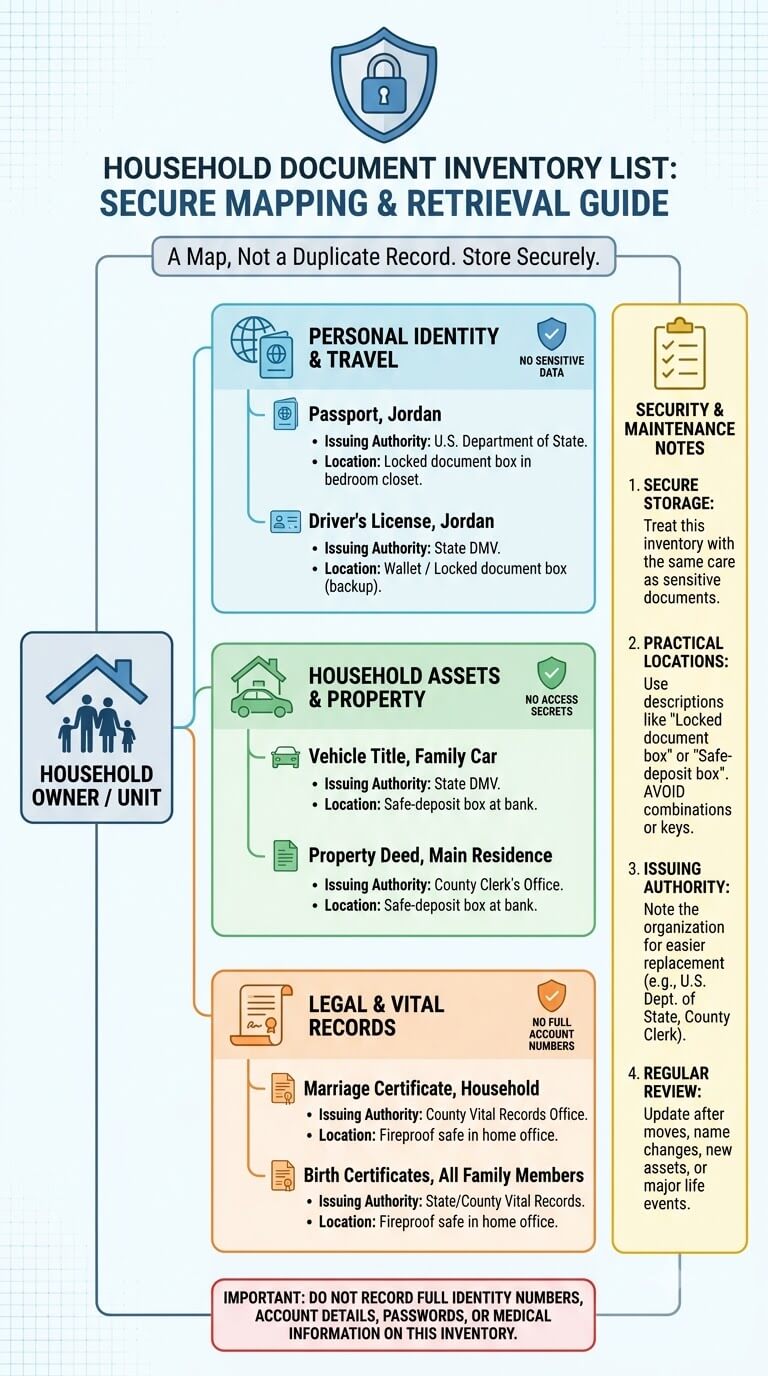
List document type and household owner
Create a short inventory that names the document type and the person or household unit it belongs to. Examples might be “passport, Jordan,” “vehicle title, family car,” or “marriage certificate, household.” Do not copy full identity numbers, account numbers, or medical details into the inventory.
The inventory is a map, not a duplicate record. Its job is to tell an authorized person what exists and where to look.
Record storage location without exposing unnecessary personal data
Use practical location descriptions such as “locked document box in bedroom closet” or “safe-deposit box at bank.” Avoid writing combinations, keys, passwords, full account details, or other access secrets on an inventory that might be left in an open binder.
If the inventory itself is sensitive, store it with the same care you would use for other household records that reveal private information.
Note issuing authority or replacement route when useful
For documents that would be stressful to replace, add the name of the issuing organization. “U.S. Department of State” beside a passport entry is more useful than a copied passport number. “County vital records office” or the relevant state agency may be enough for a birth certificate entry.
Check the inventory after a move, name change, vehicle change, family change, or other event that makes the old routing information inaccurate.
Group Documents by Household Member and Purpose
Shared household documents
Some records belong to the household rather than one person. Property ownership papers, shared insurance documents, marriage records, or certain household legal papers may fit into a shared section. Keep the group small enough that a person can identify the needed document without opening every folder.
Person-specific identity and credential documents
Create a separate folder or sleeve for each household member’s identity and credential records. This reduces the chance of mixing similar-looking certificates, passports, school credentials, or official copies between family members.
For children or dependents, make sure the responsible adult knows which documents exist and where they are kept without placing the papers in a location accessible to anyone passing through the home.
Property and ownership records
Group documents by the asset they concern. A vehicle title can live with other high-consequence ownership papers for that vehicle, while routine oil-change receipts stay in ordinary records. The same principle applies to property originals versus maintenance paperwork.
Sensitive legal or financial records at a routing level only
If a legal or financial document appears important but you do not understand its significance, do not invent a category based on guesswork. Give it a neutral folder such as “Legal Originals, Review” and verify its purpose with the issuing organization or an appropriate professional before changing or discarding it.
Originals, Copies, and Backup Boundaries
Distinguish original from working copy
Mark folders, not documents, when you need to distinguish an original from a copy. A simple “Originals” tab prevents a photocopy from being mistaken for the document the household actually needs.
Before making extra copies, ask what each copy is for, who needs it, and where it will be stored. More copies can improve convenience but also create more places where sensitive information may be exposed.
Optional scan or photo backup
A scan or photo can be useful for reference, inventory, or recovery planning when it is stored appropriately. Keep this as a backup choice rather than turning physical-document organization into a second digital filing project.
Do not photograph sensitive documents casually on a shared device if you have no plan for where the image will live or who can access it.
Never assume a copy legally replaces the original
A photocopy, scan, certified copy, and original can have different uses. Whether a copy is acceptable depends on the document and the organization requesting it. Check current official instructions for the exact situation instead of assuming a backup image can substitute for an original.
Avoid creating extra exposed copies without a purpose
Keep only the working copies you actually use. Old photocopies in desk drawers, bags, glove compartments, or open folders can outlive the task that created them. During periodic reviews, identify copies whose purpose has ended and verify whether they can be disposed of safely.
Choose Secure Physical Storage
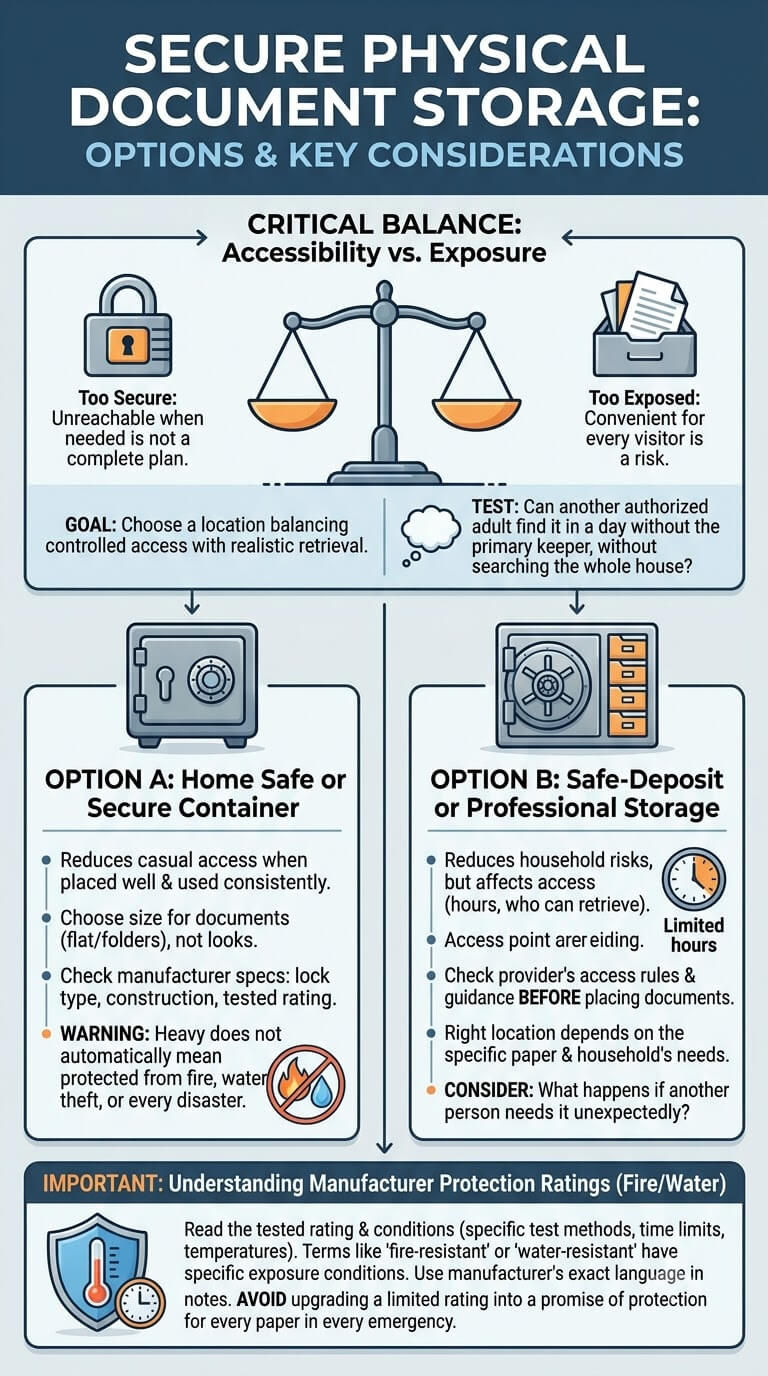
Home safe or secure container as an option
A locking document container or home safe can reduce casual access when it is placed in a suitable location and used consistently. Choose size based on the documents you need to store flat or in folders, not on how impressive the container looks.
Check manufacturer specifications for lock type, construction, and any tested protection rating. Do not assume that a heavy box automatically protects against fire, water, theft, or every disaster.
Safe-deposit or professional storage as an option when appropriate
Some people choose storage outside the home for selected records. That can reduce certain household risks but may also affect access hours, who can retrieve the item, and what happens if another person needs it unexpectedly.
Before placing a document outside the home, check the provider’s access rules and any document-specific guidance. The right location depends on the paper and the household’s legitimate access needs.
Accessibility versus exposure
A secure location that nobody can reach when needed is not a complete plan. Likewise, a convenient drawer that every visitor can open may be too exposed. Choose a location that balances controlled access with realistic retrieval.
A good test is to imagine the primary document keeper is unavailable for a day. Could another authorized adult locate the document without searching the whole house or calling several people?
Manufacturer-rated fire or water protection claims only
When shopping for document storage, read the tested rating and the conditions behind it. Terms such as fire-resistant or water-resistant can refer to specific test methods, time limits, temperatures, or exposure conditions.
Use the manufacturer’s exact language in your own household notes. Avoid upgrading a limited rating into a promise that the container will protect every paper in every emergency.
Plan Trusted Household Access
Who may need access
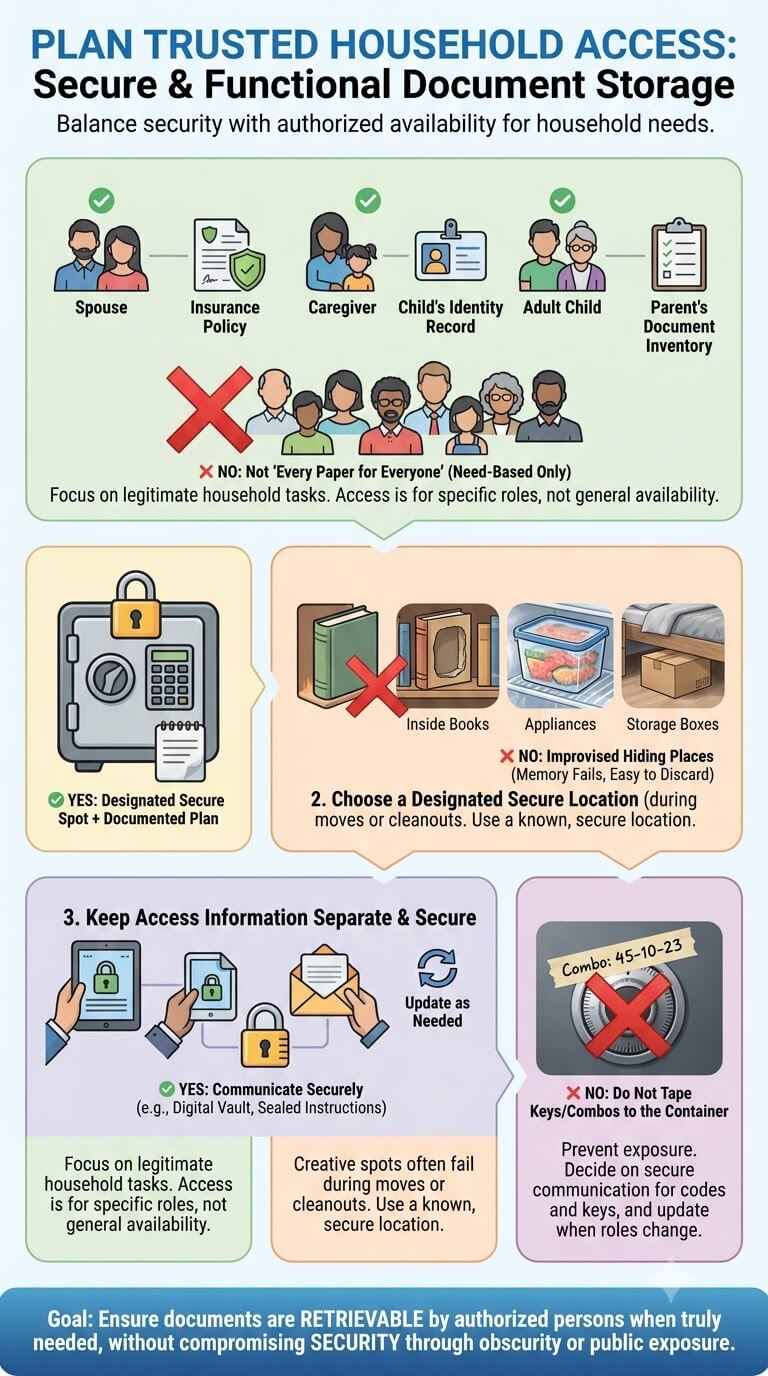
Identify the adults or caregivers who may legitimately need a document. A spouse may need an insurance policy, a caregiver may need a child’s identity record for an authorized task, or an adult child may need to know where a parent’s document inventory is kept.
Access should be based on a real household need, not on making every important paper available to everyone.
Avoid hiding documents so well that authorized people cannot retrieve them
Improvised hiding places often fail because they depend on memory. Papers can be discarded during a move, renovation, or cleanout, and another household member may never know the location exists.
Prefer a designated secure location and a documented access plan over creative hiding spots inside books, appliances, furniture, or storage boxes.
Keep sensitive access information from unnecessary public exposure
Do not tape combinations, keys, identifying numbers, or detailed access instructions to the container itself. If another person needs access, decide how that information will be communicated securely and updated when circumstances change.
Important Documents and Emergency Access Boundaries
High-level copies or inventory for emergency planning
An inventory can help a household know what records exist before an emergency. Ready.gov recommends gathering key financial, household, and identification information as part of preparedness planning; its financial preparedness guidance is a useful place to check current federal recommendations.
Keep this household organization task limited to knowing what exists, where originals are stored, and whether an authorized backup or copy is useful.
Keep everyday document storage separate from a full emergency binder
Do not automatically move every original into a portable binder simply because emergency access matters. Portability can increase exposure or loss risk. A disaster plan may use copies, inventories, or selected records differently from everyday secure storage.
Check official guidance for situation-specific needs
Emergency, immigration, military, medical, insurance, and legal situations can create document needs that an ordinary household filing method cannot answer. When the stakes are high, verify the current instructions from the responsible organization rather than relying on a generic list.
Update the Inventory After Major Life Changes
Name, address, household, property, vehicle, family, or status changes
Review the document inventory after events that change who owns something, who lives in the household, which identification is current, or which records matter. A move, marriage, divorce, birth, death, new vehicle, property transaction, citizenship event, or credential change can all make an old inventory misleading.
Review what issuing authorities require
An organization routine can remind you that a document may need updating, but it cannot tell you which change is legally required. Check the current instructions of the agency, court, school, insurer, licensing body, or other organization responsible for that record.
Replace outdated convenience copies without making legal judgments
Old copies can create confusion when a current version exists. Remove outdated working copies from wallets, travel folders, desk drawers, or household binders after you have confirmed they no longer serve a valid purpose.
Do not destroy an original merely because a newer-looking copy exists. First identify what each paper is and whether the older document still has a legal, historical, property, insurance, or other continuing purpose.
What to Do When an Important Document Is Missing
Confirm which document and issuing authority are involved
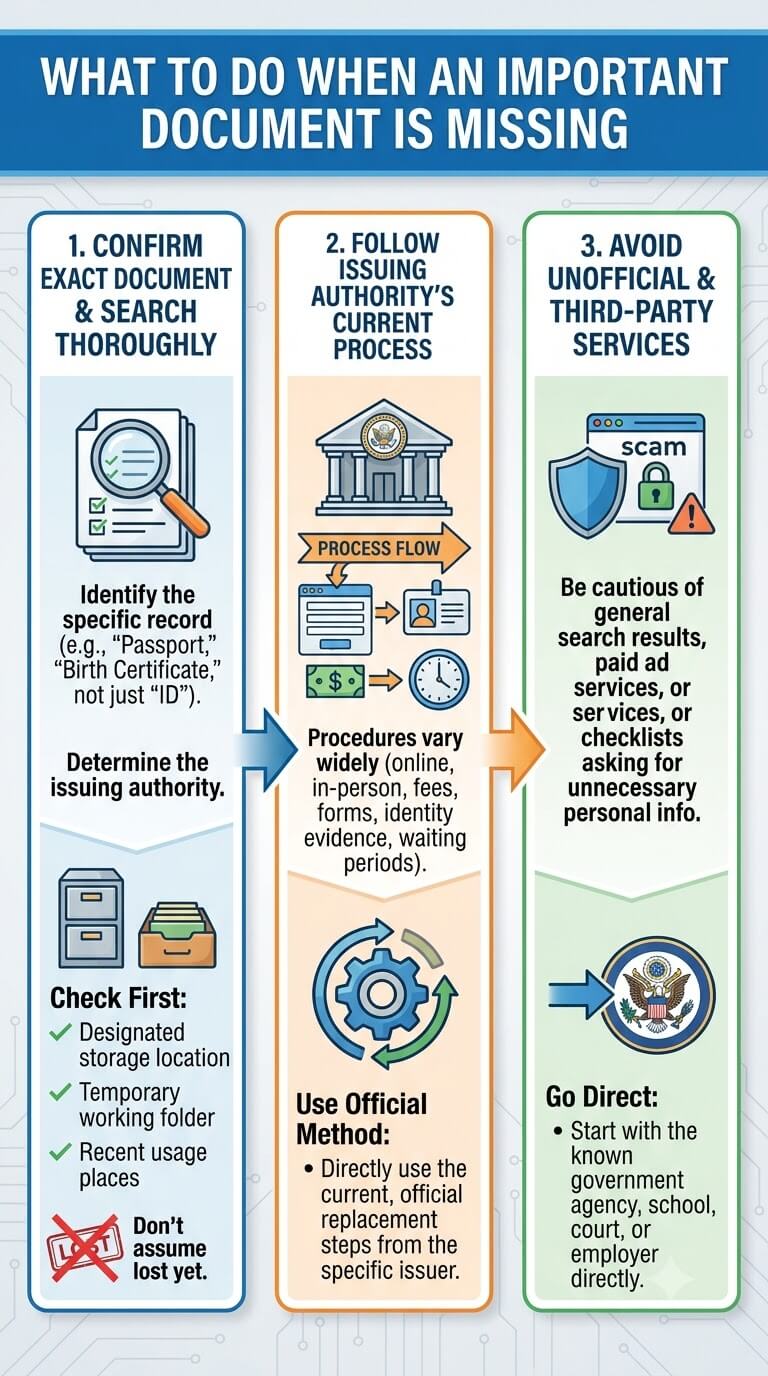
Start by naming the exact missing document. “Identity paper” is too vague. Determine whether you are missing a passport, birth certificate, vehicle title, Social Security card, diploma, court order, or another specific record, then identify who issued it.
Check the designated storage location, any temporary working folder, and recent places where the document was legitimately used before assuming it is permanently lost.
Follow the issuing authority’s current replacement process
Replacement steps differ widely. Some organizations require identity evidence, forms, in-person visits, fees, reports, or waiting periods, while others may offer online requests. Use the current official process for that exact document.
Avoid relying on unofficial replacement instructions
Be cautious with search results, paid services, or checklists that ask for unnecessary personal information. When possible, begin at the known government agency, school, insurer, court, employer, or other issuer responsible for the record.
Privacy and Sensitive Information
Identity numbers, addresses, account details, health information, and school records
Important-document storage often contains more than names. Identity numbers, addresses, financial details, health information, and student records can create unnecessary exposure if they are left on open shelves, shared desks, kitchen counters, or unlocked bins.
Keep labels general and store the details inside the protected document rather than repeating them outside.
Limit unnecessary handling and open display
Return originals to storage after use instead of leaving them in an “important” pile. If you need a paper for an appointment or transaction, remove it shortly before the task and put it back promptly afterward.
This habit is especially useful in homes with children, roommates, visitors, cleaners, contractors, or frequent moves between rooms.
Disposal requires a sensitivity and requirements check
Before discarding a sensitive document, confirm that you no longer need it and that no current rule, transaction, warranty, insurance matter, tax issue, legal matter, or other requirement calls for retention. The Federal Trade Commission’s identity-theft guidance recommends protecting documents with personal or financial information and securely destroying them when you decide they are no longer needed.
Do not treat shredding as a universal retention decision. First decide whether the paper can leave the system at all; then choose disposal appropriate to its sensitivity.
Common Important-Document Organization Mistakes
Mixing originals into ordinary files
An original can disappear among statements, warranties, tax folders, or old correspondence because the surrounding papers look equally official. Keep high-consequence originals in a clearly designated location rather than relying only on subject folders.
Keeping no inventory
Without an inventory, a household may remember a passport but forget a certified certificate, education credential, title, or other record. A short list prevents “I know we have it somewhere” from becoming the default retrieval method.
Overexposing copies
Convenience copies can spread to bags, desks, vehicles, email printouts, and open drawers. During review, remove copies that have no current job and avoid adding sensitive numbers to labels or notes.
Assuming a product is disaster-proof
A safe, lockbox, or document bag should be evaluated by its tested specifications and intended use. No household storage choice should be described as guaranteed protection against every fire, flood, theft, or disaster.
Giving no trusted person an access plan
A perfect filing location can still fail if the only person who knows it is unavailable. Decide who should know the location and how authorized access would work without leaving sensitive instructions in plain view.
Edge Cases
Documents shared by former household members
After separation, divorce, a roommate move, or another household change, some records may still involve more than one person. Do not discard, alter, or withhold a document based only on an organization preference. Separate it physically and seek appropriate guidance if ownership or access is disputed.
Multiple originals or certified copies
If you have more than one certified copy or officially issued version, label the storage folder to show what is present without writing sensitive details on the outside. Keep only the number of working copies that serves a real purpose, while preserving any originals or certified records whose status you have confirmed.
A document is both important and medically relevant
A health-related record can be both sensitive and difficult to replace. Keep routine clinical and appointment paperwork with the person’s medical records, but route any unusually important original or directive according to the access and security needs appropriate to that document.
Storage outside the home
If a paper lives with an attorney, bank, government office, relative, school, or another authorized holder, note that location in the inventory rather than creating a duplicate you do not need. Make sure the household understands how an authorized person would request access when necessary.
A replacement process differs by issuing authority
Do not expect the passport process to match the birth-certificate process or the vehicle-title process to match a school credential. The document name and issuing organization should determine the next step, not a generic replacement checklist.
FAQ About Organizing Important Documents
Should passports and birth certificates be stored with normal files?
They can be cataloged alongside ordinary household records, but many households benefit from keeping sensitive, difficult-to-replace originals in a more controlled location than everyday filing. Choose storage based on access, sensitivity, replacement difficulty, and the conditions in your home.
Do I need copies of every important document?
No. Make a copy only when it has a defined purpose, such as a working reference or an appropriate backup. Extra copies create extra locations to protect, update, and eventually dispose of. Never assume a photocopy or scan is accepted in place of an original.
Is a home safe always the best place?
No. A home safe can be useful, but the best location depends on who needs access, how often the document is used, the safe’s tested specifications, household risks, and any instructions that apply to the document. Some records may be better stored elsewhere.
What information should go on a document inventory?
List the document type, household owner, general storage location, and issuing organization when that helps with replacement. Avoid recording full Social Security numbers, passport numbers, account numbers, combinations, passwords, or other secrets unless you have a separate, appropriate method for protecting that information.
What should I do first if an original is missing?
Confirm exactly which document is missing, check the designated storage and recent working locations, then identify the issuing organization. Follow that organization’s current replacement or reporting instructions instead of relying on a generic third-party process.
Final Thoughts
Organizing important documents is less about creating more folders and more about making a few high-consequence papers easy for the right person to retrieve. Identify what truly deserves controlled storage, make a minimal inventory, group documents by person and purpose, and keep originals separate from routine copies.
Review the setup after major household changes and whenever a document is used, replaced, or moved. When retention, legal status, replacement, or access requirements are uncertain, stop at the organization boundary and check the current instructions of the responsible authority. A simple system is strongest when it tells you what you have, where it is, who may access it, and what needs verification before the paper leaves your care.

Ethan Carter is the Founder & Editor of HomeCleanSecrets. Based in the United States, he has 5 years of experience creating practical home cleaning, laundry care, stain removal, decluttering, and home organization content. His goal is to help everyday households clean smarter and build simple routines that are easier to maintain.
Read more about Ethan Carter on his author page: https://homecleansecrets.com/ethan-carter/