
Shoes by the front door are useful only when the area holds the pairs people are actually wearing now. Once every spare sneaker, dress shoe, boot, and outgrown kid shoe migrates to the entrance, the storage stops functioning as a daily system and turns into a pile.
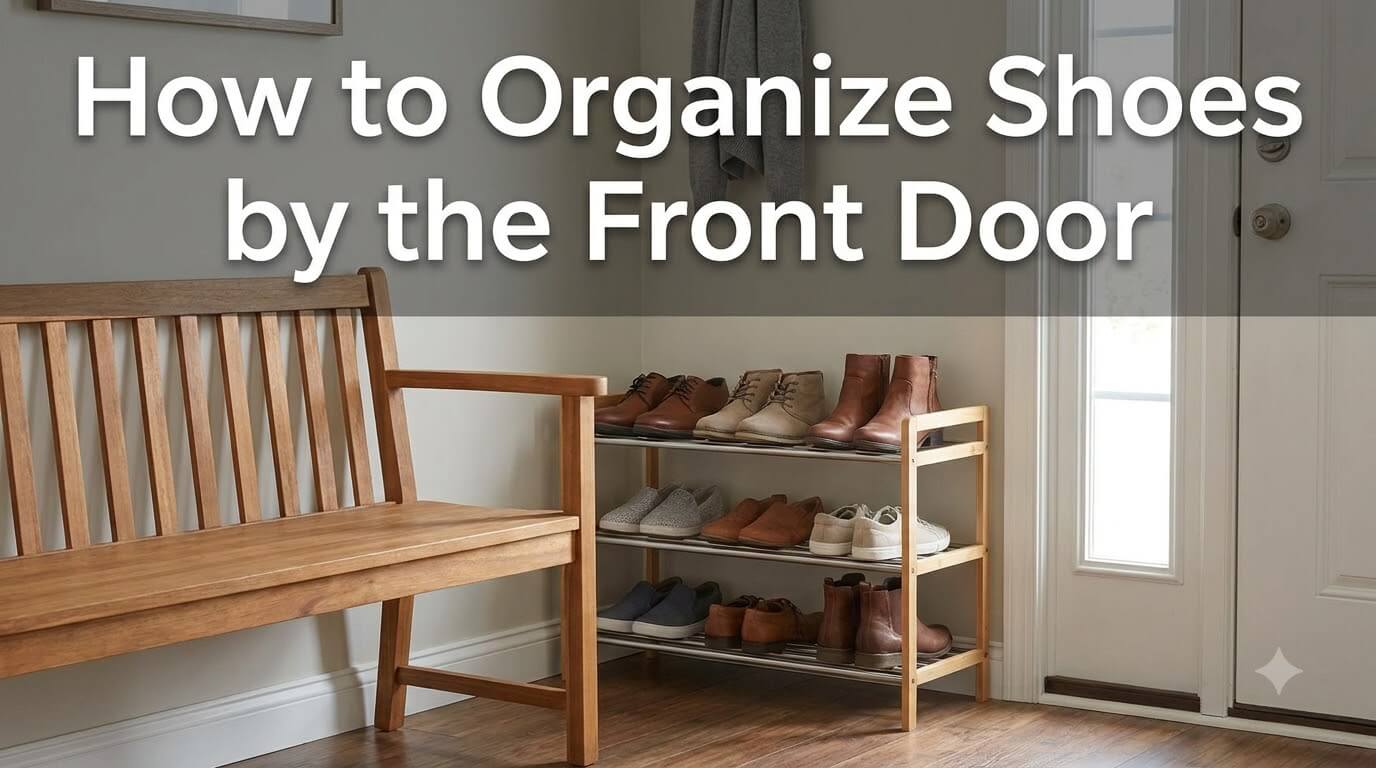
The practical goal is a small active rotation: enough footwear for work, school, exercise, weather, and everyday errands, with a clear place for wet or muddy pairs and a defined overflow destination elsewhere in the home.
Quick Answer: Keep Only the Active Rotation Near the Door
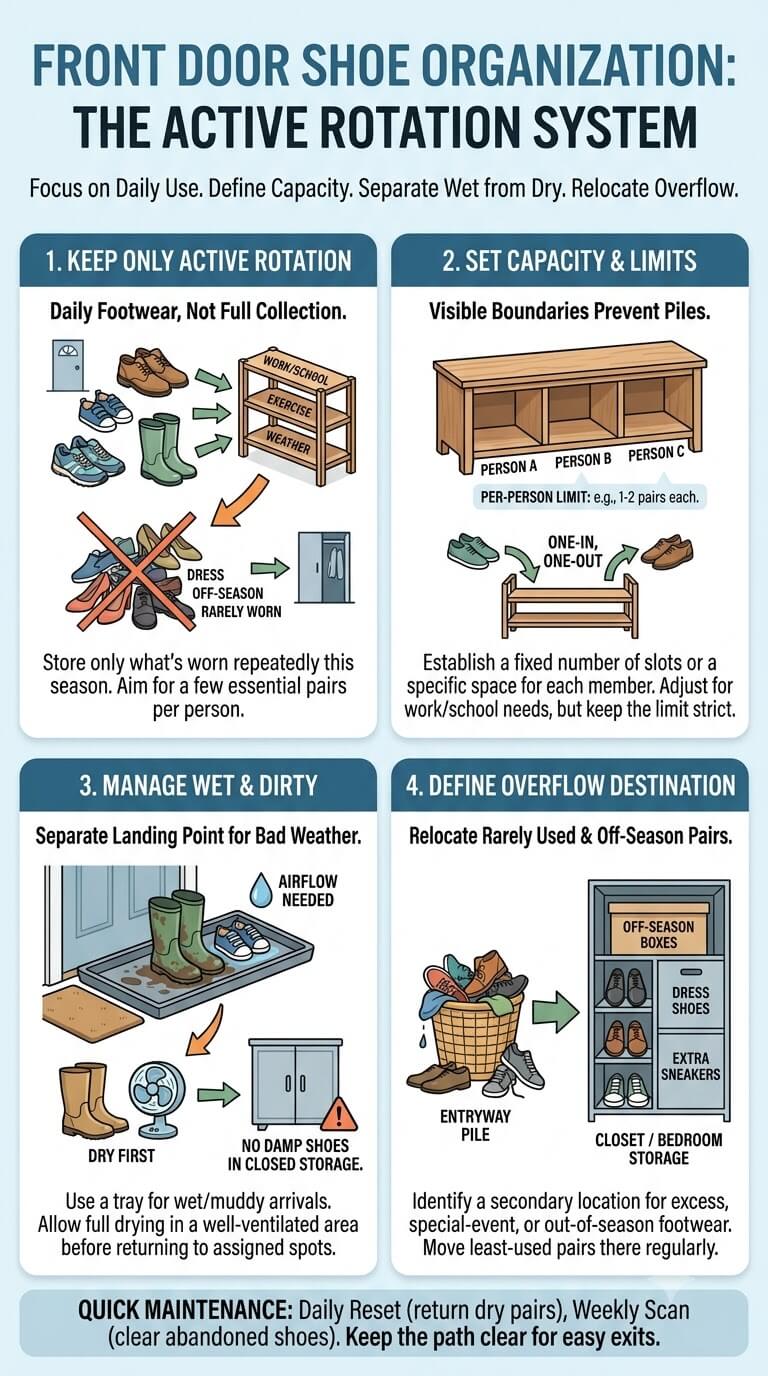
Start with use frequency, not the size of your shoe collection. The entrance should serve the next few days of normal departures, not every possible occasion.
Daily Footwear Versus the Full Collection
Active footwear is what someone reaches for repeatedly during the current season. For one adult, that might be a casual pair, a work pair, and one exercise pair. A child may need school shoes, play shoes, and weather-specific footwear.
Dress shoes, special-event footwear, collectible sneakers, travel-only shoes, and off-season pairs usually belong in a closet, bedroom, or other longer-term storage location.
Capacity Before Racks or Bins
Count the pairs that truly need near-door access before choosing a rack, tray, cubby, or bench. If your chosen storage holds eight pairs and the household tries to keep fifteen there, the floor becomes overflow almost immediately.
A good test is to clear the area completely, return only the pairs worn during a normal week, and watch what happens for seven days. If unused shoes remain untouched while the same few pairs cycle in and out, the untouched pairs are candidates to move elsewhere.
Decide How Many Pairs Belong Near the Entrance
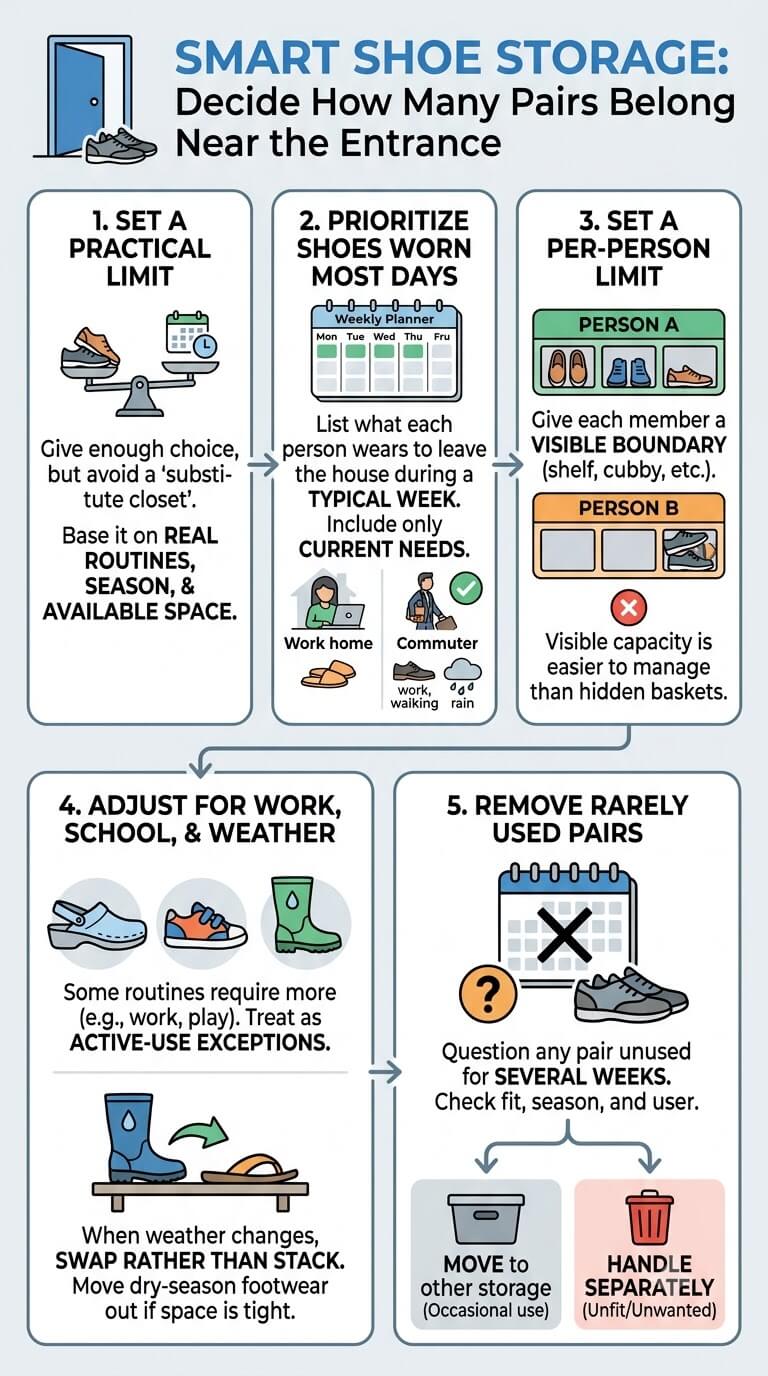
A practical limit gives each person enough choice without letting the doorway become a substitute closet. Set the limit according to real routines, season, and available space.
Start With the Shoes Worn Most Days
List what each person wears to leave the house during a typical week. Include only current needs. Someone working from home may need fewer pairs near the door than a commuter who alternates work shoes, walking shoes, and rain footwear.
Do not add a pair because it might be convenient someday. If a shoe is needed only once or twice a month, storing it farther away is usually a better tradeoff.
Set a Per-Person Limit
Give each household member a visible boundary such as one shelf section, one cubby, or a set number of pairs. If shoes are only one part of a crowded arrival area, first set the overall entryway and mudroom organization system, then keep this shoe zone limited to active footwear.
For a family of four, four identical baskets may look neat but can hide too many shoes. Visible shelf slots or cubbies often make capacity easier to understand because you can immediately see when one person has exceeded the available space.
Adjust for Work, School, and Weather
Some routines legitimately require more than one pair. A nurse may change between commuting shoes and work footwear. A child may need school shoes and outdoor play shoes. Rainy or snowy weeks may temporarily add boots. Treat these as active-use exceptions, not permission to keep every alternative nearby.
When weather changes, swap rather than stack. Bring rain boots into the active rotation and move dry-season footwear out if space is tight.
Remove Rarely Used Pairs
Any pair that has stayed by the door for several weeks without being worn should be questioned. Check whether it still fits, suits the season, and belongs to someone who actually uses this entrance.
If the answer is yes but use is occasional, move it to another storage area. If the shoes no longer fit or are no longer wanted, handle that decision separately instead of keeping them in the active zone by default.
Sort the Daily Rotation by Use Case
Different types of footwear create different storage needs. Sorting by use case helps you decide which pairs need fastest access, which can share a shelf, and which require room to dry.
Adult Daily Shoes
Keep the most frequently worn adult pair in the easiest position, especially if the entrance is narrow. A low open shelf or clearly assigned floor-level spot usually works better than a deep container that must be emptied to find a matching shoe.
Kids and School Shoes
Children do better when the storage height and action are simple. A low cubby or one clearly defined shelf section lets a child put shoes away without lifting a lid or moving other pairs. Keep the limit small enough that matching pairs remain obvious.
Check fit and condition regularly because outgrown shoes can quietly consume valuable space. When a child’s everyday pair changes, remove the old pair from the entrance the same day.
Work Shoes
If work footwear is clean enough for indoor storage, give it a predictable location near the departure route. Work boots that arrive muddy or wet need a separate landing point until they are ready for their normal spot.
Athletic Shoes
Athletic shoes used several times a week can stay in the active rotation, but avoid sealing them into a closed container immediately after a wet run or workout. Give damp footwear airflow and follow the care instructions for the specific shoe.
Boots and Bad-Weather Footwear
Boots take more floor area than low shoes, so count them separately when planning capacity. During wet seasons, reserve enough tray space for the number of boots likely to arrive wet at the same time. During dry months, move bulky boots out if they are no longer part of the regular rotation.
Indoor Slippers at the Boundary
If your household changes into indoor slippers at the entrance, keep the exchange simple: outdoor pair off, slippers on, outdoor pair returned to its assigned spot. Slippers should not multiply into another pile. Give them one compact location that does not interfere with the outdoor footwear.
Choose the Right Containment Method

The best storage method is the one that matches the shoes, household habits, and available space. Open storage is often useful for active footwear because it keeps pairs visible and allows airflow.
Shoe Tray for Wet or Dirty Footwear
A tray creates a clear boundary for shoes that may drip, shed grit, or carry mud. Size the tray for the worst realistic arrival, such as two pairs of adult rain boots and a child’s shoes, rather than for every shoe in the household.
Use the tray as a temporary wet or dirty landing point unless the material and conditions make permanent tray storage practical. Once a pair is dry and no longer shedding debris, return it to its assigned shelf or cubby.
Open Rack for Quick Access and Airflow
An open rack works well for clean, frequently worn pairs. Keep the number of tiers appropriate to the space so the rack does not project into the walking path or make the entrance feel like a shoe wall.
Before choosing a tall or narrow unit, check its stability and follow the manufacturer’s installation or anchoring instructions when applicable. A storage solution is not useful if it introduces a new tipping or tripping problem.
Cubbies for Assigned Family Capacity
Cubbies make ownership and capacity visible. One or two openings per person can be easier to maintain than one large communal shelf. Avoid stuffing multiple bulky pairs into a small opening because crushed uppers, tangled laces, and hidden shoes make daily retrieval slower.
Bench Storage When Space Permits
A bench can combine seating and shoe storage, but it should earn the floor space. Check door swing, walking clearance, and the way people actually move through the entrance before adding one. A narrow hall may function better with wall storage and no bench at all.
If the bench has closed compartments, reserve them for dry footwear unless the product design specifically supports ventilation and the shoe care instructions allow that storage method.
Vertical Options for Constrained Entrances
Vertical storage can reduce the footprint, but keep frequently used shoes within comfortable reach and do not stack footwear so high that pairs fall when someone grabs them. Wall-mounted systems must be installed according to their hardware, wall type, and rated load.
Why Baskets Have Limits for Footwear
Baskets can work for lightweight slippers or a child’s small pair, but large mixed shoe baskets often create a digging problem. Shoes become separated, clean pairs mix with dirty soles, and the basket can quietly exceed its intended capacity.
If you use a basket, define one narrow purpose and stop filling when the assigned pairs no longer fit neatly. Do not treat the rim as the beginning of a second layer.
Separate Muddy, Wet, and Clean Footwear

Wet-weather organization works best when dirty arrivals do not immediately join clean shoes. Create a short drying and containment step before closed storage.
Create a Dirty Landing Point
Choose one place where muddy or dripping shoes can stop as soon as they come off. A washable or material-compatible tray near the entrance can keep wet soles from being carried deeper into the home. Position it outside the main walking line so people do not step over wet footwear.
Let Damp Shoes Dry Before Closed Storage
Do not put damp footwear straight into a sealed bin or tightly closed cabinet. Timberland’s boot care guidance recommends allowing wet boots to dry fully in a well-ventilated area, and the exact care method can vary by material.
For athletic shoes, heat can also be a problem. Nike’s shoe drying guidance notes that a clothes dryer can damage construction or affect fit. Check the care instructions for your footwear before using heat, direct sun, or any drying device.
Protect Nearby Floors With Material-Compatible Containment
Entry mats and prompt moisture control can reduce what gets tracked onto finished floors. Shaw Floors’ hardwood care guidance recommends walk-off mats at entrances to trap dirt and moisture and prompt attention to spills.
Flooring materials vary, so avoid assuming one mat backing or cleaning method is safe everywhere. Check the floor manufacturer’s care instructions, especially for wood, laminate, specialty finishes, or floors with warranty-specific restrictions.
Move Persistent Moisture Problems Beyond Simple Organization
If the tray stays wet for long periods, boots never seem to dry, or moisture repeatedly reaches walls or flooring, adding another basket is not the answer. Improve the drying location, reduce how many wet items are kept together, and investigate the source of repeated dampness.
Stop treating the issue as a storage problem if you see swelling materials, recurring musty conditions, or water entering from outside. Those signs call for correcting the moisture source and following appropriate material or building guidance.
Build a Family Shoe Zone That Resets Easily
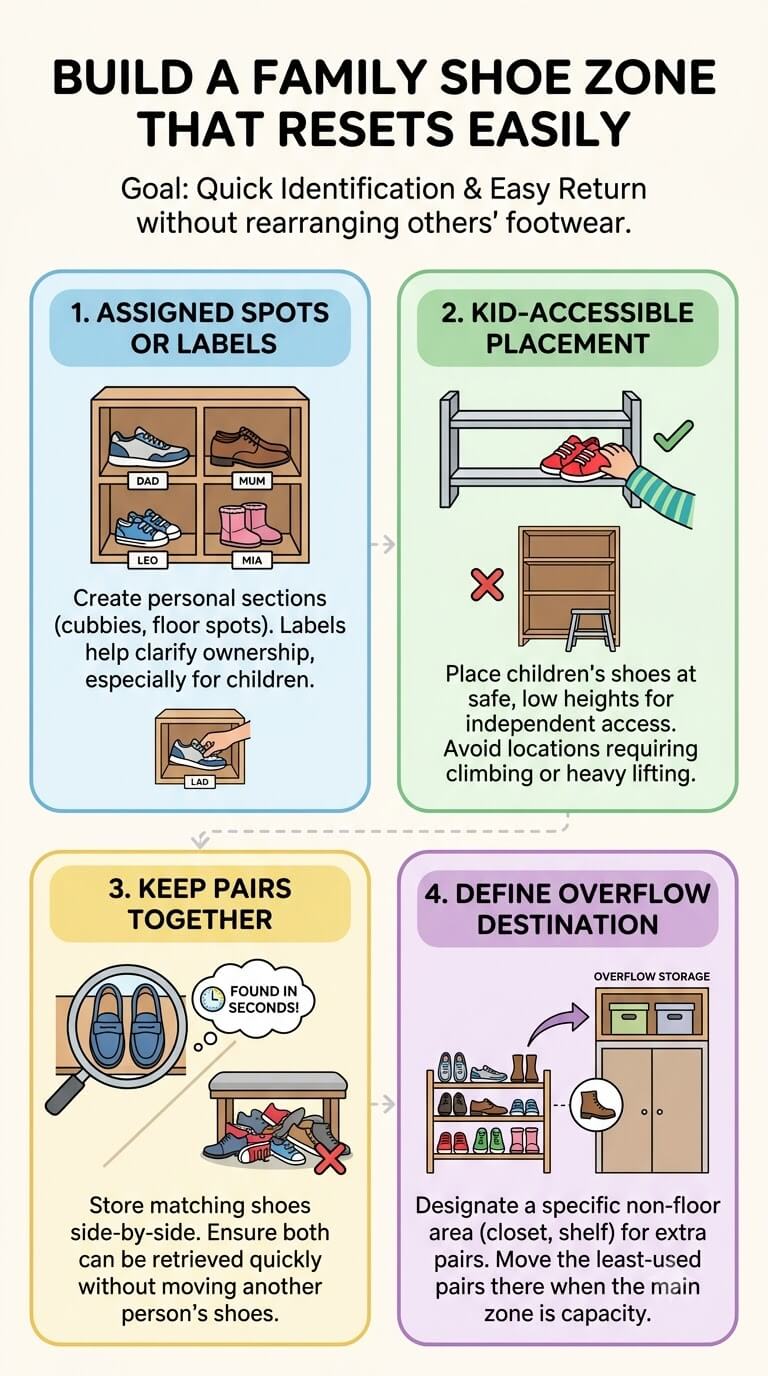
A family system succeeds when people can identify their space quickly and return a pair without rearranging everyone else’s shoes.
Assigned Spots or Labels When Useful
Assign shelf sections, cubbies, or simple floor positions by person if shared storage causes confusion. Labels can help young children or large households, but they are optional when the physical divisions already make ownership obvious.
Kid-Accessible Placement
Put children’s everyday shoes at a height they can reach safely. The goal is not a perfect display; it is a repeatable action a child can complete independently. Avoid locations that require climbing, moving heavy items, or reaching over unstable storage.
Keep Pairs Together
Store matching shoes side by side whenever possible. If one shoe repeatedly disappears under a bench or into another person’s section, the storage is either too deep, too crowded, or too undefined.
A useful check is whether someone can find both shoes in a few seconds without moving another person’s footwear. If not, reduce the number of pairs or create clearer divisions.
Define Where Overflow Goes
Every family needs an overflow destination that is not the floor beside the rack. Choose a closet, bedroom shelf, or other storage area for extra active pairs. When the entrance reaches capacity, move the least-used pair there rather than creating a second pile.
Shoe Storage for a Small Entryway
Small entrances need stricter limits because even a modest shoe collection can consume the walking path. Protect movement first, then fit storage into what remains.
Floor-Space Limits
Open the door fully and walk the normal route while the area is empty. Notice where feet naturally land, where bags swing, and where people turn. Shoe storage should stay outside those movement zones.
NFPA’s home escape planning guidance emphasizes keeping doors and windows used for escape unblocked. Do not let shoe piles, trays, benches, or racks interfere with a needed exit route.
Low-Profile Storage
A shallow rack, narrow tray, or single row of cubbies can provide enough capacity without dominating a tight hall. Measure the usable footprint instead of buying based on the number of pairs advertised on packaging.
Vertical Storage Without Creating a Hazard
If you use height to save floor space, keep the unit stable and the shoes contained. Heavy boots belong lower than lightweight footwear. Follow the product’s mounting and load instructions rather than assuming a wall or adhesive system can hold whatever fits on it.
When the Entrance Cannot Hold Every Active Pair
A very small entrance may only support one pair per person, plus a weather tray. That is acceptable. The remaining active shoes can live in a nearby closet or bedroom and rotate forward as needed.
Convenience does not require keeping every frequently worn shoe within arm’s reach of the door. A thirty-second trip to a closet is better than a permanently narrowed walkway.
Rotate Shoes by Season

Seasonal rotation keeps bulky or weather-specific footwear from occupying prime space all year. Make the swap based on actual conditions rather than a fixed calendar date.
Identify the Current Active Season
Look at what people have worn during the past two weeks and what the near-term weather requires. If sandals are no longer being chosen and rain boots are appearing daily, the active zone should reflect that change.
Move Off-Season Footwear to Closet or Long-Term Storage
Clean, dry, and store off-season pairs according to their material requirements in the location you use for longer-term footwear. The entrance does not need to carry summer sandals through winter or heavy snow boots through warm months.
Keep Transitional Weather Pairs Under a Hard Capacity Cap
Spring and fall can require both warm- and cool-weather options. Instead of doubling the shoe count, choose a fixed number of transitional slots. When a new pair moves in, another pair moves out.
This one-in, one-out rotation prevents temporary weather uncertainty from becoming permanent excess.
Daily and Weekly Shoe-Zone Reset
The shoe area should take only a few minutes to restore when capacity is realistic. Resetting is about returning the existing system to working order, not redesigning the whole entrance.
Return Pairs After Use
At the end of the day, place dry shoes back in their assigned spot rather than leaving them where they came off. This single action prevents the open floor from becoming unofficial storage.
Move Dried Footwear Into Its Assigned Spot
Wet pairs may need to stay on the tray temporarily. Once they are dry enough for normal storage and the care instructions allow it, move them off the drying area so the tray is available for the next wet arrival.
Clear Abandoned Pairs
Once a week, scan for shoes that have drifted into the entrance but were not worn. Return them to their normal storage location. This catches slow accumulation before it becomes a large decluttering job.
Clean the Tray or Immediate Shoe Area as Needed
Remove loose grit, dried mud, or standing moisture based on the tray and flooring materials. Do not use one cleaner on every surface. Follow the tray, floor, and product care instructions when cleaning is needed.
Common Front-Door Shoe Organization Mistakes
Most shoe-zone failures are capacity or workflow problems rather than a lack of organizers. Fix the rule before adding another container.
Treating the Entryway as the Entire Shoe Closet
The entrance becomes crowded when every pair is stored according to ownership instead of use frequency. Keep the current rotation near the door and move the rest to the place that manages the broader collection.
Storing Damp Shoes in Sealed Containers
Closed storage can hide clutter, but it is a poor default for wet arrivals. Let footwear dry according to its care instructions before closing it away. If a cabinet regularly receives damp shoes, reconsider the sequence rather than relying on the door to hide the problem.
Using Deep Piles Instead of Visible Capacity
A pile has no meaningful limit and makes lower shoes harder to reach. Prefer storage where the number of available positions is obvious. Visible limits make excess easier to remove.
Blocking Door Swing or Walkways
A tray that creeps into the doorway or shoes left where people turn can create a practical hazard. Test the area during busy departure times, not only when the house is quiet. If people step over storage, relocate it.
Keeping Broken or Rarely Worn Shoes in the Active Zone
Damaged, uncomfortable, outgrown, or seldom-used footwear should not consume the easiest storage positions. Decide whether to repair, relocate, donate, recycle where appropriate, or discard the pair instead of leaving it by the door indefinitely.
When Shoes Should Move to a Closet or Other Storage
The entrance is for active rotation. Moving less-used footwear elsewhere is a normal part of keeping the daily zone functional.
Dress and Occasion Shoes
Formal shoes usually do not need daily departure access. Store them where they are protected and easy to retrieve for planned events rather than letting them occupy a front-door slot for months.
Collectible or Rarely Worn Sneakers
Pairs kept for collection value, display, or occasional wear deserve storage designed for that purpose. The entryway exposes footwear to daily traffic, dirt, moisture, and accidental contact, so it is not the best place for a collection.
Off-Season Footwear
When a weather season ends, move its shoes out after they are appropriately dry and ready for storage. Keep only transitional pairs that are still being used.
Extra Family Pairs Beyond Entrance Capacity
If everyone has more active shoes than the entrance can safely hold, split storage. Keep the highest-frequency pair near the door and place secondary pairs in personal closets or another designated area.
Coordinate Shoes With Wet-Weather Coats and Mudroom Zones
Shoes interact with other arrival items during bad weather, but each category still needs its own boundary. The goal is to prevent wet items from collapsing into one mixed pile. Keep wet-weather coats on a separate hanging or drying path so dripping outerwear does not share the floor-level shoe containment area.
Keep Wet Footwear Separate From Dry Outerwear
Do not place dripping boots directly under dry coats, bags, or fabric baskets if runoff can reach them. Give footwear a floor-level containment point and keep hanging items positioned so they can dry without dripping onto stored shoes or electrical items.
Coordinate Drying Without Duplicating the Coat System
During rainy or snowy periods, think about the whole arrival sequence: wet coat off, boots off, each item goes to its own drying location, and the walking path remains clear. You do not need one oversized catch-all station for every wet item.
Use a Mudroom Shoe Zone When a Dedicated Room Exists
A mudroom can support more footwear because it usually has more floor area and stronger separation between wet and dry zones. Even there, keep the same active-rotation rule. In a dedicated mudroom, place the active shoe zone near the dirty boundary so wet footwear does not cross through coat, bag, or clean accessory areas.
FAQ About Shoes by the Front Door
These answers cover the most common decisions that come up after a basic shoe zone is in place.
How Many Pairs of Shoes Should Be Kept by the Door?
Keep the smallest number that covers normal work, school, exercise, and current-weather needs. For some people that is one or two pairs; others may need several. The storage boundary and walking path are more important than a universal number.
What Is the Best Way to Store Wet Shoes Near an Entrance?
Give wet shoes a contained landing point with airflow, keep them out of the walking path, and let them dry according to the footwear manufacturer’s care instructions before moving them into closed storage. Avoid sealing damp shoes in an airtight bin.
Are Shoe Baskets a Good Idea?
They can work for a small, clearly defined category such as children’s slippers or one lightweight pair per person. Deep communal baskets are less useful when they hide pairs, mix dirty soles with clean shoes, or encourage unlimited stacking.
How Do Families Stop Shoes From Piling Up?
Set a visible per-person capacity, give every active pair a specific spot, and move overflow to a defined secondary storage area. A brief daily return and weekly scan prevent abandoned shoes from quietly increasing the count.
When Should Boots Move Out of the Entryway?
Move boots when they are no longer part of the current weather rotation, when they exceed the safe capacity of the entrance, or when they need a better drying or long-term storage location. Bulky boots should not remain near the door simply because there is no other decision in place.
Final Thoughts
A front-door shoe area works best as a rotation point, not a collection. Decide what is active, set a visible household limit, separate wet arrivals from clean pairs, and give overflow a real destination. If the area still becomes a pile, reduce the number of pairs before buying more storage. The simplest successful setup is one that people can use on a rushed morning and restore in a few minutes at the end of the day.

Ethan Carter is the Founder & Editor of HomeCleanSecrets. Based in the United States, he has 5 years of experience creating practical home cleaning, laundry care, stain removal, decluttering, and home organization content. His goal is to help everyday households clean smarter and build simple routines that are easier to maintain.
Read more about Ethan Carter on his author page: https://homecleansecrets.com/ethan-carter/