
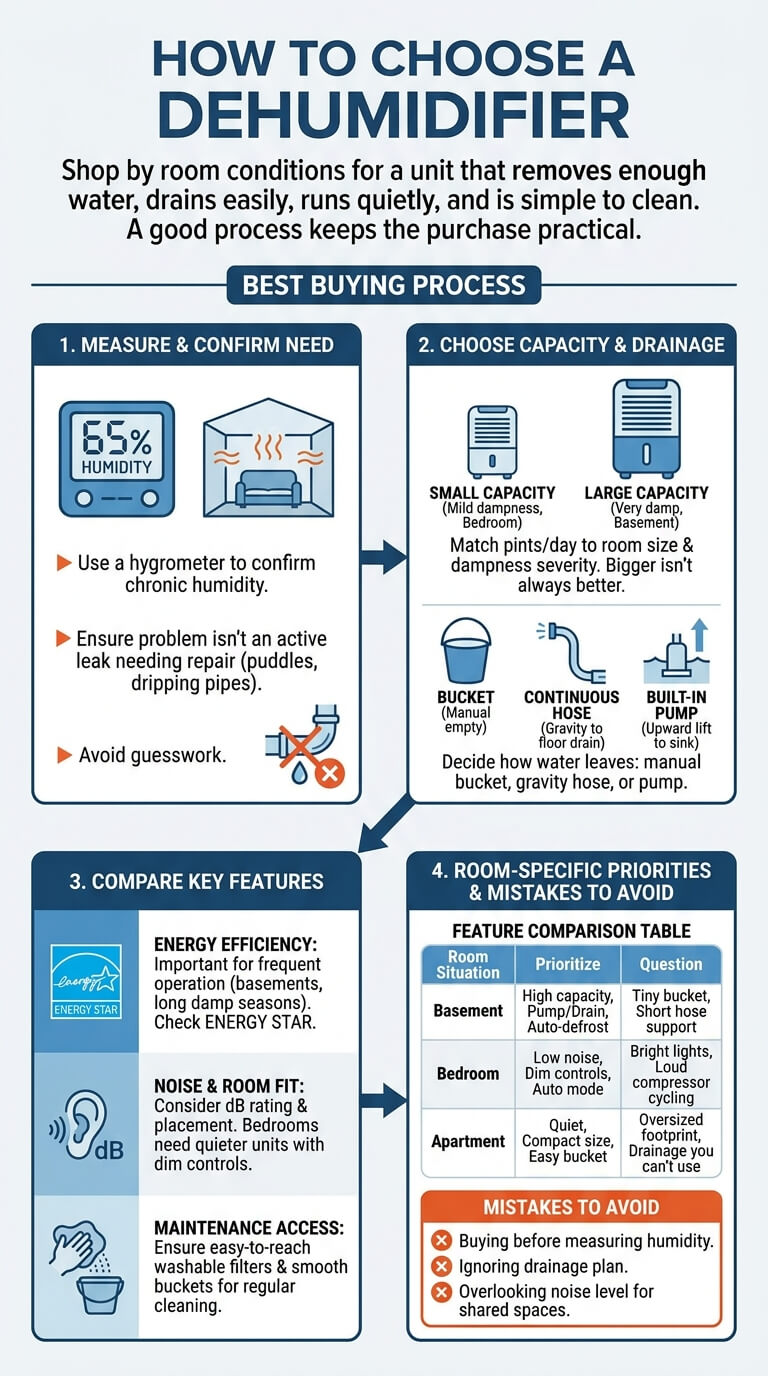
Choosing a dehumidifier is easier when you shop by room conditions instead of by the biggest number on the box. A good unit should remove enough water for the space, drain in a way you can live with, run without bothering the room, and be simple enough to clean. The wrong unit can still collect water, but it may be noisy, undersized, hard to empty, or awkward to place.
The best buying process is simple: measure the room humidity, confirm that you need a dehumidifier rather than a repair, choose the right capacity range, decide how the water will drain, then compare energy use, noise, controls, filter access, and warranty details. That keeps the purchase practical and neutral, especially if you are comparing many models with similar product photos.

Quick Answer: The Features That Matter Most
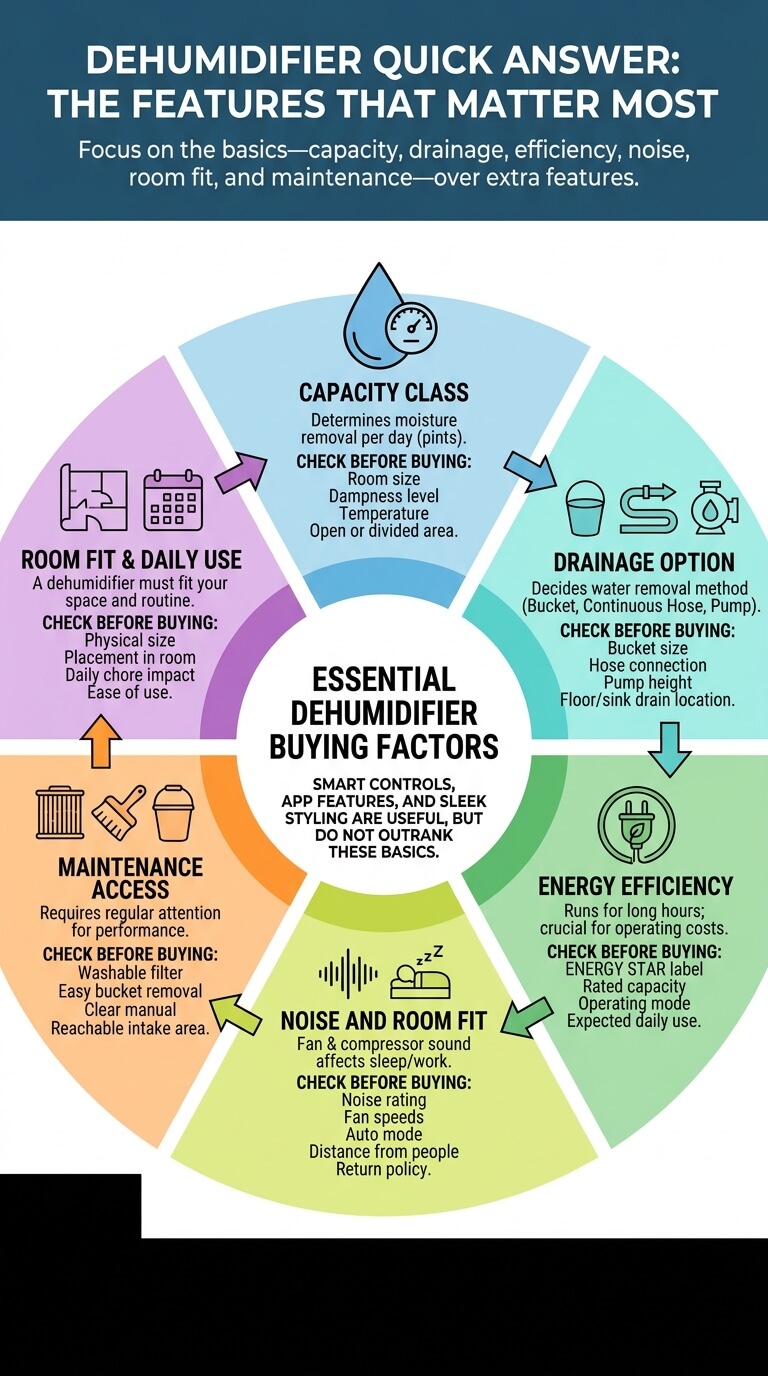
The most important features are capacity, drainage, efficiency, noise level, room fit, and maintenance access. Smart controls, app features, and sleek styling can be useful, but they should not outrank the basics. A dehumidifier that fits your room and routine will usually serve you better than a feature-heavy model that is hard to empty or clean.
If the room problem might involve ventilation, closet moisture, measuring tools, or air particles as well as humidity, compare the broader home moisture control products before choosing one device.
| Feature | Why it matters | What to check before buying |
|---|---|---|
| Capacity class | Determines how much moisture the unit can remove under test conditions | Room size, dampness level, temperature, and whether the area is open or divided |
| Drainage option | Decides whether you empty a bucket or send water to a drain | Bucket size, hose connection, pump height, floor drain, sink, or utility tub location |
| Energy efficiency | A dehumidifier may run for many hours during damp weather | ENERGY STAR label, rated capacity, operating mode, and expected daily use |
| Noise and room fit | The fan and compressor can affect sleep, work, TV, and shared rooms | Noise rating, fan speeds, auto mode, and distance from people |
| Maintenance access | Filters, buckets, coils, and drain hoses need regular attention | Washable filter, easy bucket removal, clear manual, and reachable intake area |
Capacity class
Capacity tells you how much water the dehumidifier is designed to remove in a day under standard test conditions. It is usually shown in pints per day. Bigger capacity can help in large or very damp spaces, but it is not the only buying factor. A large model with poor drainage access can become a daily chore. A smaller unit may work well in a bedroom or apartment office if the humidity problem is mild and the room can be closed off.
Drainage option
Every dehumidifier collects water somewhere. Bucket-only models are simple, but someone has to empty the bucket before it fills. Continuous drain models can send water through a hose to a floor drain or low utility drain, but gravity matters. Models with pumps can push water upward to a sink or higher drain, which can help in basements without a convenient floor drain.
Drainage only works well when the unit has a practical place to sit, so think through where the dehumidifier will sit before choosing bucket-only, hose, or pump drainage.
Energy efficiency
Dehumidifiers can run for long stretches during humid seasons, so efficiency is not a small detail. ENERGY STAR explains that dehumidifier capacity is measured in pints per day and that the needed capacity depends on space size and dampness conditions. Their dehumidifier buying and efficiency guidance is a useful place to compare capacity, placement, drainage, and energy considerations before you buy.
Noise and room fit
A dehumidifier has a fan and usually a compressor, so it will make sound. Noise is less of an issue in an unfinished basement than in a bedroom, nursery, office, or TV room. Look for a listed decibel rating when available, but also read the return policy because sound can feel different in a small room with hard floors than it does in a store or product video.
Maintenance access
A dehumidifier that is annoying to clean will be neglected. Before buying, look at the filter location, bucket handle, bucket shape, hose port, intake grille, and manual instructions. The best setup is one you can maintain without moving furniture or kneeling in a tight corner every week.
Many poor purchases come from small setup assumptions, so review the most common dehumidifier mistakes to avoid before you compare final models.
When a Dehumidifier Is the Right Product
A dehumidifier makes sense when the air in a room stays humid after normal ventilation and basic housekeeping. It is especially useful for basements, laundry rooms, closed bedrooms, humid lower levels, and rooms that feel damp during rainy or warm seasons. It is less useful when moisture comes from an active leak or a building defect that needs repair.
Signs of room-level humidity
Common signs include sticky air, musty smell, clammy bedding, condensation on cool surfaces, damp cardboard, rust on stored tools, or a hygrometer reading that stays high. In a basement, you may notice a damp smell near the stairs before you see water. In a bedroom, clothing may feel slightly cool or heavy even after the room has been closed all day.
A small home humidity meter can show whether the room stays humid long enough to justify a dehumidifier.
Problems a dehumidifier can help with
A dehumidifier can reduce moisture in the air, make a room feel less sticky, help stored items stay drier, and support odor prevention when damp air is part of the problem. It can also help protect cardboard storage, seasonal decorations, tools, books, and some furniture when the room itself tends to stay humid.
Problems that need repair before buying
Do not rely on a dehumidifier as the first fix for active water. Puddles after rain, dripping pipes, wet drywall, soaked carpet, foundation seepage, a blocked dryer vent, or a bathroom fan that vents into an attic need attention before a product purchase. A dehumidifier may collect water while the real problem continues.
Electrical safety also matters. Do not run a unit with a damaged cord, near standing water, on an overloaded extension cord, or in a spot where the plug can get wet. The CPSC maintains a dehumidifier recall page that is worth checking if you are buying used, accepting a hand-me-down, or replacing an older machine.
Start With Measurement and Room Use
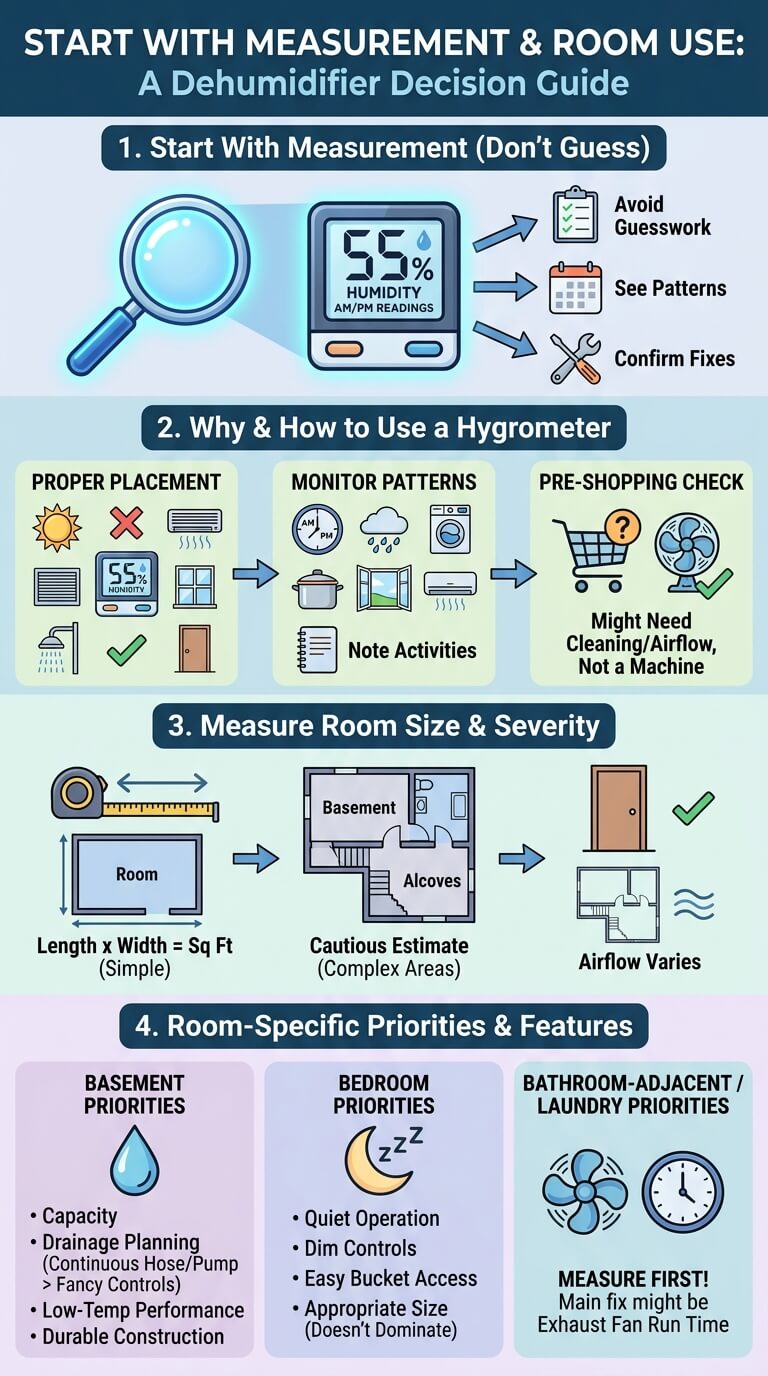
Measurement keeps the decision from becoming guesswork. A small digital hygrometer can show whether the room is actually humid, whether the problem happens at certain times, and whether a machine is helping after purchase. It also helps you avoid buying a dehumidifier for a room that mainly needs cleaning, airflow, or repair.
Why a hygrometer helps before shopping
Place the hygrometer in the problem room, away from direct sun, vents, windows, dryers, showers, and exterior doors. Leave it long enough to see a pattern rather than one moment. Check morning and evening readings, and note what happened that day: rain, laundry, shower use, cooking, open windows, or air conditioning.
Room size and dampness severity
Measure the area roughly instead of guessing. Length times width gives square footage for a simple rectangular room. Basements with alcoves, open stairways, storage rooms, or partly finished sections may need a more cautious estimate because air does not always move evenly. A closed bedroom is easier to control than an open lower level with several damp corners.
Basement, bedroom, bathroom-adjacent, and laundry-room priorities
Basements usually need capacity, drainage planning, low-temperature performance, and durable construction. A continuous drain hose or pump can be more important than a fancy control panel. Bedrooms need quiet operation, dim controls, easy bucket access, and a size that does not dominate the room. A bathroom-adjacent hallway or closet may need measurement first because the main fix could be exhaust fan run time.
Dehumidifier Capacity and What It Really Means
Capacity is important, but it should not be treated as the whole decision. Two units with similar pint ratings can differ in noise, drainage, filter access, bucket design, controls, warranty, and cold-room performance. Capacity tells you what the unit is designed to remove under standard conditions. Your home decides how useful that number will be.
Why pint ratings matter
Pint rating helps you compare the general strength of one model to another. A higher rating can remove more water under test conditions, which often helps in larger or damper rooms. The U.S. Department of Energy notes that residential dehumidifiers have federal energy conservation standards, and its consumer dehumidifier efficiency information can help shoppers understand why efficiency and capacity are linked in appliance design.
Why exact size is a separate decision
Exact sizing depends on square footage, dampness level, room temperature, layout, and how often doors stay open. This buying checklist keeps the focus on choosing features once you know a dehumidifier is likely needed. Do the capacity estimate carefully before purchase, especially for basements and larger rooms, but do not let sizing math distract from drainage, sound, cleaning, and daily use.
How to avoid choosing only by price
Price is tempting because many dehumidifiers look similar online. Compare what the price includes: capacity class, drain hose compatibility, built-in pump, filter type, auto-defrost, timer, humidistat, bucket size, warranty length, and replacement part availability. A low price is less useful if the unit needs constant emptying in the room where you plan to use it.
Drainage Choices
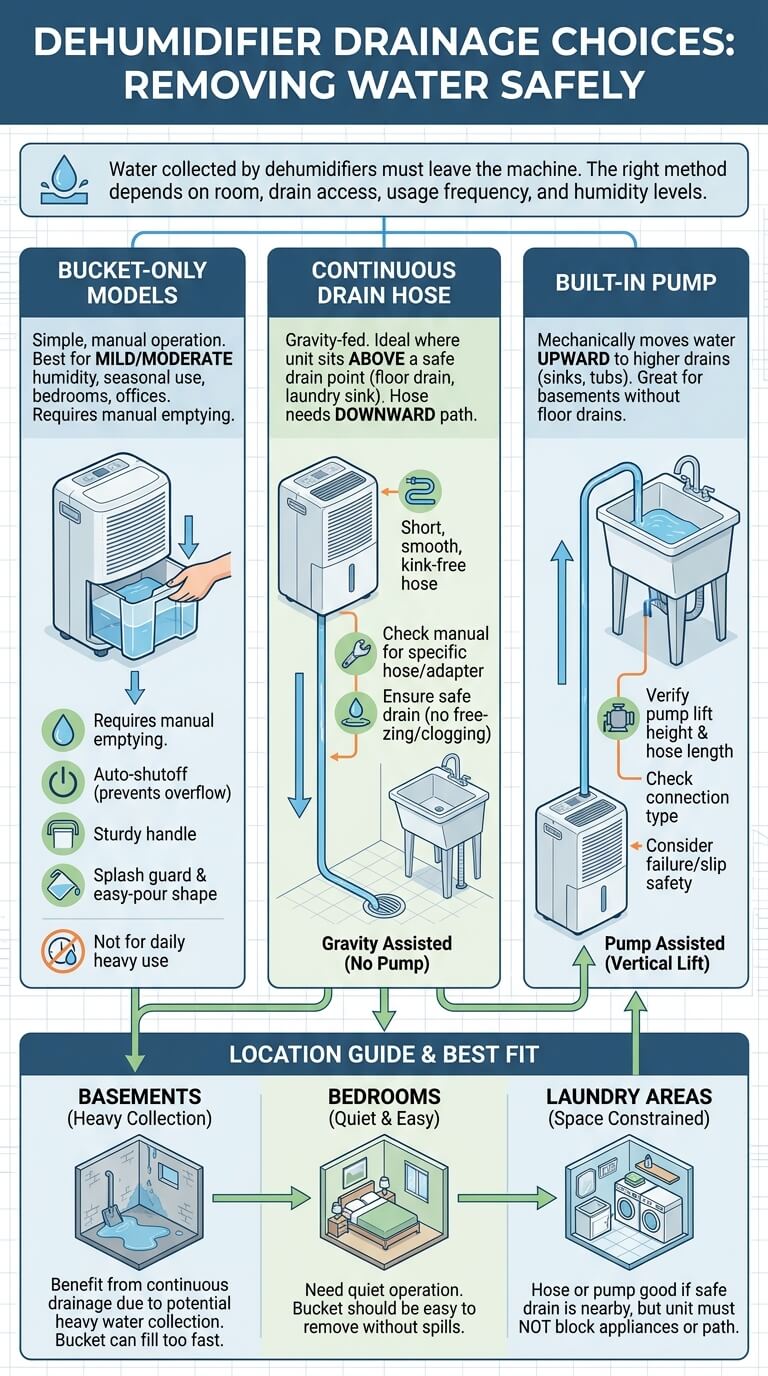
Drainage is the feature most shoppers underestimate. A dehumidifier can remove a lot of water, but that water must leave the machine safely. The right drainage setup depends on the room, the drain location, how often someone is home, and whether the unit will run every day or only during damp seasons.
Bucket-only models
Bucket-only operation is simple and does not require a floor drain. It can work well in bedrooms, apartments, offices, and seasonal spaces where humidity is mild or moderate. Look for a sturdy handle, a splash guard, an easy-pour shape, and an auto-shutoff that stops the unit when the bucket is full.
Continuous drain hose
A continuous drain hose can be ideal when the unit can sit above or near a floor drain, laundry sink, condensate drain, or other approved drain point. Gravity usually needs a downward path, so the hose cannot climb upward unless the model has a pump. Keep the hose short, smooth, and protected from kinks.
Read the manual before assuming any hose will work. Some units require a specific thread, adapter, hose diameter, or installation step. Make sure the drain will not overflow, freeze, clog, or create a trip hazard.
Built-in pump
A built-in pump can move collected water upward to a sink, utility tub, or higher drain. It can be worth it in a basement without a floor drain or in a laundry area where gravity drainage is not possible. Compare pump lift height, hose length, connection type, and what happens if the pump fails or the hose slips.
Which option fits basements, bedrooms, and laundry areas
Basements often benefit from continuous drainage because water collection can be heavy during humid weather. Bedrooms usually need quiet operation and a bucket that is easy to remove without spilling. Laundry areas may benefit from a hose or pump if a safe drain is nearby, but the unit must not block the washer, dryer, vent, or walking path.
Energy, Noise, and Daily Living Fit
The best dehumidifier is one you will actually use. A model that saves energy, sounds reasonable, rolls where needed, and holds a steady humidity setting is easier to live with than a powerful machine that feels intrusive. Think about the room during normal life, not just during shopping.
ENERGY STAR considerations
ENERGY STAR models meet efficiency criteria, which can matter when the machine runs often. This is especially important in humid climates, basements, and laundry areas. Compare capacity and efficiency together because a unit that is too small may run constantly while still falling behind.
Noise level and sleeping spaces
Noise tolerance depends on the room. A basement fan hum may be fine. A bedroom compressor cycling at night may not be. Look for multiple fan speeds, auto mode, quiet mode, and a clear return policy. Product reviews can help, but remember that sound changes with flooring, room size, and distance from the bed.
Portability, handles, wheels, and cord length
Portability matters if one unit will serve several rooms. Look for wheels that roll on your flooring, side handles that feel secure, and a cord long enough to reach an outlet without an extension cord. Avoid setups where the cord crosses a walkway or the unit sits where doors can hit it.
Smart controls and humidity set points
Smart controls can be useful when the unit sits in a basement, vacation home, or area you do not check often. App alerts, timers, and humidity settings can help you notice a full bucket or a room that is not improving. Still, smart features should not outrank capacity, drainage, noise, and maintenance.
Maintenance and Durability Checklist
Maintenance is part of the purchase. A dehumidifier pulls humid air, dust, lint, and moisture through the machine, so filters, buckets, coils, and hoses need attention. Read the manual before first use and keep it accessible.
If your main concern is dust, smoke, or pet dander instead of damp air, compare a dehumidifier vs air purifier before assuming a moisture-removal device is the answer.
Washable filters
Most portable dehumidifiers have a filter that protects internal parts from dust and lint. A washable filter is convenient if it slides out easily and dries quickly. Check how often the manual recommends cleaning it. In laundry rooms, pet homes, and dusty basements, filter cleaning may be needed more often than expected.
Bucket cleaning
The bucket holds water, so it should be easy to remove, empty, rinse, and dry. Look for a handle, smooth interior shape, and clear instructions. If the bucket has sharp corners, hidden grooves, or an awkward lid, cleaning may become frustrating.
Coil and intake access
Airflow areas should stay clear. Do not place the unit tight against walls, curtains, boxes, or stored fabric unless the manual specifically allows the clearance. If the intake clogs with dust, performance can drop and the unit may work harder than necessary.
Auto-defrost and cold room use
Cold basements and garages can be challenging. Some units include auto-defrost or low-temperature operation features. Check the operating temperature range in the specifications before using a dehumidifier in a cold space. Do not assume a normal room model is safe or effective in an unheated area.
Warranty and replacement part considerations
Before buying, check warranty length, service process, replacement filter availability, drain hose parts, pump coverage, and return window. Consumer Reports publishes dehumidifier buying advice that compares capacity categories and practical buying factors, which can help you avoid judging models by price alone.
Feature Comparison Table for Common Buyers
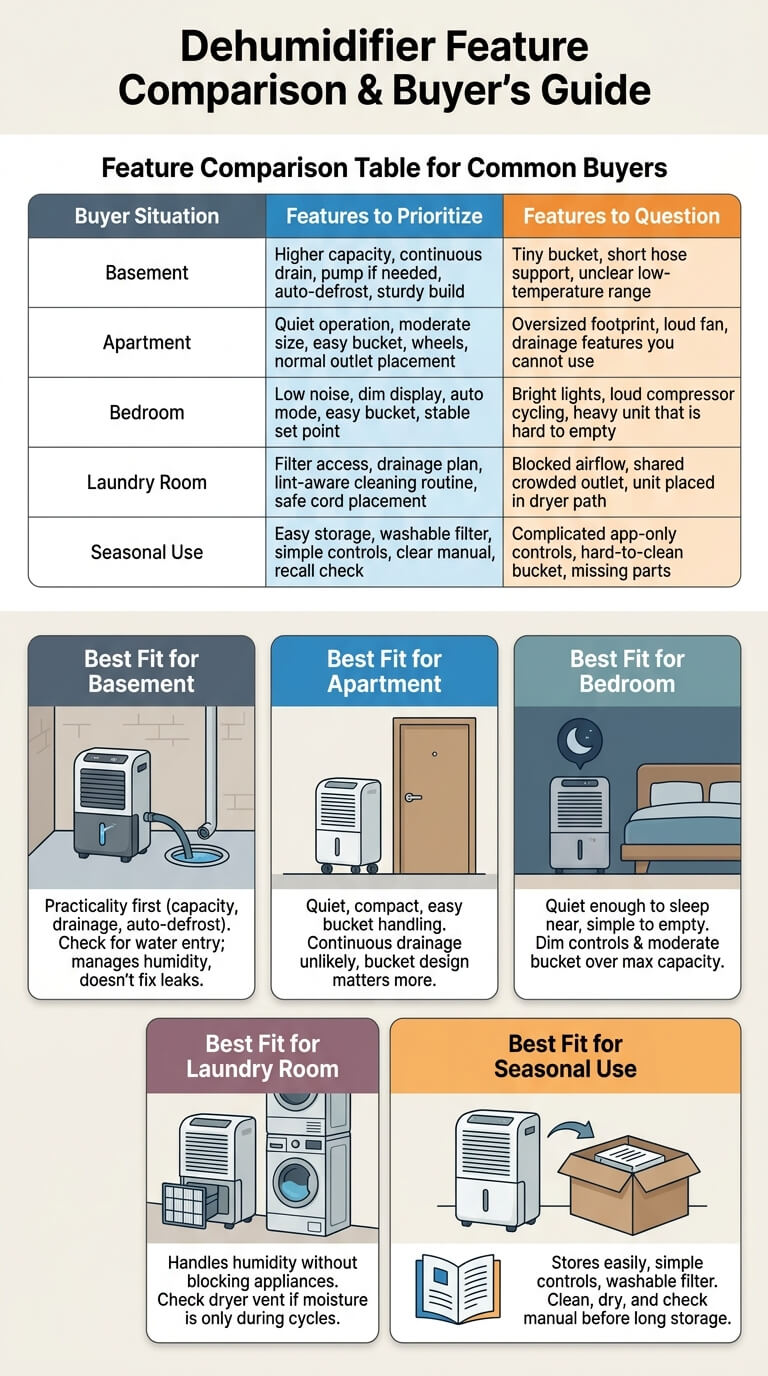
Different homes need different tradeoffs. Use the table below to narrow the feature list before comparing specific models.
| Buyer situation | Features to prioritize | Features to question |
|---|---|---|
| Basement | Higher capacity, continuous drain, pump if needed, auto-defrost, sturdy build | Tiny bucket, short hose support, unclear low-temperature range |
| Apartment | Quiet operation, moderate size, easy bucket, wheels, normal outlet placement | Oversized footprint, loud fan, drainage features you cannot use |
| Bedroom | Low noise, dim display, auto mode, easy bucket, stable set point | Bright lights, loud compressor cycling, heavy unit that is hard to empty |
| Laundry room | Filter access, drainage plan, lint-aware cleaning routine, safe cord placement | Blocked airflow, shared crowded outlet, unit placed in dryer path |
| Seasonal use | Easy storage, washable filter, simple controls, clear manual, recall check | Complicated app-only controls, hard-to-clean bucket, missing parts |
Best fit for basement
Basements usually need the most practical machine, not the prettiest one. Prioritize capacity, drainage, auto-defrost, easy filter access, and a stable place near an approved drain or outlet. Check for water entry first. A dehumidifier can manage humidity, but it should not be asked to compensate for a leak that keeps returning after rain.
Best fit for apartment
Apartment shoppers often need quiet operation, easy bucket handling, and a compact footprint. Continuous drainage may not be possible, so bucket design matters more. Look for wheels, a handle, normal plug placement, and a unit that can fit without blocking doors, closets, or shared walkways.
Best fit for bedroom
A bedroom model should be quiet enough to sleep near and simple enough to empty in the morning. Dim controls, auto mode, and a moderate bucket can matter more than maximum capacity. Place it where airflow is clear but not blowing directly at the bed if that bothers you.
Best fit for laundry room
A laundry room dehumidifier should handle humidity without fighting the dryer, washer, doors, hampers, or lint. Keep the filter easy to reach and check the room for dryer vent issues if moisture appears only during drying cycles. Do not let the dehumidifier block appliance service access.
Best fit for occasional seasonal use
Seasonal users need a model that stores easily and restarts without confusion. Simple controls, a washable filter, a bucket that dries fully, and a manual you can find next year are more important than advanced features. Before storing the unit, clean it, dry the bucket, and check the manufacturer instructions.
Buying Mistakes to Avoid
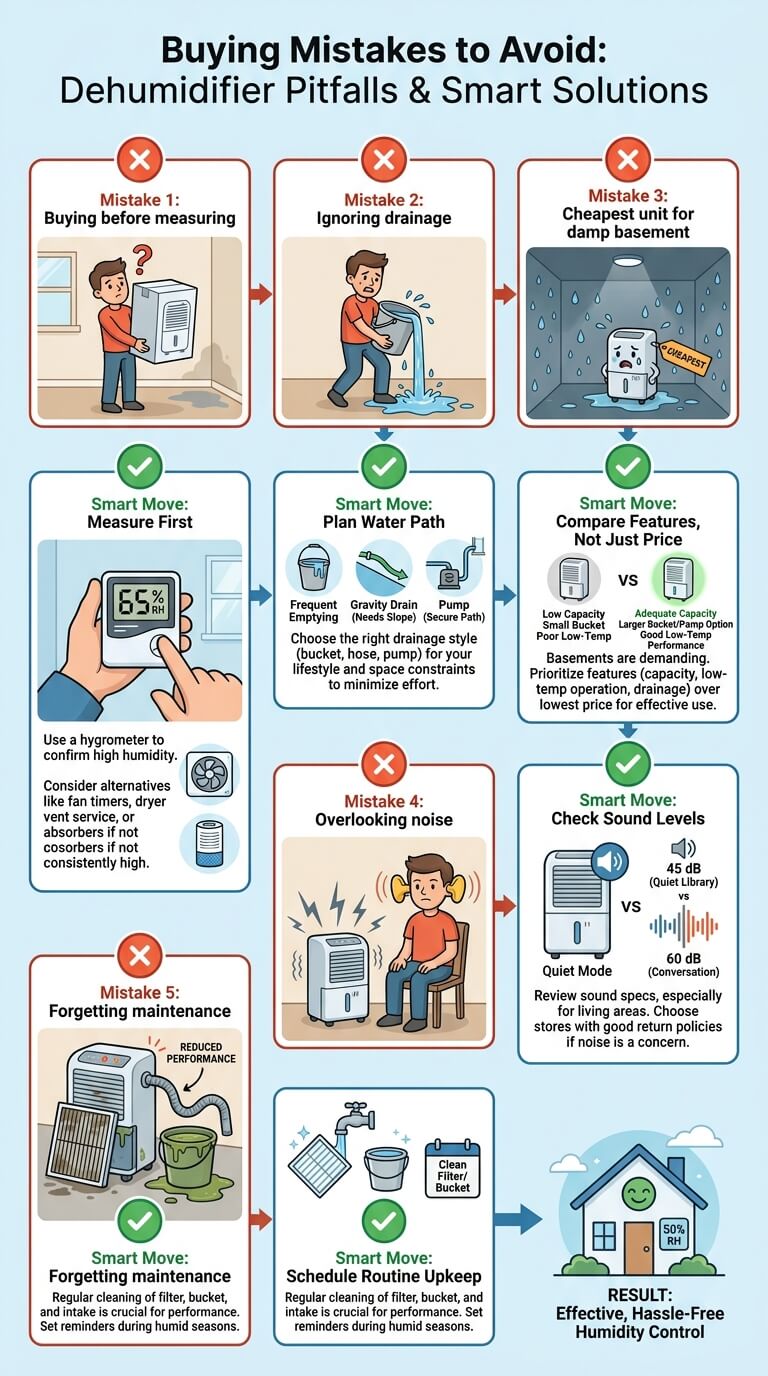
Most bad dehumidifier purchases come from skipping one practical detail. The unit may be the wrong capacity, the wrong drainage style, too loud, too hard to maintain, or placed in a room where repair should have come first.
Buying before measuring
A hygrometer can prevent an expensive guess. Measure first unless the room has obvious water damage that needs repair. If humidity is not consistently high, the better purchase may be a bathroom fan timer, dryer vent service, storage change, or closet absorber.
Ignoring drainage
Drainage decides how much work the dehumidifier adds to your life. A bucket-only unit in a damp basement may stop frequently. A hose without enough slope may not drain. A pump without a secure hose path may create its own mess. Confirm the water path before checkout.
Picking the cheapest unit for a damp basement
Basements can be demanding. A very cheap unit may have limited capacity, a small bucket, weak low-temperature performance, or fewer drainage options. That does not mean you need the most expensive model, but you should compare the features that affect daily use.
Overlooking noise
Noise becomes obvious after the first night or workday. If the unit will be near people, compare sound details carefully. Choose a store with a reasonable return policy if sound sensitivity is a concern.
Forgetting filter and bucket maintenance
Maintenance is not optional. A dirty filter, slimy bucket, kinked hose, or blocked intake can reduce performance and make the unit unpleasant to use. Check cleaning steps before buying and set a reminder during humid seasons.
FAQ
These answers cover the final buying details that often decide whether a dehumidifier feels useful after the first week.
Is a dehumidifier with a pump worth it?
A pump is worth considering when the unit needs to drain upward to a sink, utility tub, or higher drain. It is especially useful in basements without a floor drain. It may not be worth the added cost if you can use a gravity drain or if the unit will sit in a bedroom where bucket emptying is easy.
Should I choose a smart dehumidifier?
Smart controls can be helpful when the unit is in a basement, rental property, or area you do not check daily. Alerts and remote settings are convenient, but they should not replace basic buying criteria. Capacity, drainage, noise, safe placement, and cleaning access matter more than app features.
Is a larger dehumidifier always better?
Not always. A larger unit can help in a damp or open space, but it may be louder, heavier, more expensive, and harder to fit in a small room. Choose a capacity that matches the room and dampness level, then compare drainage and daily living details.
How important is ENERGY STAR?
It matters most when the dehumidifier will run often. A more efficient model can be a better long-term choice in a humid basement or laundry area. Efficiency should be compared with capacity and setup because an efficient unit still needs clear airflow and the right drainage plan.
What features matter most for a bedroom dehumidifier?
Noise, dim controls, bucket handling, auto mode, and a stable humidity setting matter most in a bedroom. A bedroom unit should be easy to live with at night, not just powerful on paper. Check the return policy if you are sensitive to fan or compressor sound.
Final Thoughts
The right dehumidifier is the one that fits the room, the moisture pattern, and your daily routine. Measure first, check for repair problems, choose a sensible capacity, and decide how the water will drain before comparing extra features. After that, weigh energy use, sound, controls, filter access, bucket design, and warranty details.

Ethan Carter is the Founder & Editor of HomeCleanSecrets. Based in the United States, he has 5 years of experience creating practical home cleaning, laundry care, stain removal, decluttering, and home organization content. His goal is to help everyday households clean smarter and build simple routines that are easier to maintain.
Read more about Ethan Carter on his author page: https://homecleansecrets.com/ethan-carter/