

Keeping clothes organized is less about doing one perfect closet makeover and more about stopping the small pile-ups before they become a weekend project. Clean laundry sits in baskets, worn shirts land on a chair, shoes drift across the closet floor, and drawers get packed until they will not close. None of that means your original system failed. It usually means the system does not have a simple maintenance routine.
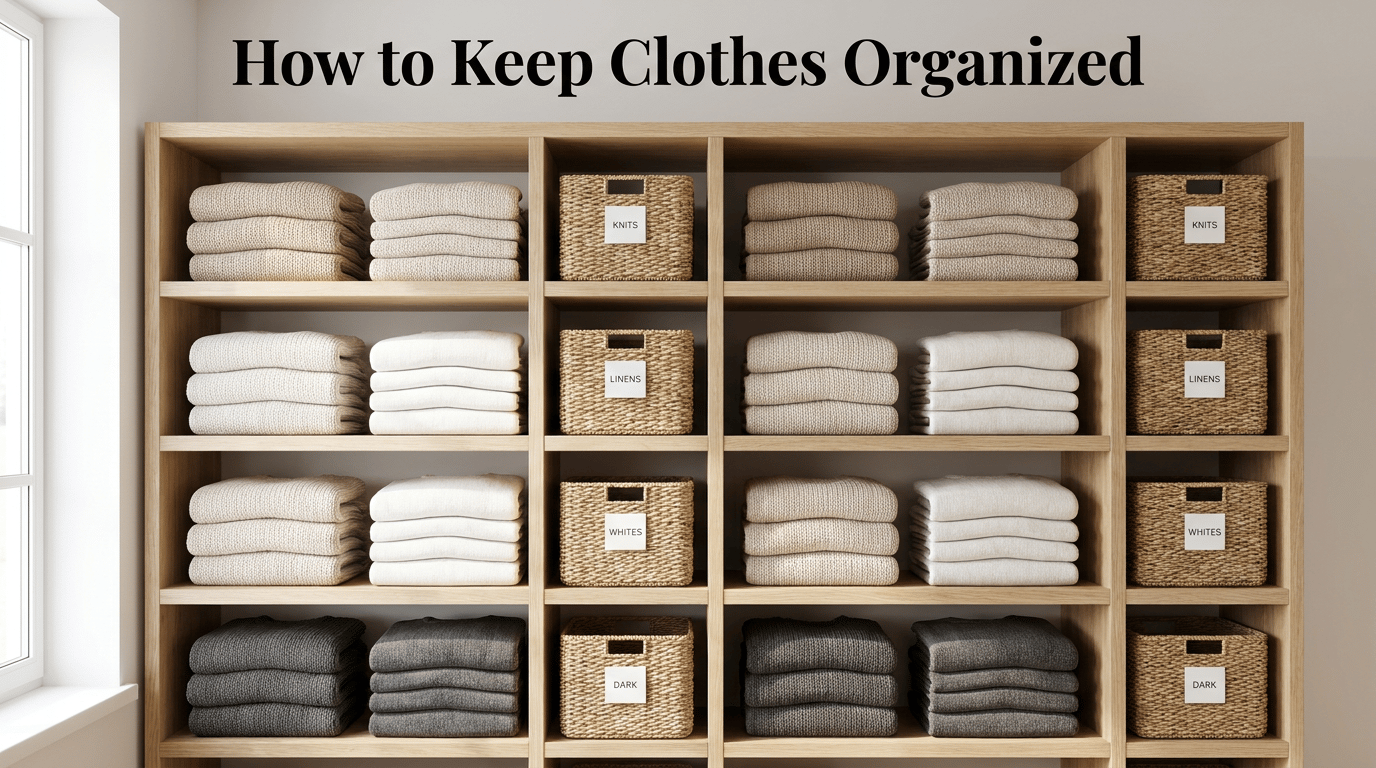
This guide focuses on what happens after the closet, dresser, shoe zone, and seasonal storage are already set up. You will build a repeatable clothing reset that fits real life: laundry days, busy mornings, shared closets, small spaces, kids clothes, and items that are worn once but not ready for the hamper. The goal is not a picture-perfect closet every day. The goal is a closet and dresser that recover quickly.
One reason clothes become messy again is that too many off-season items stay in the daily rotation. store seasonal clothes separately so your closet only holds what you actually use now.
A good clothing system gives every item a clear next step. Clean clothes go all the way back to their home. Worn-but-not-dirty clothes get one controlled holding spot. Off-season items leave the daily zone before they crowd current clothes. When something no longer fits, works, or gets worn, it moves to a decision point instead of returning to the drawer by habit.
Quick Answer: The Clothing Maintenance System
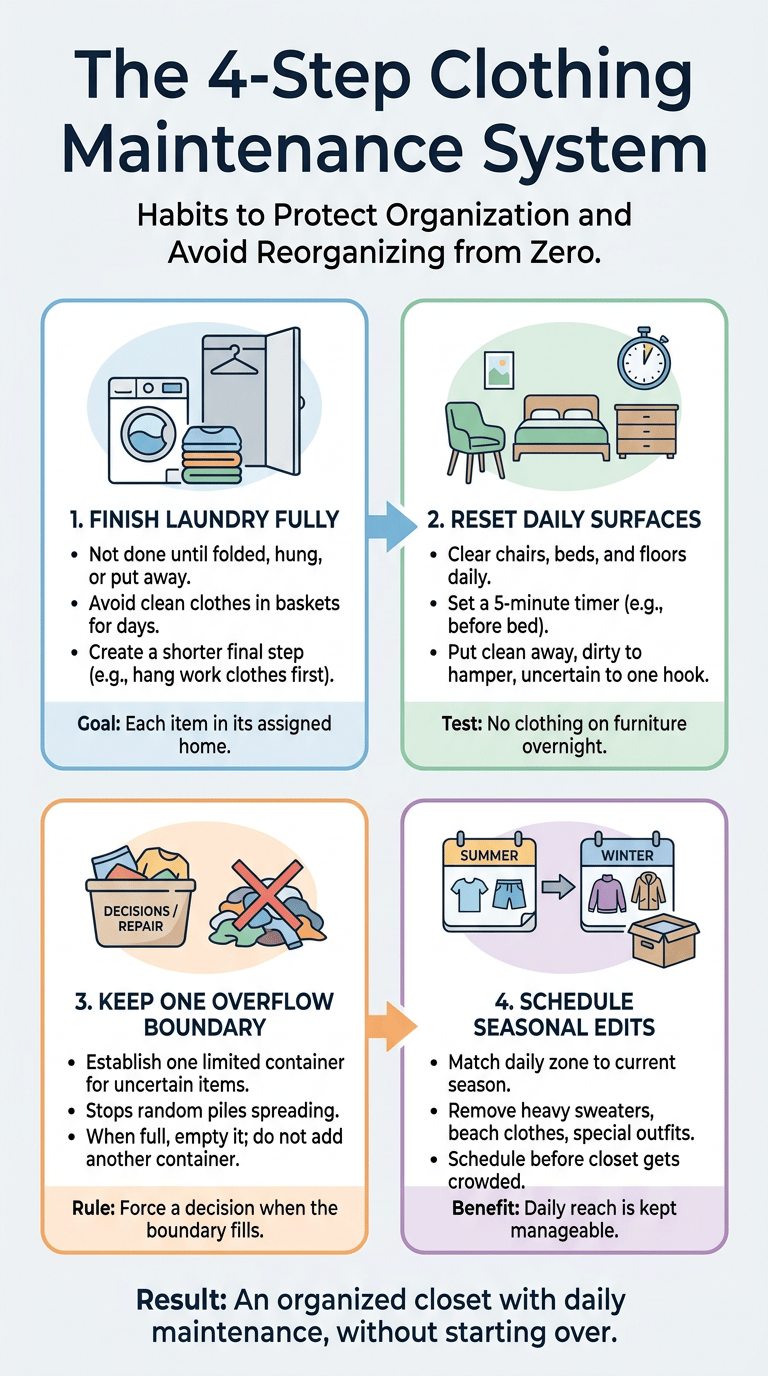
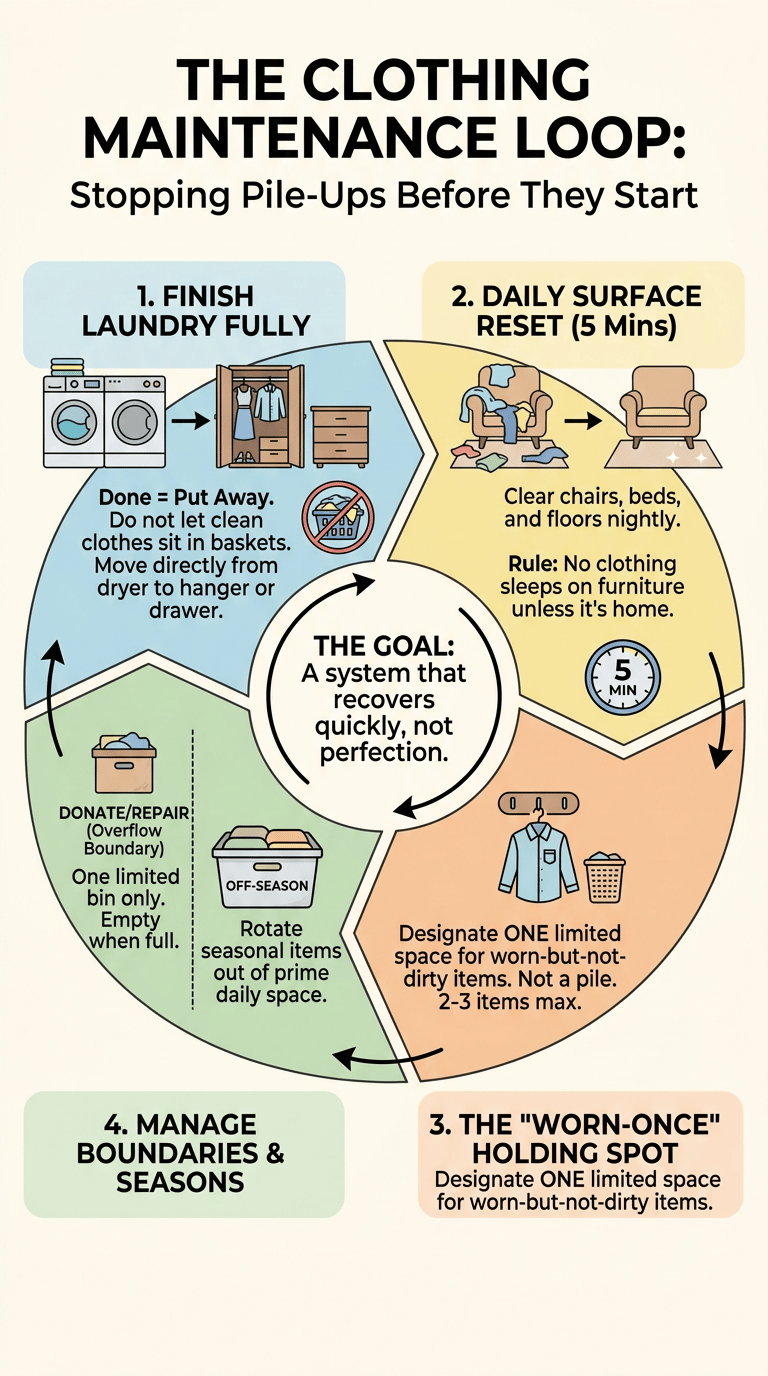
The fastest way to keep clothes organized is to finish laundry fully, reset visible surfaces daily, keep one overflow boundary, and review seasonal items before the closet gets crowded. These four habits protect the work you already did without forcing you to reorganize everything from zero.
Finish laundry fully
Laundry is not finished when clothes are dry. It is finished when each item is folded, hung, placed in the right drawer, or moved to repair, donation, or storage. If clean clothes regularly sit in baskets for days, create a shorter final step: hang work clothes first, put underwear and socks away second, then fold the rest before starting another load. The American Cleaning Institute laundry basics are a helpful reminder to sort and follow care labels before washing and drying clothing.
reset daily surfaces
Chairs, bed corners, dressers, and closet floors become clothing storage when they are not cleared quickly. Give yourself a five-minute surface reset at the same point each day, such as before bed or right after changing clothes. Put clean items away, send dirty items to the hamper, and move uncertain items to one holding hook or basket. The test is simple: no clothing should sleep on furniture overnight unless that furniture is its assigned home.
keep one overflow boundary
Every home needs one honest overflow boundary. It can be a small donation bag, one repair bin, or one basket for clothes that need a decision. The boundary matters because it stops random piles from spreading across the room. When that container is full, do not add another container. Empty it, decide on the items inside, and then return the container to its normal size.
schedule seasonal edits
Clothes stay easier to manage when the daily zone matches the current season. Heavy sweaters, beach clothes, extra coats, and special-event outfits should not compete with the clothes you wear this week. Schedule a seasonal edit before weather changes fully, not after the closet is already packed. Pull out what does not belong in daily reach, check care tags, and store only items that are clean and dry.
Why Clothes Get Messy Again
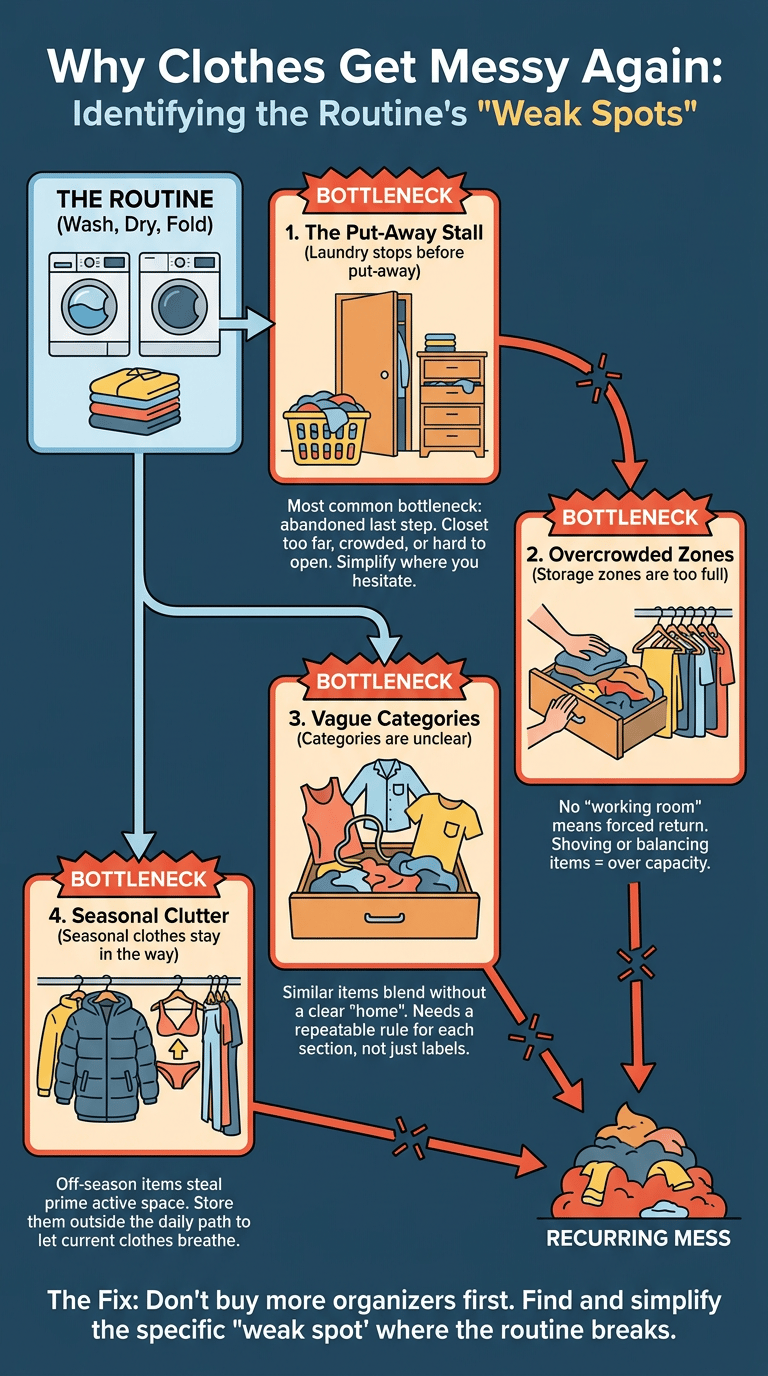
Recurring clothing mess usually has a practical cause. Before buying new hangers, bins, or drawer dividers, look for the point where the routine breaks. Most homes have one or two weak spots, not a broken closet from top to bottom.
Laundry stops before put-away
The most common bottleneck is the last ten minutes of laundry. Clothes may be washed correctly, dried fully, and folded neatly, then abandoned in baskets because the closet or dresser is too far away, too crowded, or too hard to open. A good test is to watch one load from dryer to drawer. The step where you hesitate is the step to simplify.
storage zones are too full
A drawer that is packed to the top will not stay neat. A closet rod with no sliding space makes every hanger movement annoying. Leave working room in each zone so clothes can return without force. If you have to press down a stack, shove hangers sideways, or balance folded items on top, the category is over capacity.
A small closet is harder to maintain because there is less room for error. If space is the main problem, organize a small closet before adding more daily rules.
categories are unclear
Clothes get messy when similar items do not have a clear home. Workout tops, sleep shirts, casual T-shirts, and layering tanks can blend into one pile if the drawer has no category rule. The fix does not need labels everywhere. It needs a repeatable decision: this drawer is for daily tops, this section is for workout clothes, and this hook is only for tomorrow’s outfit.
seasonal clothes stay in the way
Off-season clothing quietly steals prime space. If winter coats, heavy sweaters, or summer swimwear remain in the active zone all year, current clothes have less room to breathe. Store seasonal pieces outside the daily path when possible. Before storage, make sure clothing is clean, completely dry, and safe for the container you plan to use.
Build a Simple Daily Clothing Reset
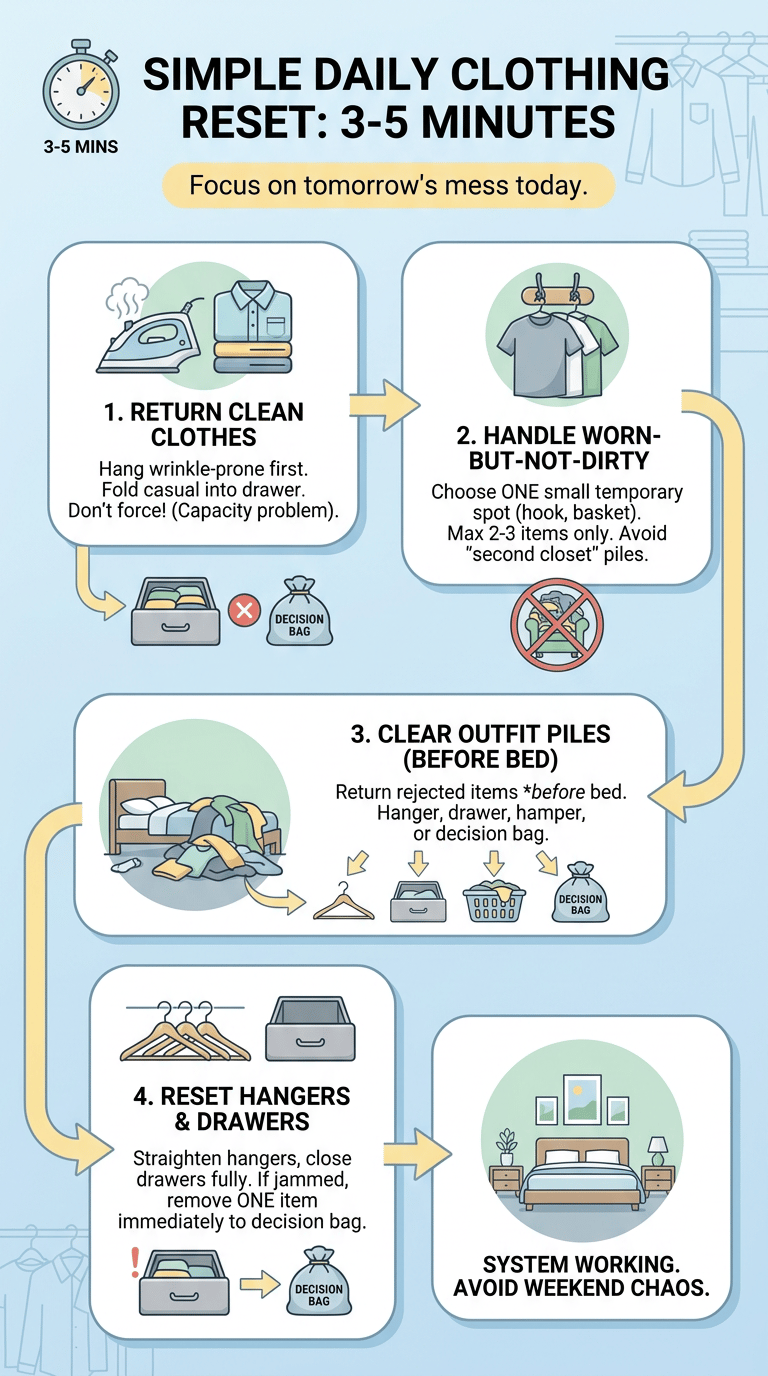
A daily reset should be short enough that you will actually do it. Ten minutes is too long for many evenings. Start with three to five minutes and focus on the items most likely to become tomorrow’s mess.
Return clean clothes
Clean clothes should move to their final homes before another load starts. Hang wrinkle-prone pieces first because they punish delay. Put small items away next because they are easy to scatter. Then fold casual clothing into the correct drawer. If a piece no longer fits the drawer, do not force it back. That is a capacity problem, not a folding problem.
handle worn-but-not-dirty clothes
Clothes worn once need a rule or they become a chair pile. Choose one temporary place, such as a wall hook, valet rod, narrow basket, or back-of-door hook. Keep it small enough for two or three items. If the spot holds a full week’s clothing, it has become a second closet and needs to be cleared.
clear outfit piles
Morning outfit changes create piles because rejected clothes feel too clean for the hamper but too annoying to rehang. Put rejected items back before leaving the room, even if the outfit decision made you late. If that is unrealistic, give yourself one evening reset rule: every try-on item returns to a hanger, drawer, hamper, or decision bag before bed.
reset hangers and drawers
Straighten hangers in one direction and close each drawer fully. These small checks show whether the system is still working. If hangers are jammed or a drawer will not shut without pressure, remove one item immediately and place it in the decision bag. Waiting until the weekend often turns one bad drawer into three messy zones.
Weekly Routine to Keep Closets and Drawers Neat
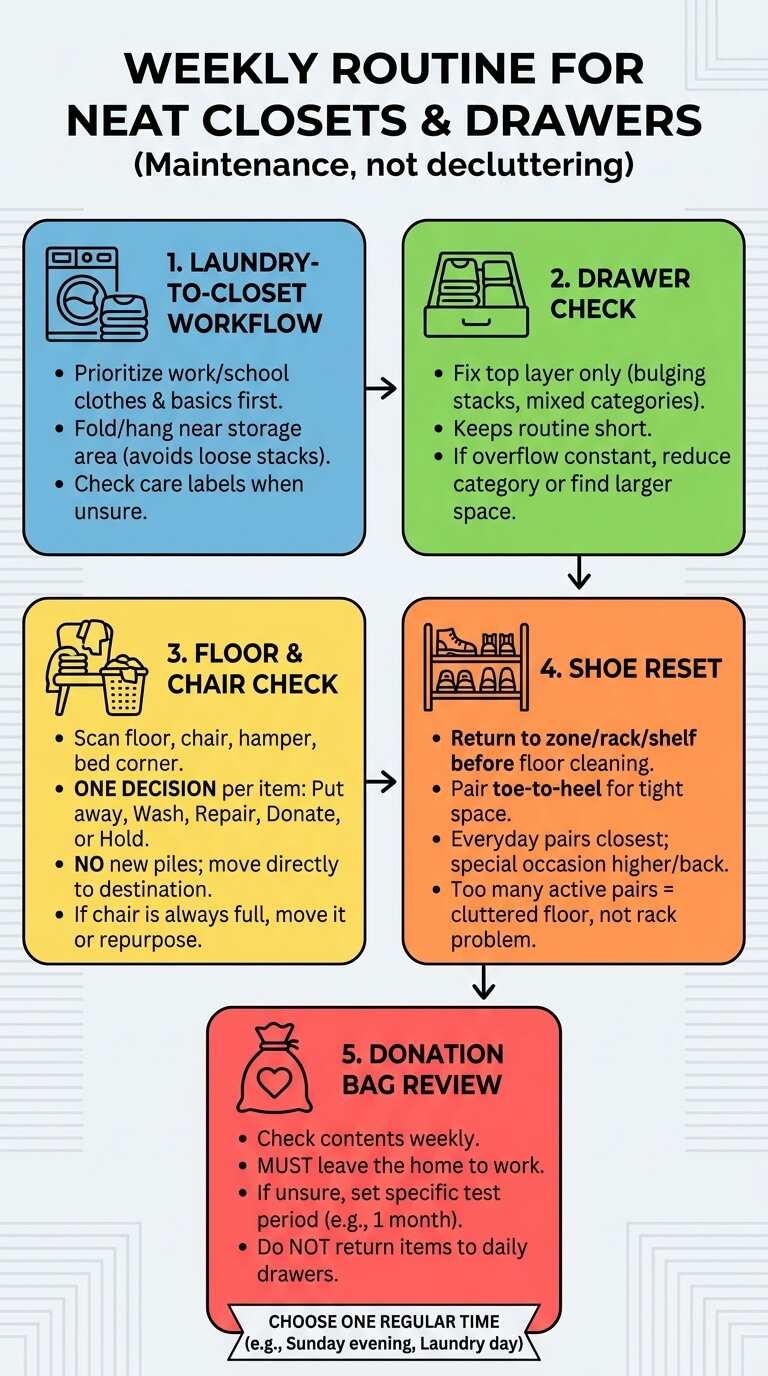
A weekly routine catches what the daily reset misses. Choose one regular time, such as Sunday evening, laundry day, or the morning before trash pickup. The whole routine should feel like maintenance, not a full decluttering session.
Laundry-to-closet workflow
Move laundry in the order clothes are used. Work clothes, school clothes, uniforms, and everyday basics get priority because they affect the next week. Fold or hang near the storage area instead of folding everything in a separate room and carrying loose stacks through the house. Check garment care labels when you are unsure about washing, drying, or ironing limits; the FTC care labeling rule explains why textile products carry care instructions.
drawer check
Open each daily drawer and look for bulging stacks, mixed categories, or items folded in the wrong direction. Fix only the top layer unless a drawer is truly failing. This keeps the routine short. If socks, underwear, pajamas, or T-shirts are constantly overflowing, reduce that category or give it a larger home instead of refolding the same cramped drawer every week.
floor and chair check
Scan the closet floor, bedroom chair, hamper area, and bed corner. Each item gets one decision: put away, wash, repair, donate, or hold briefly for rewear. Do not make a new pile while deciding. Put the item directly where it belongs. If the chair is always full, move it away from the dressing area or assign it a non-clothing purpose.
shoe reset
Return shoes to their closet zone, rack, cubby, or shelf before cleaning the floor. Pair them toe-to-heel if space is tight. Put special-occasion shoes higher or farther back and keep everyday pairs closest to the door or dressing spot. If shoes keep covering the closet floor, the problem may be too many active pairs, not the rack itself.
donation bag review
A donation bag works only if it leaves the home. Once a week, check what is inside. If you are truly not ready to let an item go, give it a specific test period, such as one more month or one more event. If you would not choose it again, keep the bag moving. Do not let donation items return to daily drawers by default.
Monthly Clothing Organization Checkpoints
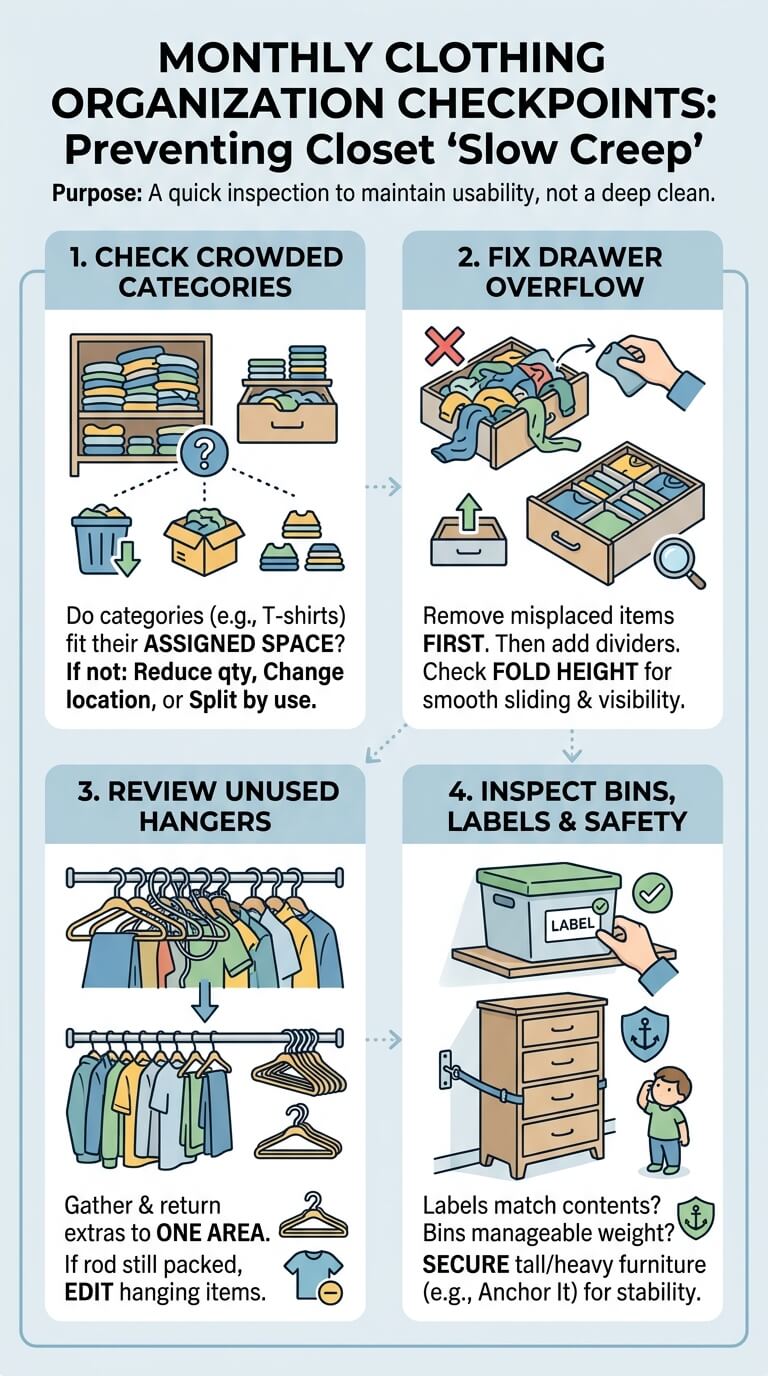
A monthly checkpoint protects the closet from slow creep. It is not a deep clean. It is a short inspection of capacity, labels, hangers, bins, and categories that keep the system usable.
Check crowded categories
Look at the categories that grow without warning: T-shirts, leggings, socks, workout clothes, kids basics, and seasonal layers. Count only if it helps. The better question is whether the category still fits its assigned space. When a category no longer fits, choose between reducing the quantity, changing the storage location, or splitting it by use.
fix drawer overflow
Overflow is a warning that the drawer is being asked to hold too much or the wrong mix. Remove items that belong elsewhere before adding dividers. Then check fold height. Clothes should slide in and out without catching. If you cannot see what is inside, adjust the fold style or reduce duplicates.
review unused hangers
Empty hangers are helpful only when they are collected and returned to the same area. Scattered hangers make the closet feel messier and slow down laundry put-away. Gather extras once a month. If the rod is still packed even after collecting empty hangers, the hanging category needs an edit.
inspect storage bins and labels
Bins should make clothes easier to retrieve, not harder. Check that labels still match the contents and that bins are not too heavy for their shelf. Tall or heavy storage furniture should be stable, especially in homes with children. The CPSC Anchor It guidance explains why securing tip-prone furniture can matter around dressers, shelves, and storage pieces.
Seasonal Maintenance That Prevents Closet Overload
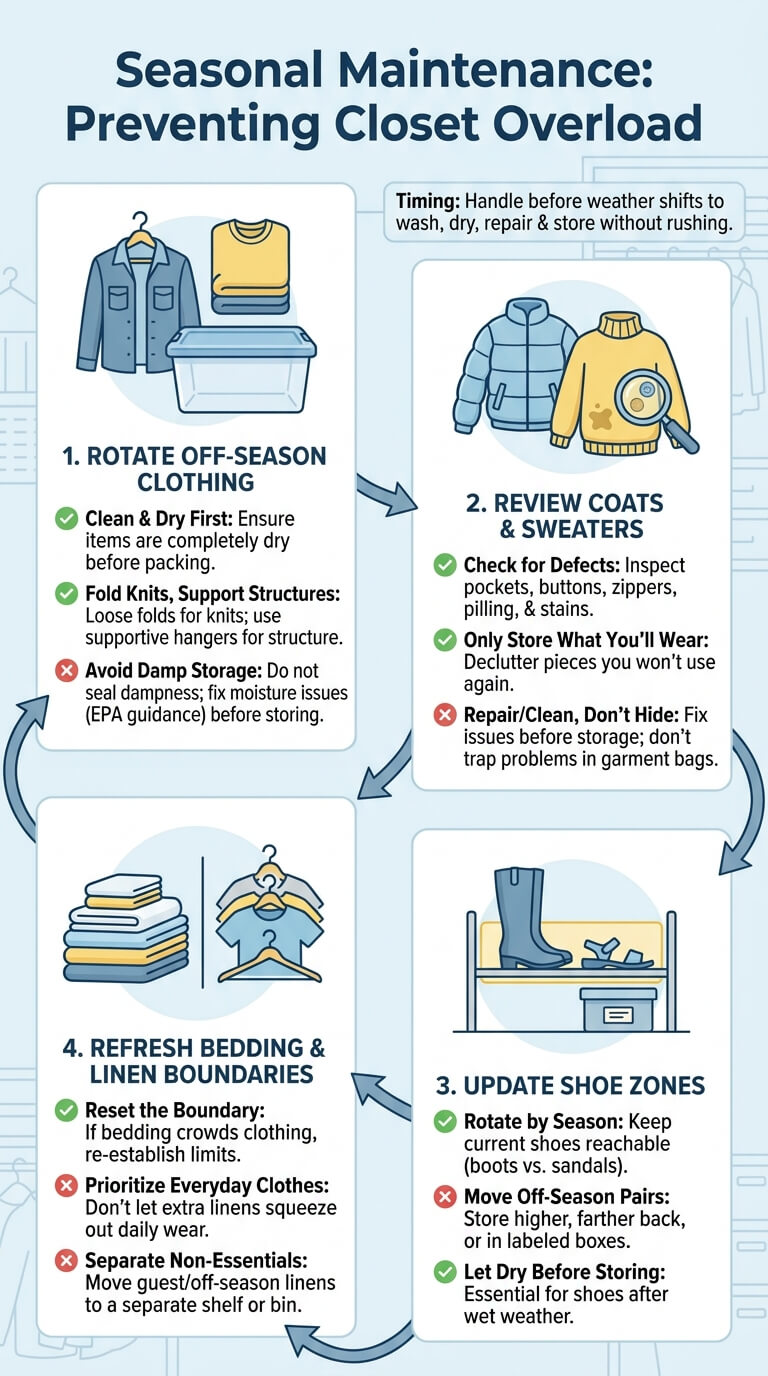
Seasonal maintenance keeps the closet from holding four wardrobes at once. Handle it before the weather has fully shifted, when you still have time to wash, dry, repair, and store items without rushing.
Rotate off-season clothing
Move off-season clothing out of prime space after it is clean and dry. Fold knits loosely, hang structured pieces only if the hanger supports them, and avoid sealing anything damp in a bin. If a storage area smells damp or has visible moisture issues, solve that first. EPA’s mold and moisture guide emphasizes controlling moisture as part of preventing indoor mold problems.
review coats and sweaters
Coats and sweaters take more room than most daily clothing, so review them before storage. Check pockets, buttons, zippers, pilling, and stains. Store only pieces you plan to wear again. If a coat needs cleaning or repair, do not hide that problem in a garment bag. Put it in the repair or cleaning path before it leaves the active closet.
update shoe zones
Shoes should rotate with the season too. Boots, sandals, rain shoes, and dress shoes do not all need the same access level every month. Keep current shoes reachable and move off-season pairs higher, farther back, or into labeled boxes. Let shoes dry before storing, especially after wet weather.
refresh bedding and linen boundaries when needed
Clothing storage often shares space with sheets, towels, and blankets. If bedding begins crowding the closet, reset the boundary. Everyday clothes should not be squeezed out by extra linens. Move guest bedding, blankets, or off-season linens to a separate shelf or bin if they are not part of the weekly clothing routine.
Systems for Different People and Homes
The best maintenance routine depends on space, schedule, and who uses the storage. Keep the same basic rules, but adjust the timing and boundaries so the system fits the home instead of fighting it.
If your clothes never stay neat for long, the issue may be the storage system, not your habits. Start with the closet organization and clothing storage guide if you need to rebuild the setup from the beginning.
Small closet routine
A small closet needs more frequent resets because it has less buffer space. Keep only current-season, frequently worn clothes in the easiest reach. Review hangers weekly and remove anything that does not belong in daily rotation. One crowded rod can undo the whole system, so protect sliding space more aggressively than you would in a large closet.
dresser-heavy routine
When most clothing lives in drawers, the weekly drawer check matters more than the closet rod. Keep categories narrow: one drawer for workout clothes, one for sleepwear, one for daily tops, and one for undergarments if space allows. Fold height should match drawer depth. If stacks spring upward when opened, remove duplicates before buying dividers.
shared closet routine
A shared closet needs clear zones by person and clothing type. Decide which shelves, rods, hooks, and drawers belong to each person. Shared overflow zones should be limited, not open-ended. If one person does laundry more often, set a shared put-away time so clean clothes do not sit in baskets waiting for someone else to sort them.
kids clothes routine
Kids clothing changes quickly because of growth, school needs, sports, weather, and laundry volume. Keep an outgrown bin nearby and review it weekly. Store the current size in the easiest drawers. Labeling by picture or simple category can help younger children return items, but the system should not require perfect folding to stay functional.
no-laundry-room routine
Homes without a laundry room need a stronger carrying system. Keep one clean laundry basket and one dirty hamper, not several mystery baskets. Fold at the bed, sofa, or table only if you can put clothes away immediately afterward. If laundry must travel from a shared laundry area, unpack it the same day so baskets do not become permanent storage.
Mistakes That Break Clothing Organization
Most clothing systems fail because maintenance is too hard, not because the original plan was wrong. These mistakes are small at first, but they make the closet slower to use every week.
Starting over instead of resetting
Starting over feels productive, but it can hide the real problem. If the same mess returns after every full reorganization, look at the routine. Which step fails first: laundry put-away, worn clothes, shoes, seasonal rotation, or drawer capacity? Fix that step before emptying the entire closet again.
saving every maybe item
Maybe items are clothing pieces you do not wear, do not love, or do not know how to style, but still keep just in case. A few maybes are normal. A closet full of maybes blocks daily clothes. Give them a deadline or a test outfit. If they still do not earn space, move them out of the active zone.
adding organizers to a full system
New organizers cannot solve an overloaded category by themselves. A drawer divider may separate socks, but it will not make fifty pairs fit comfortably in a drawer designed for twenty. Add containers only after editing the category and confirming the storage spot is the right size.
ignoring the laundry bottleneck
If laundry is the weak point, no closet system will stay tidy for long. Watch how clothes move from hamper to washer, dryer, folding surface, and storage. USU Extension’s laundry guidance gives practical timing context for items like pajamas, jeans, sweaters, and bedding, which can help you decide what needs washing now and what can be handled later.
Troubleshooting Common Clothing Pile Problems
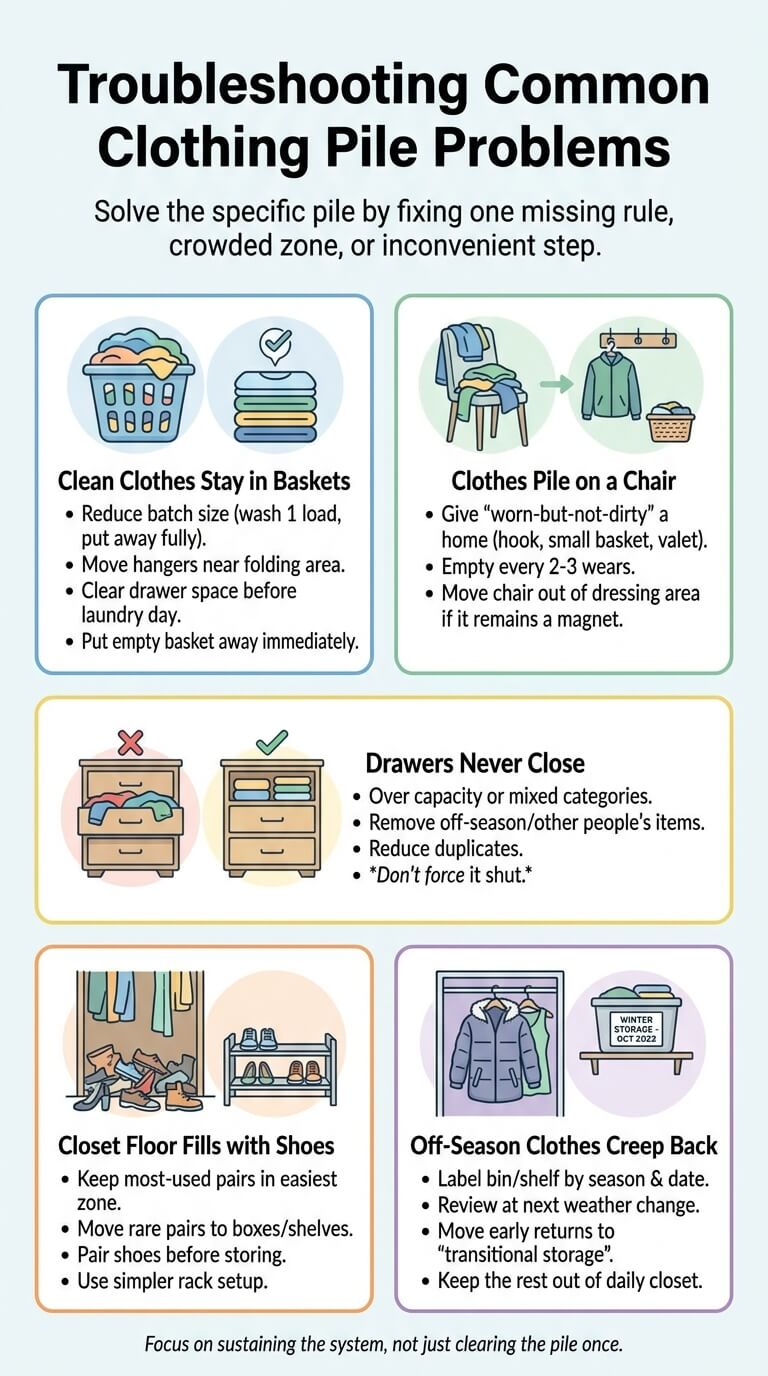
When clothing piles return, solve the specific pile instead of blaming the whole system. Each recurring pile usually points to one missing rule, one crowded zone, or one inconvenient step.
Clean clothes stay in baskets
If baskets hold clean clothes for days, reduce the batch size. Wash one load you can put away fully instead of three loads that stall after drying. Move hangers near the folding area, clear drawer space before laundry day, and put the basket away when it is empty so it does not invite the next clean pile.
Many clothing piles start because drawers are too full or too confusing. If that is the issue, organize dresser drawers so clean laundry has an obvious place to go.
clothes pile on a chair
A chair pile usually means worn-but-not-dirty clothes need a home. Replace the chair habit with one hook, one small basket, or one valet spot. Empty it every two or three wears, or sooner if the clothing is dirty. If the chair remains a magnet, move it out of the dressing area.
drawers never close
Drawers that never close are not failing because of imperfect folding. They are over capacity or holding mixed categories. Remove anything that belongs to another season, another person, or another storage zone. Then reduce duplicates. Stop if the drawer front, track, or dresser frame seems strained, and avoid forcing it shut.
closet floor fills with shoes
A shoe-covered floor usually needs fewer active pairs, not more floor space. Keep the pairs you wear most often in the easiest zone and move rare pairs to boxes, shelves, or a higher area. Pair shoes before storing them. If the rack is hard to use, choose a simpler setup with fewer motions.
off-season clothes creep back in
Off-season clothes return when the storage boundary is vague. Label the bin or shelf by season and date, then review it at the next weather change. If you keep pulling one item back early, that item may belong in transitional storage. The rest should stay out of the daily closet until the season changes.
FAQ
These answers address the maintenance problems people usually face after the first organizing session is finished.
How do I keep clothes organized after laundry?
Finish the load completely before starting the next one. Hang wrinkle-prone clothing first, put small items away second, and fold casual clothes directly into their assigned drawers. If put-away always stalls, make loads smaller and clear drawer space before laundry day.
How often should I reset my closet?
Do a tiny reset daily and a more complete reset weekly. The daily reset clears surfaces, chairs, and try-on piles. The weekly reset checks laundry, drawers, shoes, and the donation bag. Seasonal clothing should be reviewed a few times a year, usually before major weather changes.
What should I do with clothes worn once?
Give worn-once clothes one limited holding spot, such as a hook or small basket. Do not mix them with clean folded clothes, and do not let the spot grow into a second closet. Rewear, wash, or put the item away within a few days depending on fabric, use, and care label guidance.
How do I stop clothes from piling on a chair?
Remove the chair from the dressing path or assign a smaller replacement, such as one hook. Then set a nightly rule: everything on that spot goes to the closet, drawer, hamper, repair bin, or donation bag. A chair pile survives because it has no deadline.
How do I maintain clothing organization in a small space?
Small spaces need stricter active zones. Keep current-season clothes easiest to reach, limit duplicates, and review crowded categories weekly. Store off-season pieces elsewhere when possible. If a drawer or rod is full, reduce the category before adding another organizer.
Final Thoughts
Organized clothes stay organized when the maintenance routine is easier than making a pile. Finish laundry all the way, reset visible surfaces, give uncertain items one boundary, and keep seasonal clothing from crowding the daily zone. When mess returns, look for the exact step that failed instead of starting over. A closet that can recover in five minutes is more useful than one that looks perfect only after a full weekend reset.
If the closet floor gets messy first, the problem may be footwear rather than clothing. A simple plan to organize shoes in a closet can make the whole space easier to maintain.

Ethan Carter is the Founder & Editor of HomeCleanSecrets. Based in the United States, he has 5 years of experience creating practical home cleaning, laundry care, stain removal, decluttering, and home organization content. His goal is to help everyday households clean smarter and build simple routines that are easier to maintain.
Read more about Ethan Carter on his author page: https://homecleansecrets.com/ethan-carter/