
A good laundry room does not need to look like a showroom. It needs to help dirty laundry move in, clean laundry move out, and supplies stay easy to reach without taking over the room. This laundry room organization guide gives you a framework for planning that system before you start buying bins, labels, shelves, or hampers.
The goal is not to create a perfect room that only works on a quiet day. The goal is to create a room that still works when the week is busy, baskets are full, someone forgets a load, and you have only a few minutes to reset the space. Start with flow, then storage, then maintenance. That order prevents the most common mistake: making a laundry room prettier while leaving the same traffic jams underneath.

Quick Overview: What a Good Laundry Room System Should Do
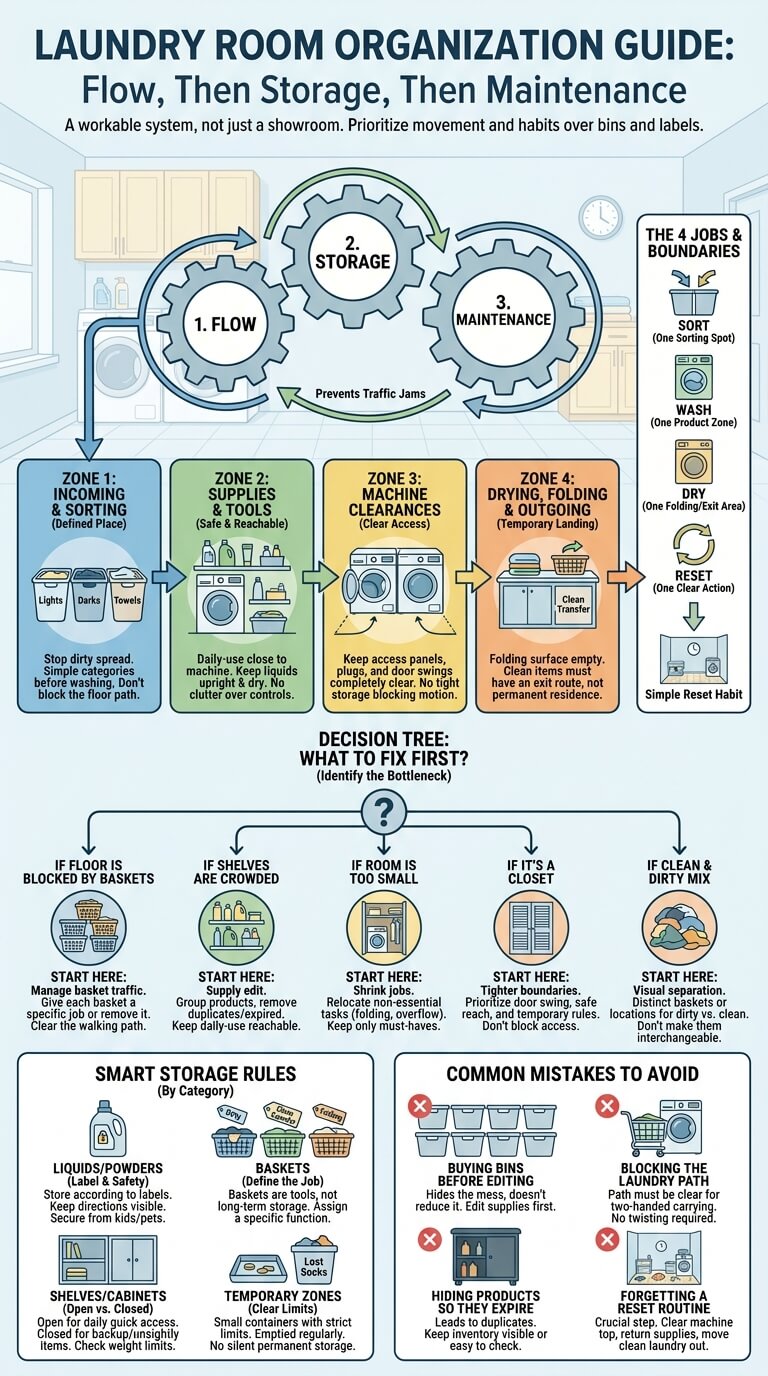
A workable laundry room system should make each step obvious. Dirty items need a place to wait. Supplies need a safe and reachable home. Clean laundry needs a temporary landing area that does not become permanent storage. The room also needs a simple reset habit, because laundry is not a one-time project.
The four jobs of a laundry room: sort, wash, dry, and reset
Most laundry rooms fail when one of these jobs has no assigned space. Sorting may happen on the floor. Products may spread across the machine top. Clean items may sit in baskets for days. The reset step may be skipped entirely, which means every load leaves a little more clutter behind. A strong system gives each job a visible boundary: one sorting spot, one product zone, one drying or folding area, and one clear action that returns the room to ready.
What this guide covers and what belongs in deeper guides
This guide stays at the planning level. It helps you decide which part of your laundry area is causing the most trouble and which category needs attention first. It will touch on supplies, baskets, small rooms, closets, sorting, and upkeep, but it will not turn into a detailed product inventory, tiny-space layout plan, or maintenance checklist. Those deeper topics work better after the main room framework is clear.
Why Laundry Rooms Get Messy So Fast
Laundry rooms collect more than laundry. They often hold cleaning products, pet towels, sports gear, paper goods, spare hangers, lost socks, and items that someone plans to return to another room later. Because the room is already a work zone, clutter can feel normal until the floor path, machine top, or cabinet space stops functioning.
Supply creep, basket traffic, and unfinished loads
Supply creep happens when detergents, scent products, softeners, dryer sheets, stain tools, and backup bottles enter the room faster than they leave. Basket traffic adds another layer because baskets are large, mobile, and easy to abandon in the nearest open spot. Unfinished loads make the room feel even more crowded. A good test is to look at the floor before you move anything. If you cannot walk to the machines while holding a basket, the problem is not decor. It is traffic control.
Why a tidy shelf alone rarely fixes the workflow
A tidy shelf can help, but it does not fix a system where dirty laundry has no waiting zone or clean laundry has no exit plan. Shelves solve storage. They do not automatically solve timing, movement, or habits. Before adding more storage, check where items pause during the process. The pause points reveal the real problem: a basket with no parking spot, products stored too far from the washer, or a folding area that is covered before laundry even starts.
The Laundry Room Organization Framework
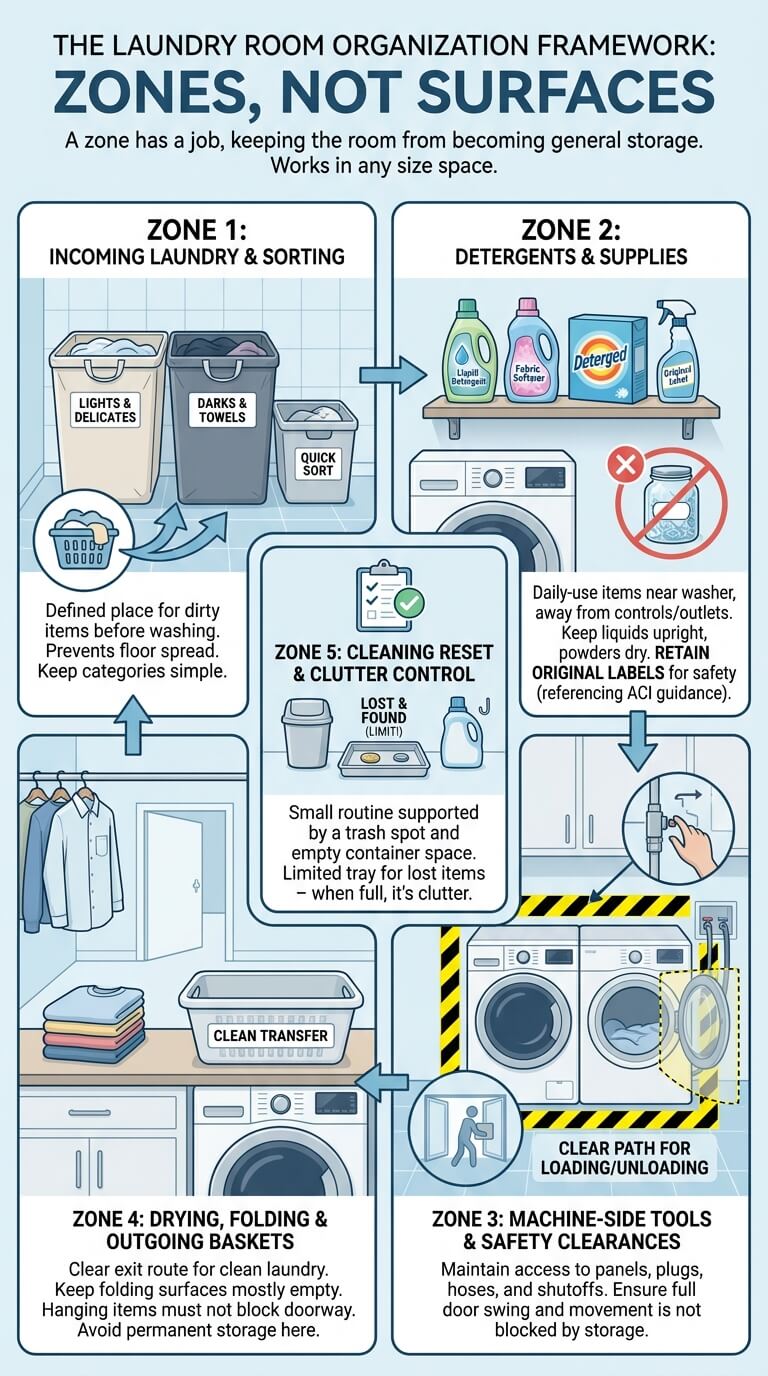
Think of the room in zones instead of surfaces. A surface can hold anything. A zone has a job. This keeps the room from becoming general storage and makes it easier for family members or roommates to return items correctly. The same framework works in a full room, a hallway laundry area, a closet, or a shared rental setup, although the size of each zone will change.
Zone 1: incoming laundry and sorting
Incoming laundry needs a defined place before it reaches the washer. In a larger room, that may be divided hampers or labeled bins. In a smaller room, it may be one hamper outside the laundry area and a short sorting step on laundry day. The key is to stop dirty items from spreading across the floor. If sorting always happens in a rush, keep the categories simple: lights, darks, towels, delicates, or whatever your household actually separates.
Zone 2: detergents and laundry supplies
Daily-use products should live close to the washer, but not where they can spill into controls, outlets, or walking paths. Store liquids upright, keep powders dry, and avoid decanting products into decorative containers unless the product label allows it and the container can be clearly identified. The American Cleaning Institute offers practical laundry product and fabric care guidance that can help readers understand why labels and product directions matter before changing how supplies are stored: American Cleaning Institute laundry basics.
Zone 3: machine-side tools and safety clearances
The machine-side zone includes the area around doors, knobs, hoses, outlets, shelves above the machines, and any narrow gap where tools tend to fall. Keep access panels, plug areas, and door swings clear. Do not build storage so tight that you have to move three bins to reach a shutoff, outlet, or manual. A practical check is to open the washer and dryer doors fully, then stand where you normally load and unload. Anything that blocks that motion needs a new home.
Zone 4: drying, folding, and outgoing baskets
Clean laundry needs an exit route. If the only folding surface is the machine top, keep that surface mostly empty. If folding happens elsewhere, the laundry room still needs a clean transfer basket that leaves the room quickly. Hanging items need a rod, hook, or door-safe solution that does not block the doorway. The mistake to avoid is creating a beautiful folding station that becomes the permanent home for clothes that should be returned to bedrooms, closets, or linen storage.
Zone 5: cleaning reset and clutter control
The reset zone is not a large area. It is a small routine supported by a trash spot, a place for empty containers, and a rule for items that do not belong. A small tray for lost buttons, stray coins, and items found in pockets can be useful, but it needs a limit. When the tray is full, it is not a tray anymore. It is clutter with a border.
Decision Tree: What to Fix First
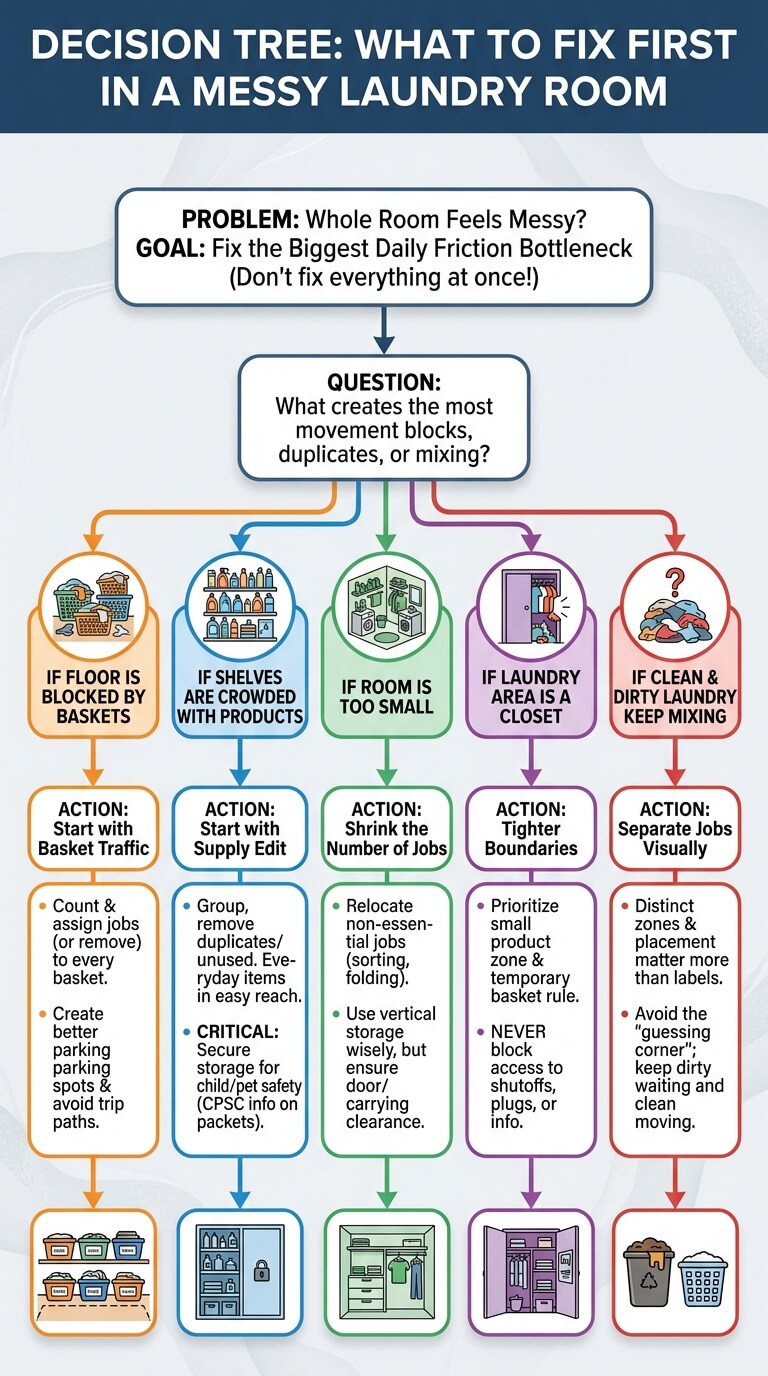
When the whole room feels messy, do not try to fix every category at once. Pick the bottleneck that creates the most daily friction. The right first project is usually the one that blocks movement, creates duplicates, or causes clean and dirty laundry to mix.
If the floor is blocked by baskets
If baskets are the main source of clutter, give each one a job and a parking spot so you can store laundry baskets without blocking the room.
Start with basket traffic. Count every hamper, transfer basket, folding basket, and overflow basket in or near the room. Give each one a job or remove it from the laundry zone. Heavy loaded baskets should not be stored high, and baskets should not sit where they create a trip path. A floor problem is usually solved by fewer baskets, better parking spots, or moving dirty laundry storage closer to bedrooms instead of forcing every basket into the laundry room.
If shelves are crowded with products
If crowded bottles, pods, sprays, and backup products are the main problem, start by learning how to organize laundry supplies by use, safety, and frequency.
Start with a supply edit. Pull products into groups and look for duplicates, nearly empty bottles, damaged containers, and items you no longer use. Keep everyday products in the easiest reach zone and move backup items to a less prime spot. If there are children or pets in the home, choose storage that reduces access rather than storage that only looks neat. Laundry packets and household products deserve extra caution, and the CPSC has safety information on laundry packet storage that reinforces the need to keep them secured and out of reach: CPSC laundry packet safety information.
If the room is too small
When the room is narrow or has almost no floor space, use small laundry room organization ideas that save the walking path before adding extra storage.
Start by shrinking the number of jobs happening inside the room. A small laundry area may not have space for sorting, folding, overflow storage, and backup supplies. Choose the jobs that must happen there, then relocate the rest. Vertical storage helps only when it does not make items hard to reach or hide products so well that you buy duplicates. Narrow carts, wall hooks, and door storage can be useful, but the room still needs enough clearance to open doors and carry a basket safely.
If the laundry area is a closet
A closet laundry area needs different rules because doors, shelves, and appliance access matter more, so it helps to organize a laundry closet as its own small system.
Closets need tighter boundaries than rooms. The doors, machines, hoses, shelves, and baskets all compete for the same small footprint. If a basket blocks a bifold or sliding door, it does not belong there as a permanent fixture. Prioritize a small product zone, a safe reach height, and a temporary basket rule for laundry day. Closet systems should never make it hard to access shutoffs, plugs, or the manufacturer information you may need later.
If clean and dirty laundry keep mixing
When clean and dirty laundry keep mixing, the next useful step is to create a laundry sorting system that matches how your household actually washes clothes.
Start by separating jobs visually. Dirty hampers, clean transfer baskets, and folding baskets should not be interchangeable unless they are emptied and cleaned according to their material limits. Labeling can help, but placement matters more. Dirty laundry should wait before washing. Clean laundry should move out after drying. If both categories land in the same corner, the system is asking people to guess, and guesses fail on busy days.
Storage Categories That Need Separate Rules
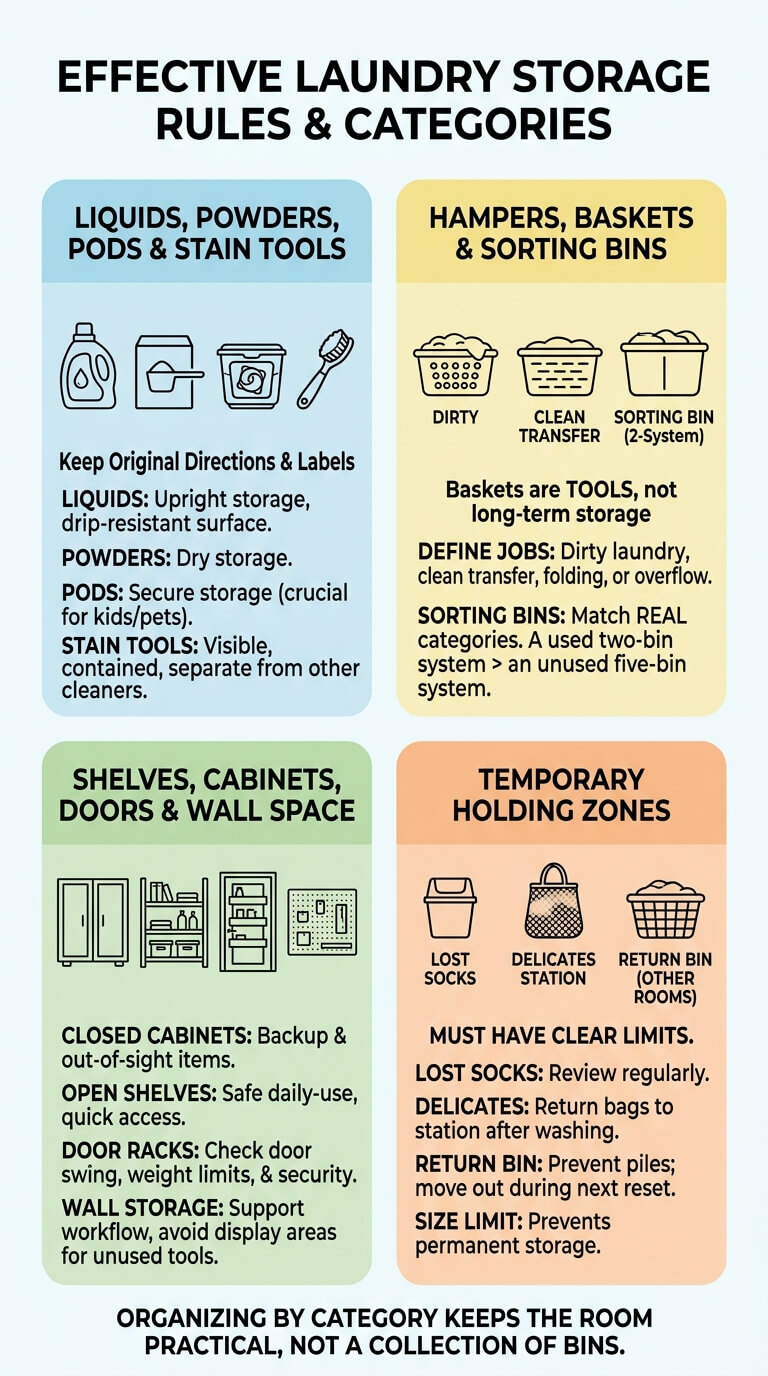
Not every laundry item should be stored the same way. Liquids, powders, baskets, shelves, small tools, and temporary holding zones each create different problems. Organizing by category keeps the room practical instead of turning every object into another bin.
Liquids, powders, pods, and stain tools
Store products according to their labels and keep original directions available. Liquids need upright storage and a surface that can handle small drips. Powders need dry storage. Pods or packets need secure storage, especially in homes with children or pets. Stain tools can live in the laundry room as a category, but this guide does not cover stain removal methods. The organization job is to keep the tools visible, contained, and separate from unrelated household cleaners.
Hampers, baskets, and sorting bins
Baskets are tools, not long-term storage units. Decide whether each basket handles dirty laundry, clean transfer, folding, or overflow. If a basket has no job, it will usually become a pile with handles. Sorting bins should match the categories you truly use, not categories that sound organized but never happen in practice. A two-bin system that gets used beats a five-bin system that sits full all week.
Shelves, cabinets, doors, and wall space
Closed cabinets are helpful for backup products and items that should stay out of sight. Open shelves work better for safe daily-use items that need quick access. Door racks can help in rentals or narrow spaces, but check door swing, weight limits, and whether products will fall when the door moves. Wall storage should support the workflow, not become a display area for tools that are rarely used.
Temporary holding zones for lost socks, delicates, and returns
Temporary zones need clear limits. A small bin for lost socks is helpful only if it is reviewed regularly. A delicates bag station works only if the bags return to the same spot after washing. A return bin for items that belong in other rooms can prevent random piles, but it should leave the laundry area during the next reset. Put a size limit on every holding zone so it cannot silently become permanent storage.
Setup Examples by Space Type
The same organization framework looks different in different homes. A full laundry room can hold more zones. A small room needs tighter editing. A closet needs door and clearance rules. A rental or shared laundry area needs portable systems that can move when the living situation changes.
Full laundry room
When the problem is the whole path from dirty laundry to clean clothes, it is usually better to organize the whole laundry room before buying more bins or shelves.
A full room can usually support five zones: sorting, supplies, machine-side tools, folding or drying, and reset. Keep the center path open first, then place storage around the path. If the room also serves as a mudroom or utility area, give non-laundry items their own boundary. Otherwise, shoes, pet gear, batteries, paper goods, and random tools will slowly crowd the laundry workflow.
Small laundry room
A small room should not carry every possible laundry job. Choose the most important functions and remove the rest. Backup supplies might move to a utility closet. Folding might happen on a bed or table outside the room. A collapsible basket may be better than three rigid baskets. The best small-space test is simple: can you open every machine door, reach daily supplies, and leave the room with a full basket without shifting clutter?
Laundry closet
A closet setup usually needs a strict product limit and a temporary basket plan. Store only the products used often, and keep anything heavy or rarely used out of awkward overhead spaces. If machines are stacked, avoid storing small loose items where they can fall behind the units. Check the appliance manual before adding shelves, hooks, or tight storage around machines, because clearance and access needs can vary by model.
Shared or rental laundry area
Shared spaces work best with portable and clearly owned items. A caddy, one labeled basket, and a small supply limit can prevent conflicts. Renters should avoid permanent changes that affect walls, doors, appliances, or ventilation without permission. If several people use the same area, labels should identify jobs, not just names: dirty, clean transfer, supplies, and returns. That makes the system easier for guests or roommates to understand.
Safety and Product Limits to Respect
Organization should make the room safer and easier to use, not harder to inspect. A storage idea is not worth it if it hides leaks, blocks access, overloads a shelf, or puts products within easy reach of children or pets. Simple choices, such as keeping labels readable and leaving floor paths open, matter more than matching containers.
Keep products away from children and pets
Laundry products can be concentrated, slippery, scented, colorful, or easy to mistake for something harmless. Store them in original containers when directions, warnings, or dosing information need to stay visible. If you use bins, label the bin by task and keep the product label readable inside it. Homes with young children, visiting grandchildren, or curious pets should favor secured cabinets or high storage that is still safe for adults to reach.
Leave appliance access, ventilation, and electrical areas clear
Do not pack storage tightly around appliances. You may need to reach plugs, shutoffs, hoses, leveling feet, model labels, or the wall area behind the machines. Indoor moisture also deserves attention in laundry areas, especially if the room feels damp, has poor airflow, or shares space with utility equipment. The EPA explains how moisture and indoor air quality connect in homes, which is a useful reminder to keep damp items and blocked airflow from becoming part of the organization system: EPA indoor air quality guidance.
Read labels, manuals, and shelf weight limits before changing storage
Before you add a shelf over machines, hang a rack, decant a product, or store loaded baskets above shoulder height, check the limits. Product labels tell you how items should be stored and whether the original container matters. Appliance manuals explain clearances and access needs. Shelf and basket specifications tell you whether a storage idea can handle real weight. If a setup requires balancing heavy items overhead, choose a lower and simpler option.
Common Laundry Room Organization Mistakes
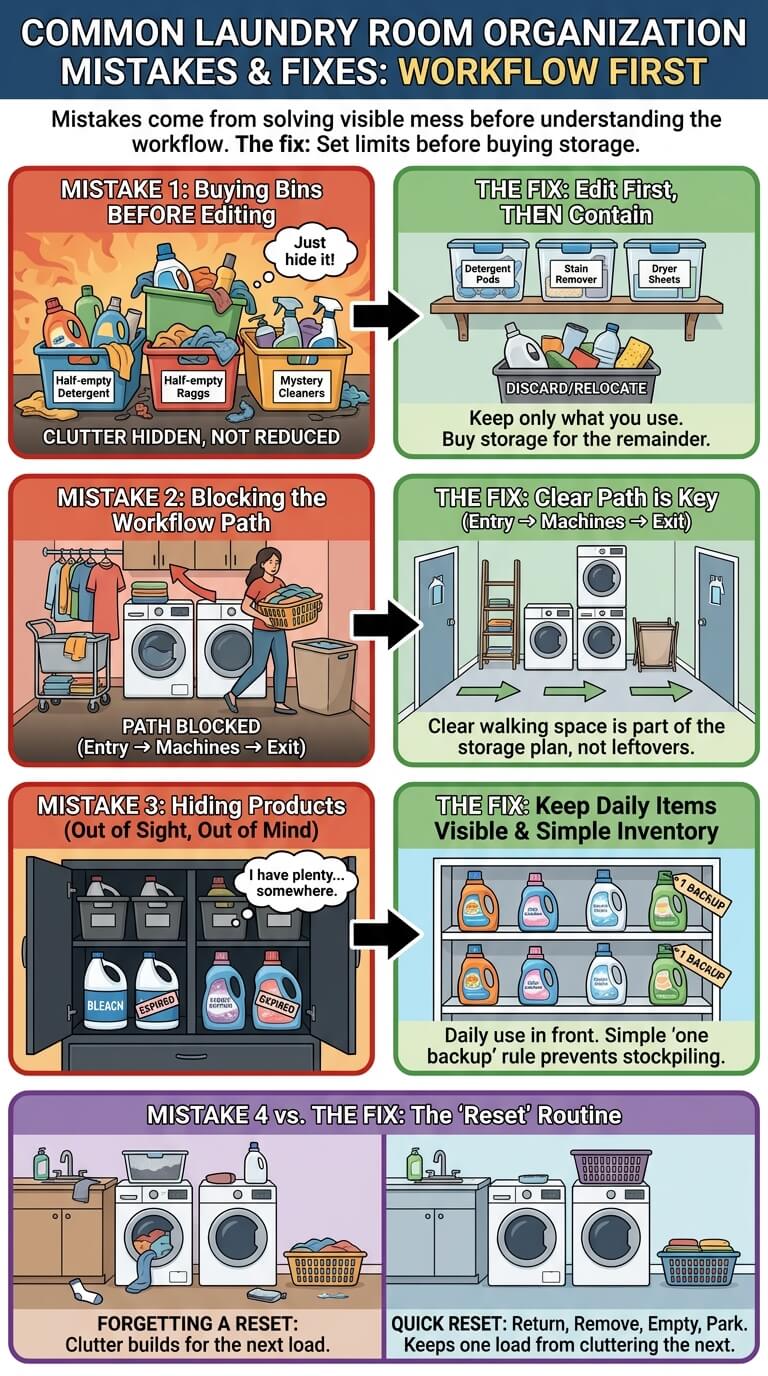
Most organization mistakes come from solving the visible mess before understanding the workflow. The room looks better for a few days, then the same piles return. These mistakes are easy to avoid when you set limits before buying storage.
Buying bins before reducing excess supplies
Bins make clutter look organized, but they do not reduce clutter by themselves. Edit first. If three half-used detergents, two open scent products, and several mystery cleaners go straight into matching containers, you have only hidden the decision. Keep what you use, discard or relocate what you should not keep in the room, and then buy storage based on the items that remain.
Creating storage that blocks the actual laundry path
A shelf, hamper, cart, or hanging rack can be attractive and still be wrong for the room. Stop if you have to twist around a basket, hold a door partly closed, or move a cart every time you load the washer. The path from entry to machines to exit matters because laundry is carried with both hands. Clear walking space is part of the storage plan, not an empty leftover.
Hiding products so well they expire or duplicate
Deep cabinets and opaque bins can hide products until you forget you own them. That leads to duplicates and crowded shelves. Keep daily-use items visible or easy to pull forward. Put backup products behind them only if you can see the count at a glance. A simple inventory mark, such as one backup per product type, is usually easier to maintain than a large hidden stockpile.
Forgetting a reset routine
Even a well-planned room needs a reset. The reset can be short: return products, remove packaging, move clean laundry out, empty lint or trash where appropriate, and check that baskets are parked where they belong. The point is not deep cleaning after every load. The point is to keep one load from leaving clutter for the next load.
Where to Start Based on Your Laundry Problem
The best laundry room organization plan depends on what is slowing you down most. Some homes need a full room reset, while others only need better supply storage, a clearer sorting system, or a better place for baskets.
When to focus on the whole room
Focus on the whole room when the problem is not one shelf, one basket, or one product category. Signs include blocked floor paths, supplies spread across several surfaces, clean and dirty laundry mixing, and no clear place for items to leave the room. A whole-room setup is the right step when you need to rebuild the flow from entry to exit.
When to focus on supplies, closets, baskets, sorting, or upkeep
A supply problem shows up as duplicates, leaks, crowded shelves, or products that no one remembers buying. A closet problem shows up as blocked doors, awkward overhead storage, and no basket plan. A basket problem shows up as piles in the walking path. A sorting problem shows up before washing, when loads are delayed because no one knows what belongs together. An upkeep problem shows up after the room has been organized once but keeps sliding back.
How to move from setup to maintenance
After the main setup is working, a short reset routine is what helps you keep the laundry room clean and organized instead of reorganizing it from scratch every few weeks.
Setup is the first pass. Maintenance is the habit that protects it. After you create zones and reduce excess, choose a reset rhythm that matches your home. A one-person household may need only a weekly shelf check. A family with sports clothes, towels, pet laundry, or school uniforms may need a short reset after each laundry cycle. ENERGY STAR also notes that laundry appliance choices and use patterns affect energy and water context, so keeping the room easy to use can support more consistent habits around full loads and efficient routines: ENERGY STAR clothes washer guidance.
FAQ
What should every laundry room have?
Every laundry room should have a place for incoming laundry, a safe place for laundry products, a clear machine-side work area, a way to move clean laundry out, and a small reset system for trash, empty containers, and items found in pockets. The exact products and bins depend on the household, but those jobs should be covered.
How do I organize a laundry room with no cabinets?
Start with fewer supplies, not more containers. Keep daily products on a sturdy shelf, in a secure cart, or in a handled caddy that can move when needed. Store backup products elsewhere if the room is too exposed. Choose clear task zones and avoid placing heavy products where they can fall or block appliance access.
Should dirty and clean laundry baskets be stored together?
They can be stored near each other only if their jobs are obvious and they are not used interchangeably. Many homes do better with separate basket types, labels, colors, or locations. Clean transfer baskets should not become long-term storage, and dirty hampers should not sit where clean folded laundry lands.
How often should I reset the laundry room organization?
A light reset after each laundry cycle keeps the room from sliding backward. That can mean returning products, moving clean laundry out, and clearing the machine top. A deeper shelf and supply check can happen weekly or monthly depending on how many people use the room and how quickly baskets and products build up.
What should not be stored in a laundry room?
Avoid storing unrelated clutter, excess household chemicals, heavy items in unstable overhead spots, paper goods in damp areas, and anything that blocks appliance access, outlets, doors, or walking paths. Products with special storage instructions should follow the label. Items that do not support laundry should earn their place or move elsewhere.
Final Thoughts
A laundry room becomes easier to manage when every item has a job, every basket has a parking spot, and every load ends with a small reset. Start with the biggest bottleneck, not the prettiest storage idea. Once the main framework works, you can refine the details: supplies, small-space layouts, closet rules, sorting systems, basket storage, and upkeep routines.

Ethan Carter is the Founder & Editor of HomeCleanSecrets. Based in the United States, he has 5 years of experience creating practical home cleaning, laundry care, stain removal, decluttering, and home organization content. His goal is to help everyday households clean smarter and build simple routines that are easier to maintain.
Read more about Ethan Carter on his author page: https://homecleansecrets.com/ethan-carter/