
Small laundry room organization ideas work best when they protect floor space first. A tight laundry room usually does not fail because it lacks cute bins. It fails because baskets sit in the walking path, shelves are too deep to use well, supplies multiply, and there is no clear place for clean laundry to land. The goal is not to fill every inch. The goal is to make washing, drying, hanging, folding, and carrying laundry possible without moving five things before each step.
This guide is for a small but room-like laundry area: a narrow laundry room, pass-through laundry room, condo laundry space, or compact utility room. It is not a full remodel plan and it is not a closet-specific guide. You will focus on vertical storage, shallow storage, foldable tools, slim baskets, renter-friendly options, and simple limits that keep the room from shrinking again after one busy week.

Quick Answer: Save Floor Space Before Adding More Storage
These ideas work best when they support a larger laundry room organization plan instead of simply filling every wall with storage.
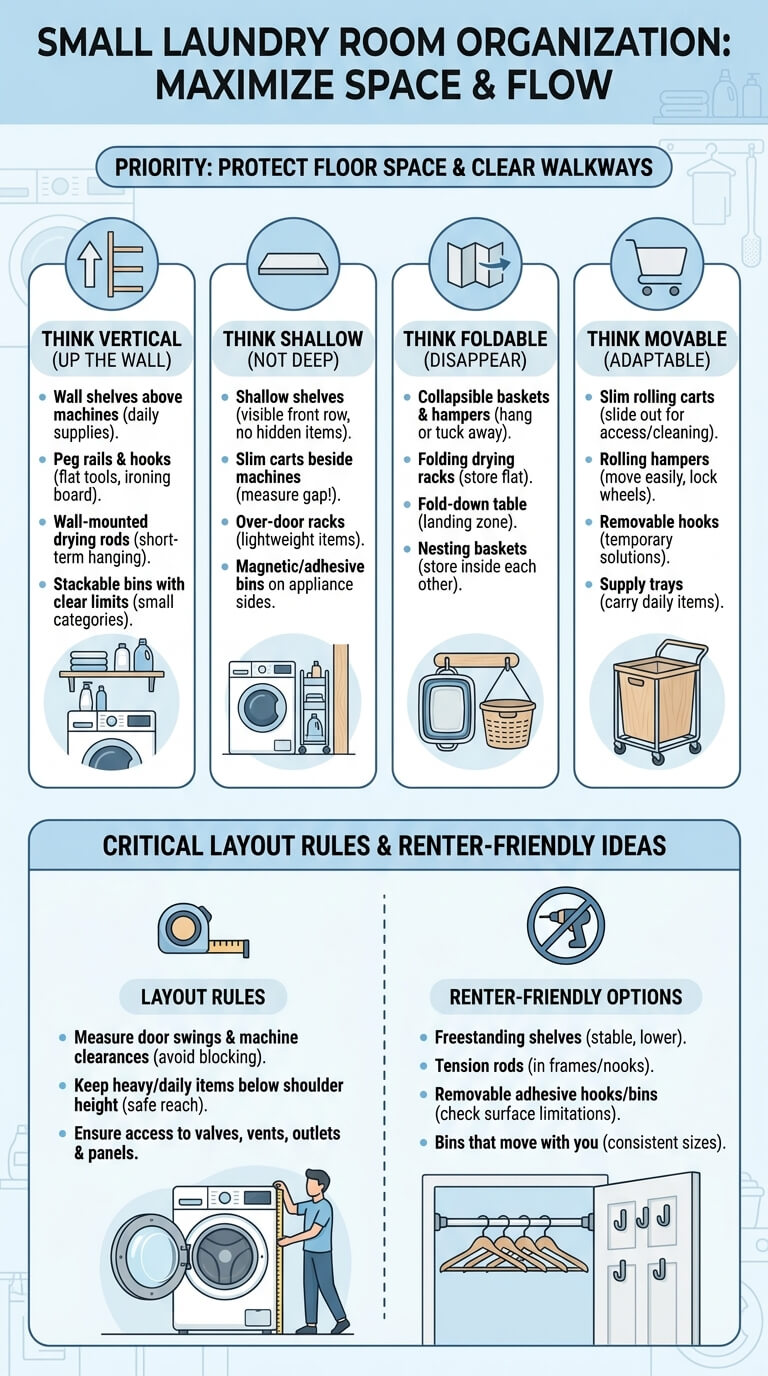
The fastest way to organize a small laundry room is to clear the walkway, remove oversized baskets, move backup supplies out of the room, and use shallow vertical storage for the items used every week. Add storage only after you know which items must stay in the room and which items can live elsewhere.
Think vertical, shallow, foldable, and movable
In a small laundry room, storage should go up the wall before it spreads across the floor. Choose shallow shelves over deep shelves, wall hooks over standing racks, folding drying racks over permanent floor racks, and slim carts over bulky cabinets. A good test is whether one person can carry a full basket through the room without turning sideways or bumping a corner.
Movable storage helps when the room also holds valves, outlets, vents, or a utility sink. A narrow rolling cart can slide out for cleaning or service access. A foldable hamper can disappear between laundry days. A removable hook can solve one job without committing an entire wall to storage you may not need.
Keep the walking path and appliance doors clear
Before you buy anything, open every appliance door, cabinet door, room door, and hamper lid. Mark the space those doors need. If a cart, basket, or shelf blocks that swing, it will annoy you every time you do laundry. Leave enough space to stand, load, unload, turn, and carry clothing without scraping the machines.
Also leave access to plugs, water shutoff valves, drain lines, dryer vent paths, and appliance panels. Compact storage should make the room easier, not hide the parts you may need during a leak, service call, or quick shutoff. Use your own manual, or a manufacturer page for owner manuals and installation instructions, before adding shelves, surfaces, or stacked storage around machines.
What Makes a Laundry Room Feel Too Small
If the whole room feels confusing, not just small, start by learning how to organize the whole laundry room around the path from dirty laundry to clean clothes.
A small laundry room can feel cramped even when the square footage is not terrible. The usual causes are object size, poor reach, bad landing zones, and too many supplies stored where only daily items should live. Fixing those causes is more useful than simply adding another organizer.
Oversized baskets
Large rigid baskets are often the biggest floor-space problem. They are useful for carrying a family load, but they become obstacles when they sit open in a narrow path. If the basket has no parking spot, it will end up in front of the washer, behind the door, or on the folding surface. Use one sturdy carry basket and one compact waiting system instead of several large baskets in the room.
Measure the width of the room with the basket in place. If the remaining walkway feels awkward while carrying laundry, the basket is too large for daily storage. Collapsible baskets, nesting baskets, or a rolling hamper that fits beside a machine can keep the carrying function without stealing the floor all week.
Too many duplicate supplies
Duplicate detergent, extra scent products, multiple stain sprays, and backup dryer sheets can make a small room feel like a stockroom. Keep the current products in the room and move unopened backups to a utility shelf, pantry overflow area, or another safe storage spot. The laundry room should hold what you are using now, not every sale purchase.
Deep shelves that swallow products
Deep shelves look generous, but in a small laundry room they often hide short bottles behind tall bottles. People buy more because they cannot see what they own, then the shelf becomes sticky, crowded, and hard to reset. Shallow shelves are usually better because every item has a visible front row.
No landing zone for clean laundry
Clean laundry needs one dependable landing zone. Without it, folded clothes go on top of the dryer, hangers hook onto cabinet handles, and clean baskets sit on the floor beside dirty ones. In a small room, the landing zone can be a fold-down table, a clear machine top, a slim counter, or one clean-only basket.
Keep this zone protected. Do not store detergent, mail, tools, or pocket finds there. A good test is whether you can unload the dryer without clearing clutter first. If not, the landing zone is being used as storage instead of work space.
Small Laundry Room Layout Rules
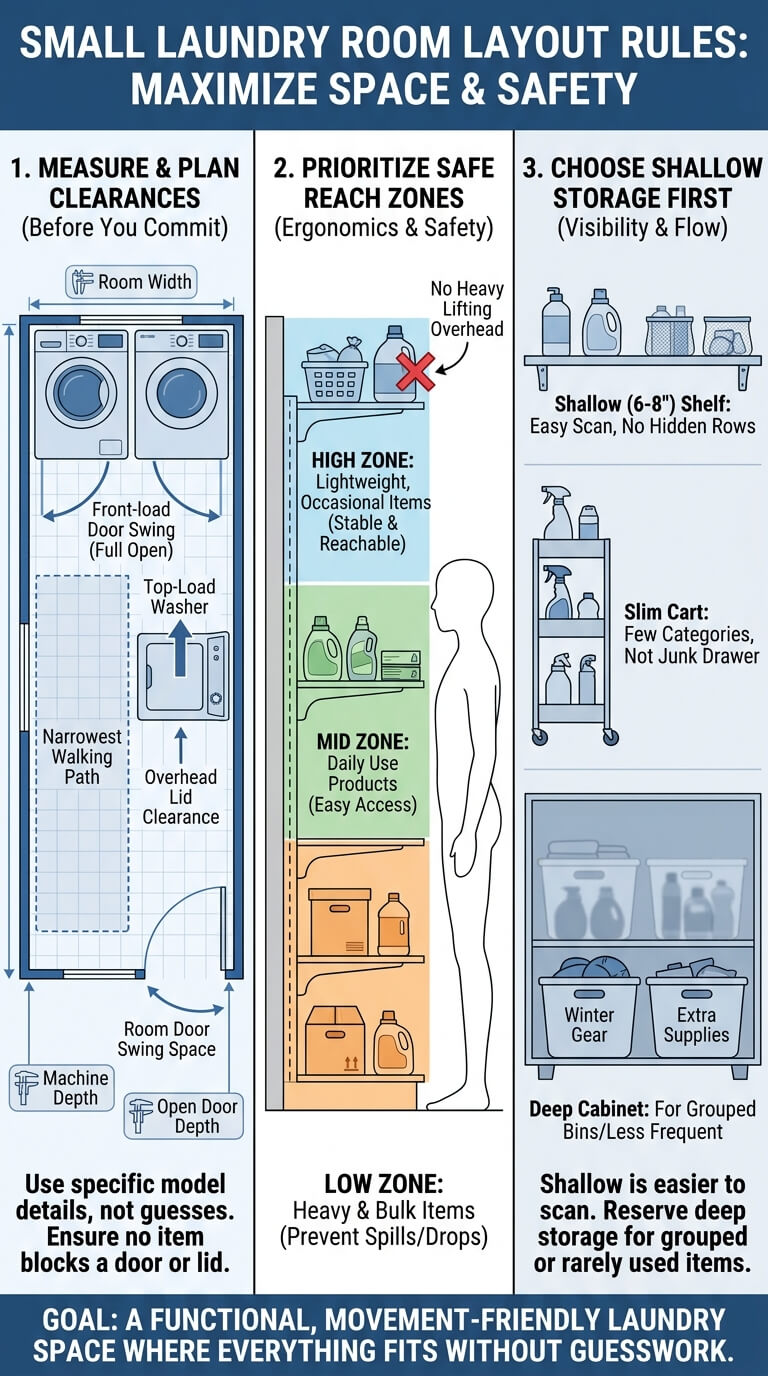
Small rooms need layout rules because every added item affects movement. These rules help you decide what fits before you commit to shelves, carts, racks, or baskets.
Measure door swings, machine clearances, and walkway space
Measure the room width, machine depth, open door depth, and the narrowest walking path. Front-load washer and dryer doors need room to open fully. Top-load washers need overhead clearance. Room doors and cabinet doors need swing space. If a shelf blocks a lid, or a cart blocks a front-load door, the idea is not small-space friendly for your room.
When you compare appliances or plan around existing machines, use your model details rather than guessing. ENERGY STAR provides helpful appliance category context for clothes washers, but final spacing should come from your own product manual and installation instructions.
Keep heavy and frequently used items within safe reach
Heavy detergent bottles, bulk boxes, and full baskets should not live high above shoulder height. Reaching overhead with a slippery bottle can cause spills or dropped items. Put heavier products lower, daily products between waist and shoulder height, and lightweight occasional items higher if the shelf is stable and easy to reach.
Use shallow storage before deep storage
Shallow storage makes a small room easier to scan. A six-inch or eight-inch shelf can hold common bottles, dryer balls, clothespins, and mesh bags without creating hidden back rows. A slim cart can hold a few categories without becoming a rolling junk drawer. Deep cabinets should be reserved for grouped bins or items you do not need every load.
Vertical Storage Ideas
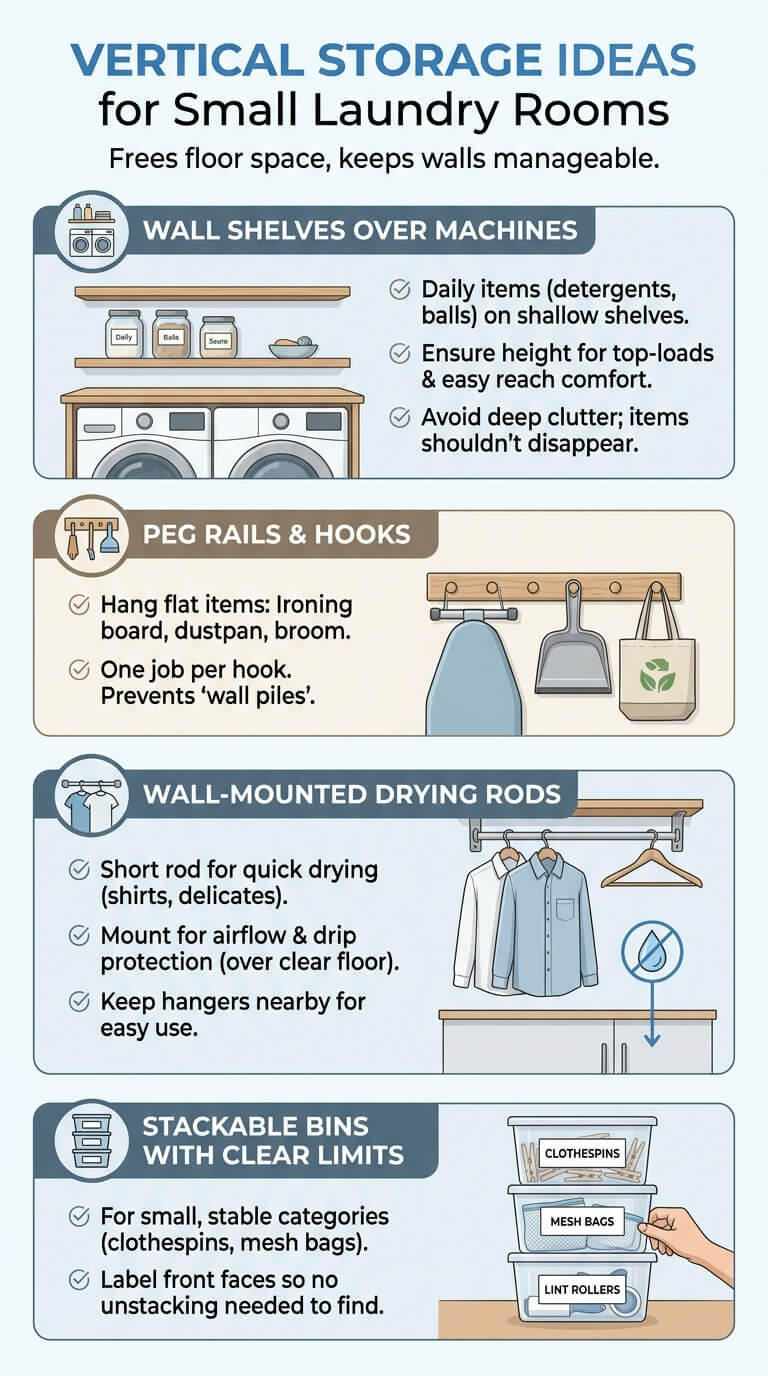
Vertical storage is usually the strongest small laundry room move because it frees the floor. The key is to add vertical storage with limits so the walls do not become visually crowded or hard to maintain.
Wall shelves over machines
Shelves above the washer and dryer can hold daily products, mesh bags, dryer balls, a lint roller, and a small lost-and-found dish. Keep shelves shallow enough that items do not disappear behind each other. Leave enough height above top-load machines and enough reach comfort for shorter household members.
Peg rails and hooks
Peg rails and wall hooks are helpful for items that need to hang flat: an ironing board, dustpan, broom, small drying rack, garment bag, or reusable laundry bag. Hooks work best when each hook has one job. If five unrelated items hang from the same peg, the wall becomes another pile.
Wall-mounted drying rods
A short drying rod can replace a standing rack when you only need to hang shirts, delicates, or damp towels for a short time. Mount it where air can move around the clothing and where drips will not damage a cabinet, shelf, or basket below. Keep hangers nearby so the rod is easy to use.
Stackable bins with clear limits
Stackable bins can work well for clothespins, mesh bags, lint rollers, delicates bags, and light seasonal laundry tools. Use them for categories that are small and stable. Label the front so you do not need to unstack everything to find one item.
Door and Side-Wall Storage Ideas
Doors and side walls can create storage without taking the main floor. They are especially useful for renters, narrow rooms, and rooms with no cabinets.
Over-door racks
An over-door rack can hold lightweight supplies, lint rollers, mesh bags, clothespins, spray bottles, or cleaning cloths. Choose a rack that lets the door close properly and does not scrape the frame. If the rack makes the door hard to shut, it will become frustrating fast.
Magnetic and adhesive options where appropriate
Magnetic bins can be useful on the side of some metal appliances for dryer sheets, clothespins, or a small lint roller. Adhesive hooks can hold mesh bags, a small brush, or a lightweight sign-out basket for pocket finds. These options are best for light items and smooth surfaces.
Slim carts beside machines
A slim rolling cart can use the gap beside a washer or dryer, but it should not trap lint, block airflow, kink hoses, or make it hard to pull the machine out when needed. Measure the gap at the front, middle, and back because walls and machines are not always perfectly square.
Side-wall broom and ironing storage
Side walls are good for flat tools such as a broom, mop handle, ironing board, foldable step stool, or drying rack. Use clips or hooks that hold the item firmly so it does not slide into the walkway. Keep handles vertical and close to the wall.
Basket and Hamper Ideas for Small Laundry Rooms
Floor space is usually the first thing to disappear, so choose a way to store laundry baskets before buying a larger hamper.
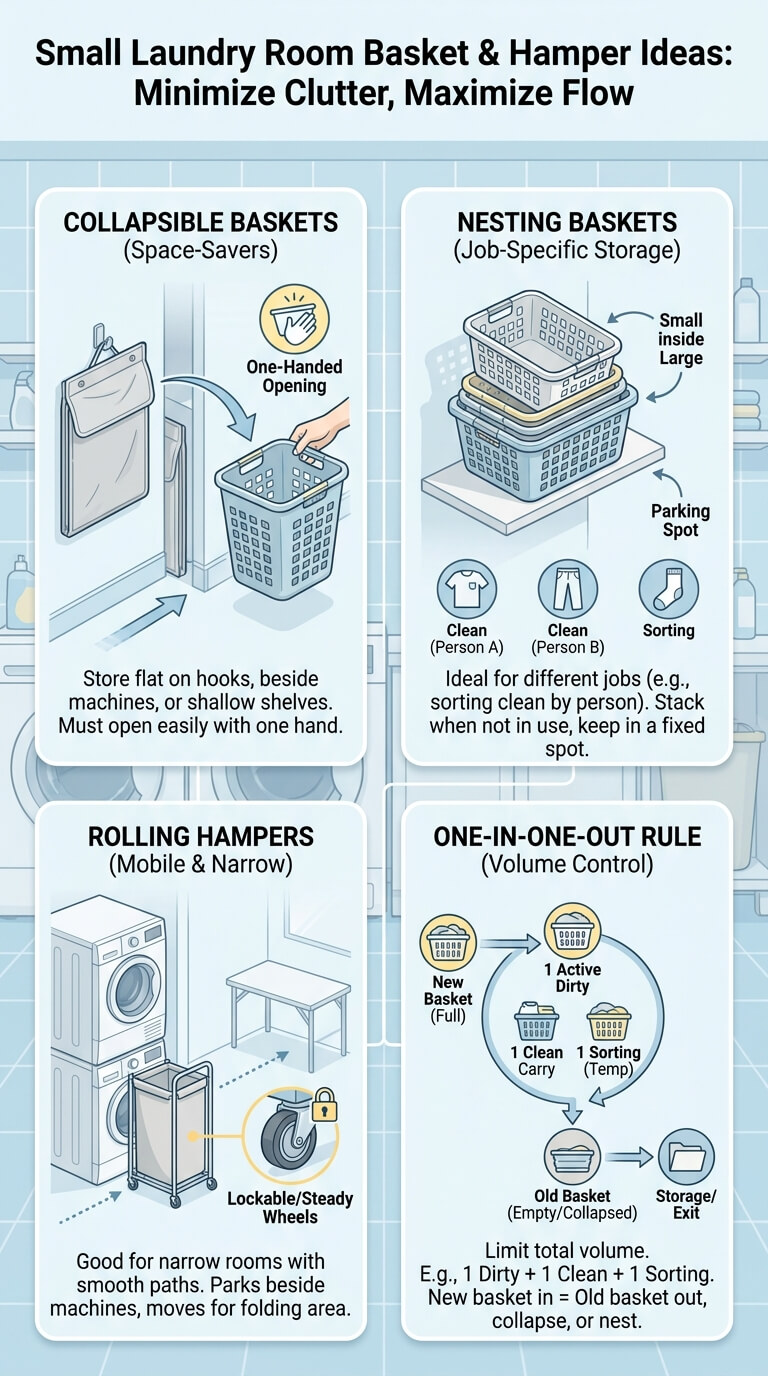
Baskets should help laundry move through the room, not become permanent clutter. In a small space, choose fewer baskets with clearer jobs.
Collapsible baskets
Collapsible baskets are useful when you need a carry basket but do not have space to store a rigid one. Hang a collapsed basket on a hook, slide it beside a machine, or tuck it on a shallow shelf. Choose one that opens easily with one hand because annoying tools do not become habits.
Nesting baskets
Nesting baskets are a good choice when each basket has a different job but they do not all need to be open at once. Store the smaller baskets inside the largest one and give the stack a fixed parking spot. This works well for households that separate clean laundry by person after drying.
Rolling hampers
A rolling hamper can help in a narrow laundry room if the path from bedrooms or bathrooms is smooth enough. It can also park beside the machines and move away during folding. Choose a hamper with wheels that lock or stay steady, especially if the floor slopes slightly.
One-in-one-out basket rules
A small laundry room needs a limit on basket volume. Try one active dirty basket, one clean carry basket, and one temporary sorting option if needed. When a new basket comes in, an old basket should leave, collapse, nest, or move to another area.
Supply Storage Ideas for Tight Spaces
A small room usually needs fewer visible products, which makes it easier to organize laundry supplies by daily use and backup storage.
Supplies need safe, visible, and reachable storage. The smaller the room, the more important it is to separate daily products from backup stock.
Daily supplies in one reachable tray
Place your current detergent, common dryer product, mesh bag, and stain tool in one tray or shallow bin near the washer. The tray catches drips and makes the category easy to move when you wipe the shelf. Keep only the products used often enough to justify prime space.
Backup supplies outside the room
Small laundry rooms usually cannot hold warehouse-style backup stock well. Move unopened detergent, extra dryer sheets, spare laundry bags, and seasonal products to a labeled overflow bin outside the room. Keep the overflow location safe, dry, and away from children or pets when products require that limit.
Labels that prevent overbuying
Labels should stop duplicate purchases, not decorate every container. Label a bin “current laundry products,” “backup laundry,” “hang dry tools,” or “mesh bags” so everyone can return items correctly. Add a small inventory note if you tend to buy duplicates.
What not to store above shoulder height
Avoid storing heavy liquids, bleach products, glass jars, bulk boxes, and frequently used bottles above shoulder height. High storage is better for lightweight paper goods, spare mesh bags, seasonal clips, or empty baskets. If you need a step stool for a product used every week, the product is stored too high.
Also avoid storing attractive items where children might climb to reach them. CPSC’s Anchor It campaign recommends securing furniture with shelves, drawers, and doors because furniture tip-over prevention matters anywhere freestanding storage is used.
Sorting Ideas When There Is No Floor Space
When there is no room for several hampers, you can create a laundry sorting system that starts in bedrooms, bathrooms, or a hallway instead.
Sorting does not have to happen on the laundry room floor. In a tight room, the best sorting system may be partly outside the room or only active on laundry day.
Hanging sorters
Hanging sorters can hold delicates, socks, reusable laundry bags, or small loads waiting for a specific wash setting. They work best on a sturdy hook, rod, or over-door system that does not block the door. Keep the bags lightweight and labeled by action, such as “wash cold” or “hang dry.”
Slim divided hampers
A slim divided hamper can replace several separate baskets when you sort by color, person, or wash type. Choose one that fits the room with all doors open. Dividers should be easy to empty because narrow compartments can trap clothing at the bottom.
Temporary sorting only on laundry day
If the room is very narrow, sort temporarily on laundry day using the hallway, bedroom, or a nearby table. Bring only the next load into the laundry room. This keeps the room from holding every category at once and protects the walkway during the week.
When to sort outside the laundry room
Sort outside the laundry room when the floor is too narrow, the machines face a pass-through path, or multiple people use the area to reach another room. Bedroom hampers, bathroom hampers, or a closet-adjacent sorter may be more practical than forcing everything into the laundry room.
Renter-Friendly and Low-Commitment Options
If the laundry area is actually a closet, use a more specific plan to organize a laundry closet around doors, shelves, and machine access.
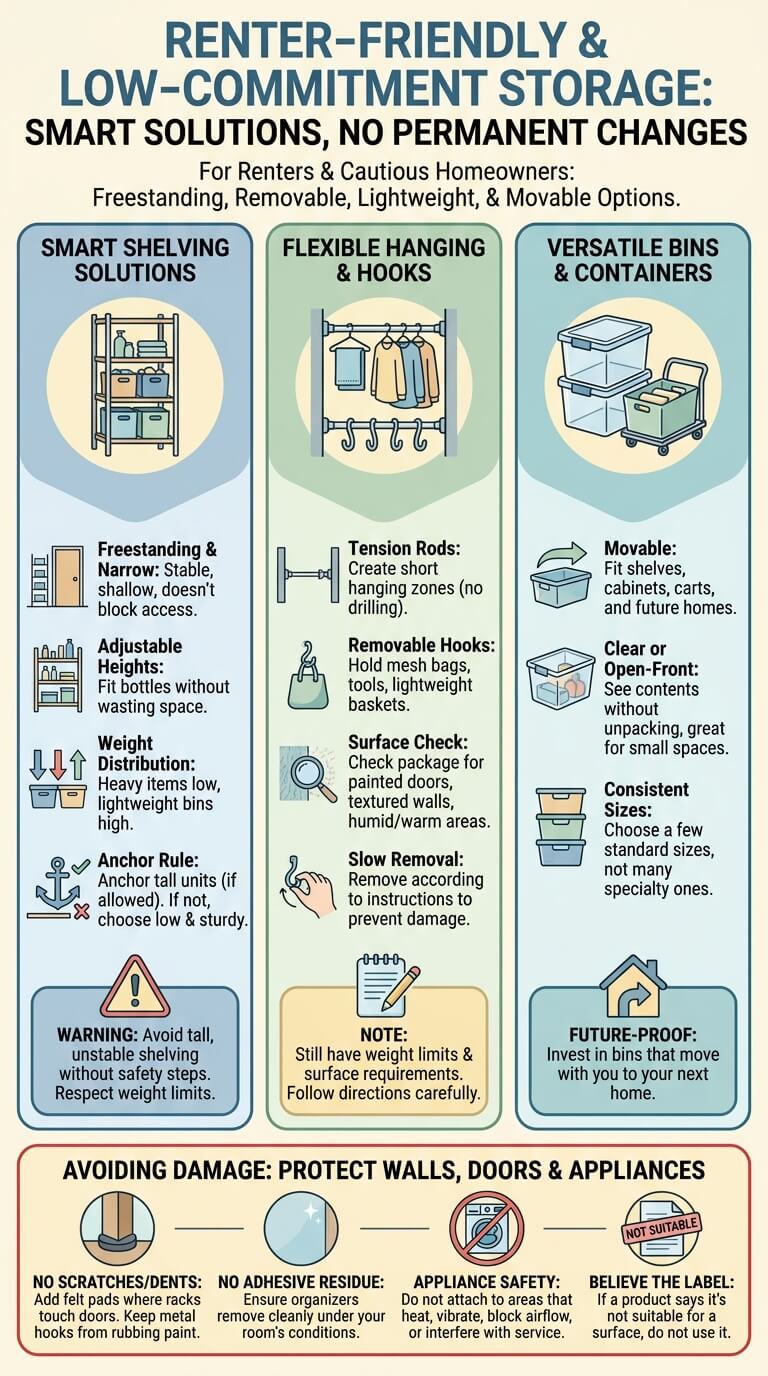
Renters and cautious homeowners need storage that solves the problem without permanent changes. Focus on freestanding, removable, lightweight, and movable pieces.
Freestanding shelves
A narrow freestanding shelf can help if it is stable, shallow, and placed where it does not block doors, valves, outlets, or vents. Use lower shelves for heavier items and upper shelves for lightweight bins. Choose adjustable shelves so the unit can fit bottles without wasting height.
Do not use tall unstable shelving without proper safety steps. Read the shelf instructions, respect weight limits, and anchor furniture where required or appropriate. If anchoring is not allowed in your rental, choose a lower, sturdier option instead of a tall unit.
Tension rods and removable hooks
Tension rods can create short hanging zones for delicates or hangers when walls cannot be drilled. Removable hooks can hold mesh bags, small tools, or lightweight baskets. These options are low commitment, but they still have weight limits and surface requirements.
Check the package directions before using them on painted doors, textured walls, humid areas, or warm appliance sides. Remove them slowly and according to instructions to reduce the chance of wall or finish damage.
Bins that move with you
Use bins that fit shelves, cabinets, carts, and future homes. Clear or open-front bins are helpful when the room is small because you can see what is inside without pulling everything out. Choose a few consistent sizes rather than many specialty containers that only fit one shelf.
Avoiding damage to walls, doors, and appliances
Low-commitment storage should not leave scratches, adhesive residue, dents, or blocked appliance labels. Add felt pads where a rack touches a door. Keep metal hooks from rubbing painted surfaces. Do not attach anything to a machine where it may heat, vibrate, block airflow, or interfere with service panels.
If a product says it is not suitable for a certain surface, believe the label. A removable organizer is only renter-friendly if it can be removed cleanly under your room conditions.
Mistakes That Make a Small Laundry Room Worse
Most small laundry room mistakes come from adding more storage before solving movement, reach, and inventory. Avoid these traps when you choose your ideas.
Buying bulky matching bins
Matching bins can make a photo look tidy while making the room harder to use. Bulky bins waste shelf width, hide products, and encourage broad categories that no one maintains. In a small room, the right bin is the one that fits the item, the shelf, and the hand that has to grab it.
Filling every wall with storage
Empty wall space is not always wasted space. In a small laundry room, blank space can be turning room, visual calm, or a spot where your shoulder does not hit a hanging rack. If every wall holds hooks, shelves, racks, and baskets, the room can feel smaller than before.
Blocking vents, valves, or outlets
Do not let carts, baskets, shelves, or hanging clothes block dryer vent paths, water valves, outlets, cords, drain lines, or access panels. These areas need to stay visible and reachable. A storage idea that hides a shutoff valve is not a good idea in a laundry room.
Moisture also matters in compact rooms. EPA guidance on controlling moisture notes steps such as venting clothes dryers outside and managing indoor moisture sources, which is helpful context for moisture control at home. Storage should support airflow and access, not trap dampness behind clutter.
Keeping full-size backup stock in the room
Bulk storage is tempting, but it can overwhelm a small laundry room quickly. Full-size backup stock takes the best shelves, makes daily products harder to reach, and increases the chance of buying duplicates. Keep only the current product and maybe one backup if the room can hold it safely.
FAQ
These answers focus on small laundry rooms where the main challenge is space, reach, and basket flow rather than a full room redesign.
How do I organize a small laundry room with no cabinets?
Start with one shallow shelf, one wall hook zone, and one movable supply tray. Keep current products in the tray, hang flat tools on hooks, and store backups outside the room. If you need more storage, add a slim cart only after you confirm it does not block appliance doors, valves, outlets, or the walkway.
What is the best storage for a narrow laundry room?
The best storage for a narrow laundry room is shallow, vertical, and easy to move. Wall shelves, peg rails, over-door racks, collapsible baskets, and slim rolling carts usually work better than deep cabinets or wide hampers. Measure the room with doors open before buying anything.
Where should laundry baskets go in a small laundry room?
Laundry baskets should have a fixed parking spot that does not block the washer, dryer, door, or walking path. If there is no good floor spot, use collapsible or nesting baskets and store them on a hook, beside a machine, or outside the room between loads. Keep one clean-only basket so clean laundry does not share space with dirty items.
How can renters organize a small laundry room?
Renters can use freestanding shelves, slim carts, over-door racks, tension rods, removable hooks, and movable bins. Choose lightweight options, follow product directions, and avoid attaching anything to walls, doors, or appliances without checking surface limits and lease rules. Lower, sturdier storage is safer than tall shelving that cannot be anchored.
How do I make a small laundry room easier to maintain?
Keep fewer items in the room, give every basket a job, move backups elsewhere, and reset the room after the last load of the day. Wipe the supply tray when bottles drip, return empty baskets to their parking spot, and remove anything that does not support laundry. The smaller the room, the faster clutter shows, so short resets work better than occasional big cleanouts.
Final Thoughts
Small laundry room organization is mostly about protecting movement. Start with the floor, door swings, appliance access, and one clean landing zone. Then add vertical shelves, hooks, slim carts, foldable baskets, and renter-friendly tools only where they solve a real problem. When the room holds current supplies, a clear basket flow, and a few carefully chosen storage pieces, it can feel calm and usable without becoming crowded by organizers.

Ethan Carter is the Founder & Editor of HomeCleanSecrets. Based in the United States, he has 5 years of experience creating practical home cleaning, laundry care, stain removal, decluttering, and home organization content. His goal is to help everyday households clean smarter and build simple routines that are easier to maintain.
Read more about Ethan Carter on his author page: https://homecleansecrets.com/ethan-carter/