
Delicate clothing needs more than a mild cycle. The safest method depends on the care label, fiber, knit or weave, garment structure, trims, color stability, and how much the item matters to you.

The practical goal is not to make every garment washable at home. It is to choose the least aggressive method that can clean the item without creating an avoidable risk.
Quick Answer: Choose the Least Aggressive Label-Compatible Method
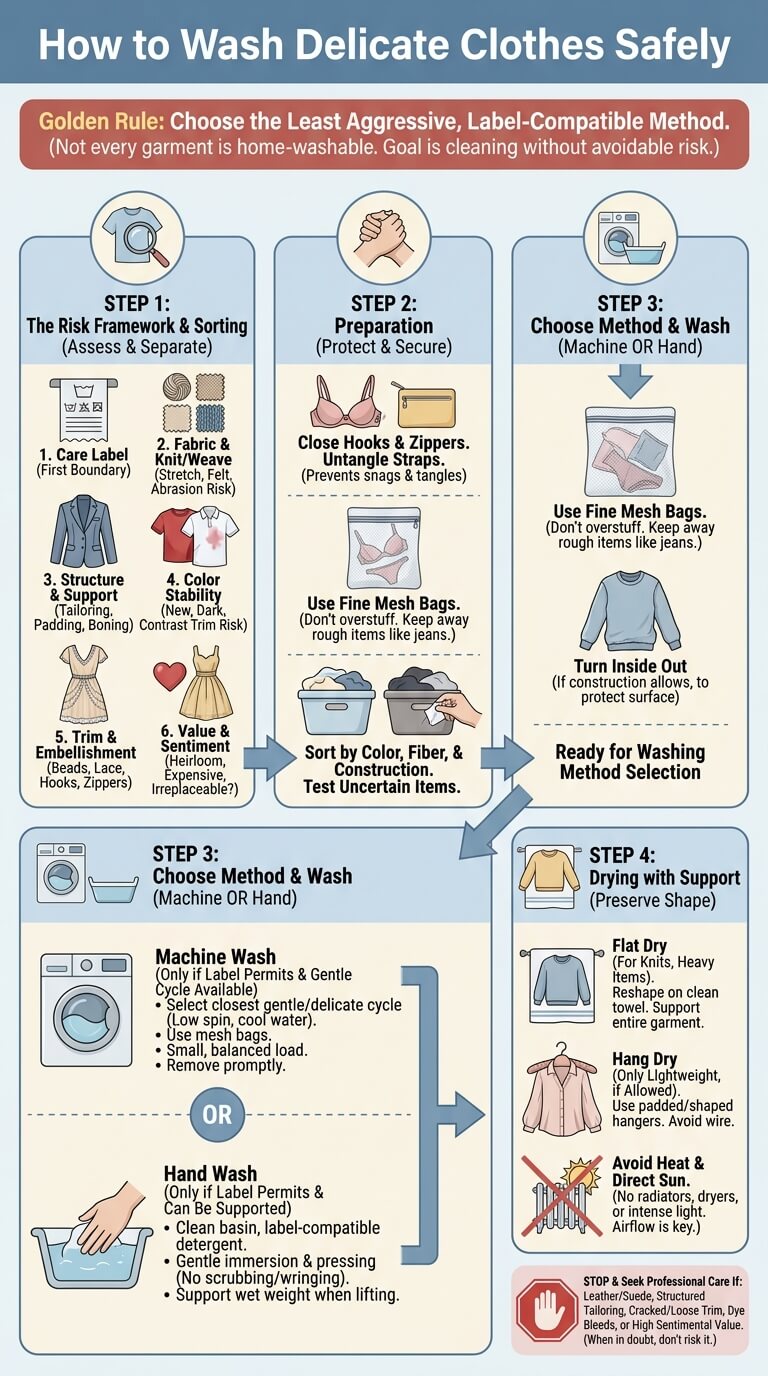
Make the washing decision before preparing detergent or filling a basin. Set out the drying surface, mesh bag, clean towel, or hanger before the garment becomes wet. This prevents rushed handling when the item is at its heaviest and most vulnerable.
Read the full garment label
Look for washing, bleaching, drying, ironing, and professional-care instructions. In the United States, the FTC care-labeling guidance explains that regular care instructions are intended to tell consumers which procedures are safe for the garment.
Assess fabric, construction, trim, and color stability
Check the fiber content, but do not stop there. Loose knits, bias-cut panels, bonded layers, underwires, lace, hooks, sequins, embroidery, shoulder pads, and contrast trim can be more important than the main fiber. Compare the strongest-looking area with the weakest seam or decoration, because the weakest part usually determines the safest method.
Choose machine wash, hand wash, or professional care
Machine wash only when the label permits it and the machine offers a suitable cycle. Hand wash when the label permits hand washing and the garment can be supported safely while wet. Choose professional care when the label requires it or when the construction makes home washing too uncertain.
Dry in the shape and position the garment requires
Plan drying before washing. A wet sweater may need a flat surface, while lightweight washable lingerie may dry on a rack with supported straps.
What Counts as Delicate Clothing
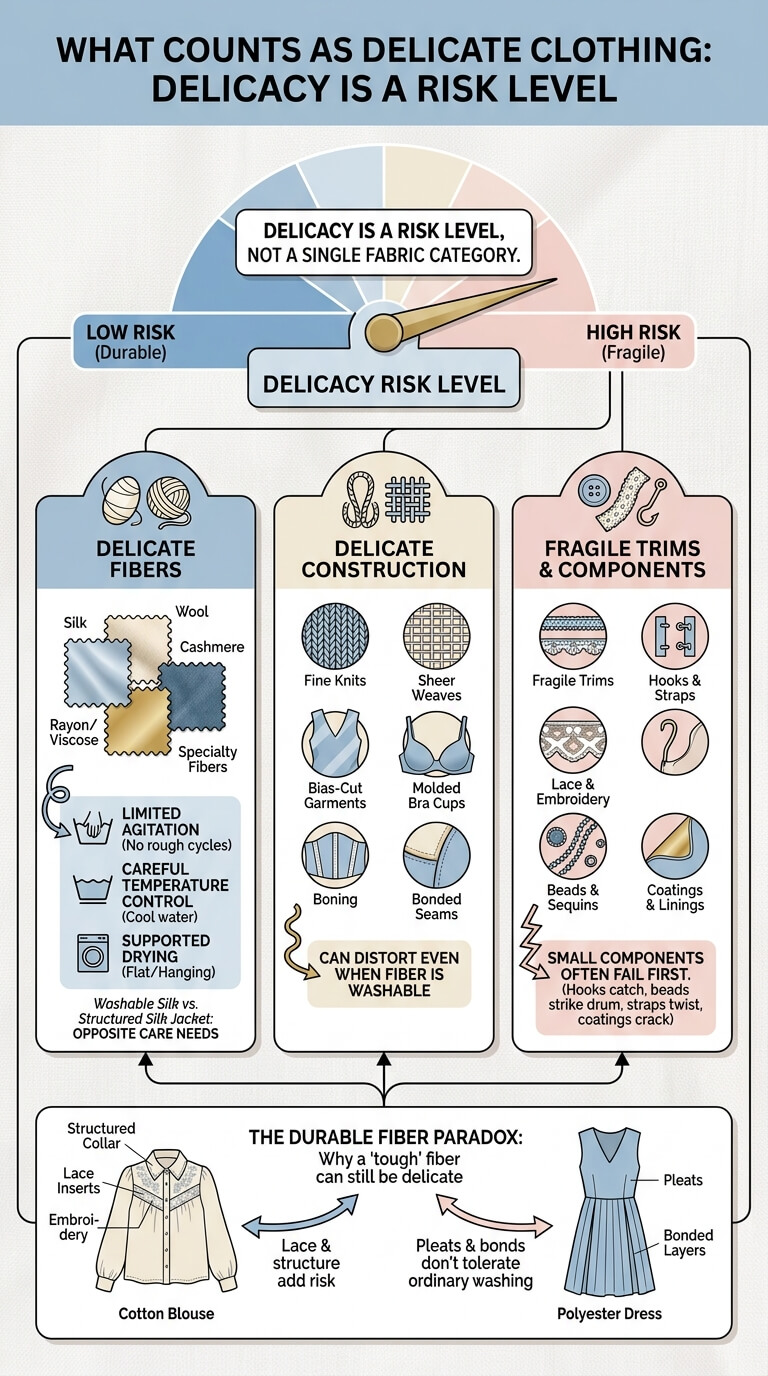
Delicacy is a risk level, not a single fabric category.
Delicate fibers
Silk, wool, cashmere, some rayon or viscose, and fine specialty fibers often need limited agitation, careful temperature control, and supported drying. A washable silk item and a structured silk jacket can have opposite instructions.
Delicate construction
Fine knits, sheer weaves, bias-cut garments, molded bra cups, boning, bonded seams, loose crochet, and tailored pieces can distort even when the fiber itself is washable.
Fragile trims, straps, hooks, lace, embroidery, beads, coatings, and linings
Small components often fail before the main fabric. Hooks can catch lace, beads can strike the drum, straps can twist around other clothing, and coated details can crack.
Why a durable fiber can still be a delicate garment
A cotton blouse may be delicate if it has lace inserts, embroidery, a structured collar, or unstable contrast trim. A polyester dress may have pleats or bonded layers that do not tolerate ordinary washing.
The Delicate-Garment Risk Framework
Use six questions to decide whether home washing is reasonable.
Care-label instruction
The label sets the first boundary. “Machine wash gentle,” “hand wash,” and “professional clean only” are not interchangeable. A label may also restrict bleach, tumble drying, ironing, or steaming even when washing with water is allowed.
Fabric and knit or weave
Loose knits can stretch, felt-prone animal fibers can tighten, and some smooth fabrics can show water marks or abrasion.
Structure and support
Tailoring, padding, interfacing, cups, boning, shoulder shaping, and bonded layers may change shape when saturated.
Color stability
New, dark, red, jewel-toned, or contrast-trim garments deserve extra caution. Colorfastness cannot be guaranteed by a home spot test. If a damp white cloth picks up obvious color from a hidden area, stop and avoid washing the item with lighter pieces. Even without visible transfer, keep uncertain colors separate for the first label-compatible wash.
Trim and embellishment
Inspect buttons, beads, sequins, embroidery, appliques, hook-and-eye closures, zippers, and decorative coatings. Loose threads, lifted glue, missing stones, or cracked finishes are stop signs.
Value, sentiment, and replaceability
The same technical risk can justify different choices. A replaceable camisole may be reasonable to hand wash, while a wedding garment, heirloom knit, designer piece, or one-of-a-kind costume may warrant professional assessment even if home washing seems possible.
Machine Wash, Hand Wash, or Professional Care Decision Tree
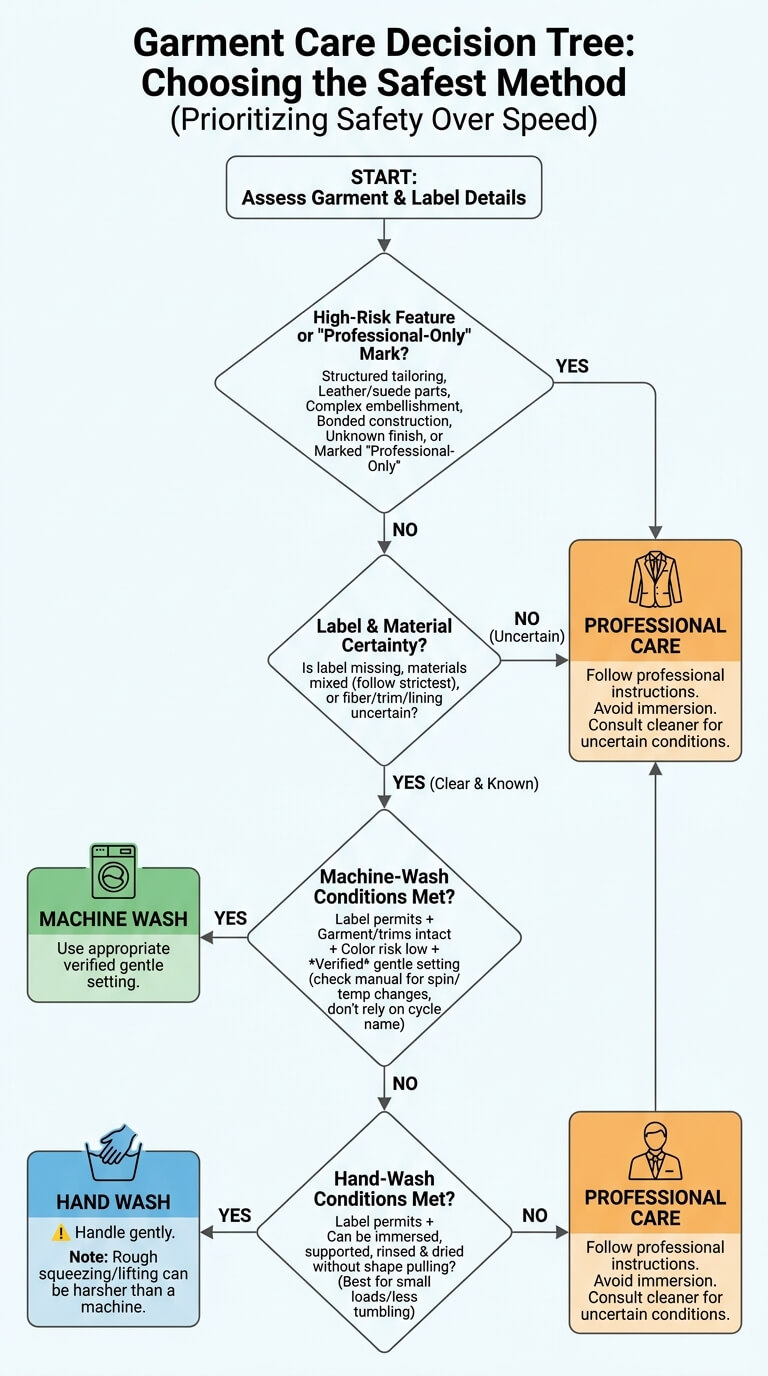
Choose the method that satisfies every important limit, not the method that is fastest.
Machine-wash conditions
Machine washing is reasonable when the label permits it, the garment is intact, trims are secure, color risk is manageable, and your washer has an appropriate gentle setting. The Whirlpool cycle guide notes that cycle behavior varies by machine, so compare the label with your own manual rather than relying only on a cycle name. Check whether the selected cycle changes spin speed, soak time, or water temperature automatically.
Hand-wash conditions
Hand washing is appropriate when the label permits it and the item can be immersed, supported, rinsed, and dried without pulling its shape. Choose it for small loads or garments that need less tumbling, but remember that rough squeezing and repeated lifting can be harsher than a suitable machine cycle.
Professional-clean-only or uncertain conditions
Follow professional-care instructions for structured tailoring, leather or suede components, complex embellishment, bonded construction, unknown finishes, or items marked accordingly.
When missing labels or mixed materials raise the risk
Without a label, identify every visible material and consider how the garment was made. Mixed-material pieces should follow the strictest component. When fiber content, lining, finish, or trim remains uncertain, avoid immersion and ask the manufacturer or a qualified cleaner.
When to Stop Before Washing
Stopping is a successful decision when the likely damage exceeds the benefit of immediate cleaning.
Leather, suede, structured tailoring, bonded layers, heavy embellishment, unstable dye, and damaged seams
These features can change permanently in water or during agitation. Cracked coatings, separating layers, loose beadwork, and weakened seams can worsen quickly.
Expensive or sentimental garments
Do not make the first wash an experiment on a difficult-to-replace item. Save the label, purchase information, and any manufacturer instructions.
Unknown fiber or conflicting instructions
If the main label says washable but a trim label prohibits water, follow the stricter instruction until clarified. The same applies when an online product page conflicts with the sewn-in label.
Why home dry-cleaning is outside this guide
Dry-clean-only garments may rely on solvents, controlled equipment, pressing, and finishing that cannot be reproduced by hand washing. This guide covers label-compatible water washing, not attempts to substitute one process for another.
Step 1: Sort and Inspect Delicates Individually
Do not create one mixed “delicates” load automatically. Sort by color, fiber, construction, soil, hardware, and care method, then decide which pieces can safely share water and movement.
Light and dark color stability
Separate pale items from dark, saturated, or new garments. Keep contrast-trim pieces with the group that presents the least transfer risk. Wash uncertain colors alone until you understand how they behave under label-compatible care.
Smooth versus snag-prone pieces
Keep lace, crochet, hosiery, loose knits, and fine mesh away from exposed zippers, rough hook-and-loop fasteners, metal decorations, and textured fabrics. Color compatibility does not prevent mechanical damage.
Soil and stain inspection
Check collars, cuffs, underarms, hems, makeup areas, and spots before adding water. Decide whether the mark needs a separate label-safe treatment. Do not scrub delicate fibers aggressively or expose an unconfirmed stain to dryer heat.
Testing loose trims and damaged areas without promising colorfastness
Tug gently on buttons and decorations, inspect seams from both sides, and look for dye on a clean dry cloth after light contact with an inconspicuous area. Stop if trim shifts, threads open, or color transfers easily. A passing check is not a guarantee.
Step 2: Prepare Fasteners, Straps, Hooks, and Embellishments
Preparation reduces tangling and point pressure, but it cannot make an unsuitable item washable.
Close or protect hardware
Fasten hooks and eyes when doing so keeps them from catching. Close zippers when the teeth or pull could snag nearby fabric, but follow the garment instructions if closure affects shape. Cover sharp decorative parts only with a method that will not trap residue.
Untangle straps
Straighten bra straps, ties, belts, and narrow shoulder straps. Remove detachable belts or accessories when the label permits separate care.
Turn inside out only when construction allows
Inside-out washing may protect a printed or embellished face from direct rubbing, but it can also place hooks or beads against a delicate lining.
Choose and load a mesh laundry bag
Use a clean, intact bag large enough for the item to move without being tightly folded. Close it fully and avoid stuffing several bras, knits, or lace pieces together. Choose fine mesh for hosiery and lace, and make sure the zipper cover or closure cannot rub directly against the garment.
Keep rough items out of the load
Do not add towels, jeans, canvas, shoes, heavy hardware, or bulky garments merely to balance a delicate load. Use a small compatible load and follow the washer’s minimum-load guidance instead.
Step 3: Choose a Compatible Detergent and Amount
Read the garment label, detergent label, and washer instructions together.
Garment and detergent label compatibility
Choose a product permitted for the fiber and wash method. Some detergents contain enzymes, optical brighteners, fragrance, bleach alternatives, or other ingredients that may not suit every garment. When the label is vague, check the garment manufacturer rather than assuming a household detergent is suitable for silk, wool, elastic, or decorative finishes.
Avoid excess product
Too much detergent can be difficult to rinse from dense knits, lace, cups, linings, and layered seams. Measure for the actual water volume, load size, soil level, product concentration, and washer type.
Wool-, silk-, or specialty-product claims
Use a specialty detergent only when its instructions match the garment. Woolmark’s wool detergent guidance emphasizes mild products intended for wool care, but the sewn-in garment label still controls whether the item may be hand or machine washed.
No chemical mixing
Do not combine detergent, bleach, ammonia, vinegar, stain removers, or other laundry chemicals unless the product instructions explicitly allow the combination. Avoid homemade dilution formulas. Rinse and seek safety advice if incompatible products are mixed accidentally.
Machine-Washing Delicates
Machine washing can be safe for labeled washable items when the load is small, protected, and matched to the actual machine.
Select the closest label-compatible gentle cycle
Compare the garment instruction with your manual’s description of agitation, cycle length, soak behavior, and spin. “Delicate,” “hand wash,” and “wool” cycles may behave differently across models.
Water setting and spin limits
Use a temperature and spin that remain within the label limit. Lower mechanical action may reduce stretching and abrasion, while a very high spin can crease cups, strain trims, or distort a loose knit. A low spin may leave more water that must be supported during removal.
Small, balanced loads
Wash only compatible items and leave room for water movement. Distribute bags evenly rather than placing one dense bundle on one side.
Mesh-bag placement
Place the closed bag in the drum according to the washer manual. Keep it away from rough garments and do not wedge it under a tightly packed load.
Remove items promptly
Take delicates out when the cycle ends. Lift them with both hands if wet fabric feels heavy. Do not pull a sweater by its shoulders or lift a bra by one strap. Check for trapped water, twisted linings, and loose trim before drying.
Hand-Washing Delicates
Hand washing should be calm and brief, with enough room to support the garment.
Prepare a clean basin
Clean and rinse the sink or basin first so cosmetic residue, cleaning chemicals, rust, and dirt do not transfer. Use water within the garment’s stated limit.
Add product according to its label
Dissolve or disperse the measured detergent before adding the garment when the product directions permit.
Use gentle immersion and minimal agitation
Lower the item into the water while supporting its weight. Press water through the fabric with open hands and move it slowly. Do not scrub two sections together, twist straps, or stretch the fabric to inspect it while saturated. Keep the wash time within the garment and product directions instead of leaving the item soaking for convenience.
Rinse without twisting
Drain the basin while supporting the garment. Refill with label-compatible water and press gently until detergent is removed.
Support the garment when wet
Gather the item into both hands or onto a clean support surface before lifting. Wet rayon, loose knits, fine lace, and heavy wool may be weaker or more easily distorted than they appear when dry.
Remove Excess Water Without Wringing
Water removal is often the highest-risk moment because the garment is heavy and the fibers are wet.
Drain and press gently
Let water leave the basin, then press the garment against the side or bottom without grinding it. Do not lift one end and allow the rest to hang.
Support wet knits and heavy sections
Slide both hands underneath sweaters, lined garments, molded cups, and heavy hems. Move the item as one supported shape.
Roll in a clean towel when care instructions permit
Lay the garment flat on a colorfast, lint-free towel, reshape it roughly, then roll without twisting. Press the roll gently to transfer water.
Avoid distortion at straps, shoulders, and seams
Never use straps, necklines, shoulder points, or a single seam as a handle. Do not clip a heavy wet garment from two small points. Support the broadest area possible until most excess water is removed.
Flat Drying, Hanging, or Reshaping Decision Guide
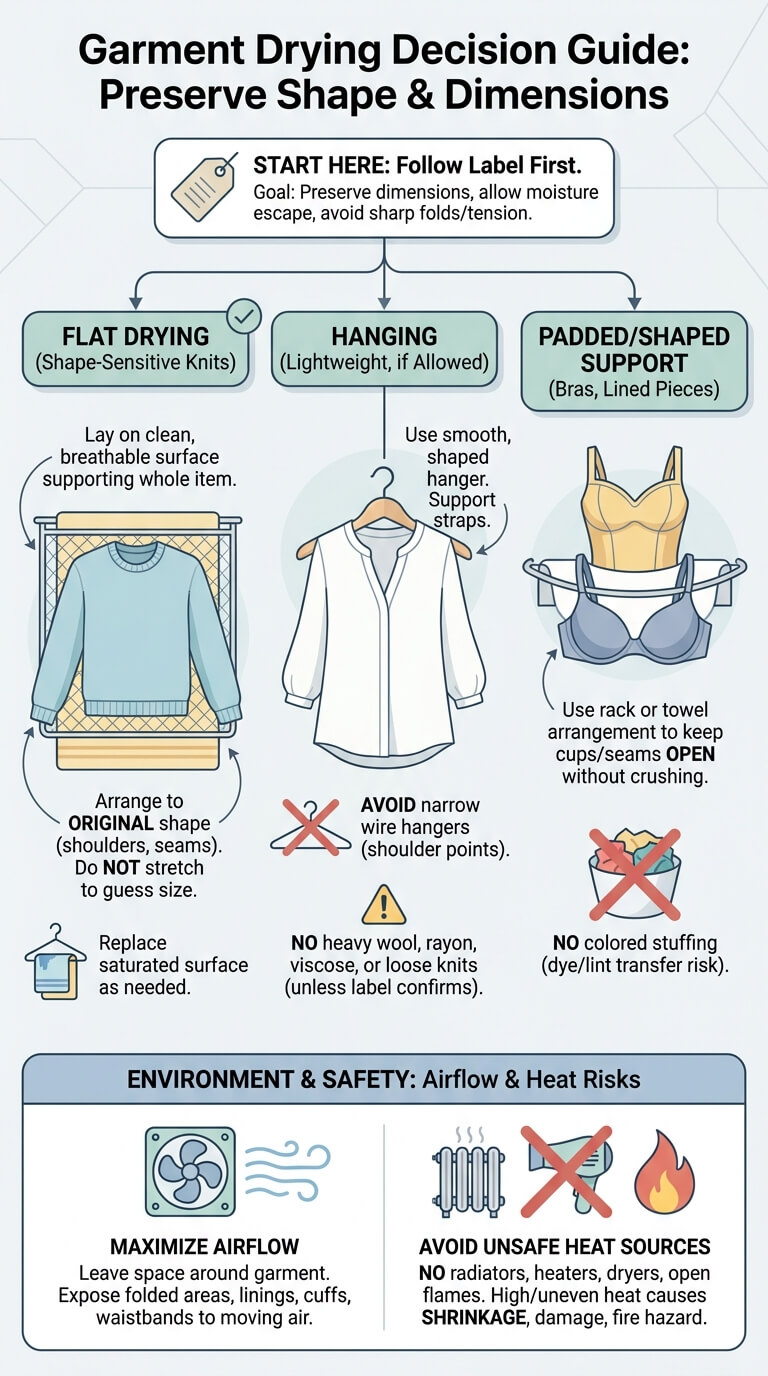
Drying must preserve the garment’s dimensions and allow moisture to escape. Follow the label, then choose the setup that supports wet weight without creating sharp folds or tension.
Flat drying for shape-sensitive knits
Lay sweaters and loose knits on a clean, dry, breathable surface that supports the whole item. Arrange shoulders, sleeves, side seams, and hems to their original shape. Compare the wet garment with its original outline rather than stretching it to a guessed size. Replace a saturated towel or move the garment to a drier surface as needed.
Hanging lightweight garments when allowed
Use a smooth, appropriately shaped hanger for lightweight pieces that will not stretch. Support straps and avoid narrow wire hangers that create shoulder points. Do not hang heavy wet rayon, viscose, wool, or loose knits unless the label specifically supports that method.
Padded or shaped support
Molded bras, lined bodices, and shaped pieces may need a rack or towel arrangement that keeps cups and seams open without crushing them. Do not stuff the garment with colored paper or materials that can transfer dye or lint.
Airflow and indoor moisture
Leave space around the garment and expose folded areas, linings, cuffs, and waistbands to moving air.
Keep items away from unsafe heat sources
Do not place wet delicates against radiators, space heaters, hair dryers, open flames, or electrical appliances. High or uneven heat can shrink fibers, set stains, damage elastic, soften adhesives, and create a fire or electrical hazard.
Material-Specific Comparison
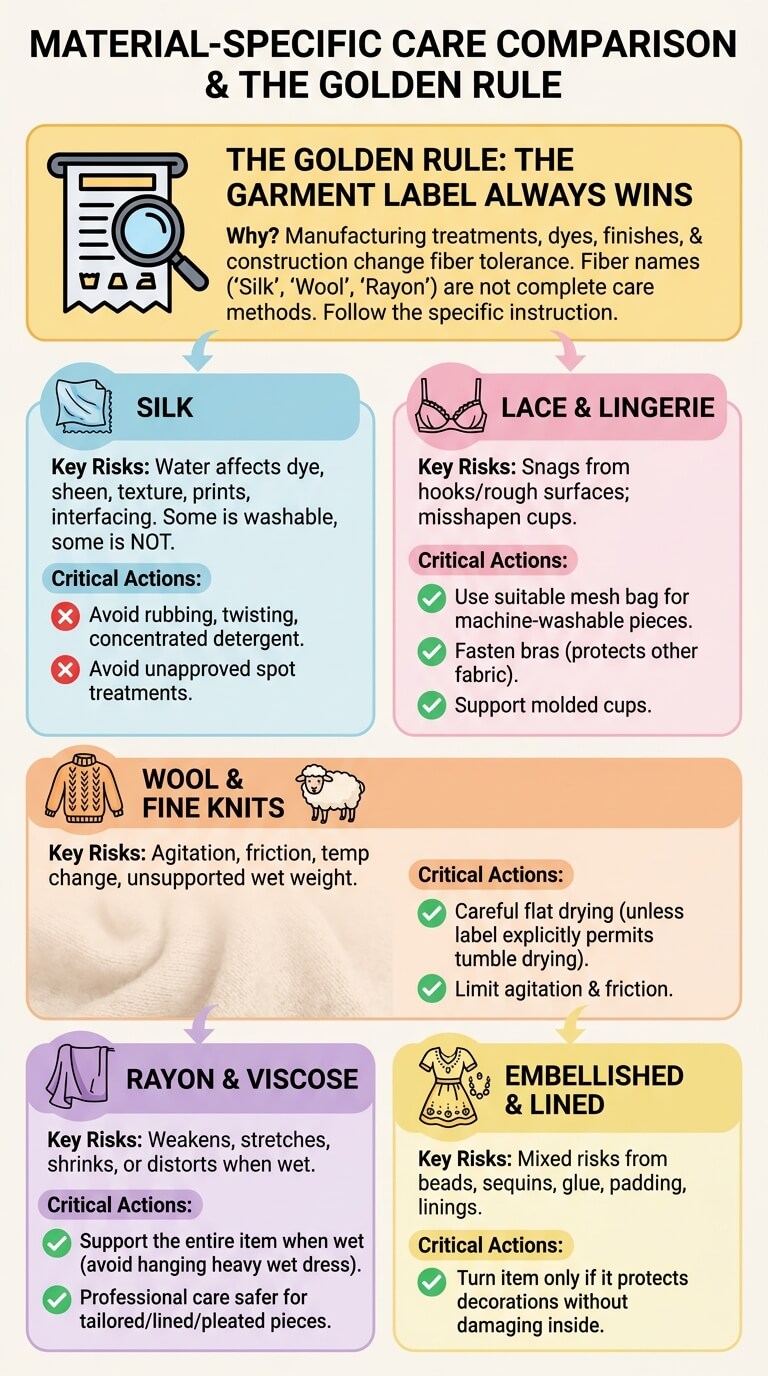
Fiber-level guidance can narrow the options, but the garment label always wins.
Silk
Some silk is washable and some is not. Water can affect dye, sheen, texture, sizing, prints, and interfacing. Avoid rubbing, twisting, concentrated detergent, and unapproved spot treatments.
Lace and lingerie
Separate lace from hooks and rough surfaces. Fasten bras when that protects nearby fabric, use a suitable mesh bag for machine-washable pieces, and support molded cups.
Wool and fine knits
Follow the specific wash claim. Limit agitation, friction, temperature change, and unsupported wet weight. Woolmark’s wool sweater drying guidance recommends careful flat drying unless the garment’s care claim permits tumble drying.
Rayon or viscose
Some rayon and viscose garments weaken, stretch, shrink, or distort when wet. Read the label closely and support the entire item. Avoid hanging a heavy wet dress from the shoulders. Professional care is safer when the piece is tailored, lined, pleated, or unlabeled.
Embellished and lined garments
Beads, sequins, embroidery, glue, padding, and linings create mixed risks. Turn the item only if that protects decorations without damaging the inside.
Why the label overrides fiber-general advice
Manufacturing treatments, dyes, finishes, pleats, coatings, and construction can change what a fiber can tolerate. “Silk,” “wool,” or “rayon” on a content label does not provide a complete care method. Follow the garment-specific instruction.
Signs of Damage During or After Washing
Inspect the garment while wet and again after drying. Check the same reference points each time: shoulder width, sleeve length, side seams, hem alignment, cup shape, trim attachment, and color consistency. Early changes are easier to document and evaluate than damage noticed after heat or storage.
Shrinkage and felting
A wool or knit item may become smaller, thicker, denser, or less flexible. Do not stretch it forcefully while wet or repeat the wash.
Stretching and distortion
Uneven hems, longer sleeves, dropped shoulders, twisted seams, or enlarged necklines indicate loss of shape. Lay the garment flat, support it, and reshape only gently within its natural dimensions.
Snags, broken threads, and trim damage
Stop pulling at a snag or loose decoration. Repair may be needed before the item is worn or washed again.
Color loss or transfer
Separate the affected item from other clothing and keep it away from heat. Identify whether color moved from the garment, another item, or a product. Do not improvise with bleach or aggressive solvents.
Water marks, stiffness, or residue
Uneven rings, a harsh feel, or visible film may come from water, product concentration, incomplete rinsing, or a finish change. Do not keep adding detergent. Review the label and seek professional advice for silk, structured pieces, or persistent marks.
Common Delicate-Laundry Mistakes
Most damage comes from treating a gentle label as permission for every gentle-sounding method.
Assuming the delicate cycle equals hand washing
A machine cycle still tumbles or agitates, drains, and spins. A hand-wash-only label should not be upgraded because the washer has a delicate button.
Wringing or hanging a heavy wet knit
Twisting strains fibers and seams, while hanging concentrates wet weight at shoulders and clips. Press water out with support, then dry flat when the label and construction require it.
Washing all lingerie or silk the same way
A sports bra, molded bra, lace bralette, silk camisole, and structured silk bodice have different risks.
Ignoring lining, trim, or structure
The outer fabric may tolerate water while the lining, glue, padding, or decorative finish does not. Examine the entire item and follow the most restrictive component.
Applying heat before checking shape and marks
Inspect residue, stains, dye transfer, seams, and dimensions before tumble drying, ironing, or steaming. Heat can set some marks, damage elastic, distort finishes, and make corrections more difficult.
Delicate Clothes FAQ
These answers cover common household decisions. The sewn-in care label and the specific product and appliance instructions remain the final limits.
Can hand-wash-only clothes go in a mesh bag?
A mesh bag reduces tangling and snagging, but it does not change a hand-wash-only instruction into permission for machine washing.
Is every silk or wool garment washable?
No. Washability depends on the garment label, dye, finish, construction, lining, trim, and structure. Some silk and wool items can be hand or machine washed, while others require professional care.
What detergent should be used for delicates?
Use a detergent whose label permits the specific fiber and wash method, then measure for the actual load or basin. Do not rely on the word “gentle” alone or mix multiple laundry products.
Should delicates be air-dried flat?
Many shape-sensitive knits and heavy wet garments benefit from flat drying, but not every delicate item requires it. Follow the drying instruction and support the garment so straps, shoulders, cups, seams, and hems do not distort.
When is professional cleaning the safer choice?
Choose professional care for required labels, structured tailoring, leather or suede trim, bonded layers, unstable dye, heavy embellishment, unknown fibers, serious damage, or valuable and sentimental garments where a failed home wash would be unacceptable.
Final Thoughts
Safe delicate care begins with a decision, not a wash cycle. Read every label, assess the whole garment, and choose machine washing, hand washing, or professional care according to the most vulnerable fiber, seam, lining, trim, or structural feature.
During washing, reduce friction and support the garment. During water removal and drying, protect its shape and wet weight. Stop when color moves, seams stretch, trims loosen, or instructions remain unclear. A conservative choice is usually easier to recover from than an aggressive experiment.

Ethan Carter is the Founder & Editor of HomeCleanSecrets. Based in the United States, he has 5 years of experience creating practical home cleaning, laundry care, stain removal, decluttering, and home organization content. His goal is to help everyday households clean smarter and build simple routines that are easier to maintain.
Read more about Ethan Carter on his author page: https://homecleansecrets.com/ethan-carter/