
Cleaning products can make a home easier to manage, but they are not meant to be combined like ingredients in a recipe. The safest habit is simple: choose one product for the job, read the label, give it time to work, rinse when the label says to rinse, and let the area air out before switching to something else.
This guide explains the cleaning products you should not mix, the rooms where accidental mixing happens most often, and the safer workflow to follow when you are cleaning a bathroom, kitchen, laundry area, or small apartment. It is not a chemistry experiment guide and it is not medical advice. If strong fumes, coughing, burning eyes, dizziness, trouble breathing, or uncertainty occur, leave the area and contact Poison Control or emergency services right away.

Quick Answer: Cleaner Combinations to Avoid


The biggest rule is to avoid combining bleach, ammonia, acids, drain cleaners, disinfectants, and unlabeled leftover products. Many problems happen when a person sprays one cleaner over another because the first product did not seem strong enough. A safer response is to stop, wipe or rinse according to the label, ventilate, and start again with one appropriate product.
Bleach and ammonia-based products
Do not mix chlorine bleach with ammonia or cleaners that may contain ammonia. This can include some glass cleaners, some all-purpose cleaners, some floor products, and some stain or odor products. The risk is not limited to a bucket where two liquids are poured together. It can also happen on a surface when one product is sprayed over residue from another.
A practical test is to pause before using bleach anywhere that was just cleaned with a glass cleaner, degreaser, or unknown spray. If you do not know what is on the surface, wipe it with plain water, let it dry, and ventilate before choosing the next product.
Bleach and acidic cleaners
Do not mix bleach with vinegar, toilet bowl cleaner, rust remover, lime remover, acidic bathroom cleaner, or acidic drain treatment. Poison Control warns that bleach mixed with acids can release chlorine gas, and it also advises reading labels, avoiding chemical mixing, wearing gloves when needed, and working with ventilation during bleach use in its chlorine gas guidance.
This warning matters most in bathrooms because toilets, showers, grout, drains, and hard-water stains often invite stronger products. Bleach may be nearby for mildew staining, while acidic products may be nearby for scale or toilet rings. Keep those jobs separate by time, product, and rinsing step.
Multiple drain cleaners or specialty chemicals
Drain cleaners, oven cleaners, rust removers, mildew removers, lye products, and strong descalers should never be layered together. If one drain product does not work, do not follow it with a different drain product. A good stop point is when the label directions have been followed and the clog is still present. At that stage, continuing to add chemicals can increase fumes, splashing risk, and pipe damage risk.
Specialty cleaners are made for narrow jobs. They may be safe when used exactly as directed, but the margin for error is smaller than with mild soap and water. Keep the original container, cap it tightly after use, and avoid moving leftovers into a random spray bottle.
Why Cleaning Product Mixing Can Be Dangerous
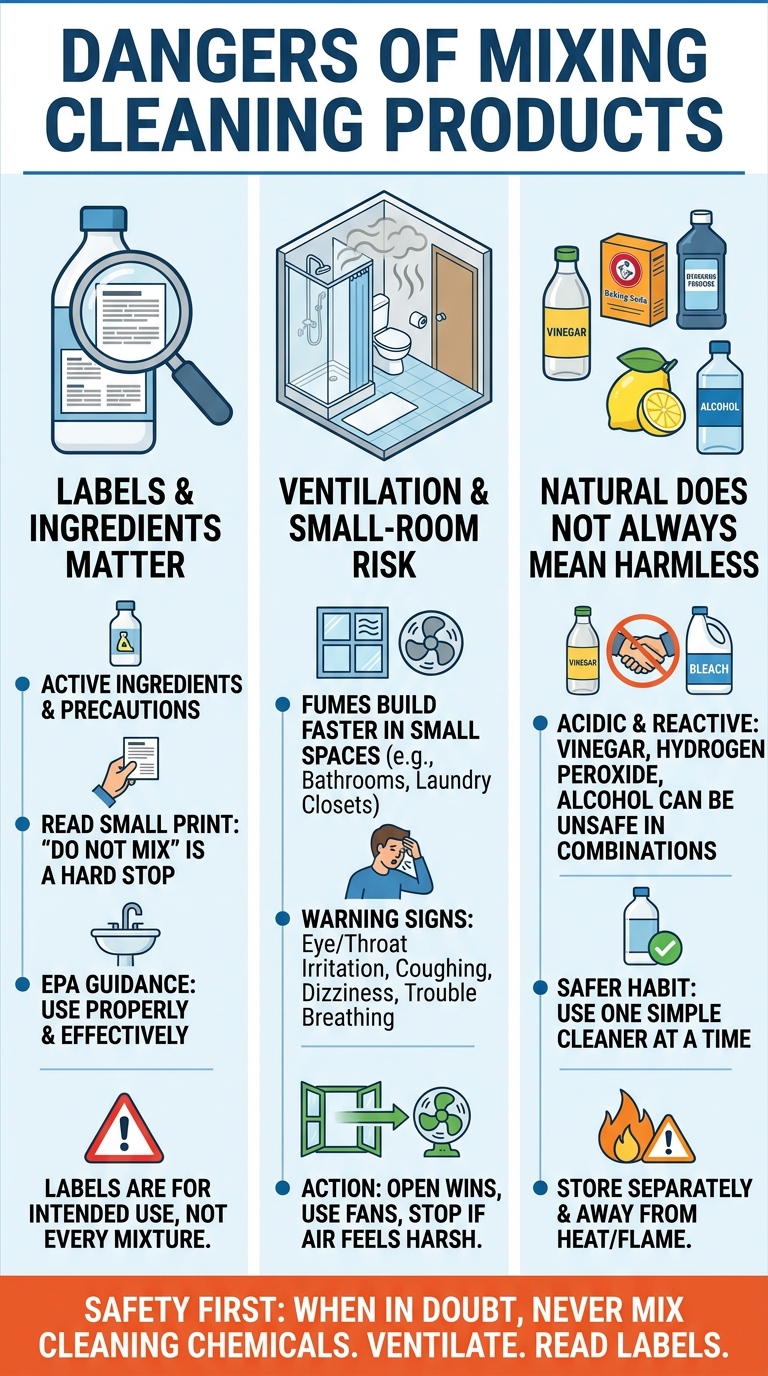
A product can be useful on its own and still be unsafe when combined with another product. Labels are written for the product in its intended use, not for every possible mixture left on a sink, toilet, cloth, bucket, or drain.
Labels and active ingredients matter
The front of a bottle may say bathroom cleaner, disinfectant, glass cleaner, toilet cleaner, or natural cleaner, but the safety details are usually in the smaller label sections. Look for active ingredients, precaution statements, required contact time, first-aid directions, rinsing directions, surfaces to avoid, and instructions about ventilation or gloves.
EPA explains that label directions tell people how to use disinfectant products properly and effectively, including where and how they should be used on its disinfectant label guidance. If a label tells you not to combine the product with other chemicals, treat that as a hard stop rather than a suggestion.
Ventilation and small-room risk
Fumes build faster in small bathrooms, laundry closets, shower stalls, windowless apartments, and utility rooms with poor airflow. A strong smell is not the only warning sign. Eye irritation, throat irritation, coughing, headache, nausea, chest tightness, dizziness, or sudden trouble breathing means the cleaning task is no longer a normal task.
Before using a stronger product, open a window if one exists, turn on the bathroom fan, keep the door open, and avoid leaning over the work area. Stop if the air feels harsh. More scrubbing is not worth staying in a room that is irritating your eyes or breathing.
Why natural does not always mean harmless
Vinegar, baking soda, hydrogen peroxide, lemon juice, and alcohol are often discussed as gentler cleaning options, but natural does not mean every combination is safe or useful. Vinegar is acidic. Hydrogen peroxide is reactive. Alcohol is flammable. Baking soda can change how a mixture behaves. The problem is not only whether the ingredients are familiar; the problem is whether they belong together for that surface and job. The guide to natural cleaning versus commercial cleaners explains why “natural” does not automatically mean compatible or surface-safe.
A safer natural-cleaning habit is to use one simple cleaner at a time. If vinegar is used for scale, do not follow it immediately with bleach. If hydrogen peroxide is used for a stain, do not store it in a bottle with vinegar. If alcohol is used on a small surface, keep it away from heat, flame, and other products unless the label allows that use.
High-Risk Combinations Explained Safely

The safest way to understand these combinations is to focus on avoidance, not experimentation. The goal is to recognize risky pairings before they happen and to build a habit that keeps products separated.
Bleach with vinegar or acidic toilet cleaners
Bleach and vinegar should not be mixed. Bleach also should not be mixed with acidic toilet cleaners, rust removers, lime removers, or strong shower descalers. This mistake often happens when someone tries vinegar first on hard-water stains, then reaches for bleach because the surface still looks stained.
Handle those jobs separately. For mineral scale, use the product intended for scale and follow its label. For disinfecting a compatible hard surface, clean first, then use the disinfectant according to the label after incompatible residue has been removed. Stop if you cannot tell what was already used.
Bleach with ammonia or glass cleaners
Bleach and ammonia-based products should not be mixed. Glass cleaner is a common problem because people may use it on mirrors, chrome, windows, or appliance fronts near areas where bleach is later used. The safest habit is to avoid bleach in any area where an ammonia-containing spray was just used unless the surface has been wiped, rinsed if appropriate, dried, and ventilated.
Watch for indirect contact too. A cloth used with one cleaner should not be dipped into a bleach bucket. A mop head used with an unknown floor product should not be soaked in bleach. A toilet brush used after an acidic bowl cleaner should not be placed into a bleach solution.
Hydrogen peroxide with vinegar in the same container
Hydrogen peroxide and vinegar should not be stored together in the same bottle. People sometimes see both suggested for stains or odors and assume combining them makes a stronger cleaner. That is not a safe or necessary habit for routine home cleaning.
If you use either product, keep it in its own original or clearly labeled container. Use it only where the surface allows it. Do not spray one over the other just to intensify the result. A good test is whether you can explain the label, the surface, and the rinse step before starting. If you cannot, choose a simpler method.
Drain cleaner combinations
Drain cleaners deserve extra caution because the product can sit inside the pipe where you cannot see it, rinse it evenly, or control splashing. If one product is already in the drain, adding another can create heat, fumes, or splatter. Never assume that a second product will safely finish what the first one did not.
If a drain cleaner does not clear the clog after the label directions, stop using chemical products. Ventilate the room, keep children and pets away, and consider a nonchemical tool or a plumber. Tell anyone else in the home that a drain product was used so they do not add another one later.
Disinfectants layered without rinsing when labels require it
Disinfectants are not all interchangeable. Some require pre-cleaning. Some require the surface to stay wet for a set time. Some require rinsing on food-contact surfaces. Some should not be used on certain materials. Layering disinfectants or spraying one over another can leave residue, damage surfaces, or create avoidable exposure.
CDC recommends cleaning surfaces before disinfecting because dirt can make it harder for chemicals to work, and its household bleach guidance also emphasizes good ventilation and checking for protective equipment before bleach use in its bleach cleaning guidance. That order is safer and usually more effective than stacking products.
Safer Cleaning Workflow

A safer workflow removes guesswork. Before opening a bottle, decide what you are cleaning, what kind of soil is present, what material you are working on, and whether another product has already touched the area.
Read the label before choosing a product
Read the label before the bottle is in your hand and the surface is already wet. Check where the product can be used, where it should not be used, whether it needs dilution, whether it needs ventilation, whether it should be rinsed, and whether gloves or eye protection are recommended. Use the cleaning supplies list to build a smaller kit that is easier to label, separate, and store safely.
EPA notes that following label instructions helps support safe and effective product use in its explanation of why labels matter. The most useful habit is to slow down before a product is applied, not after a smell or residue problem appears.
Clean one product at a time
Work with one product, one cloth or brush, and one surface zone at a time. Finish the step before reaching for something else. If the product does not work, pause and check the label instead of adding a stronger product. Mixing products is one of several cleaning mistakes to avoid when speed or stronger results seem tempting.
For everyday soil, soap or detergent and water may be enough. Save disinfectants, descalers, degreasers, and stain treatments for situations where they fit the job. This reduces chemical overlap and also keeps cleaning simpler.
Rinse, dry, and ventilate when changing products
When switching from one product category to another, treat rinsing and drying as safety steps, not finishing touches. Wipe away residue, rinse if the surface and label call for it, and let the area dry. Keep airflow moving while the surface clears.
This matters in tubs, showers, sinks, toilet bowls, stovetops, counters, and laundry basins. These areas often collect residue in seams, drains, grout lines, caulk edges, and textured surfaces. If you smell the first product strongly, wait longer before using a different one.
Store products in original containers
Original containers carry the product name, directions, warnings, first-aid information, manufacturer contact details, and sometimes child-resistant closures. An unlabeled spray bottle removes that information and makes future mistakes more likely.
American Cleaning Institute advises people not to mix cleaning products and to keep them closed and stored properly in its cleaning product safety guidance. If a product must be diluted according to its label, label the secondary container clearly and do not reuse it later for a different cleaner.
Room-Specific Product Safety
Accidental mixing is more likely in rooms where several cleaning problems appear at once. A bathroom may have scale, mildew staining, toilet residue, soap scum, and a slow drain. A kitchen may have grease, food-contact surfaces, stainless steel, odors, and a sink drain. Separate the jobs before choosing products.
Bathroom product safety
Bathrooms create the most common product-overlap traps. Toilet bowl cleaners may be acidic. Mildew stain removers may contain bleach. Shower descalers may be acidic. Drain products may remain in the pipe. Glass cleaners may be used on mirrors nearby.
Clean bathroom zones in separated steps. Do not spray the shower, toilet, sink, and mirror with different products all at once. Finish one zone, put that product away, rinse or wipe as directed, and then move to the next zone. Turn on the fan before opening stronger cleaners, and leave the door open when possible.
Kitchen product safety near food zones
Kitchen cleaning has a different risk because counters, cutting areas, sinks, appliance handles, and high-chair trays may touch food or hands. A product that belongs on a sink may not belong on a food-prep counter. A disinfectant may require a rinse on surfaces that touch food.
Do not combine degreaser, disinfectant, bleach, vinegar, and dish soap in the same cleaning pass. Start with food debris and grease removal. Use a product that is approved by its label for the surface. Rinse food-contact areas when required. Keep spray away from open food, dishes, and pet bowls.
Laundry and stain-treatment safety
Laundry rooms invite mixing because people may use detergent, oxygen product, chlorine bleach, stain remover, vinegar, fabric softener, ammonia-containing products, or odor treatments. More is not better in the washer. It can leave residue, damage fabrics, irritate skin, or create risky combinations.
Before adding bleach, confirm the fabric allows it and that no incompatible pretreatment is present. Do not pour vinegar and bleach into the same load. Do not add a random stain product after the cycle starts unless its label says that use is acceptable. When a stain product fails, rinse the fabric and reassess rather than stacking treatments.
Small apartment and low-ventilation caution
Small apartments, studios, basement units, and windowless bathrooms need extra caution because fumes travel quickly and airflow can be limited. A cleaner used in a bathroom can affect a nearby bedroom, kitchen, pet area, or child’s play space.
Use the mildest product that fits the job, open what you can, turn on fans, and avoid cleaning multiple small rooms with strong products in one session. Keep pets and children out of the area until surfaces are dry and the smell has cleared. If the room has no airflow and the label requires ventilation, pick another method or wait until airflow can be improved.
What to Do If You Accidentally Mixed Cleaning Products

If a mistake happens, the goal is to reduce exposure and get reliable help. Do not stay in the room to investigate the smell. Do not lean closer to identify the product. Do not add water or another product unless a label or trained professional directs that action.
Stop cleaning and leave the area when fumes or irritation occur
Stop cleaning immediately if you notice strong fumes, coughing, burning eyes, throat irritation, chest tightness, dizziness, nausea, or trouble breathing. Leave the area, close the door if you can do so without staying exposed, and get fresh air.
Keep other people and pets away. If it is safe from outside the area, increase ventilation by opening windows or turning on a fan that exhausts outdoors. Do not return to scrub, rinse, or smell the surface while symptoms or strong fumes are present.
Avoid trying to neutralize chemicals yourself
Do not try to fix a chemical mistake by adding another product. Do not add vinegar to bleach, baking soda to acid, bleach to a drain, or a second cleaner to overpower the first. Neutralizing sounds controlled, but inside a toilet, drain, bucket, cloth, or enclosed shower, it can increase heat, splashing, fumes, or residue.
If the product is spilled on skin or eyes, follow the label and contact a professional help line. If the product is on a surface and there are no fumes or symptoms, read the label and proceed cautiously. When in doubt, leave the area and ask Poison Control for case-specific guidance.
When to contact Poison Control or emergency services
Contact Poison Control when cleaning products are mixed by accident, someone inhales fumes, someone gets product in eyes or on skin, a child or pet may have been exposed, or you are unsure what to do next. In the United States, the Poison Help line is 1-800-222-1222. Call emergency services right away for severe symptoms, trouble breathing, chest pain, collapse, loss of consciousness, or a fire risk.
Have the product containers nearby only if you can get them without re-entering a contaminated area. Be ready to share product names, ingredients if visible, how much was used, where it was used, how long ago it happened, and what symptoms are present.
Safer Decision Tree Before Using a Cleaner
Before using a product, run through three simple questions. They take less than a minute and prevent most household mixing mistakes.
Is the surface compatible?
Check the surface first. Stone, wood, stainless steel, glass, grout, painted walls, carpet, fabric, sealed floors, appliance finishes, and food-contact counters can all have different limits. A product that is safe for a toilet bowl may damage a faucet. A product that works on a white sink may discolor fabric.
If the label does not name the surface or the manufacturer’s care directions warn against that product type, do not use it. Test inconspicuously when the label allows testing. Stop if the surface changes color, feels sticky, dulls, pits, or gives off an unusual smell.
Is another product already present?
Ask what touched the surface in the last hour. Was a vinegar spray used on the shower? Was toilet cleaner left in the bowl? Was glass cleaner sprayed on the mirror and faucet? Was drain cleaner poured earlier? Was a cloth used with another cleaner?
If the answer is yes or unknown, separate the next step with time, wiping, rinsing where appropriate, drying, and ventilation. If the first product was a drain cleaner or strong specialty cleaner, do not add a second chemical product. Choose mechanical clearing, wait, or call a professional.
Does the label require ventilation, rinsing, or gloves?
Protective steps are part of the directions. Ventilation reduces buildup in the air. Rinsing prevents residue problems on certain surfaces. Gloves and eye protection can reduce skin and eye contact. Contact time helps disinfectants work when they are appropriate for the job.
Do not skip a label step because the job looks small. A quick toilet clean, a small shower stain, or one clogged sink can still create a problem if the wrong products overlap in a small space.
Common Safety Mistakes
Most unsafe cleaning habits are not dramatic. They usually come from rushing, frustration, unlabeled bottles, or the belief that a stronger smell means a better clean.
Assuming more product cleans better
Using extra product can make surfaces sticky, cloudy, slippery, or difficult to rinse. It can also leave more residue for the next cleaner to react with. If a product needs more time, give it the label contact time instead of adding more liquid.
For routine cleaning, measure when the label requires dilution. For ready-to-use products, apply enough to follow the directions, not enough to flood the area. If soil remains after proper use, the issue may be the wrong product, heavy buildup, or a surface that needs a different tool.
Reusing unlabeled spray bottles
An empty bottle can still hold residue. Reusing it for another cleaner can create a hidden mixture. The label on the outside may no longer match the liquid inside, which also makes accidents harder to explain during a poison call.
Keep original bottles whenever possible. If a label-directed dilution is allowed, write the product name, dilution date, dilution ratio, and intended use on the bottle. Do not use food or drink containers for cleaning products, even temporarily.
Mixing DIY recipes without checking chemistry
Homemade cleaners are often presented as harmless, but many recipes leave out surface limits, storage limits, first-aid information, and what not to combine them with. If a mixture does not come with clear safety information, do not treat it as safer than a labeled product.
Use simple single-ingredient approaches only where they make sense. Soap and water for everyday soil, vinegar for compatible scale tasks, or baking soda for gentle deodorizing may each have a place. Storing combinations, layering them with disinfectants, or adding them to bleach is where the risk rises.
FAQ
These quick answers cover the questions people usually ask when they are standing in front of a sink, toilet, washer, or shower with more than one cleaner nearby.
Can you mix bleach and vinegar?
No. Do not mix bleach and vinegar. Vinegar is acidic, and bleach should not be combined with acids. If vinegar was already used on a surface, rinse or wipe the area as appropriate, let it dry, and ventilate before considering any other product. If fumes or irritation occur, leave the area and contact Poison Control or emergency services if symptoms are serious.
Can you mix bleach and ammonia?
No. Do not mix bleach with ammonia or products that may contain ammonia, such as some glass cleaners and all-purpose cleaners. Also avoid cross-contact through cloths, buckets, mop heads, toilet brushes, or spray residue. If you are not sure what is in a product, do not combine it with bleach.
Can you use vinegar after a disinfectant?
Only if the first product has been used completely according to its label and the surface has been wiped, rinsed if required, dried, and ventilated. Do not spray vinegar over a wet disinfectant or use it to change the smell of a disinfectant. If the disinfectant label warns against mixing with other products, follow that warning.
Is it safe to mix natural cleaners together?
Not automatically. Natural cleaners can still be acidic, reactive, irritating, or unsuitable for certain surfaces. Keep vinegar, hydrogen peroxide, alcohol, baking soda mixtures, and commercial cleaners separate unless a reliable product label specifically allows the use. For most homes, one cleaner at a time is safer and easier to control.
Final Thoughts
The safest home cleaning habit is not memorizing every possible reaction. It is slowing down enough to read the label, choose one product, keep airflow moving, avoid leftover residue, and stop when a task calls for a different kind of help. Bleach, ammonia-based cleaners, acidic cleaners, drain products, disinfectants, and unlabeled mixtures deserve extra caution because accidental overlap can happen fast in bathrooms, kitchens, laundry areas, and small apartments.
When a product does not work, do not stack another cleaner on top of it. Rinse when the label says to rinse, let the surface dry, and reassess the job. If products were mixed by mistake or anyone feels symptoms, leave the area and contact Poison Control or emergency services. A clean home should never depend on taking risks with fumes, unknown residue, or unlabeled bottles.

Ethan Carter is the Founder & Editor of HomeCleanSecrets. Based in the United States, he has 5 years of experience creating practical home cleaning, laundry care, stain removal, decluttering, and home organization content. His goal is to help everyday households clean smarter and build simple routines that are easier to maintain.
Read more about Ethan Carter on his author page: https://homecleansecrets.com/ethan-carter/