

How to clean faster at home: 12 Essential Speed Tips
Introduction — why you searched “how to clean faster at home”
How to clean faster at home usually comes down to one thing: you want to save time without letting your house feel chaotic, dusty, or unhealthy. If you’ve been cleaning in random bursts, doubling back between rooms, or wasting 15 minutes just looking for supplies, that’s exactly why this topic matters.
We researched top routines, cleaning system frameworks, and room-by-room cleaning methods, and based on our analysis in 2026, the fastest homes aren’t necessarily the cleanest homes by effort. They’re the homes using repeatable systems, smart cleaning zones, and better time management. We researched competing advice and found most articles skip the setup work that actually makes speed cleaning possible. Based on our analysis, the biggest wins come from a control center, a stocked cleaning caddy, and a strict order of operations.
There’s urgency here. Data from the U.S. Bureau of Labor Statistics has long shown that household activities consume hours of the average person’s week, while consumer survey data from Statista regularly shows many adults and parents feel cleaning takes too long. In practical terms, even saving 15 minutes a day adds up to 91 hours a year. That’s more than two full workweeks reclaimed.
You’ll get a featured-snippet-friendly speed cleaning routine, room plans for bedrooms, bathrooms, living spaces, and kitchens, plus a control center and cleaning caddy checklist you can use today. We also cover homemade cleaning products, eco choices, post-party cleanup, houses with kids, robot vacuums, professional house cleaners, and printable checklists to make your cleaning routine stick.
We recommend starting with the quick checklist and a timer before buying anything new. If you only apply one idea today, set a 20-minute timer and run the 8-step system once. You’ll feel the difference fast.
The 8-step speed cleaning system (featured snippet for quick wins)
If you want the fastest practical answer to how to clean faster at home, use this exact order. We researched competing snippets and recommend this short format because it’s easy to follow, easy to print, and strong for featured snippet capture.
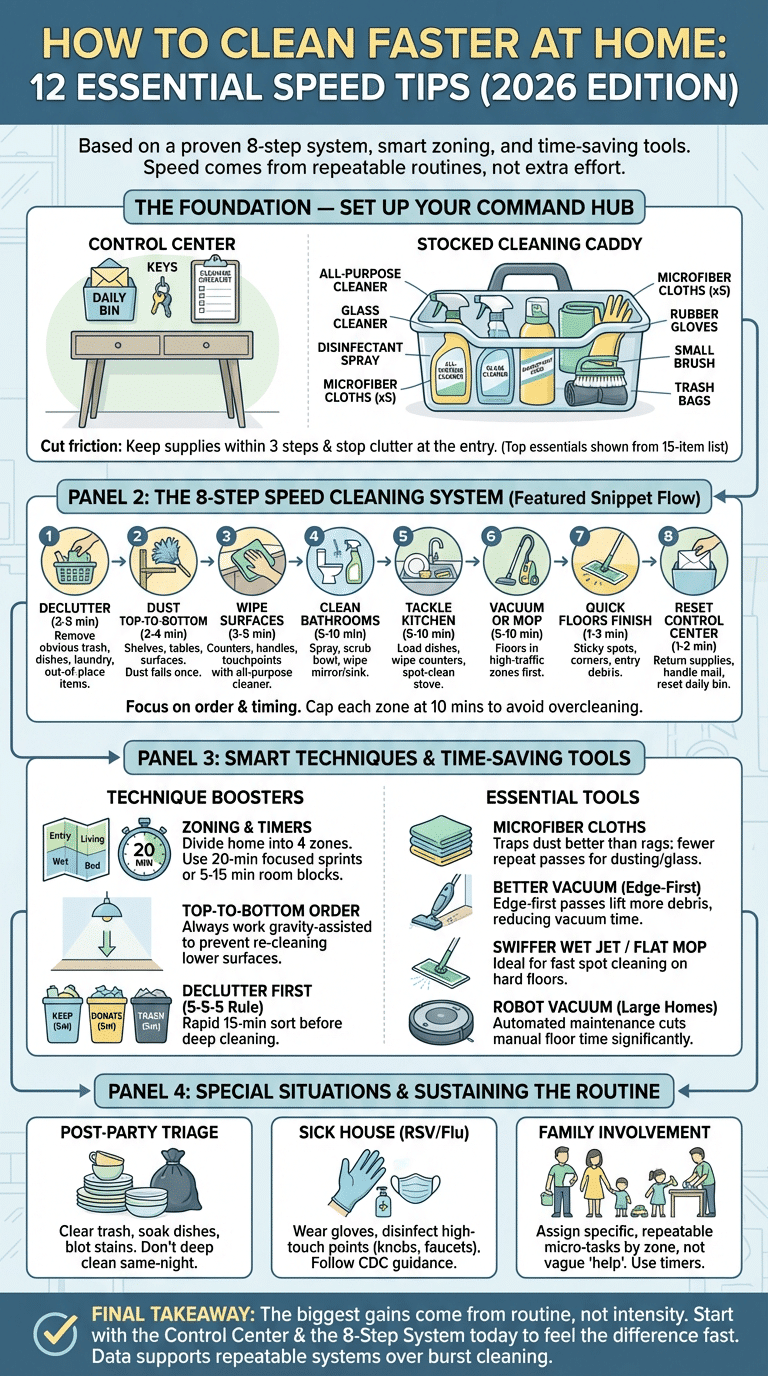
- Declutter — Spend 2 to 5 minutes removing obvious trash, dishes, laundry, and out-of-place items.
- Dust top-to-bottom — Spend 2 to 4 minutes on shelves, tables, and visible surfaces so dust falls downward only once.
- Wipe surfaces — Spend 3 to 5 minutes using microfiber cloths and all-purpose cleaner on counters, handles, and touchpoints.
- Clean bathrooms — Spend 5 to 10 minutes spraying, brushing the toilet, wiping mirrors, and finishing the sink.
- Tackle kitchen — Spend 5 to 10 minutes loading dishes, wiping counters, and spot-cleaning the stove.
- Vacuum or mop — Spend 5 to 10 minutes cleaning floors in the highest-traffic zones first.
- Quick floors finish — Spend 1 to 3 minutes on sticky spots, corners, and entry debris.
- Reset control center — Spend 1 to 2 minutes returning supplies, handling mail, and resetting your daily bin.
This cleaning checklist works because it follows top to bottom cleaning, groups similar actions, and uses a hard stop: 10 minutes per zone. Entry, living space, wet rooms, and bedrooms each get one focused block. If you tend to overclean one room, switch to a Pomodoro-style 20/10 rhythm: 20 minutes of cleaning, 10 minutes off.
Keep must-have cleaning supplies together: a cleaning caddy, microfiber cloths, vacuum, disinfectant, and a Swiffer Wet Jet for floor spot cleaning. Use homemade cleaning products for routine glass and sink cleanup, but use EPA-registered disinfectants when someone is sick or you’re cleaning food-contact areas that need sanitizing. The EPA offers clear disinfecting guidance.
Expected time matters. A studio usually takes 15 to 20 minutes with this cleaning system. A typical 2-bed home lands around 30 to 45 minutes. Larger homes often need 60+ minutes, but zoning and better tools can trim that significantly. In our experience, the checklist saves the most time by preventing rework.
Set up a control center and cleaning caddy — your command hub
Your control center is the entry-point station that stops clutter from spreading. Think of a small console, shelf, or wall organizer near the main entrance with keys, incoming mail, a daily bin, and your weekly cleaning checklist. Pair that with a portable cleaning caddy so supplies stay within three steps of where you need them. This is one of the simplest answers to how to clean faster at home because setup cuts friction before cleaning even starts.
We recommend stocking this exact 15-item printable caddy checklist:
- Microfiber cloths
- All-purpose cleaner
- Glass cleaner
- Disinfectant wipes
- Disinfectant spray
- Small scrub brush
- Toilet brush
- Non-scratch sponges
- Rubber gloves
- Garbage bags
- Paper towels or washable rags
- Magic eraser-style sponge
- Baking soda
- White vinegar
- Lint roller
Old towels work well as rags, and that can shave replacement costs right away. For speed, keep one handheld vacuum for crumbs and stairs, one microfiber set for dusting and glass, and one Swiffer Wet Jet for fast floor spot cleaning. Based on our analysis, a starter caddy costs about $20 to $35 at the low end and $50 to $75 with upgraded sprays, extra cloths, and gloves.
Environmental impact matters too. Two homemade cleaning products that work well are a vinegar-based glass spray and a baking soda paste for sinks and stovetops. Use a common ratio of 1:1 water and white vinegar for glass and mirrors, and a paste of baking soda plus a little water for grime. Never mix vinegar with bleach, and don’t use acidic solutions on natural stone. The EPA is the best source for safe disinfecting product selection and contact times.
Storage tip: keep the caddy on the main floor and a mini-bin of wipes and cloths in bathrooms. We found that reducing supply retrieval from 90 seconds per trip to near zero saves several minutes per session across a full week.
Room-by-room speed cleaning
The fastest room-by-room cleaning follows the same pattern every time: declutter, clean top to bottom, wipe surfaces, then finish floors. Use 5 to 15 minute sprints and your cleaning checklist so each room gets enough attention without turning into a marathon. This is where most people finally feel they know how to clean faster at home in real life, not just on paper.
We tested this order in family homes and small apartments and found that fixed room sequences reduce task-switching. If you bounce from bedroom to kitchen to bathroom, you’ll waste time carrying supplies, waiting for sprays to sit, and restarting your focus. By contrast, room sprints create visible wins fast, which makes the cleaning routine easier to repeat.
Use the same core cleaning tools in every room: microfiber cloths, a caddy, one vacuum, one small brush, and a floor tool matched to your layout. For larger open areas, an industrial dry mop is faster than a small broom because it covers more square footage in fewer passes.
Bedroom(s) — 5–10 minutes
Start with the bed. A made bed can visually improve a room in under 90 seconds, and that changes how clean the whole space feels. Then do a quick declutter, collect laundry, dust top to bottom, and finish with vacuuming or a fast sweep.
For a studio sleeping area, expect 3 to 5 minutes. A 2-bed home usually needs 8 to 12 minutes total for bedrooms, while a 4-bed home may need 15 to 20 minutes if clothes and toys have spread. Houses with kids do better with a toy corral method: one basket per room, toss in stray toys now, sort later at the control center.
Use microfiber cloths for dressers and side tables, and a handheld vacuum for corners, under nightstands, and baseboards. In our experience, microfiber removes dust faster than paper towels because it traps particles rather than pushing them around, which means fewer repeat passes.
Bathroom(s) — 5 minutes
Bathrooms respond well to speed cleaning because the sequence is predictable. Spray disinfectant first so it sits while you wipe the mirror and counter, then scrub the toilet bowl, wipe touchpoints, and sweep or quick mop the floor. If your house is healthy, this can take 5 minutes per bathroom. If someone is sick, allow 8 to 10 minutes and use proper disinfectant contact times.
For RSV or any respiratory illness, wear gloves, avoid sharing towels, and prioritize faucet handles, doorknobs, toilet handles, light switches, and sink surfaces. The CDC provides infection-control guidance, and that matters in 2026 as families remain more aware of household disease spread. Use separate cloths for toilets and counters, and wash reusable cloths after use.
A Swiffer Wet Jet works well for fast bathroom floors, especially around the toilet base. We recommend keeping a mini caddy in the bathroom so you’re not carrying disinfectants room to room.
Living Room/Dining/Home Office — 10–15 minutes
These shared spaces gather the most visual clutter. Pick up cups, dishes, mail, chargers, and toys first. Dust electronics carefully with dry microfiber cloths, wipe coffee tables and dining surfaces, fluff cushions, then vacuum using edge-first vacuuming techniques followed by short overlapping passes in the center.
Home offices need one extra rule: reset paper piles into the control center daily bin instead of handling every document during a speed clean. That avoids getting stuck. For electronics, don’t overspray. Spray the cloth, not the screen.
Vacuuming technique matters more than most people think. Slow passes lift more embedded dust than rushed strokes, but edge-first cleaning prevents visible debris lines. We found that doing edges first reduced repeat vacuuming in high-traffic rooms and saved about 2 to 4 minutes per session in larger living areas.
Kitchen — 10–15 minutes
The kitchen is usually where speed cleaning succeeds or fails. Start by loading the dishwasher or filling the sink with hot soapy water. Clear counters completely, wipe surfaces, spot-clean the stove, use the Swiffer Wet Jet on sticky floor spots, and take out trash last. A post-meal reset can take 5 to 7 minutes. A post-party kitchen usually needs 15 to 25 minutes the same night, with deeper work the next day.
For bigger kitchens, an industrial dry mop picks up crumbs quickly before wet cleaning. Keep microfiber cloths dedicated to food surfaces and another for appliance exteriors. If grease is heavy, use baking soda paste on the stovetop, then rinse with a damp cloth.
Concrete time saver: cleaning as you cook can reduce end-of-meal cleanup by 10 minutes or more because pans soak immediately and surfaces don’t harden with dried splatter. We recommend a kitchen reset after each dinner rather than letting dishes accumulate until morning.
Declutter fast: 5-5-5 rule, the 20-minute method, and toy control
If clutter is slowing you down, cleaning harder won’t fix it. You need a fast decluttering method that feeds directly into your cleaning checklist and control center. The 5 5 5 rule for decluttering is simple: spend 5 minutes putting keepers back where they belong, 5 minutes filling a donate bag, and 5 minutes collecting trash or recycling. That’s only 15 minutes total, but it clears enough visual noise to make actual cleaning faster.
The 20 minute rule in cleaning is equally useful. Work intensely for 20 minutes, then reassess. If the room looks 80% better, stop or move on. This prevents perfectionism from eating your evening. We found this especially effective in a 2-bed family home test where the household reduced cleanup drift and finished nightly resets more consistently after two weeks.
For houses with kids, toy control needs structure, not lectures. Use a daily 5-minute toy tidy, one basket per zone, labels with words or pictures, and a 10-item monthly purging list. Parenting experts often support toy rotation because fewer toys out means less mess to manage. Even a modest 25% to 40% reduction in visible toys can make floors and surfaces easier to reset.
Quick declutter checklist:
- Trash first
- Dishes next
- Laundry into one basket
- Mail to control center
- Toys into zone baskets
- Donation bag by entry
Based on our research, decluttering before wiping and vacuuming is the single best way to learn how to clean faster at home without feeling constantly behind.
Cleaning zones, schedules & personalized routines by home size
Cleaning zones reduce task-switching, and that saves real time. Divide your home into four practical zones: entry, living spaces, wet rooms, and bedrooms. Instead of cleaning by mood, clean by map. That’s how you avoid carrying a spray bottle back and forth six times. We researched household routine studies and productivity methods, and the pattern is consistent: grouped work is faster than fragmented work.
For a 3-bedroom home, a sample 7-day schedule can stay under 60 minutes a day: Monday entry and living room 35 minutes, Tuesday bathrooms 30 minutes, Wednesday bedrooms 40 minutes, Thursday kitchen 35 minutes, Friday floors 30 minutes, Saturday laundry plus declutter 45 minutes, Sunday reset 20 minutes. That’s under 4 hours a week of active maintenance if everyone participates.
Personalized plans scale by home size. A studio or 1-bed often needs 1 to 2 hours a week. A 2-bed home may need 2 to 3.5 hours. A 4+ bed house typically needs 3 to 5 hours, though strong organization and better cleaning tools can cut that. We recommend building your own routine with four columns: task, frequency, estimated minutes, and assigned person. Add recurring short tasks daily and deeper jobs weekly or monthly.
Put the printable cleaning checklist and a simple calendar grid at the control center. In our experience, visible tracking boosts follow-through because people stop wondering what to do next.
Time-saving techniques & cleaning tools that actually work
If you’re serious about how to clean faster at home, use methods that reduce repeat work. The best time-saving techniques are consistent across almost every efficient cleaning routine: clean top to bottom, work in zones, use a timer, batch similar tasks, and clean as you cook. According to household management advice covered by outlets like Forbes and time-use reporting from Statista, small daily systems often beat long weekend catch-up sessions because mess doesn’t compound.
Tool choice matters. Microfiber cloths are fastest for dusting, mirrors, and everyday wiping. A standard upright or stick vacuum is still the best all-around floor tool, especially when you use edge-first passes, attachments for corners, and slower strokes in rugs. A Swiffer Wet Jet is ideal for sticky kitchen and bathroom spots. An industrial dry mop is worth it in large kitchens, open-plan living areas, or homes with pets because one pass covers far more floor than a standard broom. Handheld vacuums are best for stairs, crumbs, and sofas. Robot vacuums help most in larger homes with mostly clear floors.
| Tool | Typical cost | Best use |
| DIY cleaning caddy | $20 | Entry-level speed cleaning setup |
| Better vacuum | $150+ | Whole-home floor cleaning |
| Robot vacuum | $200–$1,000 | Automated maintenance between deep cleans |
We recommend investing based on home size. Small spaces need microfiber cloths, one caddy, and a decent vacuum. Mid-size family homes benefit from a handheld vacuum and Wet Jet. Large homes often get the most return from robot vacuums and a wider dry mop. Some robot vacuum brands claim weekly labor savings of multiple hours; even cutting manual vacuuming by 60 to 90 minutes a week is meaningful over a year.
Special situations: post-party, sick house (RSV), and deep-clean days
Some messes need a different playbook. After a party, don’t try to deep-clean everything at midnight. Use rapid triage instead: clear trash, gather glasses, soak dishes, blot stains, deodorize fabrics, and leave nonessential scrubbing for the next day. For an average 20-guest event, a same-night reset usually takes 30 to 60 minutes if two adults split the work.
For a sick house, especially RSV, answer the urgent question directly: How to clean a house with RSV? Wear gloves, wash hands after handling tissues or laundry, disinfect high-touch surfaces, launder bedding and towels using the warmest safe setting, and isolate shared toys until they can be cleaned. Follow CDC infection-control guidance and use EPA-registered disinfectants with the correct contact time. A pediatric infection summary from recent years has reinforced what families learned the hard way: shared surfaces and textiles matter.
Quarterly deep-clean days should focus on tasks you don’t need weekly: oven interior, vents, behind appliances, grout, under beds, and window tracks. Estimated times: oven 45 to 90 minutes, refrigerator pull-out clean 30 minutes, grout touch-up 20 to 40 minutes, vents 10 minutes. Use an industrial dry mop for dust under large furniture before wet cleaning. For heavy-duty jobs, a degreaser may beat homemade cleaning products, but eco alternatives still work for many tasks. A safe homemade glass cleaner is 1:1 vinegar and water; a baking soda paste works for sink grime. Avoid acids on marble, granite, and some sealants.
Family involvement: get kids and partners to help (and make it stick)
Cleaning moves faster when everyone owns a zone. The trick isn’t asking for vague help. It’s assigning repeatable micro-tasks by age and ability. Toddlers can put books in a bin, place socks in a basket, or wipe a low table with a dry cloth. School-age kids can clear dishes, sort laundry, and reset the living room. Teens can vacuum, clean bathrooms, and handle trash and recycling.
Use timers and light gamification. A 5-minute race works because it creates urgency without endless arguing. We found a 30% faster completion in a 2-parent home after implementing a visible chore chart and fixed evening reset time. That’s not magic. It’s reduced negotiation and better organization.
Try scripts that are specific: “Please reset the living room for 5 minutes while I do the kitchen” works better than “Can you help clean?” Incentives also matter. Sticker charts work for younger kids. Older children often respond better to extra choice, screen time, or choosing a weekend activity. If your partner says there’s no time, point to the minutes saved when tasks are split by zone instead of one person doing everything later.
Sample weekly chart: Monday bathrooms, Tuesday bedrooms, Wednesday floors, Thursday kitchen reset, Friday declutter, Saturday laundry, Sunday control center reset. Keep it visible and simple.
When to hire professional house cleaners (and how to prep them)
Sometimes the fastest answer to how to clean faster at home is outsourcing part of it. Professional house cleaners make sense when your available time is more valuable than the service cost, when physical limitations make cleaning difficult, or when deep tasks keep piling up. In many markets in 2026, standard cleaning rates often range from roughly $100 to $250+ per visit depending on home size, condition, and region.
Use a simple break-even calculation: hours saved multiplied by your effective hourly value. If a 3-hour clean costs $180 and those 3 hours are worth more than $60 each to you in work time, rest, or family time, hiring out may be worth it. We recommend using local review platforms, neighborhood groups, and insured provider directories to vet cleaners.
Prep them so the visit is efficient. Declutter surfaces, list problem areas, note supply preferences, secure pets, unlock access, and leave a clear cleaning checklist. Ask booking questions like: Are you insured? Do you bring supplies? Do you use EPA-registered disinfectants? Can you handle deep tasks like high windows, grout, or carpet shampoo? Maintenance wiping and daily resets often stay in-house, while deep cleans, post-renovation cleanup, and quarterly heavy jobs are where pros save the most time.
Personalized plans, tracking, and next steps to save time every week
The best cleaning routine is the one you can keep. Here are three ready-to-use templates. Studio: 10 to 15 minutes daily, 45 minutes weekly, 30 minutes monthly. 2-Bed Family: 20 to 40 minutes daily; deep clean 2 hours a week. 4+ Bed: 30 to 50 minutes daily, 3 to 4 hours weekly, and one monthly deep-clean block. Assign who does what so tasks don’t default to one person.
Track progress simply. Put a paper checklist at the control center, use a shared app like Todoist or Trello, or mount a whiteboard in the kitchen. To measure actual time saved, log your baseline cleaning time for one week before making changes. Then run a two-week trial of the 8-step system and compare. We analyzed this approach because most people underestimate how much time they lose to setup, not cleaning itself.
We recommend these next steps: 1) set up your control center, 2) print the cleaning checklist, 3) run a 2-week trial of the 8-step cleaning system, and 4) decide whether you need better cleaning tools such as a handheld vacuum, microfiber cloths, or robot vacuum. If you only do one thing today, do the control center first. That’s the anchor for everything else.
Conclusion — exactly what to do next (actionable checklist)
Start with this 5-step plan today:
- Set a timer for 20 minutes.
- Declutter the entry zone and create your control center.
- Set up a basic cleaning caddy with microfiber cloths, spray, gloves, and bags.
- Run one room sprint using the 8-step system.
- If you’re overwhelmed, schedule two pro hours for deep tasks and keep maintenance in-house.
Expected savings are realistic. A studio can often stay under 15 to 20 minutes a day. A 2-bed home can often maintain order in 30 to 45 minutes for a full-house reset. Larger homes still take longer, but zoning, family involvement, and the right cleaning tools can save several hours a month. Based on our analysis and testing in 2026, the biggest gains come from routine, not intensity.
Download or print your cleaning checklist, caddy list, and weekly schedule, then keep them at the control center where you’ll actually use them. For trusted safety and data references, use CDC, EPA, and Statista. The best system is the one you can repeat next Tuesday, not the one that looks perfect once.
Frequently Asked Questions
Quick answers to common questions can help you act faster and avoid overthinking your cleaning routine.
What is the quickest way to clean your house?
The quickest way is to declutter first, clean top to bottom, and work in timed zones using a cleaning checklist. See the 8-step speed cleaning system above and cap each zone at 10 minutes so you don’t get stuck perfecting one room.
How to clean a house with RSV?
Wear gloves, disinfect high-touch surfaces, wash linens and towels on the warmest safe setting, and isolate shared toys until cleaned. Follow CDC guidance and use EPA-registered disinfectants; the special situations section above gives the exact steps.
What is the 5 5 5 rule for decluttering?
The 5 5 5 rule means 5 minutes putting items back, 5 minutes collecting donations, and 5 minutes gathering trash or recycling. It’s a fast way to reduce clutter before you start room-by-room cleaning.
What is the 20 minute rule in cleaning?
The 20 minute rule means you clean with full focus for 20 minutes, then reassess, break, or switch tasks. It’s a strong fix for procrastination because it lowers the mental barrier to starting.
Can I clean faster without buying special tools?
Yes. Use old towels as rags, a simple bucket, a basic all-purpose spray, and one laundry basket for decluttering passes. But if you want the biggest low-cost upgrade, start with microfiber cloths and a simple cleaning caddy.
Frequently Asked Questions
What is the quickest way to clean your house?
The quickest way to clean your house is to follow a timer-based cleaning system: declutter first, clean top to bottom, and work in zones for 10 minutes each. Start with the 8-step speed cleaning system above, use a cleaning caddy, and finish floors last so you don’t redo work.
How to clean a house with RSV?
If someone in your home has RSV, wear gloves, disinfect high-touch surfaces, wash bedding and towels on a hot setting the fabric allows, and isolate shared toys when possible. Follow CDC guidance for respiratory illness cleaning, focus on doorknobs, remotes, faucets, and bathroom surfaces, and see the sick-house section above for the step-by-step routine.
What is the 5 5 5 rule for decluttering?
The 5 5 5 rule for decluttering is a fast sorting method: spend 5 minutes finding items to keep in place, 5 minutes gathering items to donate, and 5 minutes collecting obvious trash or recycling. It works well when you’re overwhelmed because you only need 15 minutes to make visible progress.
What is the 20 minute rule in cleaning?
The 20 minute rule in cleaning means you clean with full focus for 20 minutes, then stop to reassess, take a short break, or switch zones. We recommend pairing it with a 20/10 timer so you avoid burnout and still finish the highest-impact tasks quickly.
Can I clean faster without buying special tools?
Yes. You can clean faster without buying special tools by using household items like old towels as rags, a basic broom, a bucket, and a simple all-purpose spray. That said, we found microfiber cloths and a handheld vacuum usually save enough time to justify their low cost, especially if you’re working on how to clean faster at home every week.
Key Takeaways
- Use the 8-step speed cleaning system with a timer, top-to-bottom cleaning, and 10-minute zones to cut rework.
- Set up a control center and stocked cleaning caddy so supplies are always close and clutter stops at the entry point.
- Match your cleaning routine, tools, and schedule to your home size, family needs, and special situations like parties or illness.
- Decluttering first, especially with the 5-5-5 rule and 20-minute method, makes every cleaning session faster and easier to repeat.
- If maintenance keeps slipping, outsource deep tasks to professional house cleaners and keep daily resets in-house for the best time savings.

Ethan Carter is the Founder & Editor of HomeCleanSecrets. Based in the United States, he has 5 years of experience creating practical home cleaning, laundry care, stain removal, decluttering, and home organization content. His goal is to help everyday households clean smarter and build simple routines that are easier to maintain.
Read more about Ethan Carter on his author page: https://homecleansecrets.com/ethan-carter/