
Learning how to organize laundry supplies is less about making a shelf look pretty and more about making products easier to find, safer to store, and harder to overbuy. Detergent, pods, boosters, dryer sheets, mesh bags, lint tools, clothespins, and backup bottles all need different rules. When they are mixed together in one crowded cabinet, you lose track of what you own and the products you need most often end up buried behind extras.
This guide focuses on the supply system only. It does not cover a full laundry room layout, detailed stain removal, washer cleaning, dryer cleaning, or a complete laundry sorting method. The goal is to build a clear storage setup for laundry products and small tools so every item has a reason to be in the room, a safe location, and a simple return spot after each load.

Quick Answer: Sort Supplies by Use, Safety, and Frequency
Supply storage is only one part of a larger laundry room organization plan, so keep the product system connected to how laundry moves through the room.
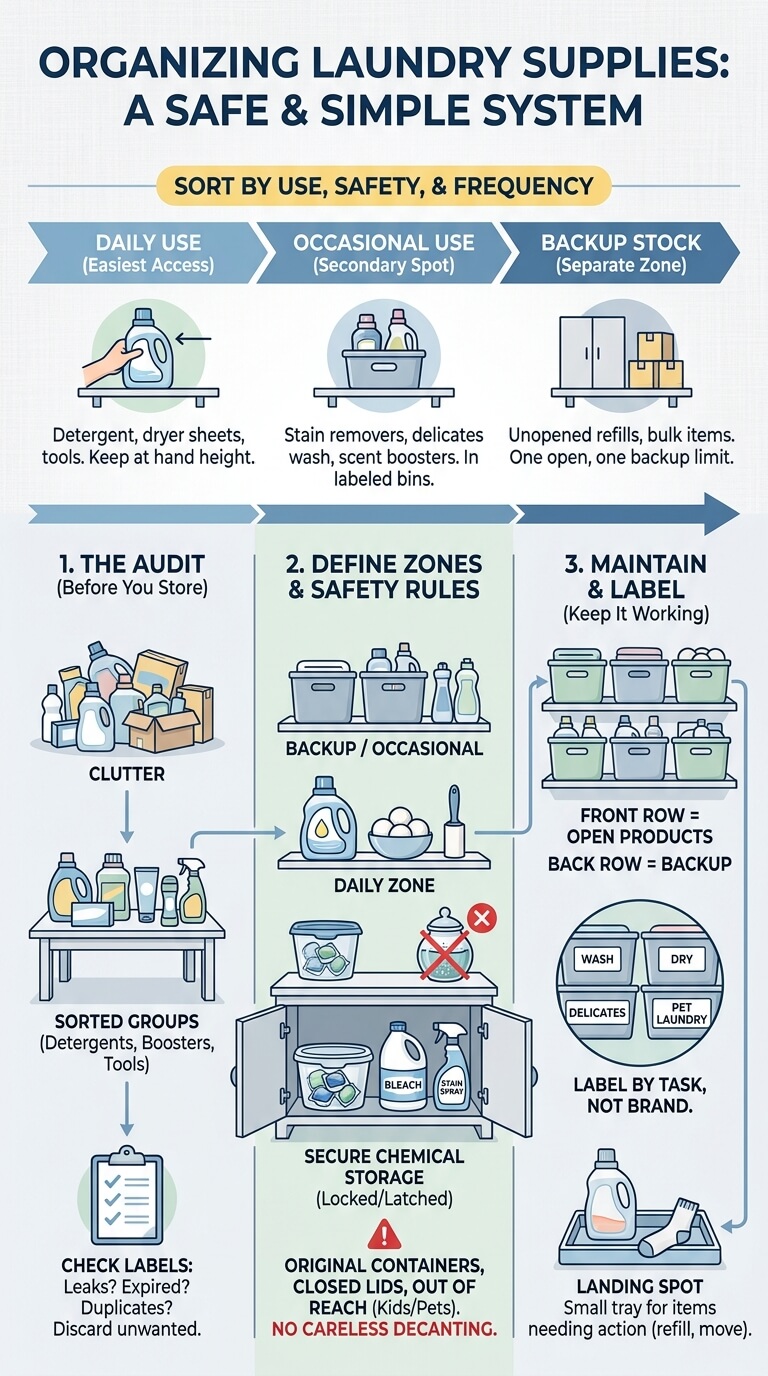
The fastest way to make laundry supply organization work is to divide products by how often you use them, how carefully they need to be stored, and whether they are current items or backup stock. A daily detergent bottle does not need the same space as an unopened refill. Laundry pods need different protection than clothespins.
Daily-use products
Daily-use products are the items you reach for during normal loads. This usually includes your main detergent, fabric softener if you use it, dryer sheets or wool dryer balls, a stain pre-treat product if it is part of your regular routine, and a small tool such as a lint roller or measuring cup. Keep this group together at hand height when possible, but not on top of a machine if vibration, heat, or spills make that area unreliable.
Occasional-use products
Occasional products include specialty detergents, delicates wash, scent boosters, laundry sanitizer, color catcher sheets, garment bags, clothespins, and items used for seasonal bedding or guest linens. These do not need the prime shelf. Give them a secondary bin, upper cabinet, or labeled tray so they remain available without crowding the everyday items.
Backup stock and overflow
Backup stock is useful only when you can see it and use it before buying more. Store unopened detergent, refill bags, extra dryer sheets, and bulk packages in a separate backup area. That area can be a high shelf, a lower cabinet, or a nearby utility closet if the laundry room is small. Put only one active container in the daily zone.
Products that should not be mixed or decanted carelessly
Some products need to stay in original packaging because the label carries directions, warnings, ingredient context, and first aid details. This matters most for pods, liquids, powders, sprays, bleach products, sanitizing products, and anything with child-resistant packaging. The American Cleaning Institute recommends reading and following laundry product safety directions, and that is hard to do if the product has been poured into an unmarked jar.
Start With a Laundry Supply Audit
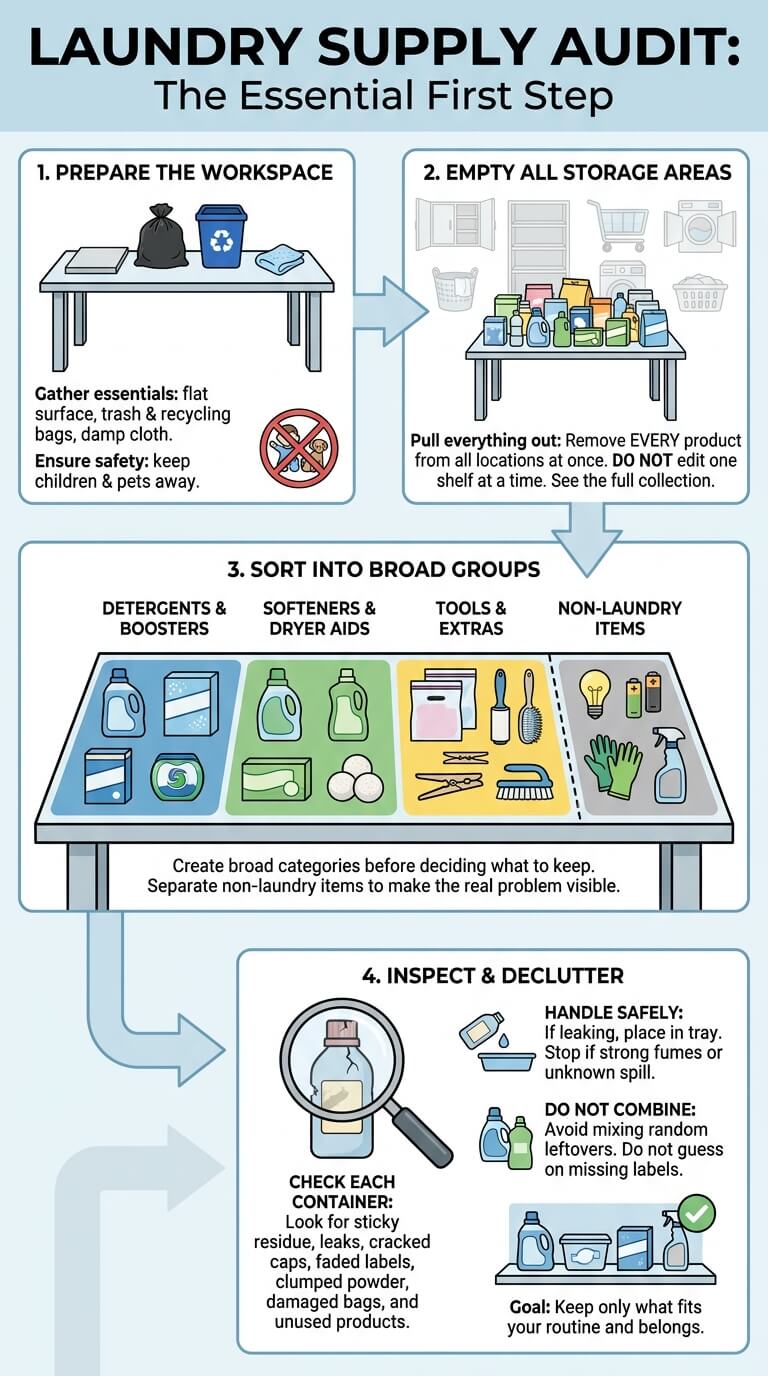
Before buying bins or labels, take inventory. A supply audit shows what you actually own, what is duplicated, what leaked, what no longer fits your routine, and what belongs somewhere else. Plan for a flat work surface, a trash bag, a recycling bag if your local rules allow, and a damp cloth for wiping sticky containers. Keep children and pets away during the audit, especially if products will be out of cabinets for a while.
Pull everything out of cabinets, shelves, and baskets
Remove every laundry product from cabinets, shelves, carts, counters, machine tops, floor corners, and random baskets. Do not edit one shelf at a time if the room has supplies in several places, because duplicates will stay hidden. Put the items on a table, counter, or protected floor area where you can see the full collection. Check under utility sinks, behind doors, and inside bins that have not been opened recently.
Group detergents, boosters, softeners, dryer products, delicates tools, and cleaning extras
Create broad groups before deciding what to keep. Put main detergents together, then powders, pods, scent products, fabric softeners, dryer sheets, wool dryer balls, delicates bags, lint tools, clothespins, hangers, and laundry-related cleaning extras. This is also the moment to separate non-laundry items such as light bulbs, batteries, gardening gloves, pet supplies, and household cleaners that only ended up there because there was shelf space. Grouping makes the real problem visible.
Check labels, leaks, duplicates, and expired or unwanted products
Look at each container before putting it back. Check for sticky residue, cracked caps, faded labels, clumped powder, damaged pod bags, and products that no one uses anymore. Do not combine random leftovers to save space. Do not guess about a product if the label is missing. If a container is leaking, place it in a secondary tray while you read the label for handling and disposal guidance. Stop if you smell strong fumes, see an unknown spill, or cannot identify what leaked.
Decide What to Keep in the Laundry Room
A laundry room should hold the supplies that support actual laundry tasks in that space. It should not become a warehouse for every household cleaner, every backup bottle from a sale, or every tool that lacks a better home. The simplest rule is to keep current laundry items in the laundry room and move rare, bulky, or unrelated supplies to a safer or more practical location.
Supplies needed every load
Every-load supplies deserve the easiest access. Most homes need one main detergent, one measuring tool if the cap is hard to read, one dryer product if used, and one small bin for clothespins, garment bags, or lint tools used repeatedly. If you have a front-loading machine and use a drawer, place the detergent close to that side of the machine. If you use a top-loader, choose a shelf or cart that does not force you to reach across an open lid.
Supplies needed weekly or monthly
Weekly or monthly items can sit one step away from the active zone. Delicates wash, bedding products, color catchers, specialty cycle products, and extra hangers can go into a labeled bin or upper shelf. Keep them visible enough that you remember they exist, but not so visible that they crowd the detergent you use daily.
Items better stored elsewhere
Move unrelated cleaners, paint, pesticides, bulk paper goods, tools, and seasonal home supplies out of the laundry room unless the space is designed for utility storage and has safe clearances. Laundry areas often have appliances, water hookups, heat, vibration, and narrow walking paths. Heavy or unrelated items can make it harder to reach shutoff valves or keep products away from children and pets.
How much backup stock is reasonable
A practical backup limit is the amount you can store without blocking daily products or hiding older containers. For many homes, that means one unopened detergent, one refill pack, or one extra dryer product, not a full shelf of every item. Larger families may need more, but the backup zone should still have a maximum line. Write the limit on a shelf label or inside a cabinet door: one open, one backup.
Safe Storage Rules for Laundry Products
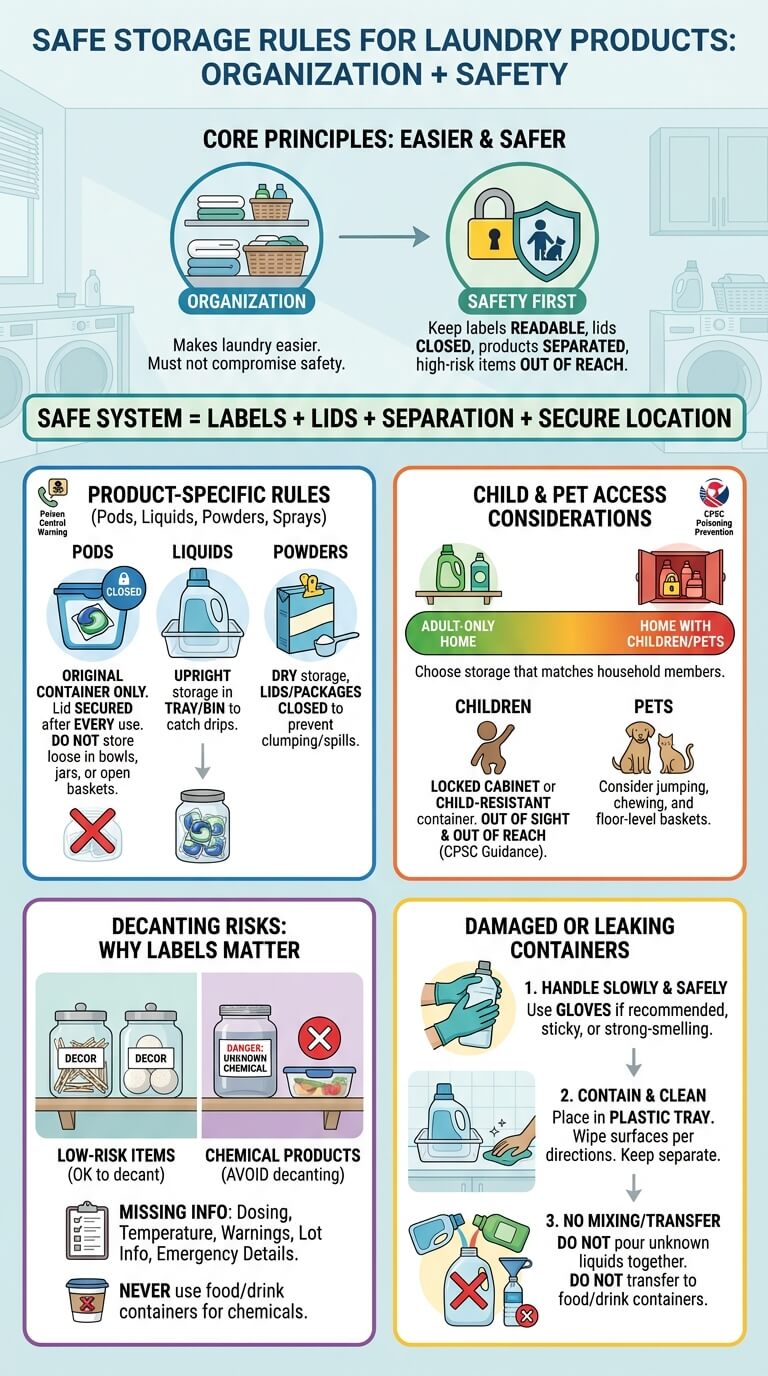
Organization should make laundry easier without making products less safe. Laundry products can be attractive to children and pets, especially colorful pods, scented products, and containers that look like food storage. The safest system keeps labels readable, lids closed, products separated by type, and high-risk items out of casual reach.
Pods, liquids, powders, and sprays
Pods should stay in their original container or package with the closure secured after each use. Liquids need upright storage in a tray or bin that can catch small drips. Powders need dry storage with lids or packages closed so they do not clump or spill. Poison Control warns about the risks of laundry detergent pods, so do not store them loose in bowls, jars, or open baskets.
Child and pet access considerations
Choose storage that matches the people and animals in the home. A high shelf may be enough in an adult-only home, but a home with children may need a locked cabinet or child-resistant container kept closed. Pet owners should also think about jumping, chewing, and floor-level baskets. The Consumer Product Safety Commission has household poisoning prevention guidance that emphasizes keeping hazardous products out of sight and out of reach.
Why product labels matter before decanting
Decanting can make a shelf look calmer, but it can also create problems. The original container may include dosing instructions, temperature guidance, warnings, lot information, and emergency details. If you still decide to decant a low-risk item such as clothespins or dryer balls, that is different from decanting a chemical product. If you decant any laundry product, keep the original label information nearby and use a container that cannot be mistaken for food or drink.
What to do with damaged or leaking containers
Handle leaking products slowly. Put on gloves if the label recommends them or if the product is sticky, strong-smelling, or unknown. Place the damaged container in a plastic tray, wipe nearby surfaces according to the product directions, and keep it away from other products until you know what it is. Do not pour unknown liquids together, and do not transfer a leaking product into a drink bottle or food container.
Organize Supplies by Storage Type
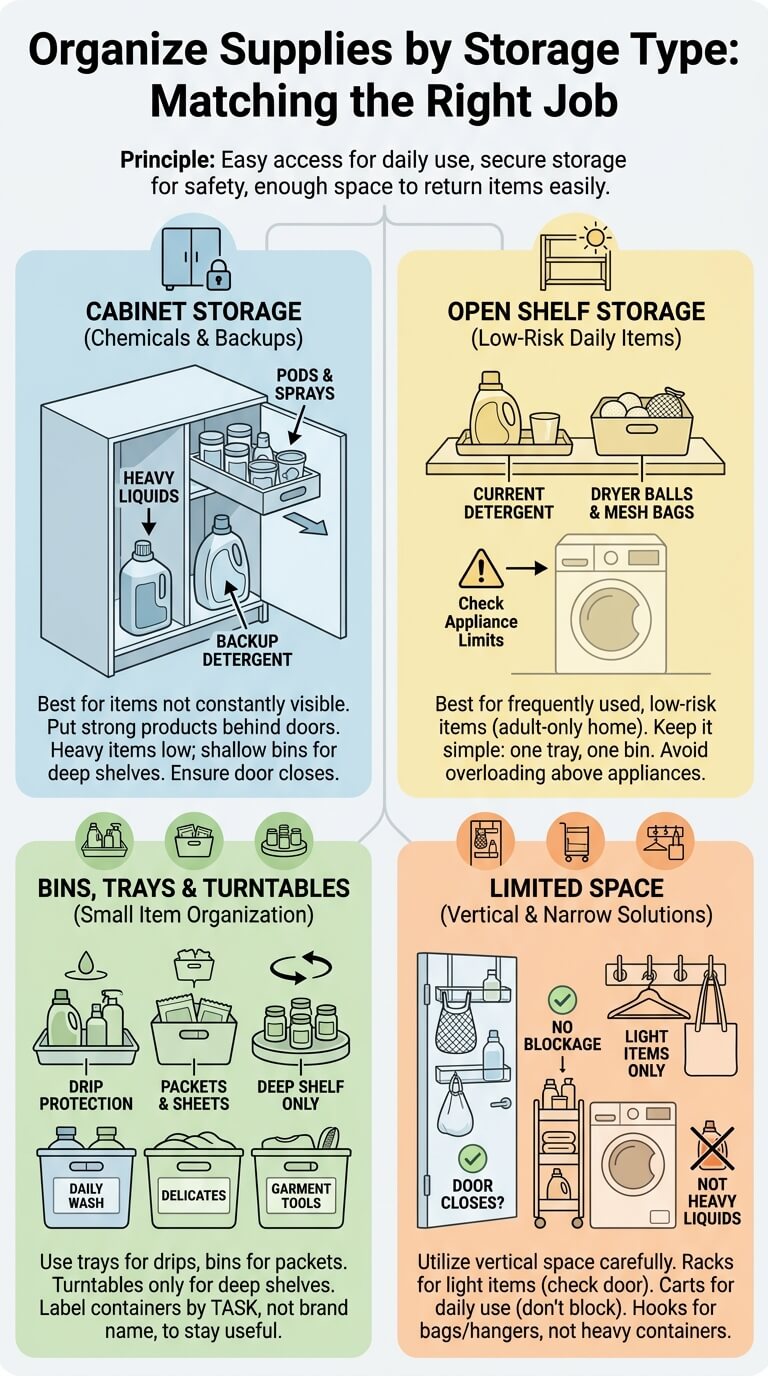
The best storage type depends on the product, the room, and who uses the space. Cabinets, open shelves, bins, trays, turntables, door racks, carts, and wall storage all work when they are matched to the right job. A good setup should make the daily product easy to grab, protect items that need safer storage, and leave enough space to return each item without rearranging the shelf.
Cabinet storage for chemicals and backup products
For a closet laundry area, product storage also has to protect door movement and appliance access, so it helps to organize a laundry closet around those limits.
Cabinets are the best choice for products that should not be constantly visible or easy to access. Put pods, strong products, sprays, and backup liquids behind a closed door. Heavier bottles should sit on lower shelves, not above shoulder height. If the cabinet is deep, use a shallow bin for each group so you can pull the group forward instead of reaching behind bottles. Check that the cabinet door closes fully after you add bins.
Open shelf storage for low-risk daily items
Open shelves work best for lower-risk, frequently used items such as a current detergent bottle in an adult-only home, dryer balls, mesh bags, clothespins, lint rollers, and empty baskets. Keep the shelf simple. One tray for daily products and one bin for small tools is usually better than five decorative containers. If the shelf is above a washer or dryer, check the appliance manual and shelf installation limits before adding heavy bottles or wall-mounted storage.
Bins, trays, and turntables for small bottles
Small products disappear quickly when they are lined up loose. Use a tray for bottles that can drip, a bin for packets or sheets, and a turntable only when the shelf is deep enough to spin without knocking items over. Label the container by task rather than by product name: daily wash, delicates, dryer, garment tools, backup. This keeps the system useful even when brands change.
Door racks, narrow carts, and wall storage for limited space
In a tight room, supplies should take up as little floor space as possible, so use small laundry room storage ideas that keep daily products reachable.
Small laundry rooms and laundry closets often need vertical storage, but every added rack must leave doors, appliance lids, vents, handles, and walkways usable. A door rack can hold mesh bags, lint rollers, dryer sheets, clothespins, and lightweight bottles if the door closes properly. A narrow cart can hold daily products if it does not block appliance access. Wall hooks are better for delicates bags and hangers than for heavy liquid containers.
Create a Product System That Is Easy to Maintain
A supply system fails when it takes too much effort to put things back. The maintenance plan should be built into the storage itself. The daily item goes in front, backup goes behind or elsewhere, labels describe the task, and a tiny holding spot catches items that need a decision. This is how the cabinet stays readable after a normal week.
Front row, back row, and backup zones
Set the front row for open products only. Place unopened duplicates behind them or in a separate backup bin. Do not keep two open detergents in the active zone unless they serve clearly different loads, such as regular and delicates. If you have deep shelves, add a riser or pull-out bin so the back row is visible. The point is not to hide clutter.
Labels by task instead of fancy categories
Useful labels sound like actions: wash, dry, delicates, hang, lint, backup, refill. They help another person put things away without memorizing your system. Avoid over-specific labels that become wrong when a product changes. A bin labeled scent boosters and dryer sheets may work today, but a bin labeled dry is easier to keep accurate. Put labels at the front edge of a shelf or bin where they can be seen without pulling everything out.
Inventory marks for refill timing
A simple reset routine helps you keep the laundry room clean and organized without letting backup products pile up again.
Add a small refill mark for products that run out suddenly. This can be a sticky note inside the cabinet, a mark on a clear bin, or a line on your shopping list that says buy detergent when the backup is opened. EPA Safer Choice encourages consumers to pay attention to product labels and safer product choices, and its label information is a useful reminder that buying decisions and storage decisions are connected.
A small landing spot for items that need attention
Create one small tray or bin for items that are not ready to return to normal storage. This might include a nearly empty bottle, a product with a sticky cap, a garment bag that needs to dry, or a tool that belongs in another room. Keep the landing spot small enough that it cannot become a second junk basket. Clear it during a weekly reset or before the next shopping trip.
Special Laundry Supply Categories
Not every laundry supply is a detergent bottle. Small tools and specialty items can make laundry easier, but only when they have a storage rule. If they float around loose, they become clutter and get replaced too often because no one can find them.
Delicates bags, clothespins, wool balls, and lint tools
Store soft tools together in one breathable bin or drawer. Mesh bags can be clipped together with a small ring or placed inside the largest bag. Clothespins need a small open container near the drying area, not the detergent shelf. Wool dryer balls can live in a bowl, fabric bin, or dryer-side basket, as long as the container is easy to return them to after a load.
Ironing and steaming supplies
Ironing supplies need a safer storage plan than small fabric tools. Store the iron or steamer only after it has cooled according to the manufacturer instructions. Keep distilled water, pressing cloths, starch sprays, and steamer accessories in one labeled bin or shelf area. If the board is wall-mounted, confirm the mount is secure and does not block doors, machines, or walking paths.
Pet laundry supplies
Pet homes often need a separate mini-zone for washable bed covers, pet towels, lint tools, and products used only for pet laundry. Keep these items separate from human delicates and guest linens so the next load is easier to identify. Do not store pet products where a dog or cat can chew packaging or knock over bottles. If a product is used only for pet bedding, label it by that task rather than leaving it with everyday detergent.
Guest or shared-house supplies
In a shared home, labels need to be clearer and product access needs to be fair. Create a guest or shared bin with basic detergent instructions, a measuring tool, and simple boundaries for what is communal. Keep personal products in separate bins if roommates use different detergents or scent levels. The best shared setup avoids mystery bottles and half-used containers scattered across the room.
Mistakes to Avoid With Laundry Supply Organization
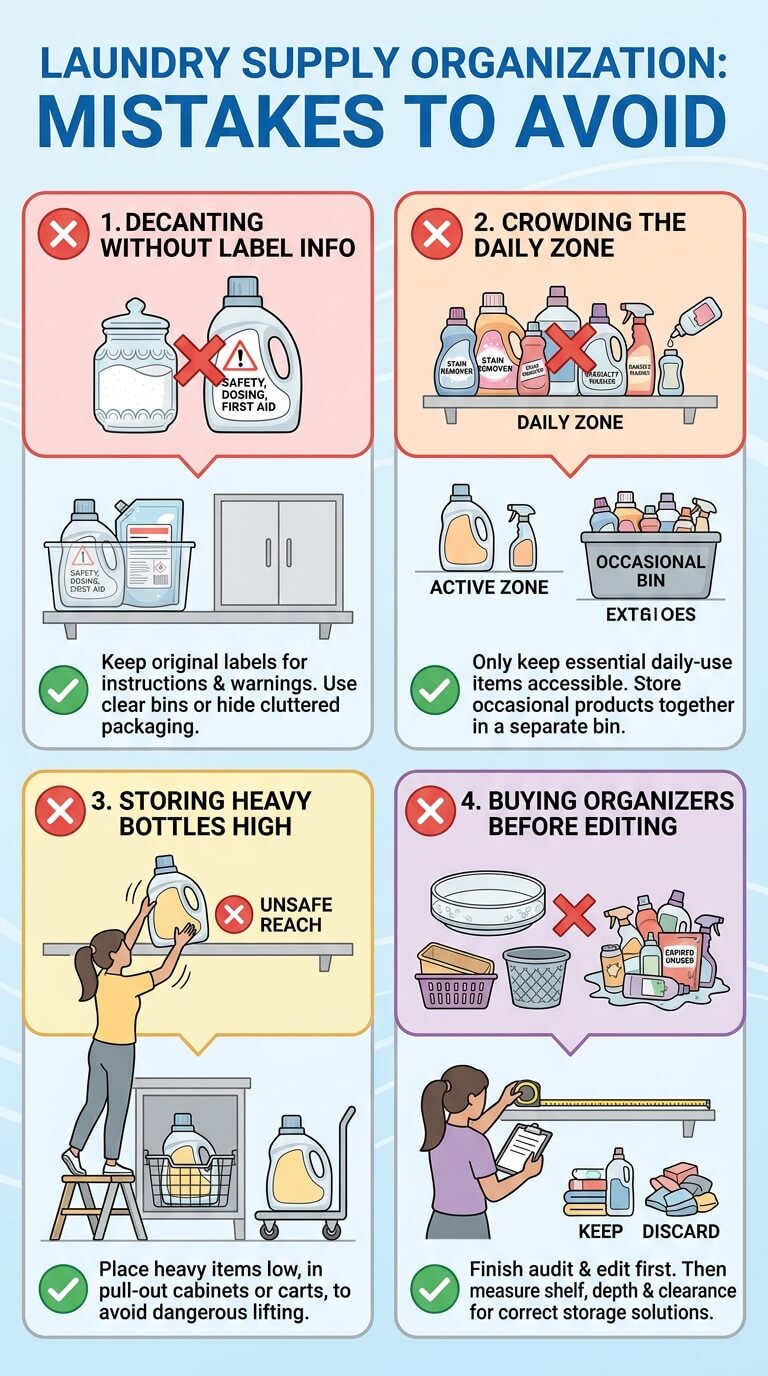
Most laundry supply problems come from skipping the edit, hiding labels, buying containers too early, or storing heavy and high-risk products where they are hard to control. The following mistakes are common because they make the room look organized for a day, then make normal laundry harder by the end of the week.
Decanting without label information
Do not pour detergent, pods, powders, or sprays into decorative containers just to match a shelf. If the product label contains dosing directions, safety warnings, storage instructions, or first aid details, that information needs to remain available. A clear bin that holds original packages can still look neat without removing the label. If you want a calmer shelf, hide visual clutter behind a cabinet door instead of removing essential product information.
Keeping every stain product in the daily zone
It is easy for the daily shelf to become crowded with specialty products. Keep only the stain or pre-treat item you actually use during normal laundry in the active zone. Store occasional products together in a separate bin and check them before buying more.
Storing heavy bottles too high
Large detergent jugs, refill bottles, and bulk containers should not be placed where someone has to stretch, tip, or lift awkwardly over shoulder height. Heavy bottles are better on a lower shelf, in a pull-out cabinet, or in a cart with stable wheels. If a product is too heavy to lift safely when full, decanting into a smaller working bottle may seem tempting, but keep the original label information and choose a clearly marked container that cannot be confused with food or drink.
Buying organizers before editing products
Buying bins first usually locks you into the wrong system. You may buy a turntable for bottles that should be discarded, a shelf riser for products that belong elsewhere, or a cart that blocks a narrow walkway. Finish the audit before measuring for storage. Then measure the shelf height, cabinet depth, door clearance, and bottle size.
Adjacent Problems to Solve Next
Sometimes the supply shelf is not the only problem. Product clutter can be a symptom of a room layout issue, a confusing sorting habit, or a missing maintenance check. When the supply system is edited and labeled but the room still feels hard to use, look at the way laundry moves through the space.
When supply clutter is actually a room layout problem
If supply clutter is spread across the floor, machines, and several shelves, the better next step may be to organize the whole laundry room instead of only rearranging bottles.
If products keep landing on the washer, dryer, floor, or folding counter, the room may not have a practical supply zone. The fix may be a shelf, cabinet, narrow cart, or wall hook near the point of use, not more labels inside a distant cabinet. In a small laundry room or closet, the supply zone may need to be shallow and vertical.
When a sorting system would reduce product confusion
When people choose the wrong product because loads are mixed together, it may help to create a laundry sorting system that separates loads before products are chosen.
If people keep asking which product to use, the issue may be the load categories rather than the shelf. A simple sorting system can make product choices clearer: regular clothes, delicates, towels, pet items, or bedding. The supply area can then mirror those categories lightly without becoming complicated. For example, delicates wash belongs with garment bags, while pet laundry tools belong in a small pet-laundry bin.
When a maintenance checklist prevents duplicate buying
Duplicate buying happens when no one knows what is open, what is backed up, and what is nearly empty. A short monthly supply check can prevent this. Look for one open product, one backup if needed, damaged containers, missing labels, and items that migrated into the wrong bin. This is not a deep cleaning routine. It is a quick inventory habit that keeps the supply system from sliding back into clutter.
FAQ
These questions focus on storage, safety, and maintenance decisions for laundry supplies. The best answer can vary by product, household, and room layout, so check product labels and manufacturer directions when they give specific limits.
Should laundry detergent be stored in the laundry room?
Yes, laundry detergent can usually be stored in the laundry room when the space is dry, accessible for adults, and suitable according to the product label. Keep containers closed, upright, and away from children and pets. If the laundry area is damp, cramped, or shared with unrelated chemicals, a nearby utility cabinet may be better for backup stock.
Is it okay to decant laundry products?
Decanting is not ideal for many laundry products because the original packaging often includes directions, warnings, dosing details, and emergency information. If you decant a product, keep the original label information available and use a clearly marked container that cannot be mistaken for food or drink. Items such as clothespins, dryer balls, and mesh bags are much safer to decant than chemical products.
How do I organize laundry pods safely?
Keep laundry pods in the original package with the closure secured, and store them out of sight and reach of children and pets. Do not put pods in open jars, bowls, baskets, or containers that make them look like candy or snacks. Place the package in a closed cabinet or locked location if your home needs that level of protection.
How many backup laundry products should I keep?
Keep only the amount you can store without hiding current products or blocking the daily zone. A simple rule is one open product and one backup for the categories you use constantly. Bigger households may need more, but the backup area should still have a limit so the cabinet does not become a stockpile you cannot read.
What is the best way to label laundry supplies?
Label by task instead of brand. Labels such as wash, dry, delicates, pet laundry, lint tools, backup, and refill are easier to maintain than labels tied to one product name. Place labels where they are visible when the cabinet, shelf, or bin is opened. The label should help someone return the item quickly, not decorate the container.
Final Thoughts
A good laundry supply system makes the next load easier and the next shopping trip calmer. Start by auditing what you own, keep daily products in the easiest safe spot, move backups out of the active zone, and protect label information for products that need careful handling. Once the supplies are sorted by use, safety, and frequency, the laundry room feels less crowded without needing a complicated makeover.

Ethan Carter is the Founder & Editor of HomeCleanSecrets. Based in the United States, he has 5 years of experience creating practical home cleaning, laundry care, stain removal, decluttering, and home organization content. His goal is to help everyday households clean smarter and build simple routines that are easier to maintain.
Read more about Ethan Carter on his author page: https://homecleansecrets.com/ethan-carter/