

A linen closet works best when every shelf answers one simple question: what does this household need to reach quickly? Towels, sheets, washcloths, guest pillowcases, and small cleaning cloths should not compete in the same collapsing stack. When the closet has clear zones, laundry returns faster, guests are easier to prepare for, and clean linens stay clean until someone actually needs them.
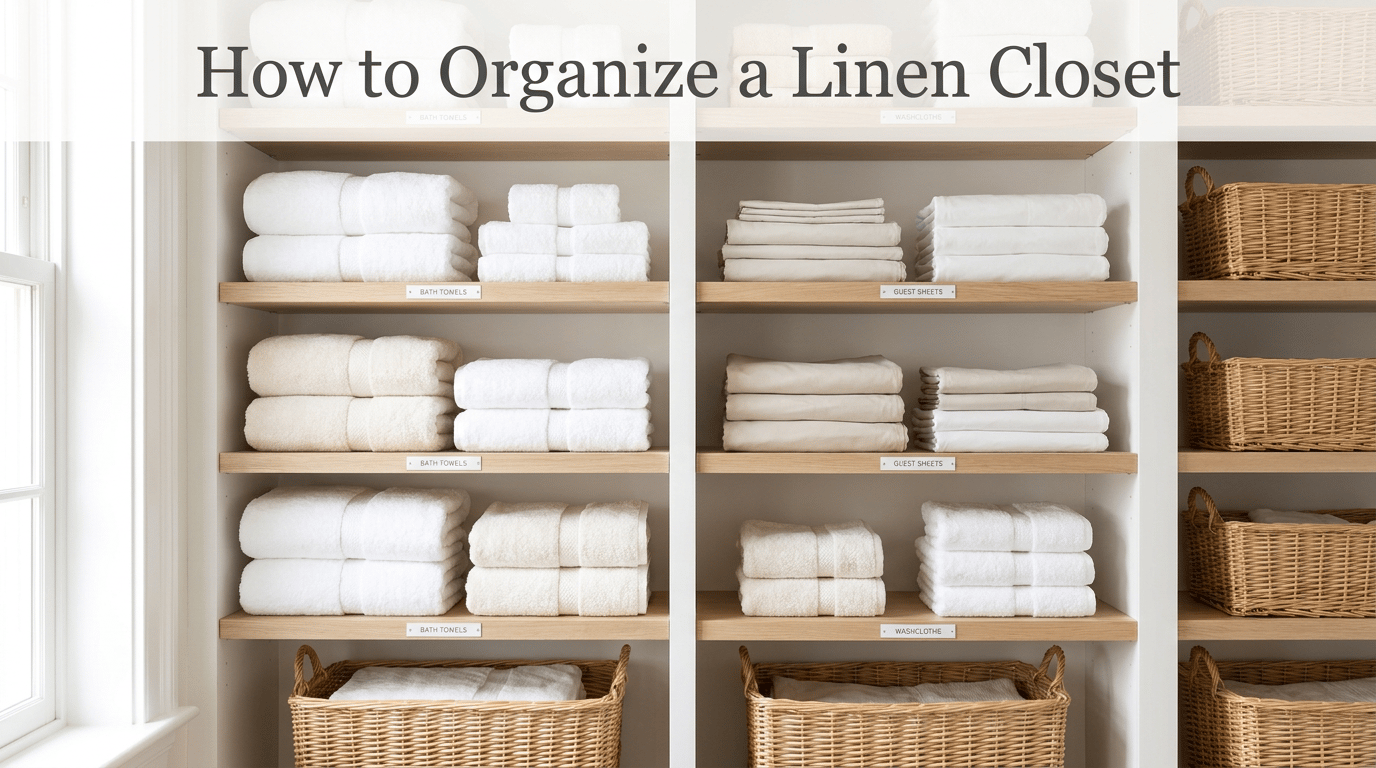
Learning how to organize a linen closet is about giving daily linens the best shelf space, limiting backups, separating messy categories, and checking condition before you store anything. A good test is whether someone else can find a bath towel, a queen sheet set, and a clean hand towel without asking.
Quick Answer: The Best Linen Closet Setup
The best linen closet setup puts everyday towels at eye level, sheet sets together by bed size, guest linens above daily items, small cloths in shallow bins, and bulky bedding outside the main daily zone when space is tight. Keep the closet simple enough that clean laundry can return to the right shelf in one minute.
Group by household use
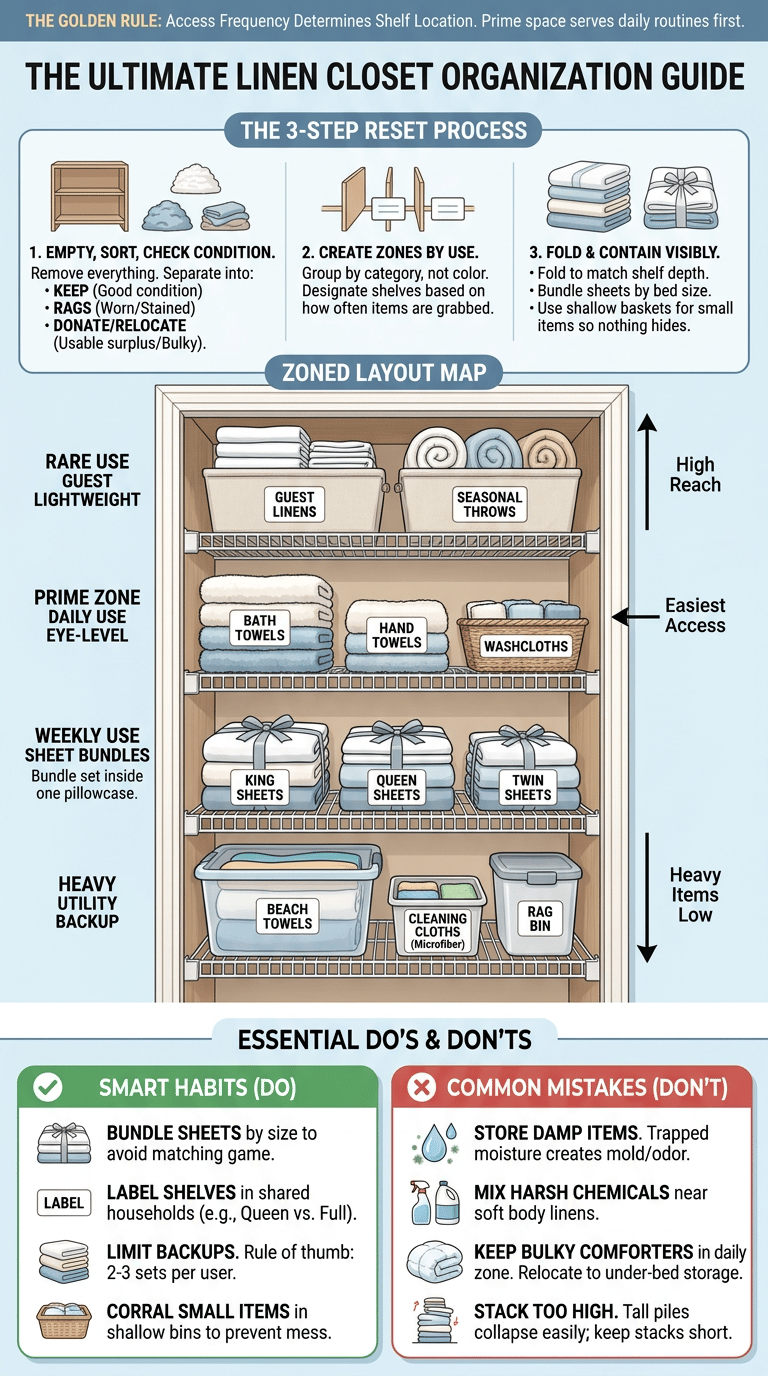
Start with use, not color. Group bath towels with bath towels, hand towels with hand towels, sheet sets with the bed size they fit, and cleaning cloths away from face and body linens. This makes the closet easier because nobody has to decode a decorative system before grabbing what they need.
Keep daily linens at eye level
Eye-level shelves should hold the items used several times a week. In many homes, that means bath towels, hand towels, washcloths, and the sheet sets currently in rotation. If those shelves are packed with guest blankets, beach towels, old pillow inserts, or decorative shams, the closet will feel messy even after a long organizing session. Prime space should serve daily routines first.
Limit backup quantities
Backups are useful until they hide what you actually use. A practical baseline is two to three towel sets per regular user, one or two active sheet sets per bed, and a small extra set for guests or accidents. Large households may need more, but the limit should still be visible.
Store bulky bedding elsewhere when needed
Comforters, thick blankets, mattress toppers, and large seasonal quilts can overpower a linen closet. If one bulky item takes an entire shelf, move it to a bedroom closet, under-bed storage, a labeled bedding bin, or another dry area.
A linen closet should support the rest of your home storage, not become an overflow zone for everything. For the bigger structure, connect this setup with the closet organization and clothing storage guide.
If you also use the linen closet for off-season items, keep those categories clearly separated. It is better to store seasonal clothes in a defined system than to mix them with towels and sheets.
What Belongs in a Linen Closet
A linen closet should hold household soft goods that are clean, dry, and used often enough to justify shelf space. It can also hold a small amount of bathroom or laundry support, but only if those items do not leak, stain, scent, or crowd the linens.
Everyday towels
Everyday towels include bath towels, hand towels, washcloths, and sometimes hair towels or gym towels. Sort them by size before folding. A mixed stack of bath towels and hand towels looks full but becomes frustrating when someone needs one specific size. Keep the most used towel size on the easiest shelf and place the rest nearby in smaller stacks.
Sheet sets
Sheet sets should stay together by bed size. A fitted sheet, flat sheet, and matching pillowcases can be folded into one bundle or tucked inside one pillowcase. Label sizes such as Twin, Full, Queen, and King if your home has more than one bed. This prevents the common problem of unfolding three fitted sheets before finding the one that fits the guest room.
Guest linens
Guest linens deserve a clear but less central zone. Store guest towels, pillowcases, spare sheets, and a light guest blanket above the daily shelf or in a labeled bin. Keep only what you would confidently offer to someone staying overnight. If guest linens are stained, rough, or mismatched beyond usefulness, decide whether they should become cleaning rags, pet towels, or donations instead of taking premium shelf space.
Cleaning cloths
Cleaning cloths can live in a linen closet if they are clean, dry, and contained separately from body linens. Use a small basket for microfiber cloths, dusting cloths, and old towel rags. Do not mix cloths used with harsh cleaners into the same stack as bath towels. Wash and store cleaning textiles according to fabric care guidance, and check laundry basics from the American Cleaning Institute laundry guidance when labels or fabric types are confusing.
Items that should not share the shelf
Avoid storing damp towels, open liquids, loose cleaning chemicals, leaky toiletries, pest products, candles that can transfer scent, and anything that sheds dust onto clean linens. If bathroom tissue, paper towels, or toiletries must share the closet, keep them in a separate zone below or beside linens. Stop if you see discoloration, sticky residue, strong fumes, or any sign that products are touching fabric.
Step 1: Empty, Sort, and Check Condition
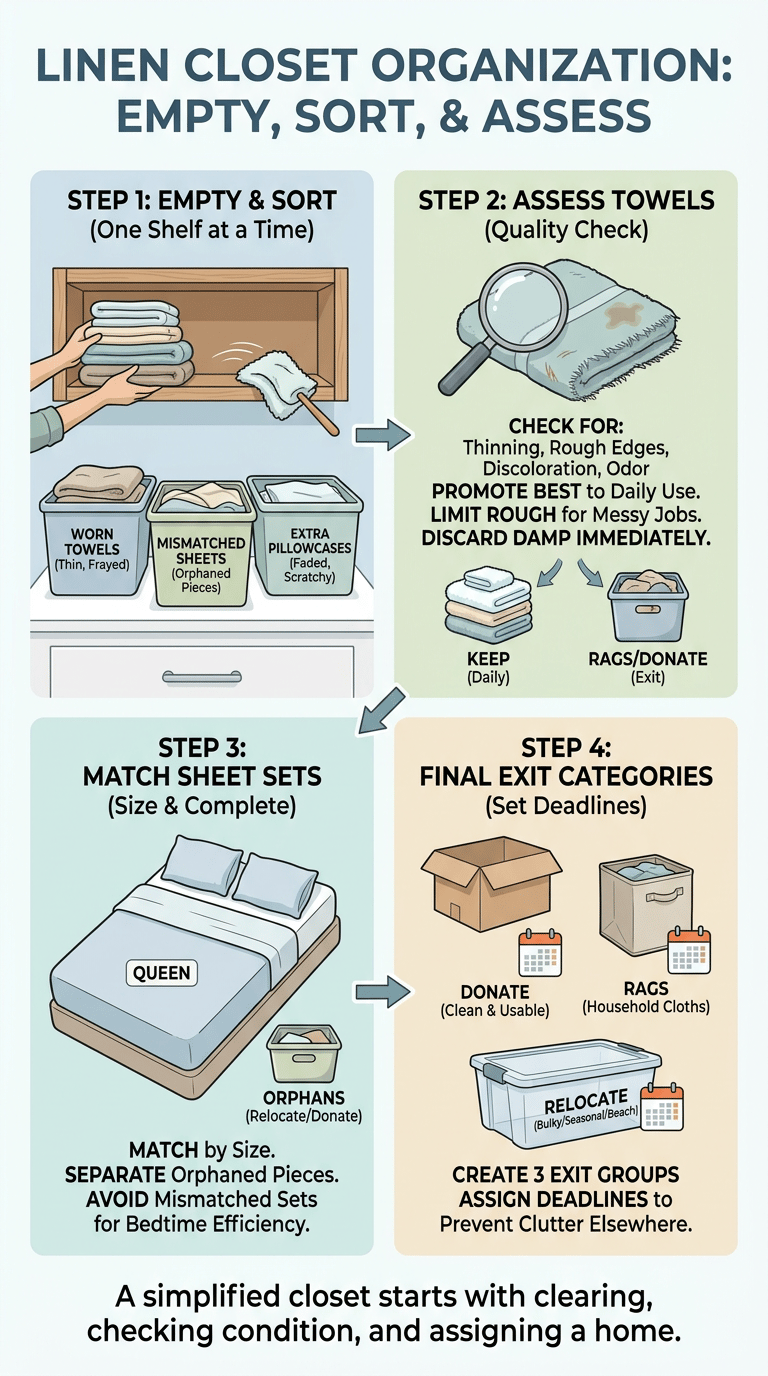
Do not reorganize a linen closet by pushing stacks around. Remove one shelf at a time, wipe the shelf if needed, and sort items on a clean surface. This avoids turning the whole hallway into a project you cannot finish. The condition check matters because damaged linens often stay in closets for years simply because they are folded neatly.
Worn towels
Check towels for thinning centers, rough edges, mildew-like odor, heavy discoloration, or frayed hems. A towel that no longer dries well does not need to stay in the best stack. Promote your best towels to daily use, keep a limited number of rough towels for pets or messy jobs, and move the rest out of the closet. Do not store damp towels to decide later because trapped moisture can create a bigger problem.
Mismatched sheet sets
Lay sheet pieces by size and match each fitted sheet with pillowcases and flat sheets if you use them. If you find orphaned pillowcases or sheets for a mattress you no longer own, separate them before anything goes back. Mismatched sets are one of the fastest ways to make a linen closet look full while still failing at bedtime.
Extra pillowcases
Extra pillowcases are useful, but only when they have a reason. Keep extras for guest pillows, acne-prone pillow changes, travel pillows, or matching sets. If pillowcases are faded, scratchy, or no longer match any sheet set, place them in a rag bin or donation bag if they are still in good condition. A small labeled stack is easier to use than a deep pile of mystery cases.
Linens for donation, rags, or relocation
Create three exit categories. Donation linens should be clean and usable. Rag linens can go into one household cloth bin. Relocation linens include bulky blankets, seasonal bedding, beach towels, and specialty items that do not need daily access. Give each exit group a deadline so the cleared closet does not become clutter elsewhere.
Step 2: Create Shelf Zones by Access Frequency
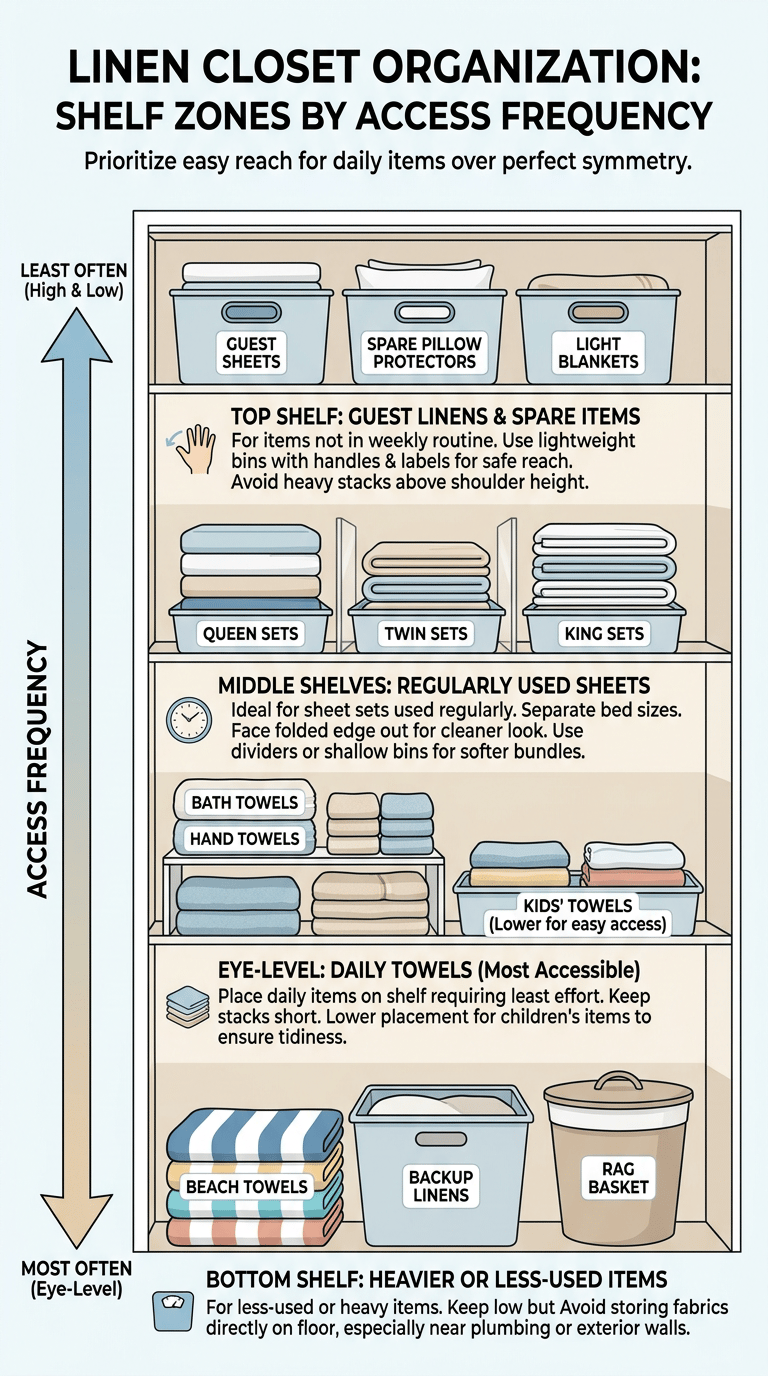
Access frequency is the easiest rule to maintain. The items used most often get the shelves that are simplest to reach. Items used rarely go higher, lower, or outside the closet. This matters more than making every shelf symmetrical. A beautiful linen closet that hides daily hand towels behind guest bedding will not stay organized in a busy home.
Eye-level daily towels
Place daily bath towels and hand towels on the shelf that requires the least bending or reaching. Keep the stacks short enough that one towel can slide out without pulling the rest forward. If children use the closet, place their towels lower so they can put items away without tossing them onto a high shelf. If guests use the closet, label towel sizes clearly.
Middle shelves for sheets
Middle shelves are ideal for sheet sets because sheets are used regularly but not usually every day. Place each bed size in its own row, bin, or stack. Face the folded edge outward so bundles look cleaner and are easier to count. When a sheet bundle is too soft to stay upright, use a shelf divider or a shallow bin instead of building a taller pile.
Top shelf for guest linens
The top shelf can hold guest linens, spare pillow protectors, light guest blankets, and special towels that are not part of the weekly routine. Keep this category limited to what you can safely reach. If the shelf is high, use lightweight bins with handles and avoid heavy stacks above shoulder height. A label on the front edge saves you from pulling down every bin before guests arrive.
Bottom shelf for heavier or less-used items
The bottom shelf can hold less-used items, but it should not become a pile zone. Use it for a small stack of beach towels, a backup linen bin, or a contained rag basket. Keep heavy items low, but avoid storing fabrics directly on the floor near plumbing, bathrooms, or exterior walls.
Step 3: Fold and Contain Linens So They Stay Visible
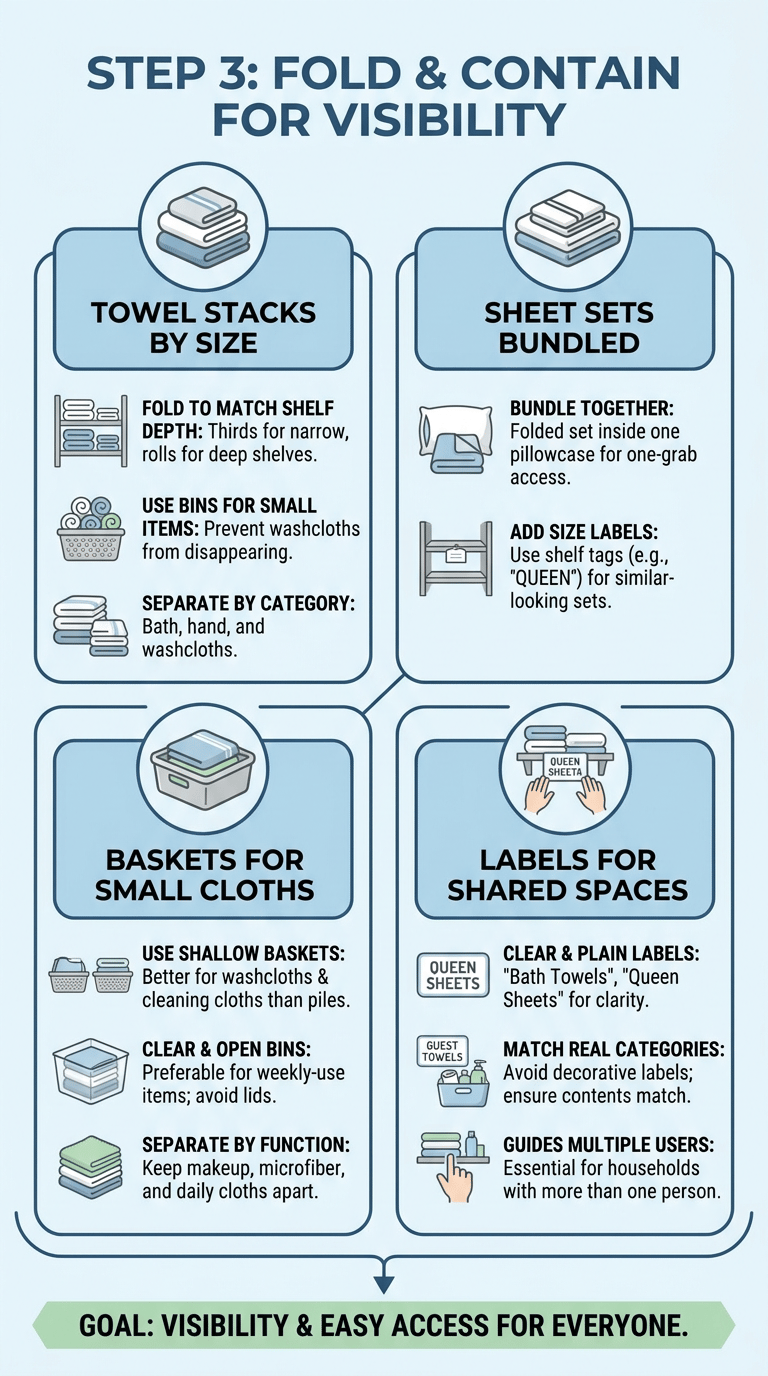
Folding should make the next action easier. A linen closet does not need hotel-perfect folds, but each stack should show what it is and allow one item to come out cleanly. Containers help when they solve a specific problem: small items falling through wire shelves, washcloths disappearing behind towels, or family members mixing bed sizes.
Towel stacks by size
Fold towels to match shelf depth. A narrow shelf may need towels folded in thirds lengthwise, while a deep shelf may work better with rolled towels in a basket. Keep bath towels, hand towels, washcloths, and specialty towels in separate stacks. A good test is whether the smallest towel in the category is still visible. If washcloths vanish under bath towels, they need their own bin.
Sheet sets bundled together
Bundle sheet sets so every bed change is one grab. Fold the fitted sheet, flat sheet, and pillowcases together, or place the folded pieces inside one pillowcase. Add a small label or shelf tag for mattress size if you have similar-looking sheets. If one family member changes beds often, place that bed size at the front and store occasional sizes behind it.
Baskets for washcloths and small cloths
Small linens behave better in shallow baskets than in open piles. Use separate baskets for washcloths, makeup cloths, microfiber cleaning cloths, and spare hand towels if those categories are used differently. Avoid very deep baskets for daily items because they hide the bottom layer. Clear, open, or front-labeled baskets work better than lidded boxes for linens that return from laundry every week.
Labels for shared households
Labels are most useful when more than one person uses the closet. Keep them plain: Bath Towels, Hand Towels, Queen Sheets, Guest Towels, Cleaning Cloths, and Rags. Labels should match real categories, not decorative wishes. If a label says Guest but the bin also holds old beach towels and extra pillow inserts, the label will stop helping. Rename the category or split it.
Linen Closet Storage by Closet Type
The same category system can work in several closet shapes, but the shelf strategy should change. A narrow hall closet needs front visibility. A deep bathroom closet needs boundaries. Wire shelves need support for small cloths. Shared closets need separation between fabric and non-fabric items.
Narrow hall closet
In a narrow hall closet, avoid deep containers that force you to unload the front row to reach the back. Use short stacks and slim bins. Put daily towels and sheets in the center, guest linens on the top shelf, and cleaning cloths or rags in a small lower basket. Keep the floor clear enough that the door can close without pressing into fabric.
Deep bathroom closet
A deep bathroom closet can hold more, but depth often causes forgotten piles. Use bins that pull forward like drawers, and label the front of each container. Keep damp-risk awareness higher in bathroom storage because steam, plumbing leaks, and poor airflow can affect fabric. If you notice repeated dampness, staining, or a persistent musty odor, address the moisture source rather than just refolding the linens.
Closet with wire shelves
Wire shelves can leave fold lines, allow small cloths to sag, and make narrow items unstable. Add shelf liners made for the shelf type, shallow baskets, or flat-bottom bins so washcloths and pillowcases do not slip through gaps. Check product weight limits before loading heavy stacks. If a shelf bows or pulls away from the wall, remove weight and repair the support before storing more linens.
Closet shared with toiletries or cleaning supplies
When linens share space with toiletries or cleaners, separate soft goods from liquids. Store cleaners upright in a tray or bin on a lower shelf, and keep them away from towels and sheets whenever possible. Poison Control warns against mixing household cleaning products and emphasizes following label directions, so a shared closet should make product labels visible and bottles stable through Poison Control cleaner safety guidance. If a bottle leaks, remove nearby linens and wash them according to care tags before reuse.
Moisture, Scent, and Product Safety Limits
Linen closets do not need complicated scent systems. Clean, dry fabric and good airflow matter more than strong fragrance. Moisture deserves attention near bathrooms, laundry rooms, exterior walls, or plumbing. Product safety matters because towels and sheets touch skin, faces, and sometimes children or guests.
Avoid storing damp linens
Never place damp towels, sheets, or cleaning cloths into a closed closet. Let towels dry before they enter the hamper if laundry will not run soon, and make sure washed linens are fully dry before folding. If a stack feels cool, clammy, or heavy, give it more drying time. The EPA explains that controlling moisture is central to preventing mold problems in homes, and its mold and moisture guidance is a useful reference when dampness keeps returning.
Use scent products cautiously
Sachets, dryer sheets, essential oil cards, and scented liners can transfer fragrance, oils, or residue to fabric. If anyone in the household has sensitive skin, asthma concerns, allergies, migraines, or scent preferences, keep fragrance out of shared linens. Do not put oils directly on shelves or cloth. A safer approach is to store only clean, fully dry linens and wash stale items instead of trying to cover the smell.
Keep cleaning products away from soft goods when possible
Cleaning products are better stored separately from soft goods. If your home has no other option, use a hard-sided tray, keep lids tight, and place products below linens rather than above them. Do not store bleach, ammonia products, toilet cleaners, drain products, or pest products where they can tip into towels. Read labels before storage, and keep products away from children and pets according to label directions.
When moisture or staining needs attention
Stop and inspect if you see yellowing shelf marks, gray specks, recurring odor, rust-colored stains, swollen shelves, peeling paint, or damp corners. Remove linens from the affected area, check the wall and floor, and look for nearby plumbing or ventilation issues. If stains return after cleaning the shelf and washing the linens, the closet may have an environmental problem rather than an organizing problem.
Common Linen Closet Mistakes
Most linen closet problems come from too much backup, unclear bed sizes, unstable piles, or mixing items that do not belong together. The real test is what the closet looks like after two laundry cycles.
Keeping too many backup towels
Extra towels feel useful, but too many backups bury the best towels and make laundry return harder. Keep enough for normal use, laundry gaps, guests, and realistic emergencies. Move worn extras to a labeled rag bin or donate usable surplus. If you keep every towel just in case, the closet becomes storage for uncertainty instead of support for daily routines.
Stacking deep piles too high
Tall, deep stacks collapse because linens are soft. Instead of building one tower of ten towels, split the category into two shorter stacks or use a divider. Keep heavier folded pieces near the bottom and lighter pieces above. If a stack leans before you close the door, it is already too tall for the shelf.
Mixing sheet sizes
Mixed sheet sizes waste time and create frustration. Similar colors make the problem worse because a Queen fitted sheet and Full fitted sheet may look almost identical when folded. Label the shelf, use separate bins, or write the size on a small tag tucked into the bundle. This is especially helpful in homes with guest beds, kids rooms, sofa beds, or mattress changes.
Storing bulky comforters in the daily linen zone
Bulky comforters can flatten shelves, block daily towels, and make the closet feel full even when it holds only a few items. Store one frequently used blanket in the linen closet if it fits easily. Move the rest to bedding storage, under-bed bins, or another dry area. Check fabric care labels before compressing delicate or filled bedding for long periods.
Simple Linen Closet Maintenance
A linen closet stays organized when the return routine is easy. The system should survive tired laundry days, guests, sick days, and quick bathroom resets. Maintenance should be small and repeated, not a major cleanout every year.
Laundry return routine
Put away linens by category as soon as they are dry. Place towels back into the correct size stack, return sheet bundles to the right bed-size zone, and drop small cloths into their basket. If a stack is full, do not force more onto it. That is the signal to remove a worn item, move surplus to overflow, or adjust the quantity limit.
Monthly shelf reset
Once a month, straighten stacks, pull forward hidden items, check for dampness or spills, and remove anything that does not belong. This reset should take ten minutes if the closet is zoned well. Wipe dusty shelf edges when needed and make sure labels still match what is actually stored there.
Seasonal guest linen check
Before heavy guest seasons, check guest towels, pillowcases, spare sheets, and light blankets. Wash stale items if needed and confirm the bed size. For older, handmade, or delicate textiles, handle storage more carefully and consider guidance such as the University of Georgia textile care resource before cleaning or folding fragile items. Do not put sentimental linens into daily stacks where they will be tugged, crushed, or forgotten.
Replacement and rag-bin rules
Create simple rules for when linens leave the main closet. Towels can move out when they become rough, thin, stained, or slow to dry. Sheets can leave when elastic fails, corners tear, fabric pills badly, or the size no longer matches a bed. Keep one rag bin, not several hidden rag piles. When the rag bin is full, discard or donate appropriate extras instead of expanding the category.
FAQ
These answers focus on linen closet decisions that affect daily access, shelf space, and safe storage.
How many towels should I keep in a linen closet?
A practical starting point is two to three bath towels per regular person, plus a few hand towels and washcloths for each bathroom. Add extras only for real needs such as guests, pets, sports, swimming, or delayed laundry. If your towels no longer fit in short visible stacks, reduce backups before buying more storage bins.
How do I organize sheets by size?
Make one zone for each mattress size in the home. Bundle each fitted sheet with its matching flat sheet and pillowcases, then label the shelf or bin with the size. If you have several similar white sheet sets, add a small removable tag inside the bundle so the right set is easy to grab on laundry day.
Should bedding and blankets go in a linen closet?
Light guest blankets and one frequently used spare blanket can work in a linen closet if they do not block daily towels and sheets. Thick comforters, seasonal quilts, mattress toppers, and extra pillows usually need separate bedding storage. The deciding factor is access: daily linens should not be hard to reach because bulky bedding fills the best shelves.
Bulky bedding needs more space than towels and sheet sets. If blankets, comforters, or guest bedding are the main problem, use a separate method to store bedding and blankets without crushing the rest of the closet.
How do I organize a small linen closet?
Use fewer categories and shorter stacks. Put daily towels on the easiest shelf, bundle sheets by bed size, place washcloths in one shallow basket, and move bulky bedding somewhere else. Avoid deep bins unless the closet has deep shelves. In a small closet, every item needs a current job, not a vague someday purpose.
Can cleaning cloths be stored with towels?
Clean, dry cleaning cloths can share the same closet if they are separated in a labeled basket or bin. Do not mix them into bath towel or washcloth stacks, especially if they have been used with strong cleaners, oils, polishes, or outdoor messes. If a cloth smells like a product after washing, keep it away from body linens.
Final Thoughts
A useful linen closet is not the one with the fanciest baskets. It is the one that makes clean towels, correct sheet sets, guest linens, and small cloths easy to find and put away. Keep daily linens in the best space, limit backups, separate small items, and remove damp or damaged fabric before it returns to the pile. Once the shelves match how your household actually uses linens, the closet can stay orderly with a short reset.

Ethan Carter is the Founder & Editor of HomeCleanSecrets. Based in the United States, he has 5 years of experience creating practical home cleaning, laundry care, stain removal, decluttering, and home organization content. His goal is to help everyday households clean smarter and build simple routines that are easier to maintain.
Read more about Ethan Carter on his author page: https://homecleansecrets.com/ethan-carter/