
A bedroom is easier to organize when you decide what the room must support before adding bins, shelves, or furniture. Give daily personal items a practical home, keep the bed and walking paths usable, control clutter-prone surfaces, and move unrelated items to the systems that actually handle them.
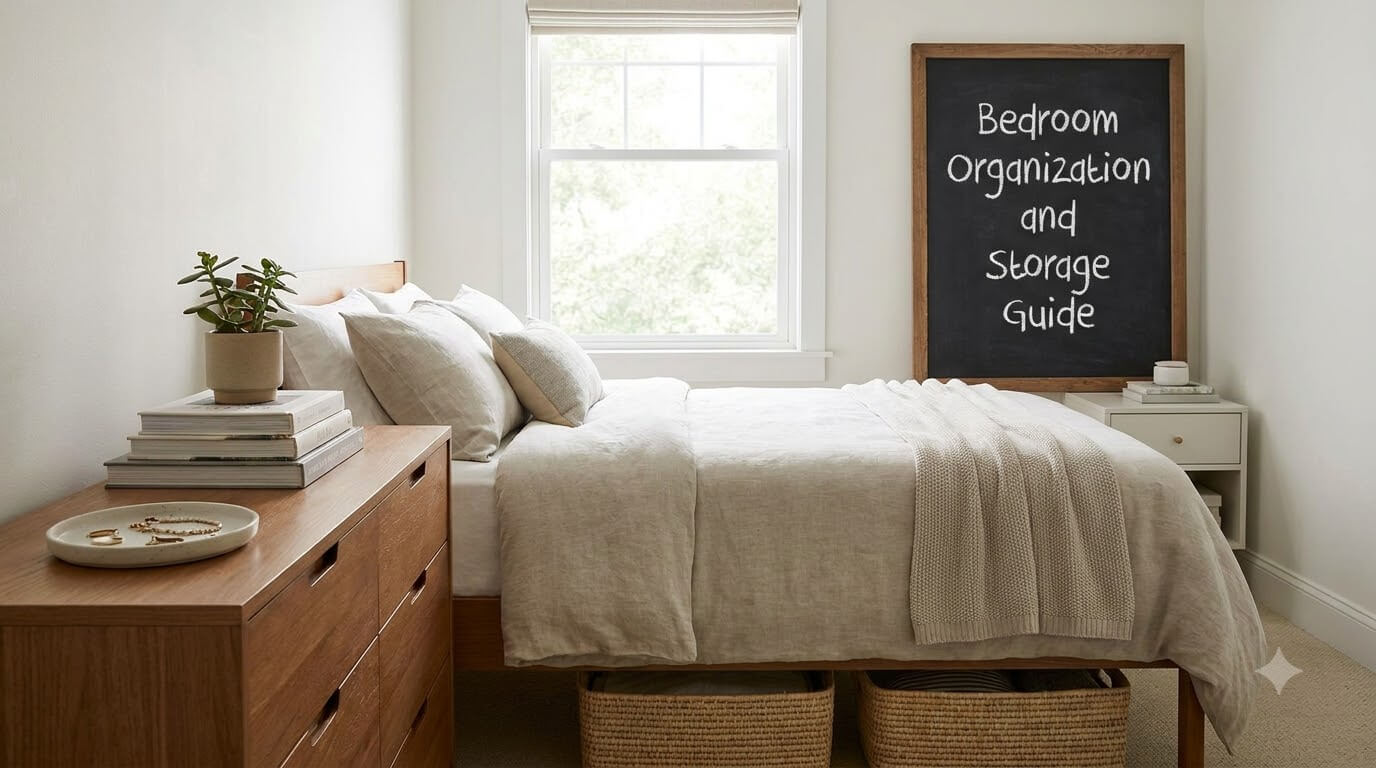
Bedroom clutter can come from different problems. A small room may lack capacity, a dresser top may lack limits, a room without a closet may need a different storage structure, and a room that refills after two days may only need a better reset. Start by identifying the problem before choosing the fix.
Quick overview: what an organized bedroom needs to do

Support sleep, dressing, reading, personal care, and shared use without becoming whole-home storage
List the activities that genuinely happen in the room. Sleeping is usually essential. Dressing may be important, but the detailed clothing system belongs in the closet, dresser drawers, or another clothing-storage area. Reading, charging a phone, or basic personal care may also belong if they happen here regularly. Anything else should earn its space instead of staying by default.
Keep bed access, walking paths, doors, windows, vents, and outlets functional
Storage should not make the room harder to move through. Check the path from the door to the bed, the space needed to get in and out of bed, and the access needed for furniture drawers or doors. Do not place containers where they force you to step over them every day. The NFPA home escape planning guidance also recommends planning two ways out of each room, including windows and doors where applicable.
Separate bedroom storage from clothing, paperwork, toys, bedding, and cleaning systems
A bedroom can hold active clothing and personal items without becoming the place where every category is managed. Dirty clothes can go to a hamper, while clean clothing returns to the established clothing system. Bills and receipts leave for the household paper system. Toys that belong to children move back to their toy storage. Spare bedding belongs with the home’s bedding storage rather than wherever there is an empty corner.
Why bedrooms become cluttered
More inventory enters than the room can support
Clutter often grows quietly. A new bag arrives, seasonal clothing stays out, another basket is added, and an unused chair becomes storage. Each object may seem reasonable on its own, but the room has a physical limit. Once drawers, shelves, floor zones, and surfaces are full, the next items have nowhere to go except visible piles.
Flat surfaces become default drop zones
Nightstands and dresser tops attract anything that does not have an immediate destination: receipts, jewelry, chargers, cups, hair products, coins, books, and folded clothing. A surface becomes a problem when it serves too many unrelated purposes.
Clothing and laundry lose their routes
Clothing piles usually indicate a broken handoff. Dirty items need a direct route to a hamper. Clean clothing needs a convenient route back to its established storage. Clothing that may be worn again needs either a defined temporary zone or a deliberate decision to return it to storage.
The bedroom absorbs overflow from the rest of the home
Bedrooms often become quiet storage because guests do not see them. Boxes, paperwork, hobby supplies, extra household products, gifts, and seasonal items migrate in because the door can be closed. This solves a short-term visibility problem but creates a room-capacity problem.
Define the bedroom’s actual functions before adding storage
List essential room functions
Write down what you need to do in the bedroom on a normal week. Keep the list specific: sleep, change clothes, read before bed, charge a phone, store a small set of personal items. If the room is shared, include the other person’s real needs as well.
Separate active personal items from occasional or overflow items
Daily items deserve the easiest access. Occasional items can use concealed or less convenient storage if the location is suitable. Overflow is different: it is inventory that no longer fits the active system. Do not automatically treat overflow as a reason to buy another cabinet.
Identify items that belong in another home system
Walk the room with a basket and collect obvious outsiders. Mail goes to the household paper area. Dishes go to the kitchen. Bathroom products go to their normal bathroom or vanity storage. Toys go to the child’s storage system. Repair items, donations, and returns need their own downstream destination.
A practical bedroom organization framework

Step 1: define what belongs
Start with function, not furniture. Decide which categories genuinely support the way the room is used. This prevents you from organizing unrelated household inventory simply because it is currently present.
Step 2: reduce or relocate excess
Remove obvious trash, duplicates you do not need, items that belong elsewhere, and possessions you have already decided to donate or discard appropriately. If a category still exceeds the space available, reduce it further or move lower-frequency items to a suitable storage area outside the room. Utah State University Extension guidance similarly cautions against buying more storage bins before reducing belongings.
Step 3: protect access and circulation
Clear the route from the doorway to the bed and any other path used every day. Open drawers and furniture doors to see where they collide with baskets, hampers, or other furniture. Check that storage does not cover floor vents, trap cords, or interfere with adjustable-bed components.
Step 4: assign visible and concealed zones
Visible storage works best for a small number of attractive or frequently used items. Concealed storage is useful for visual clutter, but it still needs categories and capacity limits. Hiding mixed piles in opaque bins may make the room look better for a week while making retrieval worse.
Step 5: test storage access
Use the room normally for several days. Can you open the dresser without moving a hamper? Can you reach the nightstand from bed? Can you pull an under-bed container out without lifting something heavy at an awkward angle? Can both people access their belongings in a shared room?
Step 6: establish a reset and overflow review
Give daily-use items a quick return path and review recurring overflow weekly. A short reset restores approved items to their homes. It should not require a new decision about every possession.
Map the room by storage zone
Floor and walking-path zone
The floor should primarily support movement and furniture, not loose storage. Hampers, baskets, and bins can sit on the floor when they have a defined location and do not narrow the route you use.
Bedside zone
The bedside zone should contain only items that need to be reached from bed or immediately before and after sleep. A lamp, phone, charger, glasses, tissues, or one current book may qualify depending on your routine.
Dresser-top and other flat-surface zones
Use the dresser top for standing-use personal items if that is where you get ready. A small tray can contain jewelry, a watch, or pocket contents. Keep current-use products separate from backups and move clothing off the surface promptly.
Under-bed zone
Under-bed space can hold lower-frequency items when the bed frame, clearance, flooring, and container design make access practical. Choose contained categories, label them from the side you can see, and avoid very heavy bins that are difficult to pull.
Vertical and wall-adjacent zones
Vertical storage can free floor area, especially in a small bedroom, but height adds stability and access considerations. Shelves, hooks, wardrobes, and tall furniture need to be installed and loaded according to the manufacturer’s directions. The CPSC Anchor It! guidance emphasizes securing furniture appropriately to reduce tip-over hazards.
Laundry-hamper and temporary-item zones
Put the hamper where dirty clothing is actually removed, provided it does not block the path. If clean clothing repeatedly lands on the floor because the closet or dresser is inconvenient, fix that route rather than adding a second hamper.
Decision tree: which bedroom problem should you solve first?
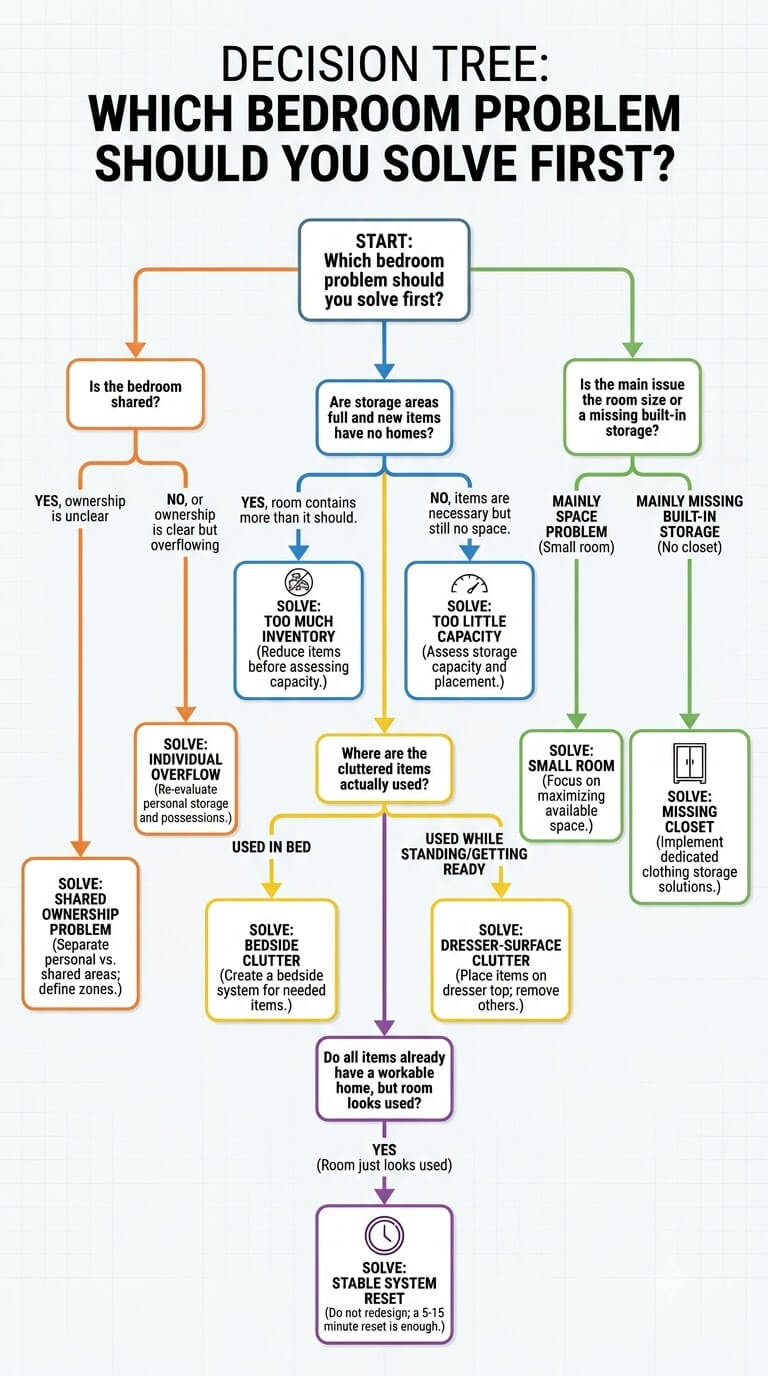
Too much inventory versus too little capacity
If every storage area is full and new items have no homes, first ask whether the room contains more than it should. If the retained items are genuinely necessary and the room still cannot support them, then assess storage capacity and placement.
Small room versus missing closet
A small bedroom is mainly a space problem. A bedroom without a closet is mainly a missing built-in clothing-storage problem. The room can have both conditions, but the solutions are different.
Bedside clutter versus dresser-surface clutter
Ask where the item is actually used. Items needed from bed belong in the bedside system. Items used while standing and getting ready may belong on the dresser top. Everything else should leave those surfaces.
Shared ownership problem versus individual overflow
In a shared bedroom, clutter may come from unclear ownership rather than lack of storage. Separate personal areas from shared areas before buying anything. Decide who uses which shelf, drawer section, bedside zone, or under-bed section.
Stable system that only needs a reset
If every item already has a workable home and the room simply looks used at the end of the day, do not redesign it. A five- to fifteen-minute reset may be enough.
Small bedroom organization at a glance
Capacity and placement tradeoffs
In a small bedroom, every furniture footprint has a cost. A second nightstand, wider dresser, bench, or extra shelving unit may provide storage while reducing movement space. Measure what you use and decide which pieces perform more than one necessary function.
Floor space versus vertical storage
Vertical storage can reduce floor use, but it is not automatically the better choice. Consider reach, load limits, anchoring requirements, and how much visual clutter open shelving creates. Lower storage may be easier to access in some rooms even if it uses more floor area.
When the room cannot safely hold everything
Stop adding furniture when storage begins to narrow access, block needed openings, or create unstable arrangements. Move seasonal or low-frequency items elsewhere, reduce duplicate categories, or reconsider which functions truly belong in the room.
Bedroom decluttering at a glance
Keep, move elsewhere, donate, recycle, or discard
Decluttering changes the inventory. Start with obvious trash and items that clearly belong elsewhere, then decide what earns bedroom space. Donation, recycling, and disposal should follow local rules and the condition of the item.
Route clothing, paperwork, kids’ items, and other categories
Do not create a bedroom filing system because papers happen to be near the bed. Do not create toy storage because a few toys migrated into the room. Use the bedroom sort to send each category back to the system that handles it.
Know when decluttering should happen before storage changes
If bins are full of things you do not use, surfaces hold duplicates, or the bedroom stores unrelated household categories, declutter first. New storage will only make the excess less visible unless the inventory decision is made first.
Nightstand organization at a glance
Keep immediate bedside essentials
Choose only the items you need from bed or directly before sleeping and after waking. That may include a lamp, phone, glasses, tissues, one book, or a stable water bottle depending on your routine.
Set surface and drawer limits
Keep the surface usable and the drawer easy to open. If you need several organizers just to contain miscellaneous objects, remove categories that are not genuinely bedside items.
Manage cables, liquids, children, and pets carefully
Inspect cords for damage, avoid overloaded outlets or power strips, and keep liquids away from electrical equipment where practical. The CPSC electrical safety resources reinforce avoiding damaged cords and overloaded power connections. Store medication or hazardous products according to their directions and with child or pet access in mind.
Dresser-top organization at a glance
Separate getting-ready items from catch-all clutter
Keep a limited set of items used while getting ready and give small objects one defined tray or organizer. Household items that merely landed there should be moved, not absorbed into the system.
Keep current-use products separate from backups
Daily fragrance, jewelry, or hair accessories may belong on the surface if they fit the room’s routine. Backups, unopened products, and rarely used items should go to appropriate storage so the surface does not become inventory storage.
Move clothing and paperwork off the surface
Clean clothes return to clothing storage, dirty clothes go to the hamper, and papers go to the household paper area. If the same categories return daily, improve their route rather than accepting the dresser as a permanent holding place.
Under-bed storage at a glance
Choose good candidates and reject poor ones
Occasional accessories, lightweight travel items, or suitable seasonal overflow may work under the bed. Frequently needed objects, damp textiles, food, leaking liquids, fragile items, and important documents generally need a different location.
Check container, access, clearance, and review
Measure the lowest clearance point and account for handles, lids, wheels, and bed supports. Place labels on the accessible side. Review the containers periodically so concealed storage does not become forgotten storage.
Keep hidden storage within a clear capacity
Under-bed space is not an invitation to use every inch. Overpacking can block vents, interfere with moving components, or make containers difficult to retrieve. Stop when access becomes awkward or the stored categories are no longer clear.
Bedroom without a closet at a glance
Create room-level alternatives for active clothing
A freestanding wardrobe, garment rack, dresser, hooks, shelving, and under-bed storage can divide the work of a missing closet. Choose only what the room can support without blocking access or filling every wall.
Choose open versus closed storage deliberately
Open storage provides quick access but exposes more visual inventory and dust. Closed storage reduces visual clutter but requires door or drawer clearance. The best choice depends on the room footprint, quantity of active clothing, and how often items are used.
Keep detailed clothing organization in the clothing system
The bedroom plan should answer where active clothing lives at room level. It does not need to define every hanging category, folding method, seasonal rotation, or drawer category. Those decisions belong with the clothing system itself.
Shared bedroom organization at a glance
Separate personal zones from shared zones
Give each person clear areas for personal bedside items, clothing storage, and small belongings. Use shared storage only for items that are truly shared. Clear ownership prevents common surfaces from becoming unclaimed storage.
Allocate space based on actual use
Equal halves are not always practical. One person may need hanging space while another needs drawers. Allocate storage according to real categories and frequency while protecting both people’s access to the room.
Assign reset responsibility and overflow boundaries
Each person can restore personal zones, while shared surfaces and walkways need an agreed routine. When one person’s items spill into another person’s storage repeatedly, treat it as a capacity issue rather than a daily tidying issue.
Daily reset versus weekly reset
Use a short reset to restore the room
A daily reset can be simple: clothing to its route, trash out, dishes removed, nightstand and dresser top restored, papers moved out, chargers returned, and the main walking path cleared. The goal is to restore the existing arrangement, not improve it every night.
Use a weekly check to catch capacity drift
Once a week, look for zones that are starting to overflow. Check the hamper, bedside drawer, dresser top, under-bed containers, and any temporary clothing area. Empty items that do not belong and note categories that are consistently too large for their assigned space.
Escalate when the room needs deeper decluttering
If a reset takes longer each week, containers cannot close, or items have nowhere to return, stop resetting the same problem. Make inventory decisions or redesign the affected zone before the room becomes a cycle of moving piles.
Storage capacity warning signs
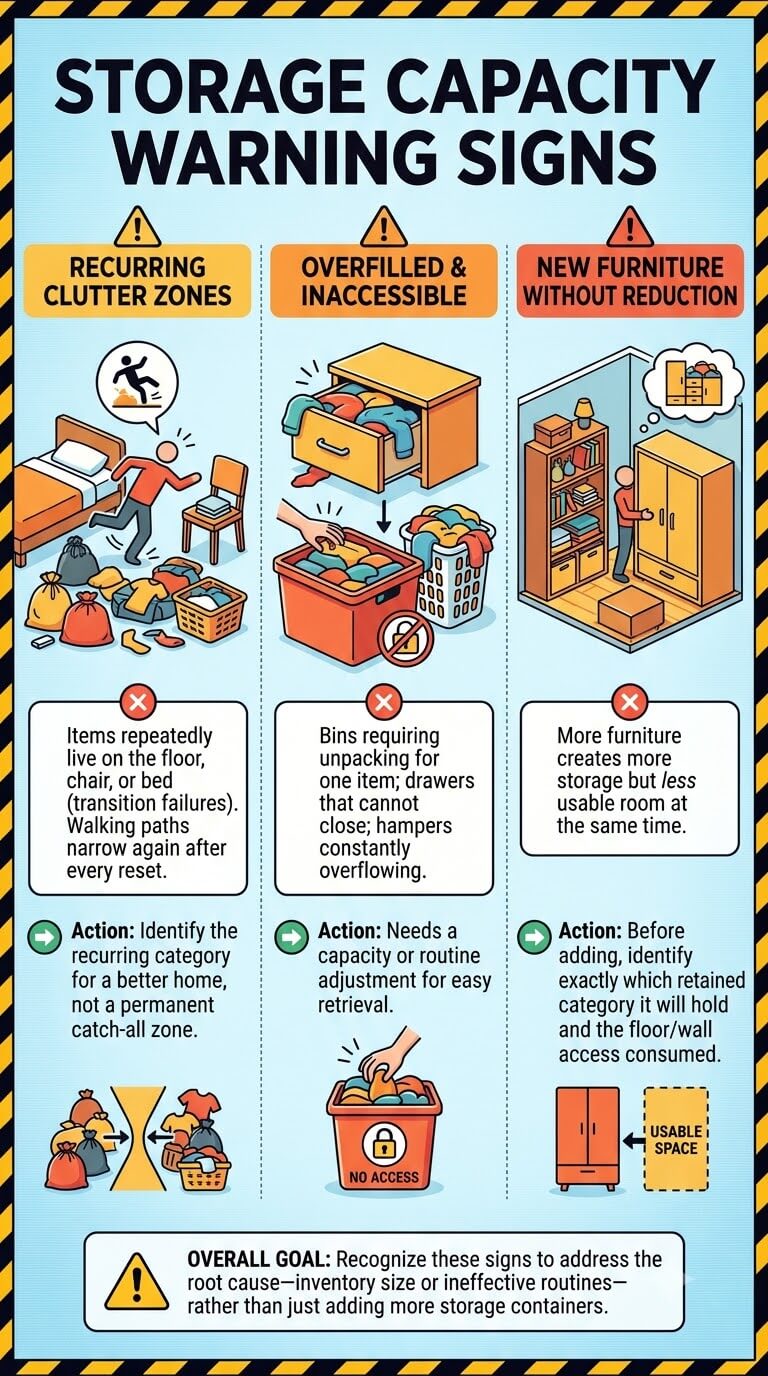
Walking paths narrow again after every reset
Repeated bags, baskets, or clothing on the floor show that the room lacks a workable destination for those items. Identify the recurring category instead of simply pushing it to the side.
Containers remain overfilled or inaccessible
A bin that must be unpacked to reach one item is not serving easy retrieval. A drawer that cannot close or a hamper that is constantly overflowing needs a capacity or routine adjustment.
New furniture is being added without reducing inventory
More furniture can create more storage and less usable room at the same time. Before adding a cabinet, rack, or shelving unit, identify exactly which retained category it will hold and what floor or wall access it will consume.
Items repeatedly live on the floor, chair, or bed
These are usually transition failures. Decide whether the category needs a better home, a faster route, a smaller inventory, or removal from the bedroom. Do not create a permanent catch-all zone just because the pile is predictable.
Safety and product limits to keep in view
Follow furniture stability and anchoring instructions
Use furniture for its intended purpose, respect load limits, and follow the manufacturer’s installation and anchoring directions. Pay extra attention to tall or drawer-based storage and homes where children may climb. Do not stack heavy items high on unstable furniture.
Keep cords, chargers, outlets, and liquids under control
Replace damaged cords and follow the charger or device instructions. Avoid overloading outlets or power strips. Keep cords out of obvious walking routes and separate drinks from charging equipment where practical.
Protect doors, windows, vents, and moving components
Storage should not interfere with the door swing, needed window access, floor or wall vents, or adjustable-bed mechanisms. If a furniture placement makes access difficult, revise the layout instead of assuming the obstruction is harmless.
Do not ignore required installation in a rental
Renters should check lease terms or ask permission before permanent wall modifications, but safety requirements still matter. If a product requires anchoring or specific installation for safe use, do not skip those directions merely to avoid holes. Choose a different product or location if you cannot install it as required.
Common bedroom organization mistakes

Buying storage before defining inventory
Containers are useful after you know what is staying. Buying them first encourages you to preserve categories simply because there is a bin available. Sort, reduce, and route items before deciding what storage is genuinely missing.
Treating the bedroom as a second closet or archive
The room can hold active clothing and personal items, but long-term wardrobe overflow, document archives, spare bedding, and unrelated household categories can quickly consume its capacity. Keep the bedroom focused on current personal use.
Creating too many catch-all zones
A basket by the door, a chair for clothes, a tray on the dresser, a bowl on the nightstand, and a bin under the bed can each become an excuse not to return items. Temporary zones only work when their purpose and capacity are narrow.
Hiding overflow without a review routine
Closed bins can reduce visual clutter while allowing inventory to grow unnoticed. Label concealed storage and review it on a realistic schedule. If you cannot remember what is in a container, that is a sign the category needs attention.
Confusing reset, decluttering, and cleaning
A reset restores items to established homes. Decluttering changes what you keep. Cleaning removes dust, dirt, stains, and other soil. Keep these jobs separate enough that a ten-minute room reset does not turn into a three-hour project.
FAQ about bedroom organization
Should I declutter before reorganizing my bedroom?
Yes when the room contains obvious excess, unrelated household items, duplicates, or belongings you already know you do not use. If the inventory is already appropriate and the problem is only placement, you can move directly to assigning better zones.
How do I know whether I need more storage or fewer items?
Look at the categories that overflow. If many items are unused, duplicated, seasonal, or unrelated to bedroom functions, reduce or relocate them first. If the retained items are necessary and still lack safe, practical homes, additional storage may be justified after measuring the available space.
What should stay visible in a bedroom?
Visible storage works best for a small number of frequently used items that are easy to return. Everyday bedside essentials or a limited getting-ready tray may stay out. Backups, mixed miscellaneous objects, paperwork, and low-frequency inventory are usually better contained or moved elsewhere.
Where should bedroom paperwork go?
Mail, bills, receipts, records, and important documents should move to the household paper-management area. A bedroom may have a notebook or current reading material if it is actively used there, but it should not become a secondary filing system.
What should I do with clothing that keeps landing on a chair?
Sort by status. Dirty clothing goes to the hamper. Clean clothing returns to its existing storage. If your household keeps rewear items separate, define one limited temporary spot such as a hook or small section. Repair or donation items should move to their downstream destination rather than staying on the chair.
When is under-bed storage a good option?
It is useful when the bed has safe clearance, the frame or mechanism allows storage, the items are suitable for concealed lower-frequency storage, and containers can be retrieved without awkward lifting. It is a poor choice when it blocks vents, interferes with moving parts, or simply hides unsorted overflow.
Final thoughts: keep the bedroom easy to restore
The strongest bedroom setup is not the one with the most storage. It is the one where room functions are clear, active categories have practical homes, unrelated items leave promptly, and daily use does not block the bed or walking paths. When the same zone overflows repeatedly, reassess capacity or inventory instead of adding another container.

Ethan Carter is the Founder & Editor of HomeCleanSecrets. Based in the United States, he has 5 years of experience creating practical home cleaning, laundry care, stain removal, decluttering, and home organization content. His goal is to help everyday households clean smarter and build simple routines that are easier to maintain.
Read more about Ethan Carter on his author page: https://homecleansecrets.com/ethan-carter/
3 thoughts on “Bedroom Organization and Storage Guide | Home Clean Secrets”