
Living-room blankets are easiest to manage when the room stores only the throws that are actually used near the sofa or chairs. The goal is to make active throws easy to reach and return while keeping them separate from guest bedding, spare blankets, and off-season textiles that belong elsewhere.

A practical system starts with use frequency and capacity. Decide which throws truly support everyday living-room use, give that active group one nearby storage zone, and route overflow back to the household linen or bedding area. When the container fills, treat that as a reason to review the inventory rather than automatically adding another basket. Treat active throws as one category within the broader living-room organization system, not as a reason to expand textile storage indefinitely.
Quick Answer: Keep Only Active Throws Near Seating and Give Overflow Another Home
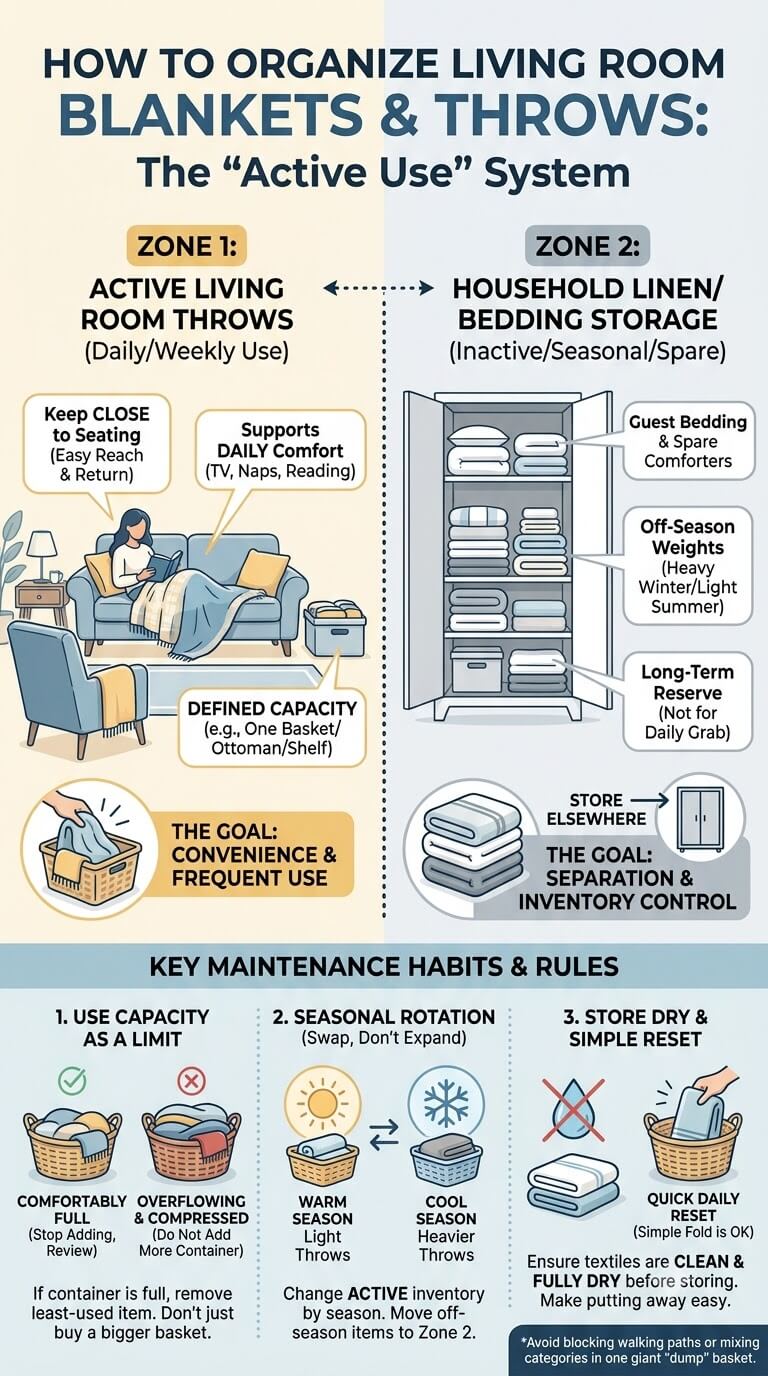
Start by separating active sofa and chair throws from everything that is merely being stored in the living room. Then choose one storage method that fits the room, the people using it, and the amount of textile that genuinely needs immediate access.
Active-use throws belong in the room
A throw used during evening television, reading, naps, or cool mornings has a clear reason to stay close to seating. Keep it where the person using it can return it without crossing the house. That might mean one basket beside the sofa, a storage ottoman designed for the purpose, or one shelf in a nearby cabinet. Frequent use is the reason it earns living-room space.
Guest, spare, and long-term seasonal bedding belong elsewhere
A blanket kept for overnight guests, an extra comforter, a spare quilt, or a heavy winter blanket that will not be used for months is not active living-room inventory. Move those textiles to the household bedding or linen-storage area. This keeps the living room from becoming a second linen closet and makes it easier to see whether the active throws still fit the room.
Capacity should match real sofa and chair use
Size the active group around actual behavior. A household where three people regularly use separate throws may need more nearby storage than a single renter who uses one lightweight blanket. Avoid choosing a universal number. A better test is whether the active throws fit comfortably in their assigned space and can be returned without compressing, stacking, or spilling into walking areas.
When This Guide Applies
This approach works when active throws are migrating around the living room. If the real issue is a large bedding collection, an overfilled linen closet, or textiles needing care, solve that separate problem instead of forcing more storage into the room.
Blankets are used most days
Daily or near-daily use is the strongest reason to keep a textile in the room. If someone reaches for a particular throw every evening, storing it in a distant closet adds an unnecessary step and makes sofa piles more likely. Keep frequent-use items close enough that putting them away is nearly as easy as leaving them on the seat.
Throws pile on seating or the floor
If blankets routinely collect on sofa backs, chair arms, footstools, or the floor, the storage destination may be too far away, too small, or too fussy. Check the return step before buying anything. A deep cabinet that requires rearranging other items may technically provide space but still fail in everyday use.
When the real problem is linen or bedding storage
If the room contains guest sheets, spare pillows, comforters, mattress pads, and multiple off-season blankets, the problem has moved beyond active living-room throws. Keep only the pieces used in this room now. The rest should be handled with the home’s broader textile-storage system so the living room does not carry inventory for unrelated bedrooms and future seasons.
Separate Active Living-Room Throws From Stored Bedding
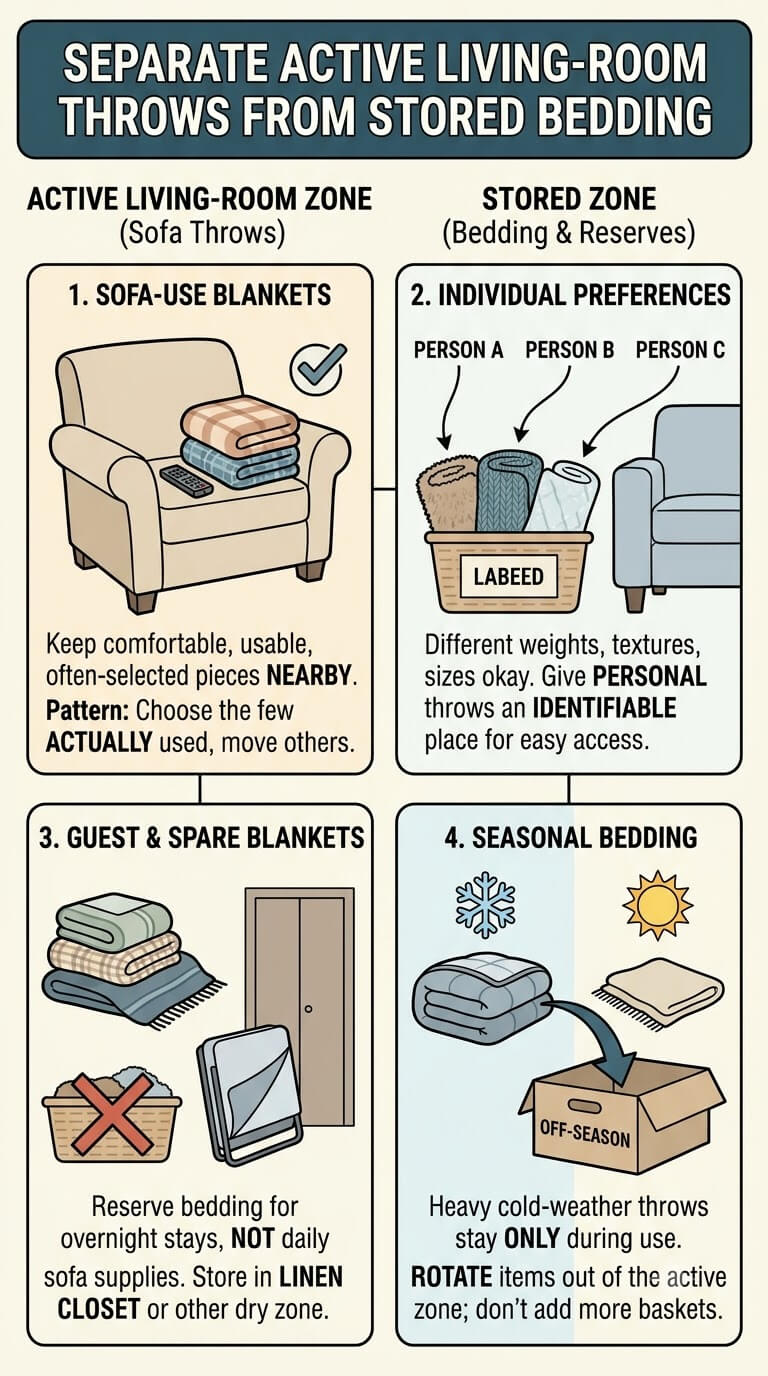
Before choosing baskets or furniture, make four simple groups. This prevents the common mistake of mixing active sofa throws with household bedding just because both categories are made of fabric.
Sofa-use blankets
These are throws intentionally used on the sofa or main chairs. Keep the pieces that are comfortable, in usable condition, and selected often enough to justify nearby space. If five throws are available but the household always chooses the same two, that pattern tells you which pieces need immediate access and which ones can move elsewhere.
Individual household preferences
In a shared room, different people may prefer different weights, textures, or sizes. You do not need identical throws or a perfectly uniform stack. Give regularly used personal throws an identifiable place within the same living-room system. A good test is whether each person can find and return their preferred blanket without pulling apart the entire container.
Guest and spare blankets
Blankets kept only in case someone stays overnight are reserve bedding, not daily sofa supplies. Store them with the rest of the guest bedding when possible. If there is no linen closet, choose another dry household storage zone rather than allowing a living-room basket to become permanent overflow for every spare textile.
Seasonal bedding that should leave the room
A heavy cold-weather throw can stay during the season when it is genuinely used. Once the room shifts to lightweight textiles, move the heavy piece to the same place as other off-season bedding. Seasonal rotation works best when it changes which items occupy the active zone rather than increasing the number of baskets in the room.
Decide How Many Throws Need Immediate Access
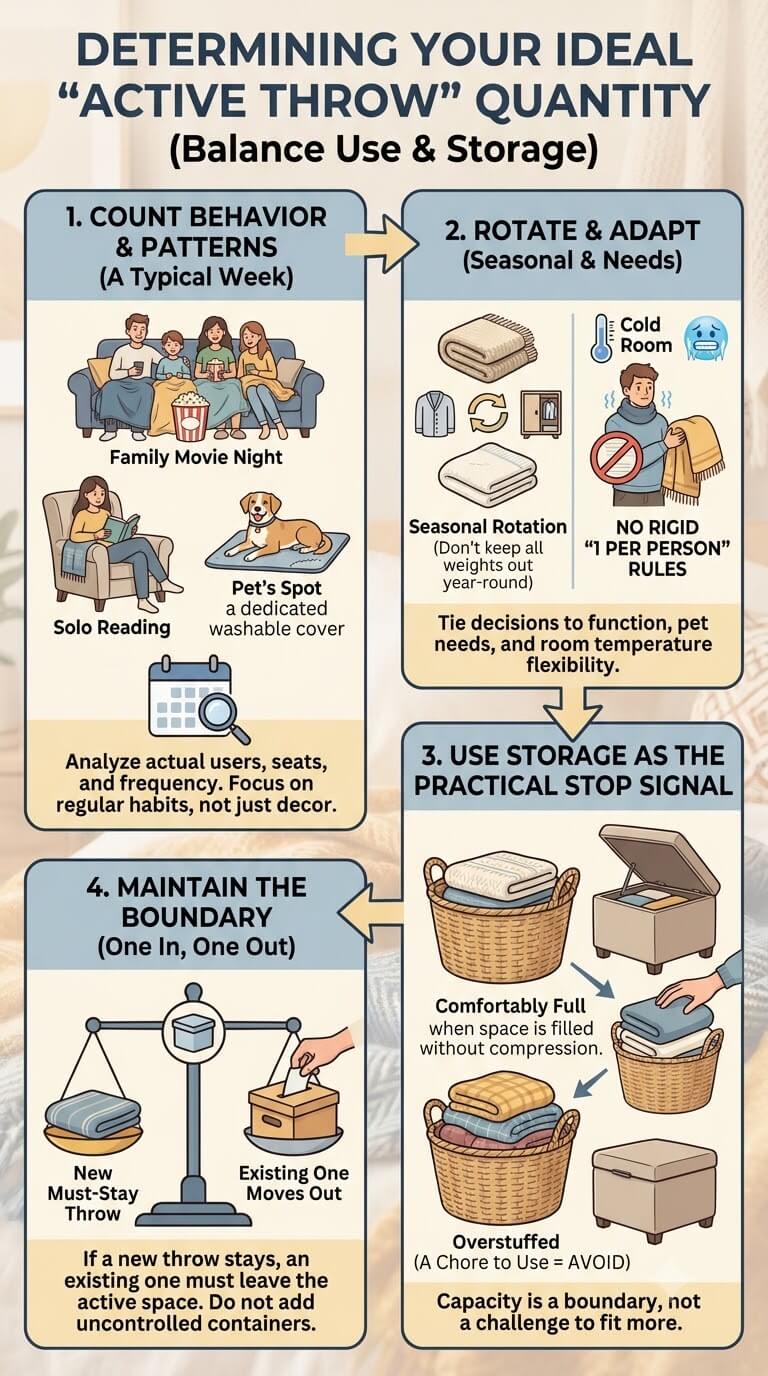
The right quantity supports normal use without making storage harder than using the blankets. Count behavior, not decorative possibilities.
Count actual users and use patterns
Look at a typical week. Who uses a blanket, in which seat, and how often? A family movie night may justify several active throws, while occasional guest use does not. If one person uses two different weights depending on the season, rotate them instead of keeping both permanently accessible all year.
Avoid universal item limits
Rules such as “one blanket per person” can be too rigid for real households. Some families share throws; some people use none; a pet may have one washable cover; a cold room may need more flexibility. Keep the decision tied to function, frequency, room size, and storage capacity rather than an arbitrary number.
Use storage capacity as a practical stop signal
Once the assigned basket, ottoman, shelf, or cabinet space is comfortably full, stop adding active throws. Do not compress textiles so tightly that returning them becomes a chore. If another blanket needs to stay, decide which existing one moves out. Capacity should create a boundary, not an excuse to add a second uncontrolled container. Make blankets part of the living room reset by returning clean, dry active throws to their assigned basket, shelf, or storage furniture.
Choose Open or Concealed Blanket Storage
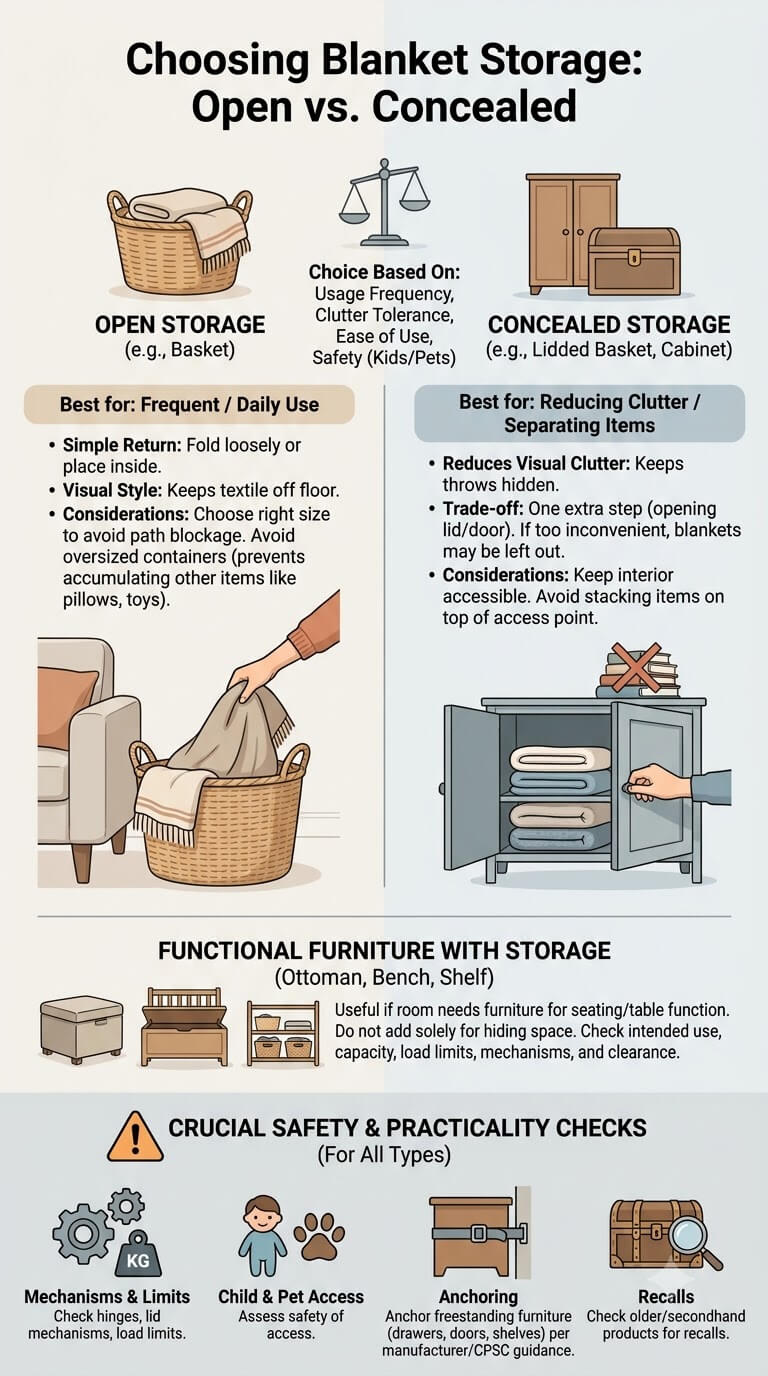
Open and concealed storage can both work. Choose based on how often the throws are used, how much visual clutter bothers the household, how easy the storage is to operate, and whether children or pets can safely access it.
Open basket for frequent use
An open basket works well for throws used every day because return is simple: fold loosely or place the blanket back inside. Choose a basket that keeps the textile off the floor without taking over the walking path. Avoid an oversized container that invites pillows, toys, laundry, pet gear, and spare bedding to join the same pile.
Lidded basket or cabinet when appropriate
Closed storage reduces visual clutter and can help keep active throws separate from the rest of the room. The tradeoff is one extra step. If people consistently leave blankets on the sofa rather than opening a lid or cabinet door, the setup may be too inconvenient. Keep the interior easy to reach and avoid stacking unrelated items on top of the storage access.
Storage ottoman, bench, or shelf as functional types
Furniture with built-in storage can be useful when the room already needs that furniture for seating support or a table function. It should not be added solely to create more hiding space. Check the manufacturer’s intended use, internal capacity, load limits, hinges or lid mechanism, and clearance before using it for textiles.
Check furniture mechanisms, load limits, and child or pet access
Do not assume every chest, bench, cabinet, or shelf is suitable for the same household. Follow the product instructions and keep heavy or unstable furniture secure. If you add freestanding furniture with drawers, doors, or shelves, review the manufacturer’s anchoring directions; the U.S. Consumer Product Safety Commission tip-over guidance also emphasizes anchoring furniture that can tip. Check older or secondhand storage products for recalls before relying on them around children.
Store Textiles Only When Clean and Fully Dry
Organization begins after the textile is ready to be stored. A basket or ottoman should not become a place to hide a damp, soiled, or recently spilled-on blanket.
Avoid trapping moisture in storage
If a throw feels damp, has been used outdoors, was recently spot-treated, or picked up a spill, let the care process finish before it goes back into concealed storage. Moisture trapped in a closed container can create avoidable textile problems. University of Missouri Extension advises cleaning household textiles before storage as part of its mildew-prevention guidance, which is a useful boundary even when the living-room system itself is not a cleaning routine.
Follow care labels and manufacturer instructions
Different throws can have different fiber blends, finishes, drying limits, or special-care requirements. Read the care tag before washing, drying, steaming, or treating a blanket, then return it to storage only after the required care is complete. The Federal Trade Commission explains that care instructions are provided so consumers know the appropriate care method for covered textile products in its care-label information.
Keep storage guidance separate from laundering instructions
This living-room system only needs a simple rule: do not store a textile that is dirty, damp, or still in the middle of a care process. The exact washing temperature, detergent, drying method, or stain treatment depends on the item and belongs to its care instructions. That separation keeps organization decisions from accidentally damaging a blanket through generic cleaning advice.
Keep Blanket Storage Close to Where It Is Used
The return path should be short enough that the household will actually use it. Nearby does not mean placing containers wherever there is empty floor space.
Sofa-side placement
Place the active storage beside or near the seating that generates most blanket use. A basket beside the sofa, a low cabinet within a few steps, or an ottoman already serving the seating group can work. Keep the opening accessible so a person does not have to move a lamp, table, or stack of objects before returning the throw.
Under or inside furniture when designed for storage
Use under-seat, under-table, or interior furniture space only when the furniture is designed to provide accessible storage and the textile fits without interfering with moving parts. Do not wedge blankets around mechanisms, vents, electrical components, or structural hardware. Follow the furniture manual rather than assuming every hollow space is a storage compartment.
Avoid blocking walking routes in a small room
Floor baskets can solve one problem and create another if they narrow the path beside the sofa or sit where feet naturally land. In a small living room, prioritize an existing cabinet, a correctly designed storage ottoman, or a compact vertical shelf over adding several floor containers. If there is no safe place for a basket, reduce active inventory instead of forcing one into the route.
Use Decorative Ladders Only as an Optional Functional Type
A blanket ladder can provide visible vertical storage, but it is not necessary and it should not be treated as a default answer for every room.
Stability and manufacturer guidance
If a ladder-style product is designed for textile display or storage, place and secure it according to the manufacturer’s instructions. Check whether it is intended to lean, mount, or stand independently. Keep it out of a route where people may grab it for support or bump it while moving around furniture.
Avoid treating an unstable ladder as a universal solution
Homes with small children, climbing pets, tight passages, or active play may be better served by a contained basket or closed cabinet. A storage method that looks efficient but is constantly knocked, climbed, or moved is not a good fit. Function and stability matter more than using a particular storage trend.
Do not turn storage into a styling project
The purpose is to give active throws a reliable home. If arranging blankets by color, drape, or display makes them harder to return, simplify the setup. A neatly folded throw in a basket can be more practical than a visually arranged system that requires several steps after every use.
Set Boundaries for Pet and Kids’ Blankets
Shared living rooms often include a few textiles used by children or pets. Keep those items intentional so the active-throw system does not become a mixed family textile pile.
Intentional active-use textiles
A child’s nap throw or a pet blanket used on one sofa spot may reasonably stay in the room. Give it the same test as any other active textile: is it used here often, does it have a clear return place, and does it fit the available capacity? If yes, it can remain part of the room’s working inventory.
Keep categories identifiable
If pet-use textiles need to remain separate from human throws, give them a distinct section or container rather than layering everything together. The same applies to children’s blankets when family members need to find them quickly. The system does not need elaborate labels, but people should be able to tell what belongs where without unfolding the entire stack.
Route extras back to pet, kids, or linen storage
Extra crib blankets, playroom quilts, pet towels, spare covers, and backup bedding do not need to live beside the sofa just because one related item is used there. Return extras to the storage area that owns that category. This keeps the living room from becoming a second pet-supply zone or a second children’s room.
Rotate Seasonal Throws Without Expanding Living-Room Storage
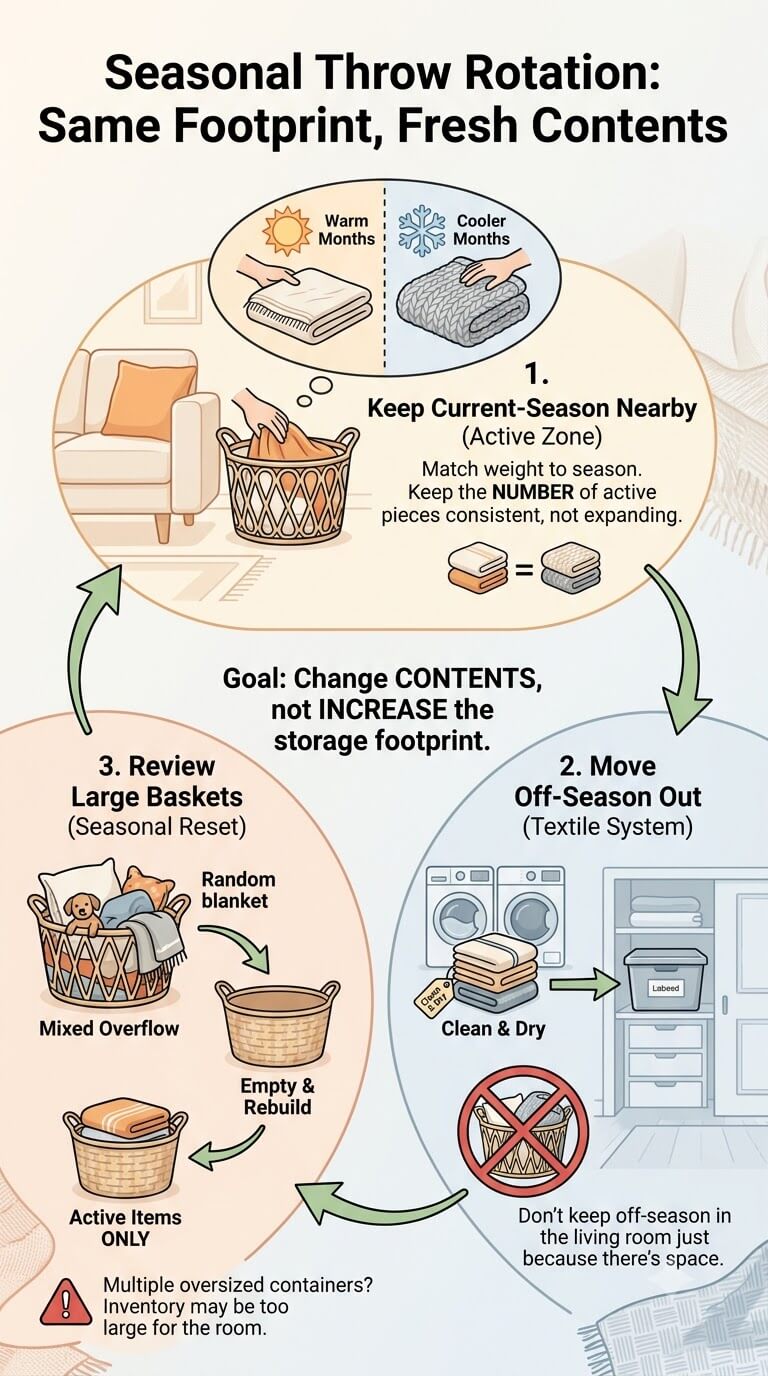
Seasonal rotation should change the contents of the active zone, not increase the footprint of the storage system.
Keep current-season active throws nearby
Bring in the weight and material that the household actually reaches for in the current season. A lightweight throw may replace a heavy one in warm months, while heavier options may return when the room is cooler. Keep the number of active pieces similar unless household use has genuinely changed.
Move off-season textiles to the household textile system
When a seasonal throw stops being part of normal living-room use, clean and dry it according to its care instructions, then move it to the appropriate household textile-storage area. Do not keep both seasons in the room simply because there is still space at the bottom of a basket.
Review when an oversized basket becomes mixed overflow
Large baskets can hide a slow accumulation of off-season throws, spare pillows, guest blankets, pet textiles, and unrelated soft items. Empty the basket during a seasonal change and rebuild it with active items only. If the living room still needs multiple oversized containers afterward, the active inventory is probably larger than the room can comfortably support.
What to Do When Blankets Are Always Left on the Sofa
Repeated sofa piles usually point to a return problem, not a lack of effort. Adjust the storage step before asking everyone to follow a more complicated routine.
Make the storage location easier than leaving a pile
Move the container closer to the seat where throws are used, remove objects blocking its opening, or choose a storage type that takes fewer steps. If a blanket must be folded precisely, carried across the room, and placed under other items, many people will leave it on the sofa instead. Reduce friction first.
Simplify folding expectations
Active throws do not need a showroom fold. A loose fold, simple roll, or tidy placement in an open basket may be enough, depending on the textile and storage type. Set a standard that protects the blanket and keeps the room functional but can still be repeated at the end of an ordinary evening.
Reduce active inventory if the container cannot close or contain it
If the storage is appropriately sized for the room but blankets still spill out, remove the least-used pieces from immediate access. Do not solve every overflow by buying a larger container. A good test is whether each active throw can be returned without forcing down a lid, building a stack above the rim, or creating a second pile nearby.
Quick Blanket Reset Routine
A short reset returns approved active throws to their homes. It should not become a full living-room cleanup or a laundry session.
Collect throws from seating and floor
Gather only the blankets and throws that belong to the living-room system. If you find clothing, towels, bedding, toys, or other soft items mixed into the pile, route those items to their own rooms or storage zones instead of placing them in the blanket container.
Fold or loosely contain according to the storage type
Use the simplest return method that keeps the textile contained. Open baskets may only need a loose fold. Shelves may need a flatter stack so items remain accessible. A storage ottoman may work best with pieces laid inside rather than tightly compressed. Stop if the storage method strains a hinge, lid, shelf, or container.
Move guest or seasonal items out of the room
When the reset reveals a blanket that is no longer part of current living-room use, move it out instead of trying to fit it into the active container. This small decision prevents reserve bedding from slowly rebuilding inside the room between larger organizing sessions.
Common Living Room Blanket Organization Mistakes
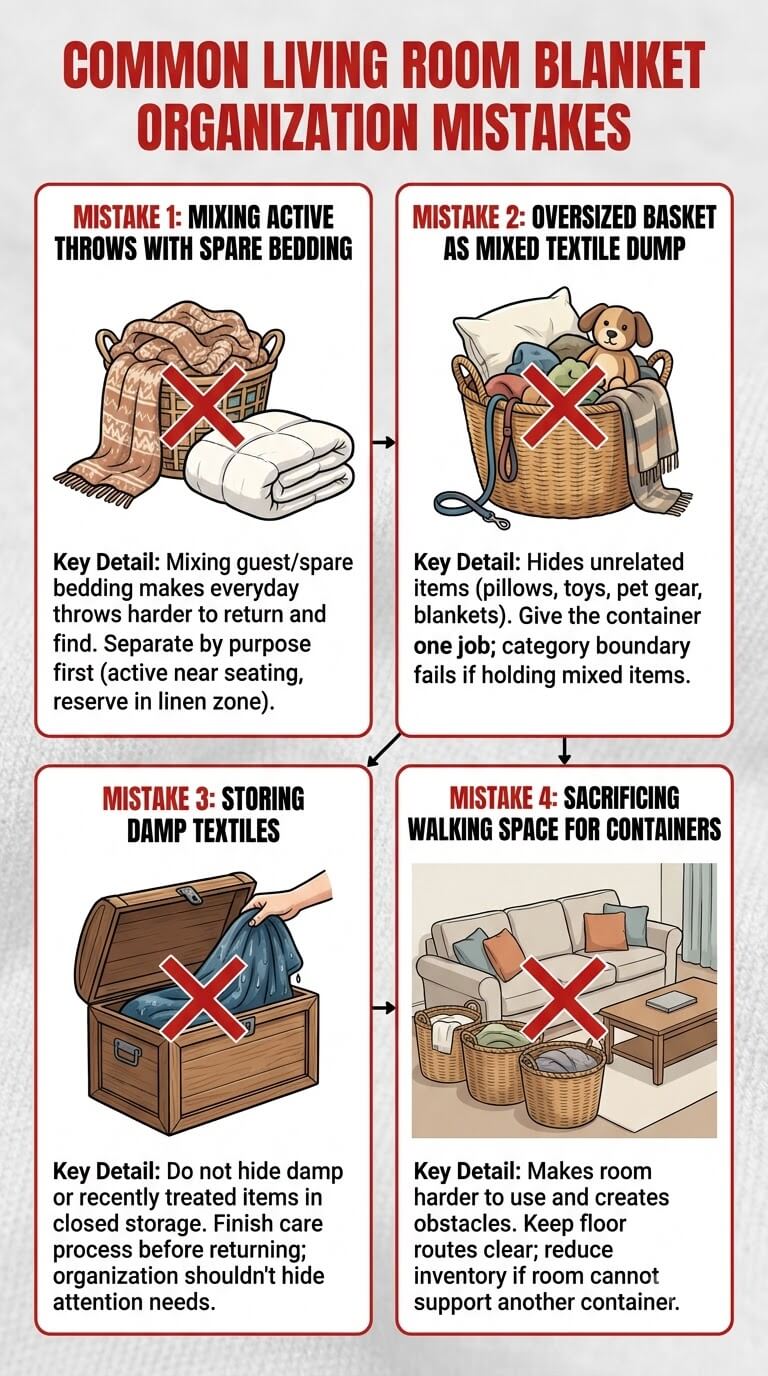
Most blanket clutter comes from mixing categories, choosing storage that is inconvenient to use, or letting capacity expand without a clear boundary.
Mixing active throws with spare bedding
Once guest blankets and spare bedding join the active basket, everyday throws become harder to return and harder to find. Separate by purpose first. Active pieces stay near seating; reserve bedding goes to the household linen or bedding zone.
Using an oversized basket as a mixed textile dump
A large basket can look organized while hiding a wide mix of unrelated items. Give the container one job and review it when it becomes difficult to tell what is inside. If the basket is holding pillows, toys, laundry, pet gear, and blankets together, the category boundary has failed.
Storing damp textiles
Do not hide a damp or recently treated blanket inside closed storage just to clear the sofa. Finish the item’s care process and let it reach the condition required by its label or manufacturer before returning it. Organization should not make it harder to notice a textile that still needs attention.
Sacrificing walking space for extra containers
Several baskets around a sofa can make a small room harder to use. Keep the floor route and seating access clear, then fit storage into the remaining safe space. If the room cannot support another container without creating obstacles, reduce or relocate the inventory instead of expanding the storage footprint.
FAQ for Living Room Blanket Organization
These questions cover the decisions that most often determine whether active throws stay accessible without turning the living room into long-term textile storage.
Where should everyday sofa blankets be stored?
Keep everyday throws close to the seating where they are used, using one clearly defined basket, cabinet section, shelf, or storage furniture compartment that fits the room. The best location is easy to reach and easy to reset without blocking a walking route. If a throw is used every day, convenience matters more than hiding it completely.
Should seasonal blankets stay in the living room?
Only while they are part of current living-room use. When a heavy or lightweight seasonal throw is no longer needed, move it to the home’s broader textile-storage area after following its care instructions. Rotation should swap active items rather than letting several seasons accumulate in the same room.
Is open or closed storage better for active throws?
Open storage is usually faster to use and reset, while closed storage reduces visible textile clutter. Neither is automatically better. Choose the option the household will actually use, then check capacity, accessibility, furniture instructions, and child or pet considerations. If a lidded container is always left open because returning a throw feels inconvenient, a simpler option may work better.
What if the living room is too small for a blanket basket?
Do not force a floor basket into a tight path. First reduce the active group to the throws that are genuinely used. Then look for storage already built into appropriate furniture, a small cabinet section, or another nearby zone that does not interfere with seating or walking. If there is still no suitable space, keep fewer active throws in the room and store the rest elsewhere.
Final Thoughts
Blanket organization works best when the living room stores active comfort, not the household’s entire textile reserve. Keep frequently used sofa and chair throws close to where they are used, choose a storage method that is simple to return to, and let the available capacity define when something needs to move elsewhere.
When piles keep returning, check the system before adding containers. The active group may be too large, the storage may be too far from the sofa, or guest and seasonal bedding may have drifted back into the room. Correct that specific problem, keep textiles clean and fully dry before storage, and make the reset easy enough to repeat after normal daily use.

Ethan Carter is the Founder & Editor of HomeCleanSecrets. Based in the United States, he has 5 years of experience creating practical home cleaning, laundry care, stain removal, decluttering, and home organization content. His goal is to help everyday households clean smarter and build simple routines that are easier to maintain.
Read more about Ethan Carter on his author page: https://homecleansecrets.com/ethan-carter/