
A living room works best when the items kept there match what people actually do in the room. In a shared household, that usually means seating, conversation, media, reading, games, and a limited amount of temporary play or personal activity. Problems start when the room also becomes the default landing place for papers, toys, chargers, clothing, unopened packages, spare bedding, work gear, and objects with no assigned home.

The practical goal is to give each useful category a realistic home, keep walking and seating access clear, and make the room easy to restore after normal use. The most reliable order is simple: define the room’s functions, decide what belongs, group what remains, assign storage by frequency of use, set capacity limits, and create a reset routine that household members can repeat.
Quick Overview: What an Organized Living Room System Must Do

A workable setup must support shared activities, prevent unrelated items from accumulating, and make everyday put-away simple enough to repeat. Storage is only one part of that system.
Keep the room focused on shared functions
Write down the activities that happen in the room during an ordinary week. Conversation, television, reading, family games, relaxing, and entertaining guests commonly earn permanent space. A child may also play there for part of the day, or someone may occasionally use a laptop on the sofa. Those temporary activities can be supported without turning the living room into a second playroom or permanent office.
A useful test is to ask, “Would we look for this item here first?” Remotes, current reading, active throws, and frequently played games may earn space; school forms, spare bedding, tools, medicine, and folded laundry usually need destinations elsewhere.
Separate active-use storage from household overflow
Active-use storage should make the next use easier. A drawer for remotes, a cabinet for games, a basket for two frequently used throws, or a shelf for shared books all support living-room activities. Overflow storage is different: it keeps expanding because another room is full or because an item has no home.
If a basket repeatedly fills with unrelated objects, empty it before adding another. When most contents belong elsewhere, the basket is hiding a routing problem rather than solving storage.
Protect walking paths and seating access
Storage should not make the room harder to move through. Keep door swings usable, preserve a direct route between main entries and seating, and avoid placing bins where people routinely step around them. Furniture should not interfere with a needed window, vent, outlet, or exit route. The National Fire Protection Association’s home escape planning guidance emphasizes knowing usable ways out of rooms, which is a good reason not to let storage creep into exits and circulation paths.
Why Living Rooms Become Cluttered
Living rooms collect clutter because they are central, comfortable, and shared. People pass through them frequently, so setting something down “for now” feels convenient. The room then accumulates objects faster than anyone makes decisions about them.
Too many unrelated categories migrate into one room
A family room may start with books, media, and throws, then gradually absorb toys, mail, work equipment, pet supplies, hobby materials, clean laundry, and items waiting to go upstairs. Each category may seem small by itself, but together they overwhelm shelves and surfaces.
Do a category scan before buying storage. Utah State University Extension recommends first assessing what kinds of clutter are present and grouping like items so the problem is easier to see. That basic approach is useful here: identify the categories before deciding whether the room needs another container. See the USU Extension guidance on assessing clutter for the same practical starting point.
Flat surfaces become default drop zones
Coffee tables, side tables, console tops, ottomans, and open shelves attract anything that needs a temporary landing place. Once one or two unrelated items remain, more items tend to join them because the surface no longer feels intentionally assigned.
Give each flat surface a clear job. A side table might hold a lamp, coaster, and current book; a coffee table may support drinks and a few active items. Anything unrelated needs another destination.
Storage is added before inventory is defined
Extra storage can make a crowded room worse when it consumes floor area without reducing inventory. Before adding a cabinet, shelf, or basket, name what will go in it and how often it is used. Treat container capacity as a boundary: when a category no longer fits comfortably, review the category before expanding its footprint.
Define How the Living Room Is Actually Used
Base the setup on what has actually happened in the room during the last several weeks, not on an idealized version of how it should be used.
Conversation and relaxation
If the room is primarily for sitting together, protect access to the seating first. Keep the floor around sofas and chairs free of overflow baskets, stacks of books, and abandoned toys. Frequently used comfort items can live near seating, but they should have a clear return spot that does not occupy the seat itself.
TV and media
A media area needs homes for current devices, remotes, controllers, headphones, and active cables. Do not let the cabinet collect every unidentified cable. Follow device manuals for ventilation and placement, and keep liquids away from electronics.
Reading and family entertainment
Shared books, current magazines, board games, cards, and puzzles can stay when they are used there. Store them where they can be returned without dismantling stacks. Frequently used games deserve easier access than occasional ones.
Temporary play, work, and guest use
Temporary activities need an exit plan. A limited toy container may be intentional, but overflow should return to the child’s main storage. Laptop gear should return to its work location when the session ends, and guest items should not become permanent inventory merely because the room is convenient.
Inventory Before You Add Storage

Review what is already in the room before rearranging furniture or buying containers. The key decisions are location, frequency of use, and ownership.
Keep here versus move elsewhere
Ask, “Is this used here?” and “Does it need to live here between uses?” A board game or nightly sofa throw may answer yes to both. A bill opened on the sofa or a spare guest comforter usually needs an off-room home.
Active-use versus occasional-use categories
Prime storage belongs to frequently used items. Daily remotes should not sit behind holiday games, and current reading should not compete with rarely opened books. Place occasional items in less convenient storage while keeping heavy objects within safe limits.
Shared items versus personal belongings
A shared room can support personal use without becoming everyone’s locker. Set a boundary, such as one small return basket or an evening return routine, so shoes, backpacks, school papers, hobby items, and clothing do not become permanent living-room storage.
Build Living Room Zones Around Real Use
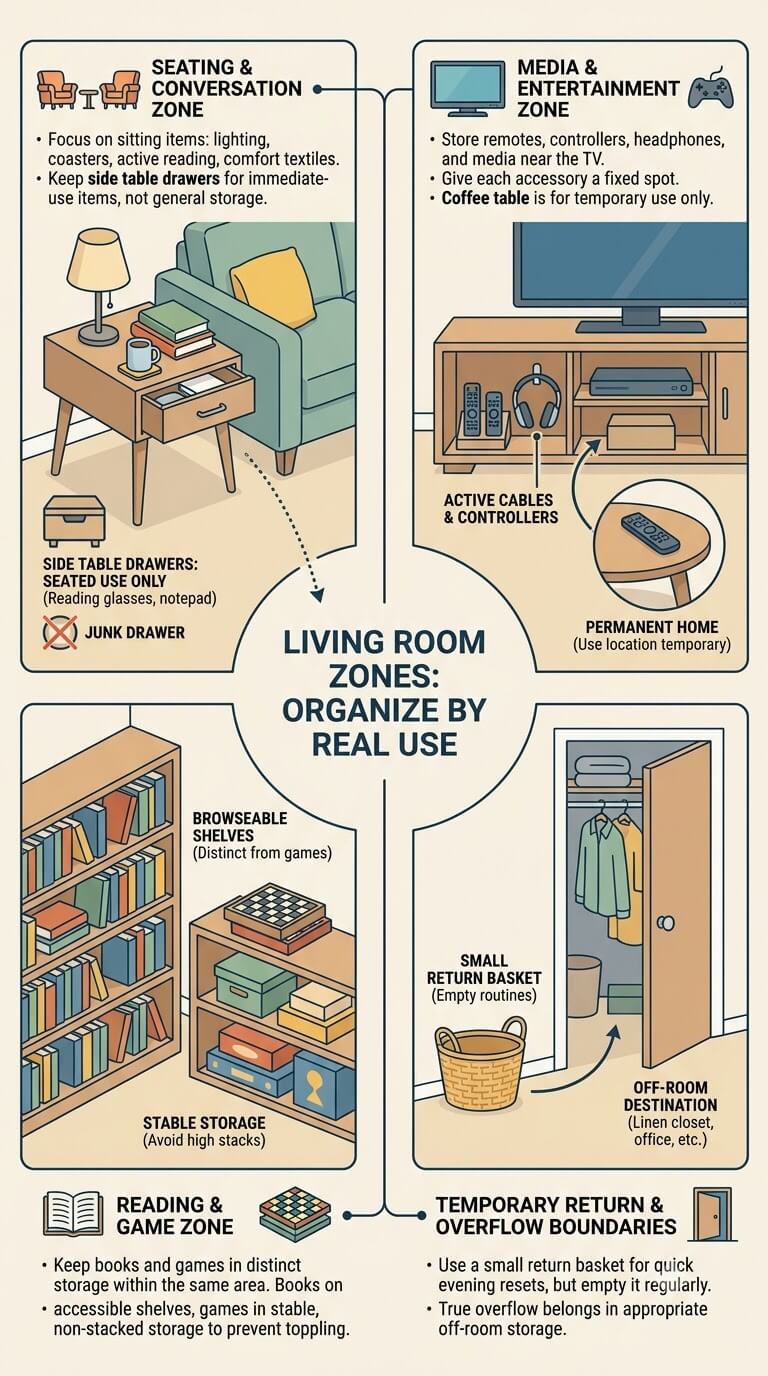
Zones simply keep items near the activity they support, shortening the return path without requiring a complicated floor plan.
Seating and conversation zone
Keep the area around sofas and chairs focused on sitting: lighting, coasters, a few active reading items, and comfort textiles. If side tables have drawers, reserve them for items used while seated rather than turning them into general household junk drawers.
Media and entertainment zone
Store remotes, controllers, headphones, active cables, and physical media near the television or media cabinet. Give each device accessory a permanent home. If someone uses a remote at the coffee table, that can be its temporary use location while the media area remains its permanent storage location.
Reading and game zone
Shared books and games can occupy the same broad part of the room if the storage remains distinct. Books need browseable shelves; games need stable storage that keeps sets together. Do not stack heavy game boxes so high that retrieving one destabilizes the pile.
Temporary return-to-room and overflow boundaries
A small return basket can speed an evening reset, but empty it routinely. For true overflow, use an appropriate off-room destination such as a linen closet, bedroom, office, playroom, or dedicated storage area.
Protect Traffic Flow and Access
Test storage against real movement: entering the room, crossing to a hallway, reaching seating, and opening doors or windows that need normal access.
Door swings, exits, windows, vents, and outlets
Keep baskets out of door swings and avoid furniture that prevents normal access to needed windows, vents, or outlets. If another cabinet would create a narrow maze, reduce or relocate inventory instead.
Clear walking routes between seating and room entries
Floor storage is convenient only when it stays outside normal footpaths. Check the route from each main entry to the sofa, common chairs, and adjacent rooms. If people routinely kick, shift, or step around a basket, it needs a different location or a smaller inventory.
Furniture stability, shelf loads, cords, children, and pets
Follow the anchoring and load instructions supplied with bookcases, cabinets, and media furniture. The U.S. Consumer Product Safety Commission’s Anchor It guidance recommends securing furniture with drawers, doors, and shelves to help prevent tip-overs. Keep heavier items low when practical, avoid using unstable high storage for tempting objects, and account for children or pets that may climb or pull.
Route loose cords so they do not create obvious trip hazards, and keep electronics ventilation openings unobstructed. Do not overload outlets or power strips. If a device, power product, or storage unit has specific placement limits, use the manufacturer’s instructions rather than a generic room rule.
Match Storage Type to Frequency and Visibility

Choose storage by use frequency, who needs access, visual clutter, and the space the container itself consumes.
Floor storage versus furniture-adjacent storage
Floor baskets can work for bulky, light items such as active throws if they sit outside circulation. Drawers, cabinet shelves, and shallow baskets placed beside the activity usually work better for small items because they do not add obstacles to the floor.
Closed storage versus open storage
Open shelving suits books and clearly grouped objects. Closed storage can calm visually mixed categories such as game components or spare controllers, but cabinets still need defined categories inside.
Vertical storage and small-space tradeoffs
In a small living room, vertical storage may protect floor area, but it introduces reach, load, and stability considerations. Keep frequently used heavy items at comfortable, stable heights. Follow anchoring instructions for tall furniture, and avoid adding wall storage where it interferes with doors, windows, vents, or safe access.
Basket and bin capacity limits
Give each container one clear purpose. If a category exceeds its container, reduce it, rotate part of it, or move less-used items elsewhere instead of mixing unrelated overflow.
Control Visible Surfaces
Visible surfaces are where active use and incoming clutter collide. Give each one a defined function and a fast reset destination rather than aiming for an arbitrary empty-surface percentage.
Console tops, coffee tables, and side tables need defined functions
Decide what each surface supports. A coffee table may need room for drinks and a game. A side table may need a lamp, coaster, tissues, and one current book. A media console top may need no storage at all. The function determines what can remain.
Current-use items versus permanent storage
An item can be temporarily present without earning permanent surface space. A novel being read this week may stay near the sofa. A stack of finished magazines should move. A remote may rest on the table during use, then return to its assigned home. This distinction prevents “current” items from becoming indefinite piles.
What should leave the room instead of being contained
Papers, dishes, clothing, packages, and personal work materials usually need routing, not prettier containers. During a reset, move them to the kitchen, bedroom, office, paper station, or other home location where the next action happens.
Set Up the Main Living Room Storage Categories

For each category, decide what belongs, set capacity, assign a home, and define how it gets reset.
Small living room capacity and multipurpose zones
In a small room, preserve circulation and primary functions before adding storage. Multipurpose activities need time-based boundaries so temporary play or work can pack away without leaving permanent equipment on the floor.
Keep the media zone contained
Keep current devices and their accessories together. Separate daily remotes and controllers from backup cables and obsolete equipment. Leave required ventilation clear and follow device manuals. Unknown cables should be identified before disposal rather than thrown away impulsively. When remotes, controllers, and cables are the main problem, organize the TV stand and media console as a separate equipment zone.
Give coffee and side tables a narrow job
Limit table storage to items genuinely used while seated. A tray can help corral a few small items, but it should not become a miscellaneous collection. Drawers need the same boundaries as visible surfaces.
Store active blankets and throws near seating
Keep only the throws actively used on sofas and chairs in the room. Store them fully dry in a basket, ottoman, cabinet, or other suitable location that does not block movement. Spare guest bedding and out-of-season textiles should move to dedicated textile storage.
Keep shared books browseable
Prioritize shared and current reading on living-room shelves. Avoid books packed behind other books and unstable floor stacks. If the collection exceeds usable shelf capacity, relocate or reduce it rather than hiding more at the back.
Keep games complete and easy to return
Store games so boxes remain stable and pieces stay with their sets. Frequently used games should be easy to retrieve without moving a tall stack. Keep small components in the original box or a clearly identified pouch.
Boundaries for Toys, Paperwork, Pet Items, and Work Gear
These categories may enter the room legitimately, but each needs a boundary for how much stays and where it returns.
Keep living-room toy storage intentionally limited
If children play in the room every day, one small toy category or limited container may make sense. Choose it intentionally. When it fills, return overflow to the child’s main toy storage rather than adding another living-room bin. Child-specific sorting, rotation, and book systems belong in the child’s primary spaces.
Paperwork should return to the household paper system
If someone reads mail in the living room, bills, forms, receipts, and action papers should still move to the household’s normal paper location. Repeated table piles call for a better route out of the room, not a deeper paper basket beside the sofa.
Pet and work items need defined boundaries rather than permanent spread
A pet blanket or toy basket may be appropriate if it supports daily living-room use. Grooming supplies, food, medicine, and larger pet inventories usually belong elsewhere. The same logic applies to work gear: temporary laptop use can be supported, but office equipment, work papers, and a permanent cable system should return to the workspace.
Overflow and Seasonal Rotation
Overflow should mean moving a specific category to an appropriate off-room destination, not putting it into another random basket.
Create destinations outside the living room
Name destinations for the categories that commonly migrate in: kids’ toys to the play area, paperwork to the paper station, work gear to the office, spare bedding to linen storage, personal clothing to bedrooms, and donations to a designated exit point. A known destination reduces decision-making during resets.
Rotate occasional categories instead of expanding furniture
Seasonal throws, holiday games, rarely used books, and occasional entertainment supplies do not need prime year-round space. Rotate them when appropriate rather than adding furniture for items used infrequently.
Signs the room is carrying more inventory than its function supports
- Seats or table surfaces are regularly used as storage.
- Baskets remain full even immediately after a reset.
- People must move items before sitting down or opening a cabinet.
- Books, games, or textiles live on the floor because assigned storage is full.
- New storage furniture would narrow normal walking paths.
- Personal belongings from several rooms remain in the living room for days.
When several of these are true, rearranging may help temporarily, but the stronger next step is usually to reduce or relocate inventory.
Daily Reset Versus Weekly Review
A reset restores an existing system; a weekly review checks whether that system still fits daily behavior.
What a daily reset should restore
A short reset can remove dishes and trash, return personal items to their rooms, put remotes back, clear the main table surfaces, fold active throws, return books and games, and clear the walking path. It should not require reorganizing drawers or deciding whether to donate things.
What a weekly check should diagnose
Weekly, check what is overflowing or repeatedly misplaced. Decide whether the cause is a missing home, an inconvenient home, or a category that no longer fits its capacity.
When repeated failure means the system needs decluttering or capacity changes
If the same pile returns after every reset, the storage home may be too far away, difficult to use, full, or assigned to the wrong category. If items cannot be returned without overstuffing containers, the room needs a deeper inventory decision rather than a longer daily routine.
Decision Tree: Which Living Room Guide Do You Need Next?

| What keeps happening? | Most useful next focus |
|---|---|
| Furniture and storage make the room feel blocked. | Review space, traffic paths, room functions, and hard capacity limits. |
| There is simply too much unrelated stuff. | Run a deeper keep, move, donate, recycle, or discard decision process. |
| Remotes, controllers, and cables have no reliable home. | Rebuild the TV stand or media-console storage by device and frequency. |
| Coffee and side tables become catch-all surfaces every day. | Define surface functions and give temporary-use items permanent return spots. |
| Throws, books, or games repeatedly overflow. | Set category capacity and improve the specific storage system. |
| The room is organized but falls apart after normal use. | Simplify the daily reset and diagnose whichever category repeatedly fails. |
Space or layout problem
Focus on circulation, seating access, floor area, vertical storage, and the number of categories competing for the room. Do not solve a small-space problem by adding furniture until movement becomes difficult. If floor area is the main constraint, the process for organizing a small living room should focus on traffic paths, storage tradeoffs, and hard capacity limits.
Too-much-stuff problem
Shift attention from storage to decisions. Separate what belongs in the room from what belongs elsewhere, then review duplicates, broken items, abandoned entertainment, and categories that exceed available capacity.
Media, surface, textile, book, or game problem
When one category causes most of the visible disorder, keep the rest of the room stable and rebuild that system specifically. The permanent home, container size, access level, and reset action should match that category rather than a generic storage rule.
Maintenance problem
If everything has a suitable home but people do not return items, shorten the return path and reduce the number of steps. A remote drawer that requires moving objects first, or a blanket bin across the room from the sofa, may be technically organized but inconvenient in daily use.
Common Living Room Organization Mistakes
Recurring problems usually come from capacity, unclear ownership, or inconvenient return paths rather than too few containers.
Buying containers before defining categories
A container chosen first often ends up holding whatever fits. Name the category, estimate its realistic volume, and identify where it is used before choosing storage. The container should serve the category, not create one.
Letting baskets become permanent mixed storage
Mixed baskets feel efficient during a fast cleanup but become difficult to empty because every item has a different destination. Keep transport baskets temporary and storage baskets category-specific whenever practical.
Using shared surfaces as personal storage
A shared coffee table cannot function well if one person’s mail, another person’s headphones, and a child’s craft supplies all claim permanent space. Personal items need a home outside the shared surface, even when they are used in the living room temporarily.
Adding furniture until traffic paths disappear
More shelves are not an improvement if they narrow access or introduce unstable storage. Before adding tall or heavy furniture, check the manufacturer’s anchoring and load directions. CPSC also advises anchoring televisions and furniture such as bookcases and keeping tempting items away from high areas where children may climb; see its 2026 furniture and TV tip-over reminder.
FAQ About Living Room Organization
What should actually be stored in a living room?
Store items that directly support regular living-room activities: remotes, current entertainment accessories, active throws, shared books, frequently used games, and limited intentional family or pet items. Temporary items can enter without earning permanent storage.
How do you organize a living room used by several people?
Assign homes to shared categories first and make return locations easy to reach. If personal items commonly appear, use a limited return routine or small assigned container without letting it become overflow for bedrooms, offices, or play areas.
How do you know when storage is full rather than badly arranged?
Storage is probably at capacity when items require overstuffing, unsafe stacking, books packed behind other books, or spill onto floors and seats after a reset. Move less-used items elsewhere or reduce the category before adding storage.
Can a living room keep toys, papers, or work items without becoming a catch-all?
Yes, if the boundary is explicit. A small toy container, current work item, or papers being read can be temporary, but each needs a limit and an off-room destination when the activity ends. If the category starts requiring permanent furniture, reconsider whether it belongs there.
Final Thoughts
A functional living room is one where people know what belongs, frequently used items are easy to return, and overflow has somewhere else to go. Define the room’s real functions, protect access and walking routes, set capacity before adding containers, and use daily resets to restore rather than redesign. When the same problem returns, check whether the cause is excess inventory, an inconvenient storage home, or a temporary activity that has become permanent.

Ethan Carter is the Founder & Editor of HomeCleanSecrets. Based in the United States, he has 5 years of experience creating practical home cleaning, laundry care, stain removal, decluttering, and home organization content. His goal is to help everyday households clean smarter and build simple routines that are easier to maintain.
Read more about Ethan Carter on his author page: https://homecleansecrets.com/ethan-carter/