
Learning how to organize a laundry closet is different from organizing a full laundry room. A closet has doors, tighter reach zones, limited airflow, and appliance parts that still need service access. The goal is not to fill every inch with bins. The goal is to make the closet easier to use without blocking the machines, shutoff valves, outlets, dryer vent, shelves, or door swing.
A good laundry closet setup lets you do three things quickly: start a load, move clothes to the dryer or drying area, and put supplies back without leaving bottles on top of the machines. It should also make room for small items like mesh bags, stain tools, dryer balls, lint bags, and spare clothespins without turning the closet into a hidden storage pile. When the closet is very narrow, the best solution may be to store only daily-use supplies inside and keep sorting baskets or backup products somewhere nearby.

Quick Answer: Keep the Closet Functional Before It Looks Full
A laundry closet is part of the larger laundry room organization system, but it needs stricter rules because there is less clearance.
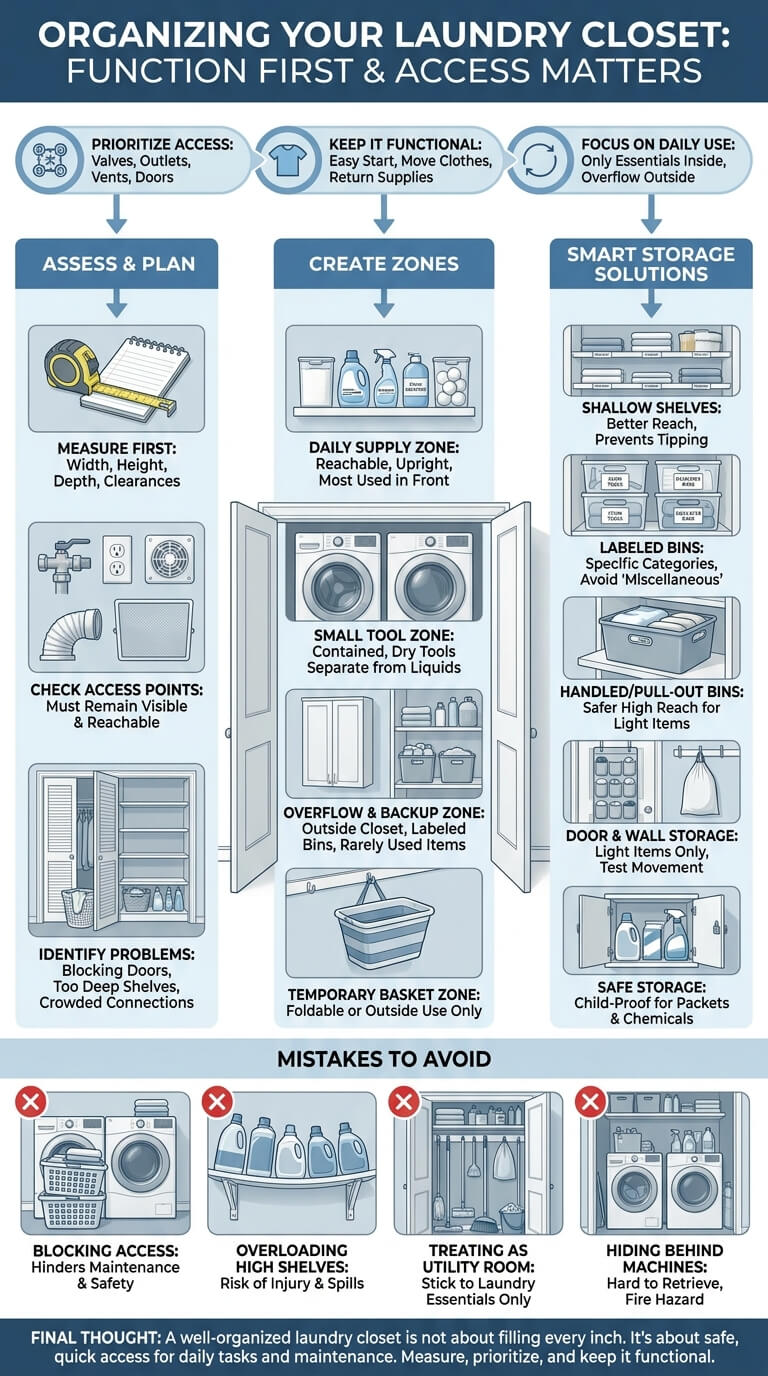
The fastest way to organize a laundry closet is to remove everything that does not support the next few loads, check the appliance access points, then rebuild the closet around daily supplies and safe clearances. Put detergent, softener if you use it, stain tools, mesh bags, and a lint container in the easiest shelf zone. Move bulk refills, seasonal products, extra baskets, and seldom-used cleaning tools outside the closet if they make the doors hard to close or the machines hard to reach.
Prioritize appliance access, door movement, and daily supplies
Before buying storage, open and close every closet door while standing where you normally load the washer. Notice whether a basket, step stool, bin, or hanging rack blocks the door. Then open the washer and dryer doors fully. Pull out the lint screen, reach the shutoff valves, check the outlet area without tugging on cords, and look at the dryer vent path. These areas should stay visible or easy to reach.
Your daily supply zone should be close enough that you can grab one product without moving five others. A shallow shelf above the machines, a slim side shelf, or a handled bin on a reachable shelf usually works better than deep decorative baskets. The American Cleaning Institute recommends storing cleaning products securely and reading labels, so keep laundry products in original containers when possible and avoid decanting items into look-alike jars that could be confusing or unsafe, especially in homes with children or guests. The American Cleaning Institute
Store overflow outside the closet when space is too tight
A laundry closet becomes frustrating when it is asked to act like a utility room, linen closet, broom closet, and sorting station at the same time. A better test is simple: if you cannot load the washer, open the dryer, and close the doors without shifting storage, something needs to leave. Backup detergent, paper towels, extra hangers, large hampers, mop buckets, bulk household cleaners, and out-of-season linens are common overflow items.
Laundry Closet Problems to Solve First
For a room that is small but not enclosed, use small laundry room organization ideas instead of treating it like a narrow closet.
A laundry closet usually fails for practical reasons, not because the bins are wrong. The door cannot open, the shelf is too deep, bottles crowd the utility connections, or there is no landing spot for clothes. Fixing these problems first makes every storage choice easier.
Doors that hit baskets or shelves
Bifold, sliding, double, and hinged closet doors each create a different storage limit. Bifold doors need room to fold inward or outward. Sliding doors hide part of the closet at all times, which can make one side difficult to reach. Hinged doors need floor clearance in front of the closet. Before placing a hamper, rolling cart, or wall hook, open the doors fully and watch the path they travel.
Shelves that are too deep or too high
Deep shelves look useful until small supplies disappear behind detergent bottles. In a closet, reach is more important than storage volume. A shelf that is too high may encourage unsafe stretching with heavy bottles. A shelf that is too deep may block your view of valves, cords, or the back of stacked machines.
Products crowded around valves and cords
The area behind and beside a washer or dryer is not spare storage. Shutoff valves, water hoses, dryer vents, outlets, and appliance cords need access. Bottles, rags, and loose packaging can fall behind machines and become hard to retrieve. If you have a gas dryer, avoid placing storage in any way that makes the gas connection hard to inspect or reach.
Check the washer and dryer manuals before adding shelves, stacking kits, anti-vibration pads, or any storage that sits close to the appliances. Manufacturer instructions are the best source for clearance and stacking limits because dimensions and safety needs vary by model. Stop and get qualified help if you see crushed venting, damaged cords, leaking hoses, a gas smell, sparking, or water near electrical parts.
No place for clean or dirty laundry
Many laundry closets have storage for products but no plan for clothes in motion. Dirty laundry piles on the floor, clean laundry lands on top of the dryer, and small items get lost because there is no transfer zone. A closet does not need to hold every basket, but it does need a temporary landing plan.
Measure the Closet Before Adding Storage
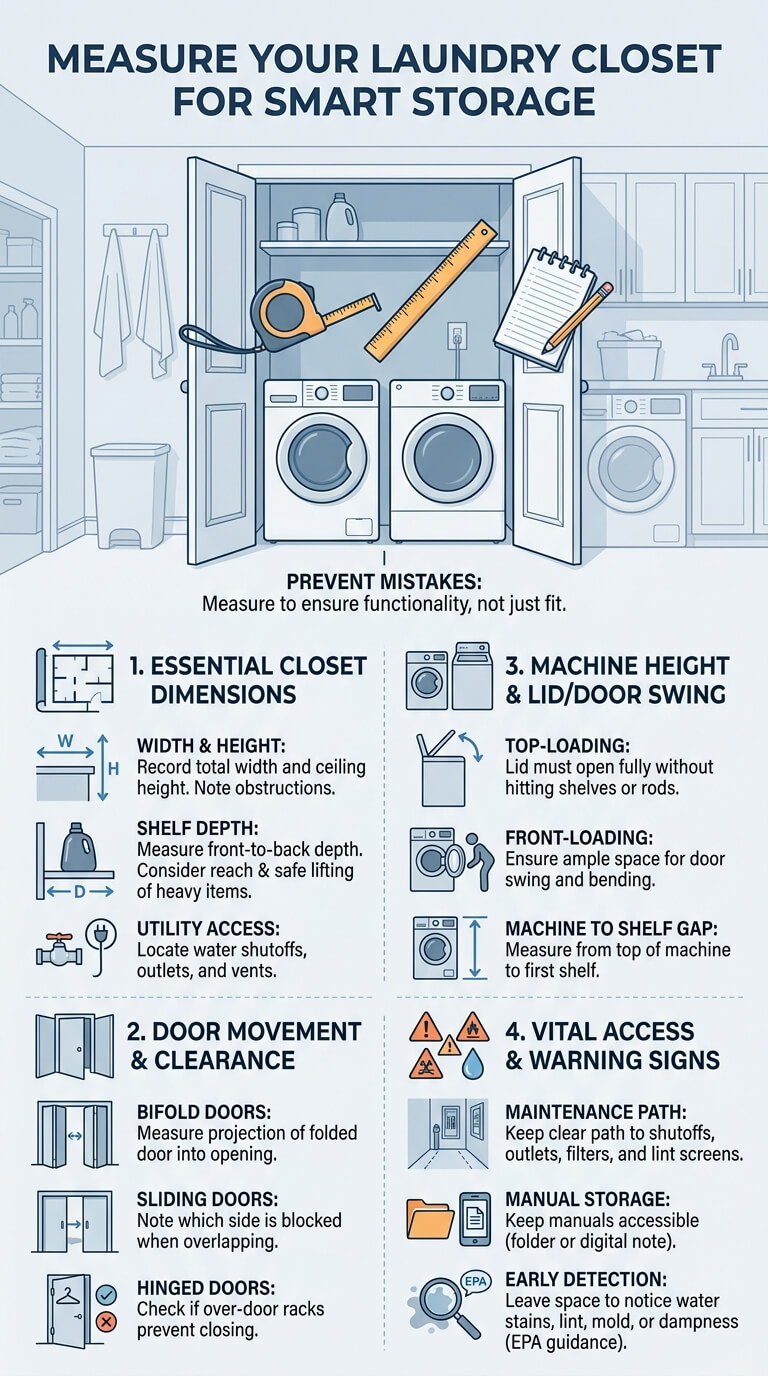
Measuring prevents the most common closet mistake: buying an organizer that technically fits but makes laundry harder to do. Write measurements on a note before shopping or rearranging. Include width, height, shelf depth, appliance door clearance, door movement, and the location of utility access points.
Door style and opening path
Measure the closet opening, then mark how the door moves. With bifold doors, measure how far the folded door projects into the opening. With sliding doors, note which side is blocked when the doors overlap. With hinged doors, check whether hooks or over-door racks prevent the door from closing. This step decides whether door storage is realistic.
Machine height, width, and clearance
Measure from the floor to the top of the machines, then from the top of the machines to the first shelf. If the washer is top-loading, lid clearance matters more than shelf space. The lid should open comfortably without hitting a shelf, cabinet, or hanging rod. If the machines are front-loading, door swing and bending space matter more.
Shelf depth and reach height
Measure each shelf from front to back and from the floor to the shelf surface. A shelf may be wide enough for bulk products but too high to lift them safely. If you need to stand on your toes while holding a heavy bottle, move that bottle lower or outside the closet.
Access to shutoffs, outlets, filters, and manuals
Every laundry closet needs a clear path to the parts that matter during maintenance or a problem. This includes water shutoff valves, the electrical outlet, the dryer lint screen, the dryer vent path, the washer filter if your model has an accessible one, and the appliance manuals. Keep manuals in a folder or digital note so you do not have to search during a leak or error code.
Leave enough room to see warning signs. Water stains, lint buildup, a crushed vent, mildew odor, or products that feel damp are easier to notice when the closet is not packed to the doors. EPA moisture guidance notes that moisture control and ventilation matter in preventing mold problems, which is especially relevant in small enclosed spaces where damp laundry or poor airflow can linger. EPA moisture guidance
Choose the Right Laundry Closet Zones
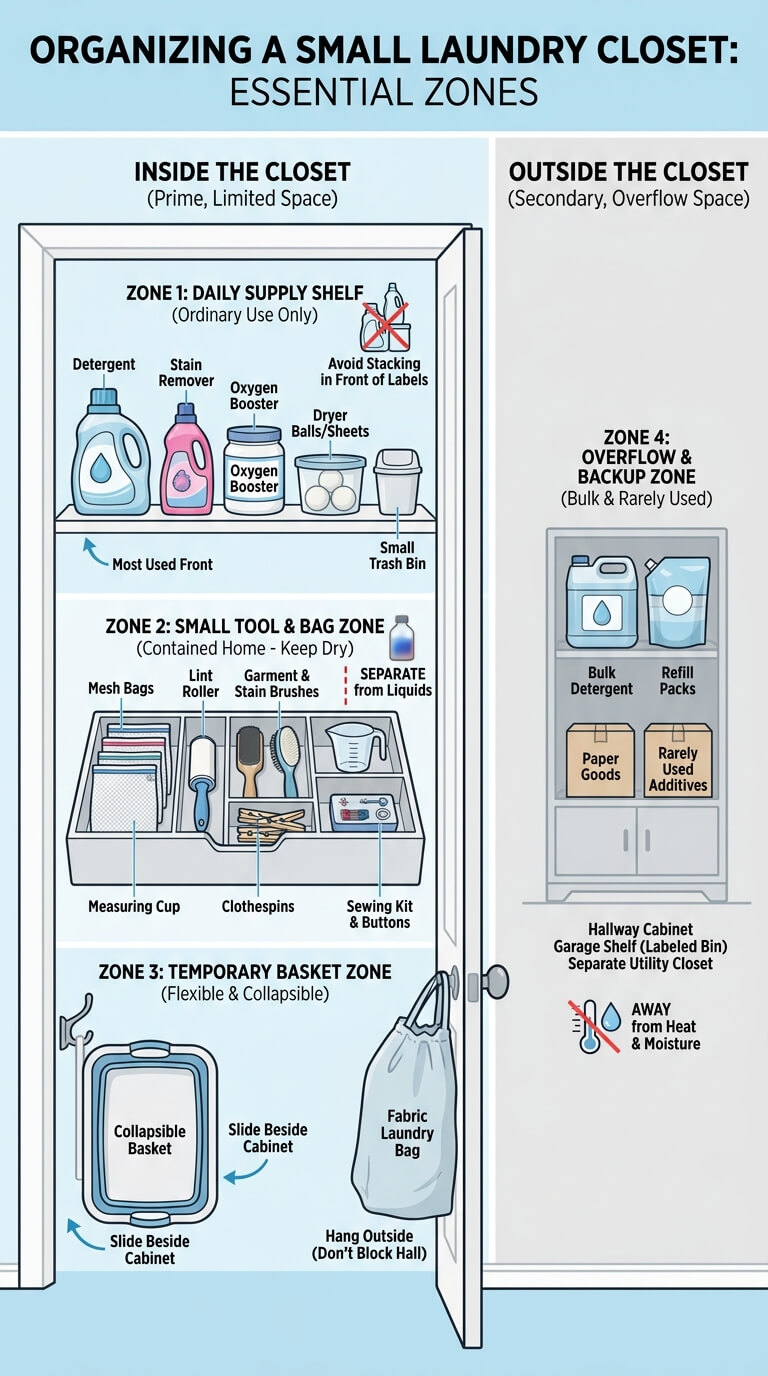
Zones help a closet stay organized after the first cleanup. Keep the zones simple because a laundry closet has less room than a full utility space. The main zones are daily supplies, small tools, temporary basket space, and overflow storage outside the closet.
Daily supply shelf
Since closet shelves are often high or shallow, it helps to organize laundry supplies so only daily-use products stay in the closet.
The daily supply shelf should hold only products used in ordinary laundry: detergent, oxygen booster if used, stain remover, dryer sheets or dryer balls, and a small lint or trash container if there is room. Keep bottles upright and easy to grip. Place the most used product at the front and avoid stacking items in front of labels.
Small tool and bag zone
Small laundry tools disappear quickly in a closet. Give them one contained home. Mesh bags, a lint roller, garment brush, measuring cup, stain brush, clothespins, a sewing kit, and spare buttons can share a small bin or drawer. Keep this zone separate from liquids so tools stay dry and clean.
Temporary basket or hamper zone
A closet laundry area rarely has room for a permanent basket system. Instead, plan for temporary basket use. A collapsible basket can hang flat on a hook, slide beside a nearby cabinet, or sit on a bedroom shelf until laundry time. A fabric laundry bag can hang outside the closet if it does not block the hall.
Overflow and backup zone outside the closet
Backup products are useful, but they do not need prime closet space. Store extra detergent, refill packs, paper goods, and rarely used laundry additives in a separate overflow zone. This might be a hallway cabinet, a labeled bin on a garage shelf, or a utility closet away from heat and moisture.
Shelf and Cabinet Ideas for Laundry Closets
Shelves and cabinets should make products easier to reach without hiding appliance access. The best choice depends on shelf height, machine style, and whether you own or rent.
Shallow shelves for daily products
Shallow shelves are often better than deep shelves in a laundry closet. A shelf that holds one row of products keeps labels visible and reduces the chance that bottles tip behind each other. If you already have deep shelves, use shallow bins at the front and reserve the back for lightweight backup items that are easy to remove.
Labeled bins for small supplies
Labeled bins work best when the labels describe real categories. Useful examples include stain tools, delicates bags, dryer items, sewing and repair, lint and trash, and extra cloths. Avoid labels that are too broad, such as miscellaneous, because they become clutter magnets.
Pull-out or handled bins for high shelves
High shelves are safer when items can be pulled down as a group. A handled bin reduces reaching and keeps small packages from sliding backward. Choose lightweight contents for high shelves: wool dryer balls, extra mesh bags, spare labels, empty spray bottles, or seasonal garment bags.
When closed storage is safer than open display
Closed storage can be safer when children, pets, guests, or shared household members use the area. A cabinet with a latch, a high shelf that is still reachable by adults, or a locked storage bin may be better than open baskets. This is especially important for laundry packets, stain removers, bleach products, and concentrated cleaners.
The Consumer Product Safety Commission advises keeping liquid laundry packets sealed in original packaging and locked up out of a child’s sight and reach. A beautiful open shelf is not worth the risk if young children can access it. Consumer Product Safety Commission guidance
Door and Wall Storage for a Laundry Closet
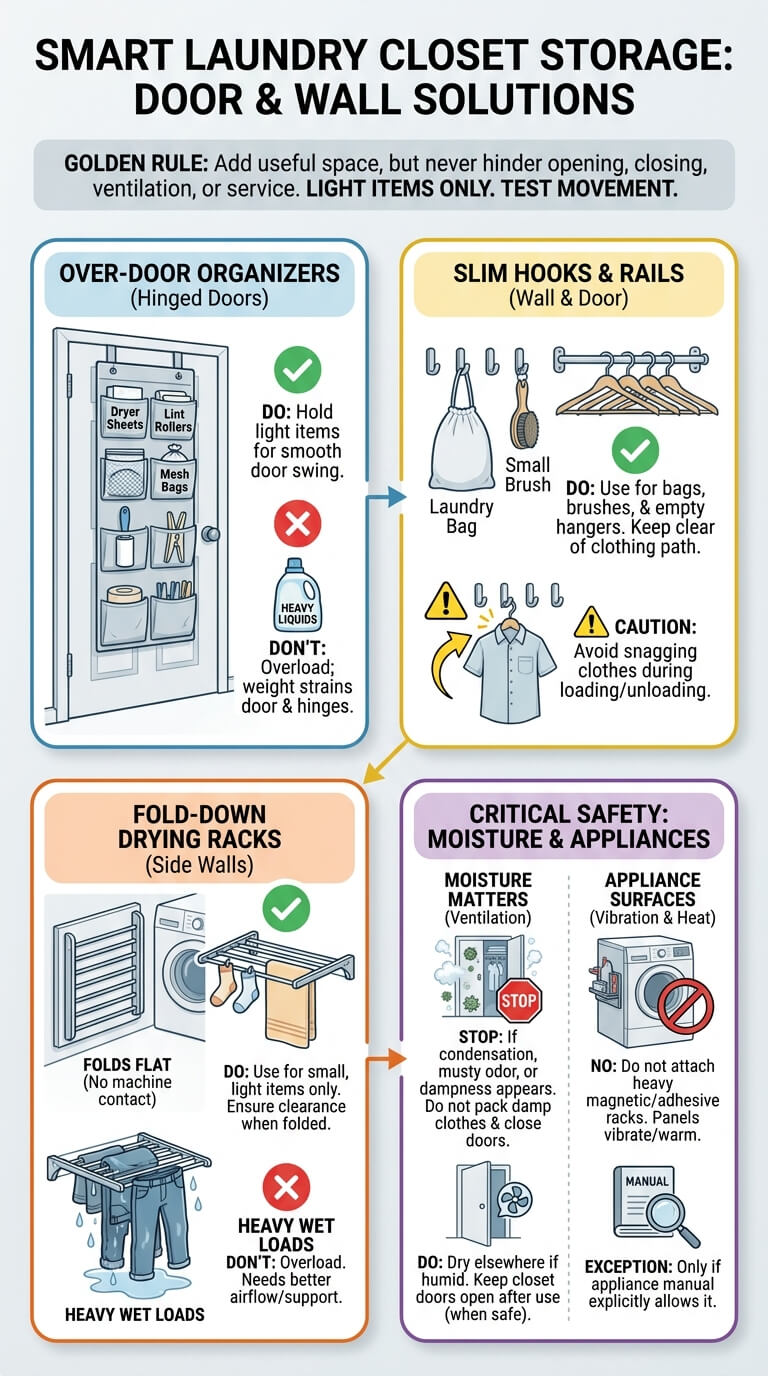
Door and wall storage can add useful space, but it should never make the closet harder to open, close, ventilate, or service. Use these areas for light items only and test movement before committing.
Over-door organizers
An over-door organizer can hold dryer sheets, mesh bags, lint rollers, stain wipes, clothespins, or small laundry tools. It works best on a hinged door that still closes smoothly with the organizer attached. Avoid overloading it with heavy liquids because weight can strain the door and make it swing poorly.
Slim hooks and rails
Slim hooks can hold a laundry bag, small brush, ironing cloth, or empty collapsible basket. A short rail can hold hangers for shirts that need air-drying after a low-heat cycle. Keep hooks away from areas where they catch clothing as you load and unload machines.
Fold-down or wall-mounted drying options
A fold-down drying rack can be helpful if the closet has a side wall or nearby hallway wall with enough clearance. It should fold flat without hitting the machines or doors. Use it for small items, not heavy wet loads that need stronger support or better airflow.
Moisture matters in a closet. Do not pack damp clothes inside and close the doors for hours. If the space feels humid, dry items in a better-ventilated area and keep closet doors open after laundry when safe and practical. Stop using any drying setup that leaves condensation, musty odor, or damp shelving.
What not to attach to appliance surfaces
Do not attach heavy magnetic shelves, adhesive racks, or hooks to appliance surfaces unless the appliance manual allows it and the item is clearly safe for that surface. Appliance panels can vibrate, warm up, or curve slightly, which makes attachments less reliable. Heavy objects can slide or fall during cycles.
Basket and Sorting Options for Closet Laundry Areas
Basket storage is one of the hardest parts of laundry closet organization because baskets need floor space, and closet floors usually belong to the machines. The answer is often to separate sorting from washing.
Store baskets outside the closet
Most laundry closets cannot hold several baskets all week, so choose a practical way to store laundry baskets outside the door or only on laundry day.
Store everyday hampers where clothes are removed, not where the washer sits. Bedrooms, bathrooms, and hallway corners often make better hamper zones than the laundry closet itself. This keeps the closet clear and reduces the chance of baskets blocking appliance doors.
Use collapsible baskets for transfer
Collapsible baskets are useful because they solve the transfer problem without becoming permanent clutter. Use one to move wet clothes to the dryer, carry clean clothes to a folding area, or collect delicate items. After laundry is put away, fold the basket and store it on a hook, shelf, or nearby cabinet.
Sort in bedrooms or bathrooms when the closet is too narrow
When the closet has no sorting space, the easier fix is to create a laundry sorting system in bedrooms, bathrooms, or a hallway.
Sorting inside a narrow closet often leads to piles on the floor. A better workflow is to sort at the source. Keep lights, darks, towels, delicates, or household linens separated in the rooms where they collect. Bring one full load to the closet when you are ready to wash.
Avoid blocking closet doors
Blocking closet doors is the sign that the basket plan is too ambitious for the space. If a basket must be moved every time you start laundry, it will eventually be left in the wrong place. Choose a smaller transfer basket, move sorting elsewhere, or keep a foldable bag on a hook.
Laundry Closet Setup Examples
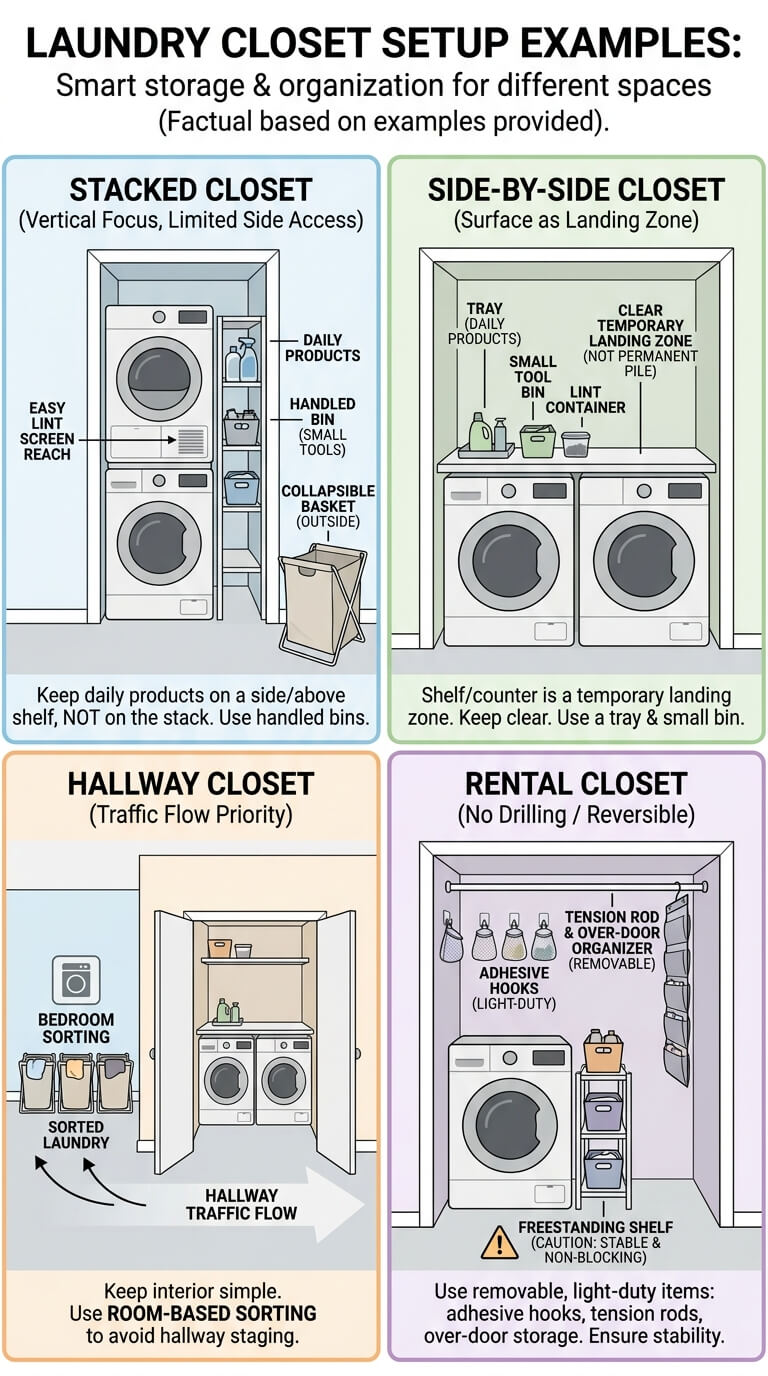
Use these examples as starting points. Your exact setup depends on machine style, door type, household size, and whether you can install hardware.
Stacked washer and dryer closet
A stacked closet usually has vertical height but limited side access. Keep daily products on a shelf beside or above the machines, not on top of the stack. Use a handled bin for small tools, and keep a collapsible basket outside the closet for transfers. Make sure the lint screen is easy to reach every time.
Side-by-side laundry closet
A side-by-side closet may offer a shelf or counter above the machines. Keep this surface clear enough to act as a temporary landing zone, not a permanent storage pile. A tray for daily products, one small tool bin, and a lint container may be enough.
Hallway laundry closet
A hallway laundry closet needs extra attention to traffic flow. Doors, baskets, hampers, and open machine doors can block the hall. Keep the closet interior simple and use room-based sorting so the hallway does not become a laundry staging zone.
Rental laundry closet with no drilling
Rental closets need reversible storage. Use freestanding narrow shelves only if they do not block appliance access or create a tipping risk. Adhesive hooks, over-door organizers, handled bins, and tension rods may help, but each one should be light-duty and removable.
Mistakes to Avoid in a Laundry Closet
The biggest laundry closet mistakes come from treating the space like something larger than it is. A closet can be efficient, but it needs limits.
Treating it like a full utility room
A laundry closet is not the right place for every household cleaner, spare paper product, mop refill, tool kit, and donation bag. When too many categories move in, the laundry workflow disappears. Limit the closet to laundry supplies, small laundry tools, and one temporary transfer plan.
Storing heavy bottles on unstable high shelves
Heavy bottles on high shelves are hard to lift and easy to drop. They can also leak without being noticed. Put heavy liquids at a stable, reachable height. If the only shelf is high, consider storing heavy backups elsewhere and keeping a smaller daily-use bottle in the closet only when the label remains clear and the container is appropriate.
Blocking service access
Service access is not wasted space. It is what lets you respond quickly to leaks, error codes, vent issues, or maintenance needs. Keep valves, outlets, hoses, lint screens, filters, and vent areas accessible. Avoid storing items behind machines unless the item can be removed without moving appliances.
NFPA dryer safety guidance emphasizes regular lint removal and attention to dryer venting. That becomes harder when supplies, baskets, or bins block the dryer area. NFPA dryer safety tips
Hiding too many backup supplies behind doors
Closed doors can make clutter easy to ignore. Backup supplies multiply because you cannot see what you already own. Once a month, check the closet before buying laundry products. Use open space as a signal that the closet is working, not as an invitation to fill it.
FAQ
These answers focus on closet-specific decisions: what belongs inside, what should move outside, and how to protect access in a tight enclosed space.
What should I store in a laundry closet?
Store daily laundry supplies, small laundry tools, mesh bags, dryer items, a lint container, and one temporary basket solution if space allows. Keep bulk refills, extra hampers, rarely used cleaners, and non-laundry items elsewhere when they make the closet harder to use.
How do I organize a laundry closet with stacked machines?
Use reachable shelves or bins beside or above the stack, keep the top of the machines clear, and avoid blocking the dryer controls, lint screen, vent path, or service access. Store baskets outside the closet and bring in one load at a time. Check the stacking kit and appliance manual before adding storage close to the machines.
Where do laundry baskets go when there is no closet floor space?
Keep baskets outside the closet. Use bedroom hampers, bathroom hampers, a nearby hallway cabinet, or a collapsible basket that hangs flat when not in use. The closet floor should stay clear for machine access and door movement.
Can I add shelves above a washer and dryer?
You can add shelves when they do not block lids, doors, controls, vents, outlets, hoses, shutoff valves, or the clearances required by the appliance manual. Use strong installation hardware, keep heavy liquids at a safe height, and avoid shelves that force awkward reaching over the machines.
How do I keep a laundry closet from getting cluttered again?
Set a limit for each zone. Keep daily products on one shelf, small tools in one bin, and baskets outside the closet unless they fold flat. Check supplies before shopping, return baskets after every load, and remove anything that blocks doors or appliance access. A five-minute weekly reset is usually enough if the closet is not overloaded.
Final Thoughts
A quick after-load reset helps you keep the laundry closet from getting cluttered again without overfilling the shelves.
A well-organized laundry closet is not the one with the most containers. It is the one that lets you start a load, reach supplies, move clothes, clean the lint screen, and close the doors without shifting clutter. Measure first, protect appliance access, keep daily supplies reachable, and move overflow outside the closet when space is tight.

Ethan Carter is the Founder & Editor of HomeCleanSecrets. Based in the United States, he has 5 years of experience creating practical home cleaning, laundry care, stain removal, decluttering, and home organization content. His goal is to help everyday households clean smarter and build simple routines that are easier to maintain.
Read more about Ethan Carter on his author page: https://homecleansecrets.com/ethan-carter/